Debate: Is Selling Licenses to Bible Translations a Sin?
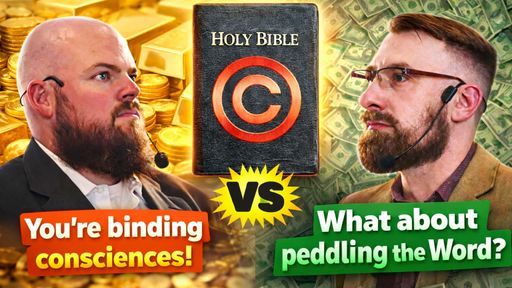
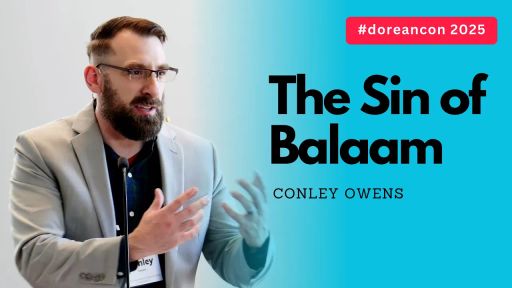
Conley Owens takes the affirmative position, and Jonathan Melin takes the negative in this debate hosted by #doreancon 2025 on "The Stewardship of Scripture" at Silicon Valley Reformed Baptist Church in Sunnyvale, CA.
"For we are not, like so many, peddlers of God’s word, but as men of sincerity, as commissioned by God, in the sight of God we speak in Christ" (2 Corinthians 2:17).
The best way to translate καπηλεύοντες in the phrase “peddlers of God’s Word” is with a word that carries the primary meaning of commercial action and intent, such as “retailers,” or “merchants,” or simply “sellers.” Paul is contrasting his own free ministry with the commercialized ministry of false teachers, and using this distinction to show God’s seal of authenticity on him as a true servant of Christ. For more on this, see "2 Corinthians 2:17: Commercializing the Word of God" https://sellingjesus.org/articles/commercializing-gods-word
RELEVANT ARTICLES
Does Jesus’ Command to “Freely Give” Apply Today? https://sellingjesus.org/articles/freely-give-today
Bible Publishers: Stewards or Gatekeepers https://sellingjesus.org/articles/bible-publishers
The Bondage of the Word: Copyright and the Bible https://sellingjesus.org/articles/copyright-and-the-bible
SIGN THE STATEMENT on the stewardship of Scripture at: https://copy.church/statement/
LEARN MORE
https://sellingjesus.org
https://copy.church
https://thedoreanprinciple.org
DEBATE SECTIONS
00:00 Introduction
03:09 Affirmative Opening Statement
12:06 Cross Examination of the Affirmative
17:55 Negative Opening Statement
27:49 Cross Examination of the Negative
33:44 Affirmative Rebuttal
39:40 Negative Rebuttal
43:00 Negative Closing Statement
45:44 Affirmative Closing Statement
Q&A SECTIONS
49:43 Aren't Bible publishers just a Christian business?
50:56 Who is the "all" that the word of Christ must dwell plentifully in? (WCF 1.8)
52:20 What is the distinction between the word of God and the Bible? (WCF 1.8)
56:05 Why would we not be imitators of Paul in not peddling?
58:30 What does it mean that Paul robbed churches? (2 Cor 11:8)
01:00:52 What is the word of God in 2 Cor 2:17?
01:02:15 What's the problem with licensing being a new problem?
01:06:39 Is it possible that Paul is talking about something other than peddling in 2 Cor 2:17?
01:08:50 Is not copyright just a way for someone to sell their labor?
01:11:46 What is the difference between the originals and translations?
01:21:50 Is the word of God in 2 Cor 2:17 the gospel?
01:25:01 How would you explain 2 Corinthians 2:17 to a 5-year-old?
01:25:52 Would it be OK for the originals to be under copyright?
01:27:34 Is requiring attribution for the word of God a sin?
01:28:43 How does difficulty in identify the word of God prove the negative position?
01:32:09 Wouldn't selling an emoji Bible still be a sin?
01:33:15 On what basis could you call something like sex transition a sin?
01:33:48 Is buying a license to a Bible translation a sin?
01:36:13 Is Paul's message sold by publishers?
01:36:41 What is the application of Matt 10:8?
01:40:27 What is your take on other Scriptures that reinforce the dorean principle? (Mic 3:11)
01:44:38 Why would it be wrong for a minister to sell the gospel?
01:45:41 If a translation has the message, how can the truth be sold?
01:46:53 Would it be wrong to sell the originals?
01:47:05 Is it wrong to sell the word in the original languages?
01:47:29 Why is a translation the author's original work and not the word of God?
01:48:55 If translations are not the word of God, how can the Christian trust them?
01:50:07 If it was wrong to sell sacrificial animals, wouldn't it be wrong to sell the word?
01:51:39 Wouldn't a large profit from publishing at least look bad in the eyes of others?
01:53:53 How can you be comfortable with extending covenantal patterns to infant baptism but not Matthew 10:8 to today?
01:56:20 Conclusion and Prayer
Transcript
Now I'd like to introduce the two debaters tonight. The first debater I will introduce is
Conley Owens. He's to your left and my right. He is a software engineer, which everyone in this room seems to be, which has been one of the funniest things about being here.
But he is a software engineer. He is a pastor at Silicon Valley Reformed Baptist Church.
He is the father of 10 kids, and I'll say so far. He's also the author of The Dorian Principle, a biblical response to the commercialization of Christianity, and that is the book that is really the foundation that launched us to be at this conference.
And of course, it's free to anyone who does not already have a copy. Conley will be arguing the affirmative.
Jonathan Malin is a software engineer. He's to my left and your right.
He has a degree in biblical studies and Bible translation. He and his wife,
Jessica, along with their four children live near Richmond, Virginia, where he also helps with the church plant of the
Orthodox Presbyterian Church. And you can learn more about Jonathan at jonathanmalin .com.
I wanna give you a brief introduction to the format of the debate.
If you've never seen a debate, basically you have two men who are arguing the opposite position on a statement.
The statement I said earlier will begin with the opening statement by Pastor Owens, and then
Jonathan Malin will have the opportunity to cross -examine Pastor Owens.
Then Jonathan will have his negative opening statement, and then Conley will be able to cross -examine
Jonathan. Conley will then have a chance to do what's called his affirmative rebuttal, where he gets to argue back against Jonathan's opening statement.
And then we'll give Jonathan a chance to do a negative rebuttal combined with his closing statement.
And then Conley will conclude with his affirmative closing statement. I will keep the time for these men, and I will moderate any need for calming them down or anything like that.
But we are anticipating a very friendly debate filled with brotherly love and a love for the
Lord Jesus Christ that governs our conduct and behavior. So with that being said,
I am going to take my seat and begin Conley's timer for the affirmative opening statement.
All right, well, thank you all for coming and giving your attention to this important topic. And thank you,
Jonathan, for coming as well. I've had the pleasure of getting to know Jonathan recently, and he's exactly the kind of person that I would like to do this sort of debate with.
He has all the kind of traits that I'm looking for, with the small exception that he's not the CEO of Crossway, which is something that I would have really liked.
But yeah, Jonathan, it's been great getting to know you. So, lower?
All right, there we go. Okay, so I'm taking the affirmative position that selling licenses to Bible translations is a sin.
I want to present to you a simple syllogism. Syllogism has a major premise, a minor premise, and then a conclusion.
The classic syllogism is all men are mortal. Socrates is a man, therefore
Socrates is mortal. Okay, so that's a syllogism. So my syllogism tonight is, selling the
Word of God is a sin. Selling licenses to Bible translations is selling the
Word of God. Therefore, selling licenses to Bible translations is a sin. Very simply put, in 2
Corinthians 2 .17, Paul says, for we are not like so many, peddlers of God's Word, but as men of sincerity, as commissioned by God in the sight of God, we speak in Christ.
Paul very simply puts forward that it is wrong, it is insincere to peddle the Word of God.
Now, there are a few words worth going over there. First is the word peddle. Now, if you look at older translations, you will often find, for example, in the
King James Version, it says corrupt the Word of God. Yet there are many reasons to affirm with the modern translations that it does mean to peddle, to sell.
First of all, all the examples we have of that word are in situations of merchants.
It is in commercial contexts. On top of that, this is what Paul says elsewhere throughout this epistle.
In chapter 11, he says that he did nothing wrong by preaching God's Word free of charge, and then afterwards mentions that this is what he will continue to do to distinguish himself from the super -apostles.
So there he's saying that he is not like so many that would sell. Rather, he distinguishes himself. It makes it clear that he is of a different sort.
In addition, you have the phrase, in the sight of God we have been speaking in Christ, in chapter 12, and just before that, he was talking about the duty of parents to save up for their children, not the children for the parents.
So even there, he's talking about not financially burdening, and beyond that, you also have in 1
Thessalonians 2, there is a very similar set of verses as to 2
Corinthians 2, that show that he is addressing the same sort of thing, and I can go into that in more detail if it is needed, but in 1
Thessalonians 2, he speaks of his sincerity as being demonstrated by the fact that he is not financially burdened, the
Thessalonians. Now what about the Word of God? What is the Word of God?
So that's what peddling is. Peddling is simply selling. What is the Word of God? The Word of God is the message of the
Bible. It is the message that was given to Paul and to the apostles, and in any format which it is given.
So it is the message, but it is also as expressed in the words.
So for example, if I gave you a classified document, and I said that it would be illegal to sell this information to any kind of foreign entity, and you went and you changed all the words, but it still had the same message in it, and you sold it to a foreign entity, you would still be found guilty of having sold that confidential information.
This is how you should be thinking about the Word of God. The Word of God is not necessarily the particular words.
The word is referring to the message, even as it is found in the particular words.
So sometimes it's talking about particular words, but regardless, it is expressed in particular words.
Now what about sin in this statement? Selling licenses to Bible translations is a sin. Sin is any transgression or want of conformity to the law of God.
A lot of people would wonder why I would call this a sin. It's not an option as to whether or not we are sincere.
It's not an option for Paul. So he is plainly saying that this is something that is sinful.
It would be sinful to be insincere. That's not an option for the Christian. So therefore, it is sinful to sell the
Word of God. Now the next part of the syllogism, the minor premise, selling licenses to Bible translations is selling the
Word of God. First of all, translations are the Word of God. Now maybe this is obvious to you.
You've always read your Bible in English and thought you were reading the Word of God. Indeed, you are reading the Word of God.
You don't have to wonder, am I really reading the Word of God like a
Muslim might? In Islam, you have to be reading it in Arabic for it to really be the
Quran. In Christianity, God's Word is the message as captured in those words, even as it's translated.
To quote the preface to the King James Bible, the translator's preface, they say, we do not deny, nay, we affirm in a vow that the very meanest translation, that means the least, the worst translation of the
Bible in English, set forth by men of our profession, containeth the Word of God, nay, is the
Word of God. So translations are the Word of God. And to sell licenses is to sell translations.
Now you might not really know what a license is, but a license is basically a contract from someone guaranteeing that they aren't going to sue you for a particular thing.
So if they were to sell you a license for access to a Bible translation, that would be, they would be selling you the ability to read it.
Now that's obviously selling a translation. Now, in addition to that, well, a lot of people would observe that, well, most of these
Bible translations aren't actually selling licenses to access, they give access for free, but they do sell licenses to re -sharing rights and to adaptation rights.
These are likewise selling the translation itself. If you look at Westminster Confession of Faith 1 .8
or Second London Baptist Confession 1 .8, they are identical in this. These are, Jonathan, my respective confessions.
It motivates Bible translations and legitimizes them based on the fact that the Word of God must dwell plentifully or richly in all.
You may recognize that phrase from Colossians 3 .16. Colossians 3 .16 says, let the Word of Christ dwell in you richly, teaching and admonishing one another in all wisdom.
The Word of God is meant to be shared. If translation can be motivated by it needing to dwell in us richly, it is also motivated so that we can share it.
It is not sufficient to have access to Scripture just to know it, but to share it as well, and then also to adapt it.
The rest of that verse says, singing psalms, hymns, and spiritual songs with thankfulness in your hearts to God.
So in other words, this verse, Colossians 3 .16, is telling us that the Word of God needs to dwell in us richly, okay, you have to have access to the
Word of God, but then you also have to have the ability to reshare it, and then you also have to have the ability to adapt it, to be able to sing it, to be able to present it to others so that it would dwell richly in them.
That is a necessary thing in order to have a full access to the Word of God the way that the Bible intends, and as the writers, authors of our confession have alluded to that verse.
So in summary, selling licenses to Bible translations, it's not merely a matter of what is going on in the heart such that someone could have the exact same activity, and as long as they're not greedy about it, it would be okay to sell the
Word of God. Selling the Word of God definitionally demonstrates insincerity.
If you have two people who have approached you for teaching, and you give it to one, you give a translation to one and not to the other based on the fact that the one is willing to pay you, and the other is not.
You are definitionally demonstrating an ulterior motive other than just the desire for the
Word to go forward. So to repeat the syllogism one more time, selling the
Word of God is a sin. Selling licenses to Bible translations is selling the Word of God. Therefore, selling licenses to Bible translations is a sin.
I yield my time. All right, Conley, when Paul uses the phrase ton logon, meaning the
Word of God in 2 Corinthians 2 .17, which you referenced, what does he mean? As I said, it's the message, but that message can take various forms of expression.
So it includes any kind of medium that it would be expressed in. Okay, so is your claim that Paul doesn't charge for the
Word of God, meaning his message from God about Christ, but the Bible is also the Word of God, including that same message, and therefore, we shouldn't charge for the
Bible? I'd say that's fair. One analogy that I've used with you as we've talked about this, it's like being told that you're not supposed to sell paint, right?
And then you can't go and make a painting and then sell that painting because you're selling paint in the process. There's no way of disentangling or dissolving the word, the message from the words that are given.
Well, do you realize that by switching the definition of the Word of God mid -argument in your syllogism, you're committing a fallacy of equivocation?
No, I don't realize that. Okay, we'll talk more about that later. I understand that it would be if I were switching it, but I am showing that there are implications to selling the message.
Selling the message in any medium is a problem. Okay, well, the Sunnyvale Statement on the
Stewardship of Scripture states, we affirm that the 66 books of the Old and New Testaments are the inspired
Word of God and that all forms thereof, whether autograph, epigraph, recension, translation, or adaptation, retain a divine quality that necessarily entails certain liberties for those to whom they are entrusted.
So who gets to decide how much of a divine quality exists in the translation as compared to the original autographs?
Yeah, ultimately it is up to God to decide in the end. Now, often the opposition to this position will be very focused on the fact that there's not a hard line.
Like if you imagine you took the Bible and you replaced the words one by one, at what point have you replaced enough words with just random words?
Let's say they're random words from the English dictionary. Is it no longer a Bible? I can't tell that. This is ship of Theseus paradox stuff.
The fact that you can't tell exactly when it stops being a Bible does not mean that it wasn't a
Bible to begin with. Or at various points along that, just with some changes.
But wouldn't the divine quality lessen across various translations the further you get into a paraphrase?
Sure, you can talk about the purity of the message as it is being given, that's.
So is the ESV a valid translation of the Bible? Yes. What about the message? Yes, I would say that according, in line with what the translators of the
King James said, it is the word of God. Okay, what about an emoji
Bible? There we're getting to the point where I'm not sure anymore. But I don't, once again,
I don't feel that I have to define a particular place in order for this to be a problem. So for example, the
Supreme Court Justice Potter Stewart, this is a famous incident where he was dealing with some visual obscenities, and he said,
I can't define when something is pornography, but I know it when I see it, right?
It's still the case that something obviously does become that. Even if you can't define it exactly with an exact millimeter mark, it doesn't mean that there isn't a point where something becomes immodest or it becomes corrupt completely.
But you're unsure whether an emoji Bible would have divine quality. Yeah, I'm not. Okay. Right.
What's the difference between the ESV and an emoji Bible in terms of that divine quality? Yeah, it'd be further along.
So when I say divine quality, what I'm talking about is authority and power. Okay, so authority is the inspiration, the fact that it has come from God as the author.
And if you've truly derived something from something that God has given, he remains, in some sense, the author of that, right?
And then the power, the power has to do with the fact that it has the ability to convert souls. So I'm very skeptical that emoji
Bible would have the power to convert souls, but you could imagine our society becoming hieroglyphic in the way we read emojis, such that you could actually obtain the true message from that.
I'm not writing that off, but I am skeptical. So if the divine quality is absent in that emoji
Bible, or it's so lacking that it's essentially absent, is it no longer a sin to sell a license?
Yes, that'd be right. Yes, it's no longer a sin. It would no longer be a sin, right? If it's so corrupt, it's no longer the word of God, yes.
So that divine quality you claim exists in a translation, is subjective? I don't know what you mean by subjective.
It's objective, God is the judge. Yes, I might have difficulty reading it and assessing at what point has it become so corrupt you could no longer call this the word of God, but yeah.
But if the degree of divine quality is subjective across translations from ESV to emoji, but you're not sure where the line is, isn't the most logical option that the originals possess a divine quality that's distinct from all translations?
There's a certain purity there, but no, I would affirm with the authors of the King James that the translations are the word of God.
And likewise, with the Second Heldetic Confession that says the preaching of the word of God is the word of God, as long as the message is being relayed, it is the word of God.
Good afternoon, brothers and sisters. My name is Jonathan Malin. First of all, I'd like to thank Pastor Conley Owens for allowing me to come out here and debate him on this important topic.
I'd like to thank Silicon Valley Reform Baptist Church for hosting this debate. I'd like to thank everyone here who has come out to listen to us debate, as well as those watching online.
And I'd like to thank my wife and kids for their support for flying out here with me from across the country. To briefly follow up on Michael's introduction,
I'm just a guy from Virginia, born and raised in a Christian home in Georgia. I eventually made my way into preparing for a career in Bible translation by pursuing degrees in biblical studies and Bible translation.
Fast forward a bit, my plans took a turn, as they often do in God's providence, and I ended up in software engineering.
I guess everyone here did the same. These days, I live with my wife and four children right outside of Richmond, Virginia, and we're part of a church plant in the
Orthodox Presbyterian Church. Quick disclaimer here, though. Though Conley is a pastor,
I am not ordained, and I'm not representing my denomination in any official capacity in this debate.
They didn't make me say that. I just want you all to understand that. Now, the reason I decided I wanted to debate the negative position is that I think my opponent is in grave error in his bold accusation that many of his brothers and sisters in Christ are explicitly or implicitly sinning because of how they treat the word of God as it relates to finances and licenses.
His accusations of sin are potentially even slanderous if applied more specifically. I believe that my opponent's position is actually in violation of what the
Westminster Confession teaches in chapter 20 regarding Christian liberty and the liberty of conscience. He attempts to unnecessarily bind the consciences of believers everywhere, whether they've sold licenses to Bible translations themselves or they've gone along with this allegedly sinful and corrupt system.
My opponent goes beyond the words of Scripture to call something sin that is merely an issue of conscience.
To get more specific, I'd like to present three main reasons why it's not a sin to sell licenses to Bible translations.
First, it's not a sin to sell licenses to Bible translations because there's no evidence from Scripture that it is a sin to do so.
Thus, it falls into the biblical categories of issues of conscience and wisdom. For the purposes of this debate,
I agree to also take the Westminster Shorter Catechism's definition of sin, which my opponent, I can't remember if you mentioned or not, but if you did,
I'll just repeat it. Any want of conformity unto or transgression of the law of God. So that's what we're considering sin.
In my opinion, it's a tall order to prove that something is a sin when it's not directly addressed in Scripture.
You see, there's a bit of a paradox when he claims that the Bible teaches about itself as it's being written, that it's a sin to charge licensing fees thousands of years into the future for translated versions of itself.
How is it possible that Paul, for example, would be indirectly communicating to us 2 ,000 years later about how translations of his words, as he's writing them down, shouldn't be licensed?
It's nonsensical to claim that the Bible speaks to whether licenses of translated versions of itself can be sold.
My opponent is forced to perform dubious exegesis of 2 Corinthians 2 .17 in an attempt to persuade us all that Paul was somehow addressing the manner in which we get access to translated versions of his words thousands of years into the future.
And in so doing, he binds the consciences of believers to make them think that they're somehow transgressing the law of God by doing something that's not actually addressed in Scripture.
We have no choice but to understand that the manner in which we provide access to translated versions of God's word is an issue of conscience and wisdom.
Now, is there room for discussing the way various publishers restrict the use of their translations and how wise or unwise their decisions are?
Certainly. Do we say they're not conforming to or transgressing the law of God by coming up with a business model in which to pay their workers for translating and transmitting a specific translation of God's word?
Of course not. The Bible itself doesn't address the issue. My opponent claims there's a Dorian principle at play that extends to licensing issues, as you heard him described, but his logic is flawed.
Can we truly say that his principle, which has been virtually unknown to Christendom for centuries, is actually so clear that it should dictate the manner in which publishers decide to provide access to the work that they themselves created?
No. Second, it's not a sin to sell licenses to Bible translations because translations are inherently different than the original autographs.
But for the sake of argument, let's say that it actually is a sin to charge licensing fees to get access to copies of the original autographs, or even hypothetically, the originals themselves, if we had them.
We're still in a different category when we move to talking about translations of the originals because translations are essentially creative works or interpretations of the original autographs, and thus not subject to the same exact treatment, meaning publishers are free to sell licenses to their translations.
The Westminster Confession of Faith in chapter one, paragraph eight, which was already mentioned, it states that the Old Testament in Hebrew, which was the native language of the people of God of old, and the
New Testament in Greek, which at the time of the writing of it, was most generally known to the nations, being immediately inspired by God, and by his singular care and providence kept pure in all ages, and therefore, authentic.
So as in all controversies of religion, the church is finally to appeal unto them.
My opponent would argue that there's a divine quality in a translation that would require the translation to be treated in the same manner as the original autographs, namely, that it should be freely given, and that it is a sin to charge a licensing fee to use such a translation.
However, we must treat translations as separate from the original autographs. Translations are not the same as the originals.
Why else would the Westminster divine say that the originals are authentical, and that we need to appeal to them in all controversies of religion?
Now, there certainly is a quality or essence that so closely matches the originals that allows us to, as the
Westminster Confession states, worship him in an acceptable manner. But every translation is ultimately an interpretation, and doesn't carry the same divine quality as the originals.
Why do you think we have hundreds of English translations? Everyone and his brother seems to think he has a better way to translate the original languages.
Even I'm guilty. There are translation decisions that I disagree with here and there. We'll never be able to capture every nuance, every subtle detail of the originals.
Some of us, many here maybe, have studied the original languages, and have tried to arrive at a greater understanding of what the text says, but we'll always be at a disadvantage since those languages aren't our native tongues.
We translate into our languages so that we can understand what God's word says to us as best as we are able.
But translations are not immediately inspired per the language of the Westminster Confession, meaning the original texts were
God -breathed, but translations are not. The minute we treat them the same, the minute we have to claim, practically speaking, translations have the same immediate inspiration as the originals, or if there's no real distinction between the two, we have to claim that the originals were not immediately inspired at all.
But since translations are indeed substantively different than the originals, and do not share the same divine quality, the publisher of a
Bible translation is free to come up with a business model for providing access to their version of what the text says.
Lastly, it's not a sin to sell licenses to Bible translations, because Leviticus 27 demonstrates a principle of assigning monetary value to possessions meant for sacred use, which contributes to a biblical principle of valuation that would allow for something like a
Bible translation to be licensed for commercial use for a reasonable fee. In Leviticus 27, values are assigned to humans, animals, and property in the context of special vows made to the
Lord. For example, in verse three, we read that the valuation of a male from 20 years old up to 60 years old shall be 50 shekels of silver according to the shekel of the sanctuary.
And in verses 14 and 15, we read, when a man dedicates his house as a holy gift to the Lord, the priest shall value it as either good or bad.
As the priest values it, so it shall stand. And if the donor wishes to redeem his house, he shall add a fifth to the valuation price, and it shall be his.
Now, admittedly, these valuations are categorically different than what we'd find with licensing fees for the commercial use of a
Bible translation. However, we can see from Leviticus that it is not inherently sinful to assign value to property that's set apart for serving and worshiping the
Lord. Not only does the Bible fail to address the licensing issue for translations, but it actually provides a positive case, as we see here, for assigning value to a possession that's meant to be used for worshiping him, which ties in perfectly with what
I mentioned earlier from the Westminster Confession. We translate into the language of every nation so that we may worship him in an acceptable manner.
When we seek to possess a translation of God's word so that we may serve and worship him correctly or help others to do the same, it's reasonable and acceptable to pay a price to do so.
You should now see that for multiple reasons, it simply isn't a sin to sell licenses to Bible translations.
My opponent is attempting to persuade you that verses like 2 Corinthians 2 .17 prove that it actually is a sin to do so.
However, when I address that specific verse in more detail shortly, you'll find that his logic breaks down immediately and that he ultimately fails in his attempt to unnecessarily bind your consciences.
Now you have my time. What is the relationship between the original writings in Hebrew and Greek in translations?
Would you say that they contain the word of God, that they are the word of God? What verb or preposition would you use to describe that?
I'm comfortable saying they are the word of God. Okay. And who does this verse apply to now?
Does it apply beyond Paul? Is he condemning any kind of activity that still exists today?
This verse meaning 2 Corinthians 2 .17? Yes. Is there anyone who could be guilty of peddling the word today or is that something that was only possible at that time?
There's probably two answers to that. One, that's clearly a specific scenario where he was referring to these super apostles who were motivated by greed, et cetera.
But sure, today there are greedy ways of working with the Bible, which gets into the wisdom issue.
Would it be appropriate for the, you know, he's addressing the super apostles and 2 Corinthians, if they did the exact same things in selling, but they did it with a not greedy heart, would that have been acceptable?
Potentially. I don't think we can know necessarily based on that verse that if they had made money in some kind of way that they were actually in sin for doing so.
Right. I guess my question is, would it be possible for someone to have the exact same activity, but it not be coming from an insincere, greedy heart?
The exact activity meaning what? Peddling the word of God. He says,
I preach the gospel free of charge. I'm gonna continue to distinguish myself from these to make it clear that I'm not the same.
Yeah, so I think his emphasis was on the distinction being about their motive, not necessarily a financial exchange, because Paul has other financial exchanges throughout scripture, or at least appeals to a right to these exchanges, but we won't necessarily.
So he's just going, is he going above and beyond in order to demonstrate this? I do think that my take is that he is trying to be above reproach in his situation with the
Corinthians because of how they view what he's doing as negative. They think that he doesn't love them, that he's working with his hands when he shouldn't, things like that.
Is it acceptable to sell the preaching of the gospel? Like if you pay me money, I'll tell you what the gospel is, that kind of thing.
I wouldn't say yes or no. I think we have plenty of examples in history, even today, where if someone needs to be supported as they're traveling and preaching,
I'm not necessarily sure that we have an exact model for how that should be handled. Okay, so I guess, once again, you don't really see this as something that could necessarily be applied to anyone today?
Just from 2 Corinthians, I'm not so sure, because it's a very unique situation for Paul, who was an apostle, and we don't have apostles today, and we didn't have the full
Bible as we have it today either. Do you believe it would have been wrong for Paul to have sold his message?
I lean towards yes for Paul because he took a specific approach. Right, but it would not necessarily be wrong for us to sell that exact same message?
We don't have the exact same message. Paul has another letter to the
Corinthians that we don't have. Right, but we have 2 Corinthians, right? Could you sell 2
Corinthians to someone? Would that be acceptable? Yes. That is his message. We could sell 2
Corinthians, we do, people do. Right, but that would be acceptable given
Paul's prohibition on himself for selling his message. He's just binding himself, he's not binding others.
I don't agree that it's the exact same thing to talk about his preaching message and what we call the
Bible. They're two different things. They're obviously related and there's an overlap there, but they are separate in the way we talk about these things.
Okay. Is it possible, or yes, is it possible to sell the words of Scripture without selling the message?
Could you distinguish between the words and the message? I mean, maybe this is a moot point at this point because you're saying it's not necessarily even wrong to sell the message itself, but would it be, if the prohibition is on selling the message and not necessarily the words, is there a way to sell the words without selling the message?
Again, with the way you're talking about the message, there is a distinction between Paul's message about Christ, which that phrase that I asked about earlier is referring to, there's a distinction between that and what we consider the
Bible. It's back to that same thing about overlap. One of the passages that I mentioned, and I think we've discussed, but I don't know if I've heard your response to this one, and 2
Corinthians 12, when he uses that phrase again, I'm speaking in the sight of God, what is it that he's referring to when he says that it's a father's job to save up for the children, not the children for the parents?
So when he's talking about that, again, I don't think it has anything to do with, this rule is for everyone for all time about how we treat a text that hasn't even been completed yet.
He has a specific scenario that he's dealing with. All right, so Jonathan gave us three points, and I once again wanna thank
Jonathan for being such a great opponent. He and I walked through each other's arguments before this, so a lot of this is stuff
I've had a chance to think through a bit and have written down in a clear way beforehand. He started off by saying that there's no evidence from Scripture that is a sin, so Bible translations.
Psalm 119 .96 says, "'I have seen the limit of all perfection, "'but your commandment is exceedingly broad.'"
We should not take a narrow view of Scripture that says unless the Bible explicitly condemns
X, then X is not a sin. You must read the full implications of Scripture.
For example, Jesus, when he spoke with the Sadducees, he was willing to really impose on them their obligation to have understood the implications of,
I am the God of Abraham, Isaac, and Jacob. He's not the God but of the living, therefore, there's a resurrection.
He said, have you not read? We have to be willing to follow the text all the way to its implications.
And here, when Paul describes peddling the word of God as something that is insincere, we have to be willing to follow that, even if it doesn't explicitly say that selling licenses to Bible translations is a sin.
Once again, if he is condemning selling paint, the word, then any kind of medium for that word to be in, the words themselves, it would be wrong to sell that.
If he says you can't sell paint, then you certainly can't sell a painting that contains that paint. So we also pointed out that there's an inherent difference between the original languages and this, and I believe this is
Jonathan just trying to say, if it were the case that this were forbidden at all, then the implication wouldn't exist.
I certainly concede that the Hebrew and Greek is immediately inspired, as said by our respective confessions.
It is immediately inspired, but the fact that the authors of the confession give that adverb indicates they still understand that the translated word is inspired in some other sense, even if it's not immediately inspired, without any kind of mediation.
Implicitly, it is immediately inspired. The way Francis Turretin, the reformer, describes it is it is not formally authentic.
Authentic means authoritative, but it is materially authentic. And then he also says it is inspired in its things, even if it is not inspired in its words.
So it is still the inspired word of God, even if the words themselves aren't the ones that were precisely written by the apostles and the prophets.
To treat it as something entirely different, and that the notion of inspiration, or the notion of God's authority or power, don't lie in significant sense, and I know
Jonathan concedes that it does, it is, yeah, it is authoritative, it is powerful, but to so separate into remotely different categories such that commands about the word of God would not apply to translations, it's just very clear that it would.
He also addressed Leviticus 27, that speaks of things that have been vowed to God and then later redeemed back.
You could imagine all kinds of things that would be similar to this that would be reasonable, or maybe not reasonable, but not necessarily specifically against scripture.
You know, if a church had a pledge drive, and they say, hey, if you back out on your pledge, we still expect you to give 10 % of it, something like that.
That's the kind of thing that's being described in Leviticus 27, is something that has been vowed, but then it is to be redeemed, that there is some fee associated with it.
There's nothing in there that says that it is okay to sell holy things, specifically things that God has said it is not okay to sell.
It's not just that because what scripture is, it can't be sold, that's true, but it's specifically the case that God has commanded us not to sell it, and that is not true about, for example, the different things that might be vowed in Leviticus 27.
There's a great quote from Augustine on this topic. Now, he is speaking of Christ as the word of God, but he is going back and forth between talking about the
Bible and talking about Jesus Christ. You could call it equivocating, but I think Augustine is right on the money with this.
For any purchasable thing is either equal to the price, or it is below it, or it exceeds it.
When anyone procures a thing for as much as it is worth, the price is equal to the thing which is procured.
When for less, it is below. When for more, it exceeds it. But to the word of God, nothing can either be equaled or to exchange can anything be below it or above it.
So you cannot compare the word of God. It is too priceless to be compared to anything, which is implicit what happens when you sell the word of God.
This is true of Christ. This is true of the revelation of Jesus Christ. Paul offered his preaching freely.
He did not charge for it. Thus, we should not charge for the message, regardless of the medium, whether it be the translated word or the preached word.
It ought not be sold. Once again, this comes down to a basic matter of sincerity.
Can you, in any sense, say that it's sincere if the purity of motive that we're supposed to have is to honor the word by giving it, to give it to one who gives us money, but not to the one who doesn't?
In an attempt to prove that it is a sin to sell licenses to Bible translations, my opponent appeals to 2
Corinthians 2 .17, which we've discussed a little bit. In the ESV, it reads, for we are not, like so many, peddlers of God's word, but as men of sincerity, as commissioned by God, in the sight of God, we speak in Christ.
The key question is, what is God's word in this context? At first glance, it seems like a slam -dunk verse for my opponent's view.
Our minds immediately think that God's word means the Bible. Of course, Paul would be against licensing
Bibles for commercial use. That's peddling the word of God. But hold on a second. Paul isn't talking about the
New Testament as God's word, and he's not even talking about the Old Testament. You see, the phrase, ton lagon tu theu, the word of God, is used multiple times in the
New Testament, and UBS translators' handbooks say over and over, in places this phrase is used, that it's talking about the message that comes from God, not
God's own spoken words, meaning not the Old Testament, certainly not the
New Testament. Concerning the two instances of the phrase in 2 Corinthians, the handbook says the reference is to the message from God, especially the message about Christ.
So, properly understood, we see that Paul's saying he doesn't speak about the message of Christ for profit like others were doing.
The heart of the issue is motive. Has nothing to do with how a Bible publisher funds translation work by selling licenses 2 ,000 years later, unless we strictly limit the discussion to a publisher's motive.
But then the sin isn't necessarily about the act of selling a license, the sin would be greed. Since we can't know the hearts of every publisher, of every
Bible translation, we can't make a blanket statement that they're all in sin for selling licenses, especially when passages such as the one we're talking about here are clearly about motive, certainly not directly about the
Bible itself. Additionally, and this is what I think is important here to understand, the entire basis for my opponent's position, the 2
Corinthians 2 .17 applies to selling licenses to Bible translations today, is based on a fallacy of equivocation.
Here's the structure. Paul doesn't charge for the word of God, meaning his message from God about Christ, but the
Bible is also the word of God, therefore, we shouldn't charge for the Bible, and more specifically, licenses for the word of God.
So, when we talk about the fallacy of selling licenses, the first two claims are valid. Paul doesn't charge for his message, and of course, the
Bible is the word of God. I don't think we would disagree about those two things necessarily, but when you jump to the third claim that we can't charge for the
Bible, the fallacy is in play. The word of God in this verse is clearly not about the text of the
Bible itself, so it can't play with the phrase, the word of God, in a way that leads to a fallacious conclusion.
Paul simply doesn't speak to how we should handle licenses to Bible translations. Ultimately, my opponent's treatment of this verse demands that we make multiple illogical leaps to arrive at his conclusion.
It's not as simple as the syllogism that he claimed. First, we'd have to agree that it's actually a sin to charge for God's message.
Then, we'd have to agree that the phrase, the word of God, in 2 Corinthians 2 .17, actually applies to the whole
Bible anachronistically. Then, we'd have to apply the principle of not charging the translations of the
Bible, which don't share the same divine quality with the originals. He even admitted it's hard to know where that divine quality line is.
And finally, we'd have to apply the principle to selling licenses to those translations, which, in reality, is simply a matter of conscience for the publisher in how it provides access to its property.
My opponent's viewpoint requires too much, and it's an error for claiming that it's a sin to sell licenses to Bible translations.
His entire argument hinges on 2 Corinthians 2 .17, meaning that selling the word of God is a sin.
But I've shown that it's logically fallacious to claim that Paul is actually talking about the text of the Bible itself.
In closing, I want to reiterate that my opponent is attempting to unnecessarily bind the consciences of believers in claiming that it's a sin to sell licenses to Bible translations.
And I don't think this is some kind of malicious thing. I think there's a good hearted attempt in why this is going on.
But I have demonstrated that it's not actually a sin because the Bible doesn't directly address it, and it's an issue of wisdom and conscience.
I have also explained that it's not a sin to sell licenses to Bible translations because even if it were a sin, for the sake of argument, to sell licenses to copies of the original text itself, translations are squarely in their own category as interpretations, and we must always appeal to the originals with any theological controversy.
Additionally, I've given an example from scripture of assigning value to a possession meant for serving and worshiping God, meaning there's a biblical principle evaluation that would allow for a publisher to charge a reasonable licensing fee for a
Bible translation. Beyond presenting strong evidence that selling licenses to Bible translations is not a sin,
I've explained how my opponent's key verse doesn't actually mean what he demands it means. When Paul says he's not a peddler of God's word, he's certainly not talking about the text of the
Bible itself, much less about translations thousands of years later. He's speaking to motive, namely the greed sometimes involved in spreading the gospel of Christ.
I hope you can now agree with me, if you didn't already, that it is not a sin to sell licenses to Bible translations.
Thank you for your time. All right, so what you just heard from Jonathan, spent some time talking about how even if it was wrong to sell the message, that it would not necessarily be wrong to sell the words.
I don't know how you could sell the words without selling the message. These are indissoluble.
They are mixed together in such a way that you cannot sell that other without the one.
Like he talked about the difficulty of identifying where something would become so corrupt that it is no longer the
Bible. Our confessions, once again, speak of this. Actually, this may only be my own confession now that I think about it.
But it talks about that churches can become so erroneous that they become synagogues of Satan.
I forget if that's in the Westminster, but it doesn't define the line. It kind of states it in such a way that you can't know what the line is exactly.
It's hard to say just exactly at what point a church, it has so much error that it ceases to be a true church.
It's difficult to discern, but that doesn't mean there aren't true churches and false churches. They exist even if it is very hard to define where exactly that line is.
When I mentioned the ship of Theseus, that's the idea you take a ship and you replace all of its parts. And as you're replacing the parts, at what point does it cease to be the same ship?
This is something that Greek philosophers talked about, that people talk about still today. And it shows just the difficult problems that exist when you talk about these sorts of things.
It doesn't mean that there's no ship to begin with or that there's no ship to end with. It's rather showing just the difficulty in definitions.
At the heart of all of this is the matter of motive. Like Jonathan said, I agree that ultimately this is about motive.
The question is, does the fruit demonstrate the tree? We should judge the tree by its fruit.
If the fruit is the sale of the gospel, then Paul has instructed us that shows insincerity.
All sins are like this. You could say, it's not really about whether or not someone murders, it's just whether or not they had anger in their heart.
Well, if they murder, it shows they have anger in their heart. You could say it's not about adultery, but it's about whether there was lust in their heart.
Well, any kind of adultery demonstrates that there is lust in their heart. Likewise, when it comes to selling the word of God, it is a matter of the heart, but the sale of the word of God demonstrates the heart of greed.
Now, it may be a very misguided heart of greed that could be easily corrected. And I understand that that is a very common case today in our world where even my favorite heroes are selling their teaching and selling translations of scripture.
But that does not change the fact that we are called to judge the tree by the fruit and bear good fruit.
Paul tells us what the heart behind this is. Out of the heart, the path is. Out of insincerity, the sale of the gospel happens.
Jonathan has spoken of translations as being the properties of the translators.
He has also spoken of in a previous segment, he spoke of them being the creators of this thing.
Now, I know that he would recognize that, as he said before, that it is the word of God.
So some of these phrases that are being used are inappropriate in a way to speak of a translation as being purely the creation of a human, as though it was not a human modifying or adapting
God's word. It is still of divine authorship, even if it becomes mixed with human authorship.
It is thoroughly divine and thoroughly human as the immediately inspired text, and then mixed additionally with human authorship, but it is still the word of God.
It still must not be sold. It demonstrates a heart of insincerity to sell it. The Bible has birthed a number of institutions, like churches, hospitals, libraries, orphanages.
I mean, the fact that the Bible is sold and the Bible commentaries and everything attached to that, is that just a natural outgrowth into the marketplace?
I don't quite understand the question. You're saying, aren't Bible translations the same thing as a
Christian business? Yeah. Okay, no. Yeah, it's not. Yeah, anybody can run a hospital, okay?
A hospital is not something that is freely given by God. And when I say freely given, I'm not thinking of Matthew 10, 8, so much as I'm thinking of 1
Corinthians 2, 13, 2, 12, and 13, which speaks of the things freely given by God so that we teach spiritual truths to those who are spiritual.
Divine revelation is not something that you can access in the natural world. The natural world, you can build a hospital, you can help the sick, et cetera, but it is particular things that God has prohibited from being sold because they are too priceless.
They're not to be compared to natural things. My question is for Jonathan. From the
Westminster 1 .8 that we were talking about, you stopped a bit short of the vulgar language section, so I wanna ask a question about a section that you can go over.
Therefore, there to be translated into the vulgar language of every nation unto which they come, that the word of God dwell in plentifully in all, they may worship him in an acceptable manner, and through patience and comfort that the scriptures may have hope.
What is the all in the scripture that you referred to here? The all in the scripture.
You're right in that I read from a portion of that. I'll skip the vulgar language part.
Vulgar is not a, I'm a fan of updating the language here, but so of every nation, so the word of God dwelling plentifully in all.
Yeah, I think that ties in with the same part of what I was talking about, in that they should be able, we should all be able to worship
God in an acceptable manner. But when it's talking about the word of God there, still,
I would make the distinction between what I did earlier in that 2 Corinthians 2 .17,
the word of God, and the word of God here are not precisely the exact same things, and they are handled in different ways for different reasons.
Can we ask a follow up on that? Oh yeah. Which is in the next clause, we do get into patience and comfort with the scriptures.
So I do struggle to understand how the word of God and scripture are one and the same, yet also different.
Where now you're looking at 2 Corinthians? Yeah, so they are, we call the
Bible the word of God, and that's what they're doing here too. But they are making a distinction between the originals and the translations.
For example, in any controversy, any theological controversy, what do people do?
They go to the original languages. There is a distinction there, a divine quality distinction, if we wanna talk about it in that sense, that I do think does exist.
There is tension obviously with some of this, but I do think in a technical sense, there's a distinction enough to where an interpretation of something can be owned, licensed, copywritten, et cetera.
Does that mean that there are things outside of the word of God that can be affected to teaching us?
And it's like, other than the law of nature that we know of, but would you sort of say that these are the word of God, but in just a lesser degree, or that they're not the word of God as scripture, or as 2
Corinthians, you'd say? Translations? No, they're not secondary in the sense of being, they're not the word of God, but they are not immediately inspired.
I think Conley mentioned that they would be immediately inspired. Again, it's old language that's not super helpful, except that there is no medium when you go directly to the originals, but we don't have the originals.
Good luck even getting your hands on a copy of the originals. The best we usually can do is our phones or the
Bible in the bookstore or whatever, but that's still never going to be immediately inspired, so we have to make a distinction somewhere.
Yeah. Yeah, I would, so one thought on that passage in the confessions, it says that the word of God dwelling plentifully in all, that is, of course, like I mentioned, an allusion to Colossians 3 .16,
that interestingly says that the word of Christ dwell in you richly. It's interesting that the confession would feel very comfortably going from the word of Christ to writing this down as the word of God.
Typically, when it talks about the word of Christ, it's often talking about preaching like in, like in, for example,
Romans 10 .17, but here in speaking of the word of God, it is exchanging the ideas of the message and then the actual scriptures as it talks about translation.
It feels comfortable taking passages about the message and then applying them to translations.
I don't know why you wouldn't feel comfortable doing that when it seems that the authors of the confession were willing to.
Well, it sounds like we're getting into issues of controversy where we have to appeal to the originals, but that's difficult for this type of discussion because it's not a typical theological controversy, but we still always have to go to the originals and what they say, and what 2
Corinthians 2 .17 says is it's talking about this preached message, not the text itself.
I'm not against, I'm not necessarily against arriving at some of your conclusions, but the way you've gotten there is illogical from my perspective.
Okay, I have a question for you, Jonathan. So I'd like to ask, Paul told us to be initiators of him, so I take it 1
Corinthians 11 .1. So why would we not model after him the selling of the word of God?
Yeah, okay, that feels a little loaded. Following after him as selling the word of God, I don't.
We have to define what it means to sell the word of God, what the word of God is, and we back up at the same spot we were earlier with how we draw that distinction between what he's talking about there.
But it's a good point to be, yes, to be imitators of Paul, but again, what are we imitating?
Are we imitating the motive aspect, the exact peddling thing that's being discussed in 2
Corinthians? It gets a little complicated there, but we're back to the same argument about what does it even mean to peddle the word of God?
So I would end up saying, selling licenses to translations 2 ,000 years later is not what he's talking about.
Yeah, I would respond to that with 2 Timothy 3 .16, all scripture is breathed out by God and is profitable for teaching, for reproof, for correction, and for training in righteousness.
I understand that some passages of scripture apply more directly, and some passages apply to our lives less directly, but it does feel almost as though you have taken 2
Corinthians 2 .17 and said that this truth does not apply, that this one isn't quite appropriate for teaching us, for reproving us, for correcting us, for training us in righteousness.
What, there has to be some kind of application for us, but every time I press for this, I don't get something clear, right?
What is it that we would apply to our lives from what Paul says? Just don't be greedy, is that really it?
I think that's clearly part of it, but it's such a specific scenario he's writing.
I mean, obviously with all scripture, we can't say it was directly written to, it wasn't directly written to me, but what can
I apply from it? But for that situation with the Corinthians, it was so specific because of how they felt about him and what he was trying to show them that I don't think we could just apply it willy -nilly to everything, especially with changing the definition of the word of God midstream.
We have a question that I'll ask Conley to start. You referenced 2
Corinthians 11, seven, where Paul says he preached God's gospel to them free of charge.
However, in the following verse, he says, I robbed other churches by accepting support from them in order to serve you.
And in other books, we see he received monetary support for his preaching ministry of the word, or for his preaching slash ministry of the word.
What is the difference between this and charging for any form of God's word since you said the word and the message are insoluble?
Indissoluble, yes. So anyone who's read my book knows that the core distinction is between reciprocity and co -labor.
The tagline quip is that ministry is to be supported, but it is not to be sold.
So it's perfectly appropriate for ministers of the gospel to receive finances, to receive support and even honor in the context of gospel ministry.
It's just not acceptable for them to receive it in exchange for the message themselves. And this distinction is made a number of times throughout scripture.
But just looking at 2 Corinthians 11, seven directly, where he says that he robbed the
Macedonians, we all recognize that he doesn't really mean that in a literal sense.
Okay, he didn't literally rob them. So what does it mean? Well, we have a lot of context on this in Acts 18.
It describes how he's reasoning every Sabbath in the synagogue, but then when brothers from Macedonia arrive, he's able to do it full time.
He's no longer a tent maker at this point. Why is that? Almost every commentator agrees. It's because they are bringing him funds.
And why do they believe that? Well, there's 2 Corinthians 11, seven, and there's also Philippians, where Paul tells the
Philippians, that's the church in Macedonia, that they are the only church that has partnered with him in giving and receiving.
And so, yeah, clearly this is the work. They are supporting the work of ministry that is different than selling the gospel or selling the message, selling the words of God.
All right, my question is for Jonathan. So it's my understanding you're making a distinction between Paul's message in 1
Corinthians 2, 2 Corinthians 2, and the word of God.
So I'd ask, what is Paul's message? Is it the words he actually said or the words written down in the original manuscript or the meaning behind the words or something else?
Yeah, I think it's hard to come up with an exact definition, but when
I referenced the UBS translators handbooks, when they talk about that phrase in the New Testament, they're talking about Paul's message about Christ.
So this, in Ephesians, there's like this mystery that's been revealed. There's this emphasis behind Paul's message specifically about Christ and everything that had happened that he was to take to the
Gentiles. So it's like this all -encompassing message that he's bringing. It's not the text of the
Bible itself, much less translations of that, much less selling licenses to those translations.
It's that four -step illogical set of leaps or whatever that I mentioned earlier.
So it's just not dealing with that phrase.
I wouldn't deal with that phrase the same way Pastor Colling is, as I've mentioned multiple times,
I guess now. Thank you. Yeah. Hey, Jonathan.
Thank you for coming for the debate today. It had made,
I think, a comment, something to the effect of this being an issue for the first time in however many centuries.
I was just wondering if you would be maybe willing to cede some role at that point, considering that the circumstances the church at large has been in throughout history, and you being a minister in the
Orthodox Presbyterian Church probably know very well, in the different issues like with the creeds and now the confessions and the
Reformation, now all these issues, especially in the context that we have today with intellectual property, so on and so forth.
Would you be willing to cede, I guess, some or all of them? Maybe some, but I'll clarify first.
I'm not a minister in OPC. Oh, sorry. No, that's fine. I must have been heard. No, that's okay. Yeah, I wanna make that clear, just because I don't want people to think that I have this pastoral authority of any kind.
So what I said was, can we truly say that his principle, which has been virtually unknown to Christendom for centuries, is actually so clear that it should dictate the manner in which publishers decide to provide access to the work that they themselves created?
No. All I'm really saying there is - Yeah, elaborate. Feel free to elaborate.
Is there so much clarity in this Dorian principle, which is a, maybe it has existed in some kind of form, but applied in this way to this issue is what
I'm getting at, because I'm not necessarily against the entire principle and other applications of it. I'm not yet convinced that we need to be like, did you take care of all these issues with it?
But for this particular debate in this topic and this conference topic, it doesn't apply the way
I think he would say it does. Okay. Yeah. Yeah, I would just say historically, first of all, the idea that we are so far removed and Paul's not addressing that, he doesn't have that in mind.
We have to make those kinds of calls all the time. The Bible doesn't talk about online church, but you have to be able to make judgments about whether or not that's real church.
And I think you and I probably have similar thoughts on those kinds of things. Paul had no idea about images online, but certainly as he addressed matters of sexual temptation, et cetera, he's not, that's not outside of the realm of the application but then the other side of the history question, which is, is this really something that nobody ever thought of?
And I have just put forward for the first time ever. I really don't believe it. It is chapter 10 in my book.
I go through some things from the early church that represent this. Since writing the book,
I've done a good bit of work on simony and it is very interesting how close the definitions of simony are to what
I ended up formulating in the book that it'd be wrong to sell the gospel or anything that directly attends to the gospel.
The standard statement on simony, you read Lombard, you read Aquinas, any of the medievals on this, and they all say it is wrong to sell a spiritual thing or something annexed to a spiritual thing.
They are thinking about it almost identically to the way that I'm thinking about this. They're not applying it to teaching or intellectual property because the issues that they're dealing with are the sale of bishoprics, sale of communion, things like that.
But the formulations are very similar. It's just we're in a new era that has a new problem that requires a new application of the same principle you've seen repeatedly throughout the years.
So I will clarify a little bit more. The way I worded that does make it sound as if I'm saying this principle itself has been virtually non -existent.
I still lean that direction. I'd have to be convinced that all these historical arguments align with the current arguments, regardless that a digital licensing issue is brand new in the scheme of the history of the church.
So there is this specific application, but there is also room to prove me wrong that this has been a clear principle for a long time.
I have a question for Conor. Yes. I'm a little interested in your understanding of 2
Corinthians 2 .17. Paul is talking also in that verse about being sincere and standing before God.
In chapter four, verse two, he's saying we don't distort the word of God.
So maybe the braggarts are the kinds of people that are peddling the gospel.
These are popular televangelist types that come into town and pander to the crowds.
They're not a little worried about God looking at them or being present, and it makes them popular.
I think when popularity is up, people make money too.
So do you think it's possible that he's meaning something a little differently than peddling the gospel for profit?
Is it possible he's meaning something different than sale? Having studied kapeluo and how it's applied there,
I don't believe it's anything other than just speaking about sale. At the same time, I do recognize that 2
Corinthians links together other outgrowths of insincerity like corrupting the word, and I do believe that influenced the
King James translators and others to say corruption there instead of peddling in 2 Corinthians two.
So yeah, just to quote that verse, we refuse to practice cunning or to tamper with God's word, but by the open statement of the truth, we would commend ourselves to everyone's conscience in the sight of God, using that phrase, in the sight of God.
Once again, I wrote an article several months ago on sellingjesus .org,
and I forget the name of the article, but it talked about the link between these two and observed, particularly in light of the scandal with G3 and Josh Bice, that the idea of selling this message of the gospel, selling conference tickets and particularly special access to the speakers and things like that is not so unrelated to underhanded ways, which ended up being a problem.
Those things were related. Hi, this is for Conley. So first of all, do you think it's okay for people to sell their labor by translating scripture?
And if so, is the copyright licensing, is that just the modern way of selling their labor?
Right, so it is good to co -labor together, right? To pool our resources, some of the resources are gonna be labor, some of them are going to be finances, and it's appropriate to do that.
You could call that selling your labor, but ultimately I don't consider that reciprocity in the same kind of sense because the people who want the
Bible translated are ones who are working together with you for the sake of the gospel. So I just,
I wouldn't think of that as reciprocity in the same sense, even though there might be some kind of agreement that we are both going to work on the same project together where you're bringing the financial resources and I'm bringing the translation skill and time and effort.
So that's not, and there's, sorry, there was a second half to your question after that. Yeah, is selling licenses just kind of the way in our modern system that we compensate these translators?
Right, I think that's how most people think about it, that these are equivalent. But who is getting charged at the end?
It's the one who is the recipient of the words, not the ones laboring together to bring those words to others, right?
It's like if instead of the brothers from Macedonia coming to Paul and supporting him, he instead went to the
Corinthians and charged from them, which he said he wouldn't do. He said that in first Corinthians nine, he says it in second Corinthians 11.
I have one more thought on capello, which means peddling and second
Corinthians too. The connection to first Thessalonians that I had mentioned, I'd like to just read that passage.
For our appeal does not spring from error or impurity or any attempt to deceive. Okay, there he's talking about sincerity.
But just as we have been approved by God to be entrusted with the gospel, so we speak not to please men, but to please
God who tests our hearts. That's the fact that he's been commissioned by God. For we never came with words of flattery, as you know, nor with the pretext for greed.
There, he's not a peddler. And later on, it talks specifically about not by burdening them in a financial context.
Later on, there's a lot more on that. God is witness. There's the sight of God. So in first Thessalonians two, he goes through the exact same ideas as in second
Corinthians two. And it is with that same context of peddling, of burdening financially.
And I find that to be one of the strongest arguments, even beyond just the examples of how the word kapoluo is used in ancient writing.
Like, I guess you would confess that between translations and the original, there's still an essential unity. But then functionally, you treat them different, that you wouldn't sell the original, but you would sell the translation.
And then you talk about, couldn't be original to sell matters of controversy.
But then, like, what do you do when the authors of Scripture themselves don't always appeal to the original Hebrew or the
New Testament or like in the book of Hebrews? In the book of Hebrews, Paul or the author of the book of Hebrews will appeal to the
Greek Septuagint to make a doctrinal point. And so if there's a non -inspired piece of writing becomes inspired, or rather is the point that the writing is inspired, the message that he's saying is inspired.
So how do you parse that out? Yeah, so that gets into difficult issues of inspiration and canonization.
So, I mean, that's beyond the topic here, but obviously it's related in the sense that we have to treat the original autographs in a separate category in some way.
We all would have to agree that they are different in some manner. The confessional standard for both of us here is that they are immediately inspired.
Translations are not, but they're both the word of God, we would say. But the issue still isn't about that specific distinction wholly.
It's also about the distinction between Paul's use of the word of God and what we call the word of God.
So there's multiple things happening there, but I would still say that we have to draw a line between the original autographs.
And in our case, it's actually a line between copies of the original autographs and translations, which are fallible in a sense, because you could pull up 10 translations right now and see multiple different takes on the same thing and have to say, well, your pastor on Sunday would have to say,
I think this one's actually more correct, here's why, blah, blah, blah, because we have a limit to our understanding beyond the original languages.
So everybody's gotta find that line somewhere. We disagree on where that line is. For those who aren't familiar, the term autographs refers to the actual manuscripts written by the apostles and prophets.
So if you had that actual piece of papyrus, that would be the autograph. I'm still not clear,
Jonathan, and I asked before, would it be okay for Paul to have sold his message?
And then if the answer is no, at what point does it start becoming okay? Is it once the message has spread more, et cetera?
I'm still not clear what the distinction you're making is between the two. Yeah, it feels like a different sort of equivocation that's happening when you're calling both the word of God, but then treating them differently.
Yeah, so I think you have to say that we can't 100 % know that it would have been wrong for Paul to take on his right to charge for what he was doing.
If we do say that that's wrong, we still can't say that he was talking about the entirety of these 66 books compiled a little bit later.
And then we still can't say it applies to translations of all of that. And then we still can't say that it applies to charging the licensing fees for the work involved in making those exist.
So you gotta go several levels deep to get to your conclusion. Have you read my work on authority and then person can sign, or write, word, right, person can sign?
I can't remember. I did send it to you at one point, so. And I probably did it. Okay, yeah, there's a connection between that word etymologically, exousia and exestin.
The word for right, exousia, is just another form of the word exestin, which is translated lawful.
When I say another form, those are the same root, like exousia is being, you know, estin is exousia, exestin.
So when he describes his right, he is describing something analogous to something being lawful, which he addresses elsewhere.
In particular, in 1 Corinthians 6, he talks about, in the context of sexual immorality, he's describing sex as being something that is lawful, something that someone would have the authority to do, but prostitution, he gives the example of, is not helpful, right?
And this is the exact same idea that he's putting forward when he says that he has the authority, but he would never, right?
His idea isn't that he has just a permissive license. It's that he's a steward, just like we're stewards over our bodies to eat or sexually, et cetera, right?
Then there is a, even though we have stewardship, there is a limit to the appropriate ways that stewardship could be used.
So authority, right, is on a permissive license. Yeah, and we don't necessarily have to go into the other verses here, but I guess
I'll bring it up if we're gonna go there. Sure. Well, yeah, and maybe this is a good point to observe. You know, we have been focusing on 2
Corinthians 2 .17 in part just to keep this a narrow focus debate. I enjoy that when
I watch debates, but this is obviously built out of a whole system. There are a few doctrines in the
New Testament that are so, I mean, there's a number of them, but relatively few that have so many texts corroborating them.
So anyone, you know, who ends up watching this recording afterward and thinks that I'm getting all of this from one verse, it's just not true.
This fits into a massive system, even though I do believe it stands on its own as well.
Yes, but just briefly about that right. To me, it's a hard sell to say, Paul had this right to do something, and then we flip it to say, oh, it's a sin to actually do it.
That's a big shift. Well, is that not what he himself is saying? Is he himself not saying it would be a sin for him to sell, both in 2
Corinthians 2, 17, and also in 1 Corinthians 9, where he says, yeah, for if I preach the gospel, that gives me no grounds for boasting.
Woe to me if I do not preach the gospel. You know, he says, woe to him if he does not preach the gospel, specifically free of charge in this context.
Yeah, so we've talked about this briefly before, but my reading of something like 2
Thessalonians 3, 9, when he's talking about support and having a right and all this, he said, it was not because we did not have that right, but to give you and ourselves an example to imitate.
And when I look at the UBS handbooks on this type of phrasing, they're saying, well, it's difficult to translate this in some languages.
The right to demand our support may be expressed in some languages as it was perfectly all right for us to ask you to give us food and lodging, or to give us food and a place to live.
One may also say it was perfectly proper for us to ask, or it was the correct thing to do, or it was the correct thing for us to do in asking.
So when there's these translation options for talking about, we had a right to demand this support, which goes against the
Dorian principle, you have to flip, do a 180 to say, actually,
Paul would have been in sin to do that. Yeah, I believe you have to read it in the context of 1 Corinthians where he defines that right as an authority of stewardship.
It is, yeah, it's his stewardship of it. And woe to him if you were to otherwise. I don't, he says he did not, in order to present a good example to them, why is that necessary to present a good example unless he would have been presenting a bad example by having charged them?
If he had done that, he would not have been the kind of worker that God smiles upon. So we can argue about the use of the word right.
And even here, I admit, it's talking about asking versus demanding. There's loose language there.
But even with all of that, which if I conceded it, I think I worded it this way earlier, where even if that were true, then this other thing still has to be true.
If we all agree that Paul would have sinned by charging for his ministry in any way, you still have to make those other leaps.
So I don't have to camp out on that one and like say, I have to disagree here.
Right, well, it's kind of hard to, your position ends up becoming unfalsifiable if I can't, if you don't answer like what it actually was it that Paul was not allowed to do.
I think we have to stop with, at the point of he's not talking about the text of the
Bible itself. Or that's at least what in my viewpoint here, you have to stop there.
Once again, if he's talking about the message, there's no way of selling the text without selling the message. You would be guilty for changing the wording of a classified document and then selling that secret.
Yeah, but then you can push that translation as far as possible to this nebulous concept of divine essence, divine quality, almost to the point of an emoji
Bible and still be kind of confused about whether it's sin or not. Sure, ethics are hard sometimes.
Hi, Brother John, it's a pleasure to have you here today. So my question is for you. So pretty much in the midst of this discourse, it has been acclaimed by Conley that it is a sin to sell the word of God and connected to that, selling
Bible licenses. But as we've heard from you in the past so far, pretty much you, when we go over, of course, 2
Corinthians 2, verse 17, you seem to object that the word of God here is in reference to the inscription of the text, correct?
Right. But it's the message of Christ that Paul was preaching during his apostleship.
Should we understand this message of Christ to be anything other than the gospel of Jesus Christ?
No, unless we're saying it's actually more specific, which there's room for. It's actually more specific to Paul's message.
You would say, okay, so you would say the word of God is more specific to Paul's message. It can be potentially in the context of 2
Corinthians, for example, that the message of God about Christ that he's preaching, you can't separate that from Paul.
I mean, a large chunk of the New Testament we have because of Paul. So with any of these arguments here, there's some things we can't separate.
It just gets difficult to figure out where you separate. Yeah, yeah, yeah. Definitely, I hear that.
And it just looks to be like when we take into account the whole counsel of God in regards to what
God reveals to us in the scripture, it looks to be consistently the case that largely the message of Christ, it's about him.
And overall, it's about the gospel of Jesus Christ that he preaches the next hour in June. So my kind of direction with this is that if we don't understand the scriptures to be the honest us, you know, they're
God -breathed, it's literally spoken by God that is used for teaching and training and righteousness.
Wouldn't it be the case that the scripture is also efficient for that, that it would contain the message of Christ?
And therefore this text would be a strength to Paul's argument that this is to be looked at in relation to the inscripturated text of God.
Yeah, and that sounds like his argument that you can't separate the two. So the message of Christ is in the
Bible, it is the Bible. But again, we're back to the same point of having to say, what is
Paul saying and how are we applying that today? Even if I can be convinced that he's saying he wouldn't sell the
Bible, again, we're talking about the next argument, the distinction between the originals and translations, and is it the property of the publisher or not?
And what freedom do they have? So I guess there's multiple levels of argumentation here, even if I eventually concede one of them,
I will not concede all of them. Yeah, I really appreciate that feedback, brother.
Thank you very much. Thanks, Jonathan.
Just one more thing. If you could summarize your understanding of this verse for a five -year -old, more or less, so how would you explain it to your child?
Was Paul not willing to sell? How would you break that down for a kid?
Yeah, it's like in Corinthians, he's writing to people who were upset with the way he was doing things.
They think he didn't love them or that he wasn't, he was doing things he shouldn't be doing by making tents instead of having them support him.
And so he was trying to set himself apart for people who were doing things for the wrong motive. And he was going above and beyond to say, no,
I'm not gonna be supported by you. I do love you. My message is good. Their message is for greed.
My motive is pure. So I guess from your perspective, having translations under copyright would be okay.
But not the original. But what about biblical manuscripts? Is that okay to be under copyright?
You can never get closer to the original languages. Wait, so if you mean biblical manuscripts, the copy, any copies of them, or the originals themselves?
Having them under copyright, is it okay to have the biblical manuscripts under copyright? Well, who has them? Oh, I'm very sorry.
No, who has the originals? Well, don't we confess as conservative
Christians that in the manuscript, by using the manuscript body, we have the original words?
Yeah, so if we, obviously if you go into textual criticism and all the things involved there and which manuscripts we prefer and all that, neither one of us are
Texas for some disguise, right? So there's a different argument there, different debates you could go look at. But even with copies of the originals that we've got in libraries or whatever,
I don't really care to draw a line on who can own those necessarily.
We'd all have to be convinced that it's a sin to sell the licenses to translations of those anyway.
Like that's the debate topic. So I'm kind of open to who can own the critical text and that may be talked about later, but who can own what?
I think a translation of the copies that we have can be owned by different publishing companies without problem.
Connelly, in addition to the selling, does also the requiring of other things in addition to money, such as requiring attribution in order to share, copy, et cetera, are those things sins too?
Yes, I believe that would also be reciprocal, which is forbidden. It doesn't matter.
Money is not really special in any sort of way. It's very convenient to exchange money for things. That's why currencies exist.
But if you lived in a society that just traded cattle or something like that, then that would be the thing that you'd trade if you can also trade attribution.
You have to give me attribution in order to be able to reshare this. As I mentioned earlier,
Colossians 3 .16 implies that the full use of the word of God is not just access to it, but it is to reshare it and it is to adapt it.
These are all required by that verse that talks about letting the word of Christ dwell in us richly so that we may be able to teach and admonish one another with all wisdom, singing hymns, psalms, and spiritual songs.
Jonathan, here's an actual tactical question. I like this one. You're trying to dismiss the affirmative because there are difficulties discerning when the line is crossed, when the translation is no longer the word of God.
The question is, how does that prove Conley's argument false? So that was actually part of the argumentation that I was using in the cross -examination to get at this aspect of divine quality to sort of tease out this concept that the only real logical line we should draw is between the originals and everything else, which fed into my actual argument that there is a true distinction between the two.
So I don't need there to be a line that's agreed upon, but by showing that there was subjectivity to that divine quality line among translations, to me proves that the logical line is between the originals and everything else.
It's almost like you're demanding that there be a line that we be able to objectively discern in order for this to really be a command from God, as though there aren't...
All of ethics includes these vague lines where you have to discern what's the line between modesty and immodesty, what's the line between pride and humility in the way that you speak and the tone of your voice, et cetera.
The fact that there's not well -defined lines in these things does not make it not a reality.
And this is a common argument that I get that people will point out the difficulty in discerning the edge cases.
And so therefore, oh, we just should dismiss the whole thing. You don't do that for any other set of ethics.
You often don't have bright, hard lines. But to circle back, I do think that showing that there's a subjective line that maybe if you cross into an emoji
Bible, it's no longer a sin to sell it, weakens this argument that we can just say, oh, selling translations is a sin because then it's very difficult to actually prove which ones are okay.
And once again, I don't really believe it's subjective. I believe it's objective to the
God. Well, it's subjective to Him who is the perfect subject. He knows at what point it has been so destroyed because you've randomly replaced every single word or whatever it may be that it no longer falls into the same requirements.
And to what degree is someone responsible? To what degree is someone, once again, our shared standards, some sins are more heinous than others.
There's a sense in which a certain kind of expression of the word of God, which is more pure, et cetera, there may be a greater guilt in selling that.
So once again, I just don't think that, yeah, the fact that we have difficulty in our subjectivity assessing it does not mean that God has any difficulty in Him being the perfect subject who is assessing these things.
Because we have a perfect subject, that means it is an objective matter even if we have difficulty with it. Good question for Conley, speaking of emoji
Bibles. Wouldn't selling an emoji Bible, L -O -L -Z, still be sinful if it's intended to convey the gospel that is applying the
Dorian principle more broadly than just to the song of the word of God? Yes, I would agree with that.
If you believe it, anyone who knows the right thing to do and does not do it is a sin.
If you have made a Bible despite all the corruptions in it that you believe should be communicating this message and then you sell that, you are selling the message.
So once again, I agree with Jonathan. It's about a matter of the heart. It's just, can you determine that from the action?
Yes. Anyone wants to explain what L -O -L -Z means afterwards?
Yeah, that's my most millennial trait is I say lull in spoken word.
Well, we're getting off topic. Jonathan, if sin must be directly stated in scripture, how would one justify saying that IVF or sex transition surgery are sinful acts?
It seems we do have a precedent for deriving the sinfulness of an act.
I don't disagree with that principle. I think I said something along the lines of it's a tall order to prove that it's a sin.
Too tall of an order for this task, in my opinion. Thank you.
Jonathan, is purchasing or buying the licenses to a
Bible translation a sin and accompanied with that, or just even buying the
Bible itself? Are you participating in a sinful act by purchasing? Right, so if you, once again, on sellingjesus .org,
there's an article, I think it's called The Sin of Buying Jesus. And yes, it can be.
It can also not be. So the way that older writings on simony, once again, they addressed a lot of these topics, the way they talked about it, is it'd be wrong to purchase something like the office of pastor, but unless you have a right to it as being withheld from you wrongly, then you're allowed to use money in order to release it from that bondage.
So like, for example, it's wrong to engage in the trade of human beings, but even though it's wrong to engage in the slave trade, no one would fault you for paying the ransom to free a friend who had been captured and kidnapped, right?
So there is a... The fact that it could be sinful in some cases does not mean it would be in others where you are not the one treating the thing as salable, someone else is, and you are using money to free it from that.
Now, you have to be... Now, I think this is where it does get to wisdom issues for the individual person as to whether or not you would want to participate and be complicit in such a system.
For example, if there is a mafia who has said, hey, you've got to pay this protection fee, and if you don't, you're going to run into some trouble, and you could decide, well, yeah,
I'm just going to pay it so that they don't break my windows, or you could decide, you know what?
I don't want to be complicit in encouraging this kind of racket, so I'm going to take a stand. Some people might be better positioned for that, and the
Lord would call them to those particular acts of sacrifice. I believe the same is true with buying copyrighted works, buying licenses to translations, for example.
You can free it for the sake of getting access to something that would be beneficial, but you should, in your heart of hearts, not understand that it is not something that is actually salable, and you should even detest or have a distaste for engaging in that transaction.
All right, another question for you, Jonathan. So I would ask if we still have
Paul's message today, and if so, would you at least affirm that Paul's message is sold by other publishers, whether or not it is a sin to sell it?
We have some of it. He said lots of things that we don't have, and I would still stand by it's not a sin to sell the words of his that we do have.
Thank you, both of you men. I have a question for you, Jonathan. I think
Conley has told us what he believes 2 Corinthians 2 .17 means. I think when you've been pressed to tell us positively what you think it means, it's been more challenging to understand what you actually nailed down.
So I'd like to ask you, when it comes to Matthew 10, when Jesus says, freely you have received, therefore freely give, if you were to preach that and apply it, what do you think that text actually means for us today?
Yeah, no, it's good you asked that, because I do have some thoughts on it that I'll reference here.
I wouldn't preach on it because I'm not a preacher, but I will talk about them here. I am aware that this has been written about by Conley on,
I think there's an article up about some of these fine details here. But in Matthew 10, eight, when he's talking about freely you received, freely give, and he's talking to the disciples there, he thinks it applies not only to the disciples' ministry, but it extends to ministry even today, even to how we handle licenses.
But when we look in the context there, we're actually seeing that, from my view, he's talking about very specific acts.
So not just anything with ministry, thousands of years later, for anyone doing it, there's a couple of lists there talking about specific acts involving unclean spirits.
So in the, well, let's take the phrase, heal the sick, raise the dead, cleanse the lepers, cast out demons, freely you received, freely give.
He likes to emphasize the freely aspect, but the true key word there to understand is the word forgive.
So the Greek word there, forgive, we don't have to talk about that, but this concept of giving, it's referring to the same word that was used earlier in chapter 10.
So we're talking about 10 .8, but in 10 .1, Jesus had just given them something, and now they're supposed to give it in return.
What are they giving? The thing he just gave them, which was this ability to do the things in that list.
I think you have to do some fanciful work to apply that to all ministry today.
Just to reference another article in Selling Jesus Done Work, it's called Does Matthew 10 .8
Apply Today? And also you can see the informal dialogue slash debate that I did with Steve Cavallaro, moderated by Keith Foskey on this topic.
Jeremy Taylor, the Anglican divine, said of this that there is in it something that is spiritual, of an eternal decency, rectitude, and proportion.
So Matthew 10 .8, saying freely you receive, freely give, it's not that it's supplying the reason that they should freely give.
It's because they have freely received. It's not because of the context of their first mission. And being the prototypical mission, it's designed to indicate how we would move going forward.
So if the whole point of the passage is to set the pattern for all disciples, for all ages, it's not something that is just them.
And so, yeah, I agree with Jeremy Taylor that there's something of an eternal decency, rectitude, and proportion that demands it must be followed even today.
Brother Jonathan, what is, so this goes into what you just were talking about.
What did you take on other scriptures marked in support of the
Dorian principle more broadly, such as Micah 3 .11 and then Matthew 10 .7
-11? If you could just answer one of those, I'd say the
Micah 3 .11 is. Yeah, Micah 3 .11 says its heads give judgment for a bribe, its priests teach for a price, its prophets practice divination for money, yet they lean on the
Lord and say, it is not the Lord in the midst of us. No disaster shall come upon us. Do you mind describing how you've written on this verse in light of the
Dorian principle? Well, I'm not sure what the original questioner is asking. I'm just quoting the verse since it wasn't on hand.
Yeah. So I don't mean, I don't see anything that is strictly
Dorian principle logic there, except that you could say practicing divination for money is the bad thing happening, right?
Well, the priests are teaching for a price. You have all the three roles, heads, these are princes, right?
Or, you know, the king being the highest prince. You have the priest, you have the prophets. Prophets, priest and king, these are the three offices of Christ.
It is wrong to sell the work of those offices for money. We are a royal priesthood.
We're supposed to speak the prophetic words. And so in doing so, it is likewise forbidden that we would sell them.
And what that verse tells us likewise is that we should expect for people to be selling them, prospering, thinking that nothing is wrong, that God is in the midst of them, no disaster shall come upon them.
That's the state we find ourselves in right now where people think that nothing's wrong because like I said, our favorite, you know, my own favorite heroes are engaged in this very work.
So it's easy to say that nothing's wrong just because we haven't seen any, the hand of discipline.
So these types of verses, just to answer the heart behind that question, I think is any of these verses used for a
Dorian principle are taking very specific situations and drawing out right, wrong or indifferent, a principle about freely giving in all kinds of ways regarding finances and ministry.
But with verses like in Micah or Matthew, we see things that may be negative or are negative or are positive, but we can't just say,
I'm gonna take that one, I'm gonna take that one and then just create my thing here. I'm not saying that's exactly what we've done, but that's how it strikes me with that kind of approach.
Oh, we're talking about bribes and teaching for a prize and practicing divination for money as if the money part is the bad part.
It's not the money, it's the motive, which is the same thing I see in 2 Corinthians.
Is not the money the motive in that verse? It can't, no, I mean, it can't, we're right. But so then you could say money is the motive in that situation, but what's behind the money, the greed, maybe not always greed, maybe power or whatever else, but we can't just say, it's the financial exchange that's the bad thing.
Right, I'm with you that it's the heart of the matter. I just believe the fruit tells you about the tree and we're instructed to determine what is in the heart by that fruit.
Yeah, the money demonstrates the motive. It's hyperbole to say the money is the motive, but the money definitely demonstrates the motive.
This is what Micah 3 .11, 2 Corinthians 2 .17, et cetera, are all teaching us. People are starting to put in the funny questions.
Sorry. Ken, we do have several more questions, not terribly many, but let's try to be a little more brief than we've been, so we can try to get to all of them.
They're all really good, except for two of Ken's. All right, Jonathan, why do you think it would be wrong for ministers of the gospel to sell or peddle the message?
What would the principles be in play in that instruction? The same thing
I've been saying is their motive behind doing it. You could have any number of pastors today are doing it for all the wrong reasons.
Where they've changed their beliefs in the middle of their career and they're still just doing it for the money. And they can say, well, if I don't do this anymore,
I'm not gonna make any money. I mean, you could have all kinds of examples of doing it improperly.
I love that you look at me and not - Well, yeah, yeah. But follow, how would we know then? But we don't,
I don't even think we need to know that. That's between them and God. It'd be nice if the congregation knew their pastor was a fraud, so they may need to know it.
I don't need to know it. Just real quick, I believe all the commandments about false teachers telling us about their greed is telling us how to discern them.
And so it is important for us to be able to discern it. Looks like this for Jonathan.
If a translation or printed edition conveys the same inspired message, by what biblical or moral right can anyone restrict access to them when the truth it contains is not theirs to control?
So we have to get specific with the same inspired message.
It's not exactly the same. It never will be. So a translation is never the exact same message, and it's definitely not inspired.
Our confessions say that translations are not inspired, maybe not directly in that language.
That's what they mean, to say that the originals are the immediately inspired one. Just in human law with copyright, if you have multiple authors corroborating on one work or one adapting the other and he's still living, he still has the rights to decide whether or not it'd be freely given.
I mean, that's just even the case in our own law, and the author of scripture is still living. I'll toss this out for both of you.
If we have the originals, wouldn't it be wrong to sell them? Yes. Is it wrong to sell the word of God in the original languages?
Yes, unknown. Right, and remember, I've defined selling and licenses, et cetera, right?
The access, the resharing, the adaptation. I'm not necessarily talking about the secular work of doing printing and binding for someone for a fee.
And Jonathan, can you elaborate on why translations are the author's original work and no longer the word of God?
So I wouldn't say they're no longer the word of God. I think we both agree that they are the word of God in some manner.
But to that question, I wouldn't call that person necessarily an author.
I don't think you can call a translator an author. So I disagree with the phrasing.
I would still call it the word of God. But as a translator and dealing with an interpretation, you've entered into a new category.
So Jonathan has basically said that if it were the case that we're wrong to sell the original words, then it still wouldn't necessarily be wrong to sell the translation.
I think the only way that you can make those is if you're not really taking that original premise that seriously.
And because Jonathan hasn't affirmed that completely, I think that's what gives him the freedom to say that it would be so different, that immediately inspired versus not would necessarily entail this sort of distinction.
It's kind of hard to imagine why that would be the case for affirming both of them as the word of God in a meaningful sense of having authority and power of God.
If the translations are not the word of God, but you just start by they are, but if the translations are different from the word of God in the immediate inspiration sense, how can a
Christian trust when they're reading their translation that they're actually receiving revelation from God?
As the confession states, the translation is or should be to a point where someone can worship
God and accept the commandment, but in a vacuum, you're now saying, well, they're not gonna have a pastor who's teaching them what it says.
And I don't think, I'm kind of against the, I can be a Christian in the woods with my Bible and don't need anyone else.
You need proper teaching and someone who ideally has studied the original languages and can talk through some of those issues as they arise in their preaching.
Next question. These are cute because they're arguments in the form of a question, which is fun.
Christ condemned those who sold sacred items in the temple, calling it a den of thieves.
If profiting from sacrificial animals was a sin, if profiting from the printed word for God, if it's profiting from the printed word of God or game, not the same timeless offense of commercializing the most sacred thing we have.
I mean, I wouldn't consider those exactly the same, especially when we're dealing with the motive.
If we just start saying X publisher, Y publisher are doing this for greedy gain, just like selling a sacred object in the temple, we're entering into different sin territory of slandering them, which is kind of what
I talked about earlier. If you apply this very specifically, you're just slandering folks who presumably are doing these things for the right reasons.
We cannot know if I was the CEO of whatever. I don't wanna name names of the places, but if I was that person,
I'd be directly responsible for doing this sinful thing thousands of times over.
I don't think you can treat them the same. Did you wanna respond?
No. Regardless of the financial balance sheet, when a
Christian entity profits handsomely from the sale of the Bible, does that not create a stumbling block or a scandal to the unconverted world and to fellow believers by giving the appearance of commodifying the free grace of the gospel and thereby violating the universal moral imperative to avoid actions that bring reproach upon the naming crisis?
I think that there's a biblical principle of valuation that stands.
People don't want something that they deem worthless. Even, I'm not saying this is like a super strong argument, but there are, in my understanding, plenty of stories of translation efforts where they want to assign a value to the
Bible so that the people will actually want the word that they just worked to translate. I think there's this principle at play that has to do with assigning value to a certain point.
One of the phrases I used earlier today was for a reasonable price, not some, you know, $1 ,000
Bible maybe has like super fancy goat skin and that's fine if you want that. I wouldn't say it's necessarily wrong, but again, it gets to issues of conscience and wisdom, not necessarily sin.
Maybe we should talk about communion so that people will value it more. Communion, well, communion is a sacrament and it's a different category altogether, but no, we shouldn't do that.
I mean, I believe they're both holy. You know, if you grab your Bible and you look at it, it says holy Bible on it. That's not without cause. Well, that's attributing a name to it that it was never assigned to, it never assigned itself.
Okay, and now the last question, one that has provided the most entertainment and fun to me, but you only get a serious version of it.
Jonathan, you seem cautious. This is in reference to being Presbyterian, of course, because it had to come up,
I knew it. Jonathan, you seem cautious about extending Matthew 10, 8 beyond its apostolic context, yet you're comfortable extending covenantal patterns to infer infant baptism.
Is there a governing? I was laughing already, sorry. It wasn't my joke, but they're all laughing at me.
All right, is there a governing principle for when Scripture's specific limits, or when
Scripture's specificity limits application, or is this a case where good and necessary consequence has a denominational excellence?
There's a lot in that question. You should have ran off the upper hand. Yeah. So, well, with the covenantal aspect, we're crossing testaments with Matthew.
We're not necessarily crossing testaments, and we're, in my view, not even crossing into all types of ministry for all time.
So, I mean, they're just different categories, different concepts altogether, really. I think this gets back to what
I was saying earlier. I think in my closing statement that we are comfortable as Reformed believers making some pretty distant applications from a particular text because of the fact that we stand on the shoulders of giants, but we seem very, yeah, it seems to be very difficult to make those kinds of assertions without the giants there to stand on.
We should be aware of the fact that we're going to run into this, just like Micah 3 .11
says, is not the Lord in the midst of us. What disaster will come upon us?
We should recognize that there are going to be a few things where we don't have giants to stand on, and we might need to leap from the shoulders of midgets, as I occasionally say.
It is necessary to be able to draw some of these conclusions, and recognize that we're willing to do it in so many other areas.
This was filmed on location at Silicon Valley Reformed Baptist Church, and no
Emoji Bible readers were injured in the filming of this thing, nor did they understand any of the arguments given.
So with that, I am going to pray for our dinner, and then dismiss you.
The dinner will be straight out the doors over to the tent where we'll have
Christian fellowship and just joy in the Lord Jesus Christ. So bow your heads with me, if you will.
Father in heaven, we are so grateful that you have given us these fine men,
Pastor Connelly Owens and Jonathan Mellon. We are so thankful for them and for their cordial spirits and brotherly love and tender heartedness that they showed toward each other and toward your word.
We thank you for their testimonies of loving the Lord Jesus Christ and earnest desire to serve him.
So we pray that you would work in all of our hearts, that we might all grow in sanctification, learning more of Christ from your word, that we may be conformed to his image.
And so we pray that for the rest of this evening, that you would let the words of our mouths and the meditations of our heart be acceptable in your sight.
I thank you for the food that you have provided for. I thank you for the servants that you've given that have labored to make it delectable for us and enjoyable people who have set things up so that we may sit and just enjoy fellowship over a meal.
I ask that that fellowship be sweet. And it's in your son, Jesus Christ's name