The Rise of the Bible Societies & the First Copyrighted Bible in America - Talk 3
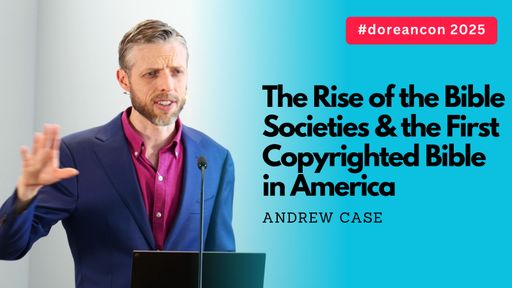
This message by Andrew Case was presented at #doreancon 2025 on "The Stewardship of Scripture" at Silicon Valley Reformed Baptist Church in Sunnyvale, CA.
Read the article version of this message: https://sellingjesus.org/articles/bible-societies
SIGN THE STATEMENT on the stewardship of Scripture at: https://copy.church/statement/
LEARN MORE
https://sellingjesus.org
https://copy.church
https://thedoreanprinciple.org
Transcript
Let me start with a story about a little girl named Mary about 15 years old a simple girl in 1784 in a small poor village in Wales now her parents loved
God, but they couldn't afford a Bible and From the time she was little
Mary's biggest wish was to have a Bible and read it for herself But Bibles were hard to find in that time and they cost a lot of money about 150 to 300 dollars in today's money and this amount seemed like an impossible obstacle to marry but She still started saving little by little and for six long years
She worked hard until she finally had enough for a Bible Now she faced another challenge
The nearest place with Bibles was in a town 26 miles away, and she had no shoes
Nevertheless she walked that whole way Barefoot over rocky paths and hills until she arrived at the house of a minister who had the
Bibles At first Mary was told that they were out of stock
They were sold out But when the minister heard her story he saw her love for God's Word and he was touched so he gave her a
Bible and this story of her determination and Love for God's Word encouraged others and it helped inspire
The start of the British and foreign Bible Society which worked to make
Bibles available and affordable to many in Great Britain and all over the world
So that was the beginning Now why were Bibles so expensive back then?
Why were they so scarce? Well, this was because of a very simple thing that started with King James and the
KJV It's sometimes called the Bible monopoly or the royal printing privilege
So when the KJV was completed what happened was the king only gave special printing rights to one guy one press the
King's printer and later to a couple other authorized presses So they had a monopoly and as with all monopolies it inevitably drove prices higher and people like John Campbell back in the 1800s
Decried this monopoly describing it as a gigantic leech a literary
Leviathan an Abomination great
Victorian language there in 1804 Thomas Charles and several other concerned
Christians in London including the famous Abolitionist who we probably know William Wilberforce Founded the
British and foreign Bible Society, which we'll call the BFBS from now on their vision was to quote translate print and distribute the
Bible throughout the British Isles and the whole world without any notes or commentary
That's a key part without any notes or commentary. In other words get God's Word into people's hands plain and pure No doctrinal footnotes and make it available to the rich and to the poor alike now in the 1816 book by John Owen not the
Puritan from the 17th century another guy. He wrote the history and origin and First ten years of the
British and foreign Bible Society. We read their founding purpose Statements or one of them and he says this
The reasons which call for such an institution chiefly refer to the prevalence of ignorance superstition
Idolatry over so large a portion of the world the limited nature of the respectable societies now in existence and their acknowledged insufficiency to supply the demand for Bibles in the
United Kingdom and foreign countries and The recent attempts which have been made on the part of infidelity to discredit the evidence vilify the character and destroy the influence of Christianity the exclusive still quoting here the exclusive object and this is important of the society is to diffuse the knowledge of the
Holy Scriptures by Circulating them in the different languages spoken throughout
Great Britain and Ireland and also according to the extent of its funds by promoting the printing of them in foreign languages and the distribution of them in foreign countries in the execution of the plan it is proposed to embrace the common support of Christians at large and to invite
The concurrence of persons of every description who profess to regard the scriptures as the proper standard of faith now
That's the end of the quote from this statement. We can conclude Well, the question is can we conclude that they were establishing a ministry or not?
so I've written an article on this a Christian a biblical definition of Christian ministry and I come to the conclusion that a biblical definition is that it is spirit empowered service specifically and directly for the edification of the body of Christ So let's evaluate it by these terms.
They say that their exclusive object is to Diffuse the knowledge of the
Holy Scriptures. Is that specifically and directly for the edification of the body of Christ?
I would say yes Is it spirit empowered service though? This is where it may be a gray area.
The administration of Distributing Bibles doesn't necessarily require spirit empowerment
Now would it be valid to err on the side of calling it biblical ministry under certain conditions?
I think so, but the society did some things And we'll get to this soon
They did some things to ensure that the spirit was left out as much as possible in what they did in essence they intentionally undermined any spiritual aspect that might accompany their mission and This was intentional
We'll read a little bit more about that soon Now you should know that at the same time the founders of the
Bible Society sometimes alluded to the idea of offering the water of life without money and without price in the words of Isaiah 55 1 and They often spoke of what they were doing in biblical language as though it were a spiritual mission from heaven
Nevertheless, they didn't want to be seen as a mission or a ministry but rather as a fully commercial enterprise with good intentions and that Those intentions were to make
Bibles cheaper So from the beginning their motivation and philosophy were full of apparent contradictions in her book cheap
Bibles Leslie Howsam writes the fundamental principle of distribution without note or comment was based upon the premise that the
BFBS was not a religious society as One person said it is a society for furnishing the means of religion
But not a religious society. This was a crucial distinction denominational differences made it impossible for dissenters and Anglicans to combine together in their religious characters to distribute the scriptures we all know about this kind of stuff right the inability of many different denominations to work together the publication of notes still on this quote and their comments
Would have raised disagreements over interpretation. So the members met as laypersons agreeing to disagree about doctrine
It was a distinction between content and process the scriptures themselves were religious, of course but the process of distribution
Had to be a commercial one stripped of all religious trappings if squabbles over doctrine were to be avoided the tension between spiritual ends and commercial means embedded in the
Constitution because of contemporary political realities was to shape the policies of the
Bible Society throughout the 19th century and Of quote so it's important to note that from the beginning the
BFBS was not interested in Giving away Bibles.
It's a commercial enterprise They wanted to make cheap Bibles, but not free Bibles their goal was to subsidize the price of Bibles through a subscription system much like patreon today if you're familiar with patreon you sign up for regular support and Depending on how much you give right you you get different perks so With the
Bible Society some of those perks came in the form of discounts on Bibles or bigger discounts and for mega donors
Some of those came as the privilege to vote on the board's decisions now in 1821 a 600 page book came out
Detailing the system of the Bible Society Explaining how things worked and why this is all public domain stuff.
You can find it on archive .org and These footnotes will be on my article as well.
The author of this book gives us the reason The society's policy rejected the idea of simply giving
Bibles instead of just subsidizing the cost quote in every instance
Gratuitous Distribution should as much as possible be avoided and the people be induced to purchase the scriptures which are generally valued and read in direct proportion to the expense or trouble which they have cost in obtaining them
Endquote in other words people don't value what they don't pay for in fact
This is the earliest expression of this mentality by a Christian that I have yet to come across So this was this is a way of thinking that was already widespread in 19th century
England This this is interesting. What what is conspicuously absent in the documentation of the society is a thorough scriptural support for their decisions
Namely the decision to charge for Bibles instead of giving them away and Maybe this was because of their desire to be so theologically neutral and generic
Interestingly when an appeal is made to the idea of partiality or favoritism found in James 2
It's applied to giving the poor the same opportunity to donate along with the rich You're giving the poor the same opportunities to give you money
All right, in other words, they they had very cheap subscription tiers, right so it's like patreon
Oh, you can give it the $2 level. So we're we're not showing partiality. Even the poor can give it the $2 level
So they believed that they were they were doing well in terms of not showing partiality
Also the verse it is more blessed to give than to receive is Used to exhort people to give money to the society not for them to give away
Bibles so Let's also talk about Matthew 10a.
It's it's mentioned also freely You have received really give but their interpretation at the time seemed to be restricted to the idea of diminishing
Obstacles not fully removing them They also interpreted the command to freely give as an exhortation to give money liberally to the society itself
So it would seem that they believed they were obedient to this command because they were making Bibles much cheaper
That is removing the obstacle of high cost right
Although removing the cop the obstacle of cost altogether was out of the question So freely quote -unquote freely was understood in terms of wider access and liberality or generosity of spirit not necessarily free of price now completely getting rid of the cost barrier between people in the word was dismissed because as We saw earlier of this folk psychological belief found nowhere in the
Bible this belief this idea that People don't value what they don't pay for This is at best a shallow
Generalization from certain consumer contexts and at worst a dangerous distortion when applied to matters of faith value cannot be reduced to price empirical evidence undermines the universality of the claim and the example of Jesus Giving his life to offer salvation freely shows the utter insanity of this mind virus that has infected the church so to predicate appreciation of scripture on financial expenditure is to misunderstand the nature of value itself this lack of diligence seeking of scriptural principles by which to operate is really unsurprising in this case
Considering the ecumenical nature of the society they were so set on being non sectarian that even preaching
Sharing the gospel praying when representing the society was strongly discouraged explicitly
They even began including the Apocrypha in some additions to please
Catholics Which resulted in no small controversy as you can imagine and division and later in 1831 another controversy erupted about Unitarians holding significant society offices
That didn't go well. So both of these issues resulted in some 2 ,000 people
Breaking off to form the Trinitarian Bible Society, which you're probably familiar with Even so in spite of this strict adherence to an almost secular approach in practice
People still wrote about the society in this kind of language. Let me read to you
This institution is one of the noblest monuments of Christian zeal that the world has ever beheld
It is the cause of God and of man. It is the cause of truth and of mercy It is the cause of the everlasting gospel.
Can you hesitate to promote it? Can you remain indifferent while thousands are perishing for lack of knowledge and while the means of salvation are within your power to?
impart Freely you have received freely give if you acknowledge for yourselves the blessed influence of divine
Revelation invite others to partake of it The light of heaven is streaming and all of its effulgence above and around you
Oh, let not the beams be intercepted open for it a free passage into the dwellings of the poor
Be the means of conducting it into the darkest recesses of human ignorance and error
It will enter them with healing on its wings and the wilderness shall be glad and the desert shall rejoice
And blossom as the rose end quote So we see the contradictions people see them as such a beautiful godly scriptural almost prophetic mission, but at the same time they see themselves as strictly
Business enterprise Now there was a second reason for the policy of not giving away
Bibles It's not just that first one it's also Howsam writes she writes that the leaders of the society were no doubt influenced by contemporary concerns about the degenerating effects of charity upon the poor
To charge a small price for a cheap Bible even to the poorest customer would avert the danger that philanthropy might cause moral decay
It seems unlikely that working -class subscribers understood or cared about the subtle distinctions between The portion of the book they received that was paid for by voluntary donations and the part that they paid for out of their own pockets
But they almost always had to pay something So she quotes one person who said a gratuitous distribution could not satisfy
The minds of those who wished to counteract the degrading influences of pauperism to check the progress of Infidelity and to extend the empire of religion and morality and quote so the committee could not forbid its subscribers or Auxiliary leaders to make free gifts of Bibles, but such gifts were hedged around with warnings so let's unpack this idea of pauperism and Infidelity that are described here and the general moral degradation of the poor that the society feared as a
Result of giving Bibles away at no cost instead of a little cost There was a widely shared conviction among elites
Officials and many Christians of the time that free unconditioned giving
Corrupted the poor by taking away the driving force of necessity it would erode work habits and foster
Dependence the term pauperism meant more than just poverty it carried a bundle of moral economic and political
Connotations that are easy to miss if we read it through modern eyes so first pauperism connoted a
Condition of legal dependence living off state charity Rather than one's own labor
Second it was associated with idleness vice drunkenness and sexual immorality to be pauperized
Was to have one's moral fiber corroded Third many feared the creation of a permanent dependent underclass
Resentful of the wealthy Glad we don't have that today This pauper class was imagined as volatile a seedbed for crime
Disorder or even political radicalism. So number four Christians feared that pauperism eroded humility and gratitude to God replacing it with a spirit of entitlement and discontent
Politicians were afraid of pauperism breeding radicalism and infidelity the dependent poor might be more open right to revolutionary ideas and They might blame their condition on social injustice number five
It was a fiscal drain on the wealthier classes to be honest who were funding relief
Through higher taxes levied on each parish. So landowners grumbled
That they were being taxed to support idleness so This is a real number around eight million pounds a year was being spent on poor relief in England back then
Which would be about a billion dollars in today's money So it was significant.
I don't want my Tax high taxes going to support people being lazy
So by making even the poor pay something for Bible society the society reassured the higher classes
It's okay. Our project isn't gonna foster more pauperism and create another tax like burden on the wealthy
If you're trying to court the mega donors, right? The rich in your society you want to tailor your methods to their liking it's just pragmatics and In that era many of the rich would not have been happy to see you giving
Bibles away completely free of cost so I'm glad we don't compromise based on mega donors today
Dudley shares an anecdote of the sort of reality they may have had in mind the desire for a
Bible being the motivation for the poor people to Industriously find ways to and creative ways to earn money
So he tells the story of Mary Smith a little girl 10 years old He says this interesting child had been long very anxious for a
Bible, but her parents who are honest But extremely poor cottagers were unable to afford the money
Mary often brought the collector the Bible Society collectors taking the donations six pence at a time and Once brought a shilling on being asked how she obtained so much
It appeared that she rose every morning by five o 'clock in the morning in Order to collect violets and other early spring flowers
Which she made up in bunches and sold in the market This was her own spontaneous act suggested by her earnest desire to obtain a
Bible which will be doubly valued Valuable as the reward of her early industry end quote
So that's what they wanted. They wanted to see the poor of rise to the occasion
Inspire them to do creative things to get the money Even if it was just a very little to earn their
Bible now just to clarify Going back to that earlier earlier quote that mentioned infidelity.
What is infidelity? What is meant by that in the quote? Which was a consequence the society feared as a as for from giving
Bibles away free of cost It was the fear of the spread of unbelief
Deism and radical politics among the poor they believed that if they just gave away Bibles away, you know for nothing
The poor might take the Bible lightly Ignore it or fall prey to infidel ideas
There was also a third reason the Bible Society didn't want to give away free Bibles Howsam writes that it was the possibility that generosity might be
Exploited by the unscrupulous. There was a constant risk that poor people might pawn their
Bibles Now, I hope you're starting to see a common thread here Letting fear
Dictate what supposedly honors God most fear supplanting faith fear
Overriding trust in the God who owns and controls all things the fear -driven ministry the fear -driven life
All of this is not to say that God did not use the society
Tremendously hundreds of millions of people have gotten access to scripture through the society's efforts all around the world even during the world wars there were they were untiring in their
Devotion to getting Bibles into the hands of soldiers and prisoners in hard -to -reach risky places in World War one alone
They distributed more than 9 million copies of scripture in over 80 languages And they have been instrumental in translating the
Bible into many languages So this is the beginning the founding the background for the
British and foreign Bible Society Now we're going to jump across the pond to America in the early 1800s
Bible societies begin to spring up Imitating the
British and foreign Bible Society mentality, but with a twist The hope of building a
Protestant Republic by flooding the nation with scripture drove many of these societies in his book the
Bible cause It's an interesting book about the American Bible Society John fee describes their way of thinking as this if everyone had access to a
Bible Prejudice and narrowness of education would be overwhelmed by a patriotic and unified spirit of self
Sacrifice the Word of God was the only way for the nation to heal itself of the wounds
It had suffered from decades of self interested Factionalism other leaders in the movement believe that they believed that they were ushering in a new era of Moral improvements for the world and that the mass distribution of scripture would usher in the second coming
So it's also important to understand that the emergence of these societies went hand in hand
With the second Great Awakening and their work often served as a catalyst for local revivals in Contrast to the
BFBS Early American Bible societies sought to give Bibles away for free.
So there's the twist in those first decades Charity really was their identity and as Paul David Paul Nord says
Their business was benevolence not book selling the Americans were more likely to see themselves first and foremost as ministries
The foundational writings are full of the language that we saw earlier this language of Isaiah 55
Freely giving money without price without money and without price. Sorry while the
BFBS stressed payment and Moral discipline the American Bible Society stressed charity and grace
Now in my research I haven't really found in Explanation for this difference any writings from Americans criticizing the approach of the
BFBS etc But I'd love to know what they thought about that difference by 1816 over a hundred and thirty local
Bible societies had formed in the u .s This is a lot people were motivated. If you read old books, you know, like Lucy Maude Montgomery and and Louisa May Alcott You'll often see these kinds of Activities going on people in local churches.
They're helping out the local Bible societies They're going and collecting money for for giving away
Bibles there. They're doing their part and they're having meetings they're doing whatever they can to help distribute and raise funds for giving away
Bibles and So these local societies, you know They were all over the place and they shared this conviction that no one should be denied a
Bible because of cost and They described their goal as distributing the
Bible among persons who are unable quote Unable or not disposed to purchase it for those who could afford to pay even a little
The societies would offer Bibles at a very low price sometimes just the cost of printing sometimes even less subsidized by donations
Now to coordinate this growing movement Leaders felt the need for a national organization
Let's kind of bring all of these together into one so in May 1816 delegates from 28 of these local societies met in New York City and founded the
American Bible Society the ABS which would become one of the largest and most
Influential Christian organizations in American history From the start the
American Bible Society echoed the ecumenical principle of the British Society which was to distribute scripture without note or comment as a
Parentheses on their strict adherence to their non -denominational policy. Let me share an example of this so in 1835
We have the British Baptist Mission in Calcutta, India It appeals to the
ABS for help in funding a translation of the New Testament into Bengali The ABS refused to fund the project
Because the translators of the Bengali Bible translated the Greek word for baptism baptizo in A way that communicated the
Baptist practice of immersion as opposed to sprinkling
So they reminded the British Baptist Mission that they were not interested in promoting local feelings and party prejudices or sectarian jealousies and Throughout much of its history the
ABS measured success not in terms of conversions But just in terms of bulk amount of Bibles Distributed around the world each year
That was their real goal Just the numbers in the early 1800s printing was
Undergoing a revolution so we have to talk a little bit about printing technology here
This is part of the story traditional printing with movable type was really labor -intensive and expensive but a new method called stereotype printing emerged and The Bible Society's really wanted to embrace this
Basically this new technology Involved creating a permanent metal plate in one piece of metal
And it could be used to print thousands of copies of that page Without needing to reset any type so the upfront cost of making the plates was really high
But once you had them each additional copy was really cheap and easy and higher quality ensured consistency and fewer typos across all copies
So the American Bible Society says hey let's become pioneers in this technology and they invested heavily in printing infrastructure by the 1820s the
ABS and its auxiliaries were producing Bibles on a scale previously unimaginable and Because of the efficiencies of the stereotyping the cost per Bible decreased over time
But this required a large amount of upfront capital to to fund it there is their sense of urgency and Ambition drove them to make a fateful decision
Get more money to print more Bibles by becoming a more commercial enterprise
In other words more money and more ministry. That's a book with that title very interesting So money had to be obtained whether that be through sales or donations
So why not just take both, right? And like the
BFBS this decision was not made based on scriptural principle, but rather expedience pragmatism economic logic
The leadership of the ABS wrote this the managers deemed it expedient to renew the recommendation to the auxiliaries to sell the scriptures at cost or reduce prices in preference to distributing them gratuitously
They had a little change of heart there the society's developed a form of differential pricing
All of which is going to sound very familiar to us in this era You know There were premium premium editions for the trade cost covering prices for general buyers
Subsidized rates for auxiliaries and free copies for the indigent and by the 1820s
The ABS had become one of the largest publishing houses in the country Nearly holding a monopoly over the production of inexpensive
Bibles in the u .s They along with the American tract Society and the
American Sunday School Union had become national publishing corporations indistinguishable in business methods from secular enterprises enter the critics
They began to accuse them of hypocrisy one insider wrote an expose of the rise and proceedings of the
American Bible Society Arguing that selling scripture mocked the claim of publishers to furnish scripture without money and without price
He pointed out that that the society's had accumulated vast wealth in Stereotype plates real estate and buildings enriching themselves while claiming to serve the poor
The author wrote the community had zealously Assisted their spiritual teachers in the formation of the society on the supposition that it would dispense their charities
Collectively to those who needed them to much better advantage than they themselves could do individually.
But in This the public were to be deceived the benefit of the suffering community
Suffering for the want of spiritual food was a very minor consideration when compared to the best interests of this society
Contributions and donations were pouring in from every section of this vast Republic for the purpose of gratuitously
Furnishing the destitute with that which the benevolent said they most needed that is the
Bible When the managers very gravely passed the following resolution
Which they unblushingly promulgated resolved that in ordinary cases occurring within the
United States It is inconsistent with the best interests of this society to distribute the
Bible gratuitously except through the medium of auxiliary societies end quote
He then explains at the cursor review of this resolution. It may appear to some that this institution still furnishes the
Bible Gratuitously, though it may be through the medium of auxiliary societies, but such is not the fact end quote
Furthermore he predicted that this new commercial approach would eliminate all competition
Other critics shared this concern about the impact on commercial publishers people doing honest work to bind and print and make books by using charitable donations to subsidize low -cost
Bibles The societies were distorting the market and crowding out honest competition and a guy named
Herman hooker wrote a book Called an appeal to the Christian public on the evil and in policy of the church engaging in merchandise nice title in which he said
What business have Christians to give their charity to do what? business enterprise and capital would do if let alone quite as well and cheaply so There were critics critics at the time
Even within the society's some leaders came to recognize the problem They came to face the facts that under the sales model scripture flowed primarily to those with money and Undermined the charitable nature of their mission
Nord writes Quote ironically the turn to retail sales, which was designed to produce universal circulation
Not profit had entrapped the societies in market forces they had been founded to resist a periodical called the reformer also
Consistently attacked the ABS it was run by men who were zealously opposed to both
Calvinism and what we would call parachurch organizations today They said its readers
Included I'm sorry this is John fee writes its readers included men and women who felt that their liberty was threatened by the attempts of benevolent societies to exert ecclesiastical and cultural power
Over America through the establishment of a Christian nation Its authors challenged the notion that Christianity particular particularly
Presbyterianism must become the official religion of the nation. They weren't happy about that John fee writes the editors of the reformer argued that the
ABS reports on the Bible needs in the United States Were heavily exaggerated
Gates the author the editor of this this Periodical questioned
These ABS assertions that there were whole neighborhoods in which there was not a single copy of the
Bible He found this hard to believe since as he put it almost every storekeeper in the country keeps Bibles to dispose of and no one that Valued the
Bible more than all his property would long be without one According to him all such reports were published to convince unsuspecting
Christians to donate more money to the ABS which in turn would empower them further to infiltrate the government and establish a
Presbyterian nation so this is the
Controversial climate in which this is all going down Amid this growing entanglement with market mechanisms the question of intellectual property arose
Early Bible societies operated in a legal gray zone in the US The text of the
King James Bible their main version was not protected by American copyright law Even though it remained under the perpetual copyright of the crown in the
United Kingdom this empowered any American to print the text of Scripture and This was a luxury the
British did not have but the publishing of copyright free Bibles Would soon go the way of all flesh
The revised version in 1885 led to the advent of the first copyrighted
Bible in the US It was published initially by the British now the
RV was the first major revision since the 1769
Blaney revision of the 1611 King James and it took a long time to convince the right authorities in England that such a revision was possible and desirable and That it wouldn't ruin the revered and loved
KJV So once enough people were persuaded the Oxford and Cambridge presses who were the
Kings official presses for the KJV two of them They funded this revision and they spent what would be millions of dollars in today's money
Over the course of 12 years to pay a team of scholars who worked on it Oxford and Cambridge were guaranteed the same monopoly as Always of printing and selling this new version
So it was a very small investment for them in comparison to the profits that awaited them
It was suggested that they invite some Americans to Get in on this work and everyone was in agreement that this was a good idea
So under the direction of Philip Schaff two American committees were formed in 1871 One for each
Testament Members were drawn from multiple denominations and included eminent scholars and the
Americans followed the same rules as the English But their role was advisory Drafts produced in England were sent to them and they reviewed and annotated them and their suggestions were considered in subsequent revisions although they had no decisive vote their influence was real and Record of the preferences of the
British Sorry a record of the preferences that the British didn't want to follow was eventually published as an appendix in American editions now
Philip Schaff Highlighted the cooperative spirit across the Atlantic noting that the project symbolized unity of faith among English -speaking
Protestants the Americans financed their own work through voluntary donations
It's a pretty big deal. You know the British they had all this funding millions of dollars put up by Oxford and Cambridge But it was all voluntary donations for all the scholars
Involved in America, you can read about the detailed process including the how the project was funded and who the donors were and all these details in this public domain book a
Historical account of the work of the American Committee of revision of the authorized English version of the
Bible and the British project It didn't help at all to fund the
Americans work It was just a labor of love no salary was given to any of the scholars in America the funds that were donated only covered the expenses so office space clerical help printing and books
Travel by the end of this 12 -year project the total amount donated in the u .s. Was forty seven thousand five hundred dollars and That figure would be about 1 .4
million dollars today So their operating costs came out to be in today's dollars about a hundred and twenty thousand dollars a year
When the New Testament came out it was a hit instant success in May 1881 the
Chicago Tribune Imagine this today the Chicago Tribune Printed the
New Testament in its entirety in a single Sunday newspaper and sold a hundred and seven thousand copies the
Tribune Freely used the biblical text from the British publishers since at the time no international agreement had been made to enforce copyright laws across national borders and so Rival papers did likewise
American book publishers jumped on this Sold bound copies and over a million copies of the
RV sold within months this frenzy highlighted the possible profits
That might be obtained by copywriting the text in America to ensure a monopoly on sales
They're paying attention Somebody was
American publishers were paying Attention and the stage was set for a shift in the stance of Bible publishers
Towards copyright although American churches had enjoyed the British revision They still wanted their own edition of the
American preferred renderings in the body of the text but as already mentioned there was a gentleman's agreement between the
British and American committee that the Americans the Americans would refrain from publishing such an edition until 14 years
Had passed this is where it gets a little complicated. So try to try to follow follow me here
The British didn't want their thunder to be stolen in their new edition
So they said okay Americans just hold on for 14 years Before you make your own edition where your preferred readings your
American isms and all that stuff that we didn't put into our text And your preferences are put into the body of this text and you can make your own
American edition of this revision For now, just put it in an appendix at the end.
Okay those preferences That makes sense. So to name a few examples the
American Committee wanted for example, Jehovah instead of Lord Holy Spirit instead of Holy Ghost demons instead of devils
Covenant instead of Testament and so on this agreement couldn't be enforced by law in America.
It was a gentleman's agreement So there were publishers who took took those notes in the appendix and then they incorporated those changes into the body of the text before the waiting period had expired and they made some money and they annoyed the
British and one of the most Reputable Christian publishing houses in the nation watched this happen
Thomas Nelson and Sons Thomas Nelson started his business in Scotland and by the mid 19th century opened a branch in New York They specialized in high quality like premium
Bibles prayer books and hymnals Especially those coming out of Oxford University Press in other words, they were the primary distributor of Oxford Bibles in America now
This made them a natural partner for the American revision committee
Nelson had the infrastructure to to print premium Bibles and established distribution networks among churches and booksellers and They had already published the
British revised version in 1885 for the US market So you can imagine that after seeing the potential profits for an official
American revised version and after seeing how things played out with other presses printing their own editions contrary to the wishes of the
British and American committees and Seeing the way Oxford and Cambridge grew rich from their printing monopoly in England through the perpetual copyright of the crown
Thomas Nelson wanted to make the deal as sweet for themselves as possible They ended up getting the contract and the
American Standard Version was published in 1901 the ASV it includes a copyright notice the first one on a
Bible in America why It would seem that Thomas Nelson Felt a little something in their conscience about this
They anticipated a question or two So a nebulous reason was given
It said copyright to ensure purity of text
Later, it was explained that because of an unhappy experience with unauthorized publications in the two decades between 1881 and 1901 which tampered with the text of the
English revised version and the supposed interest of the American public By placing the American preferences into the main text the
American Standard Version was Copyrighted to protect the text from unauthorized changes end quote
Let's unpack this the unhappy experience that motivated this change was simply the faithful Adaptation of the text to the
American preferences this change was unauthorized. It's true But it didn't introduce errors or heretical readings
Into the text so it can be concluded that the clause to ensure purity of text was I would say disingenuous
There were no reports of someone trying to commandeer the text for malicious purposes or hostile parties
Corrupting the text in order to deceive readers or cult leaders appropriating it for their own heretical ends instead a petty
Pretense laid the foundation for a new tradition of Binding the
Word of God with the traditions of men Another angle on this you have to understand is is that because of the nature of printing back then
Typos were bound to be introduced by the typesetters of presses that were less careful
Maybe less well funded less meticulous This is obviously no longer a concern today with the way we can make perfect digital copies of a work
But a typo free Bible Is a completely different kind of purity of text than a heresy free
Bible it may be that there was a concern for minimizing typos and they believe that such a thing could be accomplished by monopolizing and centralizing the printing permission but They should have known that ever since the
KJV came out The centralized printing monopoly for that version in Great Britain had been plagued
By numerous typos in its editions, and we'll talk about those tomorrow
And there's some funny ones an entire book was published about this problem in 1833 by Thomas Curtis showing that the monopoly on printing the
KJV was making the Oxford and Cambridge presses lazy and they were producing texts of poor quality and accuracy because You know no competition who cares this was a basic principle just you know
This we see this over and over proven again throughout history monopoly ultimately leads to higher prices and lower quality for everyone in the end
Was purity of text really the reason? No publisher is going to print on the cover page of their
Bible that it was copyrighted because we want more money Right are they gonna say that who's gonna say that but the fact is that the copyright
Provided an immense economic reward for the publisher So how did Thomas Nelson get the
American Committee to agree to this was the American Committee on board with this? They just spent 12 years of their lives even more working on this
Here's what led up to it that the American Committee Decided to work on many more changes in addition to what they had already suggested to the
British So they did this in anticipation to the date of publication And so they were doing all this extra stuff right and they ran out of money to do this extra work and Thomas Nelson Gave them $25 ,000 so about a million dollars today to cover the costs and this was essentially repaid by granting
Nelson exclusive publishing rights So what did the American Committee think of this issue first of all ironically?
They praised the fact that the 14 -year agreement they had with the British freed the book
From all restrictions from copyright in this country and made it a gift to the people end quote
Commenting further on the issue of copyright they wrote it was at no time desired by the
American Committee to have any such Arrangement made between themselves and the publishers in the United States or in any way to put a restriction on the sale of the new book
For the purpose of securing any remuneration for their own service or any benefit for themselves, whatever
No copyright was thought of or wished for in this country with such an end in view at one time however the subject of securing a copyright here for the sole purpose of preventing the publication of Inaccurate or imperfect editions was considered and discussed this led to a series of communications
But in the end that book We concluded should be made a free gift to the public with no limitation whatever in the way of its widest
Circulation that the whole matter was laid aside by common consent That was their hope their heart, that's what they wanted this was published in 1885 but this this desire of theirs expressed and Things were about to change in the years intervening
Matthew Riddle recorded what happened in his 1905 book the story of the revised
New Testament American Standard Edition And for the sake of time I'll summarize what he wrote
After the death of Philip Schaaf in 1893 the American Committee lost both its chief leader and its most effective fundraiser
Making it very difficult to raise the money that they needed for the final revision and preparation of the text for publication and there were only three members of the
New Testament company still alive at that time and All they were determined to continue
They knew they could not cover the costs of the final preparation of the text for publication themselves and at that point in time few publishers would risk printing the work risk without copyright protection 1897
Thomas Nelson and sons stepped in they offered their money and They even offered personal salaries to these guys who were doing the final preparation of the text and professor
Thayer Rejected the idea insisting that he could never accept money for Bible revision as a result
These scholars completed their heavy labor without pay while Thomas Nelson gave that money not as a donation
But as an act of you give me the copyright in return So you can imagine these few men they're at the end of their lives.
They're tired They're just wanting to see their life's work finally get published. They've run out of options
Perhaps they're desperate and Thomas Nelson sees a multi -million dollar opportunity easy for the taking they swoop in There was no doubt in the mind of the publisher based on the past sales of the
RV that printing the ASV Was a risk -free Way of making a killing right with with or without copyright protection
They were going to make a killing now compromise just seemed
Inevitable in this situation. So the only thing that remained was for Thomas Nelson to whitewash the cash grab with a plausible pious sounding rationale
Safeguarding the purity of the text and this conveniently aligned with securing a printing monopoly
So What went wrong? We're out of time to talk about what went wrong
But I'll just summarize really quick Everybody made mistakes here, you know Thomas Nelson made mistakes
We've talked about those the American Revisers made mistakes, you know, they failed to operate on biblical principle
They failed to persevere and reliance on God to provide and they they sold out and they sold their birthright
For a For a simple meal. They let the tyranny of urgency prevail.
They trusted the publisher more than the church and And then how did the church fail in this whole situation the
American churches should have rallied to the cause When the committee's funds ran low But they didn't they they abdicated the responsibility before God to steward the word and left everything to the publishers, you know
The publishers they'll take care of everything and then we lose The ability to share it like many
Christians in Nazi Germany. They remain silent in the face of compromise There was just no outcry
About the copyright decision. They failed to question and resist the binding of the spirits work with the laws of men
Dr. Maurice Robinson writes somewhere a great evil is involved whenever the people of God permit commercial publishers to hold -hostage their sacred texts by copyright and licensing restrictions so If you want to read more on this it's going to be online but Now we have this
Tradition we are stuck in this was the precedent. This is what started it all And it is important to acknowledge that there are some people like Biblica that are starting to offer freely
And give some of their Bible translations away under Good creative common licenses, although not public domain
But we are awash in a sea of commercialism and the question of what will sell has eclipsed all other priorities
So the challenge of the 21st century church is to recover the original vision of the
Apostle Paul that the Word of the Lord Run freely and be glorified