Keep sharing good news without ads.
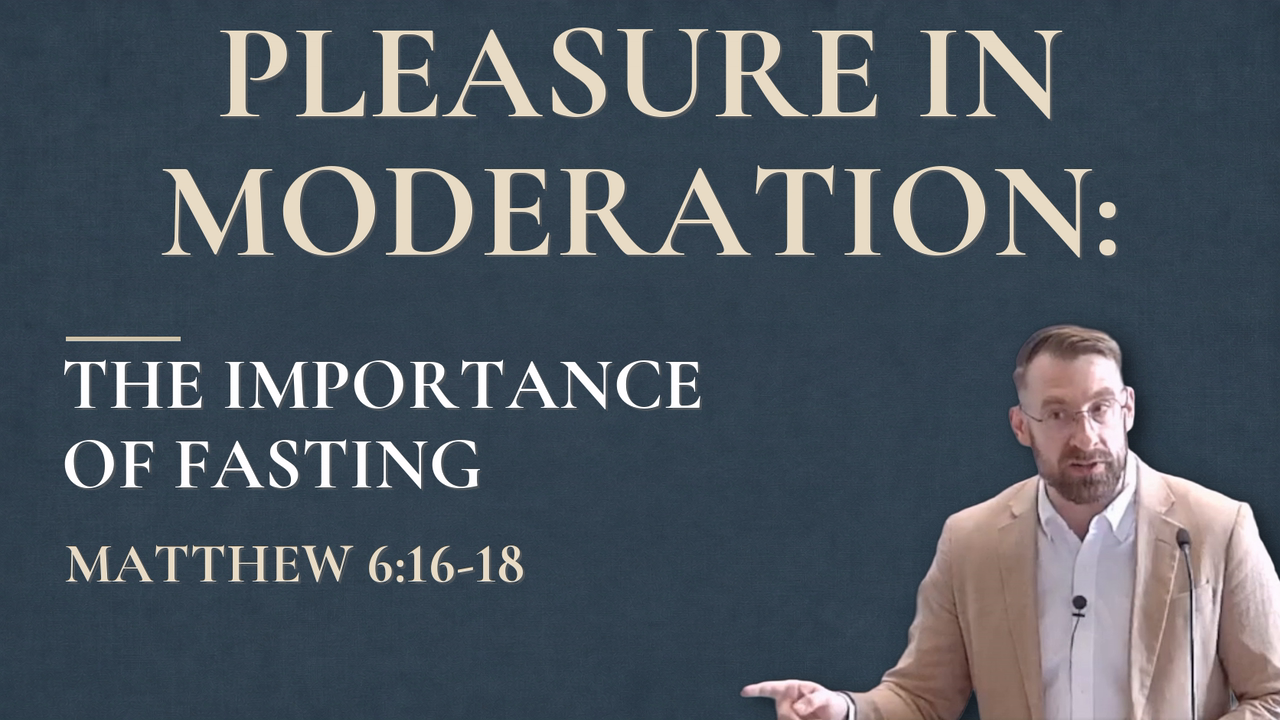
Sermon: The Importance of Fasting Date: November 15, 2026, Afternoon Text: Matthew 6:16-18 Series: Pleasure in Moderation Preacher: Conley Owens
Amen. Please turn your Bibles to Matthew chapter 6, and it can be found on page 811 if you're using the Pew Bible. Matthew chapter 6. Please stand when you have that. And when you fast, do not look gloomy like the hypocrites, for they disfigure their faces and that their fasting may be seen by others.
Truly I say to you, they have received the reward. But when you fast, anoint your head and wash your face, then your fasting may not be seen by others, but by your Father who is in secret. And your Father who sees in secret will reward you.
Amen. You may be seated. Heavenly Father, we ask that you would enlighten us, that you would help us to understand your will in fasting. Pray that we would be a people who seek you earnestly by prayer, by fasting, when you call.
And we ask that by your Spirit we would love this truth, this great privilege that you have given us of coming before you in fasting, in Jesus' name, amen. Well we are nearing the end of our series on pleasure and moderation.
We start off with a lot of different foundations of moderation and why extremes, both in excess and in abstinence, are often forbidden. Then we went through a bunch of different areas of the Christian life where moderation is needed.
And now we are looking at two different authorized extremes, this week fasting, next week feasting, and the importance of these things. So while God calls us to moderation, there are authorized extremes upon certain occasions that he calls us to, and one of those is fasting.
In this passage here, in the previous context, chapter 5 he ended with, you therefore must be perfect as your heavenly Father is perfect. Now if you look at the rest of Matthew 5, it's a number of things that are primarily commands that are showing how deep the commands of God go.
Many people think of the kind of righteousness that God calls them to be a very partial one, but he calls people to perfection. Not that they can accomplish perfection in this life, but that is the standard, it's not something less than that.
And so to make the standard less than that, and think that if you're doing that, well then you've met everything and you have all the righteousness of God, you're gravely mistaken. You therefore must be perfect as your heavenly Father is perfect.
Now you can have the perfect righteousness of Christ imputed to you through faith in him, and you can, imputed means credited. And then, through the work of the Spirit in you, he can increase your holiness, make you a more righteous person in practice, but this is all to say that the kind of righteousness that God is calling us to is a perfect righteousness, it's not a partial one where we can pat ourselves on the shoulders, say that we've, we as servants of God, have done all that's required of us when we've done far less than what he is actually calling us to.
It goes on and it describes this in a number of ways, it talks about giving, it talks about praying. These are things that are supposed to be done not publicly, which is someone who thinks that the call to righteousness is something that's a partial thing, they do it publicly because they're thinking about it from the perspective of a pleasing man.
How would you please man with your righteousness? Well, all you need is a partial sort of righteousness, an outward sort of righteousness, and you need to do it publicly. So it's partial and it's public.
But the righteousness that God calls us to is one that is perfect and it is one that is private. So the giving, giving should be done in secret, praying should be done in secret, not that there's never an occasion for being public about your giving or being public about prayer as we have been even in this service.
But in addition to such public instances, we should also be giving in private, we should be praying in private, and fasting even in private. The fasting that God calls us to is one that goes deeper than just external fasting.
It's not just a matter of not eating, and then of course not eating in public, but it is a matter of truly seeking God through humbling ourselves by denying ourselves pleasures. This is what fasting is.
It is a seeking God by humbling yourself through a denial of pleasure. So negatively, what you are denying typically in a fast is food. Now there are fasts in the Bible such as Daniel's fast in chapter 10, the book of Daniel, where he fasts from meat and eats only vegetables.
So not all fasts are strictly from all food, it might be from pleasurable foods and eating only less pleasurable foods. Also fasts are typically, you see throughout Scripture, without drink, without even water.
There are some, a lot of modern commentators look at Jesus' fast and they see that it doesn't mention that he didn't drink, and they take from this that New Testament fasts are completely different in category.
I do not believe that is the case. I believe that fasting is still typically something that is without water. And then it is also from all other kinds of pleasures, sex, 1 Corinthians chapter 7 speaks of that as something that you would fast from, that you are not to deny each other except for a set period of time for the sake of prayer only, and anything else, any other kinds of pleasures, modern pleasures like social media, there are all kinds of things that someone would fast from.
Positively, it is a time that is supposed to be spent in prayer and reading the Word. So what you see in Scripture, in Nehemiah, the people, when they fast, they spend the day reading the Word and prayer.
A quarter of the day is spent in prayer, a quarter of the day is spent in reading the Word. And in Jeremiah, you have another example of a day where the people fast and they read the Word. So these are positively what you should be doing.
Now how long is a fast? Well, the fasts that we see in the Bible that are not extraordinary, being 40 days long or something like that, are often a single day, single 24-hour period, evening to evening.
And this is typically what is prescribed throughout the Christian tradition, is a single day of fasting. Fasting might be longer than that, if you have reason to fast longer than that, but there's really no cause for it to be less than that.
If it's less than that, it's just skipping a meal. It's really not much more than that. So it would be something that would be a day that is without pleasure. Now regarding much longer fasts, like the 40-day fast, those are fasts that seem to be connected with the giving of divine revelation.
You have Moses twice over, you have Elijah, and then you have Jesus fasting for 40 days. These are not things that are possible for people apart from miraculous upholding by the Spirit of God. There are a number of people who claim that they have done 40-day fasts.
I do not believe these claims. I'm entirely 100 skeptical of such claims, that people have fasted that long, but often people want to grant themselves the righteousness of Jesus Christ in their own flesh and make such claims.
It's a very odd thing. Now why are you fasting? You are fasting to humble yourself. So it is in that denial of pleasure that you sense your own weakness, you sense your own need, and you are able to, in prayer, rely upon the Lord more intensely.
That is what is happening in fasting. Now that is what is supposed to be happening in fasting. Often fasting produces the opposite result. It is a kind of pious practice that few people participate in, and so the temptation, especially now where few people do it, is to instead feel more proud on account of your fasting.
Isaiah chapter 58, why don't you turn there for a moment. This is a relatively long passage that speaks of people being proud in their fasting. Isaiah 58, beginning in verse 3, I'll start off with the first three verses here.
Why have we fasted and you see it not? Why have we humbled ourselves and you take no knowledge of it? Behold, in the day of your fast, you seek your own pleasure and oppress all your workers. Behold, you fast only to quarrel and to fight and to hit with a wicked fist.
Fasting like yours this day will not make your voice to be heard on high. Is this the fast that I choose, a day for a person, is such the fast that I choose, a day for a person to humble himself? Is it to bow down his head like a reed and to spread sackcloth and ashes under him?
Will you call this a fast and a day acceptable to the Lord? So begins here by describing how some people might fast. They might fast in a way where, okay, well, this is a day for me to be lazy, for me to be really agitated at other people because I'm hangry all day long.
That's not the, that is not the point. Verse six says, is not the fast that I choose to lose the bonds of wickedness, to undo the straps of the yoke, to let the oppressed go free and break every yoke?
Is it not to share your bread with the hungry and bring the homeless poor into your house when you see the naked to cover him and not to hide yourself from your own flesh? Then your light will break forth like the dawn and your healing shall spring up speedily.
Your righteousness shall go before you. The glory of the Lord shall be your rear guard. This is the description of what a fast should be. Fast should be a true humbling of oneself such that he does not grow in agitation and hatred towards others, but rather a real humbling causes you to grow in love.
In fact, based on the things that you're seeing here, where it talks about sharing your bread with the hungry, historically, Christians often would take that money that was gained from not having eaten that day and give that money to the poor.
So fasting was historically frequently joined with almsgiving. That was part of the positive thing that people were doing in their fasting. I think it'd be reasonable to do the same today, although I know that a lot of times the way that calculations work for how much you're spending on food are not as, maybe not as obvious all the time.
Now, is Christian fasting different than the fasting that you see in the Bible? There are a couple of things I want to point out, sorry, different than what you see in the Old Testament. There are a couple of things I want to point out.
The first is the emphasis that we have here on Matthew on not looking gloomy. So one difference is that because many of the fasts were across the entire people of Israel, there was not necessarily a reason to keep it private and that there were a relatively large number of public fasts.
There were still private fasts, but there were a large number of public fasts. For the Christian, we have no public fasts apart from church corporate fasts. Maybe on a rare occasion, a nation might call its people too fast, and then it would not be such a surprising thing to find out that someone else is fasting.
However, even then, they would not have the authority to compel people to fast as they did in the land of Israel. And so it would still be a matter of bragging to present yourself as someone who is fasting.
So more frequently, or rather more absolutely, Christians, not just being in the land of Israel, where everybody would be by nature of the law, fasting on the days when fasting was required, it is necessary that we keep our fasting private as it is supposed to be among those who should know about it.
Now, once again, this is not an absolute such that there would never be an occasion to, by way of teaching, talk about times that you have fasted or with those communities that you are fasting with, let them know that you are fasting, obviously.
Those would be reasonable things to do. So there is your cheerfulness and your appearance, obviously, the kind of foolishness that would on the day of, on Ash Wednesday, put ashes on your face, so contrary to these passages that talk about not doing that sort of thing.
But when you fast, anoint your head and wash your face, you know, that's a good thing for your next Ash Wednesday, just remember that one so you can share it with those who happen to need it, and you can visibly see who needs to hear that verse.
The other, so that is the first matter that is different. I'm blanking on what I had, what I prepared for you for the second, let me just look at my notes real quick. Maybe I'll just pass that for a second.
Oh, right, I remember now. Second one is the day, the day on which one would fast. There are no special days that are appointed for Christians to fast on, except for ones that they would be providentially called to.
The Lord's Day is the only holy day that we have. That is not a day for fasting, in fact, it is a day for celebration. It would be wrong to fast on the Lord's Day, and I have many, there are many theologians in church history who would say the same, it is a day for the Lord's Supper.
How can you fast if you're eating the Lord's Supper, except on special occasions where God may take you away from the body, and then it would be right to fast on such days. So for example, early on in COVID, so during COVID, our church met during the lockdowns, but while we met on the first weekend of the lockdown, there were seven Sundays that we didn't end up meeting.
Those were all very appropriate days to fast. They were not days where we were gathering for the Lord's Supper. They were days where there was a lot of reason to mourn. They were very appropriate days for fasting.
Now beyond special questions of how Christians should fast compared to anything in the Old Testament, what groups should fast? Okay, you privately, it'd be right for a private person to fast. There's also, it's reasonable for a whole family to fast together.
It's reasonable for a church to call its people corporately to fast on certain occasions, and it is right for heads of nations, for civil magistrates to call people to a fast so they have no authority to impose a fast on people to compel them to fast.
These are different groups. Now you might ask whether or not this is a duty. Is this a duty that man has to fast? I find this question interesting because a lot of people seem to have trouble in understanding the nature of an extraordinary duty.
It is an extraordinary duty in that it is not ordinary. Okay, there are ordinary duties that are very regular. Fasting is an extraordinary duty in that it's occasional. There are occasions that call for it.
So could it be that someone goes their entire Christian life and never has a reason to fast? I would say that if anyone lives for a significant amount of time as a Christian, there will be some occasion that calls you to fast.
It is a duty. It may be an extraordinary duty, but it is still a duty. It says in verse 16, and when you fast, it's assuming that you are going to fast. It's not just, and if you happen to fast, it's when you fast.
It's understood that you will be fasting. So it might be an extraordinary duty, but it's still a duty. If you were to go a year, maybe two years, never fast, I am almost certain that there was some occasion that would have been very appropriate to fast that got missed.
Okay, that is, I'm not saying that that's necessarily the frequency, but I'm trying to set some kind of upper bound on time so that you, to be somewhat practical here without trying to be too heavy handed.
All right, now why is fasting important? Fasting is important to seek God's favor, especially on any kind of religious venture. Consider these words in Ezra 8, 21. Then I proclaimed a fast there at the river Ahava, that we might humble ourselves before our God to seek from him a safe journey for ourselves and our children and our goods.
Okay, so why do they pray before the Lord? They're about to go on a journey that's of significant religious importance before God. It is right to fast to seek his favor for these things. How many people, when they have something important before them, especially something of religious importance in the life of the church, do not seek the Lord through fasting and prayer and do not have success in the matter and wonder why that is?
Is it not because they have not sought the Lord as they've been called to seek him? In Acts 13, verse 2, it says,. So here you have missionaries being sent out with prayer and fasting. So in commissioning men for the work of ministry, you see later on in chapter 14, verse 23, and when they had appointed elders for them in every church with prayer and fasting, they committed them to the Lord in whom they had believed.
So in appointing elders, you may be aware that that's written into our confession. Our church's confession requires congregational fasting and the appointment of an elder. This is something that we have practiced when we have appointed elders before.
Now you may wonder at this point, what about a deacon? Should you fast when you appoint a deacon? It's very interesting that our confession does not say that because scripture does not explicitly say that.
In Acts 6, 6, when first deacons are appointed, it says,. Now just because we don't have anything specifically that says they fast, it does not mean that fasting would not be appropriate and ought not be done.
In fact, if you go read the same people who wrote our church's confession back in the 17th century, they wrote about this and they treated ordination as one thing. Ordination of elders, ordination of deacons, it's still an important venture that requires fasting and prayer.
So even though they were not willing to put it into the confession in a way that would bind all people because they understand that many might disagree, and the point of the confession was to be something that many churches could agree with, that all the churches could agree with.
You might look at it today and be like, man, there's a lot of specifics in here that I don't know how many people could agree with. It was supposed to be a unifying document that was not so specific that not everyone would be able to agree on it.
But this is one where it did not include fasting for deacons, yet, like I said, you read the framers of the confession, they considered it to be still right to fast in the appointment of a deacon. Because if ordination of elders does, and ordination is just one kind of thing, then it's right to have that same approach for deacons.
And then once you take that and you're thinking about, okay, fasting to seek God's favor for important religious ventures, what else? Well, planting a church. That's something that would certainly be an appropriate time to fast in preparation for.
The early church, you look at the Didache, the earliest extra-biblical Christian writing that we have from the first century, it records that those who are to be baptized were called to fast beforehand, before their baptism, before venturing on into the formal Christian life, being joined to a church.
Is that not an important thing for one to fast for, for themselves as they venture on that journey? These are appropriate times for fasting. So beyond seeking God's favor, fasting is also important in repentance.
Fasting is important in repentance. Joel 2 verse 12 says, Yet even now, declares the Lord, return to me with all your heart, with fasting, with weeping, and with mourning, to rend your hearts and not your garments.
Once again, getting to that depth of what fasting is. You know, fasting, because it is something that is not merely outward, it's not something that's supposed to puff up with pride but truly humble, there's some implications for that, right?
First of all, one implication is that someone who is weak and not able to deny themselves food entirely may still participate in a fast, just as Daniel, eating only vegetables or less pleasurable foods.
It also means that as you prepare for a fast, that you would not, that you would not gorge yourself with food in order to sort of camel up for the next day. That, that defeats the whole purpose of fasting.
The whole purpose of fasting is to experience the felt need, the physical need. And so if you're just gorging yourself beforehand so that you don't feel it, that is not accomplishing its purpose. It also means that the kind of partial fasts that people do that are intended to be whole fasts but excuse themselves on account of some kind of supposed weakness or maybe overblowing certain kinds of pleasures.
You know, those people who say, I'm fasting from social media or something like that. Is that really a fast that honors God to, to sacrifice something so little and not something much greater about your day?
Or a fast that's merely out of convenience that says, well, my new diet requires me to fast this day anyway, so I'll just count that as a fast toward God. Or I'm sick, not going to eat anything, so I'll count that as a fast toward God.
You know, I was sick this past week. There was a day that I didn't eat anything and I'd spent some time praying, but that was not a real fast. I just couldn't eat. It was just too gross, too nauseous.
So fasting is not just a, it's not the outward rending of the garments. It's the rending of the heart. So God calls his people to a fast here that they return to him with repentance, with weeping, with mourning.
This morning, we looked at the importance of knowing your transgressions in repentance, actually understanding your sin, actually feeling the weight of your sin. And I had mentioned that God gives fasting as a means that people can feel the weight of their sins.
If they are not naturally humbled, then God has given them an authorized means to afflict their own soul in order that they might experience that humility in a deeper way. Fasting is also important for grieving.
Many people fail to grieve properly because they do not employ fasting. Grieving is an appropriate thing for the Christian to do, even though joy is the fruit of the spirit. There are often occasions where grieving is called for.
Death of a loved one, all kinds of things that can happen require grieving. And so many people grieve only partially and they do not experience a definite end to their grieving because they only grieve partially and do not give themselves over to it wholly as they ought to do.
You should think of grieving as a duty, that when there is an occasion for grieving, you ought to grieve and you ought to grieve well, completely, so that your heart is given into it and you have sought God sufficiently that he would restore you afterward.
The patterns that you see in Scripture are typically 30 days or seven days for grieving over death. Now that may seem very short to you. You might think of grieving as being something that just goes on and on forever for a lot of people, but it's something that's supposed to happen for a limited period of time.
The one instance you see of something longer than that is for Jacob's death, and that is 70 days. The Egyptians wept 70 days, however, 40 days are appointed for his embalming. So my suspicion is that that's still just, okay, you have the embalming and then you have the actual 30 days of grieving proper, just like for Aaron, et cetera, all others who were grieved for 30 days.
Now that does not mean that there might not be some discomfort, some sadness that follows you even after that period of grieving. For example, we read of Isaac that he was comforted after his mother's death, three years after his mother's death, when he married Rebecca.
Now that does not mean that he was grieving the entire time. It just means that there was some discomfort that was finally completely removed with Rebecca. So I'm not saying that there would be no sadness at all that's supposed to follow after.
However, if you think about what grieving is, it is basically a detachment from some of your duties in order to pursue this duty of grieving, giving yourself over to that instead of what you might normally do, being cheery and upright in all your tasks and being as you ought in your work, stepping away from that in order to mourn some loss.
That is what needs to cease at some fixed period of time that does not go on for many, many months, as it often does for people. They need to return to the callings that God has given them in their life.
And so many people fail to do this because they do not give themselves to grieving with all the means that God has given them, including fasting. Fasting is one of those means that he has given. Now, people might not eat because they are grieving, but apart from seeking him in prayer and real fasting, not just outward fasting, but real fasting of humbling themselves before the Lord, why would he, why would you expect that he would then uphold them and pull them out of that?
Fasting gives you a way of turning that grieving to the Lord, of casting your cares upon him completely, of humbling yourself in that situation as God has providentially brought it into your life in order that you would experience that trial and be transformed by it.
Fasting makes that complete. I believe that many people would have more successful grieving and a more joyful life after the grieving period if they were to give themselves to it more wholly through fasting.
Now, fasting is a gift. It is a gift to us. If you think about this, God has not authorized many different kinds of ways of coming before him in worship, but fasting is one of those things that he has authorized.
There are other ways that you could punish yourself. There are other ways that you could, and I'm not saying that fasting is a punishing of the self, but it is an experience of affliction for the purpose of humbling the self.
There are all kinds of ways that you could try to do that. There are people who, when they are in angst, they cut. They cut their own flesh, and that's not just a modern thing. There are all kinds of religious practices of self-flagellation with razors and all kinds of things going throughout history, people whipping their own backs and all kinds of things.
God has not authorized such ways of self-affliction, but he has authorized fasting. It is a means that he has given us, and so it is a good gift. It's a gift that he did not call us to something worse, or something harder rather.
Not that fasting is bad. That saying worse suggests that fasting is bad. He could have called us to something harder, or he could have given us nothing at all, but he has given us fasting. That means by which we may come before him in humility and seize upon him for favor.
You look at Christ and his life. He, before the beginning of his ministry, fasted before the Lord, and he did so for 40 days, and he did so successfully, and he succeeded in a way that Israel had failed.
Israel had wandered in the desert for 40 years. They did not please God with all their time before him in their wanderings, but Christ perfectly fulfilled what God had called his people to, and so he has stood in our place.
He has stood in our place, and he has laid down his life. That fasting that we do is not fasting of righteousness where it is our own righteousness, the way that Christ was of a true righteousness, but ours is one where he has called us to suffer with him in order that we might be glorified with him.
While he was here on this earth, his disciples did not fast. They only celebrated because how can you fast while the bridegroom is with you? But him having gone has given us the opportunity to walk with him in that suffering in order that we might also be glorified with him.
Take advantage of this means. Call upon the name of your Savior in all the ways that he has given you the capacity to, including fasting. Recover this duty that is so neglected by so many. Heed the calls of providence when there are times of mourning, when there are times of repentance where you ought to fast as an individual, do so.
When there are times that the church calls you to fast, do so as well in these. And do so properly. If you're looking for some instruction, the instruction that we give people is for our corporate fasts at svrbc .org slash fasting.
You can look there at what we encourage people for corporate fasts. And when you fast, lay hold of God. Do so purposefully. Purposefully have in mind what favor you are seeking from him. What do you desire from your Lord?
And bring that to him in prayer earnestly, knowing that you are not fasting aimlessly, without purpose, but with a purpose to seize upon him some particular favor. He has given us a wonderful gift through Christ Jesus, who has been with his people, but then left and left us to comfort.
So we might have both joy, but then opportunities to fast before him. Amen. Please turn, excuse me, let me pray. Dear Heavenly Father, we thank you for your word. We thank you for the extraordinary duty that we have of fasting.
We pray that you would give us wisdom to choose proper occasions for fasting and that you would make us faithful in that duty. Jesus' name. Amen.