Keep sharing good news without ads.
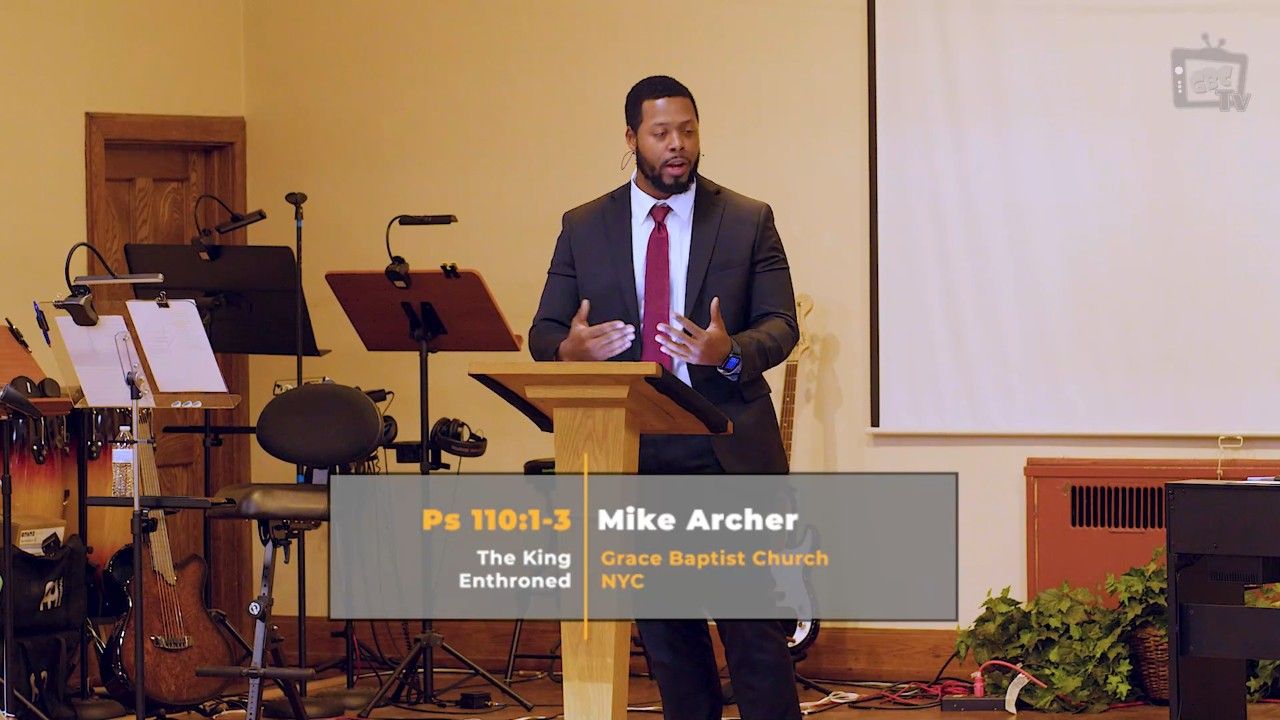
Sermon, November 1, 2026, Psalm 110:1-3, Mike Archer #gbcny † gbcny.org
"The King Enthroned"
https://www.gbcny.org/give
Well, good morning, church. As always, it is just a tremendous privilege to be with you all, be able to share more of the word of God with you this morning. And really, when you think about it, how unbelievably blessed are we to even be able to gather in a format and grow by this means of grace.
As I'm sure many of you may be aware, yesterday marked the 509th anniversary since the start of the Protestant Reformation, October 31st, 1517, right? Prior to which, had you been alive back then, certainly in Europe, you would have almost certainly have been a Roman Catholic.
What that means is that you perhaps have come to a service akin to this, but have gone through the motions, listening to a sermon you couldn't remotely understand. The Bibles, which many of you are holding in one form or another, whether digital or print, would not have been available to you, most likely.
And if it was, if you had one, it wouldn't be in a language you probably would understand. Any attempts to make that word available would have been met by threat of death and imprisonment, dire consequences as it often was.
Even today, many of our brothers and sisters overseas, places like Ethiopia, places like Nigeria, they're being kidnapped, they're being slaughtered by the dozens just for simply gathering in the way that we are today, to worship the Lord, our God.
And yet, in heaven sits a man. In heaven sits a man, and of course, more than a man, but a man nonetheless, who once declared, quote, I will build my church, and the gates of hell shall not prevail against it, Matthew 16, 18.
From his throne, the throne of God above, sits a king to whom all authority in heaven and on earth has been given, Matthew 28, 18. Beloved, Jesus is that man, the God-man, right? He is, as scripture repeatedly affirms, the son of the living God.
He is the Lord of all lords, the king of all kings. And what I would like to share with you this morning through the message that I'm going to preach is that God has enthroned his Messiah at his right hand, and from this throne, he both extends his sovereign rule to all, even in the midst of his enemies, but he also gathers at the same time to himself a holy and willing people.
And for this, as you probably guessed, as I'm standing up here, we'll be returning to the Old Testament, though this time to the Psalms, we're gonna be going to the book of God's praises, and there we'll be looking at Psalm 110, verses one to three.
The title of this message is The King Enthroned, and using a simple three-point outline, we'll trace firstly, point number one, the king's exaltation, we're gonna see that in verse one, then secondly, the king's extension in verse two, and then lastly, the king's enlistment in verse three.
So the king's exaltation, the king's extension, and the king's enlistment. And so if you have your Bibles, you can open up now, if you haven't already, to Psalm 110, and please follow along with me as I read the first three verses.
Psalm 110, verses one to three, a Psalm of David. The Lord says to my Lord, sit at my right hand until I make your enemies your footstool. The Lord sends forth from Zion your mighty scepter, rule in the midst of your enemies.
Your people will offer themselves freely on the day of your power in holy garments. From the womb of the morning, the dew of your youth will be yours. I'm gonna pray once more. Heavenly Father, how desperately we need you, oh Father God, in every hour, but certainly in hours such as this, oh Father God, as we receive your word, which we are so grateful to be able to have at our fingertips, oh Lord, yet we need your grace even still all the more, oh Lord, empowered by the Holy Spirit to press these truths into our hearts.
Mine as well as my brothers and sisters to whom I preach, oh Father God, and those who are not yours, that you would do a mighty work, oh Father God, through your awesome word, oh Lord, open our eyes that we would behold wondrous things therein, oh Lord.
Help me to step aside, oh Father God, to decrease as you increase, and may Christ be exalted. This we pray in his precious name, amen. You know, we read these glorious truths as we just read, right, in Psalm 110, and we hardly affirm them, but if we were to judge purely by, you know, things like appearances or what we observe experientially as we go about day by day, we might be tempted to wonder who it is exactly, who it is really governing this world, who's really in control, right, because as I mentioned, even with some of our persecuted brothers and sisters before in Africa, all around, and just about every day, it seems we hear of wars, we hear of political upheaval, persecution, moral confusion, and hostility towards God in many forms.
And each of these are symptoms, of course, of life in a fallen, broken, and sin-stained world. Job, writing out of the depth of his anguish, says in Job 14 .1, man who is born of woman is few of days and full of trouble.
King Solomon, concurring with this in the book of Ecclesiastes, he writes in Ecclesiastes 4 .1, again, I saw all the oppressions that are done under the sun and behold, the tears of the oppressed, and they had no one to comfort them.
On the side of their oppressors, there was power, and there was no one to comfort them. The Apostle Paul, writing much later on, in Romans chapter five, explains why things are the way that they are, right, why is there death?
He says in verse 12, therefore, just as sin came into the world through one man, Adam, and death through sin, so death spread to all men. All right, and so why do we experience suffering? Why do we experience calamity and hardship, evil, sickness, and death?
We experience these things because of sin and sometimes our very own, and because sin is all around us even in us, it often appears quite powerful, which it is, and as a result, it can make things like righteousness, justice, goodness seem virtually non-existent or weak, but Psalm 110 does something remarkable.
It pulls back the curtain, if you will, of what can easily be seen, plainly be seen with our eyes and reveals to us something greater. It gives us that behind-the-scenes look of history and human experience and gives us a glimpse into an all-surpassing heavenly reality, a reality which reminds us that above every single earthly throne, every single earthly institution, whether good or evil, sits a heavenly one, and upon that throne sits the Messiah, right?
The world may rage against him, but it can never dethrone him. His enemies may resist for a season, but they cannot ultimately defeat him, and because of this, though his people may live surrounded by opposition and oppression, they serve a king whose victory and theirs by proxy has already been guaranteed, and so we begin with a brief introduction to the psalmist, David, right?
Psalm 110 is identified as a psalm of David, and David, of course, was Israel's second king. However, before he was anointed king and even for a brief period afterwards, he was a young shepherd boy from a little town called Bethlehem in the ancestral territory belonging to the tribe of Judah, and David, initially sort of perceived as the most unlikely of the bunch to one day become a king, you know, he was the youngest brother of eight older siblings capable, yet he was nevertheless empowered by God to do extraordinary things.
Most people know, of course, of how he would go on to slay Goliath, right, that gargantuan champion of the Philistines, and how Israel, under David's leadership, would sort of inch ever closer towards its pinnacle in terms of peace, prosperity, and influence.
We also know that David, though certainly imperfect, was a righteous and God-fearing man who trusted the Lord wholeheartedly, and as a result, was delivered by countless trials that he went through as he trusted in the Lord, right?
First and foremost, one of the chief most trials he had was his unjust persecutions by the hand of his predecessor, King Saul. When David was first employed by Saul to be his armor bearer, another role in which he served was that of court musician.
You see, when the spirit of the Lord had departed from Saul, and what we mean by that, that the spirit was only there to conditionally empower Saul for the work of the kingship, a harmful spirit from the Lord would come to torment him in his place.
But when, in the course of time, Saul discovered this young, talented musician, David, and David entered Saul's service, whenever the harmful spirit would come upon Saul, David would play his lyre, and the spirit would depart, allowing Saul to be refreshed and relieved for a time, but this was only the beginning of David's musical career, if you will, right?
Throughout his life, in eventual reign, he would go on to write nearly half of the book of the Psalms, 73 confirmed, with two extra that many believe were also attributed to him, and that would include the one we just read, Psalm 110, right, and by the end of his life, he would come to be affectionately known as the sweet psalmist of Israel.
And with such a sort of an extensive repertoire, it should be of no surprise to us that David's psalms touch upon a wide variety of themes, themes ranging from praise and worship to repentance and lament, prayers that are dejected in just asking for the Lord to hear him.
However, Psalm 110 belongs to another category of psalms, often called the royal psalms, and the royal psalms are so titled because they concern things like kingship, things like rule, like victory, like divine authority.
You see, David had been promised by God a lasting dynasty in Israel. It's what we understand as the Davidic covenant, or part of that, at least, and we see this in the first half of 2 Samuel, chapter seven, but akin to that passage, when you read our psalm, Psalm 110, it quickly becomes evident that David, what he's here recording transcends anything that could adequately describe an ordinary sort of human kingship or an ordinary human heir.
The individual David is speaking of here is someone who he himself calls my Lord, right, making him someone with exceptional authority, because if a king, think about it, if a king is calling someone my Lord, who must that person be?
Moreover, this figure sits at God's right hand. He exercises worldwide dominion. His enemies, right, become a footstool for him, and his people willingly gather around him. Thus, Psalm 110 presents something and someone far greater than Solomon, his son and eventual heir, or any other ordinary descendant of David.
It anticipates the Messiah, and it looks forward prophetically to him as the anointed, the chosen eternal king who would deliver God's people not merely from oppression, but from sin and establish an everlasting kingdom, and this explains why Psalm 110 is featured so prominently in the New Testament.
As you may or may not know, this is actually the most cited psalm in the New Testament, but understanding its background, let's now look at the text itself. We begin with our first point, again, point number one, the king's exaltation, and write in verse one, and there we read again, the Lord says to my Lord, sit at my right hand until I make your enemies your footstool.
Now, from this single verse, three things, I think, become apparent. Firstly, and as I alluded to already a moment ago, this king possesses an extraordinary identity. He's not like anyone else or even any other king, right?
David says, the Lord says to my Lord. That first Lord, which your Bibles probably render as L-O-R-D, all caps, is actually the substitution for God's covenant Hebrew name, commonly pronounced Yahweh.
He is the self-existent, eternal, great I am, but David refers to yet another person, a second individual, and that second person is not being, who is being addressed by Yahweh, David refers to as my Lord, and now the second rendering, Lord, in the Hebrew is distinct from the first.
It isn't Yahweh, rather it's Adonai, right, which can mean things like Lord, Sovereign, Master. It's not necessarily a title that needs to be sort of attributed to God. In the Old Testament, Adonai was often used as a term of respect, honor, such as when addressing individuals of a higher sort of status or rank than you, even as sometimes wives may address their husbands in that way, and in those instances, the term is simply employed to show deference, such as when Sarah addressed Abraham as her Lord, Genesis 18, 12.
However, of course, Adonai may also be used as a sort of clear descriptor for God, right? We see this in Psalm 37, verse 13, also a Psalm of David where we read, quote, the Lord, and there's Adonai, laughs at the wicked, for he sees that his day is coming.
It's rendered much the same in other places, such as Amos 7 and Zechariah 9, 4, each referring to God, and so it might just be helpful to understand Adonai when referring to God as a descriptor for God and a title of respect rather than a proper name like Yahweh.
But these distinctions are important because as Pastor Nick read earlier from Matthew 22, the identity of this Lord becomes central to Jesus's argument concerning who the Messiah truly is and was. Jesus asked the Pharisees two questions.
He asked, what do you think about the Christ? Whose son is he? And they said to him, they responded, the son of David, which they were correct in saying, and just for clarification, Christ comes from the Greek word Christos, which means anointed one.
It's basically a one-to-one translation of the Hebrew word Messiah. So Christ, Messiah, same thing. And so they understood, according to Scripture, that Messiah must descend from David's line. They said he was the son of David and therefore would be a son of David.
They even understood that certain portions of Scripture, the Old Testament, which is what they would have had, passages like Psalm 110 were explicitly referring to the Messiah. However, what they were missing and ultimately refused to acknowledge and accept is how this same individual could simultaneously be David's Lord, the one whom David is calling Lord, but also possessing both true humanity and divine authority, but also a son of David.
They didn't understand that. After all, the only other Lord to which David was subject was God, the Lord of hosts, right? So how is David calling this person Lord, and yet he's a son of David? And so how could David's descendant simultaneously be David's Lord?
And the answer is because the Messiah is not merely David's biological descendant. He came from that line, but neither is he an angel, detached from human lineage. Jesus is both David's son according to the flesh and David's Lord according to his divine identity and his messianic authority.
Thus, he is greater than David. And listen to how Paul, the apostle Paul, describes in Romans 1 .4, in the beginning of that epistle, Paul, a servant of Christ Jesus, called to be an apostle set apart for the gospel of God, which he promised beforehand through his prophets in the holy scriptures.
Now, verse three, concerning his son, who was descended from David according to the flesh and was declared to be the son of God in power according to the spirit of holiness by his resurrection from the dead, Jesus Christ, our Lord.
Christ fulfills the promises that were made to David, right, in air, a line that would endure forever. But he also does so while infinitely surpassing David himself in worth, in preeminence. And so this first observation, right, that's the first observation, the king's extraordinary identity.
The second observation is that the king receives sort of the place of supreme honor. He's being greatly honored. Right, Yahweh, the Lord God, is proceeding to say to this individual, sit at my right hand.
And in biblical times, the right hand meant honor. It meant authority, power, favor, and royal dignity. It's kind of like where we get, you know, this is my right-hand man. This is someone that's right there for you, like, you know, your second-hand man.
Asaph in Psalm 80, he writes in verse 17 of that psalm, but let your hand be on the man of your right hand, the son of man whom you have made strong for yourself. Right, God raises up certain individuals and endows them with things like honor and authority, kings, and he does so for his own purposes, and glory.
David just happens to be one of those men. He himself writes in Psalm 1611, you make known to me the path of life. In your presence, there is fullness of joy, and at your right hand are pleasures forevermore.
And friends, how sweet that statement ought to be, when we recognize who, not only what, but who is at God's right hand. Christ, pleasures forevermore. Right, and that's exactly where Psalm 110 takes us.
The Messiah is actually invited, not to just stay where he is, but to sit at God's right hand. In the New Testament, sort of consistently and repeatedly identifies this act with Christ's exaltation. You know, following his death, burial, resurrection, and ascension, he's then exalted.
Now, one thing we should know is that Christ sitting doesn't mean that he is inactive. You know, you think of one of us sitting down, relaxing, reclining. That's not what's being presented here. The Bible makes clear that he, for instance, ever lives to make intercession for his peoples, Hebrews 7 .25.
We also know that it is through them, by the power of the gospel and the Holy Spirit, that Jesus is still actively building his church, as I read earlier, Matthew 16 .18. Moreover, we're comforted in the fact that he is even now, what is he doing now?
Preparing a place for us that, where he is, we will be able to forever, one day, go and dwell with him, John 14 .2 and 3. And so Jesus being seated doesn't mean that he's retired. It doesn't mean that he sort of, you know, gloves are off and he's done with the work.
Rather, it simply implies that his primary work of redemption was accomplished on the cross. He himself said, John 19 .30, it is finished. Right, that final triumph over sin and death, when he rose as well.
And this is why we read in places like Hebrews 1 .3b, after making purification for sin, he what? Sat down at the right hand of the majesty on high. And again, Hebrews 10 .12, where it states, but when Christ had offered for all time, a single sacrifice, he sat down at the right hand of God.
Right, so the crucified Christ has now become the exalted Christ. The rejected is now the enthroned. The one whom men crowned with thorns to kill him was now being crowned with glory and honor. The third and final observation pertaining to this king's exaltation is that his victory is guaranteed.
God continues, right, speaking to this individual in verse one, stating, until I make your enemies your footstool. And the image here is one of sort of complete conquest. Ancient conquerors, they sometimes portrayed their vanquished foes in reliefs and sculptures and paintings as residing beneath their feet.
It was to show that they're done, they're down there, they're not getting up anymore. And the point here is not merely that Christ's enemies will be weakened, but that they will be utterly subdued. There will be no more of them.
And Paul echoes this directly when in 1 Corinthians 15 .25, he writes for, he must reign until he has put all enemies under his feet. Right, notice the certainty there. What is Paul saying? He must reign.
Not he might reign, not he hopes to reign, not he'll reign if the circumstances permit. No, he must reign. And so we know that all history is marching towards this reign, towards this final triumph and victory of Christ.
However, it's important we make yet another clarification here that that word until, right, until I have made your enemies a footstool for your feet, it doesn't mean that Jesus is gonna stop reigning once his enemies are defeated.
You know, he's not gonna then, okay, it's done. His reign has no end. How do we know this? Luke records for us from the angel Gabriel's visit to Mary. Right, this is before Jesus is born. What does Gabriel say to Mary?
He says in Luke 1 .33, he will reign over the house of Jacob forever. And of his kingdom, there will be no end. Next month we'll probably be reflecting on this verse and chapter a lot more. And so that word until merely marks the period during, the period during which the subjugation of his enemies is taking place.
His enemies are being subdued right now as he is waiting for them to be made a footstool. They're already being subdued just as he is reigning now. And so as we contemplate what King Jesus' exaltation means for us, let us consider the following three sort of points for us.
What does this mean for us? Firstly, Christians should never interpret history by appearances alone. We shouldn't just look at what we're seeing in the news, what we sort of know of life in this fallen world and think that this is the end, right?
The church may often seem weak. Christ's enemies often appear strong, smart, well-organized, firmly resolved. However, appearances are not the ultimate reality as David is trying to get us to see here.
Consider a young and zealous, seemingly well-equipped Saul of Tarsus ravaging the church, raging against the early church with the finest training in the land, really on par to be one of the top Pharisees until, of course, God had a change of plans for him.
It would be a reminder to both him and the entire world, the early church, which owes much of its founding to his labors, that Christ reigns. And this remains true regardless of who holds office, what your professors may believe and what they may be espousing in their classes, how your coworkers, friends, or even family members treat you, regardless of all of that, Christ reigns.
Another point is that every person must decide how he or she stands in relation to this king. The text leaves no room for neutrality here. There's no sitting on the fence. Jesus has subjects and he has enemies, nothing in between.
And so the critical question for us should be, not merely do I admire Jesus? Of course, we should admire Jesus. In fact, we should adore him, we should love him. But the question should be, in addition to that, have I bowed in my heart and by my life before Jesus Christ as Lord?
Is my life submit to him? That's lordship salvation, right? And certainly what the Bible teaches, Jesus is savior and we praise God for that. Paul says, the saying is trustworthy and deserving of full acceptance that Christ Jesus came into the world to save sinners of whom I am foremost, 1 Timothy 1 .15.
However, Christ is also, in addition to our savior, our Lord, which implies obedience, it implies submission. Have you and I come under submission to him? Third point of application on this point, Christ's exaltation gives believers confidence, right?
Thankfully, our salvation does not depend on a defeated savior hoping to someday sort of regain control, he has to wait, he can't do anything, his arms are tied until his enemies are subdued, no, right?
Our Lord and savior sits at the right hand of God, right now, reigning now. And because of this, Paul asks rhetorically in Romans 8 .34, who is to condemn? Christ Jesus is the one who died, more than that, who was raised, who was at the right hand of God and who is indeed interceding for us, right?
The king who rules the entire universe is also the very savior who is interceding for his people by name. He understands what you face, right? He knows what you're going through right now in this season and he knows more of what you need and often supplies above and beyond that.
So go to him now daily for grace and help. And so we see that the king who is in throne is simultaneously an exalted king. However, an enthroned king must possess a kingdom, which brings us now to our second point, point number two, the king's extension.
Verse two reads, the Lord sends forth from Zion your mighty scepter. Rule in the midst of your enemies. And verse two takes us from the throne to the kingdom. We know Christ is exalted, he's on the throne.
Now what's happening in his kingdom? What's going on there? And here we see firstly that the king's authority goes forth from Zion and ultimately becomes universal. The scepter or the rod being used here, some of your versions may render it, represents his authority.
You think of a king, those pictures of medieval kings and they had this scepter that was an indicator of their authority. Psalm chapter two, another royal psalm, beautiful messianic psalm speaks similarly of Jesus as ruling with a rod of iron, indicating sort of not only that he possesses authority but that that authority is irresistible.
Those who sort of position themselves against it will not be able to stand. They will not be able to resist his authority. The father says to the son, beginning in verse eight of Psalm chapter two, ask of me, I will make the nations your heritage and the ends of the earth your possession.
You shall break them with a rod of iron and dash them in pieces like a potter's vessel. And returning for a moment to our previous point, going back to his authority enduring forever, having no end, right?
We find scriptural precedent for that going all the way back to Genesis. All the way back in Genesis, Moses is speaking of Christ in this way. And so right towards the end of Genesis, after Joseph has been reunited with his family, Jacob, led by the Spirit, speaks a number of prophecies that would reveal what's gonna happen in time with his children, with the 12 sons of Israel that would become later tribes of Israel.
And again, Nick read this earlier, but listen to what is said about Judah. This is, of course, the tribe of both David and the Messiah. Genesis 49, verses eight to 10 reads, Judah, your brothers shall praise you.
Your hand shall be on the neck of your enemies. Your father's son shall bow down before you. Judah is a lion's cub. From the prey, my son, you have gone up. He stooped down, he crouched as a lion, and as a lioness, who dares rouse him?
The scepter shall not depart from Judah, nor the ruler's staff from between his feet until tribute comes, and to him shall be the obedience of the people. Sounds familiar, doesn't it? As for Zion, this was historically Jerusalem, the city of David, that holy hill on which the Temple Mount stood.
And as such, Zion was often associated with, of course, David, but also his Davidic kingship, as well as the very presence of God. That was the one place where the temple was to stand, where God's people were to come and worship him.
But in the unfolding narrative of scripture, particularly as we come to the New Testament, we see something fascinating occur. There we see that Christ's authority doesn't simply remain in Zion, but rather, from there, sends forth, goes forth, stretches out, and this phrase sends forth comes from the Hebrew word shalak, meaning in this context, to stretch out, to extend, to send away, or to let loose.
Jesus told his disciples in Luke 24, 47 that, repentance for the forgiveness of sins should be proclaimed in his name to all nations, beginning from Jerusalem. And when we move into the book of Acts, which is something of a part two to Luke's gospel, if you will, we find this movement more clearly described.
Jesus says to his disciples in Acts 1 .8, which is sort of like the central theme for Acts, but you, speaking to his disciples, will receive power when the Holy Spirit has come upon you and you will be my witnesses in Jerusalem, that's first, right, but where else?
In all Judea and Samaria and to the end of the earth. That going forth, that spreading out, that extension, Christ's rule not remaining in one place, but going forth. In other words, the rain announced from Zion begins extending outward toward the nations, and praise be to God for that.
I mean, look around the room right now. That's us. Daniel 7 .14 speaks of the son of man, right, referring to Jesus, as receiving, quote, dominion and glory and a kingdom that all people's nations' languages should serve him.
Dominion is an everlasting dominion which shall not pass away, and his kingdom is one that shall not be destroyed. Again, Daniel 7 .14, right, and by the end of history, we see, as we point to Revelation 11, verse 15b, quote, the kingdom of the world has become the kingdom of our Lord and his Christ, his anointed, and he shall reign forever and ever, and so we're seeing this beautiful picture unfolded in large part realized by what's happening in the church today, right?
We're not Jews. The word has gone out in power and has affected countless individuals from many nations, tribes, and tongues, right? The Bible doesn't present Jesus as merely some regional religious figure.
You go here, and you could hear this guru. No, he is Lord of all. Lastly, we also see that Christ's kingdom advances despite opposition. He isn't charged here in verse two, back in our Psalm 110, to rule once your enemies have disappeared or to rule, you know, just rule once the opportunity presents itself.
What does it say? It says, the Lord Yahweh is saying to him, rule in the midst of your enemies, period. This means that Christ is presently reigning even in contested territory, contested, so to speak, right?
Therefore, the existence of opposition, the fact that Christians in the church face the trials that we face, it doesn't disprove his kingship. It doesn't say, oh, okay, all this stuff is happening and things are just getting out of control.
Is Christ in control? It doesn't disprove it in any way. Rather, it demonstrates the very setting in which his lordship is exercised. Consider how many supposed obstacles there was in your life and mine on our way to salvation.
Obstacles, quote unquote, right? Consider how desperately Satan and all of those forces of evil tried to keep you in his domain, right? Many false teachers going out and this and that to try to sway, if possible, even the elect.
Satan was working hard to try to keep you. But then rejoice in the exceeding love of God for you that far surpassed that, right? Where in Jesus, to quote him himself, right? He says, all that the father gives to me will come to me, and whoever comes to me, I will never cast out.
John 6, 37. We can go back to Psalm 2, which is really such a complimentary psalm to this one. We find the same reality presented to us. What's happening there? In Psalm 2, nations are raging, right? Kings are rebelling.
Rulers are conspiring. They're trying to figure out how to solve this God problem because they don't want God's lordship. They don't want his reign. They're rebelling against him. And yet heaven's answer is what?
It's derision and wrath. We read in verses four through seven that he who sits in the heavens laughs. The Lord holds them in derision, and then he will speak to them in his wrath and terrify them in his fury, saying, as for me, I have set my king on Zion, my holy hill.
Right, and so human sort of rebellion is never gonna enthrone or cancel God's divine enthronement. But what part do we have, right? What part do we have in this kingly extension? Is there any part we play, any role we play?
And how does the church presently participate in the advance of Christ's kingdom? Well, for one, it's certainly not through earthly conquest. We're not out there making jihad or forming crusades, taking sort of the kingdom by force in that way, right?
Jesus says, those who take the sword perish by the sword, Matthew 26, 52. And it's definitely not through coercion or extortion. We're not gonna try to blackmail people into the kingdom. Oh, accept Christ, or this is gonna happen to you.
Right, this Thursday is election day. And I'm sure many of you at least have some idea of who you would like or at least not like, perhaps, in office. However, while politics may be of some importance, the kingdom isn't advanced through mere political influence either.
Paul reminds us in 2 Corinthians 10, three to four, that though we walk in the flesh, we are not waging war according to the flesh. For the weapons of our warfare are not of flesh, but have divine power to destroy strongholds.
And what is this power, other than the dynamite power of the gospel? It's through the proclamation of the gospel, as it has been in every age, that Christ's kingdom is expanded, right? It goes back to the Reformation.
And we're not talking merely the Reformation of sort of a human institution, the Catholic Church, but the Reformation of souls for Christ. One of the passages that most impacted Martin Luther touches on this dynamite power of the gospel, right?
Romans 1, 16 through 17. For I'm not ashamed of the gospel, for it is the power of God for salvation to everyone who believes, to the Jew first, and also to the Greek. For in it, the righteousness of God is revealed from faith for faith, as it is written, the righteous shall live by faith.
This is also why Jesus' directive to us before he ascended in his great commission primarily was centered around the gospel. Surely you know it well, right? Matthew 28, 18 to 20. And Jesus came to them and said, all authority on heaven and earth has been given to me.
Go therefore and make disciples of all nations, baptizing them in the name of the Father, the Son, and the Holy Spirit, teaching them to observe all that I have commanded you, and behold, I am with you always to the end of the age.
By way of application for one on this point, opposition should never surprise us. We shouldn't be surprised when we face adversity for what we believe and what we proclaim. Jesus never promised that his kingdom would advance without resistance.
To the contrary, he says in John 15, 18, that if the world hates you, know that it has hated me before it hated you. And why does the world hate us? Why would the world hate us, right? It hates us because we're not like it.
It hates us because we call out against it. It hates us because we've been chosen out of it by God. Thus, if it's persecuted him, the Son of God, it's certainly gonna persecute us. And yet, Christ still reigns in the midst of it all.
His power still extends, his kingdom still extends. Secondly, the church should possess missionary confidence. What do I mean by this? Firstly, I don't mean that this confidence is in any way in ourselves, right, or in our ability.
It's in the work of Christ. Evangelism is not merely an attempt to create a kingdom for Christ. Rather, we proclaim the gospel because the king already possesses this authority. All authority has been given to him.
Go, therefore, make disciples. Command them to observe all that I've taught you. We're his ambassadors, God making his appeal through us that sinners may believe, that they may repent, and that they may be reconciled to God, 2 Corinthians 5 .20.
Lastly, just as Christ's authority extends throughout the entire world, so too must it influence every spirit of our hearts and our lives. We can, in good conscience, presume to confess Christ as a universal king, which we're doing here, yet we're maintaining these private strongholds where we don't want to submit to him, where we don't want to surrender to him.
What might these be? This means our marriages, our families, our ambitions, our finances, our thoughts, our sexuality, our speech, our work, our habits, our relationships, each reside beneath his scepter, beneath his authority.
Do we see our lives as such? Or do we compartmentalize and say, this is the life that I give to Christ, and this is for me? So the question shouldn't merely be, does Christ reign? It should be, am I gladly living beneath his reign?
All right, remember, we don't serve a tyrant. You know, when we're speaking about his lordship and about the fact that he is a king exalted, he's a king unlike any other king. He's a generous king, a gracious king, who first loved us and gave himself, what king, what person in position of authority would be so gracious to give his own life for his subjects, for his subjects, for his servants?
Mind you, we were enemies when he did this. We weren't his friends, we weren't in his corner, we weren't cheering him on. We were enemies. And really, the greatest evidence of Christ's power is not merely that his enemies fall before him in destruction, and many will, sadly, but that they fall before him in faithful worship as former enemies now having become willing servants of him.
And so, this brings us to our third and final point. We saw Christ, the king exalted in verse one, and then verse two, the king extended, now lastly, we come to point number three, the king's enlistment.
And verse three reads, your people will offer themselves freely on the day of your power. In holy garments, from the womb of the morning, the dew of your youth will be yours. And this is probably one of the most beautiful statements in this entire psalm, really.
Christ possesses a conquering army, and yet, said army doesn't consist of reluctant conscripts. It wasn't people that were just kind of hands behind their back as the draft, okay, I gotta do this, but a willing people, a willing that actually want to serve him, that want to fight for him, that want to live for him.
And that first observation here for this verse is that the king possesses, for one, a people. Right, Yahweh, the Lord, calls them your people. And often, when we think about the measure of a ruler, a measure of their success, right, we think about the scope of their kingdom, we think about how much stuff they have, how much territory, how much land, how much wealth in their treasury, we're looking at those things.
However, the emphasis here is entirely different. It indicates that Christ is, he's not so much looking or concerned with the possessions of territory or material things. What he's really concerned about is this possession of people, of hearts, of lives, of souls.
And this language anticipates the New Testament's description of his relationship towards believers. Titus 2 .14 says that Christ gave himself for us to redeem us from all lawlessness and to purify for himself a people for his own possession who are zealous for good works.
The apostle Peter in 1 Peter 2 .9 calls believers, quote, a chosen race, a royal priesthood in the holy nation, and get this, a people for his own possession. This also reminds us that his people, as they are here referred, collectively, should be unified, right, we were one people.
He's not this group of people that I possess and this group of people, but one people, knit together in heart and mind. Another observation we can make from this verse, verse three, is that the king's people are willing, and I alluded to that just a moment ago.
These people are, as the verse, these people, as the verse goes on to say, offer themselves freely, right? The Hebrew verbiage here carries this idea of free will offerings, willing volunteers, spontaneous readiness, just being willing and able to give of yourself.
Such as when the children of Israel were in the wilderness and they gave freely and abundantly for the construction of the tabernacle. However, what we should take particular note of here is what these people are actually giving, right?
It doesn't say that they're giving stuff, but they're giving themselves, because again, the king is not, he's not looking merely to earthly possessions. Though he may be pleased to use them for his own purposes, but the main focus is that he receives them, the people, as his possession, as they offer themselves freely.
It's Romans 12 .1, I appeal to you, therefore, brothers, Paul says, by the mercies of God, to present your bodies as a living sacrifice, holy and acceptable to God, which is your spiritual worship. God isn't concerned primarily with your stuff, right?
Nor even your religious activity. He's concerned with your heart, with your soul. He's looking at those things. Therefore, the appropriate response to Christ's kingship is not merely a few dollars thrown in the offering plate as it gets passed around after the message, right?
It's not the occasional show of piety and you being a good person, doing good things, right? It's you. God wants primarily you. He wants every part of you as well. And he wants you to want him too. Third observation, the people's willingness also demonstrates the king's power, right?
Notice when it is that they become willing. The verse continues. On the day of your power, people are gonna offer themselves freely on the day of your power. And here we see the harmony of sort of divine sovereignty, God working all things, even behind the scenes, and human willingness.
They don't conflict. They actually are married, right? Christ's power doesn't merely overpower hearts that remain unwilling. Again, he's not twisting our arms to get into the kingdom. On the contrary, his grace transforms our hearts so that we, as his people, actually come to desire him.
When we recognize that we were sinners before him and that it was his blood that set us free, that he gave himself for us, and now we have an inheritance, we're gonna reign with him, we see him as desirable.
We once resisted him, but now we desire him. Paul writes in Romans 6, 17, but thanks be to God that you who were once slaves of sin have become obedient from the heart to the standard of teaching which you were committed.
And the reason God gets thanks, right? The reason God gets thanks for this is because Paul's saying thanks be to God, right? Is because it was him who transformed us. We didn't transform ourselves. We wouldn't have.
We couldn't have. But he transformed us and is transforming us still for, as Paul says later in another epistle, for it is God who works in you, both to will and to work for his good pleasure. Philippians 2, 13, right?
So the triumph of grace here is not simply that God is dragging sinners reluctantly into his kingdom, kicking and screaming the whole way. Yes, we're dead in sin, and we're certainly reluctant beforehand.
We don't really want anything to do with God. However, we don't remain that way when he comes to us. And why not? Because he changes our hearts. Gives us new hearts. Rebels become disciples. Resisters become servants.
Enemies become worshipers. And people who once said we will not have this man to reign over us are brought low to say my Lord and my God. And that's the power of his sovereign grace. But not only are the king's people willing, they're also holy.
Our fourth observation on this point. The verse describes them as vested, sort of clothed in holy garments. And here certain translations, they vary slightly with some rendering as sort of like holy splendor or even the beauties of holiness.
I think the KJV has it. But regardless of what you prefer, the central idea is the same. The king's army is distinguished by holiness. How do we know we're in the king's army? We're pursuing his holiness.
We're clothed in it, in his righteousness. Christ's people, they don't merely fight for him, they increasingly resemble him because we want to be more like him. And we get a picture of this in Revelation 19 verse 14 where the armies of heaven following Christ are said to be arrayed in fine linen, white and pure.
And this is happening as they're following he who sits on the white horse. And that's not merely set dressing, right? They're not just having these white clothes for no reason. This is symbolic of their spiritual purity.
The fact that they've been made purified by the one who gave their lives for him. And as they are being sanctified day by day, they're growing in that. So that be reminded to us that the church's true beauty, it isn't cultural influence.
There are many churches that are so focused on just how to influence the culture by any means necessary. It's not our wealth. It's not our intelligence. It's not our popularity or power or influence. It's holiness.
We should pursue holiness. And we pursue it not to pat ourselves on the back, oh yeah, we're those good holy rollers. No, we should pursue it because our God and king is holy and wants us to be holy. That is his will.
Last observation, the king's people are abundant and renewed. Now in full disclosure, I gotta admit that this sort of last portion of verse three is notoriously hard to translate. And there are theologians and far more brilliant men than my all over the place on this.
They vary to exactly what it may mean. But we can look at it in a few ways, chiefly two. ESV says, from the womb of the dawn to you belongs the due of your youth. And so whereas on one hand, some have interpreted this imagery as describing the king's own youthful vigor.
And it can be interpreted that way. Others see the due as imagery for fresh, for sort of the fresh and abundant multitude that now belongs to him. And I probably line up with that second interpretation.
Right, you see, the image here seems to be portraying a vast host appearing with the freshness and certainty of the morning light, right? We get this Hebrew imagery here. The womb is a place from which things are born.
A mother's womb is the place where the child comes forth from, right? And so the womb of this dawn perhaps indicates the furthest east where the sun rises. And so what I believe David here to be communicating is that from the furthest east, which would have been well beyond the River Jordan, what they would have considered to be the larger nations to Zion in the West where they were is this due which belongs to the king.
And this is consistent with the early imagery of the king's mighty scepter, right? It doesn't remain in Zion, but it goes forth. And that scepter impacts change. It affects people. It changes nations, right?
It changes hearts. And so what I believe that this is telling us is that the king will not lack a people no matter where or when one looks, right? Morning after morning, generation after generation, you're gonna find that Christ is gathering his people in every age, in every nation.
And the church today appears again to be in large part the continuing fulfillment of that. And so lastly, in applying what we can from this verse, we ought to remember that sort of Christian service ought to be a willing service.
Ask yourself, do I serve Christ because I must? Because I know the word is telling me this and I just know I gotta do it? Is that the main drive and the only drive perhaps? Or is it because I delight in belonging to him who sacrificed himself for me?
And I'm more than willing to give of my time, of my resources, of whatever giftings he's gifted me with to serve him because look what he's given me. Psalm 100 verse 2a instructs us to serve the Lord with gladness.
May we be increasingly compelled by God's great love to do so. Secondly, holiness is a part of our allegiance to the king. Lord isn't merely calling us to activity, to be busy, to be doing this or that, but to holiness.
Sometimes our schedules may get busy because of that. But it's not busyness for the sake of business. We could be doing a great deal and yet not be doing it as unto the Lord. Martha, anxious is over many, many serving, but missing the greater part.
Mary, sitting at the feet of Jesus. And really this is the great tragedy of a busy Christian life apart from the personal pursuit of holiness. It misses the opportunity to reflect the beauty and glory of the king.
Again, we want to be holy because he's holy. Thirdly, and as a final point of application on this last point, the willingness of Christ's people should encourage the church. It should encourage us. This should be an encouragement to us that Christ's people are willing.
Sometimes we fear and not unreasonably so, especially those of us in positions of leadership, that all's gonna be lost if this or that need isn't met. We wrestle with these things. But we wonder who's gonna carry on the work?
Who's gonna serve in this capacity? Who's gonna meet this need? Who's gonna preach? Who will evangelize? Who will disciple the next generation? These are all valid concerns. Apostle Paul had these concerns.
He was very anxious over the churches. He says in 2 Corinthians 11 28, however, Psalm 110 provides the remedy, something that we need to meditate on. And that remedy is that the king's chosen and holy people will offer themselves freely on the day of his power.
No matter what happens, no matter how it looks, Christ will always have a people. He's always gonna have a people. There's always gonna remain a remnant that have, like in Elijah's day, not bowed the knee to idols, a remnant that loves him and lives for him now, having been purchased and secured by his blood.
And may it be that we continually remain that remnant. And so to wrap things up here, we find in these first three verses of Psalm 110 sort of three magnificent pictures. In verse one, we're presented with a throne, right?
A throne to which Christ has been exalted. He's sitting at the right hand of God the Father. In verse two, we see a scepter, which represents, again, his ever-extending authority with which he rules even in the midst of his enemies.
Those aren't obstacles to him. And lastly, in verse three, an army of former enemies, now made saints, whom Christ enlists in his army to be willing worshipers clothed in holiness, in his righteousness.
And every person hearing this message right now ultimately belongs somewhere within that picture. Either we will remain those who resist, those who are enemies, whom Christ will conquer, or we will become those who gladly and willingly confess, this king is my king, and his name is Jesus.
I'm not gonna continue to sort of buck against him. How gracious has he been in forfeiting his life on that cross for my sin? Taking the wrath of God deserved me. Exalted now in heaven, bringing to me redemption.
He is my king. His name is Jesus. May it be that we say that. The gospel announces something greater than simply, Jesus can improve your life. It announces Jesus Christ is Lord, the very Lord who died for your sins, who rose in power, who ascended in glory, and who reigns forever, and who is coming again.
Newsflash. And that you can take to the bank. And so, if you've come to know and believe this by faith, amen. Eternal life is yours, and one day you will be given even to reign with him. To be sung, Jesus shall reign wherever the sun, wherever the sun goes.
And we will be with him. However, if this is all to you nothing more than a fairy tale, or some religious obligation that you feel the need to fulfill week after week, thinking that, you know, surely God will accept that, then please know that firstly, this is real, but secondly, that nothing you offer, no material possession, no earthly work is gonna be good enough to satisfy the debt that God ascribes to your sin.
You can't pay for your own sin. It's, the cost is too costly. The only thing that can satisfy it is the blood of Christ. Our king, freely given for sinners like you and I. Why buck against that? Why not come to believe and receive his grace even today?
What a precious gift that is, amen? Let's pray. Heavenly Father, thank you. Thank you that at your right hand right now sits a reigning king, victorious, glorious, who reigns not as a tyrant crushing his subjects, but in love, in great power, great and tender care, affectionate, even right now as we pray, who is praying for us.
Lord, thank you that his kingdom and his church is being built. Thank you that Satan's kingdom will not prevail against the church's advance, and thank you that, Lord, he came into the world to save sinners.
Thank you that we can be enlisted in his army. Thank you for your goodness, oh Lord. I pray that you would do a work in those who are your enemies, oh Lord, that they would become your friends, your servants, Lord, even Christ's brothers, oh Lord.
Father God, and for we who are yours, oh Lord, may we rejoice in these truths, oh Lord, and Lord Father, may they impact the way we continue to live for you. God, in all things, we pray that the name of Christ our king would be glorified, and we ask this in his name.
Amen.