Sermon on Exodus 4:1–17
God calls Moses to confront Pharaoh, but Moses is convinced he’s the wrong man for the job. Full of doubts, excuses, and fear, he pleads his weakness—yet God patiently answers with signs, promises, and provision. In this passage we learn that what matters most is not the strength of the servant, but the sufficiency of the God who sends him.
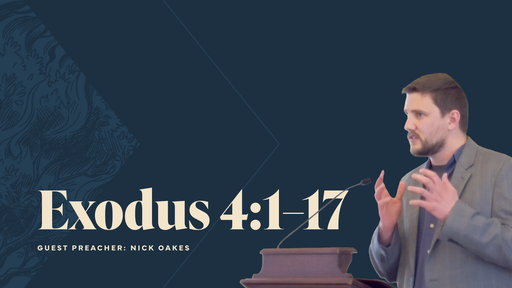
Guest Preacher: Nick Oakes
Main Passage: Exodus 4:1–17
For more information about Christ the King Reformed Church please visit our website: https://ctkreformed.com
Transcript
We're gonna be in Exodus. We're gonna be in chapter 4. We're gonna read verses 1 to 17.
Exodus chapter 4, verses 1 to 17.
Then Moses answered and said, But suppose they will not listen to me or to my voice.
Suppose they say, The Lord has not appeared to you. So they said to him, so the
Lord said to him, What is that in your hand? He said, a rod. He said, cast it on the ground.
So he cast it on the ground and it became a serpent and Moses fled from it. Then the
Lord said to Moses, reach out your hand and take it by the tail. He reached out his hand and caught it and it became a rod in his hand.
That they may believe that the Lord God of their fathers, the God of Abraham, the
God of Isaac, and the God of Jacob has appeared to you. Furthermore, the Lord said to him, put your hand into your bosom.
And he put his hand in his bosom and when he took it out, behold, his hand was leprous like snow.
He said, put your hand into your bosom again. So he put his hand into his bosom again and drew it out of his bosom and behold, it was restored like his other flesh.
Then it will be if they do not believe you nor heed the message of the first sign, that they may believe the message of the latter sign.
And it shall be if they do not believe even these two signs or listen to your voice, that you shall take water from the river and pour it on the dry land.
The water which you take from the river will become blood on the dry land. Then Moses said to the
Lord, oh, my Lord, I am not eloquent, neither before nor since you have spoken to your servant, but I am slow of speech and slow of tongue.
So the Lord said to him, who has made man's mouth or who makes the mute, the deaf, the seeing or the blind, have not
I, the Lord, now therefore go and I will be with your mouth and teach you what you shall say.
But he said, oh, my Lord, please send by the hand of whomever else you may send. So the anger of the
Lord was kindled against Moses. And he said, is not Aaron the Levite your brother? I know that he can speak well.
And look, he is coming out to meet you. When he sees you, he'll be glad in his heart. Now you shall speak to him and put the words in his mouth.
And I will be with your mouth and with his mouth and I will teach you what you shall do. So he shall be your spokesman to the people and he himself shall be as a mouth for you and you shall be to him as God.
And you shall take this rod in your hand with which you shall do the signs. Let's pray.
Holy God in heaven, we're grateful to be your people. We're thankful that you've forgiven us for our sins, that you love us and care for us, that you've assembled us together this
Lord's Day to worship you and to hear from you and to commune together. Lord, we pray that you would send your spirit, that preaching might have effect in our hearts and minds.
We pray that you would grant us love for one another and love for you. Make us an obedient people, we pray.
Here this morning and as we go into another week, we ask these things in the name of Jesus.
Amen. The story of Christianity, including the stories from the
Old Testament, the stories from the New Testament and the stories from church history, is in some ways an almost unmitigated underdog story.
Think about Gideon and the Midianite army. David and Goliath, the apostles against the
Jewish establishment, not to mention the apostles against the Roman establishment. Athanasius against the world,
Athanasius contra Mundum. Martin Luther against the corruption in the church.
I would just be to name a few. Time and time again in the story of Christianity, the odds are bad.
The need of the hour is great and the available men and resources are meager.
The empire is big and the rebel fleet is small. But the story of Christianity is not the story of the little engine who could.
It is not a story about finding inner strength to do hard things. It's not about self -realization.
It's not about self -actualization. The Bible is not a collection of Disney princess stories.
Church history is not made up of inspirational self -discovery. You can be whatever you want to be. You can be whatever you want to be. You can do anything stories.
In fact, even call the story of Christianity an underdog story is a bit misleading.
In an underdog story, there must be material and material power inequality between two parties.
You've got to have the strong man, the empire, the wealthy city. There must also be the weak man, the resistance force, the powerless citizen.
In the story of Christianity, you do have both parties, but they are not always who you think they are.
The story of Exodus feels like an underdog story. It is in some ways.
Egypt at various points in her history was an absolute juggernaut. She was almost the defining symbol of wealth, worldly success, and military power in the
Old Testament. In fact, one of Israel's great sins and struggles throughout her history was looking to Egypt for help instead of to the
Lord. This is one of the great themes of Israel's sin in the Old Testament. Ah, we're in trouble. We need help. Let's go to Egypt.
They've got lots of horses. They've got lots of chariots. And God says, no, you're going to the wrong place.
The real distribution of power, of power, however, never actually favored
Egypt in the way that people thought it did. If you can see it, if you're able to hear it,
Egypt was the lesser power. Egypt was the lesser power. It didn't look that way.
It didn't feel that way. The Hebrew people woke up every morning under a very effective yoke of bondage.
It was bricks for breakfast, bricks for lunch, and bricks for dinner. Their lives consisted of brick -making, hard labor, severe oppression, hand over your children to the state.
We're going to sacrifice them and slaughter them. The weight, the perceived weight of Egypt's power over the
Hebrew people was heavy and oppressive. It hung on the children of Israel like millstones around their necks.
No sane -minded person, according to the wisdom of the world, would look at Egypt in this story and think they better be careful here.
They're in real trouble. They're powerless. Poor Egypt, something bad's going to happen to them.
Nobody looks at a situation like this and thinks, these are the guys that need help. That's why the
Apostle Paul tells us in the New Testament that worldly wisdom, the way that you look at a situation and interpret it according to worldly wisdom, that thing has got to go.
In fact, he tells us that the logic of the fallen world must be and is turned on its head by the
Gospels. Read the Corinthian letters sometime, both of them with a highlighter, and hit all the spots that talk about fool, foolishness, folly, and on the other hand, wisdom.
There's a huge compare and contrast there that's going on in both letters. And there's a kind of wisdom that looks like wisdom to everybody else, but it's really foolishness in God's kingdom and in God's ordering of things.
And there's a kind of thing that looks like foolishness over here, but according to God, it's the greatest wisdom that ever was.
In the world's wisdom, according to the world's wisdom, Egypt had all the power.
But God has made foolish the wisdom of the world. I think we could say from a merely human perspective that the mission of the
Exodus was a foolish endeavor. Not only was the need exceedingly great, but so was the help exceedingly small.
I want you to think of Pharaoh and his armies, his horses, and his chariots as the champion of the satanic empire.
God's people stood literally against the powers of the world and of hell itself. The Egyptian empire is not sustained by itself.
Think about Pharaoh's magicians and sorcerers, and there is a satanic world empire behind Pharaoh.
So in this red corner over here of the boxing match, you've got
Pharaoh. God's champion, if you can call him that, was just a man, one man, a flawed man filled, apparently, with fears and with doubts.
We find ourselves at a point in the story of the Exodus, chapter 4, where the folly of God's salvation seems to be apparent to all of the characters in the story.
Pharaoh, no doubt, was not pleased when his daughter spared the young Moses' life against his command.
Remember, the command was that all the male Hebrew children were to be put to death, and Pharaoh's daughter finds
Moses in an ark in the river, and she spares his life, and she pays the mother to take care of him.
This is a really amazing story. But she spares his life against the direct command of her father, the king.
You can almost imagine the spoiled teenage princess telling her father, I don't care what you say, I'm keeping him, and there's nothing you can do about it.
You might further imagine Pharaoh's wife having to restrain the king's anger. It's okay, honey, let her calm down.
This is not going to be a big deal. Besides, what difference could one little Jewish boy make against all the powers of Egypt?
Pharaoh certainly didn't think very highly of God's plan. He was not only unconcerned, try me, try me, like time after time, try me,
I'm not, this God, I'm not concerned about your God, he doesn't bother me. He's not, he's not only unconcerned, he's absolutely defiant throughout the whole story.
You can have your people, God, when you grab them from my cold, dead fingers. He's not concerned about God's story,
God's plan. I think we could say that in Pharaoh's mind, this is foolishness, this is folly.
The Israelites, unfortunately, didn't seem to do a lot better through a lot of the story, at least not at first, and then not very consistently.
The Israelites, for instance, did not want to recognize Moses as their prince and ruler. The goddess begins to send
Moses to them, and they're like, who are you? We don't, we don't know you. They blame
Moses, so Moses does go, and he starts to talk to Pharaoh, and their straw is taken away. They have to make as many bricks, but now they don't have any straw, and they're not happy with their champion.
Oh, thank you, Moses, so much for getting our straw taken away. We're so pleased and thrilled that you're doing this, and we believe in the plan.
We're on board, even though it just got harder. We're totally with you. It's not how it goes. They're angry, and they blame
Moses, and then when they do finally get out of Egypt, the story of the wilderness wandering is almost completely complaining, and whining, and upsetness, and displeasure with the plan.
Both in the wilderness and at Sinai, the Israelite people treat
God's plan of the exodus like it's a foolish and contemptible thing.
What a stupid place, what a stupid desert, what a stupid plan. Why is there no water? Why is there no food?
Were there no graves in Egypt that you had to bring us out here to kill us? They at one point are missing
Egypt so much that they've got the holy God in their midst, in their presence, in a pillar of fire, and in a cloud leading them, and the thing that they want, the thing that they remember fondly, is cucumbers.
Back in Egypt, we had cucumbers. You know the fleshy, watery stuff that's bland and doesn't taste like anything without salt?
Cucumbers, we could have had cucumbers. It's ridiculous. Even Moses, at this point in the story, has some questions, if not doubts, about God's plan.
The beginning of Exodus 4 picks up in the middle of the dialogue between God and Moses at the burning bush.
This is a famous passage, and I assume that you're all mostly familiar with this. More than one commentator has pointed out that the conversation at the burning bush revolves around four objections that Moses raises to God's plan.
So even Moses hears what God is going to do, and he's got objections. God tells
Moses, this is sort of the beginning chapters 3 and 4 of Exodus, the beginning of the conversation at the burning bush.
God tells Moses that he's seen the affliction of his people in Egypt, and in verse 10 of chapter 3, God says to Moses, come,
I will send you to Pharaoh that you may bring my people, the children of Israel, out of Egypt. That's the mission.
That's the plan. That's God's calling for Moses. And then over the course of chapters 3 and 4, we get these four objections that Moses raises to God's plan.
The first one you would find in 3 .11, but Moses said to God, who am I that I should go to Pharaoh and that I should bring the children of Israel out of Egypt?
That's objection number one. Number two, you'd find in 3 .13, then Moses said to God, indeed, when
I come to the children of Israel and say to them, the God of your fathers has sent me to you, and they say to me, what is his name?
What shall I say to them? Then with our passage now, we're getting into chapter 4 .4
.1. This is the third objection. Then Moses answered and said, but suppose they will not believe me or listen to my voice.
Suppose they say the Lord has not appeared to you. The final objection is found in chapter 4 .10.
Then Moses said to the Lord, O my Lord, I am not eloquent, neither before nor since you have spoken to your servant, but I am slow of speech and slow of tongue.
Now there's a spectrum of opinion regarding Moses' attitude in this conversation.
What is Moses doing here? What is Moses feeling? What is he thinking? What's prompting him to say these things?
And what's the tone behind the objections? If you read commentators on this, there's a range of opinion.
The question is whether Moses is asking legitimate follow -up questions to God's proposal.
God tells him the plan, and Moses is saying, okay, I'm with you. I believe. This is good. How does this work?
Is he doing that? Or is he drifting into unbelief? Are these doubting questions?
This is a stupid plan. What are you talking about? We can't do this. This will never work. This will never happen. What's going on in Moses' heart here?
The consensus view is generally to view Moses' objections in a favorable light.
So there's a handful of reasons for that. Most of them are sort of internal inside of the story. God calls
Moses over to the burning bush. He tells him to take his sandals off his feet. Moses comes.
Moses obeys. Moses is listening to God. Moses has a track record of being somebody that's a
Christian, a faithful person. So there's lots of like internal reasons why somebody would read this and say, okay, let's also the responses.
Most of the responses, they change a little bit towards the end of our passage. Most of the responses from God are favorable responses.
The last interaction, God finally becomes angry with Moses. But most of the interaction, he's not upset with Moses.
And so for all of those reasons, generally people think, okay, Moses is asking, for the most part, legitimate follow -up questions.
But there's also an acknowledgment that as things progress, as they move from question to question to question, there's something, also something else going on.
Some kind of doubt, some kind of weak faith, some kind of fearfulness, maybe even,
I think, probably even some kind of sinful doubt as it progresses from question to question to question.
Look at verse one again with me. This is the third objection. Then Moses answered and said, but suppose they will not believe me or listen to my voice.
Suppose they say, the Lord has not appeared to you. Some interpreters, myself included, see the hypothetical scenario that Moses suggests as a warning sign that he's begun a progression along the line from questioning to questionable, from inquiry to inquisition.
In the first two objections, Moses asks, who am I to go and who is it that has sent me, respectively.
Now, Moses begins to ask what -if questions. He begins to ask what -if questions.
Suppose they don't believe me. Suppose they say, the Lord has not appeared to you. Now, we know this is dangerous territory because in chapter three, the
Lord, having told Moses what to say to the people, assures Moses that, quote, then they will heed your voice.
So for Moses to say, suppose they don't, seems like there's sort of a clear questioning.
God says something really clear in chapter three. I'm going to, you go, I'm going to send you, they're going to hear, they're going to heed your voice.
And Moses says, suppose they don't. Suppose they don't heed my voice. Suppose they don't believe that you've sent me.
It seems like there's the beginning of some kind of drift here towards doubt.
God, however, answers Moses graciously, answers him graciously.
And I think this is something that we see all over the Bible. Sometimes it's real sin, and it's real clear.
I think sometimes it's doubt. An interesting example is somebody like Gideon and the fleece.
There's kind of a famous passage there. And by the time Gideon lays out the fleece over and over and over again, and you're watching from the bird's eye view of being able to read the story, you're better stop doing that.
You're going to get in trouble. Don't keep doing this. God is gracious with him. And even here with Moses, as the questions multiply and as time goes on,
God is really patient and gracious with Moses. So this is the
Lord's reply to Moses' third objection. So the
Lord said to him, what is that in your hand? He said, a rod. He said, cast it on the ground.
So he cast it on the ground, and it became a serpent. Moses fled from it. Then the Lord said to Moses, reach out your hand and take it by the tail.
And he reached out his hand and caught it, and it became a rod in his hand. That they may believe that the
Lord God of their fathers, the God of Abraham, the God of Isaac, and the God of Jacob has appeared to you.
Furthermore, the Lord said to him, now put your hand in your bosom. And he put his hand in his bosom. And when he took it up, behold, it was leprous, like snow.
And he said, put your hand in your bosom again. So he put his hand in his bosom again and drew it out. Behold, it was restored like his other flesh.
Then it will be, if they do not believe you, nor heed the message of the first sign, that they may believe the message of the latter sign.
And it shall be, if they do not believe even these two signs, or listen to your voice, that you shall take water from the river and pour it on the dry land.
And the water which you take from the river will become blood on the dry land. God answers
Moses' objection here by giving him three signs to perform before the people.
These signs would authenticate Moses' ministry and authority. They would prove that he had been sent by God.
God had told Moses in one of the earlier objections, he says, what do I say to them who sent me? He says, tell them
I Am has sent you. And then God here gives Moses these signs, miraculous signs, to prove that he had been sent by God himself, by the self -existent maker of the universe.
Verse 10. Then Moses said to the Lord, O my Lord, I am not eloquent, neither before nor since you have spoken to your servant, but I am slow of speech and slow of tongue.
This is Moses' fourth objection, and once again it's hard to say exactly what's going through Moses' mind.
It's hard to say exactly what it's in his heart. But to me, as I read this, it does begin to feel like an excuse.
We don't know. We don't know if Moses really did struggle with public speaking.
That's kind of what he's saying here, right? Like, I can't do it. Don't you know I'm not very good at this kind of thing?
We don't have records of his sermons. Well, we do actually have some records of his sermons, but we don't know sort of how his delivery was.
What we do know, what we do have recorded for us, is Stephen's sermon in Acts 7. Stephen is recounting sort of the story of Israel in Acts 7, and he says that Moses was a man mighty in word and deed.
Moses was a man mighty in word and deed. So it leaves us with a little bit of a question.
Is this genuine humility? I can't do it. I need help. Or is there a kind of abdicating humility?
I can't do it because I'm afraid to, and I don't want to. I think, this is my personal opinion,
I think Moses is again progressing towards a little bit of doubt. Verse 11,
So the Lord said to him, Who has made man's mouth? Or who makes the mute, the deaf, the seeing, or the blind?
Have not I the Lord? Now therefore go, and I'll be with your mouth, and I will teach you what you shall say.
Some of you probably wrestle when you read Old Testament narrative.
The stories are of course exciting and interesting, but the struggle I imagine comes with application.
How do I fit in this story? What does this mean to me? How do we as a covenant community read this and extract meaning for our lives?
I think that could be a hard thing, maybe uniquely in the Old Covenant. It feels so far away, and the names and the characters are so strange, and the things that are happening are so strange.
How do we read it and apply it? One temptation is to read these passages and look only for moral imperatives, kind of moralist reading of the
Old Testament. Someone might suggest that the application of this passage is that we should obey God, because Moses obeyed
God by taking off his sandals when God told him to, and that's the that's the whole meaning of the story.
You should, if God tells you to take off your sandals, you should do it. That would be a real simplistic application and unhelpful kind of, let's look for isolated moral truths, and if you do that, you'll get into trouble.
You'll end up with weird rules about stuff. We don't, oh, our church doesn't do sandals because the Moses passage, and this is holy ground, don't you know?
You decide if that would be the kind of the right way to go on this. Another temptation, I think, is to prematurely insert ourselves into the story in the place of the hero or the protagonist.
There are times when identifying ourselves with characters in the story is appropriate and helpful. I don't want to, don't hear me saying you should never associate yourself with the character in the story, or that you shouldn't see their struggle and think that yours is like that, or that you shouldn't see
God's answer to the struggle and think God will be with me, God will help me, God will meet my need.
All those kinds of things are, you should do that when you read the Old Testament, but there's also a danger there of too quickly or in the wrong place putting ourselves into the story and making it all about us.
I think the danger here is because that would fail to take into account
Moses' unique calling. Moses is somebody that is special.
God is determined to lead his people out of Egypt by a man, but it really isn't just any man, it's this man, it's
Moses. It's not me, it's not Derek, it's not anybody else, it's Moses, and there's a reason for that.
The language that's here about Moses' mouth, I will go with you and I will give you words,
I'll be with your mouth, I don't want us to read that and just think God is promising to enable everybody to do whatever they want to do, you know, with their mouths.
There's something specific going on here. God is dealing with Moses, calling him to be a prophet.
Moses has a unique office and calling, so I'm going to read a couple of other passages from the Old Testament.
Hopefully this will just just help show you that, oh, when God is commissioning a prophet, this is the kind of language that goes with that, and so there's a unique office being shown here.
This is Jeremiah 1, 6 -9. Then said I, O Lord God, behold,
I cannot speak for I'm a youth. But the Lord said to me, do not say I'm a youth, for you shall go to all whom
I send you, and whoever I command you, you shall speak. Not be afraid of their faces, for I'm with you to deliver you, says the
Lord. Then the Lord put his hand and touched my mouth and said to me, behold, I have put my words in your mouth.
Or Numbers 22 -38. And Balaam said to Balak, look, I have come to you.
Do I have any power to say anything? The word that God puts in my mouth, that I must speak.
Or Deuteronomy 18 -18. This is actually the Lord speaking to Moses, telling him that in the future there would be another prophet like him.
You should look forward to this. You should expect that someday in the like you.
He says, and I will raise up for them a prophet like you from among their brethren, and will put my words in his mouth, and he shall speak to them all that I command him.
It matters as we interpret and apply this passage that Moses is special. He held a unique office.
I think we ought to expect God to enable us to fulfill our own callings. But I think the meaning of this passage as a whole depends on the fact that Moses is being called to do something extraordinary.
It matters because the role that Moses plays as savior of the people was not a role that just anybody could play.
And it is a role that would be played again. The danger of inserting ourselves prematurely into this story is to take the exodus story and make it all about us.
And the exodus story is already all about somebody else. About this other prophet that would come.
The tracks that Moses lays down are tracks that Jesus will come and follow very closely.
The overlap of the exodus story and the overlap of the Christian salvation from sin story are the same story.
Verse 13. But he, Moses, said, O my
Lord, please send by the hand of whomever else you may Now he's done it.
First, he raises objections. And most of them are pretty legitimate. Some of them are a little bit iffy. But now he suggests that God send somebody else.
And in my view, this statement from Moses does color the previous objections. We've all seen a young child complain about his food, right?
I don't want to eat this. It's too hot. I don't want to eat this. It's too spicy. 20 minutes later,
I don't want to eat this. It's too cold. And then at the end of the meal, he hasn't touched it at all. You find out that he wants a cookie or ice cream or something else.
And so the thing that we discover at the end of all this, I think, colors the earlier objections.
Moses, again, I'm trying to be fair to him. He may be operating here out of a kind of humility. And the commentators do try.
They're pretty fair to Moses. They're pretty kind to Moses. It might be a kind of sober self -assessment that's driving him.
It might be real humility. I'm not up to this. I can't do this. Don't you know what you're asking me to do? To go in front of Pharaoh?
To go in front of the whole people? To lead them out? This is a big job. This is a big deal. If that's what
Moses is doing, even if that's all he's doing is a kind of self -humility thing, that just means that he's placing his hope of result in the wrong place.
He's expecting results from the wrong place, from himself and not from God. No doubt, the undertaking of the exodus is colossal.
The odds are, from a worldly point of view, absolutely stacked against him. It's audacious.
It's unthinkable for a man, but not for God. Last verses.
So the anger of the Lord was kindled against Moses, and he said, He's not erring to leave out your brother.
I know that he can speak well, and look, he's also coming out to meet you. When he sees you, he'll be glad in his heart. Now when you shall speak to him and put the words in his mouth, and I will be with your mouth and with his mouth, and I will teach you what you shall do.
So the Lord shall be your spokesman. So he shall be your spokesman to the people, and he himself shall be a mouth for you, and you shall be to him as God.
And you shall take this rod in your hand with which you shall do the signs. Now, God answered
Moses' first objection by promising to be with him. He answered the second objection with the assurance that Moses was being sent by I Am.
The third objection was answered by the gift of miraculous signs for Moses to perform before the people.
The fourth objection was answered with a promise that God would give Moses words to speak to the people.
And then finally, Moses suggests that God send somebody else, and God answers that by commissioning
Aaron, his brother, to go with him. God is gracious to Moses the whole time, but God is not only gracious to Moses, he's also really committed to Moses.
And I think that begs a question. Why? Why is God so committed to each of these objections?
Why is he so committed to sending Moses? Why a man?
Why this man? God didn't need Moses' mouth in order to speak.
God can speak. In fact, human mouths are the analogy, and the true reality is
God's speech. God's speech pre -exists human mouths. God's speech,
God speaks, and human mouths come into existence. The human is the lesser thing.
God doesn't need Moses' mouth. God speaks, and mouths come out of nowhere. He doesn't need
Moses' mouth. Why is he so committed to sending this man that is not necessary in some ways?
God could have spoken to Pharaoh with a voice from heaven. That happens. He could have sent an angel to appear to Pharaoh.
That happens. Those are true means that God uses in other places. He could have made a great hand appear and write his message on the wall of Pharaoh's dining hall.
That happens. God could have sent angelic chariots to rescue all the people out of Egypt and bring them safely away.
He could have done anything that he wanted to do. He didn't. He didn't. God saw the children of Israel groaning under the weight of slavery.
He heard their cry. He considered the powers of Egypt, and he sent one man,
Moses. According to worldly wisdom, this is the single most foolish plan ever hatched, other than the redemption of humanity through the death of Jesus on a
Roman cross. The question which hovered over the life of Moses would be asked again 1 ,500 years later, what difference can one little
Jewish boy possibly make against all the powers of sin, death, and hell?
The answer is that what is impossible with man is possible with God.
Moses then was a typological necessity. He was a baby Jewish boy who foreshadowed the baby
Jewish boy. He was a prophet who foreshadowed the prophet. He was a prince and ruler of God's people who foreshadowed the true prince and ruler of God's people,
Jesus Christ. The triumph of the exodus through the weakness of Moses, you see, perfectly foreshadowed
God's triumph over sin through the cross of Jesus. The power of God is manifest in weakness.
That's true even in Jesus. In fact, the principle is most true in Jesus.
Jesus is the very God wrapped in all the weakness of humanity, yet without sin.
God, you see, has chosen the foolish things of the world to put to shame the wise, and God has chosen the weak things of the world to put to shame the things which are mighty.
If you read the rest of the book of Exodus, you'll find the supposedly mighty Egypt completely flattened.
Every piece of ground burned to the ground, all the armies dead, Pharaoh toppled, the whole thing is completely flattened.
Likewise, the death, burial, and resurrection of Jesus has completely destroyed the powers of sin, death,
Satan, and hell. To those who are perishing, Paul says, the cross of Jesus is foolishness.
For those who are perishing, the story of the exodus, the story of the cross, is foolishness.
But to you, to those who are being saved, it is the very power of God.
I'll close with just a point of application here. One point, and I'll break it apart a little bit.
Don't listen to worldly wisdom. Don't listen to worldly wisdom.
It's rubbish. Don't listen to worldly wisdom about abortion. We have a country filled with colleges, hospitals, doctors, and experts of every kind who will tell you that a baby isn't a baby.
They will tell you that a person isn't a person. Don't let your unbelieving friends, family, and co -workers gaslight you into thinking you're the one who's foolish, but you're the one who's crazy.
To the unbelieving world, God's words about abortion are foolishness, but to us they are truth and life.
Don't listen to worldly wisdom about human sexuality. We are creatures, male and female, made in the image of God.
You might find yourself in a situation where you're the only person in a room full of people who is willing to say that a boy can't be a girl, or that a girl can't be a boy.
It will feel like you're the fool and they're the wise man. Inevitably, if you're in a room with a hundred people and you're the only person who's willing to say a boy is a boy, you're going to feel out of place and like, don't listen to it.
It's crazy. You're not crazy. God says you're not crazy. You're not foolish. God says you're not foolish. Listen to what
God says. Even though you're all going to be in situations where it feels overwhelmingly like everybody's against you and you're a moron for believing that babies are babies and boys are boys.
Lastly, don't ever be ashamed of the resurrection of Jesus. He was mocked and derided on the way to the cross, and for 2 ,000 years since, the unbelieving world has continued to spit and grind their teeth at him.
And yet, for 2 ,000 years, the resurrection of Jesus has turned the world upside down.
It has saved all of us. It has saved countless men, families, nations out of sin and hell.
It has been vastly effective and powerful. It's toppled empires.
It has created life and flourishing all over the world. The things that we love about the western world and about America, the things that are still standing mostly, are things that were built by the resurrection of Jesus and by the gospel of changing people.
For us, the cross and the resurrection are the very power of God. In the name of the