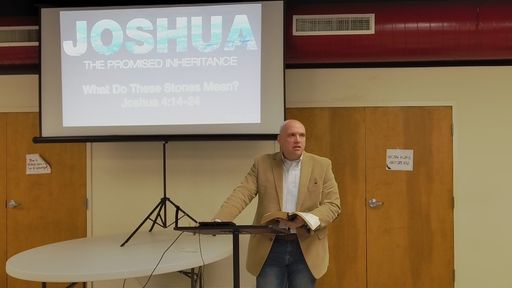
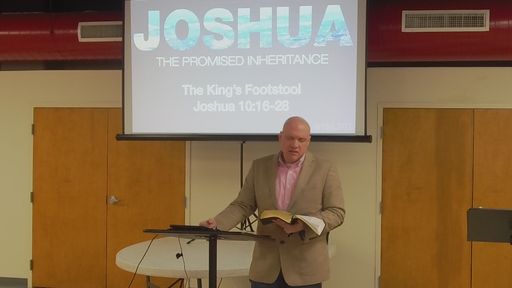
Covenant Renewal at Mount Ebal - Joshua 8:30-35
Covenant Renewal at Mount Ebal
Joshua 8:30-35
Sermon by Reed Kerr
Hill City Reformed Baptist Church
Lynchburg, Virginia
Transcript
Well good morning beloved. We are continuing this morning in the book of Joshua.
We find ourselves this morning in God's good providence at the end of chapter 8.
We'll be looking this morning at the last five verses of Joshua, chapter 8 verses 30 through 35.
Just to remind you of the context, God has just given Joshua and the nation of Israel a great victory over Ai, but it did not come without difficulty.
Because their first encounter with Ai was a failure. There was sin in the camp and this sin separated the nation of Israel from the blessing and favor of God.
Only after Achan's sin was dealt with were the people able to enjoy victory over their adversary.
This concept provides the foundation and the context really for what we see in our text today.
We will see this morning in Joshua chapter 8 this demonstration of the gospel.
That our standing before God is not on the basis of what we have done, for we do not deserve his favor.
But atonement has been made for those who are in Christ. So I'm going to read now
Joshua chapter 8 verses 30 through 35. Let us hear the word of the
Lord. Now Joshua built an altar to the
Lord God of Israel in Mount Ebal, as Moses the servant of the
Lord had commanded the children of Israel. As it is written in the book of the law of Moses, an altar of whole stones over which no man has wielded an iron tool.
And they offered on it burnt offerings to the Lord and sacrificed peace offerings.
And there in the presence of the children of Israel he wrote on the stones a copy of the law of Moses which he had written.
And all Israel with their elders and officers and judges stood on either side of the ark before the priests, the
Levites, who bore the ark of the covenant of the Lord. The stranger as well as he who was born among them, half of them were in front of Mount Gerizim and half of them in front of Mount Ebal.
As Moses the servant of the Lord had commanded that they should bless the people of Israel.
And afterward he read all the words of the law, the blessings and the cursings, according to all that is written in the book of the law.
There was not a word of all that Moses had commanded which Joshua did not read before the assembly of Israel.
With the women, the little ones, and the strangers who were living among them.
Our Father in heaven, we thank you for revealing yourself to us in Scripture.
We thank you, Father, that as the law before us revealed to us condemns us in our sin, we have in Christ direct access to the blessings of your pleasure.
I pray, Father, that you would help us this morning as we consider this text and this reminder and this covenant renewal that we see here in the book of Joshua.
We would see our own need of Christ. Would you help us this morning to behold his glory, the glory of the gospel, and delight in it this morning.
Amen. To remind you of the broader context here, we need to remember that Joshua at this point has not been long in this office that he has been appointed to.
This office of what what he calls here multiple times in the book of Joshua, the servant of the
Lord. Chapter one made it very clear that Joshua was the appointed servant of the Lord following the death of Moses.
And this is reaffirmed here in our passage this morning. On a broad level, this is the conclusion.
Here we see in chapter 8 the conclusion of the first conquest section of the book of Joshua.
This conquest section started with chapter 5, if you recall, where they they had crossed over the
Jordan and there they observed the Passover and this second generation of Israelites was circumcised.
And then after that they had a victory over Jericho. They had the defeat at Ai and then they had victory over Ai.
And then here we have this concluding passage here that is the renewal of the covenant.
This text mirrors what we saw in chapter 5 with that that covenant renewal of circumcision and the
Passover. And so this this three chapter stretch of conquest here is outlined as covenant signs, victory, defeat, victory, and then covenant renewal.
This is instructive for us. The abrupt transition from the king of Ai, as we saw last week, being utterly defeated and hung from a tree which is a sign of curse and then thrown down in verse 29, this shows a clear sign of the curse of God.
He, like all the kingdoms of mankind that stand opposed to God, will face divine judgment.
Rightly, we sang this morning, he rules the world with truth and grace and makes the nations prove the glories of his righteousness and wonders of his love.
He is the king of kings and the Lord of lords. His rule is absolute.
Those who oppose his reign will fall on the appointed day.
This is one of the themes of the book of Joshua. The nations of Canaan are a firstfruits of the harvest of the nations of judgment of sorts because they will all fall as Christ's kingdom will stand forever and the gates of hell shall not prevail.
There's also a lesson for us here in the fact that the text jumps seemingly suddenly from the victory to this covenantal ceremony.
Matthew Henry had a helpful comment here. He said, as soon as Joshua got to the mountains of Ebal and Gerizim, without delay and without caring for the unsettled state of Israel or their enemies, he confirmed the covenant of the
Lord with his people. Joshua's priorities are clear and he's rightly leading his people in accordance.
The lesson displayed by God with their defeat when Israel presumed upon their success and fought against AI without God's blessing has been heeded by Joshua.
He wants Israel to remember that their victory comes only through their reliance on God and not of their own strength.
Victory comes only through reliance on God, not through our own strength. This is a lesson that we must heed as well.
Any victory you experience in life, whether material or spiritual, comes from the hand of the sovereign
God of the universe who made all things. We are right to remember him in all of it.
Another commentator put it this way, covenant obedience has priority over military victory.
Heeding God's Word is more crucial than fighting God's war. By placing this covenant renewal ceremony here, the writer is saying that Israel's success does not primarily consist in destroying
Canaanites, but in everyone's total submission to the Word of God.
It's as if he is saying, stop the war and listen to the law of God. This is the most urgent matter right now.
All of this is true and it should be plain on a surface reading of the passage, but if we read this carefully,
I believe there's more going on here that we would do well to consider. As Joshua here is alluding to something that Moses had commanded that they would do at this time after they came into the land.
We need to recognize that this isn't just an arbitrary or coincidental reminder. Joshua didn't just happen to say, okay well, we've had a defeat, we've had a victory, let's make sure everybody's on the same page.
There's purpose here, there's a deliberate intentionality here. And this is helpful for us as well, especially now at the end of a year.
We have to keep in picture, they've completed this period of conquest and there's much ahead of them yet to be done.
And they have learned through this conquest of their need of God's blessing.
Beloved, we also, as we are here standing at the end of the year of 2025, we need to remember the promise of God.
We need to remember that he is the means by which we have standing.
We are utterly dependent on him, not on our own efforts.
So we need to gather some context here to really grasp this.
First of all, as we already saw, there's a clear link between what Joshua does here and what has preceded.
Israel has just experienced God's anger in chapter 7 and the help of God's favor in chapter 8.
And now we have, as it says in verse 34, Joshua reading the blessings and cursings of the law of Moses.
This highlights the significance both of this covenant renewal as well as the true meaning and purpose of what just happened with AI.
To get the full grasp of this, we're going to have to understand some more context. First of all, I want to take note of the location and its significance.
The text tells us that Joshua built an altar on Mount Ebal. Some commentators think that the name here,
Ebal, comes from the word for barren or bald. This mountain, some commentators say that at this time it was a harsh and barren mountain.
And then on the other side, Mount Gerizim was a more fertile, grassy, green mountain. And this valley in between them is called
Shechem. Shechem. This place is significant first all the way back in the book of Genesis.
God had just described the Tower of Babel incident. And then we see there after the
Tower of Babel, there's a giving of the genealogy of Shechem's descendants. And then it comes to Abram.
It tells us of Terah, Abram's father, and then Abram. And the whole flow of the book of Genesis shifts at this point as the focus for the rest of the book will be on Abram and his descendants.
I want to read a section here of Genesis 12 for us because of the significance of this location.
Genesis 12 starting in verse 1. Now the Lord had said to Abram, get out of your country from your family and from your father's house to a land that I will show you.
I will make you a great nation. I will bless you and make your name great and you shall be a blessing.
I will bless those who bless you and I will curse him who curses you and in you all the families of the earth shall be blessed.
So Abram departed as the Lord had spoken to him and Lot went with him. And Abram was 75 years old when he departed from Haran.
And Abram took Sarai his wife and Lot his brother's son and all their possessions that they had gathered and the people whom they had acquired in Haran and departed to go to the land of Canaan.
So they came to the land of Canaan. Abram passed through the land to the place of Sechem as far as the terebinth tree of Morah.
And the Canaanites were in the land. Then the Lord appeared to Abram and said to your descendants I will give this land.
And there he built an altar to the Lord who appeared to him. And he moved from there to the mountain east of Bethel and pitched his tent with Bethel on the west and Ai on the east.
There he built an altar to the Lord and called on the name of the Lord. So Abram journeyed going on still toward the south.
This is a significant location. This is where God first told Abram that he would give his descendants this land.
And this is where Abram first built an altar to the Lord. Presumably for the first time in his life.
All accounts we have Abram up to this point was a pagan just like the others of his land. God called him out, called him here, told him that he would be his
God, and Abram built an altar to the one true God here at Sechem.
Next this place is significant in the life of Abram's grandson Jacob. We have
Abram, Abraham, Isaac, and then Jacob. He is in the text we're looking at next about to be renamed
Israel. We need to look at Genesis 33. After fleeing because of his deceitfulness and treachery against his father and his brother, there's this pivotal scene in the life of Jacob where God himself in his pre -incarnate form as the angel of the
Lord wrestles with Jacob. And Jacob strives with God unwilling to, unable to overcome him of course, but unwilling to surrender knowing that he needs the
Lord's blessing more than anything else. The Lord changes his name to Israel and blesses him and then immediately
Jacob and his brother meet again. And Jacob fears his brother's wrath and rightfully so.
But his brother Esau does not seek vengeance but rather peace. Jacob then crosses the
Jordan into Canaan and immediately comes to Sechem where he builds an altar like his grandfather
Abraham had. And in verse 18 of chapter 33 he says, Then Jacob came safely to the city of Sechem according which is in the land of Canaan when he came from Padan -Aram and he pitched his tent before the city and he brought the parcel, he bought the parcel of land where he had pitched his tent from the children of Hamor, Sechem's father, for 100 pieces of money.
And he then he erected an altar there and called it El Elohe Israel. Lest you mistake this as a sign of Jacob's virtue and merit as one worthy of this position of honor and favor with the
Lord. Sadly it's here that we then find in the very next chapter the incident between Jacob and Sechem, the man who this land is later named after.
Sechem forcefully takes and violates Jacob's daughter Dinah. The chapter here at Sechem reminds us of Jacob's sinful nature, how poorly he handles this situation.
It's a sad commentary on his spiritual leadership and his actions here are not admirable.
Yet nevertheless God remembers his covenant promises. And ultimately it is here that Jacob's son
Joseph is later laid to rest. He dies in Egypt of course and at his death he asks that his bones be carried back and we know from the rest of Scripture that he is buried here in Sechem.
So we see here that this place is significant to the covenant promises of God.
But over and over again in multiple ways it's made explicitly clear that it's not man's faithfulness that God blesses because if it were dependent upon your own merit none would be worthy.
None would have standing before God. These promises are enacted on the work of another.
And that's what we see here in chapter 8. This finally gets to the heart of what is really going on here.
What is the purpose of this ceremony that Moses commanded Israel to do when they came into the land?
What happens here is a picture of the gospel. That the
Lord Jesus Christ did what we could not in order that God would bring peace on earth, goodwill toward men.
For without Christ's sacrifice there can be no peace with God. Without Christ's death we face only the cursings of the law but by his obedience and suffering we enter into his eternal favor, the blessing of peace with God.
And so what Joshua does here is what
Moses commands in the book of Deuteronomy. Twice in our text in Joshua 8
Joshua makes it very clear that he is doing what Moses had previously commanded.
And so we need to see these commands given in the book of Deuteronomy. Deuteronomy was as we've talked about before the second giving of the law which
Moses delivered to the nation of Israel at the end of his life just before they were able to enter into the land just before Joshua would take over as the servant of the
Lord for the people leading them into Canaan. And the first reference to what happens here in Sechem is in Deuteronomy chapter 11 verse 29.
We must understand this context for Joshua 8 to make sense. Moses has been laying out for the people here in Deuteronomy 11 the law of God and what he requires of them.
Moses has laid out the great blessing for those who keep the law and the great curses for the one who transgresses the law.
And he alludes to a ceremony here in the land that he'll describe more later in detail.
But I'm going to read from verse 26 here of Deuteronomy 11. Behold I set before you today a blessing and a curse.
The blessing if you obey the commandments of the Lord your God which I command you today and the curse if you do not obey the commandments of the
Lord your God. But turn aside from the way which I command you today to go after other gods which you have not known.
Now it shall be when the Lord your God has brought you into the land which you go to possess that you shall put the blessing on Mount Gerizim and the curse on Mount Ebal.
Are they not on the other side of the Jordan toward the setting sun in the land of the Canaanites who dwell in the plain opposite Gilgal beside the terebinth trees of Morah?
All of this is significant to their history. For you will cross over the Jordan and go in to possess the land which you the
Lord your God is giving you and you will possess it and dwell in it. So this here is from Moses to the people in his day is a message of promise that God will give you that land that land that is populated by these these mighty great terrible people that they feared rightly.
But Moses says you will go there and when you are there you will remember the law and the blessings and cursings of the law.
And then in Deuteronomy 27 this is where Moses gives the the detailed instructions of what
Joshua is to do when he comes into the land. I invite you to turn there I'm gonna read a section of this because this is this is this is the essential context to understand what's happening in Joshua 8.
Deuteronomy 27. Now Moses with the elders of Israel commanded the people saying keep all the commandments which
I command you today and it shall be on the day when you cross over the Jordan to the land which the
Lord your God is giving you that you shall set up for yourselves large stones and whitewash them with lime.
You shall write on them all the words of the law when you have crossed over that you may enter the land which the
Lord your God is giving you. A land flowing with milk and honey just as the
Lord God of your fathers promised you. Therefore it shall be when you have crossed over the
Jordan that on Mount Ebal you shall set up these stones which I command you today and you shall write and you shall whitewash them with lime and there you shall build an altar to the
Lord your God an altar of stones. You shall not use an iron tool on them. You shall build with whole stones the altar of the
Lord your God and offer burnt offerings on it to the Lord your God. You shall offer peace offerings.
You shall eat there and rejoice before the Lord your God and you shall write very plainly on the stones all the words of this law.
Now I'm going to skip down to verse verse 11. And Moses commanded the people on the same day saying these shall stand on Mount Gerizim to bless the to bless the people when you have crossed over the
Jordan. Simon, Levi, Judah, Issachar, Joseph, and Benjamin and these shall stand on Mount Ebal to curse
Reuben Gad, Asher, Zebulun, Dan, and Naphtali. And the Levites shall speak with a loud voice and say to all the men of Israel cursed is the one who makes a carved or molden image an abomination to the
Lord the work of the hands of the craftsmen and sets it up in secret. And all the people shall answer and say amen.
And then he goes down this long list of requirements of the law and the curses that they bring if the people transgress
God's law. And after each one the people say amen and amen. This then in chapter 28 he prescribes the blessings on obedience.
If you diligently obey the voice of the Lord your God to observe carefully all his commandments which I command you today that the
Lord your God will set you on high above all the nations of the earth and all the blessings shall come upon you and overtake you because you obey the voice of the
Lord your God. Blessed you shall be in the city and blessed you shall be in the country. Blessed shall be the fruit of your body.
He goes on and lists the blessings that stand for those who are in God's favor.
This is the essence of the law. The whole law stands as this
Great Testament to do this and live. It essentially it's what we see in the garden but on a larger scale.
For God made a people and he revealed himself to them in the garden. Just like he called
Abram out and revealed himself to Abram here at Sechem. God entered into a covenant with Adam but the relationship is conditioned by obedience.
By regulations. Adam may eat from any tree of the garden and be protected and preserved and provided for but for the tree in the middle of the garden.
That tree turns all these blessings into a curse. That tree brings death.
That tree brings the curse. And what happens? Adam fails. He falls and he falls under the curse of God.
Similarly in the rest of the Old Testament we see that this good law that God gave to his people through Moses as long as they obey they'll experience these great blessings of promise and provision and protection but if they do not keep his law all the blessings become curses.
God goes out of his way to make sure that all the people know and understand this. And here we even see them accepting the terms of this covenant by repeatedly saying amen amen amen after each.
I don't see how we can understand this any other way than this is a covenant of works. This relationship and the benefits that it offers are conditioned and predicated upon obedience.
And it's not just the leaders of the nation that are here. It's all the people. Joshua goes out of his way to emphasize this five times in our five verses that we read this morning.
Five times he uses the word all. Stressing that it's all the law that is given to all the people.
Even the women and children and the strangers in the land. This reminds us that this reality affects everyone born of Adam.
You don't get a pass based on your family of origin. The women are not exempt on account of their husbands.
The children are not exempt on account of their parents. You don't get a pass if you're in children's church.
This is one of the reasons one of the several passages we look to in Scripture that I think give us good justification for saying ordinarily children ought to be here in church with their parents.
Joshua wants all the people to hear this. All of them.
It's interesting. Even the strangers who are living among them are included. This means the law touches every man, woman, and child alive.
No one gets a free pass. No one is exempt from the demands of the law. And just like we saw that Adam failed in the garden, we know the story of the
Old Testament. This people, the descendants of Abraham, Isaac, and Jacob, they stumble, they falter, and they fail every step of the way.
An act of obedience is immediately followed by a great trespass. A good judge is immediately followed by a period of apostasy.
A righteous king is immediately followed by a wicked one. A return to God is immediately followed by a fall into idolatry.
Let us be reminded of Psalm 103. The Lord is merciful and gracious, slow to anger and abounding in mercy.
He will not always strive with us, nor will he keep his anger forever.
Israel's idolatry ultimately climaxes in them losing the land, as possession of it was always conditional upon obedience.
And we are no better. All have sinned and fallen short of the glory of God. What then are we to do?
What is the message here for Joshua, for his people, and the message here in our text for us?
Beloved, listen carefully. The remedy is seen on Mount Ebal. Not on the mountain where the blessings were recounted, but the mountain of the cursings.
For there an altar is made. Not an ornate altar, intricately detailed with human craftsmanship.
Rather, this altar must not bear the marks of human effort. No tool may be used on these stones.
There on that altar they offered burnt offerings to the Lord, a picture of the atonement for sin.
For in the Old Testament, burnt offerings are always a picture of atonement. The whole sacrifice is burned and consumed with fire.
And there they also offered peace offerings, which mirror the blessing of communion and peace with God.
Peace offerings were a celebration. The priest and the one offering the offering would share in this food together, and with thankfulness to God for the peace that they have because of the atonement that has been made.
So there on that altar we see atonement, a picture of atonement, and a picture of communion and peace with God.
Please see the significance of this. There is a debt that is demanded.
God knew. Moses knew. Joshua knew. No one measures up to the law of God.
None of us. These blessings that we can experience through obedience may be held in a limited, temporary sense, but ultimately we all fall short.
But praise be to God, for a sacrifice has been made, not by human effort or skill, not because we are worthy, not by our own crafting, for no tool touched this offering.
This speaks of the sacrifice of the Lord Jesus Christ, who was obedient, utterly obedient, even unto death.
He himself is the burnt offering to the Lord that stands atop the mountain of God's cursings.
He is the sacrifice that brings peace. Ebal has been satisfied for all who are in Christ Jesus by faith, and the blessings of Gerizim have been secured, not because God doesn't care about our sin, but because it has been dealt with by Christ on the cross.
Christ satisfied the righteous demands of the law. This is why
Paul says in 2nd Corinthians 5, be reconciled to God, for he made him who knew no sin to become sin for us, that we might become the righteousness of God in him.
This is the gospel of the Lord Jesus Christ, and it's the only gospel that saves, because it alone deals with our sin and a righteous, holy
God who made atonement for us. How then should we live?
We must be a people committed to the word of God. These are the words of life.
Just as Joshua had all the people sit under the reading of the word, so we must submit ourselves to the reading, to the hearing, to the teaching of God's holy word.
And not only that, beloved, we must be doers of the word. Not because we can earn those blessings by doing, for the gospel is not do this and live as we saw in the law.
The gospel is what he has done to make us his own, to make us righteous in his sight, that we might have abundant life, that we might have life with him, that we might dwell in the house of the
Lord forever. This must cause us and free us to lay down our lives in love and devotion and obedience to him.
And so in conclusion, as you look ahead to the new year, commit yourself now to be a student of the word in the coming year.
Commit yourself now to strive to live in obedience to his word. Commit yourself now to trust not in your own efforts and merits, but in the righteousness of Christ alone.
Let us pray. Father in heaven, we thank you.
We thank you that you are holy and righteous and just, that you are perfect in all of your attributes, that you sit enthroned on high, the king of all, the ancient of days.
And we tremble before your holiness, your righteousness, because we are sinners.
But praise be to Christ who offered his own life, that we might be made clean, that we might be robed in his righteousness.
Would you help us to be and do what you have called us to be and do.
May we be faithful to your word. May we cling to Christ as our only plea, that you might receive the glory and honor and praise that you alone are worthy of.
Help us this day and this year ahead to follow