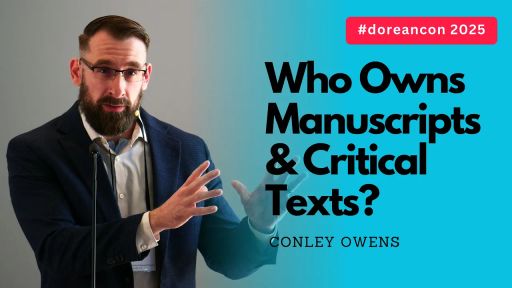
Who Owns Manuscripts & Critical Texts? - Talk 2
This message by Conley Owens was presented at #doreancon 2025 on "The Stewardship of Scripture" at Silicon Valley Reformed Baptist Church in Sunnyvale, CA.
Read the article: https://sellingjesus.org/articles/manuscripts
SIGN THE STATEMENT on the stewardship of Scripture at: https://copy.church/statement/
LEARN MORE
https://sellingjesus.org
https://copy.church
https://thedoreanprinciple.org
Transcript
And I'll let you know for this next message, which is on who owns the manuscripts and critical texts, this may be the driest, most detail -oriented of all the messages that you'll hear this entire conference.
But what I'm really counting on is for that prenatal acetaminophen ingestion to kick in so that you all are on the edge of your seat, just eager to hear all the details.
All right. So who owns the Bible? Who owns the Bible? When I ask that question,
I'm not talking about the English translations you use. I'm talking about the Hebrew text and the Greek text.
And this can be thought of in several different ways. Last night, you heard the word used, the autographs.
Those refer to the actual manuscripts that the apostles and prophets wrote. Then from that are autographs.
Those are manuscripts that are copied from those documents or copied from other autographs.
And then after that, there are digitizations. So that's where you have a computer file that is a picture of various manuscripts of scripture as it was recorded.
And then you have critical texts. Critical texts are where you take those manuscripts, you collate them, and then you come up with recensions that pull together all the data so that if you have various fragments, you piece it together, and you have just one final text that you use.
So since the autographs of scripture are not available, generally considered non -existent, meaning not existent, that's not really so much the issue.
The question is, we can ask it in three different ways. Who owns the physical manuscripts of scripture?
Who owns the digitizations of those manuscripts? And then third, who owns the critical texts?
Now, I'm going to approach this in two different ways. First, and the bulk of this is just, given current law as it exists, as recognized by mankind, who owns them?
And then afterward, more briefly, I'll explain theologically who should own each of these different things, the manuscripts themselves, the digitizations of them, and then the critical texts.
So the physical manuscripts. So before the invention of anything like the printing press, manuscripts were written down by hand.
That's what manuscript means, handwriting, right? Manual, like manual, and then script, like scripture.
It is writing. So manuscripts existed before other kinds of recordings of words, handwriting.
And so the apostles and prophets wrote things by hand, and then these were copied by hand.
Who owns the manuscripts that exist today? First, the
Old Testament. The Dead Sea Scrolls are the oldest set of manuscripts that we have.
These were discovered between 1946 and 1956, and were housed in what was then called the
Palestine Archeological Museum in Jerusalem. After the Six -Day War in 1967,
Israel gained control of the museum, and consequently of the Dead Sea Scrolls. Almost all of these scrolls now exist in the
Shrine of the Book in the Israel Museum in Jerusalem. So the Israel Antiquities Authority is now in control of the
Dead Sea Scrolls, but because of the timing of the discovery and the contentions around the actual property and everything,
Jordan and Palestine both contend with this claim that they would own them. Second, the two primary manuscript codices that we have of the
Old Testament. So a codex is like a book, right, with binding, not a scroll or just a bunch of loose leaves of something together, but rather all the different leaves bound together into a single book.
That's called a codex. So the two primary codices that we have of the Old Testament are the
Aleppo Codex and the Leningrad Codex. So the Aleppo Codex is likewise housed along with the
Dead Sea Scrolls. The Leningrad Codex is in St. Petersburg. That is owned by Russia.
And of the two, that is probably the more important one that ends up getting used, the Leningrad Codex. So beyond that, there are many other
Hebrew manuscripts that exist. A lot of these are in London and Oxford and elsewhere.
In public collections, there are also private collections. One of the larger ones being what's now known as the
Museum Collection, used to be called the Green Collection in Washington, D .C. Does anyone know who owns that?
Hobby Lobby. Hobby Lobby. And they were required to give back a number of their artifacts and manuscripts to Egypt and Iraq when they didn't have sufficient provenance to demonstrate where they got these things from.
So once again, there's often contention in who actually owns these things.
It's not just a, it's not an obvious thing a lot of times. Now beyond that, the
New Testament manuscripts. So the papyri, so that's the papyrus reeds, you know, crushed and made into some kind of paper.
Those are the oldest sorts of manuscripts that we have of the New Testament. Those exist in various libraries, most notably the
John Rylands University Library in Manchester, the Chester Beatty Library in Dublin, Bodmer Library in Cognizant, Switzerland.
Now the two primary codices that we have, once again, you know, in book form, are
Codex Sinaiticus and Codex Vaticanus. So Codex Sinaiticus is owned by the
British Library in London, and the Codex Vaticanus is owned by the
Vatican and housed in the Vatican Library. Now after this, after the physical manuscripts, what about the digitizations of these things?
It used to be that you would copy these by hand. Now we're capable of copying them by photographs, even digitally.
Of course, there were many different steps of technology in between. These really aren't so important because anything that we were able to record with those, we can now record with more modern technology.
So who owns the various digitizations of scripture? When the
Dead Sea Scrolls were acquired by the Israel Antiquities Authority, they had a policy of keeping these under wraps until sufficient research was done on them, and then they would be released.
However, even though they were discovered, these manuscripts were discovered so long ago, even into the 90s, only 50 % or less than 50 % of the manuscripts had actually been released in any kind of photographing to the public.
Now for safekeeping, there were photographs stored at different libraries, but these were not released to the public.
So Herschel Shanks, who was the founder of the
Biblical Archeology Museum, he had access to the ones in the Huntington Library here in California.
That's like really far away. Five hours and 30 minutes, I know you're in California, maybe you think it might be close.
It's not really that close. But he had access to these, and he released the facsimiles before they were supposed to be released.
He was successfully sued, but this gave access that didn't previously exist and accelerated the disclosure of many of these discoveries.
So in more recent years, the Dead Sea Scrolls have become more accessible by partnerships with the controlling authorities and Google.
Google worked with the Israel Antiquities Authority to make two different digital libraries of these things.
One is the Leon Levy Dead Sea Scrolls Library. The other is the Dead Sea Scrolls Digital Project.
I'm not sure why there are two different ones. I think it just has to do with funding. But who owns these?
Here are some of the copyright statements on the websites.
All rights reserved, the material may not be reproduced, displayed, modified, or distributed in any form with the exception of single copies for private use without the express prior written permission of the
Israel Antiquities Authority and in compliance with the stipulated terms of use. For information on licensing content from the site, please contact us.
And that was for the Leon Levy Dead Sea Scrolls Digital Library. The one for the Dead Sea Scrolls Digital Project, that says, copyright in the digital images of the manuscripts created by the
Israel Museum and displayed on the site is held by the Israel Museum. Reproducing these digital images in any manner other than for research or private study requires prior permission or licensing.
Notably on that site, there's also a comment box that has since been disabled, but a lot of people were asking about this.
And I wanna read you just one of the comments. Someone says, may I take a small screenshot of this section to share in a
PowerPoint to show the paragraph break at 52 .7 for Isaiah, Isaiah 52 .7.
As well as the mark in the margin, the screenshot would not be distributed beyond the presentation.
The response is, I can't authorize any copying of the contents of the site from that is from the official moderator.
So he asked if he can show a space, not even like real characters, just a space.
No, no, I cannot authorize you to do that. Pretty well, and if you've ever, you know, this is something that I have gone and looked at even prior to doing research for this message.
And the tools that they use to display these manuscripts are very nice, but they intentionally keep you from being able to copy anything.
You know, if you try to, you know, if you try to go and inspect the image so that you'd be able to download it, it makes it so that it's very difficult.
Of course, you know, if you know what you're doing, you could still do it. You could take a screenshot or whatever it is, but they try to make it very difficult.
There are also the Masoretic manuscripts. In short, these are manuscripts that come later.
These are older, or less old, newer. These are newer than the Dead Sea Scrolls.
Color scans of the Leningrad Codex all appear with copyright Bruce E. Zuckerman on every single page.
And then the Benz V Institute in Jerusalem claims the copyright on the best digitizations of the
Aleppo Codex. Those were made in 2002. It's pretty interesting, though, because if you go and you try to look at these, you will often not find them.
A lot of people will point to the Aleppo Codex digitizations. These don't actually exist.
They've been down for a long time, and because no one else is able to archive them because of copyright, they can't, and they haven't.
So there's, they exist. I actually emailed the guy who did all the photographing,
Ardambar Harma, and yeah, he just acknowledged that they're down, and they'll be up at some point, hopefully, but that's it, that's it.
No one else can archive these things. The Bodleian Library has a number of Hebrew manuscripts that have been made available online, asserting a
Creative Commons attribution non -commercial license on each. If you're not familiar with Creative Commons, that's just a special kind of license that you can put on that gives you access to read, but then might have restrictions on how you would share or change it.
So this is saying you can't use it in any kind of commercial way. Even Creative Commons itself has acknowledged that people are very confused by what this means, and it is difficult to understand what non -commercial means, because you can always tie something to money in some way.
The British Library also has a large collection of digitized manuscripts under the same terms. The Cambridge University Library has a large collection, et cetera.
Yeah. Greek New Testament digitizations. About those codices,
Codex Sinaiticus project says the following on their website. This electronic version of Codex Sinaiticus is provided only for non -commercial, personal, and educational use by the
British Library, Leipzig University Library, St. Catherine's Monastery at Sinai, and the
National Library of Russia. So it goes on to explain, the original item itself is in the public domain in most jurisdictions, and therefore not protected by copyright under the applicable laws.
However, rights in the electronic copy and certain associated metadata are owned by the holding institutions.
If you wish to make use of this electronic copy or its metadata other than for non -commercial, personal, or educational use, you must first obtain the written permission of the relevant institution.
It's kind of hard to know which institution that would even be, given that there are several. So you see what they're saying.
They're saying the words themselves aren't copyright, but our photographs of them are copyrighted.
The Vatican Library publishes images of Codex Vaticanus. If you go and look at this, just watermarks all over, all rights reserved, you know, everywhere on top of the manuscripts.
And then in the metadata of the website says free use of this image is only for personal use or study purposes where rights must be requested for any use in printed or online publications.
Now, some of you will know that the CSNTM, the Center for the Studies of New Testament Manuscripts, is probably the most prolific archivist of photographs of New Testament manuscripts.
And they have in their copyright statement on their website, not just a statement that you can't use these things without permission, but likewise, a justification and legal threat.
You know, you don't need justifications for why you would have a copyright statement. I think the fact that they do have these things is somewhat telling.
I'll read this also. Current US copyright law protects any and all works produced by any individual or institution at the moment of production, whether published or unpublished.
Therefore, all material produced by CSNTM, defined as including all original works of creative, expressive, and or intellectual works without limitation to text, pictures, graphics, movies, and audio -visual pieces, sound recordings, photographs, images, website content at all, is under copyright protection.
CSNTM may bring legal action against such offenses. These proceedings would seek, but are not limited to, injunctions to stop the usage of CSNTM copyrighted material and, if necessary, monetary damages, including court costs, from the offender.
I don't know why all those statements are needed. You could just say that these are copyrighted. Cambridge University Library has a number of digitizations available under Creative Commons of Attribution.
Non -commercial British Library has some labeled as being in the public domain and some as being in the public domain outside the
UK. It's interesting because the Crown claims copyright on certain things, but won't enforce it outside of the
UK. Moving on to critical text. Okay, so we've done physical manuscripts, digitizations of manuscripts.
Now, what about the critical text? Manuscripts are collated and then they're rescinded into a single text.
This is what a pastor would use if he's going to read Greek or Hebrew. He's typically going to use some kind of critical text.
He's not going to be consulting individual manuscripts. These critical texts are published along with a critical apparatus that tells you about the manuscripts that record these different things, because we have different fragments.
Some of them have different spellings, et cetera, and so it will record little details about where these words are coming from.
There are also what is known as diplomatic editions. These are not critical texts in the sense of trying to restore precisely the original words so much as they are trying to restore a particular version.
So, for example, a diplomatic edition of the Leningrad Codex is just trying to show you the
Leningrad Codex. It's not trying to do anything beyond that. The German Bible Society publishes the...
I've never known how to pronounce this, so forgive me. Biblia Hebraica Stuttgartensia, BHS.
This is what everyone calls it, BHS, right? This is a scholarly edition of the Leningrad Codex.
They claim the copyright on this, the German Bible Society. And then there are several others.
There's the Open Scriptures Hebrew Bible, the Open Hebrew Bible. A lot of these will say that the text is public domain, but then all our lemma data and morphology data, you know, data about the words that you would use to tap into on an app or something, those are all under different licenses like Creative Commons Attribution or Creative Commons Attribution on Commercial.
By the way, all of this information will be published on the article on sellingjesus .org. It's actually already there.
If you go to sellingjesus .org slash doriancon2025, no space. I know this is a lot of details that you may want to come back to at some point, and I'm not even explaining all the details, but they are recorded all there.
There are a number of incomplete critical texts as well that are likewise under asserted copyrights.
All right, Greek New Testament critical texts. Similar situation. There's the
Nestle -Alland. There's the United Bible Society's text. Those are both the same text. One comes with a critical apparatus, a more detailed critical apparatus.
There's also the Tyndale House Greek New Testament. So the former ones, the
German Bible Society claims copyright. The latter one, Tyndale House claims copyright. And then the one many people will use is the
Society of Biblical Literature's Greek New Testament, the SBLGNT. When I make any kind of, occasionally when
I'm developing software that wants to look at the Greek New Testament, this is what I will use. This is available under Creative Commons Attribution.
So they only require attribution, but they still are claiming copyright. There are, of course, older critical texts that are not under copyright just by virtue of how old they are.
There's the original Nestle, 1904, the 1881 Westcott Hort. There's Texas Receptus of various kinds, et cetera.
There are things like that. There's also the majority text that was published by Robinson and Pierpont. That is, that was in 1979.
They claim copyright. If you look at the opening page, they claim copyright, but then release it into the public domain. And one that is notable is the
Berean Interlinear Bible that accompanies the Berean Standard Bible, which is based on the
Nestle 1904 and is released into the public domain. And many of you know that that is a, one of the fruits of this particular movement.
Praise God for that. There's reason to doubt pretty much every single one of these copyright claims that I've just told you.
And that reason is that almost every jurisdiction or any of these jurisdictions that we've been talking about that assert copyright, whether it be
Germany, the UK, Israel, the US, any of these, none of these have a, what is known as a sweat -of -the -brow doctrine.
Okay, a sweat -of -the -brow doctrine based on Genesis, that idiom is coming from Genesis 3 .19.
And by the sweat of your brow, you will eat your food. Sweat -of -the -brow doctrine is the idea that copyright is designed to reward laborers.
So if you do hard work and you publish some work, then you would have copyright based on the virtue of hard work.
Jurisdictions that have a sweat -of -the -brow doctrine would say that a phone book where you did the hard work of putting together all the records and all the phone numbers, this would be under copyright.
A non -sweat -of -the -brow doctrine jurisdiction would say that that is not actually under copyright because the purpose of copyright is to incentivize creative works.
And a phone book does not have a modicum of creativity. That's like a technical phrase, at least a modicum of creativity.
So because none of these jurisdictions have a sweat -of -the -brow doctrine, that is almost always what they are appealing to, the fact that it is by the sweat of the brow that they made these things that they made, not actually creativity.
There are various court cases that deal with this. FICE Publications versus Rural Telephone Service, that was the phone book kind of situation that I was talking about.
That was an important case in the U .S. that made it very clear that, yes, U .S. copyright is not about sweat -of -the -brow, it's about creativity.
The U .K. used to have a sweat -of -the -brow doctrine, but since entering the EU, the
EU does not, and they dropped theirs. Post -Brexit, U .K. has upheld, at least one case,
THJ versus Sheridan, that has upheld that they are not a sweat -of -the -brow doctrine jurisdiction.
So you cannot, just by sweat of the brow, claim copyright. Israel, likewise, has no sweat -of -the -brow doctrine, but their bar for originality is very minimal.
So in that case, I was mentioning about Herschel Schenck. So what he's doing is, there was a researcher who was taking all the fragments of the
Dead Sea Scrolls, piecing them together, doing that hard work. That was considered in the
Israel Supreme Court as sufficiently creative that Herschel Schenck was successfully sued.
So they don't have a sweat -of -the -brow doctrine, but very minimal creativity. Anyway, because of international copyright law, that could have been argued from a
U .S. perspective instead. There are legal journal reviews speculating how it would have happened if the arguments had been made differently, if U .S.
laws had been applied instead of Israel laws, given the fact that it was interesting because the facsimiles were published in the
U .S., but then it was one or two people in Israel who had bought it, and so that's what made the
Israel law suddenly apply. Anyway. Manuscript digitization copyrights.
Okay, so that's sweat -of -the -brow in general. Let's apply these things specifically to manuscript digitization. Bridgman Art Library versus Corral Court.
This is one of the most important court cases in this whole thing. You'll read a lot of, if you go look at legal journals, a lot of people have written about this.
There were transparencies made from public domain art in this library, and there was a copyright case around that, and once again, it was decided that there's no sweat -of -the -brow, so you could not claim copyright on the digitizations.
It was free for anybody to copy these things, even though the museum would have preferred that they could have restricted the revenue streams and claimed these as their own, to be copyrighted.
And that is really the justification for these things. To quote one legal reviewer, asserting copyright ownership will allow museums greater control of their collections in creative, lucrative revenue streams.
So they claim it, and he's explaining why they claim it, even though there's clear legal precedence that it doesn't mean anything, that there's not actually copyright.
There's no penalty for asserting copyright. There's only things for them to gain by asserting copyright, and so they do.
There are, of course, other motivations for this. To give you one example, back in 2014, over in Mountain View, which is very close to here,
Dan Wallace, who's the guy in charge of CSMTM, the Center for the Study of New Testament Manuscripts, he went and gave a talk on the
New Testament. I went and listened, and it was very fun. Got to talk to him afterward, and I asked him,
I said, why does CSMTM assert copyright on all of the digitization state reviews, on all the photographs?
And he said, well, the manuscripts are in the public domain, but because the photographs are our work, those are under copyright.
And I said, yes, but there's clear court precedent that these cannot be under copyright protection.
And his response to me was essentially, well, we have contracts with the various monasteries and museums, et cetera, and if we were just to release these, they would no longer want to work with us.
I handed him my card, and I said, please contact me if you'd like help with releasing these, because I dealt with copyright stuff a lot, even though I'm not a lawyer.
By the way, yeah, none of this is legal advice. I'm not a lawyer. I said, I'd love to see the word of God in the hands of the people of God.
He never contacted me, in case you were wondering how that turned out. Okay, what about critical text copyrights?
What does it mean for these things to be copyrighted? If you are producing a critical text, if you're collecting manuscripts and you're trying to figure out, okay, what was the original spelling?
What was the original ordering of the words, et cetera? This should be done with scientific rigor, not with creativity.
And if you were to claim that this was creative, that's almost undermining the nature of the work itself, and you're kind of expressing that you're not doing the job that you're supposed to be doing.
Or if you did a perfect job and you actually produced the exact words of the
New Testament, the exact words of the Old Testament that were written by the apostles and prophets, the very spelling, the very ordering, all the words, et cetera, how can you claim copyright on such things?
If you are aiming to give the reader the actual words of the
Old and New Testaments, how could you claim that this is your own creative work?
The only thing you could claim creative work on is the errors. And you're admitting failure at that point.
So this whole idea of asserting copyright is foolish. It's interesting, too, because that case about the phone book, the way that was discovered is because they had intentionally put errors in it to detect if anyone copied.
And so they couldn't even claim copyright on their errors in that case. Consider the example of the majority text.
Okay, a majority text, that is where you're not necessarily considering which manuscript a word comes from or a spelling or an order, et cetera, comes from, but you are just taking whatever the majority of manuscripts say.
Okay, that is just raw work. That is not creativity at that point.
And so while on one hand it's very noble that they would dedicate it to the public domain, it's also kind of funny that they would assert that they even have the copyright to put it in the public domain.
It's just scientific rigor. Now, court cases around critical texts, there are less of these, but there is at least one case in France more recently that has upheld that critical texts of public domain works are themselves in the public domain, despite whatever work went into it.
Okay, beyond all that, what about a biblical view, a biblical view of who should own these things? First of all, physical manuscripts.
God has established property in Genesis 1. Subdue the earth, take dominion.
The idea of dominion is the idea of ownership. God has established physical property. The ninth commandment reaffirms this.
And so as people own copies of things, it's totally reasonable that they would.
You know, my own daughter has copied the book of Luke by hand. I think she's at least almost done with that.
And that's hers. No one could just go and take that away from her. However, the only thing here that seems outside of what the
Bible says about ownership is the idea of these patrimony laws where Egypt or Iraq or whoever it is could just take property from another because it has some notion of heritage to it.
There is the idea of a private ownership and ownership of things is based on actually having subdued them, actually having possessed a chin of them.
The idea of some corporate state being able to claim anything that has a similar heritage to the people that live in this land or has the heritage of the people that live in this land, we would be able to take back from you if you cannot demonstrate how you got it.
This is something that I believe is very shaky at best from a biblical perspective of property, these patrimony laws that would allow entities to reclaim possessions as their own, though they never were even aware that they possessed them in the first place.
Now, on the ownership of manuscript digitizations, who should own these?
Clearly, these should be in the public domain. If they are simply reproductions of what is very old, they should belong to the people of God.
There's a serious chilling effect that happens from asserting copyright on the digitizations of manuscripts.
I have a friend who runs earlybible .com and he has received numerous threats of litigation about P66, that's one of the earliest papyri that he had up on the site.
He's taking it down because he's just a hobbyist. He doesn't have the capacity to even think about what a lawsuit would entail, even if he would likely win the lawsuit.
And so he's taking it down. I mentioned earlier the Aleppo Codex. It's impossible to go look at the best digitizations of that because the website is broken at the moment and no one was ever allowed to archive the digitizations of them.
That chilling effect is seriously problematic. The Bible says in Deuteronomy 19, 16 through 21, if a false witness testifies against someone accusing him of crime, both parties to the dispute must stand in the presence of the
Lord before the priests and judges who are in office at that time. The judges shall investigate thoroughly and if the witness is proven to be a liar who has falsely accused his brother, you must do to him as he intended to do to his brother.
So you must purge the evil from among you. Then the rest of the people will hear and be afraid and they will never again do anything so evil among you.
You must show no pity, life for life, eye for eye, tooth for tooth, hand for hand, foot for foot. If there were some kind of penalty for asserting copyright where there was none, if it were not so easy to just claim this is wrong, we're gonna send you emails scaring you to death so that you don't try to copy the word of God, you don't copy manuscripts, et cetera, then there would be much more fruitful archiving of the digitizations of these manuscripts.
There's all kinds of additional work you could do with them. Imagine if CSNTM, if all their manuscripts were available for others who might have additional uses for stitching them to get the images together, doing all sorts of collages, anything that they could do with that, but right now only
CSNTM and those who are authorized get to use CSNTM manuscript digitizations.
What needs to change here is there needs to be in line with the word of God, some kind of penalty for wrongly asserting copyright, asserting it without cause, perhaps even knowingly that it is illegitimate.
Okay, what about critical texts? The word of God was given as a gift, it cannot be sold, for we are not like so many, peddlers of God to where it is, but as men of sincerity commissioned by God on the side of God, we speak in Christ.
Truth itself, likewise, is something that cannot be sold. So not only the critical texts, not only the word of God should not be sold, but then likewise, even saying the lemma and morphology data, the details about the words can be sold, that's just truth.
Why would you sell truth? How could that be right to sell truth? What this gives us is a complex landscape, but in the end, it is important that the word of God not be bound because it cannot be bound according to 2
Timothy 2 .9. The word of God cannot be bound. These are things that need to change.
My prayer is that as more people recognize how the law works and what the
Bible says about itself, what the Bible says even about the way law should work, that more and more, the word of God will truly belong to the people of God.
Let me go ahead. Dear Heavenly Father, we do thank you for your word.
We thank you for the, the freeness with what you have given it.
We ask that in the future, in future decades, in future centuries, that it would be spread far more freely.