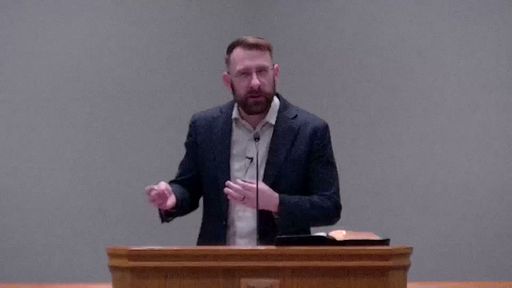
Pour Out Over Burn Out
Sermon: Pour Out Over Burn Out
Date: February 8, 2026, Afternoon
Text: Philippians 2:17
Series: N/A
Preacher: Conley Owens
Audio: https://storage.googleapis.com/pbc-ca-sermons/2026/260208-PourOutOverBurnOut.aac
Transcript
Please turn to Philippians chapter 2. Philippians chapter 2.
When you have that, please go ahead and stand. I'll read from verses 12 to 18. Amen.
Dear Heavenly Father, we thank you for your word. We ask that it would minister to our souls and that it would comfort and encourage us.
In Jesus' name, amen. You may be seated. This message is entitled,
Pour Out Over Burnout. I could not come up with a better title, but Paul speaks of him being poured out on the sacrificial altar, on the sacrificial faith of the
Philippians. That God has used him for a purpose of completing the work that is being done in them.
And this is something that he is happy to do. He has run the race. He has spent every last drop.
He is not worried, as some people are, about burnout, but he is eager to be poured out.
A lot of people caution about burnout, about becoming so exhausted from doing work that you're not really able to do any more work and you become useless.
But when you think about what burnout is, that it's really an emotional state and not a kind of physical burnout that people are worried about.
A physical burnout would make sense. You can only lift so much. You can only run so hard, etc.
But when it comes to the emotions, these are things that derive from the fruit of the
Spirit. Fruit of the Spirit is love, joy, peace, patience, kindness, goodness, faithfulness, gentleness, self -control.
These are all things that come from the Spirit. And when you realize that that is what's at the heart about concerns about burnout, it leads you to realize that this is a spiritual matter, that it very well may be the case that the world is misguided on.
The worldly approach to dealing with burnout or to protecting from burnout are many self -protective techniques designed to either cut you off from the world or designed to, from other people, or designed to lower your productivity and your own fruitfulness.
There are all kinds of things that people prescribe for burnout.
But if you realize it's a spiritual condition that must be addressed, where people are, quote -unquote, emotionally exhausted and feel discouraged, then the
Word of God has answers for us. It tells us how our emotions should be guided, what sorts of things we should be doing in order to make sure that we do not burn out but are spiritually charged and encouraged so that we, like Paul, would be able to pour ourselves out or to be poured out by God on the sacrificial altar that He has ordained for us so that at our final breaths we are not preserving ourselves for something that we are not meant to preserve ourselves for.
Whoever would lose his life will gain it, but whoever will lose his life for my sake will...
Yeah, you know what I meant to say here. Whoever would gain his life would lose it, but whoever would lose his life for my sake will gain it.
It will help for context to go back and look at a passage that explains the nature of a drink offering.
The first time you see a drink offering is in Exodus, excuse me, is in Genesis when Jacob pours it out on a pillar.
But in Exodus 29, verse 38, we see a drink offering spoken of here.
Now this is what you shall offer on the altar, two lambs, a year old, day by day, regularly.
One lamb you shall offer in the morning, and the other lamb you shall offer at twilight. And with the first lamb a tenth measure of fine flour mingled with a fourth of a hen of beaten oil and a fourth of a hen of wine for a drink offering.
The other lamb you shall offer at twilight, and you shall offer with it a grain offering and its drink offering as in the morning for a pleasing aroma, a food offering to the
Lord. It shall be a regular burnt offering throughout your generations at the entrance of the tent of meeting before the
Lord where I will meet with you to speak to you there. So describing this regular offering that's happening day by day, there is a food offering that's being offered and then also a drink offering.
In other words, these really are supposed to represent not just us sacrificing our food, but a food and a drink for the
Lord. The food that is given is us giving things that could be used as food for us to the
Lord. Drink that could be used for us given to the Lord. And what does wine represent most especially as drink?
It is not just any drink like water would be. It doesn't have them pour water out upon the sacrifice, but wine.
Why wine? Because it represents joy. Judges 9 .13, Vine said to the branches,
Shall I abandon my wine that cheers both God and man?
Judges 9 .13, it talks about wine even cheering God. Just as the
Bible describes the incense rising up to him being a sweet scent to him, so it describes the wine that's being poured out to him as being something that makes him joyful.
Now we know and it is explained especially as Solomon dedicates the temple that God does not truly subsist on animals or sacrifices.
He does not have a nose to smell the incense. He does not drink wine.
And yet these things represent him receiving from them being joyful in the sacrifices that the people make.
Now further context that would be helpful for us is to understand what's going on with the
Philippians. The Philippians are one of the most faithful if not the most faithful church that we see in the
New Testament. They have given of themselves in a way that seems to really go beyond a lot of the other churches.
They may not be as persecuted as some churches like you see in Thessalonica, but they have really given of themselves in a special way.
Financially, they are the only church that has partnered with Paul in giving and receiving. And Philippians 4 .15
says, And you Philippians yourselves know that in the beginning of the gospel when I left
Macedonia, no church entered into partnership with me in giving and receiving except only you. There are other churches that give to Paul for the sake of the collection in Jerusalem, etc.
But it's really the Philippians that have given the most to Paul and they are not the richest of the congregations.
They may even be the poorest of his congregations. 2
Corinthians 8 says, We want you to know, brothers, about the grace of God that has been given among the churches of Macedonia, the primary church of Macedonia being
Philippi. For in a severe test of affliction, their abundance of joy and their extreme poverty have overflowed in a wealth of generosity on their part, for they gave according to their means, as I can testify, and beyond their means of their own accord, begging us earnestly for the favor of taking part in the relief of the saints.
So that's describing the Jerusalem collection. But then later on in 2 Corinthians 11 .8,
it says, speaking of Paul's own funding that he's not receiving from Thessalonians or from the
Corinthians. In fact, he's explaining why he hasn't received from them. But he goes on to say in 11 .8,
I robbed other churches by accepting support from them in order to serve you. Them being
Macedonia, because he goes on to say, and when I was with you and was in need, I did not burden anyone for the brothers who came from Macedonia supplied my need.
So the Macedonians, and you can see this in Acts where it's described that the Macedonians come and that's how Paul is able to work full time.
The Philippians, the Macedonians, have been contributing to Paul even out of their great poverty.
They are, out of any group that has going above their ability, as it were, speaking hyperbolically.
It is the Philippians, okay? They are giving of themselves more than what you see from other churches even.
And what is Paul's call to them, even at this time in Philippians 2, verse 7 and 8, it says, of Christ that they are to have his mind.
He emptied himself by taking the form of a servant being born in the likeness of men and being found in human form.
He humbled himself by becoming obedient to the point of death, even death on a cross. So he is calling them to walk in the footsteps of Jesus Christ who has emptied himself.
He is calling them, likewise, to be poured out themselves and he is willing to be poured out on them.
He is calling them for a serious, radical giving of themselves that does not despair but is joyous out of an overflow of the joy they were eager to serve in the ways that they have served.
If you are to understand what God would have for you as far as giving of yourself without burning out, then you need to understand several things.
You need to understand yourself in your own capacities. You need to understand the effort that you are supposed to be giving and you need to understand also what fruit you should be looking for.
Just a clarification on the term. I understand that Paul is speaking about being poured out here in the sense of death but even later on in 2
Timothy 4, he speaks of himself as already being poured out even while he is alive and you see him speak of his labor having run hopefully not in vain this is all connected to his current activity even though it is a phrase particularly associated with his potential upcoming death.
First, understanding our own selves. Now this is what most people speak about when they speak about burnout is that you can't go beyond your own ability.
You have to understand your own self. This is true and so I say this by way of concession because it is not primarily the truth that is mentioned here but I want to address it since it's what most people think about when they think about burnout is assessing your own abilities rightly.
It is possible to think that you are capable of more than you are capable of. Romans chapter 12 verse 3 says,
For by the grace given to me I say to everyone among you not to think of himself more highly than he ought to think but to think with sober judgment each according to the measure of faith that God has assigned.
So you should be aware of your abilities. If you're going to do something beyond what God has given you the capacity to do you're not going to be in his will and it is going to be exceedingly difficult.
It is not going to work out well for you. It's also possible for you to underestimate your abilities and for you to aim too low.
First Corinthians 7 verse 21 says, But if you can gain your freedom avail yourself of the opportunity.
Speaking of each person doing what they were called to do. If you're a slave you can still serve
God as a slave. If you're a free man you can still serve God as a free man. But if you can avail yourself of freedom then do.
Become free to do more for the sake of the Lord. That's a good thing to pursue. So many people will be satisfied with a certain kind of service to the
Lord that is not really a very excellent service and they will just kind of lay down because it's easy.
Issachar in Genesis 49 is described as being a donkey who thought that the grass looked nice and so he lays down and he does not and he becomes subject to forced labor.
Basically he becomes a slave and is not able to serve as greatly as he should be able to. This is what it looks like to not use your talents to the greatest ability.
But the problem is okay so it is possible to overshoot. It's possible to undershoot. But what is happening most of the time when people are answering this question about their abilities is not a sober assessment of their own abilities but an un -sober, a drunken, intoxicated assessment of their emotions.
They're asking themselves what's the problem in 1 Corinthians 3? What are they asking themselves?
What would they be asking themselves if they are not thinking soberly about their abilities? They're thinking questions like well what kind of thing would stroke my ego?
What ways could I serve in the church that would make me feel good about myself? So they're answering this question emotionally and then what are most people thinking when they decide that something is too hard for them?
Once again they're thinking emotionally. They're not thinking I couldn't bear this in terms of my actual abilities that God has given me.
They're thinking I can't bear this in terms of the emotional difficulty that this would cost me.
Think about how people address this. Well could I have another kid? What are they asking when they're asking that question?
It's not about the physical capacity usually. Usually it's about do I have the emotional makeup that that wouldn't be too hard that I would be too distressed?
Or can I handle this difficult move? Could I handle serving in the church more? Could I handle hospitality? Oh no
I don't think I could handle hospitality. Not because of you know the home that God has gifted you with etc.
But a lot of times what people are answering is do I have the emotional capacity to do these things that God has called me to do?
They're not asking do I have the calling or do I have the actual natural abilities but do
I have the emotional makeup? This is the wrong way of thinking about it because God has promised to provide the fruit of the spirit necessary in order that you would be able to do those things.
He has not promised to provide every gift. He won't give you every kind of teaching gift. He won't give you every kind of financial gift but he will grant you the fruit of the spirit so that you can be faithful in serving him in the way that he has called you to serve him.
A lot of people when they are thinking about their abilities they are thinking in terms of willpower instead of in terms of raw power.
What you should be asking soberly is about what is the raw power that God has given you not what is your willpower.
Your willpower should be transformed by the spirit so that you can do the things that God has called you to. You know if you are obese and you need to go on a diet you don't ask yourself is this going to be too emotionally hard to go on a diet?
You know can I do this? Yes you can. It is willpower that you are asking about at that point not raw power.
Very similarly the theological language for this is natural ability and moral ability.
If you have never heard me speak of this before natural ability is your capacity to do things where moral ability is your will to do that thing.
So we might even apply this category to God where when it says that he cannot lie what we are not saying is that he doesn't have the power to say any words that he might want to say.
Of course he can say whatever words he wants to say. He has the natural ability to lie but he does not have the moral ability to lie.
He would never will to lie that is not within the scope of his will. Similarly many would argue against Calvinism promoting an
Arminian doctrine where they say that look man is held responsible it doesn't make sense for man to be held responsible if he has no capacity to trust in God.
My response is man actually does have a natural capacity to trust in God and he is held accountable on the basis of that natural ability but what he needs from God is a moral ability because he lacks the will.
God makes him willing and able to believe. So ask yourself do
I have the natural ability not do I have the moral ability because once someone has been saved by the
Spirit if you have trusted in God and you have the Holy Spirit He will grant you the will to do what is right.
That is the work of the Spirit. If you ask yourself do I have the will to do what is right and that's the question you're answering what you're saying is that you do not trust the
Spirit to give you what you need in order to obey. So ask yourself about raw power not will power.
Ask yourself about natural ability not moral ability. Okay so that first that's understanding yourself and I address that because that's the primary thing that people think about when they think about burnout and going beyond your capacities etc.
Next just looking at this passage you must also understand the fruit that would come from your efforts.
The primary reason that people are burnout is because they are expecting some kind of fruit that they are not receiving.
What Paul says here in Philippians what he says in Philippians verse 16 holding fast to the word of life so that in the day of Christ I may be proud that I did not run in vain or labor in vain.
Paul's primary concern here is about his effort being for nothing.
This is the primary thing that causes burnout is when your efforts do not pan out the way that you are expecting.
Someone can do a difficult thing if it's providing good fruit if it's providing the fruit they want they can do that indefinitely but if they are expecting something different then it's not coming they will get burnout they will feel fruitless and they will not put the effort into it that they ought to put into it.
So you can have a wrong kind of so think about how you have to understand the fruit you have to look for the right fruit.
People can be discontented with the fruit they are receiving for a couple of reasons. One is they're expecting a meaningless kind of fruit.
A lot of people will serve the Lord and when I'm talking about serving the Lord I'm really any capacity any capacity of obedience whether it be the way you're going about your job the way you're serving in church the way you're you're serving
God privately or in your family in any kind of way they will be expecting a meaningless sort of fruit.
Many people will serve the Lord in the church expecting gratitude for man and not primarily doing it for the
Lord. And so when they're serving God for weeks or months or years and they're not seeing others appreciate them because that's the fruit they're looking for what happens?
They get burnt out. Because they are looking for the wrong kind of fruit.
Or maybe they are looking for ease and what they're getting is something very difficult. God has not promised ease as being one of the forms of fruit that we would receive.
Christ for the joy set before him endured the cross despising the shame. He was able to with joy for the joy set before him endure the cross despising the shame.
So do not look for meaningless fruit. Also do not expect fruit that has not been promised.
Many people will serve the Lord expecting fruit that is truly good it's not meaningless. But and I don't want to say that gratitude for man is entirely meaningless but you know what
I mean it's a very limited value. They will be looking for good kind of fruit and when they do not find it because they are expecting it in a certain quantity they will become burnt out.
How many people share the gospel early on in their Christian walk expecting manifold conversions and when that does not happen they become pretty jaded and just do not continue in the work of evangelism because they were expecting fruit that was not promised to them.
It's a good fruit to want but it was not promised. These are things that you should desire but you should not expect them in capacities that they are not promised to you.
We are told that the Great Commission is blessed and that in general the gospel will go forward but we are not promised every kind of measure that we would want from the
Lord. Now that's those are ways that people can be sinfully discontent. There are also ways that you can be sinfully content.
When someone is discontent they are not trusting the providence of God they think that God would be wiser if he had given them something different.
When people are sinfully content it's not necessarily the best word because contentment is a virtue but when people are satisfied with the current state of affairs because they are not really expecting anything at all they are aiming for nothing and they are hitting it and they are kind of okay with that.
There are a lot of people who will go about their life just quote unquote being faithful.
I was talking to someone recently about this and air quoted the word faithful and I had to explain what
I meant by this. A lot of people will go about not really aiming for anything not seeing any kind of real fruit and then not adjusting anything or changing anything and they continue on and this is considered a good thing by many people but doing the bare minimum and not addressing any kind of faults or errors that is not true faithfulness.
But many people will call that kind of plodding along faithfulness and if you do it with a smile on your face a lot of times people will say well that's faithfulness.
No, not necessarily. What you should be doing instead is you should be not expecting the wrong kind of fruit or the fruit and the wrong measure but when you don't see good fruit that you should have and the right measure the fruit that has come from that situation is a learning experience for you.
It is God's providence for you that you might adjust and that you might correct yourself and that in itself is a good kind of fruit.
The right kind of expectations the right kind of goals are ones that are for the right kinds of things.
They are flexible so that they can adjust to what God would have them to be and they are things that are correctable that as he shows you that you are either looking for the wrong things or you're going about it the wrong way that you would adjust and that itself is a joyful thing as the
Lord corrects you if you are taking all that rightly. I just keep thinking of ministry things because that's where my mind goes.
I know that there are many ways people serve the Lord but just thinking about ministry things I know that a lot of times people will give teaching maybe it's just teaching like this a sermon and they're hoping for the
YouTube views afterward to come in or a lot of people to attend and not a lot of people attend and heard it not a lot of people are watching it afterward and they get very discouraged by this because this is what they are expecting.
That's not that's not the way to go about it. You need to be satisfied with what the
Lord brings to you and then if it seems like there should be a different fruit ask the
Lord what it is you're doing wrong go to his word and find out these are ways of refining and that itself is a good process that's a good fruit.
You should understand effort correctly. A lot of people will deal with burnout by half -heartedly pursuing something because you don't want to get burned out if you're thinking about this physically right what does burnout look like in a car engine or something right it's running it too hard and so you just don't run yourself too hard but then what happens you're not fruitful that way and if the whole thing that prevents from burnout is having a good kind of fruit like Paul describes here him not wanting to have labored in vain then you're guaranteeing that you will be fruitless and that it will not be a very rewarding experience.
People do this kind of stuff all the time where they will use scriptural language to justify all sorts of lazy behavior that ends up making things less fruitful and more discouraging.
They will in pursuing some difficult work they will take vacations that are either excessive or not helpful at the moment now vacations can be totally good they can be totally a time of rest but I know that often people will take vacations they'll speak about them being restful but really it's hard to get going afterward because they are just they were already discouraged they went away they're not being fruitful on the time away and so they're coming back still in the state of discouragement and they feel obligated to say that that they feel rested but really they're right in the same state of burnout.
Don't do don't do that. There's another thing that I've seen frequently a lot of pastors will take sabbaticals okay so there's multiple kinds of pastoral sabbaticals right there's ones where pastors would go work on something else maybe they go on the mission field or maybe they write a book etc.
okay so those are working sabbaticals there's another kind of sabbatical where it's just understood that oh pastor's job is so so hard that they need to go take a very long extended vacation.
I think a lot of time what's going on there is what
I'm describing here is a kind of not eagerness to pour yourself out because you are looking for the wrong kind of fruit and so you want to cease from being poured out because you are not enjoying the process and I have seen a number of times where that kind of sabbatical does not end well it just ends in worse situations so don't don't dress it up and you know if you if you end up ceasing from a good work be honest about what it is you're doing be honest about the reason for the recess so that you can assess whether or not it's actually going to be helpful for you or if it's just going to further the discouragement so that you are not being fruitful and you're just further burned out
Philippians 2 verse 14 says do all things without grumbling or disputing this is another surefire way to get burnt out is to grumble and dispute now remember
Paul's talking about himself but he's also talking about the Philippians the Philippians having given of themselves quite a bit they need to do things without grumbling or disputing if you grumble what you're doing is cultivating discontentment in your heart gratitude cultivates joy in your heart grumbling cultivates sadness and anger at God in your heart a lot of people don't realize that when they're grumbling they're grumbling against the
Lord they don't think of it as targeted they think of it as just kind of against their situation but who is the one who placed them in their situation whose wisdom are they arguing against they are arguing against the
Lord and it is guaranteed that as you cultivate a grumbling in your heart as the ancient
Israelites did and ended up wandering in the wilderness because of it as false teachers do according to Jude grumbling is it's one of the greatest sins it seems like a very small sin the
Bible speaks of it as one of the greatest sins because it is basically the heart that rejects
God and his wisdom go about your efforts wholeheartedly and without grumbling this will bring you the most joy and the most fruit as your efforts are fruitful you will be able to thank the
Lord for that fruit and it will be ah it will be an enjoyable experience even as even as it is a difficult experience even as your own life is being poured out for the sake of the
Lord just reviewing some of these things here understanding yourself and your own ability assessing things by raw power not by will power by natural ability not moral ability what
God has actually gifted you with and not how you feel about how you're going to handle it emotionally two understanding what fruit you should be looking for being correctable so that even being ah even being corrected by God is a potential fruit and then three wholeheartedly and without grumbling pursuing the things that God has given you now that does not mean that you can't decide in that correctability that maybe this isn't what you should be working on whatever the case may be that's within scope here but ah yeah count those three things understand those three things
Paul later on second Thessalonians three excuse me
I don't know why I said that ah second Timothy four says for I am already being poured out as a drink offering and the time of my departure has come so this is what happens later on he is indeed poured out as a drink offering he can sense it that that is what's happening he is at the end of his life and he is finally done he few know from his writings he is happy with the way that he is ending his race he is joyful and that he has been poured out he does not feel burned out because he appreciates the fruit that the
Lord has brought him Psalm sixteen verse four says indeed
I have a beautiful inheritance the more that you give up of yourself the more that you can receive of Jesus Christ the more that you are not holding onto ah your own things trying to establish a very temporary temporary short sort of joy the more you can receive the eternal joy that God gives if you think that you are going to be joyful by experiencing the very fleeting pleasures of this life and trying to reduce the difficulties that you have to face and the emotional turmoil that you might face in facing real difficulties you are essentially looking for something that the gods of this world offer that is the drink offering of blood that they would give you why is it that we are not supposed to drink blood is because it is life right but we are supposed to give out our own lives because in doing so we may receive the life of Christ if we suffer with him we will also be glorified with him he says in Matthew 26 28 for this is my blood of the covenant which is poured out for many for the forgiveness of sins
Christ has called us to pour out our own lives as drink offerings not because he needs of us but because in giving his own life to us this is the only way that it can be fully received if you hang on to the things of the world you will lose them and you will not gain the things of the next but if you give up the things of this world you will gain so much more
Christ himself will be experienced even in this life in a greater measure than he would otherwise and he would have us to remember that even with the