Biblical Church Revitalization By Brian Croft - God Centered Recommendations
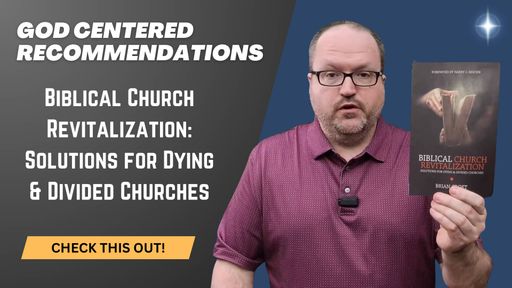
Biblical Church Revitalization: Solutions for Dying & Divided Churches (Practical Shepherding)
Purchase On Amazon - https://www.amazon.com/Biblical-Church-Revitalization-Solutions-Shepherding/dp/1781917663
There is a unique and special power and testimony in not just a vibrant local church full of life, but an old historic one that had lost its way, was on life support, and into which God saw fit to breathe life once again. Biblical Church Revitalization calls us to an intentional commitment to church revitalization in the face of dying and divided churches.
This is the place for consistent God-Centered, God-Honoring, and God-Glorifying biblical content.
Transcript
Hello there, and welcome back to God -Centered Theology. This is Andy Cain. I have another God -Centered recommendation for you.
We have today before us Biblical Church Revitalization by Brian Croft.
This is an excellent book on the topic, Biblical Church Revitalization, Solutions for Dying and Divided Churches.
Now, this became a very important book to me after my first church, because unfortunately the first church
I pastored was a dying church. It still is one. It's very sad. I take no joy in saying that, but there is no biblical foundation of the authority of scripture in operating in that fashion.
You don't see a bend towards studying the scriptures and implying the scriptures.
You see all the hallmarks of what we would see in a very unhealthy dying church. And so this became church health and the study of dying churches, healthy churches, so on and so forth, became a very big subject for me while I was there to start trying to figure out something
I could do to hopefully turn the ship around. But also after I left, so that I would know if I was ever in a situation like that again,
I would be able to handle it better and be more prepared for it. But also, maybe it's an area of influence
I could have in the church to help people understand what to look for. But it isn't so much about the identification and the acknowledgement or the labeling of saying, okay, we know we're a dying church or unhealthy church, or even saying, hey, we are healthy and here's why.
It's about the revitalization. It's about taking, even a healthy church can go through a period where they need to sort of revitalize themselves and remind themselves why they're there.
But for a dying church specifically, you need revitalization. You need to get back to who you're supposed to be.
And so Brian Croft here has an excellent book. He has some really good stories in here and a couple of them really resonated with me, but he has a good job of going through this subject and detailing out some of the things that are very much important.
Everything from diagnosing the situation to coming up with a plan and just sort of the history that goes with that, membership, leadership, and all those things.
So a really good book. I highly recommend this one. And if your church is in need of some revitalization or is in need of a turning around of the ship to go away from being a dying unhealthy church to a healthy one,
I encourage you to reach out to me or reach out to someone you know that is involved in that work and we can help you with that.
Now, information is just information. All one can do is share with you the pitfalls of unhealthiness, describe for you what true healthiness looks like, but it's up to the people in your local body to make the choice to give up their traditions, give up their preferences, stop letting idols and preferences rule.
Typically, what you see in a church that needs revitalization is in some way, in some manner, preferences and traditions have come to rule and Jesus Christ has been made subject to those preferences.
Whereas we're supposed to be subjecting ourselves and destroying our idols and subjecting and submitting our preferences to the truth of Scripture.
Now, Scripture doesn't handle every possible thing you can think of in a church. It's not going to tell you what color the carpet should be and things like that.
So how does leadership work and make those decisions and things like that? The one thing you definitely would want to stay away from is the thing that I think plagues the
American church more than anything else and that is the firm congregationalism or congregational rule where it's treated like the
American business, I call it sort of like the American business church model where it's like they look at it almost like it's
American politics. So, you know, we vote for or elect leaders, but we're the constituents.
And so in American politics, you elect representatives to go represent your voice or what you want in your government.
That's not biblical church government. It's not of the people, by the people, and for the people.
It's of God, by God, and for God. We are here to make sure we are being obedient and carrying out and living in the church the way
God has instructed us. So it really matters not what man thinks, but what God has said.
And so if you have a church where the primary documents and understanding is that the people rule and they say what goes, you're setting yourself up for failure.
Because if you're going to say, well, every church member has a vote and every church member has equal say. Not only does scripture not say that, but think about the logic of that.
You're now saying, okay, you're a babe in Christ. You've been saved so you can be a church member.
They're going to get the same amount of say as a seasoned, mature, fundamentally sound
Christian that would make wiser decisions, but their vote counts the same. My friends, that's just not a way to go.
You need healthy, qualified leadership that makes decisions based on what
God wants and based on what Christ would want. And also there's this balance that you see there.
So when you have biblical oversight with elders, while they are there to take oversight and make decisions and lead and guide the church, they should never pursue something that it's clear that a huge majority of the people they're there to shepherd are just against or just something just ain't sitting right.
And if you have wise, good congregational members coming and saying, you know what, sir, you're talking to your elders like,
I hear where you're coming from. I think it's a good idea. And you know, this is obviously dealing with something where there wouldn't be any obvious scriptural references for it.
Maybe just an idea the elders have, you know, I just don't, something just don't feel right.
You know, you need to listen to those people. It doesn't mean the oversight's been transferred to them, but there's wisdom in taking that in and making those good decisions.
And it could be the Holy Spirit's using them to tell you, hey, pump the brakes here, elders. You may not need to be doing this right now because when it comes to what we should do, when it comes to what we ought to do, the only thing that matters is what this says, the
Word of God. In all the areas where this doesn't specifically address things like, you know, what chairs to buy, how to order your service and things like that, you need to have good, qualified elders to make these decisions.
And if they delegate that responsibility off to a team of very smart and gifted congregants, well, they would need to defer at that point and let them do what they've been delegated to do.
You know, we'll look at this in a series on God -Centered Church where there's two things you have to decide and two things that will really help you in your revitalization.
Understanding who should have the oversight, regardless of what that looks like. The Bible's very clear, biblically qualified men that are called and equipped to be elders, they are the ones that have the oversight.
Not the deacons, not the congregation, not the bylaws, not the way we've always done it, but biblically qualified leadership.
But second to that, the part that fundamentalists and a lot of other people leave out, they just think, hey, I'm in charge, you better do what
I say. No, no, no. The second part of that is what does Scripture say about what true
God -Centered eldership conducting oversight looks like in the church?
And there are some times where elders would need to say, hey, this is what we need to do. There's also times where you need to say, hey, we've put this team in place to oversee this area.
Yes, we have oversight, but if you go in to start micromanaging people, they're going to say, well, what's the point of me being here?
So there's going to be times where even elders would even say, you know, I might would do this a little differently, but I'm not.
Because we have taken the time to look at these people and say, you know, they would do a good job helping oversee this area, so you need to let them do it.
And so part of oversight is knowing when to step back and say, hey, look, I'm not going to put my hand. Now look, if there's something obviously biblical going on, something obviously contrary to Scripture, both congregants and elders should immediately say, hey, we will hold on, time out, we can't be doing this.
And elders may need to step in sometimes and do that. But not everything is that. Trust me.
And if your elders are making everything that, you've got some issues there. So, you know, understanding good biblical leadership is a good step towards healthy biblical church revitalization, but also having good, healthy, wise congregants that understand how to model holiness and righteousness, people that have great wisdom in the
Bible. You don't have to be a biblically qualified elder to demonstrate great biblical wisdom.
And these people in our churches are so vital to the health of a church.
Yes, leadership's important, but my friends, if you have a influx or if you have a, you know, an already existing depth of wisdom in your church, you need to lean on that.
You need to lean into that and use it. And so there's a lot more that can be said.
I'm going to leave it at that because I try not to let these recommendations be too long of a video. We're probably somewhere right around 10 minutes on this one, but this particular subject is near and dear to my heart.
So I wanted to say a little bit more than I normally do. Now I'm going to have a series coming up where we'll deal with this in more detail, but I do highly recommend this book,
Church Revitalization, Biblical Church Revitalization by Brian Croft. Pick it up, and if you want to discuss it, let's do it.