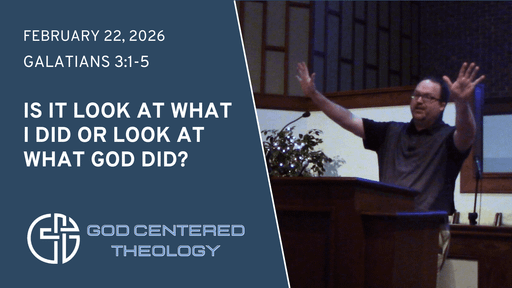
Is It Look At What I Did Or Look At What God Did?
Is It Look At What I Did Or Look At What God Did
This message was preached on Sunday, February 22, 2026, at Roanoke Baptist Church in Roanoke Rapids, North Carolina.
Transcript
I want you to imagine a man, or a woman, either one, trying to sail a boat across a large lake.
Now this person refuses to use the wind and instead decides to row the entire way himself.
Hour after hour, he strains, he sweats, barely making any progress.
His arms are burning, his pace slows, and frustration sets in.
Meanwhile, another sailor on the same lake lifts his sail.
The same wind that was available to the first man that refused to use the sails and the wind lifts his sails, and now the wind begins to carry him forward.
Now this other person still has to steer, adjust, and stay attentive, but he's no longer relying on his own strength.
The power moving him forward isn't coming from within him, but from something greater outside of him.
That's the difference between living the Christian life by works and living by the
Spirit. So many believers try to row their way to holiness, trying harder, doing more, striving endlessly.
But the Christian life was never meant to be powered by human effort alone.
Galatians reminds us this morning when Paul asked the question, having begun by the Spirit, are you now being perfected or ending in flesh?
Living by the Spirit means we still obey, we still pursue righteousness, but our dependence shifts.
We rely on the Spirit of God to empower what God has called us to do. Trying to live by works is exhausting and discouraging.
Trust me, I know. Living by the Spirit brings power, direction, and even joy.
Don't spend your life rowing when God has already provided the wind, my friends.
The Christian life, is it a matter of, look what
I did? Or is it look what God did?
Who's getting the credit? Who ultimately is bringing the power? Well, in Galatians chapter 3 here, as we open this chapter, before we look at some other things, in fact the entire chapter of Galatians 3 is focused on the fact that the righteous ones, the saved ones, live by faith.
If you will remember, we've already dealt with the legalists and Judaizers. Now, they haven't gone away.
We'll still deal with them through this book. But if you will remember, they wanted to force the law and works onto salvation.
If you will remember in chapter 1, Paul asks, he says, you know, why are you so easily deserting the gospel for something that's not the gospel?
He talks about how this and everything is so important. Remember, last time we were in Galatians, we read
Galatians 2 .20. I have been crucified with Christ, and it is no longer I who live, but Christ who lives in me.
In the life which I now live in the flesh, I live by faith in the Son of God, who loved me and gave himself up for me.
I do not set aside the grace of God, for if righteousness comes through the law, then Christ died needlessly.
He's saying, if righteousness, if justification, if salvation comes through works, through following the law, then what's the point of Christ dying?
It changes nothing. But if righteousness, if justification, if our salvation comes through faith, based on the finished work of Christ on the cross of Calvary, then his death, burial, and resurrection changes everything.
But these Judaizers now, even though they would already have said, you know, hey, it's not good enough to believe in Christ.
You've got to follow the Mosaic law. You've got to be circumcised. You've got to do all these things. But they also are troubling our
Galatian believers and troubling our Galatian brethren further. They're telling them that...
Paul's telling the Galatian believers, rather, in this letter, that they've been deceived to the point of thinking that their life as Christians is somehow lived by works as well.
You see, the Christians, us, children of God, those who have been saved by grace through faith, and through our repentance and faith, we are certainly made or created for good works.
This is true. But it is not empowered by them. Ephesians 2 and verse 10 is a well -known verse in this regard.
It says, we are His workmanship. This word workmanship means that which has been made or that which has been created.
It's a word that would readily reference the works of God as Creator. So we, if you'll think about the verse in 2
Corinthians where it says we're a new creature in Christ. So when we are saved, we are born again.
We are a new creation in Christ. We are His workmanship. We are the creation of the Spirit of God in the sense that we are created in Christ Jesus, meaning we are created or united with Christ for good works.
Notice it is not good works that saves us. It is not good works that keeps us saved. But our salvation is for the purpose of us living righteously, living holy, and doing and performing good works.
And notice that these good works are which God prepared beforehand so that we would walk in them.
This word walk means the conduct of your life. It is a word that means to make one's way.
How you're planning and living out your life is based upon the fact that you've been united in Christ.
We now have new desires. We're a new creature. We want to serve Him. We want to obey
Him. We want to, as this man was on this lake, steer the boat. You know, attend to the boat.
All these things we adjust as needed to conform to God's will. But the power of the
Christian life has never been in our rowing, in our steering, our adjusting. It's in the wind that pushes us forward.
It's in the power of God through the third person of the Trinity, the Holy Spirit that empowers us.
John MacArthur, who's now with the Lord but was a longtime pastor in California at Grace Fellowship Church and his commentary on the book of Galatians says the following, the faithful, effective
Christian life is first of all the humble pursuit of God's truth and of His will and of conformity to it.
The obedient Christian experiences joy and satisfaction beyond measure. And it's true.
But you need to understand, my friends, the true power that we have as Christians, the true power that we need to overcome things in this life, the true power that we need to truly live for Christ does not come from or originate in us.
It is the power of the Spirit that saves us and lives in and through us.
God doesn't save you and then say, all right, have at it. Go on, live your life, do what you want to do, see what you can muster up, see if you can figure this thing out.
We're saved for a purpose. We're saved for a divine plan and divine will.
See, the Galatian believers have been duped, they've been deceived. They're going around thinking that they can row their boat on their own power.
So I want to look with you this morning at really three questions that Paul asks, and we want to consider the issue at hand here.
Number one, he asked, were you saved by works or by the
Spirit? Notice with me here in verse one. He says, O foolish Galatians, who bewitched you before whose eyes
Jesus Christ was publicly portrayed as crucified? This is the only thing I want to learn from you.
Did you receive the Spirit by works of the law or by hearing with faith? Now, this word foolish here when he says,
O foolish Galatians, it may seem like he's being a little derogatory or mean here.
This word foolish in the original language doesn't imply that they're stupid. He's not saying you're stupid
Galatians, how stupid you are. You're in a mean way here. No, this isn't about mental deficiency here.
This is a word that refers to mental laziness. It refers to someone that's not being discerning or thinking clearly.
So if you've ever had a child or in particular a teenager, as you're going through all those things in life where they have all the gumption and energy and things of the world, but sometimes their thinking isn't so clear.
If you were like me, when I was younger, I'd jump into things head on and probably, and in most cases, probably too quickly.
I didn't really think things through. You know, you didn't analyze it and think about it from every possible angle about, you know, if I do this, then this may happen.
Well, I didn't think about that, so now I'm here. So now I have to backtrack and go down the path I should have been going down.
This is what he's saying. He says you foolish Galatians. He's not saying that they are foolish.
You have to make the distinction here. Don't take this too literally. Paul's not saying you Galatians are foolish or stupid people.
He's saying you're behaving in a foolish way. You're not discerning. You're not thinking this through.
Why? So he says, you know, they're foolish, but he says you've been bewitched. Now, this word bewitched, it has a lot of sort of magical components in the sense that a lot of people that would, you know, trick people and stuff in this time of day would do that.
But the idea here is this word bewitched means to charm in a misleading way.
Have you ever been scammed, had somebody try to scam you? The thing that always
I think about when I think about this, you ever go into like Walmart or Target or someplace or even back when we had malls and you'd have these kiosks and these people trying to sell you stuff and they're the nicest people in the world.
They will charm you. Man, let me tell you, you need this. Here's why you need it. Oh, I've already got something like that.
Oh, no, what you got ain't good enough. I mean, they're just so charming and so positive.
And that's kind of the whole shtick. It's to mislead you into buying or doing something.
That's what he's saying here. These Judaizers have charmed you. They've sold you a bag of goods.
They've scammed you. You have fallen for their charm. And that's why I'm saying it's not about being stupid.
We all have fallen for something at some point. Anybody can be duped if you're not, you know, on your
P's and Q's and thinking through things. The smartest people in the world can be charmed and duped if they're not paying attention.
That's what he's saying here. You've been bewitched. He's like, so let me ask you this question, Galatian believers. You want to follow these
Judaizers and listen to what they're saying. Well, were you saved by your works or by the Spirit?
That's what he's asking them here in verse 2. He says, the only thing I really want to know from you, I don't want to know about any of this other stuff with the
Judaizers. I want to know, were you saved by works or by faith?
If works, well, okay, then you've saved yourself. Now, my friends, it is true.
God expects perfect righteousness to enter His kingdom. And if one could perfectly obey the law, you could certainly enter
God's kingdom on your own effort. Here's the bad news. Nobody can do that.
There's only been one man to ever live that perfectly kept the law and fulfilled it, and that was Jesus Christ.
No flesh, no human being can present to God their own righteousness.
We, when we stand before God and we're perfectly justified and we have eternal life in His presence, we will not stand before Him and boast about our own righteousness.
Look at what I did. Look at how I kept your law, Lord. I was so good.
We're going to stand before God and speak of the righteousness of Christ that has made us righteous.
We have been made perfectly righteous by the blood of Christ, not by our own blood, sweat, and tears.
Did you have to perform some special ritual? He probably has in mind.
Because these Judaizers, much like modern legalists that we deal with, and we've already touched on this in great detail in previous sermons in chapter 2, so we're not going to delve on this too much, but the one thing about modern legalists is it's never enough.
There's always something else you have to do to be accepted. There's always something else you'll have to do to maintain fellowship or to be accepted or be included.
Well, you're not dressed the right way or you're not speaking the right way or you're not watching the right things.
You're not doing this and this. It's just endless. It's like a revolving loop. You think about a little hamster in the wheel running around, right?
It never ends. It just don't ever think to stop. It's keep running, running, running, running. It's what they want us to be, little hamsters in that wheel that's constantly turning, constantly moving forward, and constantly doing as we're told.
Well, he says here in this second question, he says, if the Spirit saved you, are you now living on your own power?
So he moves forward. He starts with, well, how were you saved to begin with? Were you saved by your own effort or by Christ through faith?
And now he moves forward here to the second question. He's like, okay, well, if you say you've been saved by faith, are you now living your
Christian life on your works? Your works didn't save you. You're going to live off them now? Look at verse 3.
He says, are you that foolish? Are you that deceived? Having begun in the
Spirit or by the Spirit, are you now being perfected in the flesh? This word perfected means ending.
So you think of a race, right? A start and a finish line. Did you start at the race?
Did you start by the Spirit? Yes, good. Well, are you telling me now that the finish line is going to be based on your own effort and works?
That doesn't jive. That isn't consistent. That doesn't go together. He's asking, well, are you saying now that you're starting by the
Spirit, but ending in flesh? It is foolish and a betrayal of Christ to suggest that any
Christian needs any additional work or experience to maintain their salvation.
It's a betrayal of Christ. Your works did not save you. Your works are not keeping you saved.
You work because you are saved. I do everything that I do because I am saved.
You should be doing everything that you do for the glory of God because you are saved.
Not to get you saved. Not to keep you saved. Because you are saved.
And that's what he's saying. Even if you say you were saved by faith, what are you doing now trying to live by works and your own effort like this man in the boat?
You're sitting there. You don't even put up the sails. You're not using the wind. You're not using what has come with you and that power.
You're rowing as hard as you can trying to do it on your own. You can even use the example of trying to push that rock uphill.
You keep trying to push it uphill and not using available tools to you. You're making things harder than it has to be.
And that's what it felt like for me anyways in legalism is it feels like, you know, if you were to go out every morning to go about living, doing your job or living out your day and you're not just going out there with the power of the
Spirit on your own two feet, going to live for Christ, do everything you can to image
Christ and live with joy. No, that's not good enough. So we're going to add a whole lot of extra weight.
We're going to add on hurdles and things to make it that much more difficult because in our minds it's, well, you know, if I'm doing it with all this,
I'm better than them other Christians that are just relying on the Spirit because I'm carrying all this extra weight.
I'm carrying all these extra. Look at me. We have all these standards and extra rules and things we do.
We're far better than you Christians. It's a betrayal of Christ.
It's foolish. That's not how we're meant to live. You were never meant to carry all that weight.
So drop all that off and just live and walk in Christ because remember as our Lord Jesus told us, my yoke is easy and my burden is light.
That's what's being said here. Well, the third question they asked him, he says, Does God who has the power to create the world, the power to enter this world in the incarnation of the
Son, in the second person of the Trinity, the one who performs miracles or acts of power, does this same
God not have the power to save you unless you add your works? Notice what he says here in verse 4 and 5.
He says, Did you suffer or experience so many things for nothing, if indeed it was for nothing?
What he's saying here is what's the point? Because remember, these
Jewish believers, they already are going to have issues because they're breaking from Judaism.
They're breaking from everything they've always known. And that's what the Judaizers are saying. They say, hold on a minute here.
You want to add Christ? Okay, fine. But you better stick with what we've always done. You hear this all the time.
It's one of the deadliest things you can hear. That's the way we've always done it. Or that's the way it's been, so that's what we're going to keep doing.
Well, that's what these Judaizers are saying. No, look, if you want to go over there and talk about Jesus and have your little
Bible study, that's fine. But you better make sure you come back to Judaism at the end of the day. He's saying,
Paul's telling them, Look, you've already accepted Christ. You've already repented and put your faith in Christ.
You're already driving that wedge between yourself and Judaism, between yourself and the Old Covenant.
You're going to have family members. You're going to have friends. You're going to have other work associates or colleagues and different people.
They're going to question you. They're going to have issues with what you've done here. That's why you're being dealt with now by these
Judaizers. You're already dealing with this. Why are you going to make it harder by adding a whole bunch of effort of your own on top of it?
That's what he's saying here. Did you experience so many things that you dealt with with these Judaizers for nothing?
That's when he asked a question. He says, Okay, so then let me ask you another question. Does He, God, who provides you with the
Spirit and works miracles among you, did He do it by works of the law or by hearing with faith?
So now he's gone from the first question. He said, Okay, were you saved by works or faith? Okay, you say faith.
Check. Let me ask you a second question. Now that you're saved, are you going to continue living your
Christian life by works? You weren't saved by it. What's going on here? He's covering all his bases here.
And so now this third question, he's saying, Okay, you say you've been saved by faith. You say you're living by faith, but you're still trying to adopt works.
Let me ask you a question. Are you basically saying that God, the God who created the world, the
God who created the universe, the God who created you, the God who has now made you a new creation in Christ through the raising of your spirit life by the
Spirit, are you saying that God, that His power is only able to save you if you have works to add to it?
Is He only able to save you if you are of a certain level? You think about it in video games and stuff.
A lot of video games, they'll have characters you'll create. And you'll customize them and you'll add different clothes or armor or characteristics.
And then as you go through a game, you'll level up. You'll get experience points and all these different things.
And your character will get stronger and stronger and be able to do more abilities and so on and so forth. It's a modern -day way of saying what
Paul was saying. Are you telling me that God can't save you unless you've leveled up to a certain level first?
That's what he's basically asking here. Now, let's make this make more sense. You know how we say things like, well, you don't have to clean yourself up first to get saved?
We say that a lot in Baptist churches. You come as you are. You could be the most rotten, dirty sinner to ever walk the planet.
And through repentance and faith in Christ, you're just as saved as I am because you have a perfect Savior just like I do.
That's what's being said here. You say, what do you think? Your works are necessary? That God's power isn't enough?
My friends, I hope you would never think like that. That we would never act like that or believe like that.
That somehow, some way, God's power isn't enough. And you see this in many churches today.
And it's sad. They think that, you know, God, yeah, He's strong, He's powerful.
He did a lot on the cross. We don't take that away from Him. But He needs us. Or He needs that pastor, you know,
Pastor So -and -so. He's just so special and He's just a rock star. He's so powerful and great and we need
Him. My friends, there ain't nothing about the guy standing behind this pulpit. You don't need me one bit for your justification.
You need 100 % of Christ and 0 % of me. There is no pastor, no deacon, no
Sunday school teacher, no man, no woman, adult, child, fill in the blank with whatever you want.
If that blank does not contain the name Jesus Christ and Jesus Christ alone, you are not perfectly saved.
If you try to add or take away anything from what Jesus did, you will not find
Him to be a perfect Savior. But, my friends, I can encourage you, I can assure you, and I can guarantee you that if you repent of your sin and place your full faith and trust in Jesus Christ alone, you will 100 % of the time find
Him to be a perfect Savior for every single person.
His power is powerful enough to save every single believer. He does not exhaust
His power. His power does not go down when He saves someone with a need for a recharge period.
It is always available. And that's what Paul is finally asking Him here. He says, I'm getting to the heart of the matter.
It's not so much about whether or not you were saved by works or Spirit. It's not so much about whether or not you're living your
Christian life by works of the Spirit. Ultimately, what you're saying, if you say Christ is not enough, if you say the
Spirit of God is not enough, if you say faith is not enough and you add anything to it, what you're ultimately doing is questioning
God. You're questioning His power. He's not good enough. His power's not good enough.
He needs me to bring something to the table. And you see this in every single man -made religion.
You've got to do this. You've got to look this way. You've got to go through this ritual. Now look, parenthetically, let's stop for just a second.
We baptize people. We have certain ways we do our worship services. We have certain things we do, certain things we don't do.
We're not talking about those things. You know, if a church has a particular way they do the Lord's Supper or if they're going to baptize someone and maybe they have a certain song they play or do it in a certain order and things like that.
It's kind of their tradition and how they do things. Nothing about that is wrong in and of itself.
You're not worshiping a ritual or saying that someone has to be baptized this way or somebody. Now I have experienced this.
I was told you have to do the Lord's Supper this way and it had every little thing ironed out.
I'm just like, can we cut out five of these steps and focus on the part that's important? Oh my goodness, you're going to make somebody mad.
I'm like, who? Well, the people sitting up top that have the money. I'm like, well, can we just ask them to leave because they're really hindering the power of the
Spirit here with their narcissism and all this nonsense. You get to that point where it's, oh, we can't dare change it because so -and -so says, well, are they the authority?
Or is God's Word the authority? But just simply having something you do that's traditional and you look forward to it maybe at a certain season or maybe
Easter or whatever it is we would do, those things aren't necessarily wrong. That's not what's in view here.
What it's talking about is you're saying, well, you're not saved unless you do this and you do it this way exactly like we outline it.
Then you've crossed into a path that you don't need to be in. We don't ever need to put those burdens on people.
Or if we say, well, you know, it's not good enough that you're living your Christian life and you're coming to church and fellowshipping and trying to live obediently and living by the power of the
Spirit. You've got to make sure you're dressing this way and doing this and only singing these songs and doing this and just you outline all these things.
That's what Paul's saying. He says when you do that, you're basically saying God isn't powerful enough to save you.
He isn't powerful enough to communicate to you what you should and should not be doing. You need man to step in and then fill in the gaps for you.
And that's what we need to avoid. And ultimately, it comes down to that question. Is it?
Look at what I did. Look at what I accomplished. Look at what I bring to the table.
Look at how I saved myself. Look at how I keep myself saved.
So my friends, when we talk about things like the perseverance of the saints, we're not talking about saints actively persevering and keeping them safe.
Perseverance of the saints and why when we are saved, we are saved eternally, is all about the fact that God has saved us and God keeps us saved because the judicial decree of God that justifies us based on the work of Christ cannot be changed.
You are perfectly saved because you were saved by a perfect Savior. So is it look at what
I did or is it look at what God did? That's what Paul's telling him. He told the Galatian believers this.
I'm telling you this today. You need to tell each other this and tell me this. We need to always remind each other, all of us, anything we accomplish as Christians, anything this church accomplishes for His glory, it's about look at what
God did and not what we did. He uses us, and yes, it's a joy to be used by God to accomplish
His purpose, accomplish His will for His glory, but it's not about our power. It's not about what we've done.
It's about what God did. And that's the whole point of this illustration about the man trying to sail his boat across the lake.
He's rowing. He's steering. He didn't even put up the sail. I don't need that.
I can make it happen. And the other one, who is the type of Christian we need to be, he says, okay,
I understand I may have to steer. I might have to put forth some effort here and I'm going to have to do what
God wants me to do. But the real power behind this thing is in the sail. God's wind,
God's power pushing me forward. So I put this to you here as we close.
When we consider the cross, do we say the following? Wow! Look at how my works made it possible for Christ to save me.
Is that what we would say? My goodness, how arrogant to think that anyone would say that.
Look at the cross of Calvary with our Savior dying for us and say, look at how my works everything that's great about me is making it possible for Christ to save me.
Is that what we say? Or do we look at the cross of Calvary and say, my goodness, you mean
God had to die so I could live? God had to die so I could be saved?
And take this further, God chose to die for me so that I could live.
My friends, this is a very important subject. Are you trying to live on your own effort?
Are you trying to live the Christian life based on what you can produce? I don't want that for you.
I really don't. I know what that feels like. It is debilitating. It is frustrating.
It is literally a no -win scenario. But I can promise you by the truth of God's word based on His authority that there's a better way.
I want you to live every single day as a
Christian. Not by your own efforts, but by the same power that saved you on the cross of Calvary.
Because my friends, there's no greater joy, there's no greater way to live, and I can assure you you won't be sitting back at the end of the day and saying, look at what