Systematic Theology - Understanding Scripture (3 of 3)
This is the third of three training modules in the Understanding Scripture course, on Systematic Theology. It's highly recommended to first check out the whole course at https://training.freely.giving before going through this video. There are a number of documents that complement this video. You can also download the video from the website for offline use.
0:00 - Preamble
1:20 - Part 1: Introducing Systematic Theology
10:15 - Part 2: Research
18:22 - Part 3: Analysis
31:09 - Part 4-6: Preparation & Feedback
Comments are turned off for this video
Transcript
Welcome to the third part of the Understanding Scripture course, Systematic Theology.
This material is intended to equip all believers with basic skills in exegesis and theology so they can gain a deeper and more accurate understanding of God's Word.
It's completely free, and you can download all the material at training .freely .giving.
If you're not yet familiar with the basics of exegesis or biblical theology then it's best to look over the material for the first two parts of Understanding Scripture before continuing with this part on Systematic Theology.
These trainings are commonly run in small groups over six sessions with a leader teaching the content from the slides provided.
That way there's someone there to answer questions and give feedback on work completed. So most people won't need these videos, rather they're to help in the following situations.
Individuals who want to learn the content by themselves or groups that don't have a leader to run through the material with them or leaders who want to learn the material before running their own groups.
So let's get started. What is Systematic Theology? Theology is the study of God and his will.
The Bible has many stories and events, but they're not merely there to entertain us. They're there to teach us things about God.
And when we study what the Bible teaches, we are doing theology. There are a few different ways to approach theology.
For example, you could trace the way a concept is progressively revealed by God throughout the
Bible which is what we call biblical theology. But if we want to know all the
Bible has to say on a certain topic whether it is essential to the story or not we need
Systematic Theology. In terms of what we'll be studying in this training there'll first be an introduction to Systematic Theology.
We'll then learn how to do research, which is gathering all the data on a topic together.
After that, we'll learn how to analyse that data. And then the last three sessions will be on creating your own study or talk based on a topic of your choice from the
Bible. You'll first do research on the topic and you'll then write a study or talk outline on that topic and finally, you'll give each other feedback on your study or talk outline.
Part 1. Introducing Systematic Theology In this first session, we'll cover what
Systematic Theology is and why it is important. Is theology really necessary?
Yes, in fact, you can't really know anything about God without doing theology. We may not use the word theology but whenever you learn something about God through Scripture you are doing theology.
If someone heard you say, free speech is good for society and they then went around telling everyone that you approve of hate speech you would probably be upset that they misconstrued your views based on a single statement.
So too, if we claim to know what God wants without carefully examining everything he has to say on a topic not just based on one verse or one sentence.
Here is a way to visualise how theology helps us. With no theology, the
Bible is just a collection of random books that you can entertain yourself with or be confused by.
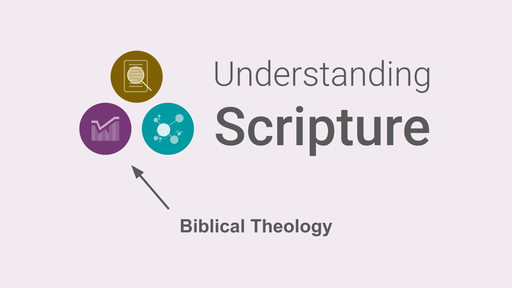
Biblical theology helps us see how the Bible is one big story that leads to Jesus and points to his return.
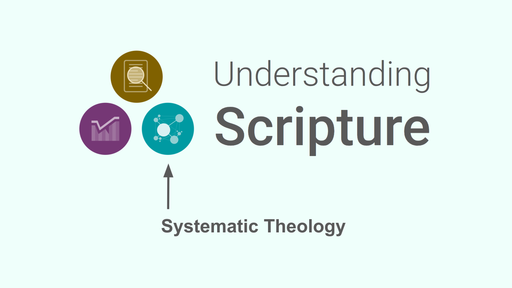
In addition to that, Systematic Theology helps us organise everything Scripture teaches on a topic.
Both approaches are complementary and you can't really read your Bible properly without doing a bit of both.
Whether you consciously think about it or not doing theology is simply being faithful to what
Scripture actually says. To refresh our understanding of Biblical theology here is an overview of the story of the
Bible. Notice how the whole Bible tells of God's relationship with people and how sin gets in the way.
There is a constant gospel trajectory throughout. The story starts out with God creating everything out of nothing.
But then his people disobey him and sin enters the world. And ever since then, especially signified with God's promises to Abraham the rest of the
Bible is all about how to fix that relationship with God that's been broken by sin.
The history covered in the Bible can be divided up into eight periods. There are other ways you could divide it, but this is a helpful one.
Who God's people are and where they belong has changed over time. But God's promises have remained and they're ultimately fulfilled in Christ.
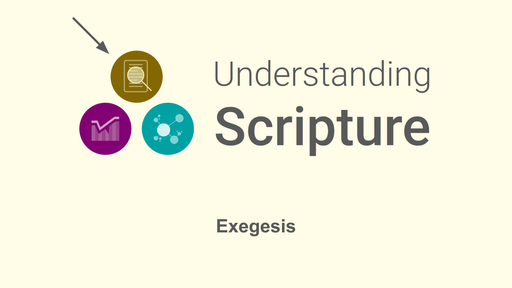
Let's also refresh our understanding of exegesis. Exegesis is the study of the original meaning of a text.
You can't even begin doing theology without first exegeting text as otherwise we might come to false conclusions.
There are three main areas of investigation when doing exegesis. First, there's the context, which is what's around the passage.
Then there's the actual content of the passage itself. And finally, there's the implications of the passage.
What it meant for the original audience and also what it means for us today.
Let's further refresh our understanding of exegesis by exegeting this passage,
Matthew chapter 18, verses 15 to 22. We'll just focus on the context and content for now and save the implications for later.
You should now pause the video and spend time reading this passage in multiple translations, highlighting things that are of interest and then thinking through the context of the passage in terms of its historical context, which is its place in history and in the
Bible as a whole. Also, its literary context, which is its place and function in the book of Matthew and also its immediate context, what happened immediately before and after the passage.
You should then think about the content, determine what genre the passage is, highlight and note any important details such as repeated words, themes or contrasts in the passage and come up with a helpful structure for the passage that breaks it into sections and helps to understand its flow.
Let's now go through these in turn, starting with the context. What was the historical context?
Well, these events take place at the time of Jesus' presence on earth where he's giving instructions to his disciples who are being formed as the church.
In terms of the literary context, Jesus is in or near Capernaum as we read from chapter 17, verse 24 and he's making his way towards Jerusalem where he expects to be killed.
These details are just helpful to know. They may not have a big impact on how we interpret the passage but they are worth keeping in mind.
In terms of the immediate context, it follows the parable of the lost sheep and it precedes the parable of the unforgiving servant which continues the theme of forgiving those who repent.
In terms of the content, the genre is a historical narrative that quotes teaching from Jesus.
So this is a story but it actually happens and these are things Jesus actually said and he actually taught.
In terms of details, the numbers 2 and 3 are repeated several times and there's a common theme of forgiveness.
In terms of structure, we could potentially break it down into the following sections.
Verses 15 to 17 are the steps to take when rebuking someone. Verses 18 to 20 is about the spiritual dimension to rebuke and forgiveness and verses 21 to 22 are about being willing to repetitively forgive people.
This isn't the only way to break it down but it's a fairly logical one. In connection with the passage we just looked at, we'll be studying the topic of rebuke over the next two sessions.
You should pause the video now and discuss in your group what you already know about this topic and what does the passage earlier have to do with the topic of rebuke.
While we'll be looking at rebuke as a group, you'll also be working on a topic of your own choosing.
Choose one of these topics to study. You'll research it yourself and later turn what you've learnt into a
Bible study or a talk outline. Depending on your group, you may wish to choose from other topics instead.
You should now begin doing some basic research into your topic for the rest of the session. Part 2.
Research During this session, we'll learn how to thoroughly research a topic.
Since the Bible is not a textbook organised by topic, its teachings are spread out through various books.
They might be taught explicitly in a letter or taught implicitly in a story.
There's great value in the Bible's use of story and progressive revelation, but it can make researching a specific topic a challenge.
Even if research can be challenging, it is important to still be thorough. For example, if you limited your study of the topic of justification to a verse like this one, a man is justified by his deeds and not by faith alone.
James 2 verse 24. You could well come away with the conclusion that Christ's sacrifice is not enough and we must earn our own salvation.
So in order to avoid that, we'll now consider how to ensure our research is broad and comprehensive, so we don't come away with a limited understanding of a topic.
Firstly, going beyond single words. If you wanted to know what someone thinks about money, searching for just the word money wouldn't come up with everything you'd want to know.
They could talk in depth about finance, investing, profit, loss, wealth, etc.
without ever using the word money. To give an example from the Bible, angels are sometimes mentioned without using the word angel.
For example, see Joshua chapter 5 verse 14, where an angel is referred to as the commander of the
Lord's army. Or Mark chapter 16 verse 5, where an angel is referred to as a young man dressed in a white robe.
So it is important we think beyond just single words. You should pause the video now and discuss in your group what words are relevant to the topic of rebuke.
Firstly, what are similar words, but also what are contrasting words, what words mean the opposite, as they could be relevant as well.
For the first question, what are similar words, you may have come up with words like the following.
Correct, judge, admonish, reproach, condemn.
And you may have had some other words as well. For the second question, what are contrasting words, they could be words like forgive, overlook, ignore, or something similar.
We'll want to look for all these words when researching the topic of rebuke. Some will be more helpful than others though, so prioritise the words most likely to yield relevant results.
So we should not limit ourselves to just single words, but we should also not limit ourselves to just passages we remember either.
We should go beyond our own memory. And there's several resources that can help with this.
A simple web search will often tell you the most important passages for any given topic, just by looking at what passages come up most often.
There are also websites dedicated to finding passages by topic, such as openbible .info
.com. You could also use a Bible or Bible app that has cross -references to follow any of them for passage you have already identified.
So if you already found a good passage on rebuke, there may be cross -references to other relevant passages as well in other parts of the
Bible. There are also often lists of passages by subject if you've got a printed
Bible, but you can also find these online and in other academic resources as well.
But to be honest, AI is probably better these days than many of these resources that we used to rely on.
You should be very careful when using it to come up with conclusions and philogy, as it will often yield results from unorthodox sources, as well as the good ones.
But when it comes to the topic of research, it's actually an excellent tool, as it will quickly give you relevant passages that you can then look up yourself in your own
Bible. You should pause the video now and practice researching this topic as a group, the topic of rebuke.
You may like to split into different groups. One group could use word searches in a
Bible app or website, another group could use a topical search tool, and another could use
AI. All of these should yield helpful results, and you can create a list of all the relevant passages you discover.
So we should go beyond single words, and we should go beyond our own memory, but we should also go beyond a single category.
Passages that clearly identify the topic we're interested in are ideal, especially when they include the words we've identified, but much can still be learned from other categories as well.
We should not just research words, but also concepts, characters, events, different genres, and there may be other categories you could list as well.
Let's practice this with the group topic of rebuke. What are some examples for the following categories?
1. Calls to rebuke others. 2. Why we should rebuke others.
3. Instructions on how to rebuke. 4. An example of someone rebuking.
5. A relevant proverb. Try to identify passages that fit into all of these categories.
So let's now think of some examples. In terms of calls to rebuke others, you may have found a passage like Titus 2, verse 15.
Encourage and rebuke with all authority. For reasons why we should rebuke others, you may have found a passage like James 5, verse 20.
Whoever turns a sinner from the error of his way will save his soul. In terms of instructions on how to rebuke, our group passage is an excellent example.
For an example of someone rebuking someone else, you may have found Galatians 2, verse 14.
If you are a Jew, live like a Gentile and not like a Jew, how can you compel the
Gentiles to live like Jews? Finally, a relevant proverb would be
Proverbs 12, verse 16. A fool's anger is known at once, but a prudent man overlooks an insult.
You should now begin researching the topic of your choice. Remember to think of similar and contrasting words.
Use word searches, topic searches, cross -references, and AI, etc. Also look for events, characters, concepts, etc.
And create a list of passages and organize them by how relevant they are. You'll have more time to do this during the next two sessions as well.
Part 3. Analysis. During this session, we'll learn how to analyze our research and develop theology from it.
The Bible is consistent. As it says in Psalms 119, verse 160, the sum of your word is truth.
While Scripture has different human authors, the fact that all Scripture is God -breathed means it is all consistent with His will and cannot contradict itself.
So when our theory of what the Bible teaches on any given topic doesn't match up with all of Scripture, then the problem lies with our work and not
Scripture. The first step in analyzing our research is ensuring we have correctly understood what the passages teach.
There may be a verse that sounds very helpful but turns out to mean something different to what we thought once we consider the context of it.
When we are confident we know what the passages mean, we can begin assembling them and determining all that Scripture teaches on a topic.
Finally, we must test what we come up with. It should not contradict anything else in Scripture and it should be faithful to Scripture's own emphasis.
Let's look at each of these in turn. Firstly, exegeting passages.
We must ensure we understand what is being taught by a passage before using it to substantiate a certain theology.
You don't have to write out answers for every passage, but you must consider the context before quoting them.
You should also use biblical theology. Any Old Testament passages must be viewed through the lens of Christ and must be treated with more caution than New Testament passages because of that.
Pause the video now and practice exegeting these passages in their own context.
How could these verses be misunderstood when building a theology of rebuke? For the first verse, 1
Timothy 5, verse 20, but those who persist in sin should be rebuked in front of everyone.
Now, it could suggest that public rebuke is the norm and appropriate for even minor sins, but the context is regarding elders who might lead those who look up to them astray, hence the emphasis on public rebuke.
The next one, 1 Timothy 5, verse 1, do not rebuke an older man.
It sounds like older men are exempt from criticism here if you read this by itself, but that could cover up all sorts of abuse.
The context, rather, does not describe the severity of sin and is mainly focused on treating fellow believers like family.
The last one, 2 Thessalonians 3, verse 6, keep away from any brother who leads an undisciplined life.
Now, it's unclear what an undisciplined life refers to unless you consider the context, and when we do consider the context, we find out it refers to those who are lazy and they do not do any work and they just burden other people.
So we should be careful before applying this to anything else we might consider undisciplined. It's time to now assemble all that the passages teach into one orderly outline on the topic.
First, you should group passages with similar teachings together. Group them by what they teach rather than any other category, as there's many ways we could organize passages, but we want to focus on the theology of them, what they teach.
It's perfectly fine to reuse the same passage in multiple groups if it's relevant to all of them.
Second, account for importance based on Scripture's own emphasis.
After consulting all the passages, you should get a feel for what aspects of the topic are most clear and important.
This is the kind of thing that you simply need to learn by reading the Bible a lot. The more you read of it and the more that you study, the more confident you'll become in what the
Bible teaches. You should also ensure to bring out
Scripture's emphasis rather than what you would prefer to emphasize, and that's a great temptation when you're looking for a particular topic or you want the
Bible to answer a particular question, but you must remember to always be faithful to the passages that you're interpreting.
Third, you need to unify the teachings into main points and sub -points so that there's some way to organize and comprehend them all.
You should substantiate each point with multiple passages where possible, though there may be some points that simply only have one passage.
So let's think about how we could organize teachings on the topic of rebuke.
Pause the video now and discuss, out of the following options, which way of organizing teaching on this topic is most helpful.
Let's now go through them. For A, it's organizing the teachings based on where they come from and who said them.
But dividing up Scripture based on who said what implies that Scripture is not unified and it depends on the opinion of different authors.
B divides the teaching based on what Scripture says compared to church policies and case studies.
But church policies and case studies cannot override what Scripture teaches, and so they're actually not relevant when discerning a biblical approach to rebuke.
C, they may be helpful in pointing you to passages and explaining why they came up with a certain policy based on Scripture, but in the end, your conclusions need to be founded on Scripture itself.
C categorizes the teachings based on the type of passage, whether it's a call to rebuke, a description of it, or an example of it.
And this categorization might be helpful when doing research, but it doesn't help us know what
Scripture actually teaches. So finally, D, this is the best option, as it systematically informs of different aspects of rebuke and it unifies
Scripture's teaching on each. It tells us what Scripture says about the importance of rebuke, about anything we should consider before rebuking, and then finally, how to rebuke.
As part of this training material, an example outline on the topic of rebuke has been provided on the website, training .freely
.giving. You should now spend time observing from that outline how the teaching is structured, how it follows
Scripture's own emphasis, how it consults multiple books, genres, and types of passages, and how it nuances teachings that are not black and white.
It is quite a comprehensive outline, but you won't necessarily have to come up with something as comprehensive as that for your own topic of choice.
Once we have a draft outline, we need to put it to the test. First, we need to ensure it adds clarity rather than confusion.
Second, we need to ensure that nothing contradicts, either itself in the outline or in other parts of Scripture.
Third, we need to make sure the teachings are nuanced when they don't fit all the passages.
We shouldn't try to squeeze passages into conclusions we've come up with ourselves. Also, avoid any temptation to bend it towards a conclusion you favor.
As mentioned earlier, this will be a great temptation when you're trying to get an answer from the
Bible on a particular topic you're interested in. It could be that the Bible simply doesn't answer the question that you want it to, or you find the answer isn't as complete as you would like.
In such situations, it's best to be humble rather than asserting that Scripture says something more conclusively than it actually does.
Finally, you should consult what others have written on the topic, especially important theologians of the past who may have wrestled with some topics more than you have.
They may also point out passages you haven't yet considered. So let's now test some potential teachings on rebuke.
Pause the video and think through the following teachings. For the first task, solve this apparent contradiction.
Matthew 7, verse 1, and 1 Corinthians 5, verse 12.
In Matthew 7, Jesus says to not judge. But Matthew 7 is primarily about hypocrisy rather than not judging.
Jesus actually instructs us to judge and rebuke in the same book, in Matthew 18, verse 15, which is then in line with Paul's teaching in 1
Corinthians 5. Next, nuance Matthew 18, verse 15 with Proverbs 19, verse 11.
If you are very legalistic when it comes to Matthew 18, verse 15, you might decide that it's appropriate to confront people even over trivial matters.
However, when we consider passages and verses, like Proverbs 19, verse 11, that should nuance our understanding of this teaching.
We should confront people when they sin against us, but not over trivial matters. We should use wisdom to decide what is best, rather than having a black and white procedure.
Next, do these provide clarity or confusion? A. Jesus says to not judge, but Paul explains that he meant do not judge unbelievers.
Now, this would be to confuse Jesus' teaching on hypocritical judgment, which applies to everyone, no one should be a hypocrite when they judge people, with Paul's teaching on hypocritical behavior, which is focused on fellow believers.
So no one should claim to be a believer but live an immoral life. Now, there is some truth to not judging unbelievers like we do fellow believers, but this statement is adding confusion rather than clarity to the matter.
B. Rebuke can be done privately or publicly. Now, this is true, but it doesn't elaborate on how one would decide which is appropriate.
So in that sense, it doesn't really give us clarity. C. We should normally be gentle, but may need to be strong for serious or persistent sin.
Now, this one is clear. It nuances the general teaching about being gentle when rebuking, but also acknowledges that Jesus was very strong at times as well, such as in Matthew 23, verse 33.
D. We shouldn't rebuke elders unless there are two to three witnesses. This is taken straight from 1
Timothy 5, verse 19, but it suggests a rigid interpretation that would not be suitable for situations of abuse, etc.
Having reliable witnesses is important, but it would be legalistic to then dismiss all other situations if those witnesses aren't available.
You should now start to form an outline with the passages you've researched for the topic you chose for yourself.
The next session will be dedicated to this as well. You should consult the example on rebuke for an idea on what your outline should look like, but don't worry if your own is more basic than that, as you may not have as much time to go in such depth.
Part 4 – Preparing an Outline This session is dedicated to your chosen topic, so you should finalise an outline of Scripture on the topic you chose.
Once your outline is complete, you'll then create a Bible study or talk outline on the topic using the research you came up with.
Part 5 – Preparing a Study or a Talk Outline You now need to turn your research into teaching.
Create a Bible study or a talk outline on your topic. You should use the main points you identified in your research as the basis for a study or talk.
Choose whether you wish to create a Bible study or talk outline, and you'll then give each other feedback in the final session.
Note that you don't actually have to write the entire talk, you just need to create an outline for it. See the website for examples of a study and talk on rebuke.
Part 6 – Feedback It's time to review our study and talk outlines.
The following are helpful questions to think about when reviewing someone else's
Bible study. These don't all need to be answered, they're just there to help those giving feedback.
If you want to learn more about these questions, you should consult the first part of the Understanding Scripture course on exegesis, which goes through how to create a
Bible study or talk outline. Likewise, here are some questions that will be helpful when reviewing someone else's talk outline.
It's now time to take turns to share your outlines and give each other feedback. Go through your outline sequentially, explaining it to the group, but also be sure to explain how you used systematic philology to interpret and apply the passages for today.
This is a suggested way on how to give feedback, but you may prefer to ask a different set of questions.
First, the author can share what they themselves feel they could have improved, and then the reviewers can share what they thought was good, and maybe one or two ways it could be improved.
If you're doing this training by yourself, you may like to ask a pastor or someone else who has a good understanding of systematic philology to help give you feedback.
I hope you've enjoyed this training material. This material is entirely public domain, which means you can copy, modify, translate it without any limitation.
You don't have to attribute us or anything. We recommend keeping this slide so that any modifications are also dedicated to the public domain as well.
All scripture has been quoted from the Berean Standard Bible. You can learn more about this training and download all the original source files for it at training .freely
.giving. Also note, if you check out the original slides in the speaker notes, there's extensive notes for leaders explaining tips and timing and how to run groups well, so make sure you check out that as well.