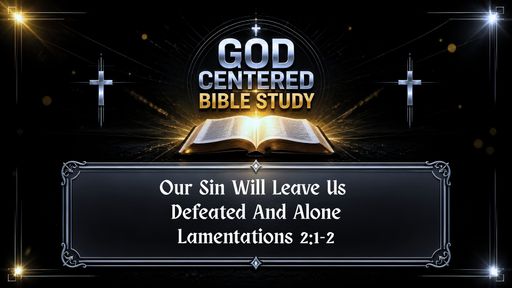
God Centered Bible Study - The Unmistakable Judgment Of God - Lamentations 2:1-2
This is the place for consistent God-Centered, God-Honoring, and God-Glorifying biblical content.
Transcript
Hello there, everybody, and welcome back to The God -Centered Podcast. This is Andy Cain, and we're in another God -Centered Bible study, and today we're picking up in the second chapter of Lamentations.
So far in the first chapter, we have seen how God has brought a great reversal of fortune.
We've seen how Israel has been deserted. We've seen how their sin has affected them.
They're seeking bread. You've got the understanding in verse 18 where true repentance starts from with declaring that they rebelled against His command and things like that.
We've come down to chapter 2 here, and the focus here is going to begin to be on God and be very—it's all
God -centered, but it's very God -centered in the sense that it's going to be very focused on the God -centered nature of the judgment that has come.
It's God that has brought it. It's God that has determined it. God determines the outline and the parameters and all those things.
So nothing is outside the sovereignty of God.
This is no accident what's happened to them. It's no accident that the judgment has come. It's no accident that they have had
Babylon come in and take them over and destroy their city and kill many of them and drag the rest off into slavery.
God has covered them in a righteous anger, and we see the anger of God on full display at the beginning of this chapter.
He's brought them low. So we see here, chapter 2, verse 1, it says, How the Lord has covered the daughter of Zion with a cloud in His anger.
Now just in passing here, when you deal with eschatology and things like that, you always have the talks of Christ coming on the clouds and these different types of things where metaphors and great imagery is used.
And so this is an example here. We need to use language the same way Scripture uses it.
And so we see here the word cloud. This is not a literal cloud of anger, like you could look up into the clouds and like,
Oh, there's a nice rhinoceros and there's a nice looking cloud fixture over there.
Oh, and there's the cloud of God's anger right there. No, this is not what's being done here.
Here obviously we need to be doing the Bible literally, which means according to the literature.
And so since it's not a literal cloud, it's speaking of the anger of God and judgment as being like a cloud, one that would be very large, maybe even enveloping a large area.
It says, He has cast from heaven to earth the beauty of Israel. Now once again, if this was literal language, it would make much sense, but because it's symbolizing something, we understand that the beauty of Israel, particularly the beauty of what
Israel was supposed to be, was as high as the heavens. Because they were supposed to be
God centered and they were supposed to be very obedient and they had the law of God and they had the law of Moses and they had
God's word and all these things. But because of their sin and repeated sin and just absolute rejection of the true prophet when
Jeremiah was trying to tell them, hey, you guys need to tighten up. Judgment's coming. They didn't listen.
We didn't listen. And so now their beauty of what they should be, the beauty of what they were, it's such a great reversal of fortune.
It's such a from a great high to a great low that it's being said as if it's been cast literally down from heaven to earth.
It says, it's not remembered the footstool of his feet in the day of his anger.
So it's picturing God here as being so angry and obviously he really was.
This isn't to say that this is saying something about God that he wasn't or didn't do or didn't feel.
It's describing how he feels in time in this moment. The anger that he has over this sin and why he has brought this judgment.
And it's so much so that he's not even remembering the footstool of his feet. He's not even taking care to watch where he's stepping.
He's not even taking care for what's below him down to earth because his anger is so strong.
And this verse one here in chapter two is a great summary verse for all the details that are about to come because verse two, all the way through verse nine, we're going to see some very pointed and distinct and detailed language that shows
God's anger being let out. His anger being acted out in judgment on these people, on the
Israelite people, because the Lord fully swallows them up here. It says verse two, the
Lord has swallowed up. He has not spared all the inhabitations of Jacob.
The time for mercy has passed. Everybody will say, oh God's love, God's forgiveness, he would never do that.
Well, yeah, he is all those things. He's all those things in an eternal, infinite sense that we can't even begin to understand.
But when he says, you need to obey me, you need to do what I'm telling you to do or else, well, you know, you think about the parent that always says, you better tighten up or you're going to be in trouble.
And the trouble never comes. Well, the child's going to learn, like, man, I can get away with whatever
I want to. They're not going to do anything about it. Well, Lord, he's a man of his word. It's like the joker in the dark night.
He's like, I'm a man of my word. You know, it's like God's a man of his word and he told you judgment's coming.
He told you through Jeremiah that judgment was coming. All these things were going to happen. And now it's here.
And the language here in verse two is that this judgment is so complete.
This judgment is so comprehensive that it's said as if the
Lord literally swallowed up all of Israel. You picture some huge sea animal and say there's just hundreds of small fish and stuff.
It's like this huge sea animal just coming through like a whale or something, just opening its mouth and just going across and just swallowing, swallowing up and just devouring everything in its path.
That's the picture that's going on here. It says here in verse two, in his wrath, he,
God, has pulled down the strongholds of the daughter of Judah. You hear a lot of talk about the strongholds of God and wanting to be attached to and be protected by the strongholds of God.
You cannot tear down the strongholds of God and things like that. It's very true. But notice here, the strongholds of man is torn down by God.
The strongholds of the daughter of Judah. He in his wrath pulled them down. Now we see instances of God's wrath throughout scripture on sin and as bad as it is, it doesn't even come close to the fact that when
Jesus Christ was on the cross, the amount of wrath for our sin that was poured out on him, this is like a
Sunday picnic in comparison, what Jesus took for you and I in our place. And you know, the wrath that God has against sin is perfectly justified.
He has no one to answer to. He has no reason to justify it. He is the cosmic creator.
We are the creatures that have sinned against him and he's perfectly right in bringing judgment how he sees fit.
It says here, he has brought them down to the ground. He does not spare.
God pulls down the proud. You may sit back and you see this a lot in daily bites of God's word when we look at Psalm 119 and other places and Psalms, David talking a lot about, you know, it seems like the evil getting away with it and they're just living scot -free, nothing ever happens to them, but here
I am trying to do what I can and all this bad stuff keeps happening. Well, the proud, the sinful, their day is coming.
They will get pulled down by the judgment of God. God will not let any pride stand and the judgment will come.
Every idle word will be judged. Every deed will be judged. Everything that the proud does will be judged and they will be pulled down either in this life or the next.
In this instance, with Jerusalem, with the lament here over what has happened with Babylon coming and taking them into captivity for 70 years, it is said that he has brought them down to the ground.
So not only did we see here in verse 1, it says, you know, he's cast from heaven all the way down to earth, the beauty of Israel, not just the beauty of what they were, but the beauty of what they should be.
And it said, he's literally brought their pride down to the ground because so many people, so many of the prophets, especially the ones where God says,
I believe it's in Jeremiah 14, one of the times where he specifically says, you know, these prophets that are saying peace and safety, these prophets that are saying, you know, judgment's not coming.
He says, they don't speak for me. I don't know them. Don't listen to them.
Well, did the people heed the warning? No. They just kept right on listening to those false prophets.
And now that pride has brought them down to the ground. He says, he has profaned the kingdom and its princes.
The very kingdom, they were supposed to be the great kingdom of God and these great princes and elders and priests and all these wonderful examples and people that were supposed to be men of God and people of God and have the very words of God.
And now they've been profaned. They've been fully brought down to the ground level.
And we see here when he says, you know, he's profaned the kingdom of his princes. God can make kingdoms as nothing.
I don't care how strong your country is, how strong your kingdom is, how long you've been in existence.
America, we're celebrating, I think, was it 250? We're, you know, a few hundred years here and, you know, we've had a great run and I certainly hope we continue on for hundreds of years into the future.
If the good Lord were to bring us down under somebody else's rule, we would have, we'd very much deserve it.
And you know, no matter how strong we may think we are, God can very easily profane the kingdom of America or the country of America and bring us down and make us as nothing.
All it would take is a few election cycles of having Satan worshiping,
God hating people that want to see chaos and torment and all these things and that'd be it.
I mean, the judgment of God is sure, it is complete and unmistakingly from God.
When God's judgment happens, even those that don't really believe in God or don't have much to do with God, even those nominal
Christians that don't really know their scripture, but they, you know, they believe in the Lord, they're babes in Christ, they haven't really matured, but they, you know, they don't really know a lot.
Even they can tell. Like when certain things happen, it's like, oh man, like this is judgment.
This is judgment. This is righteous judgment. There is no mistake when
God acts. When this happened, when Babylon come, even though they were told about it beforehand, it still was complete and was unmistakingly from God.
It had one source. All true righteous and holy judgment only has one source and that's from God.
When we engage in and carry out righteous judgment is because we're doing it in light of what we've seen
God do and what he's commanded us to do. The very nature of righteous judgment doesn't originate in and from us.
It originates from God and it can be worked through us. But true judgment and true righteous judgment, knowing what to do, what not to do, being able to command judgment to come, that comes from God.
And so we see this here as we open up the second chapter in these first two verses here, Lamentations, not only have these people been through a great reversal of fortune, not only have they had their pride and what they thought they were brought completely down to the ground, everything that was beautiful about what they should have been or what they were is completely gone.
But we see here the absolute, unequivocal proof that it is the
Lord who has swallowed them up. It's the Lord that didn't spare, have mercy in this moment.
It's the Lord that in his wrath pulls down and it's the Lord that brings kingdoms down and it is the
Lord that brings judgment. Unmistakable, full and complete, the wrath of God, the judgment of God.
And my friends, the good news is as people, we don't have to fear the judgment of God.
We don't have to fear the wrath of God. If we repent of our sin, put their full faith and trust in Jesus Christ, we will find him to be a perfect Savior.
We are saved from the wrath that we deserve for our own sin. This type of wrath, this type of judgment, we will not have to see, we will not have to go through because Jesus Christ paid the penalty for us.
He took the wrath that we see here, wrath for sin, that was due to us and took it upon himself.
And that's the great exchange. That's the great grace and mercy of God. It's amazing to think because we like to look at these people and think,
I'd never do what they did. How dare they? Are we so different?
Are we really so different? We sin too. We like to think in terms of, well, that person over there, they're a sinner.
Let me tell you all about how bad of a sinner they are. But me, no, no, no, no. We minimize our sin.
It wasn't that bad. Yeah, it was. It was. And we need to call our sin and recognize our sin in ourselves and say the same thing about it that God does, repent of it and live by faith.
And so, you know, once again, Lamentations is not exactly the happiest book in the Bible, but it is very important for us to study and to understand what happened to bring about this lamenting, where it's going, because we've seen the situation in chapter one.
We're seeing the origin of the judgment on that sin here in chapter two, and we're going to be turning that corner and you're going to see hope come into view because the story of human history is not just a story, it's not a story of wrath and judgment and all these things.
It includes those things. But ultimately, the story of human history as designed by the sovereign
God is a story of redemption, redemption found in Jesus Christ and Jesus Christ alone.
Amen. Well, thank you for joining me on this God -Centered Bible study, which is part of the God -Centered podcast, and I hope you enjoy this study.
I hope you'll go ahead and be reading ahead and getting familiar with what's coming. I look forward to being with you guys again soon.