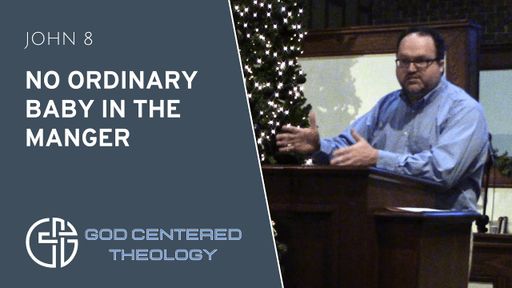
No Ordinary Baby In The Manger
This is the place for consistent God-Centered, God-Honoring, and God-Glorifying biblical content.
Comments are turned off for this video
Transcript
Today we're going to, and you will see that this goes right along with the hymns that we have sung today, because we want to talk about the fact that this was no ordinary baby in the manger.
Everything from Away in the Manger, Hark the Herald Angels Sing, all of it, we talked about the baby in the manger and swaddling clothes and cloths, and I have no doubt that that manger had a nice little stench to it, all the animals.
But everything that was involved, I think sometimes we have this pristine image of a manger scene in our minds that we would see, you know, in front of a church or even in a church, and we think, oh, how lovely, it'd be so nice and everything's just so nice.
It was probably not exactly the best living situation with animals and everything that goes on with that.
But the baby that was born by that Virgin Mary in that manger on that first Christmas was certainly no ordinary baby.
And in John chapter 8, we're going to see some elements that are brought out in this chapter, one of the best chapters in all of the scripture that testifies to the deity of the
Lord Jesus Christ. And we're going to learn some things about that baby in that manger this morning.
The first thing that I want you to understand this morning with me is that this baby is the light of the world.
Look at John chapter 8 and verse 12, it says, then
Jesus again spoke to them saying, I am the light of the world. Now parenthetically, this is one of the many
I am statements by Jesus, and I believe they pick up in John chapter 6 and make their way through the book.
I think there were six or seven of them. Now when he says, I am the bread of life, or I am the light of the world, this is just plain
English descriptor statement. I am these things. We need to have that.
It is separate from when he says, I am that I am. He has self identifies with the title that God gives himself, if you remember, all the way back in the book of Exodus, when
Moses says, who I tell them that you are, he says, I am that I am the ego, I mean
Greek, the, I am the self existent one. It is the self describing title that God gives himself.
I am that I am the, I am. And so when Jesus tells them, and we'll see this later in the sermon, when he says before Abraham was,
I am, there's a reason why they wanted to pick up stones to stone him. There's a reason why when they finally took him to the courts and said, we want him dead for blasphemy, not for breaking the law, for blasphemy, because he attributes himself to deity as a son of God.
So anyone that would tell you that Jesus never claimed to be God simply doesn't know their
New Testament. But this is one of the, I am statements. He says, I am the light of the world.
He says, he who follows me will never walk in the darkness, but we'll have the light of life.
Light and darkness are used very often in scripture to make a contrast.
Obviously in the literal sense, there's the dark of night and the light of day.
And when we won't have time to look at it, but if you were to use the creation account of how
God created this world, I think there is no mistake that God created a world that had night and day cycles because it allows us to use the natural revelation of God, the literal creation of God, as an example of righteousness versus sin and all of the things that we need to be saved from.
And Jesus is the very light of the world. The ones that follow him will never find themselves in darkness.
And this is very much in concert with the prologue of John. When John says in John chapter one, verse one, in the beginning was the word and the word was with God.
The word was God. He says he was in the beginning with God. All things came into being through him and apart from him, nothing came into being that has come into being.
And then notice it says in him was life and the life was the light of men and the light shines in the darkness and the darkness cannot overtake it or comprehend it.
It is the darkness is overwhelmed by light. If you ever go into a room with no windows, that is completely dark.
If you were to take just one of these small little candles with you now, it may not light it up like Christmas, but that light is going to overtake that darkness.
You're going to be able to see in that room. Darkness cannot eliminate light, but light can eliminate darkness.
And Jesus, the very light of the world, eliminates the darkness that is in us and replaces it with the light of his eternal life.
Just for you, you don't need to turn on to all these unless you're just really fast and moving through your
Bible. I'm going to read them all for you, but Jesus is the fulfillment of all
Old Testament references when it talks about the light of the Messiah, the light of the coming servant, the light of this baby that was born in Bethlehem.
Notice here, Psalm 27, one says that the Lord is my light and my salvation, whom shall
I fear Isaiah nine verse two, which we've already read in a previous sermon.
The people who walk in darkness will see a great light. Those who live in the land of the shadow of death, the light will shine on them.
So notice as I, there's about six or seven of these I'm going to read for you. Notice as we read through these, the usage of the word light and darkness and the contrast that is used,
Jesus is the fulfillment of all of these things. Isaiah 42 verse six says,
I am Yahweh. I have called you in righteousness. I will also take hold of you by the hand and guard you, and I will give you as a covenant to the people.
So this is God, the father in this section through Isaiah, he's talking about his suffering servant, his servant that he's going to send to the people that are captive in Babylon.
And these people will be redeemed. There's a lot of language in Isaiah 42 about God being the husband that comes and saves you and marries you, the redeemer of Israel.
So he's saying here, this servant, this person, I'm going to give to you to save you.
I'm giving to you as a covenant. So if you'll think in your minds here about what we had studied in Hebrews, the new covenant in Christ's blood, he's going to send him as a covenant to the people as a light to the nations, to open blind eyes, to bring out prisoners from the dungeon and those who inhabit darkness from the prison.
Notice the same words, the same idea when it says in John 8, 12.
So now you have a New Testament apostle, a New Testament disciple, writing and speaking about the
Messiah who now has come, who walked in human flesh. John witnessed him every day and he's saying that Jesus said,
I am the light of the world. Now these Jews that were there, they knew what he was saying.
Now they were certainly spiritually blinded. They didn't get the actual truth of what he was saying, but they knew enough about what he was saying that it made them very angry.
And they would no doubt go back in their minds to the book of Isaiah and say, he's talking about if we follow him, we're not going to be walking in darkness, but we'll have the light of life.
Is he really trying to claim that he's the suffering servant of Isaiah, the great prophet?
Yes, he is. Jesus is the one that brings light to the nations.
If you'll think about the fact that we talk about who a nation whose Lord is
Jesus, whose Lord is the one true God, that is a blessed nation. He opens blind eyes.
He brings out prisoners from the dungeon and yes, those who inhabit darkness from the prison and they, you're going to notice these
Jews that are here that he's conversing with. They're so earthly minded, so physically minded that they miss so much about what
Jesus is trying to tell them. They miss the real truth of what Jesus is conveying to them. It's not about their need to be taken out of some literal dungeon.
Their greatest need is to be redeemed from their own spiritual enslavement to sin.
Isaiah 49, it says, he says, it is too small a thing for you that my servant or that you should be my servant to raise up the tribes of Jacob and to cause the preserved ones of Israel to return.
This is speaking of the time in which they would be freed from Babylon and return. He goes on to say,
I will also give you as a light to the nation. So you see that same repeated phrase once again. He says, notice, so that my salvation may reach to the end of the earth.
And it is very much through Jesus Christ that we see salvation come to the ends of the earth.
Psalm 119, one of my favorite Psalms, Psalm 119 verse 105, very familiar scripture here.
We've probably memorized this as a youth. Your word is a lamp to my feet and a light to my path.
This is no doubt a connection to Proverbs 623, which says, for the commandment is a lamp and the light, the low is the light, excuse me, the commandment is a lamp and a light and reproves for discipline of the way of life.
So notice in Proverbs 623, you've got darkness, you've got light, and you've got life. Most of these verses that we're reading, and this ain't all we can read from the
Old Testament, but these that we're reading, you've got everything present in John 8 verse 12, light, darkness, life.
There is life found in light, not in darkness. Malachi chapter 4 verse 2, but for you who fear my name, the son of righteousness will rise with healing in its wings and you will go forth and slip about like calves from the stall.
And then probably, and this is our last one that I'm going to read for you for now, but some of my favorite scripture in Isaiah chapter 60, verse 1 through 3, it says,
Arise, shine, for your light has come and the glory of Yahweh has risen upon you.
For behold, darkness will cover the earth, a dense gloom on the peoples, but the
Lord will rise upon you. Nations will come to your light and kings to the brightness of your rising.
So we see here in the blessed reading of scripture, all these things, all this talk, you can go on in other places in Isaiah where he talks about how
I, even I am the Lord and my servant who is coming, he is me.
So God, and through the voice of the prophet, details out that this Messiah, this person that is coming to save you from your sins is not just some random person, is not just simply some man, not some baby in a manger, is the one that will save you from your sins.
So he's the light of the world. Also, we see that this baby was sent by the father. Look at verse 18 and 19 of John chapter 8.
Jesus says, I am he who bears witness about myself and the father who sent me bears witness about me.
Now, there's a whole lot packed up in there because when he says that I am he who bears witness about myself, he's telling them,
I know who I am. I know my origin. I know where from whence I came. Now, I'm not that Jesus was a created being, but what he's saying here is
I come from above. And when he says the father bears witness about me, he's telling them, you have your scriptures.
Jesus even tells them at one point, you know, you search the scriptures and you don't know truly what you need to know.
Verse 19, for they were saying to him, where is your father? So once again, we see they've got an earthly mindset.
They're no doubt thinking about Joseph. Where's your father? You say your father bears witness about you?
Well, show him to us. Let us see him. Let him tell us if his little boy has lost his mind or if he's telling the truth.
But they missed it. Just as I believe it's in John 14 where Jesus says, if you want to see the father, you need to see me.
And if you've seen me, you've seen the father. He says that here as well. They say, where is your father? And Jesus answers them and says, you know, neither me nor my father.
If you knew me, you would know my father also. Jesus was sent by the father.
Notice here, and this is not something we can get too deep in today for time, but for a sermon for another day.
But notice in passing here, the Trinitarian language being used, identifying now that the spirit is not represented in this chapter, but obviously the spirit is in other places.
But right here, we have two persons of the divine trinity, two persons that are Yahweh, but in the person of father and son.
And he says, if you know the son, you know the father. Not that the father changed modes or essences to become a son, but the father sends the person of the son.
And this is all fulfillment of Old Testament prophecy. Notice also that this baby in that manger on that first Christmas is not of this world.
Verse 23, Jesus says to them, you are from below. I am from above.
You are of this world. I am not of this world. See, Jesus entered into this world, but he did not originate from it.
Jesus is not a created being. He is the creator. John 1, the prologue, it says, everything that has come into being has come into being because of him.
And nothing that has come into being came into being without him. He's the creator of all things.
He came into this world. He, in the incarnation, he comes and tabernacles among us.
He enters into his creation, but he did not come out of this creation.
You, I, all of us, we are originated and come out of this world by dust.
And to dust, we will return. We have our origin point in two people, a mother and a father, that were of this world from Adam, the first Adam.
And because of them, we are here. But Jesus is saying, you're of the world. That's why you're thinking in earthly context.
You keep thinking, well, where's your human father? They're putting an earthly or a humanly spin on everything
Jesus is saying. He's saying, look, you're not getting this because you are of this world.
I am from above. And this should all take you to John chapter 3.
Notice the consistency and harmony of scripture, but also the consistency and harmony of what
Jesus taught. Because remember what he told Nicodemus? Nicodemus, was he not doing the same thing, thinking of earthly things from an earthly mindset?
Wait, hold on a minute. You're telling me I got to go back into my mama and be born again?
You do realize I'm full grown. Like, what are you talking? He thought he was nuts because he didn't have the spiritual eyes to see.
Now, I do believe in this. You see this in scripture, Nicodemus coming on the scene later around the time of Jesus' death, burial and resurrection.
I do believe Nicodemus was saved at some point. I don't think at this point he was because Jesus explained to him, son, you're thinking about the wrong thing here.
I'm from above. You need to be born again from above, from heaven, spiritually, a spiritual birth.
And that's their problem here. And he's saying, I created this world. He's drawing that stark contrast between the realm of God and a fallen, sinful world.
See, if our Messiah, if our Savior, if our
God was of this world, then you can't rely on him.
My friends, I would not want to rely and put my full faith and trust in flesh and blood, in dust, in something that had to be created, not something that is eternally existent.
Excuse me, someone who is eternally existent. Yes, Jesus entered his creation.
Yes, Jesus took on and added flesh to his deity. But he never ceased to be deity.
He was always deity in human flesh. He's the God -man. It takes someone, in this case
God, outside of creation, someone, something outside of ourselves, to save us from ourselves.
And that's what he's saying. You're from below. You need saving. I can save.
Notice also that this baby is the only Savior, the only one.
This is why all human religion plays and inevitably falls and cascades down into some form of cultic worship.
Some leader, some man, some woman, some thing that everybody thinks we're so united around.
And that's why it's as important as it is for us as Christians to be involved in politics, both on the local, state, and national level, and to be aware of these things, and to make good choices and support people that will be godly, and all these things that go with that.
Never forget that those people need to be saved just like we do. That's why as much as I may love one candidate or another,
I may love this political person or even someone that's in a political arena, and I may really appreciate what they do or say, we see sometimes that Christians have this tendency to take it too far, and their whole world is consumed by, well,
I'm pro this person, or they can do no wrong in my eyes almost. We need to guard ourselves from that, recognizing that, yes, they can certainly serve a role.
Same thing with pastors. Don't ever put pastors on pedestals. One of the great sins of the church throughout the 50s, 60s, 70s, and 80s, and especially in fundamentalist circles, is they put pastors on these pedestals, that they're holier than thou, they have some sort of special measure of grace.
No. If they hadn't been standing here, they would have needed Jesus just as much as the
Jews did. We are not special. We're made special by the blood of Christ.
We have something worthwhile because of Christ, but in and of myself, I cannot save myself.
I'm of this world. I can't do anything about my spiritual condition. I need a Savior. He's the only
Savior. No Joseph Smith from Mormonism, no anybody from anything else, the
Pope himself could walk in this building, and you know what? He's just a man. That's all he is.
He cannot save you. He's flesh and blood. Notice in verse 24, he's the only
Savior. He says, therefore, Jesus says, I said to you that you will die in your sins.
And here's the first time we see the other I am. Not an I am statement, but an
I am in terms of declaring who he is. He says, unless you believe that I am, you will die in your sins.
Now, in some of your translations, you may see the phrase, he'll say, I am he. That word he is not in the original text.
It is applied by translators to flesh out the English so you'll know what's being said.
In the Greek there, it's just simply, he says, unless you believe that I am, meaning he's directly saying here, unless you believe that I am
Yahweh, you will die in your sins. He's making no, pulling no strings, making no bones about it.
He's telling them, you're of this world, I'm from above, unless you believe, not that I'm just some kind of servant, not that I'm just some kind of God, little
G, or an idol, or some type of Savior politically. I'm not here to save you politically.
I'm not here to save you from, you know, a bad work environment or whatever it is. I'm here to save you from your sins.
And think about how 1 Corinthians 15, we read this a lot around Easter and different things, it talks about if Christ dies and if he isn't raised, you're still in your sins, your faith is void.
It's the resurrection of Jesus Christ that proves to the world that our sins are forgiven. And that's what he's saying here,
I'm the only Savior. Not because I'm some kind of special man or I have some kind of superpowers.
As much as I love Superman, he's a fictional character. As much as I love little
Crypto the Superdog, it's a fictional dog. I could get a dog that looks just like Crypto, put a little cape on it, it'd look really cute, but he's not going to go lifting off the ground and flying.
It's fiction. Jesus Christ is God in human flesh. He is not fiction.
He's the only Savior. He claims deity and attributes
God's self -representing name, I am, to himself. So that's why we largely say, either
Jesus was a complete whack job, completely insane, out of his gourd, or he was a complete liar.
One of the worst liars that ever walked the planet because he's telling people, I'm God. Or he was telling the truth.
And he really is who he says he is. Isaiah 43, verse 10 and 11, it says, You are my witnesses, declares
Yahweh, declares the Lord. So he says, You, the Jewish people, who are now in John 8, giving
Jesus grief and questioning him, they were told by their own prophets that God told them,
You are my witnesses that my servant, Jesus, whom I have chosen, so that now you can know and believe me and understand that I am he.
Notice, God is telling his people that this
Messiah, this servant that is coming, it's me. It's God.
Before me there was no God formed, and after me there will be none, even
I and the Lord. And there is no savior besides me.
Notice the exclusive salvific language. There is no other.
This baby's the word of God, verse 31 and 32. Jesus says, If you abide in my word, you are truly my disciples.
Notice that he takes the very scripture, scripture that they would have been holding in their hands, which would have been the
Old Testament, the Torah, and he says, It's my word. And they're like,
Is he telling us to go against the Old Testament? No, he would tell them, I'm the fulfillment of it. I'm the fulfillment of the law of the prophets.
You keep my word, you're my disciples. He says, You'll know the truth because I am the truth, and it will set you free.
This baby's the perfect savior. Psalm 36, notice this goes in concert with the one we just did.
36, it says, So if the Son makes you free, you will be free indeed. Verse 34, if you back up, there's a reason for this.
Jesus says, Truly, truly, I say to you, everyone who commits sin is a slave of sin.
But he says, If the Son makes you free, you're free indeed. You see these
Jews that were standing before Jesus, they thought they were free. They thought because they were ethnic sons of Abraham, because of their ethnicity, because of their ancestry, that they were special.
We're not blinded by anything. We're not bound to anything. We're special.
We're Jews. We're of the seed and line of Abraham. Jesus is telling them,
No, you're in slavery. You're in bondage, spiritual bondage.
And here's what I want you to take away from this before we move to our last point this morning. When it says, If the
Son makes you free, you will be free indeed, it's one of the best verses you could find in Scripture because every single, without fail, every single works -based salvific religion in the world has as its motto, whether literally or basically, that if we set ourselves free, we'll be free indeed.
Mankind thinks he can set them free. There are people in this world right now that work every single day to try to find new ways to extend their life.
Because in their mind, this is all there is. We've got to live as long as we can. We've got to set ourselves free, or because I joined this club, or this religion, or this church, or whatever it is, they think
I've set myself free. It's one of the worst bondages you could be in is to think you've set yourself free.
But here's the good news of the Gospel. Remember we talked about the God -centered Gospel last week? The good news of Christ's Gospel is that if the
Son sets you free, no person, no organization, no thing, not even death itself can put you back in bondage.
If you have been set free by the power of Christ, the power of His salvation, there's nothing, not even yourself, can put you back in bondage.
It is a one -time judicial justification by God to say you are righteous because of what
My Son did for you. Which brings us to our closing here, this last point that I want you to see in this chapter.
Verses 56 through 58 of this chapter. Jesus is telling these
Jews, Your father Abraham rejoiced to see My day, and he saw it and was glad.
The Jews said to Him, and notice once again, earthly mindset.
You're not even 50 years old, and you're telling us you saw Abraham? They were missing it.
There's some 32, 33 -year -old man telling us he knew and saw and knew what
Abraham saw? You're not even 50 yet. Who do you think you are?
They missed it. He said, truly, truly, I say to you, before Abraham was,
I am. What he's saying here is before Abraham was even a glimmer in his mother's eye, before I even created
Abraham, I was already in eternal existence. Here's why all this is important.
Let me sum this up for y 'all while our train continues to blow its horn. Every time, right around this time, is that, you know what
I think it is? I think y 'all scheduled the train so that way it's a reminder that the sermon needs to be over with because we're getting hungry, right?
I always know, oh, yeah, it's getting to be about lunchtime. I'm getting a little hungry. That train starts blowing its horn.
Now, don't start having that train come by at 1120 now. What's funny is
I use my phone to record the audio for this. My phone never picks up the train. You'll hear it just a little bit off in the distance.
I'm like, yep, there's that train every time. Well, look, let me sum this up for you. Why is it so important that we look at these instances in John 8 of Jesus himself speaking and declaring who he is?
Well, you know how we always say around Christmastime, the reason for the season, which is a cliche, but there's truth behind it.
Well, the reason Jesus is the light of the world, the reason Jesus was sent by the
Father, the reason Jesus is not of this world, the reason Jesus is the only Savior, the reason
Jesus is the Word of God, the reason Jesus is the perfect Savior, the reason
Jesus is eternal life, the reason Jesus sets captives free, the reason that Jesus is the reason for the season is because Jesus is
God. Jesus is Yahweh. That little baby in the manger, as cute as he was, that's
Yahweh. That's God. That's Lord. We serve not a physical human baby, but who that baby was and is.
We serve the fact that that is God encased in human flesh. If it wasn't, we'd still be in our sins.
So I encourage you this season, I encourage you have this in the forefront of your thinking.
When people ask you why for the joy of this Christmas season because there was a baby in a manger and it was the
God that created me and He saved me because He came to this earth and lowered
Himself down to my status as a human to save me from my sins.