A Promise at the Water's Edge: Part 1 - Joshua 1:10-15
A Promise at the Water's Edge: Part 1
Joshua 1:10-15
Sermon by Bryan Richey
Hill City Reformed Baptist Church
Lynchburg, Virginia
Transcript
Good morning. It's so good to see everyone here under the same roof Always look forward to Being together with my church family as many of you know last week.
We well actually two weeks ago We started in our study in the book of Joshua We're gonna be continuing on in chapter 1 of Joshua So you have a moment go ahead and take the time to turn to Joshua chapter 1 verses 10 through 15
This message is going to be the first of a two -part series
Where we're going to be finishing up Joshua We'll be going through verses 10 through 15 this
Sunday, and then we will be closing out the series in verses 16 through 18 next week
So this is part 1 And the title of this message is a promise at the water's edge
Now if you recall in our previous study at the beginning of Joshua chapter 1 we found ourselves in a period of historic transition where where Joshua assumes leadership after the death of Moses and he found himself
Tasked with the leading of an entire nation of people into the promised land
This was just not evident in the commission of Joshua, which I'm I could covered last week in verses 1 through 9
But we've also find in this passage here that we see a transition now, that's moving really from that of divine generational promise to the necessity of human preparation
Always remember that godly preparation is not trusting in our own devices, but but rather seeking out
God's guidance and God's grace It's knowing that that God ordains our steps and that God equips us for the task at hand
And that God has prepared us for every good work In the book of Proverbs we find this same sovereign principle
Summed up in one short sentence where we see in Proverbs chapter 16 verse 9
Where the writer says that a man's heart plans his way, but the Lord directs his steps
Now Likewise we find in his ministry as it was coming to a close here on earth the
Apostle Paul He touched on this very same point as well, which we see in his very last letter to the
Timothy Where we see in 2nd Timothy chapter 3 17 He said this he said that the man of God may be complete thoroughly equipped for every good work
So the scene in this passage here is one of great anticipation Perhaps a little bit of anxiety coming from the memory of past disobedience
I'm sure that there were many within the nation of Israel that were haunted by that previous Generation who had dismissed the report of the good spies on the promised land ultimately rejecting
God's promise So these things really cast a very long and foreboding shadow of past Disobedience and as such we find ourselves now at Israel's second attempt at obedience
Where they would once again be at the threshold of claiming God's promise That God made to Abraham so long ago
Thus in many ways the scene here is a familiar one for the Israelites and once again We find themselves standing at the brink of Canaan Where they're haunted by past failure and yet they're confronted with the challenge of inheriting the land
That had been promised to Abraham by God all the way back in Genesis chapter 15
So with that said let's take a look at the passage now that is before us Let's look at Joshua chapter 1 verses 10 through 15
The writer says this Then Joshua Commanded the officers of the people saying pass through the camp and command the people saying
Prepare provisions for yourselves for within three days You will cross over this
Jordan to go to possess the land which the Lord your God is given you to possess And to the
Reubenites and the Gadites and half the tribe of Manasseh Joshua spoke saying remember the word which
Moses the servant of the Lord commanded you saying The Lord your God has given you rest and given in and has given you this land talking about the land east of the
Jordan here Your wives your little ones in your livestock shall remain in the land of Moses That which
Moses gave you on the side of the Jordan this side of the Jordan But you shall not pass
But you shall pass before your brethren armed all your mighty men of valor to help them
Until the Lord has given your brethren rest as he gave you And they also have taken possession of the land which the
Lord your God has given them Then you shall return to the land of your possession and then enjoy it which
Moses the Lord servants Servant gave you on this side of the Jordan towards the sunrise
So now as we move further here to Joshua chapter 1
We will find ourselves now looking at a pivotal moment in history Where Israel will be called on to seize the moment and the following two points of our message this morning
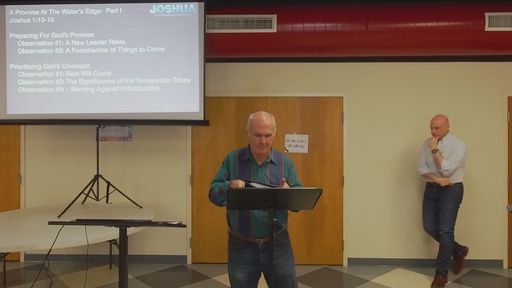
The first point that I would like to draw your attention to is preparing for God's promise
This is clearly seen in Joshua chapter 1 verses 10 and 11 This will bring us to the second and then the final point of our message this morning, which is
Prioritizing God's covenant. This is clearly seen in Joshua chapter 1 verses 12 through 15
Now the passage that we just read here is one of recorded history and it demonstrates
God's Sovereign faithfulness to his covenant and it demonstrates how God unilaterally initiates and it sustains his people and It will ultimately become a challenge for each one of us to respond in obedient faith
In his letter to the Ephesians The Apostle Paul explains what we were created to be where he said this at Ephesians chapter 2 verse 10
He said for we are his workmanship created in Christ Jesus for good works, which
God prepared beforehand That we should walk in them So our passage here in Joshua is an interesting one where we find really three distinct speeches now flowing from God's words to Joshua First we see where Joshua was preparing the people with a call to action
Secondly, we then see where he provides an important reminder to the officers of the people and those transjordan tribes of their obligation
To Moses and the rest of the nation to fight alongside them west of the
Jordan this of course would require them to leave their households to You know leave their belongings east of the
Jordan River and of course Leave the land that was previously allotted to them and move forward with the rest of the tribes in their conquest of the promised land
And of course we finally see here the tribes making their commitment known to Joshua Which will be addressed in a subsequent message next week when we get to verses 16 through 18 so now this brings us to the very first point on our message this morning and That is we see the nation of Israel now preparing for God's promise
You know as we look at the opening verses in our passage here we find Joshua now at the forefront of a generational imperative as You know, he commanded
God's people to prepare for God's promised inheritance This is a time of great anticipation
It's a time where they would begin to move from a nomadic people to a nation building people
And of course, it'd be a time where they are now being called on to seize God's promise
And in this opening verse here, we begin to see where a new leader rises in Joshua chapter 1 verse 10
We now find Joshua rising to the occasion as God's appointed leader and in his first order here would be to mobilize the officers
Directing them to have the people to prepare their provisions for the imminent crossing of the
Jordan Of course, this would lend one to question That is what exactly are these officers to the people?
You know the meaning of the word officers here is translated from this the Hebrew noun which is show to ream which is a word that is used to refer to as officers or or overseers or officials in the
Old Testament it denotes individuals that are in positions of authority or leadership oftentimes with administrative or judicial responsibilities
However within the context of Joshua chapter 1 verse 10, it appears that they refer to officers that were under Joshua's command
It oftentimes refers to officers who are responsible for for organizing and directing the people of Israel I mean, these are the guys that are responsible for ensuring order and the execution of God's instructions
It Was also likely that these individuals had a role in maintaining discipline sometimes serving as scribes depending on the context
We see references to these type of officials in Exodus chapter 5 verse 6 as well as in Deuteronomy chapter 16 verse 18
So as we examine these verses here We really begin to see a spiritual focus on these
Officers of the people as they would be assuming very important leadership responsibilities for the challenges that lay ahead
Thomas Brooks He was a prominent Puritan minister and author He lived from 1608 to 1680
He was known for works that he wrote Entitled heaven on earth as well as the crown and the glory of Christianity And as it related to the qualities of godly leadership, he'd have this to say
He said a good leader must first be a good liver One who lives rightly?
He must be a man of God before he can be a guide to men now as it relates to what we see here in Joshua's appointed leaders the
Status of the officers of the people is sometimes difficult to determine with any precision
I mean we do see they first appear in the infamous bricks without straw reference that's found in Exodus chapter 5
We see that the ESV actually will translate that word of official as a foreman like a work foreman
We see this specifically in Exodus chapter 5 verse 6 In Numbers chapter 11 verse 16
We see several occasions also in Deuteronomy that these men are aligned oftentimes being drawn from the elders
Within the community of Israel, but yet they're considered distinct from them In Deuteronomy chapter 20 verses 5 through 9
We see that the exercise management functions and a military rather than a civilian capacity
They're oftentimes drawn into judicial functions that's seen in Deuteronomy chapter 16 verse 18
Where we also find in later texts and first Chronicles and and in second
Chronicles We see them sometimes originating from the the tribe of the Levi Levites and of course the scribes
When we meet them though here in the book of Joshua They form really part of a group with the elders and the judges
We see references to them in Joshua chapter 8 in chapter 23 and 24 as well
So this reference to the officers of the people it really can mean many things It's it's rather broad
But I think within the context of this passage here and the challenges that lay ahead we can get a pretty good idea of what?
They're doing It is expository commentary on the book of Joshua David Reimer He summed up the role of these officers of the people in the following manner where he said this
He says what we do see across these texts is the officers are seen as exercising a broad organizational authority in the life of the
Israelite community One in which such authority is derived rather than inerrant and where it is a matter of function and not status
Here that authority involves serving as the conduit of Joshua's commands to the wider population
Much as Joshua himself is the conduit for God's commands to his people
You know one thing is for sure and that is despite what these specific duties or responsibilities may have been
We do find ourselves within a period of great transition for the nation of Israel and we also find a new and untested leadership here who would really have to dedicate themselves to God's mission and purpose
Joshua's leadership team no doubt no doubt would be tested in the days ahead For that what we're seeing here is really the early planning stages of God's promise here
We also understand that when it comes to God's sovereign plan as Joshua well knew and the officers of the people
Is that they would have to have a total reliance on him in order to complete and to fulfill this promise?
Unfortunately, we live in a day where leadership by the world's standards stands in stark contrast to what the
Christian view of leadership should be And yet so many times we look at our world as the standard -bearer when we really should be looking to God in his standard instead
Let us never forget that true leadership stems from personal holiness and submission to God let us understand that that it's not a mere position of popularity or charisma and let us also remember that leaders who fail in moral character will ultimately determine and undermine their own ability to guide others and This of course is the godly standard that not only are we to apply to ourselves
But as a congregation you're to apply to us and leadership as well So now that we've really considered the fact that a new leader is rising here
We now have to look at another observation where we find a foreshadow of things to come
Specifically what we find in Joshua chapter 1 verse 11 is we see this emphasis on on Practical preparation that may seem like a preliminary task on the surface, but it also it contains some very interesting parallels as well one thing that is for certain here and that is that narrative chronology and Joshua sometimes can be a little difficult for the modern
Christian to follow However, what we do see in Joshua here is that he's directing three days to be taken before breaking camp and crossing over into the
Jordan now What is so interesting here in this passage is that this story Will essentially take a pause when we start chapter 2 and what will happen there is it'll kind of take a pause
It'll move over to the story of the spies that were spying out Jericho And then it'll pivot back to our place where we're at now in chapter 3 verse 2
Which we will learn about here in ensuing Sundays another interesting thing that we see here is we're seeing a three -day like Preparation time for provisions before they cross the
Jordan and likewise when we're in Joshua chapter 2 You're gonna find that the story of the spies would also have their own three -day
Span as well, which we see in Joshua chapter 2 verse 22 now
So this time frame that we're seeing here within three days. It's found in this passage It really kind of builds anticipation and likewise
We see that this same anticipation and this same time frame is evident in the death burial and resurrection of Jesus Christ In fact, the
Apostle Paul tells us in 1st Corinthians chapter 15 verse 4 Where he says and that he was buried and that he rose again on the third day according to the
Scriptures So just as we have a new life in Christ due to his resurrection
So do do we find Joshua now the symbol of the new life that they would once they would they would achieve when they go
Into the promised land and while many may tend to write these things off as mere coincidence I'm here to tell you that taken as a whole.
We see this spiritual continuity Emerging through the ages over long periods of time.
Of course, it makes it quite difficult not to believe otherwise Thus as we consider this foreshadow of things to come
We find this to be of a very relevant consideration not just from Israel's future standpoint here
But also we find that there's a foreshadow of a greater covenant that would one day come to God's people
In his sermon on Acts chapter 16 verse 9 John Owen proclaimed that earthly events serves as Reflections of God's eternal plan where he said this
He said the events of this world are but a glass Wherein we see the shadow of God's eternal counsels pointing us to his ultimate design
Now before we get too far in our study of Joshua chapter 1 I would like to take a moment to offer a brief explanation of this doctrinal concept of foreshadows and covenants and I believe that this is important to us because We need to be familiar with this because we find ourselves here in the
Old Testament and with this passage and of course many more to follow as It relates to the doctrinal term of foreshadows anyone who attends this church
Will readily find that the elders view and teach the scripture through the lens of covenant theology
This is a theology that emphasizes the unity of God's redemptive plan through the ages
It is often viewed as God's intentional design It reveals glimpses of his ultimate salvation through through types and shadows and promises readily seen in the
Old Testament where we find ourselves this morning and They ultimately point forward to the greater reality realities that are found in the
New Testament Where we find it in the person in the work of Jesus Christ now this concept here is rooted in the belief that God's sovereignty is seen throughout the ages and that his
Redemptive plan is is unified across both Old and New Testaments here So in the
Old Testament for which Joshua here is a part of we find it serves as a preparatory
Revelation here a revelation that would find its fulfillment in Christ and the New Covenant therefore in the end
We must really keep this in view as we consider the preparations that are being undertaken by Joshua and his officers here
We need to understand that this is a precursor to the fulfillment of God's greater promise and the honoring of his covenant
Now I don't want to get too far in the weeds here But I would also like to quickly address another term of doctrinal significance, which is that of covenants?
In the Old Testament covenants on the other hand We see such as the Abrahamic the the Mosaic and the
Davidic covenants are there understood as progressive? Revelations that anticipate the
New Covenant established by Christ's death burial and resurrection We see this evident in Hebrews chapter 8 verses 6 through 13
Ultimately the promised land for which Joshua and his people of Israel would begin to possess is a
Gift from the Lord your God it is not earned by merit But it is sovereignly bestowed which is what we see in Deuteronomy chapter 9 verses 4 through 6
And as we consider this anticipated event of the Israelites crossing over into the promised land
We are reminded of God's irresistible grace where he draws his people into blessing
Yet commands them to exercise an act of faith, which is seen in James chapter 2 verses 14 through 26
So in the end where there's a foreshadow We often find a covenantal theme close by Where there's a foreshadow we find a covenantal promise being fulfilled or alluded to Where there's a foreshadow we often find a covenantal transition taking place
So covenants are a very important thing to view the Old Testament through this is why scripture here is so profound
Especially due to the spiritual continuity that we see throughout the ages and all of these things are bound together
By God's covenants to his people not as much that we can apply to our lives here
But I would say that within our church family we see many imperatives Where a leader will rise
Whether it is the God -given leadership responsibilities of husbands and fathers over their respective families in our church or Deacons and elders that are called on to lead a church history shows us the importance of spiritual preparation in these matters for example men especially need to be mindful of those transitions from from singleness to dating relationships from dating relationships to Responding to the call of husband and marriage to becoming a father or the appointment of deacons and elders within a church context so the question that we need to be asking all of ourselves is
Are we preparing our hearts and lives for God's advancing purposes or we just complacent?
In each case where God Calls on a man to be married. We see that a leader rises
Each case when a church congregation calls on a deacon or an elder to assume a ministerial responsibility
Within the body we see where a leader rises and therein We find an example here with Joshua where we too are called on here to lead courageously to accept
Responsibility and to always keep an eye on the greater reward And just as Joshua called on the people of Israel to prepare to cross over into the promised land
Or perhaps a family in our midst that one day will pack their belongings for a long -awaited move
Or a young married couple that will become parents for the first time and any and all of these things
One thing is consistently seen here and that is God's people must ready themselves spiritually for every season of life through prayer through the study of Scripture through repentance renewal and purpose
And why is this My brothers and sisters.
It's because that our inheritance is secured in Christ The Apostle Paul said as much in Colossians chapter 1 verse 12
He said given thanks to the Father who has qualified us to be partakers of the inheritance of the saints of the life
So let us not forget That just as we see Israel's call to prepare as a foreshadow of things to come
We too are to demonstrate a covenantal Solidarity here amongst believers because in the end
No one is exempt from the need for spiritual preparation Now we've really covered some doctrinal territory here, and I really appreciate your
Paris patience But I believe that to be a necessary exercise Especially when we look at the next point in our message this morning where we see the nation of Israel prioritizing
God's covenant You know as we move into Joshua chapter 1 verses 12 through 15, we now see
Joshua and the people prioritizing covenantal unity over personal rest the passage highlights the unity of God's covenant people the necessity of Corporate obedience and the outworking of divine grace and human responsibility
Now this brings us to some important observations as well and of course as it relates to these covenant priorities
We need to really take a look at the fact that rest will ultimately come Specifically what we see here in Joshua chapter 1
Verses 12 and 13 Joshua now Joshua is now reminding the tribes of Reuben and dead and half of the tribe of Manasseh He reminds them of Moses's command that the rest will come
Now it should be noted that this rest is not self -achieved But rather it will come from God and it will come at some future point in time
And while rest is indeed a divine gift These two and a half tribes of Israel would have to wait until God's promise was completely fulfilled
Whether that rest followed God's six days of creation, which is seen in the book of Genesis Whether we see that that rest would come after the conquest of the promised land
Which we see here whether that Sabbath rest comes after six days of labor Like we deal with on a weekly basis in our workplace and all these things rest is a blessing.
That's to be enjoyed After hard work and accomplishment and this scriptural pattern here we see here as well
Another observation that I think is important for us to take a look at is the significance of the transjordan tribes now
Let me explain this a little bit to you You know as we consider this subgroup here within the nation of Israel We really have to consider that there's some prior history that we kind of need to bring forward into our passage this morning
You know when we look back at God on God's speech in Joshua chapter 1 verses Chapter 1 verses 1 through 9 we find really it included several
Implied references of passages that reach all the way back into the book of Numbers in Deuteronomy And of course the same is true in these verses this morning as well as a group the
Rubenites and the Gadites and half of the tribe of Manasseh are sometimes designated as the Transjordan tribes or perhaps the
Eastern tribes or sometimes we see people refer to them as the two -and -a -half tribes These naming conventions are generally assigned to that group within the nation of Israel that would possess the promised land east of the
Jordan River These are the people that kind of had their land secured first Prior to the
Jordan River being crossed and the rest of the Israelites having to claim their promise
So what we find now is we got really this subgroup that this Joshua now is focusing on and the origin of this grouping is found all the way back in Numbers chapter 32 verses 10 through 32
And we see references to this same group later back in Joshua as well However, this exchange will also have something of a foreshadowing to the dramatic events that we see in Joshua chapter 22
So we see this connectivity here with this group And in this way of course the claims and the actions of the
Transjordan tribes Would have a special role in displaying the status of all the tribes of the nation of Israel And it would also serve as an opening glimpse of God's fulfilled promise to the nation as a whole as well
But the rest that would come would have to wait until the commitments of the present were accomplished
The arrangements with the Transjordan tribes here are predicated on a promise that was made by Moses Where they would be given the land east of the
Jordan River We see this in Numbers chapter 32 and we also find a summary repetition of it in Deuteronomy chapter 3 verses 18 through 20
Again, we also find it in this passage as well However, we do find a significant difference here in this account that we find in Joshua where Joshua is actually in turn endearing this term of rest a place of rest in his preconditional charge here to these
Transjordan tribes And in this significant difference we see this in verse 13
Where he assured the tribes that God would indeed be providing them a place of rest This assurance is not seen in either account which we see in Numbers chapter 32 or Deuteronomy chapter 3
So now that we've really discussed the fact that rest would ultimately come And we've also kind of seen the relevance of the
Transjordan tribes here in this story We also need to really carefully consider the warning against individualism.
Now, what do I mean here? You know as we move further into Joshua chapter 1 verses 14 and 15
We are once again having to go back and bring some history forward into the text that we're considering this morning
This is especially important for us to really understand what is going on here you know one thing is for certain and that is that when we examine these verses through the lens of Numbers chapter 32 and through the experience that we see with these two and a half tribes within the nation of Israel We find that really when they first engaged
Moses on this Request of theirs that Moses really was kind of somewhat taken aback
Moses actually responded in anger We find that Moses said hey look you're you guys are a brood of sinners here
You're wanting to claim your inheritance so you don't have to to commit yourself to the rest of the conquest
Now what we find here, of course Moses would hold them to their commitment He would make sure that they promised that they would see this thing through with their brethren as well
And in an effort to maintain this unity of purpose when it came to God's promise Moses would secure this commitment
To a full conquest of the promised land before they would be allowed to enjoy the rest from the land that had already been secured east of the
Jordan So Joshua Remaining faithful to this promise.
He would address these trans Jordan tribes Recalling Moses's command and reminded him that they may one day settle in the east of the area east of the
Jordan But they must first aid their brothers in conquest So many ways we see this implied warning against individualism
Because these tribes would risk a covenant curse If they were not to fulfill this commitment made to Moses This is seen in Numbers chapter 32 verse 23
And when you think about it from a New Testament Church perspective We find this akin to the church discipline that sometimes imposed on on individuals engaged in unrepentant sin
Now one of the most noteworthy things that we do see is in verse 14 where these men of valor
They would be crossing the Jordan River armed before their brothers Which essentially stresses this sacrificial unity here that we should have as a church body as well
It was very clearly demonstrated in this passage that None of Israel would enjoy this rest until all of them were able to receive it
Now, you know, we live in a time where promises are quite disposable Commitments are untimed
Oftentimes not kept and a kindness extended is oftentimes a kindness to be forgotten
And this is in large part due to the disposable nature of our culture here Unfortunately self -interest rather than self -sacrifice becomes the order of the day and we see this increasingly becoming part of the cultural norm
However Christians as our church family as our body of Christ here we are challenged to view promises and commitments differently
This should be within the context of these promises and commitments being with Christ in mind They should be directed for the good of others.
They should be a statement of our faith and our honor instead So prioritizing
God's covenant is what we see here in Joshua and likewise. It should be the case for our church family as well
Again, there's much to be applied here You know one thing that is distinctive in Reformed baptist churches and that is that each member within our congregation.
We are in covenant commitment towards one another Some of the ways that we accomplish this is supporting one another within the context of a church family
Or through missions or through discipling others or through safeguarding the church's doctrine
So that way it can be enjoyed by ensuing generations What we see here in this passage today
Is an example that we should follow So the question that we should all be pondering is this
Are we willing to leave personal rest in order to advance God's kingdom? You know one thing that we do see in this passage is that it serves as a model for the perseverance of the saints
In his letter to the philippians the apostle paul also stressed this point Especially as it relates the importance of God's elect
Especially when they are remaining faithful in trials where he said this We see this in philippians chapter 1 verse 6
He said being confident in this very thing that he Who has begun a good work and you will complete it until the day of jesus christ
We also find joshua's imperative here It reflects a covenant theology
Where the visible community which in this case is the nation of israel includes obligations to one another
We see the foreshadowing of the church as a covenant body under christ We see this in hebrews chapter 4 verses 8 through 11 actually
And of course we see christ as our greater joshua Now let us be judicious in the promises that we make
Let's make sure that a promise made is a promise kept Let us realize that each one of us here are imperfect humans.
And so we should only make promises with great care and introspection And we do this so that way it does not become an occasion for sin on our part you know, we
Live in that world where promises can easily be broken or made with the wrong motivation However, we need to run counterculture to the world today
We need to understand that a broken commitment can result in a damage to ourselves or other people sometimes we may find ourselves in a position as a christian where God may require us to follow through with the commitment made by others
Which in turn would require a change in our own priorities and if we're called to do that So let's do so with honor and dignity and in a manner that will glorify our god, which is in heaven
One last thing that does come into view And that is that there's clear echoes here of the new covenant where christ here and his finished work secures our inheritance
Yet as a church, of course, we are Basically called on to persevere and faithfulness in the time in which we find ourselves
As it relates to this challenge of persevering in confidence Richard seabees encouraged us to trust christ grace to overcome personal setbacks where he said this
He said there is more mercy in christ than sin in us Let us therefore go on with boldness in the way of godliness
And this is really what god's covenant Looks like to these soldiers who would leave their families and fight alongside of their brothers in battle
And likewise we as believers should forsake worldly ease for the gospel mission
This reflects the important doctrine of perseverance Where the true faith is evidenced by not just a fleeting zeal that by a steadfast endurance through trials
Rooted in god's preserving grace Let us pray Our heavenly father lord, we come before you as a covenant people united in christ in mission and purpose
Lord let us take the example of joshua and these officers of the people who found themselves at the water's edge of promise
Let us understand that your redemptive plan transcends history
It begins in the old testament and goes all way through the final words in our new testament experience
Dear lord, I just ask that we stay focused on you That we understand that we were created for a specific time such as this
Lord that we will honor you Lord that we will glorify you in all our ways And lord that we will be ready to stand with the ensuing generations that are to come