A Geography of Grace - Joshua 19
A Geography of Grace
Joshua 19
Sermon by Micah Green
Hill City Reformed Baptist Church
Lynchburg, Virginia
Transcript
and let's turn again in the book of Joshua chapter 19 rapidly approaching the the end of the of the book and today we are finishing a major portion of the book as Joshua has gone through and and recounted and chronicled for us the distribution of the land the boundaries of the tribes of Israel that will finish today and Lord willing starting next week we will be looking at the the
Levite cities of refuge so we're continuing today in the distribution of these remaining six tribes last week we looked at Benjamin the tribe the the boundaries we also considered the the source of the inheritance last week the source of the inheritance that it came from God himself that that this the center of worship the tabernacle that had been moved from Gilgal to Shiloh this was the the place from which
God's commands issued regarding which of these allotments would be given to which tribes we also saw last week a warning against faithlessness we saw the charge from Joshua to take the land that had been given to them this why are you waiting here how long are you going to put this off how long are you going to neglect doing what
God has commanded you to do we also saw God's meticulous sovereignty we saw his sovereignty in his sovereign plan in that he commanded the these representatives three from each of the seven tribes they were all to go and survey the remaining land and parcel it out in seven presumably more or less equal pieces of land a very practical thing that they were to undertake and then that was coupled with the miraculous distribution of the land through the casting of lots at the tabernacle we saw the the first tribe of these seven tribes
Benjamin this land of mediation this land that sat between the tribes of Joseph to the north and the tribe of Judah to the south this tribe of Benjamin that would be home to the city of Jerusalem the city in which
Jesus would spend the last week of his earthly ministry teaching and confronting the religious leaders healing and then finally being crucified on the cross buried and raising victorious from the dead
I'm I'm always shouldn't say amazed but maybe encouraged and and also convicted as we have been going through each of these chapters and and this repeating theme that we see over and over again of God's sovereignty of his grace and his mercy his loving -kindness his long -suffering towards the people of Israel and each week we've seen in some point in some portion of the passage that we've looked at each week this warning for the last number of weeks almost as if God wants us to get the message that there is a warning against disobedience we saw that last week and we'll see again this week a warning against disobedience if you were to to sit down and read a legal last will and testament of someone of a complete stranger you would you would see references made to assets to financial accounts to property to other goods if we were to read this from a from a complete stranger it it probably would not really mean anything to us it was somebody well -known it might be interesting but otherwise it would have no consequence for us on the other hand if you were to read the last will and testament of your own father suddenly every word matters deeply every piece of of promise everything that is given out every bequeathment would be highly consequential to us so our passage today we continue to look at these allotments the distributions of the land and far from being a rattling off of cities and regions and geographical references that are inconsequential to us today we see this inheritance from a loving heavenly father to his children and we also see an inheritance that that was temporal in nature but it points forward to a perfect in a lasting and everlasting an eternal inheritance that God promises to all who come to faith and call upon the name of the
Lord for salvation so with that in mind let's continue on we're going to read will be in chapter 19 this morning in the second lot fell to Simeon the tribe to the tribe of the sons of Simeon according to their families and their inheritance was in the midst of the inheritance of the sons of Judah so they had as their inheritance
Beersheba or Sheba and Moladah Hisar, Sheol, and Bela, and Ezzam, and Elshalad, and Bethul, and Hormah, and Ziklag, and Beth -Markaboth, and Hazar -Suzah, and Beth -Lebeoth, and Sharuun, 13 cities with their villages.
Ayen, Riman, and Ether, and Eshan, four cities with their villages and all the villages which were around these cities as far as Baalath -Beer,
Ramah of the Negev this was the inheritance of the tribe of the sons of Simeon according to their families the inheritance of the sons of Simeon was taken from the portion of the sons of Judah for the share of the sons of Judah was too large for them so the sons of Simeon received an inheritance in the midst of Judah's inheritance.
Now the third lot came up for the sons of Zebulun according to their families and the territory of their inheritance was as far as Sareed.
Then their border went up to the west and to Maralah. It then touched Dabeshieth and reached to the brook that is before Jochanim.
Then it turned from Sareed to the east toward the sunrise as far as the border of Chisloth -Tibor and it proceeded to Dabereth and up to Japhia.
From there continued eastward toward the sunrise to Gath -Hefer, to Eth -Kazin, and it proceeded to Reman which stretches to Neah.
The border circled around it on the north to Hanathon and it reached at the valley of Ith -Tethel.
Included also were Kata and Nahalal and Shimron in Edalah and Bethlehem, twelve cities with their villages.
This was the inheritance of the sons of Zebulun according to their families these cities with their villages.
The fourth lot fell to Issachar to the sons of Issachar according to their families. Their territory was to Jezreel and included
Chesoloth and Shunem and Hapharam and Shihon and Anaharath and Rabeth and Kishon and Ebez and Rameth and En -Ganim and En -Hadah and Beth -Pezes.
The border reached to Tabor and Shaz -Zuam and Beth -Shemesh and their border re -ended at the
Jordan, sixteen cities with their villages. This was the inheritance of the tribe of the sons of Issachar according to their families the cities with their villages.
Now the fifth lot fell to the tribe of the sons of Asher according to their families. Their territory was
Hel -Koth and Hali and Betan and Ak -Shaf and Al -Melek and Amad and Mishal and it reached to Carmel on the west end to Shihor -Lifnoth.
It turned toward the east to Beth -Dagon and reached to Zebulun and to the valley of Iftithel northward to Beth -Emek and Niel.
Then it proceeded on north to Kabul and Ebron and Rahob and Haman and Cana as far as the great
Sidon. The border turned to Ramah and to the fortified city of Tyre and the border turned to Hosa and then it ended at the sea by the region of Ak -Zib.
Included also were Umah and Apak and Rahob, 22 cities with their villages. This was the inheritance of the tribe of the sons of Asher according to their families these cities with their villages.
The sixth lot fell to the sons of Naphtali according to their families.
Their border was from Helef from the Oak in Zanarim and Adonai and Jabnil as far as Lekum and it ended at the
Jordan. Then the border turned westward to Asenoth -Tabor and proceeded from there to Hokok and it reached to Zebulun on the south and touched
Asher on the west and to Judah at the Jordan toward the east. The fortified cities were
Zedim, Zer, and Hamoth, Rakath, and Shinareth, and Adamah, and Ramah, and Hazor, and Kadesh, and Edrai, and Hezor, and Yiran, and Migdal -El,
Haram, and Beth -Enah, and Beth -Shemesh, 19 cities with their villages. This was the inheritance of the tribe of the sons of Naphtali according to their families the cities with their villages.
The seventh lot fell to the tribe of the sons of Dan according to their families. The territory of their inheritance was
Zorah, and Eshtal, and Er -Shemesh, and Shabalin, and Shalabin, and Ijan, and Ithlah, and Elan, and Timnah, and Ekron, and El -Keteh, and Gibethon, and Baleth, and Jehud, and Beni -Barak, and Gath -Rimon, and Majokon, and Reikon, with the territory over against Joppa.
The territory of the sons of Dan proceeded beyond them for the sons of Dan went up and fought with Leshem and captured it.
Then they struck it with the edge of the sword and possessed it and settled in it, and they called Leshem Dan after the name of Dan their father.
This was the inheritance of the tribe of the sons of Dan according to their families these cities with their villages.
When they finished apportioning the land for their inheritance by its borders the sons of Israel gave an inheritance in their midst to Joshua the son of Nun.
In accordance with the command of the Lord they gave him the city for which he asked, Timnath -Sarah, and the hill country of Ephraim.
So he built the city and settled in it. These are the inheritances which
Eleazar the priest and Joshua the son of Nun and the heads of the households of the tribes of the sons of Israel distributed by lot in Shiloh before the
Lord at the doorway of the tent of meeting. So they finished dividing the land. Father we thank you that in your word we are we are reminded of the of the seriousness, the reality, the persistence of sin, of the warnings against disobedience.
That we are reminded even in passages like this that sin crouches at the door and it seeks to pull away those whom you've called to yourself.
That we are reminded that apart from you we are nothing, that we have nothing, that our identity is that of a rebel, of someone who is your enemy, who has turned aside and gone our own way.
Father we thank you this morning that we are reminded that we desperately and constantly need you.
And father at the same time we are also thankful that in the midst of these warnings that you also give us assurance of your grace and your mercy.
That you are a God who is slow to anger and abounding in steadfast love.
That that love reached its fullest measure and demonstration and the sacrifice of our
Savior Jesus on the cross. Father today as we so we read your word and as we consider it we consider what you have to say in your word would we would we be warned once again would we be exhorted once again to serve you and you alone would we be encouraged would we be edified as we remember again your grace and your mercy your chesed your your unfair it unmerited favor that is shown towards all of those who call upon the name of the
Lord for salvation Lord would we we have a fresh thankfulness and gratefulness for your mercy for your salvation which you have brought to us which was proclaimed all the way from the from the garden was was shadowed foreshadowed again in passages like the one that we've read this morning and it was made real in the life and the death and the resurrection of Jesus we ask this in Jesus name last week for the most part we saw the process of this inheritance we saw that the setting up of the tabernacle and the casting of lots and the survey of the land we saw that the process by which the land was distributed and then in the case of Benjamin we also saw the result this land that they were given we saw that the long -term implications and ramifications of the giving of that land this week we will see the process and the results for those remaining six tribes again as in previous weeks we see
God's grace we see warnings against disobedience and again we see the gospel that is proclaimed that is foreshadowed we look back at these passages with the cross in mind the gospel of Jesus Christ in mind we see first of all that the first tribe that is mentioned here is is
Simeon Simeon receives an inheritance that is in the midst of Judah it is unique in this situation it is the only territory that is completely surrounded by another tribe and in political geography we call this an enclave when one independent state is completely surrounded by another and it's not something that happens very often in fact as of today there are only three recognized independent states that are enclaves
Lesotho which is completely surrounded by South Africa and then there are San Marino and the
Vatican City which are extremely small and they're surrounded by Italy it's not very common and it is something that was as it was unusual for the tribes of Israel Joshua gives us the reason here that that Simeon's territory was carved out of Judah he says that the share of the sons of Judah was too large for them we see that in verse 9 to the to the casual reader this might seem like a textual problem because we've been talking about how all of these tribes were defined they were given by God so for Joshua to say that it was too large for them yet God was the one who gave it did that mean that God made a mistake oh we would know the answer to that is no
God did not make a mistake so there is no contradiction here it could be that the land of Judah was given
God intended for them to take it all but through their lack of effort they failed to settle the entire land ultimately
Joshua doesn't give us explicit reasons on this or why the land was too large for them but we also see alluded to four centuries before another reason that Simeon is placed in the midst of the tribe of Judah we've we've read for the last couple of weeks now in Genesis chapter 49 if you remember
Genesis chapter 48 Jacob is giving a blessing to his sons and then he gives a prophecy in chapter 49 regarding his sons and what would happen in the years to come in chapter 49 verses 5 through 7
Jacob says Simeon and Levi are brothers their swords are implements of violence let my soul not enter into their counsel let not my glory be united with their assembly because in their anger they slew men and in their self -will they lamed oxen cursed be their anger for it is fierce and their wrath for it is cruel
I will disperse them in Jacob and I will scatter them in Israel so what is what is
Jacob referring to here this violence that they committed well we can't go into detail of what happened time won't allow us to do that but the details for this are in Genesis chapter 34 he's referring to this this act of deception and violence that Simeon and Levi undertook in avenging the assault of their sister
Dinah the sin was probably not as much in avenging their sister as it was that they used the the sacred right of circumcision as this pretext for incapacitating
Shechem this man who assaulted Dinah and the other men in the tribe of the
Hivites and so able to unable to fight at full strength they were at a at a serious disadvantage and so Simeon and Levi killed all of the male
Hivites now that they don't not only killed the male Hivites they went into the city and they looted it they took all of the goods out of it they even killed the livestock they took the women and the children as captives and so there was this there was this unholy and even blasphemous response the ways in which they they used this sacred ceremony this right that God had given to those who were a part of the nation of Israel they were using this as a weapon against their enemies and so it's for this that Jacob says that Levi and Simeon will be scattered among the tribes of Israel in the future promised land we've already seen alluded to multiple times during the the book of Joshua and we're gonna see this in more detail starting next week
Lord willing that the Levites will have inheritances of cities of refuge all throughout the nation of Israel and that God himself will be their inheritance but Simeon receives his own dispersion within Judah to the extent by the time that we see first and second
Kings later on that bear Sheba for example is noted as being part of Judah that there's this this complete complete subservience or or integration that has happened long term but even in this legacy of deceit and even blasphemy we see here
God's grace towards the Levites towards the tribe of Simeon that he dispersed
Levi absolutely but they became priests to serve God to be the mediators temporary mediators between God and the nation of Israel those priests who would point forward to the perfect high priest who can both sympathize with our weaknesses and is without sin he dispersed
Simeon but yes but he did it in the midst of one of the strongest tribes
Simeon was encompassed by strong Judah in the years to follow the years of the judges when it is said of that period over and over again everyone did what was right in his own eyes in the turbulent years that were to follow after that of civil war when the the southern kingdom of Judah and the northern kingdom of Israel would split and would go their own ways
Simeon was encompassed by strong Judah received protection this this protection of Judah points forward to the days when
God will look at us who are sinners who are deceitful and murderous and blasphemous and he would not deal with us as our sins deserve but he would send his son the
Lion of Judah he would make us to be a kingdom of priests and a holy priesthood as he did with Levi God's grace here is on full display in his handling how he deals with the tribe of Simeon we see secondly the tribes of Zebulun and Issachar Asher and Naphtali these are all lands that that are given in the northern part of the of the of the kingdom of the promised land we saw this last week these four tribes are in the north part they're in the the northern part that is west of the
Jordan west of what is now what we refer to as the Sea of Galilee the time it was called the
Sea of Shinareth these next four tribes Zebulun, Issachar, Asher, and Naphtali they will receive their inheritances in the far north at the end of the country and these tribes along with Manasseh and Gad and Ephraim they will eventually split off and they will constitute that northern kingdom of Israel their inheritances mean that they are on the frontier and if you read further on you read the book of Judges you read first and second
Kings you read first and second Samuel you even read in the the prophetic writings you'll see that these areas these tribes are on the frontier they are on the front lines of invasions that take place from the north these people will experience that the brunt of the fighting and the invasions that happen and eventually these will be the people that will experience exile first to Assyria and it's for this reason that Isaiah later on refers to this as a
Gentile land as we look ahead far after the time of Joshua and the the judges
Saul and David and the other kings that would come and go up to the time of Isaiah this place would eventually become one of spiritual darkness but out of this land would come the light of the world reading in Isaiah 9
Isaiah says but there will be no more gloom gloom for her who was in anguish in earlier times he treated the land of Zebulun in the land of Naphtali with contempt but later on he shall make it glorious by the way of the sea on the other side of the
Jordan Galilee of the Gentiles the people who walk in darkness will see a great light those who live in a dark land the light will shine on them you shall multiply the nation you shall increase their gladness they will be glad in your presence as with the gladness of harvest as men rejoice when they divide the spoil for you shall break the yoke of their burden than the staff on their shoulders the rod of their oppressor as at the
Battle of Midian for every boot of the booted warrior in the battle tumult and the cloak rolled in blood will be for burning fuel for the fire for a child will be born to us a son will be given to us and the government will rest on his shoulders and his name will be called wonderful counselor mighty
God everlasting Father Prince of peace there will be no end to the increase of his government or of peace on the throne of David and over his kingdom to establish it and to uphold it with righteousness and justice from then on and forevermore the zeal of the
Lord of hosts will accomplish this so we see this land that for now is on the frontier that will be taken by these tribes that will eventually experience invasions fighting war deportation eventually spiritual darkness and idolatry from this land would come the light of the world this this is what
God does he takes these lands that are dark and he does what only he can do the light that dawned in this northern land was not something that was worked up by the people this was
God's grace and his mercy as we will see later on in God's Word he is not done with these lands of Zebulun and Naphtali but when the fullness of time came
God sent forth his son born of a woman born under the law so that he might redeem those who were under the law so that all who will call upon the name of the
Lord Jesus for salvation would receive the adoption as sons so this is in this very area of Naphtali and Zebulun home to Capernaum and what would become
Nazareth and the surrounding areas that Jesus begins his ministry we think back to our study in the book of Matthew Matthew explicitly calls this out he says when
Jesus heard that John had been taken into custody he withdrew into Galilee and leaving Nazareth he came and settled in Capernaum which is by the sea in the region of Zebulun and Naphtali this was to fulfill what was spoken through Isaiah the prophet from that time
Jesus began to preach and teach and say repent for the kingdom of heaven is at hand the light would shine in a world in an area of darkness that had been plunged into spiritual darkness this is the hope to which these inheritances point it's not to land that would be temporarily given and then lost through disobedience it's the point ahead to a greater inheritance that would be given through Jesus Christ see third it's the testimony of the territory of Dan the tragedy of unbelief perhaps the saddest story of all of the tribes is that of the territory the people of Dan as we saw last week representatives from Dan were part of that surveying party that look and split out these seven pieces of land the territory that was assigned to Dan was one of seven parcels that these representatives divided out measured out and presumably these these areas were all more or less equal in terms of their resources their size the challenges that would have been faced in conquering them so it's hard to argue that Dan received a a worse or less desirable territory than the other six as we talked about last week that's from an earthly standpoint but but even more important than the equitable distribution is the fact that we know that this is the land that God had ordained for Dan to take this was what
Dan was supposed to to grab hold of they were supposed to conquer in obedience and faithful obedience and yet Joshua tells us that the territory assigned to them proceeded beyond them and as we read on we see that they went instead to the city of Leshem they captured it and settled in the region and named it named it
Dan this is not just a a slight adjusting of their borders when it says that they went north they went as far as they could go away from what
God had given them and still be somewhat in the promised land so what does
Joshua mean by the phrase proceeded beyond them some scholars would say that it means that Dan outgrew the land that God gave them there's some problems with this first of all
Joshua doesn't imply that at all that the text doesn't support the idea that Dan just was too big for what
God had given them so they moved north the the idea as we read both here in Joshua and in judges is that they moved in mass up to the city of Dan and took it another translation of the phrase is that the land slipped away from them or it was lost to them and the most obvious explanation for this was because they did not take it maybe they captured some pieces for a period of time but they did not in full take the land that God had given to them that God had provided for them this move to the northern extreme of the promised land is is recorded in judges 18 events in judges 18 occurred possibly 30 years later maybe as many as 60 years later but it was probably three to four decades after what we're reading right now it's an amazingly sad account of how quickly some of the
Israelites fell into apostasy and false worship if you read judges 18 it we're told that that Dan sent out men to spy out the land which is striking in the similarity of the words it's word for word the same thing that we see in Joshua when
Joshua sends spies to spy out the land or when Moses rather sends those spies identical to that wording of Joshua and Caleb and the other spies who were sent to survey spy out the promised land but here the spies of Dan are going to spy out land that wasn't given to them it wasn't theirs to take while traveling north they come to the house of a man named
Micah no relation to yours truly they learned that Micah has hired a
Levite complete with his own breastplate his own ephod probably with a copy of the
Urim and Thummim he's a high priest for hire and Micah has hired him to to be a priest over his own personal collection of idols household gods this is just a number of years after what we're reading right here in the book of Joshua the spies continue on northward and they find that the city that would eventually be called
Dan is a peaceful outpost of the Sidonians it's it's far away from any other
Sidonian settlements and so they realize that this is going to be an easy city to take the implication is that it's not fortified it's not really heavily guarded and so the emboldened spies return to the tribe and inform them this is the city seems to be an easy target this is this is good a good place for us to settle the
Levite hired by Micah has told them that God will go with you not not something you should trust but they do army of 600
Danites leave from the area where they have been living where they've been encamped they follow the route of the spies back northward again and they stop back at Micah's house again and this time they steal the idols they steal the ephod they go to the
Levite and they say hey come with us it'd be better to be a priest over a whole tribe than to be over one household right and he says it's a good point and so he goes with them to be a priest for the tribe of Dan they ruthlessly ruthlessly destroy the city they rename it
Dan and thus Dan establishes itself as an illegitimate inheritance far from where God had given them complete with their own illegitimate priest it's a tragic warning of how quickly a people can fall into apostasy apart from worship from true worship apart from remaining grounded in God's Word this isn't a single generation this is not centuries that this took place
I found an Ephraim ite who was involved in idol worship and pressed him into their service and judges 18 closes by stating that this idol worship persisted for the entire time that the tabernacle was in Shiloh now if you remember last week we talked about how once the tabernacle was in Shiloh it stayed there for over 300 years so this becomes the center of idolatrous worship the syncretism between the worship of Yahweh the one true
God and the worship of the Canaanite idols these false gods years later if you keep reading throughout the
Old Testament you'll see that King Jeroboam the wicked evil king over the divided northern kingdom of Israel it is
Dan where he chooses to set up a northern northern city of worship complete this time with a golden calf where we heard that before not only apostasy but complete disregard and and unawareness of the sins of the previous generations the same exact idol would be set up that was set up in the wilderness by the
Israelites so the seeds of apostasy that are sown here in Joshua 19 will fester and they'll grow and they'll be fully receptive to the idol worship that takes place in the years to come we see this this legacy that this idolatry leads to thankfully our chapter ends on a on a positive note after the land is allotted to the tribes a special allocation is given to Joshua if something about this sounds familiar it's because there has been a special allocation that was given previously back in chapter 14 we we read of how the the nation gave a special allotment to Caleb the other faithful spy city that Joshua requests is one that has not been conquered yet instead of asking for some secure land around Shiloh something that's already been settled something that's secure he asks for an area that has to be fought for so stark contrast to the ease sought by Dan that when they're given an inheritance from God they say that's too much but here's an easy city in the north let's take that instead in a in a small sense
Joshua points forward to the greater the perfect Joshua Jesus who did not look after his own interests but to the interest of others that Joshua could have asked for an easy portion he could have asked for it to be received first before everybody else
I've worked hard I earned earned this I deserve it but instead
Joshua waited until the rest of the land had been divided reminding of it reminded of the testimony of our
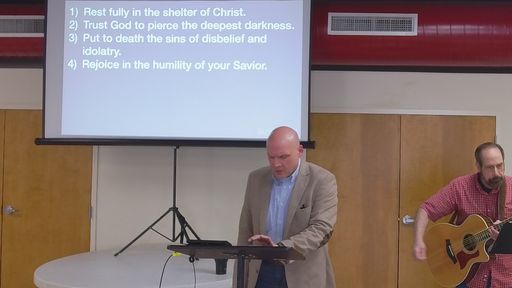
Savior Jesus who although he existed in the form of God did not regard equality with God a thing to be grasped but he emptied himself taking the form of a bondservant and made in the likeness of men being found an appearance as a man he humbled himself by becoming obedient to the point of death even death on a cross his testimony of Joshua points forward to the greater and the perfect Joshua and so when we think about this passage that is is full of again of warnings of reminders of God's grace and his mercy this is first of all a gracious encouragement to us to shelter fully to rest fully in the shelter of Christ Simeon's deception and blasphemy were deserving of death indeed
God declared that his descendants would be scattered among Israel that they would receive no inheritance truly of their own in a sense this removed
Simeon's legacy that was to come and the generations that would follow but instead of it of it erasing
Simeon's legacy we see God graciously placing Simeon within the bounds of the tribe of Judah as sinners blasphemers rebels against God's commands full of deceit we are deserving of death we're deserving of the same death that Simeon was deserving of and yet we find a gracious God who does not deal with us as our sins deserve but Jesus totally and perfectly envelops us in his grace and in his mercy his righteousness becomes our righteousness his inheritance becomes our inheritance if you're in Christ today rest in the shelter that he gives you when you feel unworthy this week acknowledge that in yourself yes you are unworthy and then rejoice that Jesus's victory is your victory through his grace and mercy if you are not in Christ and you've never trusted in him for salvation know that this is
God's gracious word to you that you don't need a
Savior because you're worse than everyone else you need a Savior because you are a sinner like everyone else that you are deserving of death you're deserving of God's wrath but because of the love and the mercy and grace of God he desires to extend that grace to you and to rest in him that your identity would be found totally in Jesus we see also that in the allotments of Zebulun and Asher and Issachar and Naphtali God sovereignly drew and assigned those territories these tribes would be sent to the far north where they would be subject to invasions both of a military nature and to a spiritual nature that in the years to come that they would be they would be buffeted that they would be it would be attacked not only by their own idolatry but also by the idolatry of the nations that were around them and for a time
God treated this area with as Isaiah put it contempt it would have been easy to write off this area as a spiritually bankrupt area even today if we're looking at this area in modern day we look at it we're tempted to say that this is a spiritually bankrupt area and it is without any hope at all but the future hope of which
Isaiah wrote that later on he shall make it glorious this future hope has been fulfilled in Jesus the light that has dawned closer to home it's easy for us to look at the darkness in our culture it's easy for us to look at the lostness of family members discouraging words and attitudes and practices that we see in our workplaces it's easy to feel like these people are too far gone there's too much darkness here how can
God overcome this how could God redeem these lands in the far north of Israel how can
God redeem these people who are in my life this is a gracious reminder again remind remembering
Isaiah's words later on in chapter 59 behold the
Lord's hand is not too short that it cannot save nor is his ear so dull that it cannot hear don't grow weary in praying that the
Lord will bring salvation to these people that he will bring light into darkness his hand is not too short to save that he will use you and he will use me to carry that light to be that light to be in that light we will carry in us that light of truth that we would put to death the sins of disbelief and idolatry that we would recognize that apart from God's grace the story of Dan would be should be the story of my life and the story of your life the allotment that God gave
Dan seemed to be too hard it was too full of challenges the city that they spied out was appealing it was an easy target along the way in their rebellious journey the
Dan the man the men of the tribe of Dan found these idolaters and brought them along with them when we encounter trials and struggles when we encounter a piece of the inheritance that is tough it is not because God hates us as James reminds us we can have confidence that these trials produce endurance and endurance results in our sanctification and are growing in Christ likeness are you choosing the easy road to this easy city instead of taking the inheritance that God has provided for you because know without fail that the easy alternative is also going to be filled with idolatry and idolaters it's not just about that easy city it is about the rebellion away from God that that will be a part of our passage today is a gracious warning lest we follow in the error and the sin the tragedy of Dan they rejected
God's plan for them God's design for them they sought an easy alternative within the exact opposite of God's plan along the way they gathered idols and a false priest and they built a heritage that would be a center of idolatry that would last for over 400 years it's now a downward spiral is is described by James if we look further in chapter 1
James says each one is tempted when he's carried away and enticed by his own lust and then when lust is conceived it brings gives birth to sin and when sin is accomplished it brings forth death this is a gracious call to us today to repent and turn from the paths of disbelief and idolatry you are walking in or considering those this is a gracious warning finally the example of Jesus of Joshua rather points forward to the humility of Jesus who didn't didn't grasp but didn't claim the equality with God that that was real that was his but he emptied himself he took on the form of a slave a doulos he became made in the likeness of men and he became obedient to the point of death on a cross rejoice today that Jesus did not take what was rightfully his but he took what was rightfully his his righteousness and gave it to us so that we can put to death disbelief and idolatry that we can rest in the identity that God has given us in Jesus we can do that for his glory but we can also do that for our everlasting good father we thank you that we are reminded once again that yes
Lord your word is indeed breathed out by your Holy Spirit and it is so good and so profitable for the teaching and the correction and the training and righteousness that you know that we need
Lord what a what a blessing we receive when we read your word what a blessing we forfeit when we neglect your word we neglect the teaching of your word and the praying through of your word and talking about your word with one another