Twelve Stones, One Foundation - Joshua 4:1-13
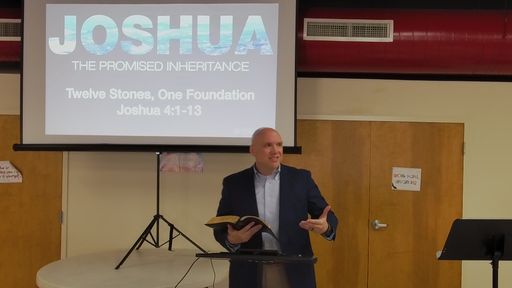
Twelve Stones, One Foundation
Joshua 4:1-13
Sermon by Micah Green
Hill City Reformed Baptist Church
Lynchburg, Virginia
Transcript
Amen. I hope you'll turn with me again to Joshua chapter 4.
Joshua chapter 4, Lord willing, this week and next week we will be looking at the entirety of chapter 4.
Today we're going to be focusing on the first 13 verses. Last week we saw the nation of Israel as they crossed the
Jordan River that God separated. The waters caused them to stand in a heap and the
Israelites were able to cross over on dry land, walking across the riverbed and setting foot into the land that God had promised them.
This was of course was not the first time that God had caused the waters to part for the Israelites to walk across.
We saw the first time the Israelites were delivered from bondage in Egypt and they were they crossed the
Red Sea and now they stand on the edge of the land of promise.
So we can see in a way that these these miraculous crossings form a sort of bookend to the wilderness wanderings.
Joshua continues the telling of this account in chapter 4. So what we're going to be reading today is in some part a recounting of what we saw last week and as we will see he will be adding to that in the command that God gives to Joshua and to the
Israelites. So let's read again we'll start in verse 1 of chapter 4.
Now when all the nation had finished crossing the Jordan the Lord spoke to Joshua saying take for yourselves 12 men from the people one man from each tribe and command them saying take up for yourselves 12 stones from here out of the middle of the
Jordan from the place where the priests feet are standing firm and carry them over with you and lay them down in the lodging place where you will lodge tonight.
So Joshua called the twelve men whom he had appointed from the sons of Israel one man from each tribe and Joshua said to them cross again to the ark of the
Lord your God into the middle of the Jordan and each of you take up a stone on his shoulder according to the number of the tribes of the sons of Israel.
Let this be a sign among you so that when your children ask later saying what do these stones mean to you and you shall say to them because the waters of the
Jordan were cut off before the ark of the covenant of the Lord when it crossed to the Jordan the waters of the
Jordan were cut off so these stones shall become a memorial to the sons of Israel forever.
Thus the sons of Israel did as Joshua commanded and took up 12 stones from the middle of the Jordan just as the
Lord spoke to Joshua according to the number of the tribes of the sons of Israel and they carried them over with them to the lodging place and put them down there.
Then Joshua set up 12 stones in the middle of the Jordan at the place where the feet of the priests who carry the ark of the covenant were standing and they are there to this day.
For the priests who carried the ark were standing in the middle of the Jordan until everything was completed that the
Lord had commanded Joshua to speak to the people according to all that Moses had commanded
Joshua and the people hurried and crossed and when all the people had finished crossing the ark of the
Lord and the priest crossed before the people. The sons of Reuben and the sons of Gad and the half tribe of Manasseh crossed over in battle array before the sons of Israel just as Moses has spoken to them.
About 40 ,000 equipped for war crossed for battle before the Lord to the desert plains of Jericho.
Lord we thank you that you give us in your word shadows and foreshadowings and signposts that point to what you have done to the grace and the mercy and the long -suffering that you have shown to your people.
We thank you for those shadows and types and signposts that point forward in the
Old Testament to the fulfillment of those promises in Jesus Christ. Thank you today that we are able to worship in spirit and in truth we are able to worship as those who have been called out of darkness into your glorious light.
So father would you be honored and glorified as we we read your word today and you fix our eyes on your word and on your promises would you grow us and our love for you our desire to grow in Christ's likeness and in holiness that in that you would be honored and glorified and that we we would be blessed we ask this in Jesus name amen.
We looked again at the crossing of Israel crossing the Jordan last week the nation has now entered the land of promise and they are standing on the banks the
West Bank of the Jordan River. Reuben and Gad and the half tribe of Manasseh as we see here were crossed over and armed and ready for war in Georgia we would say that they are loaded for bear they are ready for a fight but before they move forward into the promised land
God calls a pause he causes them to stop and to remember how they got to this place where they're now standing.
Central to this remembering is the memorial that God commands to be set up to be built and so again this week and next week we're going to look at this memorial this week we're going to look at the the what of the memorial the nature of it and and what it was comprised of and Lord willing next week we're going to look more at the why behind the memorial what was the blessing what was the purpose of the memorial for the people.
We can see this morning three three observations about the memorial first we can see that God was the one who commissioned the memorial he's the one who commanded it to be set up.
We saw this emphasized last week at the end of chapter 3 and and and Joshua under the inspiration of the
Holy Spirit reiterates that again that the whole nation finished crossing the
Jordan that the crossing was complete the people of the nation of Israel are now safely on the other side save of course for the priests who were who were standing in the middle of the riverbed and it's then and only then that God commands this memorial to be built this is not something that Joshua does of his own volition thinks that it would be nice to have a monument here that that one day it'll be a big tourist attraction this is something that God commands for a specific purpose prior to crossing the
Jordan Moses Moses is speaking to the people and again under the inspiration of the Holy Spirit he's giving instructions to the people for what they need to do and how they need to prepare to cross over the
Jordan and enter the promised land back in Deuteronomy God through Moses warns them that they are prone to forgetfulness he says only give heed to yourself and keep your soul diligently so that you do not forget the things which your eyes have seen and they do not depart from your heart all the days of your life but make them known to your sons and your grandsons we were
Jennifer and I were listening to a podcast yesterday and and the speaker in the podcast talk was talking about a family business this is actually
David Green the founder of Hobby Lobby and he he talks about how how how it's very common that that generational wealth can sometimes turn into this this phenomenon of shirt sleeves to shirt sleeves and what he meant by that was that you have a generation one that rolls up their shirt sleeves and builds a business and then they give all of their wealth to their children who squander it and then you see this third generation that ends up having to roll up their shirt sleeves and go back to work for themselves if this is true in the business world we know that it can very easily be true in spiritual terms as well that if we are not diligent if we do not remind ourselves starting first of all with ourselves and then our children and our grandchildren of the things that God has done spiritually we will find our succeeding generations will very quickly be bankrupt it's not for nothing that God gives this warning in his word he knows that we need it he knows that we need to be reminded to remind ourselves to talk of the works of God to one another to our children to our grandchildren so this memorial that God commands is for the good of Israel obviously it's for God's glory it's to point glory to God and what he's done but it's also for the good of the nation of Israel and we'll consider next week the purpose of the memorial in more detail but for now we can acknowledge that God intended this memorial to remind the people of Israel of God's faithfulness next we can see that God is clear in his direction to Joshua he's to take stones from the middle of the
Jordan and we know this because last week we read that the priests stood firm on dry ground in the middle of the
Jordan it's very clear very specific wording there since the time that mankind first started creating states and establishing borders rivers have served as the borders of lands they've indicated where one state or kingdom or Empire ends and where another one begins customarily the precise border of a river is legally defined as the
Thalweg it's the deepest part of a river it's the part where this current is strongest and normally where the geographical makeup of the river is deepest and so typically when you're driving across a river and you're going from one state into another legally and technically speaking you're not crossing over from one state or one land to another until you cross the deepest part of that river that's that's in most cases that legal definition of what defines the border when a river is involved and so we can say that in Joshua's account these these priests were standing at the
Thalweg they were standing at the deepest part of the Jordan River they're standing precisely dead center on the border of the land that God has promised to Israel this is a very specific area that God has told them to stand and it is from this spot that God commands the stones be taken to create this memorial
God commissions a specific memorial because he provided a specific deliverance and he is providing a specific inheritance we're surrounded by many today who would claim to follow
Christ they would claim the name of Christ they would identify with him but they cannot clearly articulate what it is they have been saved from they cannot clearly articulate what it is that they have been called to they cannot clearly articulate what they have been given in Christ many who would claim to be in Christ want to stress that on the cross the love of God was magnified but ignored the fact that it was in God's love being magnified only when his wrath was satisfied by the atonement of Jesus's substitutionary death there are many who would claim to follow
Christ who are not specific and they don't have a specific understanding of what it is that God has saved them from supposedly what it is that God calls them to Jesus has given to those who would follow him a very specific deliverance from sin a very specific remedy of the wrath of God that justly fell upon us because of our sin that was graciously and mercifully taken on by Jesus Christ on the cross he's given those who would follow him a very specific word to obey and thanks be to God he has given those of us who follow him a very specific inheritance so we see here that the commands of God are not vague they're not ambiguous they are clear and they are precise they also point back to the goodness of God that God would be glorified but again they are also for the good of Israel we see secondly that there's details here regarding the nature of the memorial two important points here first we we see the representative nature of the memorial we saw last week that God told
Joshua to take a representative from each of the twelve tribes chapter 3 verse 12
Joshua kind of leaves us hanging a little bit especially if we're if we're preaching from chapter 3 one week in chapter 4 the next and we don't know what this the purpose of these twelve people were have to come back the next week but Joshua doesn't immediately say in the following verse this is what those representatives were for but we see it today in chapter 4 these men were to bear the stones for the memorial that was to be built and each stone would represent one of the twelve tribes this echoes the comments from Joshua back in chapter 3 verse 17 all of Israel crossed over onto dry ground when all the nation had finished crossing the
Jordan this was a complete and it was a corporate deliverance and it's one that's represented then in the twelve stones that are stacked up as a memorial to what
God has done but this wasn't just corporate either we would be wrong in saying that this this deliverance was simply just a corporate blanket that was thrown over everybody without regard to what they thought of God's law whether they followed
God's commands God specifies that each of the men are to take a stone on his shoulder this indicates that this was not a rock that you could just pick up and hold to your chest and carry easily it was something that the weight of it the mass of it required that these men put it on their shoulder but they could more easily carry the weight each man was to bear a burden this was not a light task literally a weighty task it wasn't a matter of just picking up a stone and walking across a nice flat floor either they would have carried the rocks from the lowest part of the riverbed and then they would have carried them up the banks of the river itself of course we're told that the
Israelites are crossing over during the harvest season where when the river would have been at its highest typically the
Jordan River is about 10 feet deep in most cases when it swells and overflows its banks it's even deeper than that so where the
Israelites would have been encamped there could have been an elevation difference of 50 feet from the lowest part of the river to up to the point where the
Israelites were able to camp and in some places it's even higher than that so this was not a short little fun trip that these men were taking with a rock on their shoulder a small boulder geographically these banks are more like a gorge than they are a gently sloping incline up to the top of the bank and it's only then that after the stones were laid down on the shore then they would also bear the physical signs of having carried this weight on them they would have had bruised shoulders maybe bloodied shoulders they would not have been left without some kind of physical evidence of the burden the weight that they had carried often some scholars place an emphasis on the corporate nature of Israel's salvation and while we can definitely see the blessings and the benefits that were given to the entire nation we also see plenty of examples of God calling individuals from outside the nation of Israel to join his covenant people we just looked previously at Rahab who was called from among and out of idolatry is grafted into the nation of Israel and even becomes a part of the lineage of Jesus we see
Ruth a Moabite someone who was born into a land a people of unbelief who's grafted into the people of Israel and marries
Boaz who himself is the son of Rahab we're told in Matthew second
Kings we we read the account of the Syrian general Naaman who is so closely associated with this very
River we'll see Jethro Moses his father -in -law who advises
Moses on how he should administer and how he should bring other men to help him administer the temporal matters the practical matters of the nation of Israel as they are in the wilderness
Jethro we're told is a Midianite he's a descendant of Abraham but not by not by Isaac and Jacob he's a descendant by one of Abraham's wives
Keturah so he's not a descendant of Isaac and he's not descended from Jacob or Israel so we see these examples of where where God has drafted in individual people into his covenant people at the same time we see many references in the
Old Testament of God referring to sins that would cause an individual to be cut off be excommunicated from the people of God so the so the
Old Testament simply does not support the concept of a national identity that was purely corporate and was devoid of any responsibility for the people involved people could be grafted in through God's grace and mercy and they could be cut off because of their sin and unbelief we see that reflected in this memorial it is both corporate and it is also individual the foreshadowing of this obviously is clear it's hard to read the words of the
New Testament and not think that it points Paul and Peter didn't have this exact event in mind when they wrote the words like the ones we see in Ephesians chapter 2
Paul says therefore remember that formerly you the Gentiles in the flesh who were called in circumcision by the so -called circumcision which is performed in the flesh by human hands remember that you were at that time separate from Christ excluded from the
Commonwealth of Israel and strangers to the covenants of promise having no hope and without God in the world but now
Christ Jesus and Christ Jesus you who were formerly far off have been brought near by the blood of Christ for he himself is our peace who have made both groups into one and broke down the barrier of the dividing wall by abolishing in his flesh the enmity which is the law of commandments contained in ordinances so that he himself might make the two into one new man thus establishing peace he might reconcile them both in one body to God through the cross by having put to death the enmity and he came and preached peace to those who were far away and peace to those who were near for through him we have both our access and one spirit to the father so then you are no longer strangers and aliens but you are fellow citizens with the
Saints and are of God's household having built been built on the foundation of the Apostles and Prophets Christ Jesus himself being the cornerstone in whom the whole building being fitted together growing into a holy temple of the
Lord in whom you also are built together into a dwelling of God in the Spirit again it's hard to imagine that Paul did not have this event in this memorial in mind as he wrote these words
Jesus brings peace to all those who follow him both those who are far away and those who are near there's 12 stones sitting on the banks of the
Jordan are a road sign a road sign pointing forward to the foundation of the Prophets and the
Apostles with Jesus as the cornerstone it's the same idea of living stones that Peter speaks of in first Peter chapter 2 and coming to him as a living stone which has been rejected by men but his choice and precious in the sight of God you also as living stones are being built up as a spiritual house for a holy priesthood to offer up spiritual sacrifices acceptable to God through Jesus Christ there's a clear foreshadowing here of the reality of this of this identity the fulfillment of this identity in the church it's a corporate identity identity that only comes as a result of an individual new birth the stones of this memorial are imperfect and representative but the true temple built with living stones is going to be truly corporate everyone in this spiritual dwelling will be a stone will not be representative and finally we see that the source of this memorial is
God is the presence of God see that Joshua sets up a second memorial there's one that's sitting on dry land that will be up on the riverbank where the nation is encamped there will also be we might call it a mirror memorial in the midst of the river the place where the priests are standing but really more importantly it's it's not where the priests are standing they are standing there because the
Ark of the Covenant is there and they are carrying it curiously some scholars have attempted to make the point that these are really it's just the same set of stones that that this is really just saying that that Joshua put the stones together and then he gave them to the twelve representatives and then they went and set them up again on on the shore or on the bank
I I don't know that this is something to be dogmatic about at the same time
I think there is very extremely strong evidence to support that these are two completely different memorials that are being set up and I think there's a reason why
Joshua does this problem in the text is that it does not support this idea of one memorial or one set of stones verses 1 through 8 described the sons of Israel taking the stones up out of the water and then we read that then
Joshua set up twelve stones the translators of the
Septuagint in the second and third centuries BC obviously saw this and took this interpretation when they were translating the
Hebrew scriptures into Greek for the purpose of of the Jewish people who were scattered throughout the
Greek Empire they translated this as then
Joshua set up twelve other stones it was very clear to believers or to Jewish people at that time that that this was a second memorial that Joshua is setting up so I do think it's important to consider why
Joshua would have done that why would he have set up a second set of stones first this mirror memorial was to be in a spot where God brought them from for a short period of time the nation would stand on the banks of the
Jordan until God calls those waters to flow back into their normal and natural places again they can look down into this temporary valley that God was commanding to exist for a short period of time they can look down into this lowland this chasm a place that any other time would be deadly inhospitable for human life they could see for a short time where God had brought them from this pile of stones represented where they were and the other 12 separate stones would commemorate where God had brought them to coming up out of the
Jordan River soon the waters would return to their natural place and this mirror memorial would be covered but it would be there as a silent testimony to the unseen presence of God that went before the people of Israel and that would continue to go before them and this river the
River Jordan would continue to symbolize the provision of God's grace his deliverance his inheritance his merciful healing we just spoke of Naaman as a
Syrian a Gentile one who did not follow
God who was shown grace and mercy and 2nd Kings chapter 5 we're told that that Naaman the
Syrian general is afflicted with leprosy he writes to the king of Israel Jehoram and he he asks if there is a cure for this disease that the people of Israel might have and Jehoram feels that he fears that it's a ruse to provoke the people of Israel into a war with Syria by this time
Israel has broken into two kingdoms Israel in the north and Judah in the south and Israel itself is on the cusp of being taken away in exile and so this king is fearful this might be the means by which this exile comes the
Prophet Elisha intercedes for Naaman and he says send Naaman to me and he he tells Naaman gives him a very strange instruction he says go down into the
Jordan seven times and initially Naaman and thinks this is silly but he obeys it and he does it and he finds that he is healed of his leprosy we read in 2nd
Kings as prompts Naaman to declare now I know that there is no God in all the world except in Israel your servant will never again make burnt offerings and sacrifices to any other
God but Yahweh and of course we know that the same Jordan River was the place where Jesus was baptized on the eve of his earthly ministry so we see here in Joshua the
Jordan is the site of a giving of an inheritance we see that it's an inheritance that's given by God to the
Israelites but it will be a temporal inheritance as we will see we see in 2nd
Kings that that Jordan is the site of healing by God of a Gentile but this will be a temporal healing
Naaman will succumb to some disease or affliction or another and he will go the way of all the earth eventually his healing is temporary but Jesus Jesus fulfills these promises perfectly and eternally his baptism was not for himself but it was for us his baptism in the
Jordan declares that he is bringing complete deliverance complete inheritance complete healing so we see as the
Israelites are standing on the banks of the Jordan that this inheritance that they are receiving in part points forward to an inheritance that in Christ we receive in full an inheritance that is imperishable undefiled reserved in heaven for you so as we look ahead to a new work week to a new school week we think about all of the things that we must accomplish in the remaining ten and a half weeks of 2025 and I did the math for those of us who wish that we had about 14 or 15 or maybe 20 for all the things we need to get done do you feel the way that perhaps the
Israelites did the tribes of Reuben and and Gad and Manasseh that they're suited up they're ready to go they're ready to go take on all of the nations and conquer all of the land and then some and yet God called them to stop and to remember what he had done the call to look back and to remember to look down into the dry riverbed of the
Jordan this was a gracious act of God this call to remember and to recognize that it was all of God's grace that they stood there that day all of God's grace that they were brought out of the land of Egypt all of God's grace that he preserved a people through all of their idolatry and sin the grumblings as I consider all of the things that God calls me to as a husband and as a father as an elder as an employee far too often
I'm like these armed tribes I'm just ready to go I'm ready to go in my own strength even the good things that God calls me to to not spend time in committing my day and my actions my thoughts and my words to the
Lord our passion passage today is a gracious reminder to us that God calls us to remember and think back on what
Christ has already done for us you're empowering for future obedience comes from a remembrance of what
Christ has already done reminded also that God commanded the twelve representatives to take up the stones from the dry riverbed there was an action on their part this remembrance was not to be just passive it was not a a sentimental sitting around and just thinking about the good times the times when
God has worked and blessed this was an active remembrance that calls us through the writings of Peter and Paul to remember that we are living stones we're created unique by our
Creator Father and then we are fitted together we're not a stone that is to exist by itself that we bear one another's burdens as the twelve representatives bore the stones that they brought up out of the depths of the
Jordan River just as there was an unseen second memorial at the site of God's presence so we too should anchor our hope in the work of Christ that is unseen that has been accomplished for us on the cross that continues to be accomplished for us through his intercession just as the priests stood firm in the midst of the
Jordan so to Jesus accepted the punishment and stood firm and accepted that punishment that was due to you and to me because of our sin and as he stands now as the true and the perfect and the everlasting intercessor now unseen as he stood in the
Jordan and was baptized at the start of his earthly ministry he indicated the fulfillment that was foreshadowed so we can look back at what
Christ has done for us we can live as a living stone we can have a hope fixed on what
Christ has done what he is doing now and what he will do when he returns just as Israel was temporarily delivered from bondage it was temporarily given an inheritance it was temporarily given a home
Naaman was temporarily given healing and an infinitely greater way
Jesus has prepared and secured for us a permanent deliverance from sin an inheritance that is imperishable and unfading reserved in heaven for you a healing that is complete and it is eternal father we we stand as living stones today our hearts before the throne of grace recognizing that we in an infinitely greater way are unworthy to be living stones that whereas the people of Israel could look at a stone that was representative of their individual tribe on that pile of stones we through the work of our
Savior Jesus on the cross are living stones individual living stones that are fitted together by our