A Renewed Conquest - Joshua 8:18-29
A Renewed Conquest
Joshua 8:18-29
Sermon by Bryan Richey
Hill City Reformed Baptist Church
Lynchburg, Virginia
Transcript
Good morning. Once again, it's so good to have the church family together here with kids, adults, food, fellowship.
Just a time to get together as a church family. Indeed, what a blessing it is.
If you brought your Bibles with you today, let's go ahead and turn to the book of Joshua. We're going to return to Joshua chapter 8, where we're going to be in verses 18 through 29 this morning.
The title of this message is A Renewed Conquest. Now if you recall in our previous study, we began to examine the broader narrative found in Joshua chapter 8, where we saw a divine trap being set for the pagan people at Ai.
This had really been a rough road for the nation of Israel. They had been defeated earlier at Ai, and this forced
Joshua and the Israelites to take a step back to reflect on what happened, to repent, and of course to deal decisively with Achan's unconfessed sin.
We saw this all delineated in great detail in Joshua chapter 7. And while the lesson here was a painful one, where that lesson learned would come with a loss of life, where justice of course would be severe, we nonetheless see where God restores
His people through discipline, repentance, and of course renewed obedience.
Let us never forget that the victorious life that we live in Christ is predicated on a disciplined obedience throughout every season of our life.
And during those times when we've lost our way, repentance will always bring us back to a renewed relationship with a holy
God. In his work entitled,
Atreus Disconcerning Religious Affections, John Edwards, he explained the nature of the victorious life we have in Christ where he made this statement.
He said, true Christian fortitude consists in strength of mind through grace exerted in two things.
One, in ruling and suppressing the evil passions and affections of the mind.
And two, in steadfastly and freely exerting and following good affections and dispositions without being hindered by sinful fear or the opposition of enemies.
So while our passage back in Joshua chapter 8 verses 10 through 17, which we covered last week would focus on this divine trap that would be set for the people of Ai here, we now see the focus now shifting to a renewed conquest as God's sovereignty will orchestrate victory along with the human endeavors of Joshua and the nation of Israel.
This of course brings us to the passage that we're at this morning where Israel's path will back to renewal, will of course come in the form of a climactic battle, which we see here in Joshua chapter 8 verses 18 through 29.
So if you've got your Bibles, let's read that passage this morning. Then the
Lord said to Joshua, stretch out the spear that is in your hand towards Ai, and I will give it into your hand.
And Joshua stretched out the spear that was in his hand towards the city. So those in ambush arose quickly out of their place.
They ran as soon as they had stretched out his hand and they entered the city and they took it and hurried to set the city on fire.
And when the men of Ai looked behind them, they saw and behold, the smoke of the city ascended to the heavens.
So they had no power to flee this way or that way. And the people who had fled to the wilderness turned back on the pursuers.
Now when Joshua and all Israel saw that the ambush had taken the city and that the smoke of the city had ascended, they turned back and they struck down the men of Ai.
Then the others came out of the city against them so that they were caught in the midst of Israel from on this side and on some on that side.
And they struck them down so that they let none of them remain or escape. But the king of Ai, they took alive and brought him to Joshua.
And it came to pass when Israel had made an end to all slaying of all the inhabitants of Ai in the field, in the wilderness where they pursued them and when they had all fallen by the edge of the sword until they were consumed, that all the
Israelites returned to Ai and struck it with the edge of the sword. So it was that all who fell that day, both men and women, were 12 ,000, all of the people at Ai.
For Joshua did not draw back his hand with which he stretched out the spear until he utterly destroyed all of the inhabitants of Ai.
Only the livestock and the spoil of that city Israel took as a booty for themselves according to the word of the
Lord which he had commanded Joshua. So Joshua burned
Ai and made it a heap forever, a desolation to this day.
The king of Ai, he hanged on a tree until evening. And as soon as the sun was down,
Joshua commanded that they should take his corpse down from the tree, cast it at the entrance of the gate of the city and raise over it a great heap of stones that remains to this day.
So the passage that we just read here begins really with Israel's repentance and of course it will culminate on a victorious note where God's sovereign grace would come to the forefront after judgment.
For in the end, this renewed conquest of course would be yet another demonstration of how
God wins victories for His covenant people. And it will be clearly seen in the following four points of our message this morning.
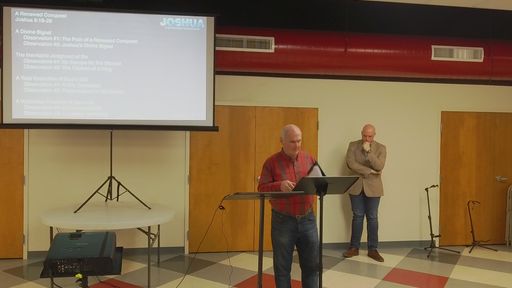
The first point that I would like to visit with you on is that of a divine signal.
This will be seen in Joshua chapter 8 verses 18 and 19. This will then give way to the second point in our message this morning where we will talk about the inevitable judgment of sin.
This is going to be seen in Joshua chapter 8 verses 20 through 23. This will then bring us to the third point of our message where we will see a total execution of God's will.
This will come from Joshua chapter 8 verses 24 through 26 and then fourth and finally the last point will be a victorious provision and memorial.
This will be seen in the last verses of our passage found in Joshua chapter 8 verses 27 through 29.
Now some things become quite clear here in this passage where we see God's absolute control over human history, where we see certain consequences for sin and of course we see the necessity of a faithful obedience in response to His grace.
So just as we see this renewed conquest on the part of Joshua and the nation of Israel, and we see it coming through God's grace alone, so too is the victorious
Christian life. It is not achieved by our own human effort but rather by the abiding sense and presence that we have in Christ.
What a blessing that we have to proclaim as Christians. Jesus Christ has already won the ultimate triumph and as believers we can now live our victory out progressively through an abounding faith, through the mortification of sin and of course through a reliance on the
Spirit. Now this brings us to the very first point of our message this morning where we're going to talk about a divine signal.
In Joshua chapter 8 verses 18 and 19 we find a detailed account of Israel's second attack on the city of Ai and this of course followed their humiliating defeat that was seen in chapter 7 due to Achan's sin.
And after God had exposed and judged that sin, He restored fellowship with His people.
He renewed His promise of victory and He gave Joshua this very detailed strategy of an ambush that would involve a divine signal and an obedient response.
So God grants victory not through human strength but through obedience to His word, demonstrating
His holy wrath against sin and foreshadowing the ultimate triumph that each of us would now have in Christ.
Now this brings us to an important observation where the nation of Israel is now on this path of renewed conquest.
You know when we look at Joshua chapter 8 verse 18 we find God now commanding Joshua to lift up his javelin as a final sign of Israel's renewal and recommitment to conquest on God's terms and not their own.
And this is really what this cycle of renewal looks like where we see a deeply expressed repentance followed by a recommitted obedience which then leads to a restoration and a renewed sense to God's purpose which ultimately results in victory and provision.
Another important theological perspective that we see here in these verses is the emphasis on God's sovereignty and salvation and for that matter all the affairs of mankind.
Let us never overlook the importance here of the authority and the sufficiency of Scripture and the necessity of faith expressed through obedience.
This passage clearly illustrates these truths and its lesson of course continues to be relevant to us in the current day.
My dearly beloved, let us not forget that all success in the conquest of Canaan and likewise in the
Christian life it flows from God's gracious decree and power and not human effort.
For in these things we see now that God ordains both the ends which is the victory over his enemies as well as the means which we see in the obedience of Joshua in the nation of Israel.
And let us remember that all these things foreshadow and point forward to Jesus Christ our greater
Joshua who through perfect obedience secured an eternal victory for his people delivering us from the curse of the law and empowering us for holy living through the mortification of sin.
So now that we've established this path of renewed conquest we should also take a closer look at Joshua's divine signal.
Again in Joshua chapter 8 verse 18, the Lord commands
Joshua to stretch out his javelin towards Ai as a divine signal for the ambush to proceed.
This symbolic act of course would demonstrate to the nation of Israel that Joshua was receiving guidance from the
Lord throughout the entirety of this battle. We find that it's reminiscent to Moses back when Moses raised his staff when they battled
Amalek many years before. In both cases this act on their part would symbolize a continued dependence on God rather than military might.
In his book entitled The Wonderful Works of God, Herman Bavick, he emphasized the importance of a total dependence on God where he said this.
He said man is an enigma whose solution can only be found in God.
So just as Joshua here would give us this divine signal in accordance to God's directive, so also should we remember that our human existence and understanding relies on God alone.
This is clearly seen in this passage and in a broader context our humanity has always been dependent on our sovereign creator and yet how many times do we overlook that?
But my dearly beloved all things are contingent upon God and sustained by him and our lives should be patterned after an absolute dependence on his unchanging being.
Joshua clearly understood this and his divine signal given to the people of Israel would be a valuable reminder of this as well.
Now there's much to apply here as we consider this passage in our walk with Christ.
You know as Christians we really need to recognize that the consequences of sin can be severe but we can take heart because we are spared through Christ's substitutionary atonement.
However, let us not take this blessing for granted but rather treating sin with the gravity that God himself assigns to it.
Let us heed God's call for help. Let us pursue discipline and purity and let us always remember that just as we see with Joshua's call here for a nation of people to act of faith so also we find this call in our own lives as well.
So as we go ahead and continue the story we now come to another somber point in this message where we see the inevitable judgment of sin.
In Joshua chapter 8 verses 20 through 23 we find this climactic moment here in Israel's second attack on Ai where God would restore
Joshua and the people through obedience and strategic planning and his divine promise.
The ambush succeeds. Ai's defenders are lured out into the open plain.
The city is burned. The enemy is trapped between two converging Israelite forces. The king is captured alive and of course would later be hanged as a sign of divine judgment.
So God's judgment now would come to its full measure where we first see that there would be no escape for the wicked.
In Joshua chapter 8 verse 20 the men of Ai they quickly realize that they're now trapped between Joshua's forces and the unfolding ambush to their rear.
Now they were not only taken by surprise here but in this verse we see that there was this sense of doom and despair among them where they were told that the people of Ai literally had no power to flee this way or that.
So the smoke would begin to rise from the city as a visible sign of their impending doom and of course the open plain, their death in the open plain would soon follow.
Now think about the significance of this judgment here, especially if you were one of these men from Ai.
For these men would bear witness to the complete destruction of their city. They would bear witness to their families being slain before their eyes.
They would be completely powerless to do anything about it and this reality would ultimately become their last memory as they too would be killed in the open plain.
And in this occasion we see the total depravity and the divine wrath of God coming together in stark focus as the
Canaanite sin had indeed reached its full measure and where a complete destruction would become
God's judgment. Unfortunately we live in a day where many churches treat
God's judgment as a doctrine to be avoided at all cost. They preach a message that is free of judgment, that minimizes sin, that spurns accountability.
But what we see in Scripture here is quite to the contrary where God's justice is impartial, it is thorough and it will always reflect
His holiness. Let us resist the temptation to minimize this attribute of God, but let us rather pursue holiness in our personal journey as well.
Now another aspect that's readily seen here in these verses, especially as it relates to God's inevitable judgment, is the fact that there's the capture of a king here.
In Joshua 8, verse 23, we now see where Joshua's men, they take the king of Ai alive which would in turn set the stage for an execution as a symbol of his defeated authority.
And in this grisly detail, we find God's overruling providence where even enemy kings will fall under His decree, which in turn, of course, reminds us that earthly powers are subjected to Him.
And in his letter to the church at Rome, we find the Apostle Paul addressing this very same issue where he said in Romans chapter 13, verse 1, he said, let every soul be subject to the governing authorities, now listen here, for there is no authority except from God and the authorities that exist are appointed by God.
In question number 10 of the Baptist Catechism, we are asked to identify the decrees of God for which we're provided the following answer.
The Catechism says that the decrees of God are His eternal purpose according to the counsel of His will whereby for His own glory
He hath foreordained whatsoever comes to pass. So the king of Ai would be captured in defeat and God would ultimately be glorified in righteous judgment.
So as we conclude this rather somber point here, especially as it relates to the defeat of Ai, there's some lessons that we can apply to our own lives here as well.
You know, as Christians, each one of us should encourage one another to confront sin boldly, to trust in God's promises, and of course to live in obedient faith.
For this is what it means to experience a victory that we have in Christ. And if sin is ruling over us, we must dethrone it from our lives through the power of the
Holy Spirit. We see this in Romans chapter 6, verses 12 and 14, therefore do not let sin reign in your mortal body that you should obey in its lusts, and do not present your members as instruments of unrighteousness to sin, but present yourselves to God as being alive from the dead and your members as instruments of righteousness to God.
For sin shall not have dominion over you, for you are not under the law, but under grace.
However, let us be encouraged as believers, for under the new covenant we don't fight physical battles per se, like we see
Joshua here with the nation of Israel, but rather we find that we wage spiritual warfare against sin, against the world, against Satan himself.
And as we consider such things, I think it would be beneficial for us to consider some of those lessons as well.
You know, one such lesson that I think readily comes to mind here is that we need to trust in God's timing and methods in the spiritual battles that we find ourselves in.
For just as Joshua and the nation of Israel would have to wait, where they would have to adhere to a battle plan that was prescribed by the
Lord Himself, where they would have to then of course execute that plan with a precision that really depended on God's grace, we find that we too must follow
God's direction in our own struggles, whether it be personal sin or relational conflicts or financial hardship or spiritual weakness.
I'm here to tell you from personal experience that God will oftentimes work through seemingly indirect and unexpected ways, which will not correspond to our own timing here.
And so when such conditions arise here, let us resist this temptation, of course, to take shortcuts and to rely on our own strength, but rather let us seek
God and His guidance through prayer and through Scripture, and then let us act in obedience.
Another important lesson that we need to keep in mind is that we should repent quickly and fully when we fall into sin.
This can be a very humbling experience, but it is an exercise worthy of our effort. If you recall
Israel's defeated Ai, we find that it was the result of one man's sin that had a negative impact on an entire community of people.
And in times in which we live hidden sin, whether it be pride or bitterness or adultery, can grieve the
Spirit and it can impede our walk with Christ. Be encouraged, my brothers and sisters, because God will not leave us or forsake us.
We are promised this in 1 John 1, verse 9, where God's Word says if we confess our sins,
He is faithful and He's just to forgive us of those sins and to cleanse us from all unrighteousness.
So once our sin is confessed and forsaken, God restores fellowship.
Therefore, let us not become paralyzed in our own guilt, but rather let us turn to Christ, our greater Joshua, who has already won the ultimate victory on our behalf over sin.
For in the end, God is sovereign, He is holy, He is faithful. And furthermore, when we repent and obey,
He delivers us from our enemies in His perfect timing. So let us cling to Christ, our conquering
King, who has defeated sin and death forever. And may this truth, of course, strengthen our resolve as we face the battles of spiritual warfare with courage and hope.
So now that we've examined this inevitable judgment of sin and, of course, our timely response to it, we now come to the next part in our story where we now see a total execution of God's will.
You know, as we move to Joshua chapter 8, verses 24 through 26, we find grim evidence of the total execution of God's will, where we are told that for Joshua did not draw back his hand with which he stretched out his javelin until he had utterly destroyed all the inhabitants of Ai.
So what we see here is a total and a complete execution of God's will.
And while some may have believed that this was a long time coming, when God's judgment came to full measure, it was complete, it was comprehensive, and it was irreversible.
Simply put, the execution of God's will. Found in these verses, they chronicle a total annihilation of the people of Ai at the hands of Israel.
And such an occasion, of course, really illustrates persevering faith in God's commands.
And likewise, we too should take this moment to consider, really, a couple of complete important observations as well.
The first observation that really comes to the forefront here is that a city was indeed destroyed.
In Joshua chapter 8, verses 24 through 25, we find the utter and complete destruction of Ai, where Israel slays all 12 ,000 inhabitants of the city in the field of battle.
And more importantly, no one was to be spared per God's direct command. And while the extermination of an entire people may lead someone to question the nature or the scope of this judgment, it is important for us to, of course, view this from the standpoint of God's sovereign judgment.
This is a sovereign judgment against sin and idolatry. We need to remember that in the conquest of Canaan, included
Ai, it was not an act of ethnic cleansing, but rather it was a divine judgment on a very deeply sinful and unrepentant culture.
Let us not forget that the Canaanites would engage in the vilest form of adultery. They would engage in the rampant atrocity of child sacrifice.
They were unrepentant. They would commit themselves to abominations which warranted
God's divine wrath. So this wasn't an innocent community caught in the crossfire of a battle between two armies.
In Romans chapter 1, verses 18 through 32, we find a very comprehensive explanation of what needs to come when
God has to exercise His holy justice. Simply put, God is righteous in punishing sin.
And in this passage, He is sovereignly using Israel to execute His divine judgment.
And as we view this, of course, from the perspective of the new covenant, which we ourselves find ourselves in here, this points to the believer's call to put sin to death.
We find the Apostle Paul reiterating this similar sentiment here, where he proclaimed in Romans chapter 8, verse 13, he said,
For if you live according to the flesh, you will die. But if by the
Spirit you put to death the deeds of the body, you will live. So just as we see this day of reckoning here for the people of Ai, the execution of God's will will also have relevance in the life of a
Christian. Where a pagan people here of Ai really suffered from a divine judgment, we find that was due to their lack of repentance.
Of course, God's will for the Christian is much different. It's for them to deal with their sin, not through legalism, but through a grace -enabled mortification.
Let us never forget that true regeneration, it produces the fruit of obedience, which in turn will lead to a perseverance in obedience.
In Joshua chapter 8, verse 26, we find Joshua's now his unwavering hand in the midst of this battle as he held his javelin to the sky before the nation of Israel.
It would symbolize his perseverance in obedience, for Joshua clearly understood the importance of what he was doing here.
This was a symbolic act. It would become part of the role that he would play in the total execution of God's will.
It would demonstrate the continued need of Israel to rely on God's help in all things. And of course, finally, we would find that it would reinforce the fact that the victory would indeed come from the
Lord. And likewise, we find a similar expectation in the life of us as believers who should endure in faith, all the while trusting in God's provision and sustaining grace.
Let us not forget that a failure to fully obey God's word is to invite certain defeat.
Another thing that we also see here in this passage of Scripture is the total execution of God's will as it relates to the issue that it rewards obedience, and of course, it will punish sin.
You find throughout Scripture that when we move forward in our obedience with Christ, that there's always blessing connected with that.
We need to remember that the victory that's seen here in this passage of Scripture, it follows what? It follows
Israel's obedience after dealing decisively with the sin of Achan. It underscores our understanding of God's covenant and blessings.
And of course, those blessings flow from a faithfulness to God's command, while disobedience, of course, will bring consequences.
In this case, Joshua would raise his javelin, or his spear for that matter, which symbolized a persistent faith and a reliance on God.
And likewise, we see a similar symbol with Moses many years prior, where he raised his hands to sustain the battle against Amalek.
Now, what we find here with a total execution here of God's will is the destruction of AI, and so too do we find a picture of final judgment of unbelief.
So how do we apply these things to our lives as Christians? You know, as Christians, we should view this passage here from the standpoint of God's unyielding holiness.
We should take a look at it from the standpoint of the gravity of sin, and of course, the need for a total surrender to our
Lord. These are the things that should be really guiding the steps that we take.
These are the things which we should view as we emphasize God's sovereignty and salvation and judgment.
These are the things that we should be aware of in our walk with Christ. The complete destruction of AI is a sobering reminder of God's holy justice against sin.
But it is a necessary truth in order that mankind will come to repentance and salvation. In the conquest of Canaan, we find that God used
Israel as instruments for His righteous judgment. We find that the iniquity of these people would ultimately come to full measure.
This was not an arbitrary act of cruelty, but it was one of divine justice, where the total execution of God's will condemns these
Canaanites to destruction. This would serve as a lesson of God's intolerance towards the issue of idolatry and rebellion.
So this passage conveys some important lessons for us as well. For us believers, one such lesson that we see, especially as it relates to the new covenant, is the ultimate fulfillment of this judgment in Christ's crucifixion on the cross.
God's wrath was poured out against sin, and it was poured out against His own Son on our behalf.
This, of course, should be a reminder to each one of us that God's standards of holiness and justice will always have to be poured out either on the sinner or on the sinner's substitute.
Thank God we have a substitute in Christ. And just as Joshua, he stretched out his hand with a spear in his hand, it echoes
Moses' raised hands during the battle many years before at Amalek. And of course, we would see that it's an important symbol of our own dependence on God for victory.
We should always look to Christ as the author and the finisher of our faith. So just as Joshua would not lower his hand until the total execution of God's will was complete, so too do we find this as an example of our own persevering faith and unwavering obedience that we should have for God's commands as well.
My dearly beloved, what we find in this passage here is not mere symbolism, but rather it challenges us to trust
God's Word that will transcend time and, of course, will accomplish what He has promised. For just as the victory here belonged to God alone, so too do we find ourselves engaged in persevering obedience when it comes to spiritual warfare in our own lives.
And just as Joshua held that spear to the sky steady until that battle was won, we believe that we must persevere in faith and obedience until our preordained end, all the while relying on God's power.
So let us proclaim the gospel faithfully. Let us hold fast to the truth of God's Word. Let's do so without compromise.
Let us remember that, of course, that victory will not come on our own human efforts, but rather from God's sovereign grace instead.
Ultimately, the lessons that are drawn from this passage points us to Jesus Christ, our greater
Joshua, which is clearly seen in Hebrews 4, verse 8. He, Jesus Christ, is the one who fully obeyed
His Father. He who is Jesus Christ is the one who outstretched His hands on the cross as He died for the sins of the world.
And He is the one who has secured eternal victory over sin and death. My brothers and sisters, it is by grace alone that we are able to persevere in faith and in obedience.
So let us hold fast until such time we see the full consummation of the kingdom of God.
Now, this brings us to one last point, if I may, which is found in the closing verses of this passage this morning, where I would like to discuss a victorious provision and memorial.
In the closing verses of Joshua 8, verses 27 through 29, we now see the complete fulfillment of God's sovereign command to destroy
Ai. And what an amazing outcome from a deeply expressed repentance and a renewed sense of obedience.
This was quite a turnaround for the nation of Israel. This victory would follow
Israel's earlier defeat at the hands of these very same people. We see this in Joshua chapter 7.
God's provision of plunder, of course, is permitted in this case. It's taken by Israel, unlike Jericho, where everything was devoted to destruction.
And in this last point, we see now that God's precise and gracious direction and judgment as well would be a blessing for the nation of Israel.
Ultimately, the city would be burned into permanent ruin. The king is hanged on a tree until evening, and then his dead body is buried under a heap of stones.
Both of these acts are ones of provision and memorial. They serve as a lasting testament to God's justice and God's blessing as well.
Thus, we find two final observations that I would like to cover before we wrap up this message, the first of which is a provisional gift.
This is seen in Joshua chapter 8, verse 27, where we find this provisional gift where the plunder of Ai is available and it is taken as a spoil to Israel.
So Israel takes the livestock, and of course, this is provided a very stark contrast to Achan's covetousness back in Joshua chapter 7.
This provision, of course, would serve to meet the needs of the nation of Israel in the days ahead. And of course, it would be a reminder of the victory that God had given them that day.
In his work entitled, The Vision of the Wheels, a treatise on the providence of God, Matthew Mead, he explained the divine providence of God in this manner.
He said this, he said, all events are wisely disposed of by the governing care of God's providence.
Providence is a servant to God's eternal counsel and decree. There is no altering the course of providence.
Another thing that we readily see in this passage is that obedience and, of course, divine blessings go hand in hand.
And such blessings, of course, follow faithful obedience after repentance. Let us not forget that God here will always reward his people, not because of their own merit, mind you, but because of his sovereign grace and in accordance to his divine word.
What a wonderful relationship that each of us has with Christ, where all the blessings flow from God's grace and not our own merit.
This not only pertains to our salvation, but this also pertains to the daily blessings that we find in our contentment and stewardship.
This, of course, is to focus the glory on the Lord as well. So let us never forget the source of our blessings and let us make sure to, of course, express gratitude for those blessings to our
Lord in heaven. Now we come to one last observation here before we close, and that is a lasting testimony here.
In the final verses found in Joshua 8, verses 28 and 29, we find this lasting testimony to God's power and work on behalf of the nation of Israel.
And while these lasting testimonies can take on many forms, whether it be a heap of stones piled on top of the body of a king, or whether it is the
Passover feast, which we saw in the days of Moses, or the practice of communion, which we practice here as a church family, all these encourage us to remember
God's mighty acts. In Joshua 8, verses 27 and 28, we find a lasting testimony that serves as a really an enduring testament to God's faithfulness and judgment and deliverance.
It will remind Israel and us as well that God's word does stand forever.
His promises are a blessing for us to behold. And, of course, our obedience is what facilitates those ends.
The psalmist put it quite plainly in Psalm 135, verse 13. The psalmist said,
Your name, O Lord, endures forever. Your fame, O Lord, throughout all the generations.
Therefore, what we read in this passage here this morning should serve as a perpetual reminder that God, in His sovereign faithfulness, is sovereign in His redemption.
He's sovereign in His promises. These promises transcend from Abraham to Isaac, through Jacob, and ultimately to Jesus Christ.
So, Ai is ultimately burned into a smoldering heap, and this would serve as a lasting testimony of God's judgment.
Now, another aspect of this lasting testimony, of course, we find in the final verses of this passage where we see the king's fate.
In Joshua 8, verse 29, the king who had been captured alive during the battle there at Ai would be hung on a tree until the evening.
And after his death, he was taken down and rocks were piled over his body, much like we see in the case of Achan all the way back in Joshua.
So, we see in Joshua 7, verse 26, now, this pattern of execution and exposure and burial, it follows the legislation that we see in the book of Deuteronomy, where we see in Deuteronomy chapter 21, verses 22 and 23, the legislation lays out as follows.
If a man has committed a sin deserving death, and he is put to death, and you hang him on a tree, his body shall not remain overnight on the tree, but you shall surely bury him that day, so that you do not defile the land which the
Lord your God has given you as an inheritance, for he who's hanged is accursed of God.
Joshua made sure that even after the battle was over, that God's expectations would be met to the letter of the law.
Ultimately, this victory over Ai, it does restore Israel's confidence, and it advances their conquest to Canaan.
And just as Christ, of course, would conquer sin and death in our own lives, not through physical armies here, but rather through his sacrifice and his atoning death, we find that he secures for us eternal rest by his sovereign grace alone.
This now brings us to one last concluding application here. That we see in Joshua chapter 8.
And that is as Christians, we are called on to learn from the biblical history that's found in this passage here.
And throughout this story, we find lessons to learn. We find examples to emulate and to avoid.
We find that, of course, repentance is important. Renewed obedience is important.
We also find that really God's sovereignty will always prevail over his enemies. But what should we make of all this?
Each one of us should live with a sense of gratitude for God's faithfulness. And this should be exhibited in the worship that we engage in as a body of believers.
One of the key takeaways that we find in these verses, and what we get from this victory at Ai, is that really it would come from a renewed sense of worship.
We see that there's a renewed conquest in this verse. But Reed will be talking next week about a renewed sense of worship that flows from this victory.
I believe if each one of us were to reflect on the course of our own lives, we would see a testament of God's deliverance.
Whether our past experience comes from an answered prayer, or really from God's provision or his divine forgiveness of our many sins, let us respond with praise and obedience and witness of his great things.
One last thing we need to think about here is we need to be mindful of God's sovereign orchestration of judgment and victory through obedient faith.
This is relevant when God delivered the nation of Israel from defeat to triumph, and it applies to us in our victorious life in Christ.
Let us never underestimate the gravity of sin, all the while embracing what? A grace -enabled perseverance.
Let us understand that we conquer sin not by our own might, but by God and Christ's finished work.
Let us examine our life for unconfessed sin, and when we find it, let us repent, obey, and of course, trust in God's promises.
And let us renew our commitment through the study of Scripture, prayer, and a community accountability amongst us believers as a church.
For in the end, let us praise God for the victories we experience in the Christian life, and let us live boldly for his glory.
Let us pray. Our heavenly Father, Lord, we come together, breaking bread together as a body of believers, communing in fellowship and learning from your word.
Dear Lord, we want to thank you for the sacrifice of your son, Jesus Christ, on the cross, which made victory and triumph possible in the battle that we wage against death, sin, and Satan.
Dear Lord, I just ask that we abound in faithfulness, that we will renew our obedience, that we will move ever closer to you through sanctification, and Lord, that we will glorify you in all our ways.