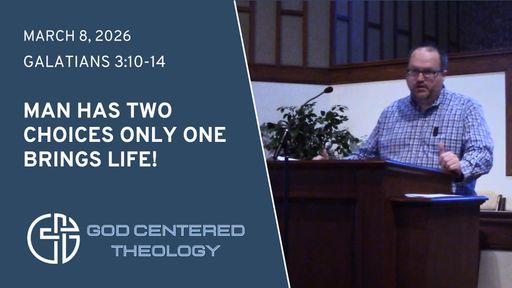
Man Has Two Choices Only One Leads To Life - Galatians 3:10-14
This message was preached on Sunday, March 8, 2026, at Roanoke Baptist Church in Roanoke Rapids, North Carolina.
This is the place for consistent God-Centered, God-Honoring, and God-Glorifying biblical content.
Transcript
Well, I want you to imagine a man who takes a job where there's only one rule and the one rule is actually very simple.
If you make even one mistake, you're fired immediately. Now, how many of you glad you didn't have jobs like that?
Now, I'm sure if you're like me and some of the experience I've had, if you ever had a job that weren't exactly the best one in the world, you probably have felt like that at times for sure.
I know I have. But imagine that. You take on a job and it says if one mistake, you're done.
Well, this particular person, at first they feel confident. He or she could even work hard, pay attention, try to do everything right.
But every day they go to work, they have a knot in their stomach. One small slip after all, a missed detail, wrong number, a single error, it's all over.
Well, instead of bringing freedom, this job would become a constant weight of fear and pressure.
And that's what it's like to live under the law or works of the law. You see, the law demands perfect obedience.
One failure brings condemnation. Instead of bringing life, it places us under a curse because none of us can keep it perfectly.
Perfectly. But thank the good Lord above that the good news of the gospel is that Christ took the curse for us so that through faith we can live in the freedom of His righteousness rather than the crushing burden of trying to earn our own.
Here's the two choices, sort of an ultimatum, if you will, although it's more about just simply the choice involved, but mankind, men, women, children have two choices.
That's it. Only one of these choices brings life.
In Galatians chapter 3, verses 10 through 14, we will find that to live by the law and to live by the works, by self -effort, will lead to failure, condemnation, and death.
However, to live by faith is to respond to God's grace and will lead to justification and eternal life.
We're going to look this morning at the two choices that are presented here in these five verses. We're going to consider which one is, and I think it'll be pretty obvious to all of you which one's the right choice, being that we are all saved by the grace of God.
But look at what happens when one picks one or the other. Now the first choice brings a curse.
Verse 10, it says, for as many as are of the works of the law are under a curse, for it is written, cursed is everyone who does not abide by all things written in the book of the law to do them.
So if you will remember our context, we've been moving, and this started back in chapter 2 of Galatians, particularly when you look at chapter 2, verse 16, when it talks about how we know that a man is not justified by works, but through faith in Jesus Christ, since by works no flesh is justified.
So Paul set the stage, and he's carrying us through, he's dealt with legalism and some other different things, but the primary focus of what
Paul wants to get these Galatian believers to understand started in chapter 1, when he said that he was so disturbed by the fact that they had so easily and so quickly left for another gospel, because there is no other gospel.
There is one gospel. So you can either live by faith in the real gospel, or live under a curse.
And so he's really building on this argument here, layer by layer, verse by verse.
And so now he's gotten to the part where he's going to portray why you do not want to live under works, because ultimately what we're dealing with when it comes to heaven, when it comes to eternal life, is that God is perfectly righteous and perfectly holy.
God cannot be in the presence of sin. So, God demands perfect righteousness to enter his kingdom, and there's a problem with that because none of us can produce it, on our own anyway.
It's only by the grace and mercy of God, as we talked about last week, the blessing of Abraham when we referenced there in verse 9, it said, those who are of faith are blessed with Abraham the believer, or blessed with the believing
Abraham. So if you're blessed in the same way as the believing Abraham, you could say the believing
Mark, or the believing Andy, believing Gina, so on and so forth, throughout everyone that is here this morning.
We are the believing ones. We're not the working ones. Now we covered this last week.
We won't rehash it again because it's not in front of us this morning. But yes, we are saved unto good works.
We are created in Christ Jesus for the good works that he has predestined us to walk in and expects us to walk in those works.
There's certain roles that he has called me to, certain callings he's put on my life that he hasn't put on your life.
And there's certain roles and callings and things he wants you to do in your life that he doesn't expect me to do because you know different people,
I know different people, I've had different jobs in different places I've lived, and all these sorts of different things.
You know, we were talking this morning, you know, I was talking to Kim about, you know, she's cold. And, you know, I said, well, it's okay because if we're all the same and hot -natured like me, it'd be a very boring world.
It's one thing my father -in -law says all the time, he says, hey, it's what makes us different, that's what makes the world go around, right?
Well, think about the beauty, and I think, I think Ms. Toots brought this up on a Wednesday night one time about the diversity of what we find in the body of Christ.
All of us are different. Different heights, different weights, different looks, different backgrounds, different intelligence levels.
Now, I know we're supposed to, you know, we're all supposed to be Einsteins, but the fact of the matter is, I'm no Einstein, okay?
My intelligence is good in some areas, but not in others. It's okay to recognize that, some of us have gifts in certain areas, but not gifts in other areas, and that's okay.
Each different person sees things different ways, but we all are blessed in Abraham.
Now, in verse 10, when it says here that for as many as are of the works of law, meaning your justification, your life, your standing before God is going to be based in works.
Now we've already covered that can't fly, but if that's the way you're going to live, meaning you're unsaved, you're unregenerate.
So when it says here in verse 10, for as many as are under the curse, this word curse is a word in the original language that means liable to the appointed penalty, an act of calamity or divine wrath upon someone.
So think about this in terms of Romans chapter 8 verse 1, when it says, therefore there is now no condemnation in those who are in Christ Jesus.
There are only two types of people in the world, saved and unsaved, regenerate and unregenerate, slaves of sin, slaves of righteousness, servants bond servants of sin, servants bond servants of Christ.
And to be without Christ in this world is to be under a curse, the liable or the liability that you have to receive the just penalty and just wrath on your sin, not the sins of anyone else, on your sin.
You'll never stand before God and be responsible for the sins of other people. You're only going to be responsible for the sins of yourself unless, and we're going to see this in the next point with choice number two, unless you're under grace and under mercy and living by faith.
But the one who lives by works is living under a curse. Now this verse here is quoting
Deuteronomy 27 verse 26. And in that verse it says, cursed is he who does not confirm the words of this law by doing them and all the people shall say amen in verse 26.
So what we have here is an allowance, if you will, or a recognition that God is saying, yes, if you want to live by works and you think you can do it and you can be perfectly righteous on your own, have at it.
You're not going to do it, but you're certainly welcome to try. No flesh can, we can't,
I certainly can't. You think about it like this. If you ever had a glass of water and someone was going to give you that glass of water to drink, and let's say someone put the tiniest,
I'm talking like almost microscopic drop of poison in that water, would you drink that water?
No, I would not drink that water. I would dump it out on the ground. Well, why? I mean, 99 .99
% of it's still clear drinking water. But that .0001 % of poison can kill you.
You hear people talk about this all the time when they don't understand the gospel, understand the scripture, or they're trying to live under this curse of works.
They'll say, well, you know, I've lived a pretty good life. I'm not as bad as so -and -so down the street.
I mean, if you want to see a sinner, go see my neighbor, right? You know, I've done a lot of good work. Surely they'll outweigh the bad, but that isn't what scripture says.
See, it matters not what man thinks, but what God has said. It isn't a matter of, well, okay,
I had five good works and four sins. Well, I had more good works, so I'm okay, right? No. Just one small speck of a stain of sin is enough to poison the well.
You have to be 100 % perfectly righteous, and there's only one way to do that, and it's through the shed blood of Jesus Christ and not through our works.
And so that's choice number one. Frankly, I don't like choice number one. Choice number one is not good.
So let's look at choice number two. Well, choice number two we find in verse 11. Verse 11, it says, now no one is justified by the law, meaning no one's justified by works, and the fact that no one is justified by the law before God is evident for, and now we have here a quotation of Habakkuk 2, chapter 2, verse 4, and it says, the righteous shall live by faith.
Now, what this is saying is that in our
English translation here, it'll say the righteous shall live by faith. If you were to literally translate this, what it's really saying is that the righteous ones, the ones who are righteous, the ones who are holy, the righteous ones, the believing ones like Abraham, they live out of or from their faith.
But that's what it's saying here, that the righteous ones live, you think about this, if somebody were to ask you, you know, if you think about an athlete or a runner and that, you know, he wins a race and everybody's impressed, they're like, well, man, how'd you do that?
How'd you accomplish that? A humble, honest athlete is not going to sit there and say, well, you know,
I was just blessed with this phenomenal athletic ability, I don't have to really try, I just show up at the starting line and they blow the gun and I just win.
No, a true athlete, one that is humble and honest is going to tell you, I won that out of or because of years of practice, fine -tuning, having to skip out on certain meals to eat more healthy and, you know, having to really train my body and condition my body and commit my body to all these things.
And so that's the same sort of thing we're saying here. The righteous ones, when we're saved, we weren't saved by works and we've already covered this in previous sermons, at the beginning of chapter 3,
Paul says, why are you trying to live by your works now? They didn't save you. You weren't saved out of works, you were saved out of faith.
So the righteous ones live out of or because of their faith. And this is another perfect example of how the
New Testament writers, under the inspiration of the Holy Spirit, confirm the
Old Testament and interpret the Old Testament for us. Those who would say the gospel is just a
New Testament thing are wrong. You have the gospel being preached in Genesis, you have it being preached here in Habakkuk when it says the righteous ones live by faith.
And this is choice number two. And when you look at Habakkuk chapter two, verse four, you see it said, behold, as for the proud one, his soul is not right within him, but the righteous will live by his faith or by his faithfulness.
Now it is not our faith that keeps us saved. The answer to every single question regarding our salvation is
Jesus Christ. He saves us. He empowers us with the Spirit. He keeps us saved, but it produces a faithfulness within us.
Now he's behind my camera. I'm keeping an eye on him. But it references the proud one here, and it says that this proud one, his soul is not right within him.
Now don't think of this as just generalized pride here. There is a contrast in the literature here being drawn between the unsaved and the saved.
The unsaved here is referenced as the proud one, the one who thinks he can stand before God righteous.
The one who thinks his work can save him. We see this in so many unsaved people if you encounter them.
There's a certain level of pride that tells them, I can earn this. I can make my own way.
I can achieve perfection, and it's just simply not the case. As far as this proud one goes, we see in Psalm 49, verse 18, it says, for while he, and for context here, we don't have time to go into the whole
Psalm, but the he here in Psalm 49, verse 18 is referencing the same type of proud person that Habakkuk 2, verse 4 is referencing.
So it says, while he lives, he blesses his soul. And men will praise you when you do well for yourself.
Think about it. Do you see on TV and in the news and in media and in our world today,
Christians being propped up, Christians being put out there and saying, hey, y 'all, we all need to live like them.
No. You see unsaved sinners, those that are God haters, that hate
God's Word, they recoil from it. They'll put them out there and, look what I've done. Look what
I've achieved. Look at who I am. Be like me. And they praise it. They go, oh man, that's great.
And look, there's nothing wrong with achievement. Many of you have no doubt been successful in your lives. These things are not wrong.
The key is, who are you giving credit to? Because if you remember, any success you have, you're relying on a body that you didn't create.
And one of the things the proud has to do is realize in their humility that we owe everything to God. Everything that we have, everything that we are is by the grace of God.
So when you see these people standing in their pride and wanting to think that they did it themselves, that's what's being addressed here.
It says, men will praise you when you do well for yourself. Men are going to tell you, oh man, you are exactly what everybody should be.
You're so self -sufficient. And look, I'm a very proud American. We talk about self -sufficiency and being individuals and things like that.
And to a degree, there's nothing wrong with that. But we need to be careful that even in living in America, if we can go out there and live the
American dream and do well for ourselves and all these things and find success, which inherently there's nothing wrong with it, we need to remember it's not ultimately
American politics that we're thankful for. It's the God who saves us and created us to do these things.
But we do remain thankful that we're in a country where we have the freedom to do these things. And so choice number two, we see the contrast there of that proud one and the one who lives by faith.
True saving faith is a biblical faith. It's an obedient faith. Not obedient to man or what he thinks, but what
God has said. So you think about even when Jesus was on the planet and in the incarnation when he's dealing with a lot of this stuff, he came up with a lot of different people that wanted to put forth their works as some sort of manifesto of why they should be accepted and Jesus would turn them away.
And ultimately he tells a lot of the people that are in front of him at one point, he says, you know, my words are going to cause division and strife.
My words are going to be offensive to the unsaved. We see this in our world every day.
The unsaved, they recoil at the thought that they can't do anything about it, that they have to rely on something outside of themselves to be saved.
It's offensive to them. We see this in the book, I believe it's 1 Corinthians where it talks about the preaching of the cross being offensive.
So we understand that. And if you were an adult, if you were a little older, maybe when you got saved, maybe you have a history of that in your life where maybe at one time you were offended by church or offended by the gospel.
I was saved at a very young age, so I don't really have a lot of memories per se of that. But we see many people with testimonies that will tell you, you know,
I was offended by Christ. I was offended by the gospel. I was offended by it.
But choice two is the only one that brings life, and we need to be pointing people to it.
Choice, well not choice number three, but point number three, we need to recognize this in this text, that living under choice one, which is to live under a curse by works, is to live based on the limitations of mankind.
Going back to Galatians chapter 3 and verse 12, it says, however, the law is not of faith or a better way to translate this would be that the law is not based in faith or is not built on faith.
The law is not built on that. Rather, and here we have a quotation of Leviticus chapter 18 verse 5, he who does them shall live by them.
So why is Paul, under the inspiration of the Holy Spirit, pointing us to all these
Old Testament quotations, particularly from the first five books of the Bible? He's doing so because he's trying to help us understand that Jesus is the fulfillment of it all.
Jesus is the source of salvation. Jesus is the source of your righteousness.
Jesus is the source of everything you need. We don't need man's wisdom, we don't need the world's wisdom, we don't need the pride of the proud one that thinks he can earn it on his own as we've seen, but the righteous will live by faith.
Because as it says here, living under the law, living by works, that's not based in faith.
That's something completely wholly separate. So we see here in Leviticus 18 verse 1, it says,
Then Yahweh spoke to Moses, saying, Speak to the sons of Israel and say to them,
I am the Lord your God. So notice first, we have an establishment of who's in charge, who the real
God is. Because if you think about it, how many, and look, as Christians, we need to be careful, we don't do this obviously, of course, and I think one thing as Christians, we do struggle with idolatry from different times in our lives.
But you see this in the unsaved, that purest form of idolatry that breaks the first and second commandment, that you should love the
Lord your God with all your heart, soul, mind, and strength, but then you think about the ten commandments, the first and second ones about not having no other gods before me, not having any graven images, idols.
The one that doesn't even recognize, they can't get to verse 5 because they can't get past verse 2, it says,
I am the Lord your God. You notice how God doesn't debate it, he doesn't say, well, you know, if you feel like it, if you want me to be your
God, no, he says, I am the Lord your God. He goes on to say, you shall not do according to what is done in the land of Egypt where you live.
So, this is coming after they've already lived in Egypt, the exodus has occurred, and now they're outside on the other side of living in slavery, and he's saying, don't live like you did in Egypt, you're beyond that now, nor are you to do according to what is done in the land of Canaan where I'm bringing you.
You shall not walk in their statutes. There is a reason why God used ethnic
Israel, and of course, as we know, we've covered it many times, just simply being ethnic Israel does not make you a
Jew, as those that have been circumcised in their hearts, those that have been saved by the grace of God, but he still uses ethnic
Israel to display his glory. So, he says, look, I've called you as a people out of Egypt, don't live like them, you're going to Canaan to possess the land, you're going to be tempted by all sorts of idols, all sorts of pagan religions and influences, don't be like them.
Why? Because you're holy, meaning you're different, you're called out of that, you're to be separate, you're to be different, people are to look at your life and say there's something different about them.
He says, verse 4, you are to do my judgments and keep my statutes, walk, live in them,
I am the Lord your God. And so you shall keep my statutes and my judgments, which is if a man does them, he shall live by them,
I am the Lord. And so Paul is using the quotation from Leviticus here over in Galatians, telling these
Galatian believers, look, if you want to live like the Judaizers and require circumcision and follow the law and all those things, fine, but you better make sure you perfectly live according to it.
That's what he's telling them. Now, just because we recognize that the law and living by works is not the basis of our justification, it doesn't mean the law isn't good.
Paul deals with this in other scripture. The law is still good, God's word is still good, it's still perfect, it's still holy.
It just means it's not the basis upon which we do it. We obey God's word, we study
God's word, we live as Christians, we live as children of light because we have been saved.
That's what he's telling them in Leviticus. He says because you're my people, because you're saved, because you're righteous and holy like the believing
Abraham, you come out of Egypt, don't be like that, don't be like what you used to be, but remember, there's still going to be more ahead.
Sounds just like our lives, don't it? We're saved out of our sin, we're saved from the penalty of sin.
Sometimes it's a little easier for us to understand, okay, now I'm not going to be what I used to be.
So many Christian testimonies are based on that. Here's what I used to be, here's what I used to do, now
I'm saved, I want to live for God. But we can't neglect the other half of the statement in Leviticus.
It's not just about what you're saved out of, it's understanding what you're going to face. My friends, don't be so ignorant or naive to think that just because we're saved, we're saved from the ability to sin, or saved from the influence of sin, or saved from our flesh.
We'll see this when we get to chapter 5 of Galatians. Our flesh is still very much warring against us.
But the key is, living under choice two, living by faith, we have the empowerment of the
Holy Spirit, which we'll see here in verse 14, to overcome all this. As that's why living under curse one, you're living based on the limitations of man.
If you want to live under the works, to live by works, you're only going to accomplish, and you're only going to be able to do, that which your own body can produce.
And trust me, I know me, how sinful inclinations I have been throughout my life, and how it's hard, you get tempted, and obviously throughout our
Christian life we get better and better and stronger at resisting sin. But particularly babes in Christ and new believers, it can be particularly difficult for them.
I don't want to live like that. I want to live in the blessed righteousness of Christ. That's what it tells us here when we'll see this in a minute, that Christ redeems us from all that.
So point number four, our last point for this morning in this text, we've seen choice one brings a curse, choice two brings life, living under choice one is to live based on limitations of man.
Well finally this morning we see that the reason we don't have to live under choice one, which is to live by our works under a curse, is because we are redeemed out of choice one, and we receive choice two in Christ.
We do not save ourselves. We cannot save ourselves.
God saves us out of who we are and transforms us. Notice verse 13, it says,
Christ redeemed us from the curse of the law. So Christ, you know this word redeemed means to, it's a word that was used in likelihood sort of the idea of a ransom.
So if you think about it, you have these movies where somebody's kidnapped and they have a ransom and then if you pay the ransom you, in theory, get the person back, although in the world it seems like it doesn't really go that way because the movie's got to create drama to keep you interested, but typically speaking the way it's supposed to work is you pay a ransom to buy back something that was already yours.
So God, Jesus Christ, is purchasing out of the slave market of sin. He's redeeming us, buying us out of it.
He makes the payment not through money, not through gold and silver, not through man's wisdom, not through anything created.
He makes the payment for you and I, of Himself. He redeems us from the living under that curse.
Notice, having become a curse for us, for us.
Now we didn't ask Him to do this, there's nothing about us that puts
Jesus in a position where He has to. Why would God want to become a curse for His people?
Because He loves us. He loves us. He loves us with an infinite, eternal love that I don't know that we can truly comprehend.
He loves us and so He chose and He knew that the only way to take a sinner and make them righteous is for them to be made righteous from someone outside of themselves.
And so He redeems us and the payment is to become a curse for us. For it is written, curse is everyone who hangs on a tree.
And this is coming from, once again, quoting the Old Testament, showing you that there's no division between the
Testaments. In Deuteronomy chapter 21 and verse 22 it says, if a man has committed a sin, the judgment of which is death, he is to be put to death and you hang him on a tree.
Or more literally, you could say you hang him on wood because obviously you're hung on a cross, which are the two beams of wood there.
Verse 23, his corpse shall not hang all night on the tree, but you shall surely bury him on the same day because cursed of God is he who is hanged in that manner so that you do not make unclean your land which the
Lord your God has given you as inheritance. So the Jewish people knew this.
They knew about the curse of someone that was crucified and killed in this manner.
And Jesus says, that's okay, I'm going to become that for you. I'm going to take that curse that you deserve on myself so that you don't have to be under that curse.
Which brings us to verse 14, it says, in order. So one of our keys to make sure that we consistently interpret scripture according to the literature is when we see certain words that imply or push back to something, we need to make sure that we don't take verses on an island by themselves.
So when it says in order that here in verse 14, it's bringing in everything that was said before it, specifically in verse 13,
Christ redeems us, becomes a curse for us. Why? Verse 14 is the explanation of the why.
He did that so that, in order that, or so that in Christ Jesus, meaning those that are spiritually unified in Christ by grace through faith, the blessing of Abraham.
So remember last time we talked about those that are blessed with Abraham because of faith. The blessing of Abraham might come to the
Gentiles so that we would receive the promise of the Spirit through faith.
And so Jesus Christ's sacrifice is to bring the blessing of the believing Abraham, not just to Jews, but the
Gentiles as well. And so now we see here the divide, the contrast between the two choices, works, it brings failure, it brings a curse, it brings slavery, and ultimately it brings death.
We think of Romans chapter 6 verse 23, the wages of sin is death. If you want to work with your, and have as your works to be what you can earn, you'll only find that your payment is death.
But the gift is eternal life through Jesus Christ. And that's what brings us to choice two, faith brings life.
But it isn't just bringing you life, it brings you eternal life. The blessing of having righteousness credited to our account like Abraham.
So you remember the previous sermon, it said Abraham believed God. This is verse 6 of Galatians 3, just as Abraham believed
God and it, that faith was counted to him as righteousness. So now
Paul down here in verse 14 saying that if you're in Christ, that same blessing that Abraham received, which means he's not righteous, he can't earn righteousness, but he's treated by the
Father as if he's perfectly righteous because of his faith. That is not exclusive to Abraham.
It's not something that just Abraham has. Every single believing one in like manner like Abraham has the same blessing.
There are, I love Superman, I know it's fiction, but I love it, but there are no super Christians.
There are no Christians that have a special dose of faith or a special dose of God and all the rest of us, well we're just left out.
I don't want to be unkind towards some of our different denominational friends, but this is where they tend to err.
It's not that they're heretics or anything like that, but they're an error because you'll hear some of this come out, well oh my, brother so -and -so or sister so -and -so, oh they just have a special dose of the
Spirit that they must learn. No. Every single one of you sitting here this morning equally have 100 % of the
Holy Spirit indwelling you. There's nothing you have to do to get more Holy Spirit. You all have the same level of empowerment by the
Spirit that I do, that any other Christian in our community does. Because it says in order that in Christ Jesus the blessing of Abraham might come to the
Gentiles, so that we, meaning his audience, the original audience, these
Christians, these Galatian believers, me, Paul, and you, we, it doesn't say, oh well you know those of us that have taken a special course, or you know those of us that have demonstrated certain things.
No. We, period, would receive the promise of the
Spirit through faith. Don't let anyone, any non -Christian,
Christian, pastor, deacon, Sunday school teacher, congregant, I don't care who they are, person on TV, person down at Walmart, whoever it is, fill in the blank with whoever you want, nobody, don't let anybody ever tell you that you're a second rate
Christian. Scripture, inspired and errant Scripture, knows nothing of second rate
Christians. Now it does know of carnal Christians and sinning Christians that need to repent and start living out of that faith and living more righteously and walking with Christ and abiding
Him better, but it doesn't make you a second rate Christian. There are no inferior Christians or superior
Christians. We're all saved and justified equally. That's the basis of choice too and why it is the better choice.
That's why, if you remember the illustration at the beginning, the person that goes into the job and has the one rule, you mess up one time, you're done, and he had that knot in his stomach and the constant weight and the fear and the pressure.
You weren't meant to live like that. You weren't meant to live in such a way where every day you have to wonder, now, did
I do enough to keep myself saved today? That's not how you were meant to live. You're supposed to wake up every morning and say, man,
I have the grace and mercy of God. I have the empowerment and dwellment of the
Holy Spirit. I get to go live for God today. Will there be hard times?
Will there be temptations of sin? Will there be times where I fail my Lord? Well, sure, but it doesn't change anything about the fact that before Him, I'm perfectly righteous.
It brings us the indwelling presence of the
Spirit who leads us in that righteousness. So I ask you this morning, which choice have you made?
Now, I would venture to say we're all choice two people in here. I hope so. I pray so. But if for some reason you are still thinking your works are going to save you, my friends,
I do not want to lie to you. They will not. The grace and mercy of God, which is full and free, saves you perfectly because remember, we have a perfect Savior.
He saves perfectly, and He will lead us in all righteousness.