The Commander of the Army of the Lord - Joshua 5:13-15
The Commander of the Army of the Lord
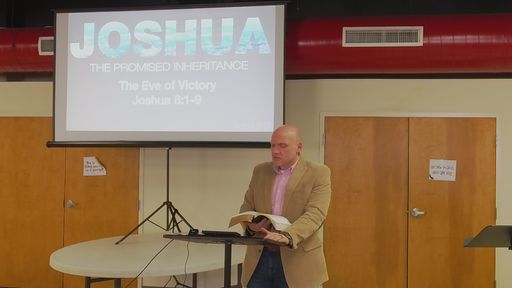
Joshua 5:13-15
Sermon by Reed Kerr
Hill City Reformed Baptist Church
Lynchburg, Virginia
Transcript
Good morning, beloved. We're continuing in the book of Joshua this morning.
We find ourselves near the end of Joshua chapter 5.
Seems like just about every commentator on the book of Joshua has pretty diverse and disparate view of the outline of the book and how it is to be understood structurally.
But nevertheless, several of the commentators see this as the start of a major section of the book of Joshua.
Because all of the preparation has been done. They have come across the
Jordan River. They are now in the land of Canaan that God has promised to give them. And our text this morning begins the actual act of claiming this land because God has given it to the nation of Israel.
When you view it this way, you see that the significance of those steps that have gone before in preparing for this great task.
God has called out Joshua to be the new leader of the nation of Israel after Moses.
God has put the fear of the Israelites into the hearts of the inhabitants of the land. God has made himself known to Rahab and has has promised to save her when her city
Jericho falls. God has miraculously brought the nation of Israel across the
Jordan River on dry land, which should remind them of the great wonders that they have heard of the generation before them.
And he has had them set up this memorial as a reminder of his wondrous works that they themselves have seen and witnessed.
God has instructed them to remember his covenant with them in renewing this practice of circumcision for this second generation.
And then he has led his people to observe the
Passover again. Again, as this reminder of what he has done in delivering those who have gone before from slavery, from the clutches of Egypt, in order that they might be his particular people, in order that they might give him glory and honor and praise and display his victory and sovereignty over all the nations.
All of this proves to be preparing the nation of Israel as now God has them in the right place, at the right time, with the right ruler.
He has reminded them of what they need to remember and he has sanctified them for what lies ahead.
And make no mistake, what lies ahead, what we will see coming in this book is significant.
It's easy for us to read accounts of wars and and conquests and to to remove ourselves so much from them that we miss the the weight and the significance and the fear that would have filled the hearts of men.
Men like you and me. We have no concept, most of us have no concept of what it would feel like to face evil to the extent that they want you dead.
They hate you. We have just one last episode here as the
Lord himself is going to speak to Joshua. Not just, not just some general vague leading.
He is going to speak to Joshua face to face. So let us read our text now.
We're just going to look at, primarily our focus is on three verses this morning. Joshua chapter 5 verses 13 through 15.
I'm going to read down the first, I'm going to include the first two verses of chapter 6 in our reading this morning because it will serve a key point that we're going to need to see and understand in our text this morning.
But Lord willing, chapter 6 will be our focus next week. So let us hear the word of the
Lord. Joshua chapter 5 starting in verse 13. Joshua went to him and said to him, are you for us or for our adversaries?
So he said, no, but as commander of the army of the
Lord, I have now come. And Joshua fell on his face to the earth and worshipped and said to him, what does my
Lord say to his servant? Then the commander of the
Lord's army said to Joshua, take your sandal off your foot for the place where you stand is holy.
And Joshua did so. Now Jericho was securely shut up because of the children of Israel.
None went out and none came in. And the Lord said to Joshua, see,
I have given Jericho into your hand. It's King and the mighty men of valor.
Let us pray. Our great God and Father, we thank you that you are a
God who hears our prayers and you are a God who in your mercy and kindness draws near to us that we might know you, that we might see and behold the glories of Christ, the one and only
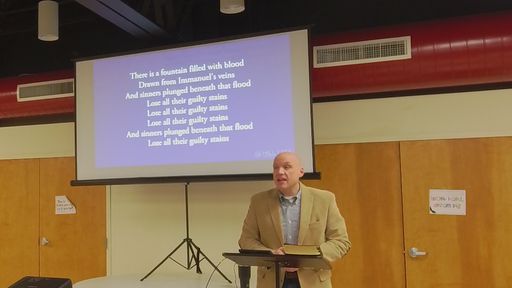
Redeemer, the one who is the commander of the armies of heaven, the one who is seated even now on his throne in heaven as we have just sung.
Father, as we consider these words, these words that you have delivered to us, would we be humbled would our hearts be changed as we are reoriented to the purposes of Christ, our commander?
Help me, Father, to speak rightly about your word. Would your spirit help us to understand and glory in Christ alone.
In his name we pray. Amen. Now to get the obvious question out of the way, who is this individual who
Joshua comes upon and meets? Who is this individual who speaks to Joshua here in this manner?
To quote a British author in an entirely different context, this must be distinctly understood or nothing wonderful can come of the story
I'm going to relate. As I already implied in my introduction,
I believe the commander of the army of the Lord is the Lord God himself, the second person of the
Trinity, the Lord Jesus Christ, the eternal Son of God. I connect this passage to others in the
Old Testament where he is referred to as the angel of the Lord. I willingly admit that there are, that some of these passages are enigmatic to say the least, leaving plenty of mystery for us and even for this particular passage this morning
I don't have the answer to every question you could ask particularly concerning the nature and form of his appearance here.
It's important that we maintain our understanding of the uniqueness of Christ's incarnation that we see distinctly in the
New Testament. This is, this incarnation that we will see in the gospel accounts is a unique event, a distinct event, when at the fullness of time the eternal
God took upon himself humanity, one person in two natures forever.
What we see here in Joshua chapter 5 is not the same as what we see in the
New Testament, but it is nevertheless real and true that the
Lord Jesus Christ appeared to Joshua as a man and not just any man, as a man clad for war with a sword in his hand claiming to be the commander of the
Lord's armies. While it would be impossible for me to do an exhaustive study of every writer and theologian on this topic,
I understand this interpretation that this is God himself, the pre -incarnate
Christ, to be consistent with the vast majority of Orthodox theologians throughout all of Christian history.
It is not the only view, but it is the dominant view including, but not limited to, the
Reformed and Puritan writers, the heritage that I personally identify with. So let this be our first point this morning.
Who is the commander of the army of the Lord? First, I submit to you that we can clearly tell from the immediate context here in Joshua that it is
God. It is God, and I'll give you three reasons, at least three reasons we see here for that.
First, we see in the second half of verse 14 that Joshua fell on his face to the earth and worshiped and said to him,
What does my Lord say to his servant? Now the word translated
Lord here in verse 14 is the more generic term for Lord that we see in the
Bible. It just means master. It falls short of an explicit declaration of the divinity of the individual, but nevertheless the fact that Joshua worships him in this manner and is not rebuked for doing so should be to us at least a strong evidence of the divinity of this individual.
The lesser created angels cannot righteously accept worship in this manner.
We could think of Paul and Barnabas in Acts chapter 14 when the people there in Iconium see the wonders and the miracles that Paul and Barnabas are doing and they want to worship
Paul and Barnabas as Zeus and Hermes. And Paul and Barnabas recoiled at this and they rend their clothes.
They're so grieved that they might be worshipped. But an even clearer contrast that we see in Scripture is the angel of the
Lord in the book of Revelation. The angel, this created being, though glorious as he is, who is delivering this series of visions to the
Apostle John. Listen how he responds to John's worship and how different it is than what we see here in Joshua chapter 5.
This is from Revelation 22. And with them that keep the words of this book, worship
God. This mere created angel, regardless of how glorious he is, cannot accept the worship of men.
He rebukes John for doing so. For that worship is due to God and God alone.
And yet here in Joshua chapter 5, Joshua falls down and worships the commander of the
Lord's army. And he does not rebuke Joshua for doing so, because it is right for him to worship
God. Second, the commander of the Lord's army tells Joshua to take your sandal off your foot for the place where you stand is holy.
Now this, of course, would have, it should remind us, and it absolutely reminded Joshua of what what we see recorded for us in Exodus chapter 3, when
Moses encounters the presence of the Lord God in the burning bush on Mount Horeb, the mountain of God.
This is what Exodus 3 says. So when the Lord saw that he turned, he, Moses, turned aside to look,
God called to him from the midst of the bush and said, Moses, Moses, and he said,
Here I am. Then he said, Do not draw near this place.
Take your sandals off your feet, for the place where you stand is holy ground.
Moreover, he said, I am the God of your father, the
God of Abraham, the God of Isaac, the God of Jacob. And Moses hid his face, for he was afraid to look upon God.
This is the manner in which we see this encounter between God, the commander of the
Lord's army, and Joshua, in Joshua chapter 5. Now I want to make this point here.
What makes the ground that Joshua or that Moses was standing upon holy?
There is nothing inherently holy in the dirt in and of itself. But it is made holy by the one who is holy in himself, the one true and living
God. Beloved, this is true of all of creation. All that God has created is not holy in and of itself, but is made holy when it is set apart for God's special purposes.
That includes you and me as well, beloved. We are sinful men and women.
We're no better. In fact, in many cases, we're worse than the dirt that we walk upon. And yet,
God in his infinite mercy has called us to be holy. Not because of anything in us, but because of what
Christ has done. Thirdly, we know that this is
God standing before Joshua because, as we just read down in chapter 6 verse 2, there we see the
Lord said to Joshua, See, I have given Jericho into your hand. This word in your
Bible's LORD is probably rendered in small caps, or it might say
Jehovah or Yahweh. This is a different word than what we saw earlier in verse 14 of chapter 5.
This is the divine personal name of God. I am that I am, as he said to Moses in Exodus.
Very God of very God. Now, identifying this divine being as the second person of the
Trinity takes a little bit more work. We must rely upon the New Testament, where Christ is more fully revealed to us.
John chapter 1 makes it exceedingly clear that the Lord Jesus Christ is eternal, from everlasting to everlasting.
Jesus is the eternal word of God, who was there in the beginning, uncreated.
It was through him whom all things were made that are made. I'm going to read from John chapter 1.
In the beginning was the word, and the word was with God, and the word was God.
He was in the beginning with God. All things were made through him, and without him nothing was made that was made.
In him was life, and the life was the light of men. And the light shines in the darkness, and the darkness did not comprehend it.
And then down in verse 14, John tells us, and the word became flesh and dwelt among us.
The word of God is the second person of the Trinity, the
Lord Jesus Christ. Paul clarifies this for us in Colossians chapter 1, when he says,
For by him all things were created, all things were created that are in heaven and that are on earth, visible and invisible, whether thrones or dominions or principalities or powers, all things were created through him and for him.
And so when Paul, in Hebrews chapter 2, calls Jesus the captain of our salvation, he is, of course, revering to Christ's work on the cross.
What Christ accomplished on the cross, that he, though the eternal son of God, shed his blood and truly died on the cross in order that we might be redeemed.
He is the captain of our salvation. And when
Paul used that phrase in Hebrews, certainly he had in mind that Christ appeared to Joshua as the captain or the commander of the
Lord's armies. I see this conquest of Canaan as a type and shadow of the salvation that Christ secures for us.
For his bride, for the true spiritual Israel in securing our eternal home in the new creation.
Just like this commander of the Lord's army is leading the charge into Canaan to give this nation, this land, in the same sense and even in a truer and fuller sense,
Christ has gone before us to prepare for us an eternal home.
An eternal home that this is but a shadow of that we see here in Joshua 5, from shadow to substance.
Also we see in the book of Revelation, our Lord Jesus revealed as a mighty warrior, sword in hand, overcoming his enemies and bringing his people into glory.
I'll read from Revelation. And he, Christ, is arrayed in a garment dipped in blood, and his name is called the
Word of God. And the armies which are in heaven followed him upon white horses, clothed in fine linen, white and pure.
And out of his mouth proceeds a sharp two -edged sword, that with it he should smite the nations, and he shall rule them with a rod of iron.
And he treads the winepress of the fierceness of the wrath of the anger of God the
Almighty. And he has on his garment and on his thigh the name written,
King of kings and Lord of lords. We have to see the connection here.
That what we see in Joshua 5 is a small -scale shadow of the true spiritual reality that is unfolding in all of creation, and will be brought to completion on the day of the
Lord. This is the Lord Jesus Christ, and he is the commander of the
Lord's armies. And when we say the commander of the Lord's armies, we can think of passages like 2
Kings 6, where the servant of God's prophet Elijah was trembling with fear because he saw the armies of their enemies around them.
And the prophet prayed that his eyes would be opened, that he would see the armies of God, that they greatly outnumbered those who were against them.
And God granted that request, and opened the eyes of this humble servant to see, to see that God indeed commands armies unseen.
The armies of heaven, these angelic hosts. We say that phrase, the angelic host, we see it over and over again in the
Bible. But beloved, do we believe this? That there are beings that we have little to no knowledge of, that are real, that are unseen, that do the
Lord's bidding. It's so easy for us to get caught up in what we can see merely, and forget the realities that are all around us.
So having established this critical point, that this is the Lord Jesus Christ, God himself, the pre -incarnate
Christ appearing to Joshua in this way, we need to we need to now consider the significance of what is happening here.
And I've got three short points for us. First, I think as we consider
Christ's appearing here to Joshua, we need to see that this is a parallel to the
Lord himself appearing to the the the patriarchs of the
Old Testament. We can think of Adam himself in the garden, where the the
Lord himself walked in the midst of the garden with Adam, revealing himself to him.
We can think of Abraham. There's multiple instances in the life of Abraham, but one significant one that parallels this well is when
Abraham entertained these three individuals. And he did not know who they were, but one of them clearly was
God himself. God was revealing himself and his purposes and his promises to Abraham.
We can think of Jacob, when Jacob wrestled with the angel of the Lord, wrestled with God himself.
Again, the second person of the Trinity, because he knew that he needed
God's blessing. He knew he was a sinner, and he needed blessing from God and sought it with all his strength.
We can think of Moses. Moses, who was enabled to experience the presence of God in a powerful way.
Moses hid himself in the cleft of the rock, and and God just revealed a glimpse of himself and his glory to Moses, and it changed
Moses. God is now making clear to Joshua that he is in this line of men that are going to be used not because of anything special in Joshua himself, but because he is the one appointed.
He is the one appointed to this task. And I can only imagine the comfort that this brought to Joshua, the courage that it gave him for what he was going to have to face.
The rest of the book of Joshua is going to be difficult.
Much, much lies ahead, and Joshua needed this courage, this affirmation that he is the one appointed to this task.
Second, in considering the significance of why the
Lord Jesus met with Joshua here, I think there's an important note that we need to make.
And Brian really set us up very well for this consideration last week.
When we're considering first things first, what must we, God's people, do before we proceed on what he has set before us and called us to do?
We need to sanctify ourselves. We need to pursue Christ in obedience.
And we see this here because we see, as we saw last week earlier in chapter 5, the people under the leading of Joshua submitted again to this sign of circumcision, this ordinance that was commanded from God for the people of Israel.
And then they went through this Passover ordinance, this reminder of God's deliverance of his people from Egypt.
These were significant things that they must do in pursuing obedience to the commands of the
Lord. And now the commander of the
Lord's army comes to Jesus. And the Hebrew is very, like, there's a great emphasis on these words when he says,
I have now come, in verse 14. The timing of this was not accidental.
This was purposeful. It is at this time that Joshua, we don't know exactly what he was doing as he was wandering here beside Jericho.
Perhaps he was thinking strategically how he might take this city.
He was looking for an entry point, perhaps. We don't know. Perhaps he was going prayerfully. He was considering this great task, the gravity of what lay ahead of him.
We don't know what he was doing, but the Lord appears opposite him and he lifts up his eyes and he sees the
Lord before him. This timing was purposeful.
We are right to anticipate when we we walk in obedience to the commands of our
Lord, that that obedience, if performed in true faith, we're right to anticipate that it will bring the blessing of our
Lord and the provision of Christ, but only by grace through faith.
I want to be very clear. Our obedience does not merit or force
God to act on our behalf, but scripture is clear over and over again.
The path of obedience is the path of blessing, even when it is difficult, even when it requires great sacrifice and suffering on your part.
Beloved, obedience is always the way that we ought to walk, and there in obedience to his commands, for his commands are good always, there we find the blessing of nearness to Christ.
We find his provision. He gives strength. He gives courage for the task that lies ahead.
I'm reminded of psalm 23, this beautiful psalm that speaks of us as God's sheep, and where are the sheep cared for?
Where are they protected? Where do they find their sustenance?
The Lord's my shepherd, I shall not want. He makes me down to lie in pastures green.
He leadeth me the quiet waters by. Beloved, the law that God gives us is for our good.
It puts us in the path of still waters and green pastures.
My soul he doth restore again, and me to walk doth make within the paths of righteousness, even for his own name's sake.
Yea, though I walk in death's dark veil, yet will I fear no ill.
That's true of Joshua. He's facing this great battle before him, this conquest of the land of Canaan.
He is walking in the shadow of death, but he need not fear, because he's walking in obedience, within the paths of righteousness.
For thou art with me, thy rod and staff need comfort still. My table thou has furnished me in presence of my foes, my head thou dust with oil anoint, and my cup overflows.
He's in the presence of his enemies, and yet God is with him, because this is what the psalm concludes with.
Goodness and mercy all my life shall surely follow me, and in God's house forevermore my dwelling place shall be.
Beloved, when we are obedient to Christ's commands, there we meet
Christ. When you daily open the pages of scripture and read the words of God, there you find
Christ. He is the word of God in flesh.
All of our obedience, let me put it this way, all of our obedience means nothing and is utterly worthless if not for Christ.
It brings us to him. It leads us to him that we might meet him. Without Christ, we are dead in our transgression and sin.
We need Christ. There is no other path forward for us but death and damnation.
For we have fallen in our father Adam, and we daily choose sin and iniquity.
We need Christ. We need Christ. Thirdly and finally,
I want to really understand and emphasize this question that Joshua puts forth to the commander of the
Lord's army and the answer that he receives. Are you for us or for our adversaries?
The answer is not what any of us would have expected, for the
Lord says no, no. He's not for Joshua in and of himself, no more than he is for the city of Jericho or these
Canaanite people who hate and despise him. The purpose of the
Lord is what he wills. It is not what we will.
It is not what we want on our own. He's not coming alongside us in our mission to make us successful in what we want to do.
He is for his own purposes and he is calling us to be obedient to his leading.
The Lord's purposes will stand and we are called to be his servant.
As Joshua here says, we are at his command.
One of the commentaries, James Montgomery Boyce, had a paragraph here that personally
I found quite convicting and I want to read these sentences to you. We here as reformed
Christians in particular, I think we have a tendency to, we take our doctrine very seriously and rightly we should, but we need to have a right perspective in the ends and purpose of our theology.
James Montgomery Boyce makes a contrast here that I think is really, really helpful and it gave me a lot to think about this week.
He's speaking of partisan believers who are so sure that God is like their particular denomination that they are unpleasantly intolerant of all other expressions of faith.
We've known plenty of those, but I ask, haven't you also known people who are exactly the opposite?
It isn't that they don't belong to a denomination or don't have strong beliefs about the true theology of the
Bible, proper forms of church government, or Christian worship. They are anything but theological or denominational drifters.
These people have strong beliefs, but they have something else too. They have a larger, grander view of God, and as a result, they are not primarily interested in whether others have dotted their particular theological
I's or crossed their particular denominational T's. They are only interested in serving
God and expect him to lead others in his own way and according to his own timing.
What makes these people the kind of Christians they are? The answer is quite simple.
They have actually been meeting with God and have bowed low before him and have asked what he chooses to do with them.
So they bear the touch of heaven and speak words that are in some ways the words of God.
We need people like that and we need to follow them. Beloved, this is why our
Lord taught us to pray, your kingdom come, your will be done.
Our purpose is to follow Christ. We're so quick.
I'm so quick to take up arms and engage in this petty infighting that is pointless.
True doctrine matters. True doctrine is what unites the church. We should love it and strive for it.
We should take our teaching very, very seriously. Do not misunderstand what I'm saying here.
I love theology. I love to talk about it. My kids know this. If we're working on some task, we've got a job to do, they can easily derail me with a simple question.
About 45 minutes later, I'm still going and I love doctrine.
I love sound doctrine because it brings us to know Christ with greater clarity.
My point here is make sure that that doesn't become the ends in and of itself. Beloved, we are to follow
Christ and his leading because his kingdom is coming and his kingdom is what we are to be striving for.
The glory of the name of Christ exalted in all nations that he might receive the glory and worthy and honor and praise that he alone is worthy of.
To him be glory forever and ever. So in conclusion, there is a heavenly city, a true promised land, a kingdom, a city whose builder and foundations are set by God.
And that is the the true promised land that even Abraham in Hebrews 11, even
Abraham was looking forward to not a land in Canaan but a heavenly land. And we on our own because of Adam's fall and our own sin, we have no claim in that land.
We have no standing there. We don't deserve it because we have broken covenant with our
God, every one of us. And yet our God is merciful and kind and he goes before us and he has has conquered every enemy.
Beloved, if you are struggling against your sin and you feel the weight of your defeat that you are not worthy, you're right.
But run to Christ, meet with Christ, seek him. He is the redeemer, the only redeemer of God's elect.
He is the one who can bring us to that heavenly country because he is the commander of the
Lord's armies. He is the righteous king of kings and lord of lords that sits enthroned on high.
The quest is his and he is securing for himself a bride radiantly arrayed in his righteousness for his good pleasure to be his possession and an eternal testament to the glories of his grace.
Let us pursue Christ, our father in heaven.
We thank you that you are the ruler of heaven and earth and that you sit above every authority, every power enthroned on high in your holy glory.
And yet in your mercy you have sent your son to reconcile sinners to yourself that we might be dressed in a righteousness not our own, that we might be secured unto that day of our final salvation where we stand in your presence and love you with an unsinning heart.
Lord may we long for that day. And yet in the meantime as we wrestle and war with our flesh and with the enemies of this dark world, may we seek the power and courage and strength of Christ who goes before us that he might receive the glory and honor and praise that he is worthy of.