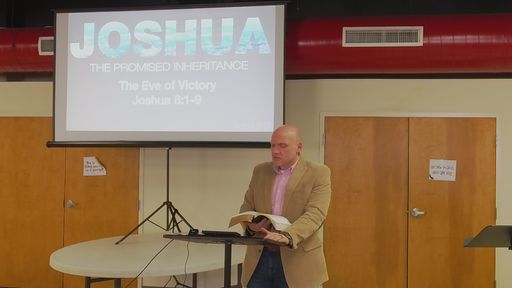
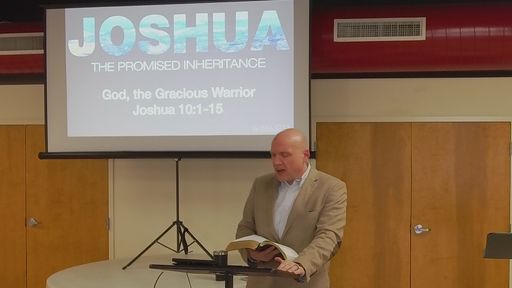
God, the Gracious Warrior - Joshua 10:1-15
God, the Gracious Warrior
Joshua 10:1-15
Sermon by Micah Green
Hill City Reformed Baptist Church
Lynchburg, Virginia
Transcript
And, well, let's turn again to the book of Joshua, starting in chapter 10 this morning.
We'll be looking at the first 15 verses of Joshua. Lord willing, we'll be looking at verses 16 through 28 next week.
Last week we saw this deceit of the Gibeonites, and for context the
Gibeonites were part of the larger tribe of the
Canaanites, the Canaanite people group. The Gibeonites were a subset of that, and they were surrounded by other peoples.
We could classify many of these other groups as the Amorites, but there were individual city -states that were governed by kings, and so there would have been a city that would have been defined by walls in most cases, and then there would have been lands outlying that a king was able to control and able to exact power over, tribute over.
And so an idea that's somewhat foreign to us today with these internationally agreed upon borders in most cases, but this was a day in which basically a king's kingdom was as wide as he could conquer it and as wide as he could hold it.
And so when we've been talking about these different people groups over the last few weeks, and we'll continue to do so, these were fairly small areas as we would think about them today for a time when most people would live and die within a 10 -mile radius of where they were born.
They were quite large, but for us they're not so much today. And so last week we went through Chapter 9, that the
Gibeonites, again, who through deceit and through craftiness and cunning, my section heading in the
New American Standards says the guile of the Gibeonites, they trick the people of Israel into making a peace treaty with them.
We saw that one of the faults of the people, of the
Israelites, was that they did not consult God, they did not take counsel from the
Lord, we see in verse 14. And so the Israelites make this foolhardy agreement with the
Gibeonites and then they realize the truth that they are not, in fact, some people from far away, but they are among them, they are part of the
Canaanites, part of the people that God had commanded that they were to, the Israelites were to get rid of, to destroy.
And so now because they have made this agreement with the Gibeonites, they realize that they must hold to that agreement that they have made in the name of God, in the name of Yahweh.
We saw that this deceit ultimately was born out of fear.
It was out of fear, not just of being destroyed by the Israelites, but it was out of fear of God who had clearly given
Israel success. It is not for nothing that when the people of Gibeon come to the
Israelites, they say, and we saw this in verse 9, your servants have come from a very far country because of the fame of the
Lord Hebrew, Yahweh your God. This was the personal name of God. They were acknowledging
God whose name means I am, the one true
God. And so in a sense, there was this acknowledgement that God is who he says he is, that there are no other gods before him, and they're making this plea to the nation of Israel for protection, to be brought under the guardianship, under the protection of Israel.
And so now we see that not only Israel is responsible for the well -being of Gibeon, but in our chapter today, we see this response of these fellow
Canaanites to this alliance that Gibeon has undertaken. So starting in verse 1 of chapter 10, and again, we'll go through verse 15.
Now it came about when Adonai Zedek, king of Jerusalem, heard that Joshua had captured Ai and had utterly destroyed it, just as he had done to Jericho and its king, so he had done to Ai and its king, and that the inhabitants of Gibeon had made peace with Israel and were within their land, that he feared greatly, because Gibeon was a great city, like one of the royal cities, and because it was greater than Ai, and all of its men were mighty.
Therefore Adonai Zedek, king of Jerusalem, sent word to Hoham, king of Hebron, and Pyram, king of Jarmath, and to Japhia, king of Lachish, and to Debir, king of Egalon, saying,
Come up to me and help me, and let us attack Gibeon, for it has made peace with Joshua and with the sons of Israel.
So the five kings of the Amorites, the king of Jerusalem, the king of Hebron, the king of Jarmath, the king of Lachish, and the king of Egalon, gathered together and went up, they with all their armies, and camped by Gibeon and fought against it.
Then the men of Gibeon sent word to Joshua to the camp at Gilgal, saying, Do not abandon your servants.
Come up to us quickly and save and help us. For all the kings of the Amorites that live in the hill country have assembled against us.
So Joshua went up from Gilgal, and he and all the people of war with him, and all the valiant warriors.
The Lord said to Joshua, Do not fear them, for I have given them into your hands.
Not one of them shall stand before you. So Joshua came upon them suddenly by marching all night from Gilgal, and the
Lord confounded them before Israel, and he slew them with a great slaughter at Gibeon, and pursued them by way of the ascent of Beth -horon, and struck them as far as Azekah and Makedah.
And they fled from before Israel while they were at the descent of Beth -horon. The Lord threw large stones on them as far as Azekah, and they died.
There were more who died from the hailstones than those whom the sons of Israel killed with the sword.
Then Joshua spoke to the Lord in the day when the Lord delivered up the Amorites before the sons of Israel.
And he said in all sight of Israel, O sun, stand still at Gibeon, and O moon, in the valley of Eijalon.
So the sun stood still, and the moon stopped, until the nation avenged themselves of their enemies.
Is it not written in the book of Jashar, The sun stopped in the middle of the sky and did not hasten to go down for about a whole day.
There was no day like that before it or after it, when the Lord listened to the voice of a man, for the
Lord fought for Israel. And Joshua and all Israel with him returned to the camp at Gilgal.
Father, as we read your word, we are humbled when we are reminded that you are the
God who takes people that are nothing and makes them to be your people. You are the
God who takes mighty and powerful nations and makes of them nothing.
That you are a God who fights for your people better than they can fight for themselves.
God, your word from beginning to end is all about you.
It is about your glory. It is about your power, your sovereignty, your might, your wisdom, your perfect holiness.
And father, thanks be to God that from beginning to end, your word is about your loving kindness, your mercy, your grace, that you would have mercy on sinful people and that you would display that mercy and the sending of your perfect, holy, spotless son, that you would make him who knew no sin to be sin for us as we call upon you in faith for salvation.
Father, we thank you that we can exalt you today. Thank you for this passage in which you clearly display your power, your majesty, your sovereignty, and you display your care and your loving kindness.
Lord, would we worship you in the proclamation of your word today.
We ask this in Jesus' name, amen. Many of us have heard parts of this passage that have been used, have been pulled out in different ways, in various ways to somewhat extremes that I've heard of verses from this very chapter used in the past.
On one hand, there are those who will read of the moon and the sun that stands in its place and they'll use this as an example of something in scripture that is so unbelievable that there has to be some rational explanation for it, that naturalism, one of those legacies of the enlightenment will prove so alluring that a scholar can't help but make some a feeble attempt to explain away what was described in scripture, to say that this passage means anything other than what it says that it means.
Another approach to parts of this passage is to hold it up as a proof text for how we can use prayer to bend
God's ear as if we can, through our cunning words and clever phrases and maybe even just the emotionalism of our prayer, that we can somehow bend the will of God to our will.
Of course, many people wouldn't put it in those words, but when you read their books and when you go through their programs, it's obvious that there is this attempt there to get
God on our side, to get God with our program. That if you work up enough faith and you pray fervently enough, that you can convince
God to do great things through you. In reality, both of those views are faulty because the focus here in this passage is clearly on God, on His power, on His grace and His mercy.
The only right focus for this passage is on God. The only right focus for all of God's Word is on God.
It's God who gives the gift and the power of prayer. It is God who gives the gift and the power of faith.
It is God who gives goodness. The focus is on His power and His sovereignty.
In our passage today, we see three things that God did for His people, for the
Israelites then and for the Gibeonites, and what He does for His people today.
We see, first of all, that God keeps His promises. As chapter 10 opens, we see the response of the
Amorite city -states to Gibeon's treaty that they have made with Israel.
Again, for context here, and we use these terms somewhat interchangeably sometimes, but if you can think of a big circle as the
Canaanites, and within that there are smaller circles of the Amorites, and then there is a circle of the
Gibeonites. So they're all Canaanites, but they're distant relatives. Joshua tells us that Gibeon was greater than Ai.
When we think back, Ai is the city that initially the Israelites go against and they run away, and then they confess the sin that has been committed by Achan and his family, and he's killed, and then they come back and they are subsequently victorious over the city of Ai.
So Gibeon is greater than Ai, and yet, as we saw last week, it's Gibeon that is willingly, preemptively, we might say, coming to Israel and saying, hey, we see what you've done, and we want to be your servants.
Make a treaty with us. So this preemptive surrender is alarming to the
Amorites. So the king of Jerusalem, Adonai Zedek, assembles this coalition of the other
Amorite city -states to respond to Gibeon's surrender. Now if his name sounds a little familiar, especially the
Zedek part, and if you're reading through the Bible, you probably, or depending on your reading plan you're using, you may very well have already gotten to Genesis chapter 14.
If you haven't, you can still catch up. It's only January 11th, so don't stop yet. But you probably have gotten to Genesis 14, or you're going to get there soon, where Melchizedek, king of Salem, or Jerusalem, goes out and greets
Abram and blesses him. Melchizedek, Melchi means king, and Zedek means righteousness.
So his name means king of righteousness. If you know a little bit of the Hebrew words and names for God, that means that Adonai Zedek means the
Lord of righteousness. The writer of Hebrews later on, as we saw in our study of the book of Hebrews previously, the writer of Hebrews says that Melchizedek prefigures
Christ's priesthood, that Melchizedek is a shadow, a type of the true high priest who is to come.
And so now, after this reign of Melchizedek, who was not only a king, but also a priest of, as Genesis tells us, of the
God Most High, some 680 years later, during the time of Joshua, now there's this other king,
Adonai Zedek, who is assembling an army to fight against Gibeon.
We see this contrast here. We see Melchizedek, a priest -king who serves the God Most High.
He comes out to Abraham and he blesses him. He brings bread and wine.
Now later on, Adonai Zedek comes out to fight against Abraham's descendants and any who will ally with him.
The stark contrast between these two leaders. So the
Gibeonites send word to Joshua for help. And this is an interesting point for Israel.
As we saw last week, remember the promise of Israel was that because of their hasty agreement, their treaty, it meant that they could not touch them or fight the
Gibeonites. But it could have been argued that by the letter of the agreement, in this case the
Gibeonites are calling to them for help, Israel could do nothing. They could just ignore the request.
How easy would it have been from a human standpoint to say, this is only going to work to our advantage.
The Canaanites, these are all our Canaanites. They're just fighting each other. Let's just let them fight each other and we'll take on whoever's left.
By that point, they'll be weakened. Interestingly, we don't hear from God at all in chapter 9 regarding this agreement, this treaty that's made.
We know from what Joshua says that the treaty was undertaken without the counsel of God.
But now in verse 8, God does speak. He gives
Joshua the assurance of victory. He says, do not fear them for I have given them into your hands.
Not one of them shall stand before you. Again, another promise of a victory that has already been assured.
This is not just, well, Joshua, do your best, come up with a good battle plan, and make sure all your guys are trained.
Well, this is, I have given them into your hand. So there seems to be this clear confirmation here that God is honoring this promise made to the
Gibeonites to bring them under the protection of Israel. Reid pointed out last week that Israel later on would suffer the consequences of their failure to honor this agreement.
And so there was clearly a covenant that was made that was to be honored between the people of Israel and the people of Gibeon.
And so it also stands to reason that when the people of Gibeon allied themselves to Israel and to Israel's God, that they were going to face opposition.
They were going to face hatred from their own kinsmen. The recognition that we saw last week that they acknowledged the mighty acts of Yahweh, the
God of Israel. And so this acknowledgement for protection, for aid, for mercy was answered by God resoundingly.
And even though as we saw last week, their plan was imperfect, it came from imperfect motives, it was made in fear and with deceit, it was answered by the
Israelites prayerlessly, it was honored by God because God keeps the promises that He makes to His people.
We see secondly that God fights for His people. This is in itself proof that God keeps
His promises. He tells Joshua, I have given them into your hand.
Victory is assured. As we saw a few weeks ago in the battle of Ai, we see that there's also this, could call it a dichotomy, but there's at the same time that God has promised to give these people into the hand of the
Israelites, there's also this action that He calls Joshua too. Joshua is not to be this third party observer with a little
UN patch on his arm, just standing there with binoculars watching it all go on. He is to be an active participant in what
God is doing. And so Joshua here marches all night from Gilgal.
A night march means that there's probably going to be a battle at first light.
If you ever study history, you study battles, study the order of battles, no leader, no general wants to lead his men on an all night march to make a battle the next morning.
That's not what you would call optimal conditions for a fighting force. It's probably the last thing that he wanted to do, the last thing that his army wanted to do.
But this speaks to Joshua's faith in God's promises. God says, I have given them into your hand and the people need help.
So there's no reason to wait. He gets up and he goes then. He speaks to Joshua's faith in God's promises and Israel's commitment to protect
Gibeon. This was a march, by the way, that wasn't an easy road. There wasn't a paved path that they could just go on.
When it says that Joshua went up from Gilgal, it's because he's going up and there's a change in altitude.
And it was over a 21 mile march that he took going up to Gibeon.
We see that once he got there, the text tells us that God confounded the people, the
Amorite army. Depending on the translation that you're reading, it might say confounded.
Most English translations say confused or threw into confusion. The King James and its derivatives, if you're reading
King James, New King James, it renders the word as discomfort, which is not a word that we really use anymore.
At the time that the King James was written, discomfort in most cases meant to defeat in battle, which doesn't really add a whole lot to the meaning or to the translation.
Today, the word discomfort means to make someone feel uneasy or uncomfortable, which that doesn't really fit with the meaning here either.
So neither sense of that word really conveys what the Hebrew is trying to say. What it's conveying here is confusion.
God threw the people, the Amorite army into confusion. Of course, this is not the first time that God has acted in this way on behalf of the
Israelites. When we think back to the Israelites leaving
Egypt and they're headed towards the Red Sea, and from Pharaoh's army's perspective, they are driving
Israel into the Red Sea. We're told in Exodus that God threw the
Egyptian forces into a panic. It's the same idea that's being conveyed as they were pursuing
Israel towards the sea. They didn't know what was happening. They didn't know where Israel was.
And this is not the last time that God will do this either, particularly in the book of Judges, one that always comes to my mind is when
Gideon is fighting Midian. And it's almost humorous.
It's not humorous for the Midianites, but he causes the Midianite army to turn on one another. They start fighting each other.
This is what God can do. So the scene here for the
Amorite army is one of chaos, is one of confusion. And throughout this, we see
Joshua acting in faith. He marches through the night. He doesn't wait until morning.
He doesn't give his army a good night's sleep and a good breakfast to get them on their way. Gideon needs help now, and God has given him the victory.
So why wait? And then he pursues this
Amorite army that has been thrown into confusion. He doesn't just watch what happens passively and slap his knee and laugh at the
Amorite army. No, he pursues them. He pursues them to take them over and to defeat them as God has told them that he will do.
And in the midst of Joshua acting, we see God act as well. God rains down these large hailstones from heaven onto the
Amorites. In verse 10, it says that God slew the
Amorites. He struck them as far as Azekah and Makedah.
It's interesting that the same exact Hebrew word that is used here is the same word that Adonai Zedek uses in verse 4 when he says, let us attack
Gibeon. This attacking, this slaying that Adonai Zedek thought that he was going to do is being done to him instead.
Such is the intensity of this attack that Joshua notes that God killed more people with the hailstones than Joshua's army killed with the sword.
Humanly speaking, I think if any of us were writing that, we might be tempted to say, well, it was kind of half and half. Hey, the hailstones killed some people.
We fought valiantly too. You know, there's some ways we could wordsmith that, but Joshua was pretty clear.
God killed more people with hailstones falling from the sky than his army was able to kill with the sword.
God was able to do so much more than the Israelite army was capable of. This is what our
God can do. God fights for his people. And finally, we see that God is sovereign over his creation.
What follows next is this miraculous act of God in which he displays his control over creation.
We see first that Joshua speaks to God. The implication here, the posture here is clearly of prayer, that Joshua is falling before God in prayer.
We see sometimes throughout history, and especially American history, sometimes this romanticized general praying and that type of thing.
We don't really think about that really happening in battle, at least not in modern -day warfare of a general praying, but here is
Joshua clearly praying in the midst of this battle that is taking place. And it was this posture of prayer that then led him to command the sun and the moon to stand still.
This was, again, not unlike Moses who commands the waters of the Red Sea to part. Again, Joshua, as we saw very recently, did the same thing at the edge of the
Jordan, as we saw when we started our study of the book of Joshua.
So in the sense that the Israelites were able to reckon time, it seemed to them that time stood still, the sun stood in its place.
The book of Joshua that Joshua references here has been lost to history, but we see a reference made to this book one more time in 2
Samuel chapter 1. And so it seems from both of these references that it may have been a book that was a historical book, but also one that included the work of God for the time of faithful men up through the time of the judges.
So we see here the ultimate source of this miracle. Yes, absolutely, Joshua prayed to God and God listened to him, but ultimately the
Lord God fought for Israel. Throughout this entire account, it is God who is the initiator.
It's not man, it's not Joshua, it's not the Gibeonites, it's God. It is
God who prompted the Gibeonites to cry out to the God of Israel for help.
It is God who makes good on this promise that was made to Gibeon. It is
God who gives assurance to Joshua that he will be victorious. It is God who gives faith to Joshua to undertake this journey in the night and then to command the sun and the moon to be still.
It is God who actively wages war on Israel, I'm sorry, on the
Amorites, wages war for Israel. This is not an example of using prayer as a tool to get
God to do what you want him to do. This is not an example of things that we see, miraculous events, and ways that we can explain away something that we can't explain, of God exacting sovereignty over the creation that he brought into being by his very word and upholds by the power of his word.
God had given him such a measure of faith that Joshua could tell the celestial bodies to stand still, and they did.
This was a gift of God. And again, unfortunately, there have been attempts by scholars to explain this away, to rationalize it, that maybe there was a visual trick being played.
If you ever have low blood pressure, you can find certain commentaries, and I can tell you which ones they are, that if you read things like this, it will try to tell you, oh, well, it could have been shadows, like the shadows could have made it look like the sun, no, it means what it says that it means.
Do I understand it? Do I understand how that happens? No. But when we see miracles like this happening, we can have full assurance that God does do what he says that he does.
Because after all, is this miracle that we see here, this miracle of the sun and the moon standing still, is it any less great of a miracle than when a dead enemy of God is transformed from death to life through the power of salvation through Jesus Christ?
Really, do we believe what we say we believe? That salvation is an act by which me, a sinner, an enemy of God, someone who is fully deserving of hell, of separation from God, that I'm given faith to cry out to God like these
Gibeonites, like Joshua crying out to God, and that God in his mercy and his grace, he makes me a new creation.
He fills me with the Holy Spirit. He counts me as righteousness because of the righteousness of God.
And more than that, he adopts me as his child. Is that miracle that I have experienced, that if you're in Christ, you've experienced, is it any less great than the sun and the moon standing still?
I can't say that it is. Our problem is that we have too low.
We have too paltry a view of what God does for us in salvation. Our problem is that we don't take
God at his word. We don't believe that what takes place when we come to the throne of grace with confidence and find help for our very, every need.
Some 650 years later, Isaiah would recount this victory at Gibeon.
Isaiah says, so this is what the sovereign Lord says, see, I lay a stone in Zion, a tested stone, a precious cornerstone for a sure foundation.
The one who relies on it will never be stricken with panic. I'll make justice the measuring line and righteousness the plumb line.
Hail will sweep away your refuge. The lie and water will overflow your hiding place. Your covenant with death will be annulled.
Your agreement with the realm of the dead will not stand. When the overwhelming scourge sweeps by, you will be beaten down by it.
As often as it comes, it will carry you away. Morning after morning, day by day, night by night, it will sweep through.
The understanding of this message will bring sheer terror. The bed is too short to stretch out on, the blanket too narrow to wrap around you.
The Lord will rise up as he did at Mount Parazim. He will rouse himself as in the
Valley of Gibeon to do his work, his strange work, and perform his task, his alien task.
Now stop your mocking or your chains will become heavier. The Lord, the God Almighty, has told me of the destruction decreed against the whole land.
This promise and this warning that Isaiah is making here is first a promise of the precious cornerstone,
Jesus, who would come. Ultimately, this is a warning for those religious leaders who would oppose
Jesus at his coming. Just as God worked miraculously to fight for his people at Gibeon, in a far greater way he would fight against the evil ones who oppose the coming of his son and the salvation that he would bring.
Indeed, this victory, as miraculous as it was, pales in comparison to the salvation that has been granted to us through Jesus Christ.
So when we think about this passage and thinking about this this week, passage today is a reminder to us that God's enemies will rise up, that they do rise up.
It's easy for us to look at the news today and look at the things going on around us and say that this is something new that is happening.
The enemy has opposed God and his people ever since he told the first lie in the garden.
It took no time at all for the surrounding Canaanites to develop hatred for their fellow
Canaanites who aligned themselves with God and his people. The nation's rage, that is not a new thing.
If you have allied yourself to God and to his people, don't be surprised when the nations rage against you.
The Gibeonites were related, again, to these Amorites. They were part of the larger Canaanite group.
They were family. But the miracle of the new birth is that God creates bonds between us if we are in Christ that are stronger than any earthly familial bonds that we experience on this earth.
That God means what he says that he means when he promises that from every tribe and language and people and nation, he is making a kingdom of priests to serve him.
That when I talk to one who is an earthly family member who is not in Christ, we no longer speak the same language.
We don't even live in the same reality. You experience that? I know I do.
So don't be dismayed when God's enemies rise up against you. Trust in God's covenant promises.
He will come to your aid just as he came to the aid of the Gibeonites. We're reminded too that God calls us to action, that Joshua marched uphill in the middle of the night.
He pursued the enemy. But we are also reminded that God fights for us better than we fight for ourselves.
Yes, we are called to put on the whole armor of God as Paul reminds us in Ephesians chapter 6.
As he reminded Timothy towards the end of his own life, we are to fight the good fight of faith.
We are called to action. But we also have to remember that our victory is one that we receive and not one that we achieve.
If my victory was dependent upon my own actions, I would be defeated.
We have the blessing of battling, of being on the battlefield as we witness
God's hailstone crushing the head of the serpent. We have the blessing of tending to the wounds of fellow believers on the battlefield, of providing the beans and the bullets and the bandages to one another as we fight this good fight of faith.
But ultimately, our victory is sure. It is even more sure than that of the victory of Joshua over the
Amorites because this victory was won for us once and for all at Calvary.
And soon it will be acknowledged by the whole world at the glorious returning of Christ who will come, not this time as a helpless baby in Bethlehem, but he will come as the victorious
Lion of Judah. The Israelites would fight more battles.
Some they would win, some they would lose. Some they would lose to their own idolatry.
They would be carried away into exile. Not so with the people of God who cry out to Christ for salvation.
Our victory is sure. So, let us then cry out to our victorious warrior
King Jesus, whether it was Gibeon calling on Israel for mercy or Joshua racing to meet this assembled army.
It was God who gave faith. Logically, there was no reason why the
Gibeonites should call out to Israel for mercy. Logically, there was no reason why
Joshua should tell the sun and the moon to stand still. Earthly speaking, it would not give me a whole lot of confidence in my general if he stood out on the battlefield and told the sun to stay still in the sky.
These acts of faith were not the acts of a madman or the acts of someone who was completely misled.
These were acts that were the result of the gracious gift of God of faith.
The problem for most of us is not that our prayers are too big, but that our prayers are too small. The accounts that we have considered for the last few weeks serve as exhortations that God would give us an ever -increasing faith.
I do believe, Lord, but help my unbelief that that would be the prayer of our hearts, that we would see prayer for the act that it actually is, that we are going to the very throne of Jesus Christ.
Do you believe that? Do I believe that? Too often I don't when I pray. God help us that we would.
That we would pray for hearts that are so aligned to God's will that if he tells us to tell the sun to stop in the sky, that we would do it and we would see it happen.
I hope for faith to trust God more, that we would truly believe that God is willing to disrupt the natural order of the universe to save his people.
He did it by pausing the sun for Joshua on this particular day. He did it by causing the sun to flee as the greater
Joshua took our judgment upon himself as the sky darkened. And then on the third day, he did it again by shaking the earth and causing
Jesus to rise from the dead. So let us cry out to our gracious, our merciful warrior savior,
Jesus, that he would equip us with faith and armor, that he would equip us with grace and mercy, that he would fight for us, and let us rejoice, beloved, that he has given us the victory.
Father, we are so humbled when we read your word, when we read passages of your mighty acts.
Humbled, Lord, because partially we realize that we don't have a full understanding of your power and your glory, that we read these words of you, our
God, being a warrior who fights for your people. Lord, would you give us a greater understanding of this faith that you give to us, of the fighting that you do for us, of the mercy that you continually show to us in ways that we are oftentimes not even aware of.
Lord, would you grow us in our faith, that as we come to you in prayer, that we would see our prayer to you for what it really is, that it is a gift that you have given to us, that our faith is a gift that we can exercise when we come to the throne of grace with confidence.
Father, would you grow us in our love for you and our love for one another, that we would battle together well, that we would do this, that you would be honored and glorified.
Because again, Father, this is all about you. We ask this in Jesus' name, amen.