Keep sharing good news without ads.
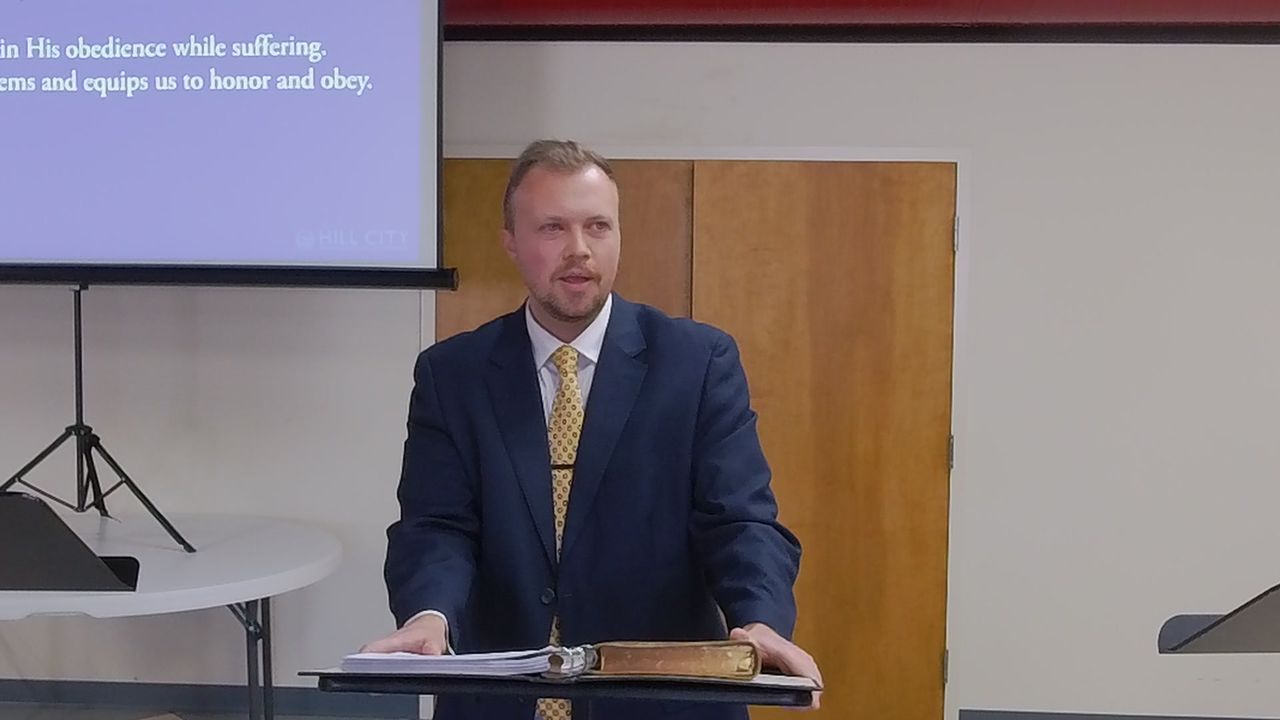
Honoring the Dishonorable 1 Peter 2:18-25 Sermon by Rob Graham
Hill City Reformed Baptist Church Lynchburg, Virginia
Thank You Micah for that introduction. Thank You Reed. Thank You Brian, and thank you church family for welcoming us. It's been such a pleasure this past year and a half to be a part of this church. And it's truly an honor and very humbling to be able to bring you the word today.
I want to start with just a short story. That has a lot to do with what we're going to be talking about today. Let's imagine that there is a Christian man. We'll call him Tony, pick that name because among guys in this congregation, I don't think there's a Tony.
And he works for one of those big corporations you've probably heard of. And at this corporation, of course, he is one of the only Christians and his boss will call him Dave. He is not a Christian and he's very unfriendly to Christians.
Now Tony one day was Evangelizing sharing the gospel with some of his colleagues and Dave caught him doing this. Dave really was not a fan of that and from then on he really started going harder on Tony.
He started nitpicking his work. Tony was a hard worker. Tony provided very high quality work, but he nitpicked everything. He worked him harder longer hours and never was satisfied with them. This really discouraged Tony.
Tony Went to the Lord and was constantly worrying. Was he gonna lose his job? Was he gonna be able to provide for his family anymore? But he was encouraged as he continued to read the scriptures and pray and think of the trials of People in the Bible and he gave him the resolve the spirit encouraged him to work even harder.
To be even more efficient even more respectful and honoring of his boss. This really frustrated his boss Dave because Dave really wanted to expose Tony as a hypocrite. He wanted Tony to break down and say ha you Christians are just a bunch of hypocrites.
We were right all along. But he couldn't do it. Tony remains steadfast and pressed on and he stood out among his colleagues. Well one day Tony came into the break room and saw Dave there weeping because Dave realized how wicked it really was even as an unsafe person the fact that he was trying to break another man down and expose him and proven to be a fraud when he wasn't and Tony came up to him and they shook hands and Reconciled and had a much better relationship.
From there on out and even several months later through the example of Tony's life and his words Dave himself became a Christian. Now having said all this I completely just made that story up. Because I went on the Google looking for a story to start this sermon with and I said Give me an example of a story of good overcoming evil in the workplace.
And you know what probably no surprise to anybody here, but Google did not want to give me that. Instead it wanted to give me a laundry list of oh, no. Things like that in the workplace. That's very serious.
We need to take this to HR. We need lawsuits. We need the whole nine yards because AI Often today is trained with a secular worldview and mine. And what does the world think is most important? Is it overcoming evil?
Overlooking offenses. Loving other people more than yourself. Now what the world thinks is we got to look out for me myself and I look out for number one. If anybody ever hurts me, I'm gonna lash back out.
And they're dead to me. But that's not the way of Christ. And we see this all throughout the Bible. It's a very practical and sanctifying book and we especially see this in Peter's first epistle. Which is where our passage comes from today the book of first Peter.
It was written to a group of Christians spread out throughout the Roman Empire and In this book Peter really emphasizes different relationships of Baltic season authority. One of those relationships is relation of Citizens of the Roman Empire to the Emperor.
Another relationship is wives to husbands particularly unbelieving husbands. And then lastly we also have the relations of slaves to their masters and that's what we're going to be looking at in today's passage.
Which is first Peter 2 18 through 25 and. The main proposition I want us to see from this text today is this. We must honor and submit to authorities. Even when they are harsh and lice and light of Christ's example and our redemption.
Say that again we must honor and submit to authorities. Even when they are harsh in light of Christ's example and our redemption. I Think the passage breaks down very nicely into three points here verses 18 to 20 focus on this idea.
We must honor and obey authorities even when they are harsh. Verses 21 to 23 reflect that Christ is our example in his obedience while suffering and. Then lastly verses 24 and 25 show us that Christ's suffering redeems and equips us to honor and obey.
So let's read today's passage and go to the Lord in prayer first Peter 2 18 to 25. Servants be subject to your masters with all respect not only to the good and gentle but also to the unjust. For this is a gracious thing when mindful of God one endures sorrows while suffering unjustly.
For what credit is it if when you sin and are beaten for it you endure. But if when you do good and suffer for you endure, this is a gracious thing in the sight of God. For this you have been called because Christ also suffered for you leaving you an example so that you might follow in his steps.
He committed no sin. Neither was deceit found in his mouth when he was reviled. He did not revile in return. When he suffered he did not threaten. But continued entrusting himself to him who judges justly.
He himself bore our sins in his body on the tree that we might die to sin and live to righteousness. By his wounds you have been healed for you were straying like sheep. And have now returned to the shepherd and overseer of your souls.
Let's pray Heavenly Father we thank you so much That we live in a place in a time where we can get together freely like this to read your word To hear it exposit in to pray to you to fellowship with one another and to practice the ordinances you've given us.
Lord, I pray with you. I pray to you that you would be so kind to us in this time that the Holy Spirit would convict us of the truths in this passage namely that We are called By your fifth commandment to honor thy father and mother and Then likewise as what that commandment really teaches that we are to honor Respect and obey the authorities you've placed into our lives.
And we are to do this in light of your clear teaching throughout the Bible and especially Through the example that Christ gave us that even as he suffered even as he was scorned. Even as an innocent man, he was blamed and yet he still obeyed and he didn't revile and he respected authority.
Lord equip us and work through the word by the power of your spirit for you promise that it does not go out and return void. We pray this in Jesus name. Amen. So As I mentioned already our first point today is that we must honor and obey authorities Even when they are harsh.
Now in the context of this passage As I mentioned some of the people that Peter was addressing were slaves. There are many people who are either sold into slavery or became slaves Voluntarily themselves in the Roman Empire.
So what was it like to be a slave in the Roman Empire? Well, there's a lot of ways where as much akin to what we modern-day people think of as slavery based on slavery in the West in the modern era era for example.
Some people were kidnapped and then sold into slavery much like how some Africans kidnapped other Africans and sold them to Europeans. Likewise, some people were born into slavery just as some Africans were born into slavery.
However, there's also many ways in which it was very different. For example, some people money was tight. And so they sold themselves into slavery. Some slaves were actually more educated than their masters surprisingly and they served as a family doctor or perhaps a tutor to children.
However, the main thing to take away from this is that it was not a pretty and stylish and fashionable life to be a slave a Couple commentators have things to say about this such as Tom Schreiner. He says this.
They as in the slaves could suffer brutal mistreatment at the hands of their owners and Children born in slavery belonged to masters rather than the parents who gave them birth. Slaves had no legal rights and masters could beat them brand them and abuse them.
And this is what J .A. Harrell notes. Despite claims of some New Testament scholars ancient slavery was not more humane than modern slavery. So not only is it important for us to understand the historical context of a passage but we have to see why it was so important and in this case, it's important because.
What Peter is really trying to say is hey, this is a difficult life. You're in as a slave. But it's no excuse not to practice the fifth commandment. I still expect you as Christians as servants of the Lord Jesus Christ to honor and obey.
Now, of course, I want to say there are always going to be contexts in life where we have to disobey. There are going to be going back to our earlier example of HR offices times where an HR office or a lawsuit is unfortunately Necessary, but let's be honest.
Most of the circumstances in our life where we're offended where we might have a harsh taskmaster are not These level that not this level of severity. And so what Peter's teaching here is very applicable to us as well.
So as I've already kind of hinted at I believe really what the core behind this is is the fifth commandment. Now, of course being the theology nerd that I am. I'm very tempted to go into a digression about The perpetually abiding nature of the moral law the threefold division of the law.
The Ten Commandments is a summary of the moral law. But I will not. I will save you that instead. I will content myself with Ephesians chapter 6. I want to look at the first couple verses there. Because I think they're pertinent to this discussion.
Ephesians 6 starts this way. Children obey your parents in the Lord for this is right honor your father and mother. This is the first commandment with a promise that it may go well with you and that you may live long in the land so.
What I believe this passage teaches teaches. Is that Paul despite being under the new covenant? Believe that the Ten Commandments were still a moral duty for Christians to live they did not expire with the Old Covenant.
Now, yes, of course as we've seen all throughout the study of Galatians. We've been going through we are not justified at all. By our keeping of the moral law. We never could do that but in light of our justification we are expected to cheerfully Keep these commandments and one of them is the fifth commandment honor thy father and mother.
Now this commandment I face value. It just says honor thy father and mother. Is that really all it means? Well, the Pharisees certainly would have hoped so. The Pharisees wanted to keep everything very surface level external just the letter of the law.
You know why it's because they wanted to justify themselves. They thought they were good. They thought they could be righteous on their own. But we know that as both David and Paul remind us no one is good.
No, not one. We cannot justify ourselves. The Pharisees believed they could show up before God when they die or on Judgment Day and say look I was good I kept your law at the at the externals here. And so I'm justified before you you might think of the parable of the Pharisee and the tax collector God.
I thank you that you didn't make me like this tax collector here, but God is gonna say I never knew you. Because you know what the Lord Jesus Christ taught he taught that there is a spirit of the law behind every single one of these ten commandments we see the examples he gives and Thou shalt not commit adultery.
He says even if you look upon someone with lust in your heart You've committed adultery and how about thou shalt not murder? He says if you have looked with hate upon your brother, you've killed him in your heart.
So there is a deeper more pressing spirit of law behind each one of these commandments. So, how do we apply that to the fifth commandment? Well, I believe that the letter of the law says that You shall honor your father and mother because these are the very first authorities that God puts into our lives our father and mother.
But really the pressing principle here is that we are to honor and obey every rightful authority. That God has providentially placed in our lives. So that's a very heavy and difficult thing that we're being exhorted to to keep the Ten Commandments.
None of us will do that perfectly by any means every single day. We'll break the Ten Commandments. So Peter wants to give us encouragement here. He goes on to say but if when you do good and you suffer for it you endure.
This is a gracious thing in the sight of God now right before this Peter was reminding his audience that Just because you're suffering. Just because your master lashes out against you does not automatically mean that you're blessed of God.
For enduring that because you could just be a lazy slave. Men some of us sometimes at work are probably a little lazy and we get a little rebuke from a boss. We deserve it. Let's just be honest however, if when you do good You are hard-working you do everything your boss has asked you to do or for a slave that your master has asked you to do.
And you still get a lashing you still get a beating you still get harsh words. Well, that's a gracious thing. What does that mean a gracious thing? Well on the surface level it looks like it's saying that this is evidence of God's grace in your life the sanctification of the Spirit.
However, a lot of commentators say that well, that's true. Of course that really there's something even deeper even more hopeful going on beyond this in The previous verse where Peter was talking about how if you disobey and or receive a beating for it.
Then you're just getting what you're deserved. He uses the word credit and this is parallel to gracious thing if you have a credit that means you have a reward or some kind of award coming your way and so Obviously for the one who's disobeying it's a bad credit not a good one.
But a gracious thing coming to the believer that is the glory that comes from when Christ returns. We are resurrected and we reign with Christ as vice regents and he says well done well done. So that's a great hope for us to look forward to but you know what there's still glory for us in this life.
Did you know that? Listen to what Proverbs 19 11 says. Proverbs 19 11 reminds us good sense makes one slow to anger and it is his glory to overlook an offense. I want to read that again. Good sense makes one slow to anger and it is his glory to overlook an offense.
That verse really is worth memorizing and carrying with us every single day because each of us has various authorities in our lives and we're gonna be confronted with many occasions to be offended and Our flesh wants us immediately to jump right back out at that person.
But we need to stop and think good sense makes one slow to anger. Why am I getting angry so easily here? Perhaps I'm prideful. And you want to think about that glory. Imagine people, you know in your life I'm sure each of us know some people that lose their cool very easily.
And we also know some people that seem very calm and steady no matter what happens. They're not easily shaken. They can take a slight they can take a joke against them and they just laugh at it. Which of those people do you most respect?
Which which of those people do you most aspire to be like? Here's a more important question, which of those people looks more like Jesus Christ, I think you know the answer. Good sense makes one slow to anger and it is glory to overlook an offense.
So Christian, why would you settle for anything but glory? So just as a reminder in our first point here We saw that we must honor and obey authorities even when they are harsh. And moving on to our second point.
We see this Christ is our example in his obedience while suffering crisis our example in his obedience while suffering. Peter presses on here now explaining to the slaves that they're suffering under the harshness of their masters.
It's not random. It's not for nothing and it's providentially placed there by a sovereign God who ordained them to that. Let me repeat that God purposely put suffering into your life. There's a lot of people today that don't want to hear that and certainly won't be preaching that but it's true.
Peter explains why for to this you have been called and why is that because Christ also suffered for you. Leaving you an example so that you might follow in his steps. Now the Greek word here, for example is hoople grandma.
You might pronounce it hypo grandma. Hypo being a prefix and then grandma. I'm sure you can figure out what hypo means. I know there's some nurses here. Think of a hypodermic needle needle goes under your skin.
So under and then grandma comes from the same stem that would mean grammar or graphite referring to writing so we have an underwriting and the context and the ancient Greco-Roman world world for this word comes from the fact that Children when they were in school, they would have a sheet of paper.
It was a sheet of paper that went under a tracing sheet and that sheet of paper had a letter on it. And so you put the tracing paper above it. So this underwriting this example letter you would trace over it to learn how to write the letter.
Now, let's compare this to the example of Christ. Think about the first few times that a child is writing a letter and learning, right? It looks a little bit like scribble. Maybe they write an A and it looks more like a B.
And so on and so forth. Well, likewise the first few times we go through suffering and trials in our life. We often are kicking and screaming and complaining and oh god, why would you do this? I thought you were good.
I thought you loved me this that and the other and it doesn't look so good. We're not really tracing out the letter of Christ's example very well yet. But as we go on as we master what the word has to say and as the Holy Spirit continues sanctifying us.
We learn to trace out how Christ suffered so well. But of course, it's one thing to have an example or to say that someone is an example. But we have to know why and how they're an example. You you're really good at that thing over there.
How do you go about doing that? I want to learn from you. Well Peter. Peter teaches us how Christ suffered so well and in doing so throughout the rest of his Chapter 2 right here. He is using language from Isaiah 53 now.
How providential was it that Jake's last sermon that he gave to us was on Isaiah 53? So we're already familiar with the passage. It's of course the passage of the suffering servant being prophesied. Peter says this.
He committed no sin. Neither was deceit found in his mouth. When he was reviled he did not revile in return. When he suffered he did not threaten but continued entrusting himself to him who judges justly.
Christ really suffered a lot for us to start. He had perfect fellowship as God the Son with God the Father and God the Holy Spirit For all eternity and he left this taking on sinful flesh to endure pain suffering.
Reproach scorn. Imagine him as a little one. Just having come out of the womb crying. Imagine him as a little boy falling. Scraping his knee. Imagine him growing up into adulthood being made fun of by people.
Being laughed at being scorned for the things that he was teaching in his ministry. And of course. Think of him being falsely accused. Think of him being whipped cords tearing the skin of his back. Think of a crown of thorns ripping into his skull.
Think of him carrying a cross on that already torn back. Think of his arms being nailed and his feet being nailed into a cross. And then of course the worst agony of it all might be hard for us to imagine but The father who he once had perfect fellowship with cutting off his presence from him.
Which is very apropos that we looked at Psalm 22 earlier. That's why he said my God my God. Why have you forsaken me? Can you imagine the pain of being on a cross and going through all that and yet? He probably wasn't even thinking about in the moment.
He was thinking about how he had no access to the father at that moment and that all the wrath. That all Christians of all time have ever earned being thrown on him into that moment and experiencing the worst of hells more so than any other person ever has.
Or ever will experience he suffered all of it without any type of bitterness. I Think John Gill said it best when he says this. For since Christ suffered who had no sin nor did any nor could any be found in him.
Charged upon him and proved against him and which sufferings of his he bore with patience. How much must it become sinful men to bear their sufferings patiently. Though they may not be criminal with respect to the things for which they suffer.
But yet are so in other things. Whereas Christ was not criminal Nor blameworthy in anything. Beloved if Christ not retaliate in word or deed. If he did not revile a Reproach back those who reproached him those who put him as an innocent man on the cross.
What excuse do we have when someone says something just a little unkind to us? Or even our boss who's a jerk. I mean really what excuse do we have? Let's always keep that in mind as we go ahead in this week ahead.
So in review of our first two points. We started with the fact that we must honor and obey authorities even when they are harsh. Christ is our example in his obedience while suffering and. Then lastly what we want to see here is that Christ's suffering Redeems and equips us to honor and obey.
Peter tells us that there is a blessed result to Christ's suffering namely this. He himself bore our sins in his body on the tree that we might die to sin and live to righteousness. I Have many fellow bookworms in a congregation and so I'm sure many of you have read pilgrims progress.
Think about Christian with that burden on his back that he starts with. It's the weight of all of his sin. It's the weight of him trying to keep the law. It's heavy. He's tired. How do I get this off my back?
Well, eventually there's that beautiful scene him coming to the foot of the cross and laying it down now picture Christ and his burden except his burden is not the weight of Just can't keep this law by myself.
He could. It's not the weight of his sin. He didn't send at all. It's the weight of the sin of each and every one of us. Who's a Christian here. It's the weight of the sin of every Christians ever come before us.
Every Christian alive today and every Christian still yet to be born. All on his back all that he had to carry the cross the hell that every single Christian Deserved was compiled into one giant Source of wrath of God poured out onto him so that you did not have to experience it.
That is the tremendous weight. That's what he bore in his body on the tree so that we might die to sin and live to righteousness. Now sorry again to go to John Gill, but I just have to for this please bear with me.
It's just a slightly longer quote. His bearing them was in this manner. He becoming the surety and substitute of his people their sins were laid upon him by his father. That is they were imputed to him.
They were reckoned as his and placed to his account and Christ voluntarily took them upon himself. He took them to himself as one may take the debt of another and make himself answerable for it. Or as a man takes up a burden and lays it on his shoulders so Christ took up our sins and carried them up as the word here you signifies alluding to the priest carrying up the Sacrifice to the altar and referring to the lifting up of Christ upon the cross.
Whether he carried the sins of his people and bore them and did not sink under the weight of them. Being the mighty God and the man of God's right hand made strong for himself and so made entire Satisfaction for them by enduring the wrath of God the curse of the law and all that punishment which was due unto them.
And thereby bore them away Both from his people and out of the sight of God and his vindictive justice and remove them as far as the east is from the west and made a full end of them and This he himself did and not another nor by another or with the help of another.
Not by the means of a goat as the high priest but by himself. Though he was assisted in bearing his cross. Yet he had no help in bearing our sins. Angels could not help him. His father stood at a distance from him.
There was none to help his own arm brought salvation. Once again, Peter goes to those words that were so reflective of Isaiah 53. By his wounds you have been healed. By his wounds you have been healed.
What does that mean? That means not only are we redeemed from the wrath of God? But he's also given us now the spirit so that we can go forward and yes, we will constantly stumble. We will constantly day by day say Lord.
I Tried to keep the fifth command. I tried to honor and obey My husband or I tried to honor and obey mommy and daddy or I tried to obey my boss. And I lashed out again. Or maybe you don't actually lash out but you know in your heart you're constantly thinking Wicked thoughts about that person, but he calls us to come to him.
Peter goes on to describe how he is a shepherd to us. He says for you were straying like sheep but have now returned to the shepherd and overseer of your souls. I Can't help but think that Peter was thinking about the episode of the Good Shepherd.
You might remember it from the gospel according to John. Where Jesus says things like I am the Good Shepherd. I know my own and my own know me. Just as the father knows me and I know the father and I lay down my life for the sheep.
And he says also the sheep hear his voice that is Christ and he calls his own sheep by name and leads them out. When he has brought out all his own he goes before them and the sheep follow him for they know his voice.
Beloved we know the Lord's voice. He will call us to repentance and we will because we know his voice. Every day we'll probably have multiple instances where we fill that conviction by the Spirit and He draws us softly back in.
He calls his elect. They know his voice they come he beckons them to repent when they turn away and they do because it's not about how much faith they have. It's about Christ being a faithful shepherd who will complete the work he started in his sheep.
I think about a Story that da Carson told in the past it was in relation to Israelites. The night before the Passover and the land of Goshen and I want to adapt it slightly to this circumstance. You might have two sheep.
One is very confident in the shepherd. Oh, I know that no matter what happens to me. He's gonna protect me. No wolf is gonna harm me. If I wander off, he'll pull me right back in and you might have another sheep.
It's just I don't know. It's kind of scary out there. There's those wolves are they've got sharp teeth. They're really scary. I know there's some out there in the woods. They're nearby. I Think I think you're right.
I think the shepherd is gonna protect me, but I just I don't know. Now do you think the shepherd is gonna protect that sheep? Less because he had a little less faith in the shepherd. Or is the shepherd gonna protect him because he's a shepherd and that's his job to protect him.
The same thing applies to Jesus Christ. You might be of little faith or you might be of great faith. You might be going through one season or the other but either way, he will constantly draw you back in and sanctify you and it is by this redemption and Sanctification that he has accomplished for us.
That we will continue to grow in our ability to honor and obey the authorities that he's placed in our lives. And of course to keep the rest of his commandments, too. So just in conclusion for what we have talked about.
Again, the three points we discussed we saw in this passage where we must honor and obey authorities even when they are harsh. Christ is our example and his obedience while suffering. And then lastly Christ suffering redeems and equips us to honor and obey.
What does that look like for us though? I Think it's very important not only to get an exposition of a passage that we're talking about. But also to see how it applies to our lives today as well. You're gonna wake up tomorrow and no matter what you're called to do.
Whether you're a worker from home or you're a worker outside the home. We all have authorities in our lives and we're all going to be tested tomorrow morning. Perhaps you didn't sleep very well the night before.
Perhaps your boss is just straight-up a jerk. And you're gonna be called to experience that trial and To obey the Lord no matter what. So boys and girls. Perhaps mommy and daddy has asked you to do something that you just don't quite understand why they've asked you to do that but keep in mind that mommy and daddy often have your best interest in mind and The Lord expects you to love and obey them.
Obedience does not look like rolling your eyes and huffing and puffing and then going to do it. Yes, you did it. But you did it disrespectfully. So say yes, mommy. Yes, daddy. You're right. I'll go do that.
Wives Peter actually addresses you specifically in the very next chapter. Encouraging you that if you have a harsh husband. You should try being gentle and kind and as a husband myself I can attest that that is a very winsome spirit and it has done me well and softened my heart at times as well.
For those working outside the home. Perhaps your boss is somebody who constantly just nitpicks every little detail. Never ever tells you what you did, right? He just constantly tells you what you did wrong.
And so you think you're just always doing something wrong. But press on press on and saying yes, sir. I'll do that right away. It might be difficult but try finding things that your boss does well and point that out to me, you know, sir.
I think you did that really well. I think that was a really good idea on your part. That was a great strategy to move ahead with this project in that way. You would be surprised at the ways that the Lord uses those things to soften people's hearts.
You know, even if he doesn't we're still bringing him honor and glory by our actions and We're being conformed to the image of Christ. Another word of caution. Don't gossip about the authorities in your life.
It can be very tempting a group of women are together. If somebody is having a difficult situation at home, please don't gossip about your husband. It tears him down and it ruins the testimony of Christ and It can be very hurtful to a marriage.
Instead offer encouraging words think of all the things that your husband has done well and praise him in public. He'll probably hear wind of it and that will be very pleasing to him. And it would be very good for your marriage.
And of course, we'll bring honor to Christ. Perhaps there's some people that we have disrespected that we really should be respecting. Perhaps we need to go to those people now, of course. Just as a word of caution if it's just things you've been thinking in your heart.
Don't go to that person say hey. I just wanted to let you know it was wrong of me, but I was thinking this really mean thing about you. Probably not a wise idea. But if you've said or done something that has hurt a relationship.
Go repent and ask for forgiveness. And see the relationship restored. Heavenly Father. I thank you so much for this time that you've given us to study your word and this very important topic that is often neglected in regard to keeping the fifth commandment to respecting and Honoring and obeying authorities that you have providentially placed into our lives.
It's a difficult thing to do especially with our sinful flesh. We want to rule ourselves. But that is not how you've set up this world. We ultimately submit to Christ and his his kingship his lordship is Ultimate over every other authority and if those things ever cross we must disobey and obey him instead.
But the normal pattern is for us to obey them because you have put them in that place for a reason Lord. And so I pray that you would give us the strength Father. Give us the strength by the example of the Son and the power grace and sanctification of the Spirit this week to go forward and To honor respect and obey the authorities you've placed in our lives.
We pray this in Jesus name. Amen.