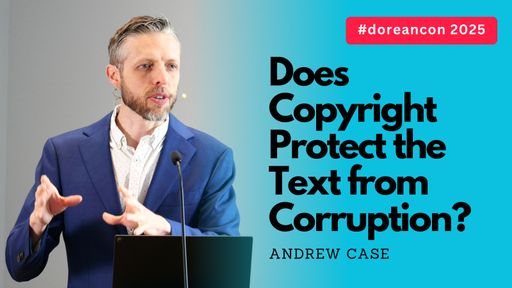
Does Copyright Actually Protect the Text of Scripture from Corruption? - Talk 5
This message by Andrew Case was presented at #doreancon 2025 on "The Stewardship of Scripture" at Silicon Valley Reformed Baptist Church in Sunnyvale, CA.
Read the article version of this message: https://sellingjesus.org/articles/copyright-protect-scripture
SIGN THE STATEMENT on the stewardship of Scripture at: https://copy.church/statement/
LEARN MORE
https://sellingjesus.org
https://copy.church
https://thedoreanprinciple.org
Transcript
Martin Luther said the following in a sermon in Wittenberg on March 10, 1522.
Here's what he said, the Word created heaven and earth and all things. The Word must do this thing and not we poor sinners.
In short, I will preach it, teach it, write it, but I will constrain no man by force, for faith must come freely without compulsion.
Take myself as an example. I opposed indulgences and all the Papists, but never with force.
I simply taught, preached, and wrote God's Word. Otherwise I did nothing.
And while I slept or drank Wittenberg beer with my friends Philip and Amsdorf, the
Word so greatly weakened the papacy that no prince or emperor ever inflicted so much loss upon it.
I did nothing. The Word did everything. What do you suppose is
Satan's thought when one tries to do the thing by kicking up a row? He sits back in hell and thinks, oh what a fine game the poor fools are up to now.
But when we spread the Word alone and let it alone do the work, that distresses him, for it is almighty and takes captive the hearts.
And when the hearts are captured, the work will fall of itself."
So this was the heartbeat of the Reformation. It was based on a
God who is mighty, whose Word is mighty, and who answers to no king or human contrivance.
Luther and others trusted in a God who ruled the universe with absolute power and authority, who could take care of his
Word without man's gimmicks, traditions, or ingenuity. Lorraine Bettner wrote, put the truth of God's sovereignty into a man's mind and heart, and you put iron in his blood.
And the Reformers who who ushered in a divine light, dawning into this world, flailing in murky darkness, they had iron in their blood.
Now the Inquisition, what did they think? They believed a chained
Bible would protect God and the people. The Reformers in the meanwhile saw the gospel flourish under God's blessing, as they flooded the world with unrestricted access to Scripture.
In the case of some, like Luther, it meant the loss of potential prophets.
In the case of Tyndale or Tyndale, it meant the loss of his very life.
And some people would call this foolishness or sacrifice. I would simply call this obedience.
Obedience to a God who cares and provides for his children with unmatched faithfulness.
Now just like the Middle Ages saw Christians limiting the access of other
Christians to Scripture, today we see the same playbook being used by the prowling lion and enemy of our souls.
Christians once again are keeping other Christians from freely using the
Word of God. This is always done with the belief, whether sincere or feigned, that Scripture must not fall into the wrong hands.
But Scripture was meant for the wrong hands. I have the wrong hands.
You have the wrong hands. That's how the wrong hands are washed and cleansed and made new.
First Peter 1 .23 says, you have been born again, not of perishable seed, but of imperishable, through the living and enduring
Word of God. Medieval gatekeepers said, the Bible is too dangerous for the masses.
Yes, an unrestricted Bible is dangerous, but not to the masses, rather to falsehood and unbelief.
That's what it's dangerous to. When the sword of the Spirit is unsheathed, it pierces the heart, cuts down the darkness, and severs the head of the twisting serpent.
In this talk I want to show three things, three main things. Number one, since the recent invention of copyright, it has failed to advance the protection of Scripture from corruption.
Number two, how the origins and purpose of copyright reveal its inadequacy to protect
Scripture. And number three, I want to show that God in this providence preserved Scripture for centuries without the help or existence of copyright.
So let's look first at some concrete examples of how human attempts to monopolize the
Word have been unsuccessful in protecting it from corruption. As we saw in my last talk yesterday, the
KJV was born in a time before modern copyright law, but it fell victim to this printing monopoly ordained by the crown, which did essentially the same thing.
And so no one was allowed to print it besides a few privileged presses. Did this guarantee perfect Bibles is the question.
Not at all. You've probably heard of the Wicked Bible from 1631.
This was an official edition of the KJV that ended up with a scandalous typo. The word not was accidentally omitted from the seventh commandment and rendered as thou shalt commit adultery.
The error slipped through the proof readers and thousands of copies went out before anyone noticed.
So clearly the crown's system did not prevent a corrupted text from being published in this case.
As history has demonstrated again and again, central control is no guarantee of perfection.
Fast forward to 1633, with the publication of what has now been called the
Unrighteous Bible. In that official KJV printing, a typesetter once again dropped the key word not in 1st
Corinthians 6 .9, so it read the unrighteous shall inherit the kingdom of God.
And these were not isolated errors. So in 1833 Thomas Curtis published this book, and you can you can read the whole thing, it's on archive .org.
It's called The Existing Monopoly, An Inadequate Protection of the
Authorized Version of Scripture. People were noticing this back then already, and they were making lists of all these crazy errors that were coming out in these official sanctioned editions of the
KJV. His core claim in this book was that the crown's Bible printing monopoly did not actually protect the integrity of the biblical text and ensure fair prices.
On the contrary, it bred carelessness and variable accuracy, and Curtis was not alone in his criticisms either.
His book sparked others to rally behind him and push for a change, get rid of this monopoly.
For example, in 1840 James Campbell wrote, monopoly and unrestricted circulation of the sacred scriptures contrasted.
And let me give you two examples, just these are fun, let me give you two examples from this book, some quotes.
Oh what a hardship is Bible bondage. Men and brethren, will you not arise and put on your strength and help to break its fetters?
On what principle, consistent with the good of our country, the glory of Christ, and the renovation of our world, can this cruel monopoly be vindicated?
Gentlemen, answer me. I behold an answer in your emotions. It cannot be vindicated.
No, men, angels, earth, and heaven, the voice of the universe, as with the sound of 10 ,000 thunders, proclaims the impossibility of its vindication.
This is not a question of sects and schisms of church and descent, but of the common salvation.
It involves the honor and the operations of principle, which are dearer to the people of the most high than life itself.
Oh, who can estimate the impiety of a monopoly of the Word of God? Who does not shudder at the thought of converting the charter of man's redemption, the record of God's mercy, and Christ's blood into a mercantile monopoly?
What Christian bosom is not convulsed in agony to think of exacting tribute from the world's salvation?
You'd be a little bit sad to find out that there are not many bosoms convulsed in agony even today with the status quo of exacting tribute from the world's salvation.
Another quote, he says, brethren, this is our awful present condition.
The thought is dreadful. It sickens the very soul. Earth or in heaven, who among men or angels can calculate and estimate the earthly and everlasting consequences of perpetuating this inhumane restriction, this barbarous embargo on the
Word of God? At the very first intellectual approach to the dread subject, the ears tingle, the blood runs cold.
Who can even attempt the terrible computation? I love this
Victorian language. Do men reason and declaim concerning taxes on knowledge, taxes on correspondence, taxes on corn?
They do well. But hurtful and hateful as are all such taxes, vile weeds of the empoisoned soil of selfish, selfish nature, evil emanations of class rule and perverted legislation, they are roses of Sharon, plants of paradise as compared with the malignant and deadly effects of this monopoly.
Think, a tollbooth on the path of life, a tax on the site when the pen of inspiration has inscribed with the blood of Christ the terms of pardon to a condemned world, a tax which must be paid before the trembling spirit of man dares either to listen to the word or look to the writings of his offended but compassionate
God. How revolting the thought." End quote. People were riled up about this back then and I hope we get a little bit riled up too.
So let's go back to this book by Thomas Curtis that I mentioned, his lists of examples of textual corruption in printings of the
KJV over the years because of this monopoly. Judges 11 7, we have children instead of elders of Gilead, we have three instances of God instead of Gad, we have head for stead in 2nd
Chronicles, making the nonsensical sentence, he reigned in his head.
We have Psalm 5, table instead of temple, worship at thy holy table, and he says this is advocating for potpourri, holy table.
Door instead of doer, you plentifully reward the proud door instead of doer.
Remainder instead of Redeemer in an important prophecy in Isaiah 59.
Hosea 8, we have angel instead of eagle, we have idol,
I -D -L -E instead of idol, I -D -O -L, and on and on.
There's many of these. You can go look at it for yourself. Another fun one, hate not his own wife instead of hate not his own life, is repeated in Luke 14.
So, copyright not only failed to prevent these kinds of corruptions, but it also failed to prevent cults and cult versions of the
Bible. You would think, okay, copyright ensures the purity of the text, prevents this kind of stuff, and this is often what
I have heard very big speakers, you know, even like John Piper, say they applaud the copyrights on modern versions because it will prevent cults from using them or manipulating them.
Well, then why do we live in this world where we have thousands or millions of Jehovah's Witnesses and Mormons?
What happened? First, we have the Jehovah's Witness Bible, the
New World Translation. So, this group objected to Orthodox doctrines like the deity of Christ.
So, in the 1950s, well after the first copyrighted
Bible in America, the ASV, they commissioned their own translation that famously renders
John 1 -1 as the Word was a God, and God lowercase, among other biased alterations.
No existing copyright could have prevented them from doing this because they had scholars of their own who could translate the
Greek, and indeed the NWT is entirely their own product, published with full legal rights by the
Watchtower Society. Copyright didn't protect the text of Scripture from this corruption because a determined group just made a new translation.
Second, we have the Joseph Smith Translation, the JST from the 1800s, in which he made significant additions to Genesis and other books to fit
Latter -day Saints theology. He wasn't hindered by any copyright. He mostly used the
KJV as a base and edited freely, obviously in spite of these heretical versions of Scripture.
The identity of the genuine biblical text remains clear.
Who in the Protestant churches have been deceived by these?
Because, oh, you know, I can't find a true Bible anymore. We have them all around us.
It's worth noting that also groups with heterodox beliefs prefer to make their own translation from scratch precisely because they don't want the stigma of being a derivative of a mainstream
Bible from orthodox people. If a cult thinks your translation is doctrinally corrupt, you think they're gonna want to base their translation off of yours?
No, they won't build on it. They'd rather start fresh and assert their independence and the truthfulness of their claims.
So copyright has failed to protect textual corruption and stop the massive advance of cults who use and misuse the
Bible. And this is unsurprising. You know why? Because copyright was never intended to do this.
It was not its intended purpose. So let's talk about its telos.
The telos, the purpose of something is important. If you try to use a pencil to hammer down a nail, you'll be frustrated and never achieve your goal.
That's not what it was made for. It's not because you have a bad goal of hammering the nail.
It's just that you're using the wrong tool. You're using something that wasn't made for that.
The same is true of copyright law. Carl Fogel writes in the
Surprising History of Copyright, fantastic article, encourage you to listen to it on our podcast or read it.
The first copyright law was a censorship law. It was not about protecting the rights of authors or encouraging them to produce new works.
The system was quite openly designed to serve booksellers and the government, not authors.
For about a century and a third this partnership worked well for the government and for the stationers or the publishers.
The publishers profited from their monopoly and through them the government exercised control over the spread of information.
Later as copyright evolved it would become focused on creating artificial scarcity to maximize profits and minimize risk for publishers.
Listen, this is a completely different idea from protecting texts from corruption.
It's very different. It was never copyright's purpose or goal. Even if copyright were intended and useful for ensuring the purity of the text, another glaring question arises.
Can the gatekeepers be trusted? The assumption today, in today's world, is that the gatekeepers are these holy saints.
They're the incorruptible good guys who would never want to take advantage of anyone, never want to twist anything, never want to change anything to be erroneous, etc.
While you and I, we cannot be trusted. The average
Christian, we are inherently suspect. We are not to be trusted with the text.
Only the guys at the top, you know, they would never do something wrong.
Is that a valid assumption? I did a long series on the Bible in Arabic for my
Working for the Word podcast on Bible translation, and in that, I covered the Son of God controversy, which really shook the world of Bible translation a number of years ago.
So the gatekeepers, in this case, were operating under an all -rights -reserved copyright mentality, and they were publishing
Bibles in Muslim contexts that avoided calling Jesus the Son of God. That is, they used other phrases to avoid translating
Son of God as it stands for fear of offending Muslims. Now, the people who are pushing for this translation philosophy were often external actors, but much of the indigenous church, the local people, the leadership, were not in agreement with what they saw as unfaithful translation practice that was misleading at best.
In spite of this, the local church community had no recourse because the custodians of these copyright -restricted translations were in favor of downplaying
Son of God language. So, because the indigenous churches lacked the legal freedom to revise or correct theological error as they saw it within such translations, they were rendered powerless to safeguard sound doctrine in their language.
And this was all being funded by Westerners and megadonors. This is not just something that threatens people in distant lands, though.
Oh, in the Middle East, who cares, right? No, the same control
Western publishers wield could be misused just as easily and could prevent timely correction if they go astray.
So, to give a not -so -nefarious example, the 1984
NIV Bible was updated in 2011, as we probably all remember, with changes that not all readers welcomed, and there was a lot of hoopla about this.
The NIV owners then withdrew the 1984 edition from print, meaning only the new
NIV can be legally sold. So, churches or individuals who preferred the old wording found it increasingly hard to obtain legally.
Although this may not sound catastrophic, it demonstrates the principle. Copyright gives a publisher power not only to publish but to unpublish.
A translation can be altered and then the people of God who used and loved and relied on it in their church, maybe they bought all these, you know, these pew
Bibles, people are used to this translation, all of a sudden they're barred from printing the original.
History has seen denominations and institutions drift theologically over time, and if that drift happened to the owners of a copyrighted
Bible, the faithful in that language group could face a crisis. So, returning to our question, is it a valid assumption that the gatekeepers are incapable of corruption?
Absolutely not. I think if we have a healthy understanding of human depravity and indwelling sin, that should be an obvious answer as well.
So, on one hand, if we choose to live in a Pollyanna world where you see publishers through rose -colored glasses and never prone to temptation as paragons of perfection, who would never countenance the idea of intentionally corrupting the text of Scripture, I would say we're naive.
The Bible never calls us to have such confidence in sinful man. On the other hand, if we choose to live in a man -centered world where God is not supreme, where he is not the sovereign owner and master who ordains all things, who guards, governs, and guides every molecule of the universe, then we're setting ourselves up to operate out of fear.
Fear of man and other forces outside of our control. Now, many people, as you know, live in this world where they simultaneously trust in sinful man, they put their trust and their confidence in sinful man, and then fear sinful man at the same time more than God.
Isn't that sad? But that's the reality. The way this plays out in the context of our topic, of course, is that the
Church entrusts the stewardship of Scripture to publishers believing that they will always do right and act in the best interest of believers and of the
Great Commission, and at the same time they doubt, number one, that God is able to protect and preserve
Scripture, so man must do it, and number two, that God is able to provide through his people in order to undertake large translation and publication projects.
God could never, I mean, God can provide for Joe Schmoe to go to the mission field, but oh, we're talking about millions of dollars for a big translation project.
God, we can't be asking God to just give offerings for that. What? Often there is a lack of faith in both areas.
This is the sticker shock argument that I hear often. It's like, oh, yes, support is great, but with the big projects, you know, oh, so many millions of dollars, and God's just like, yeah,
I own the cattle on a thousand hills and the whole universe, and I created everything, but God, you know, it's gonna cost like three million dollars to this
Bible translation, you know, and God's like, oh, oh, yeah, yeah, you're right, you're right, you guys go sell it, sell it.
I'm not gonna provide for that, but when we look at the world through the lens of God's goodness, faithfulness, power, and providence, we see his wisdom, and we realize that unrestricted scripture is actually one of the most effective safeguards against the entrenchment of theological unfaithfulness.
So in a context of openness, nothing remains hidden. All is subject to scrutiny, reform, correction, which is also why those responsible for the proliferation of distorted translations are often opposed to dedicating anything to the public domain.
This idea of protecting and preserving scripture by letting it run freely and be glorified, as 2nd
Thessalonians 3 .1 says, leads us to the third point I want to make. God and his providence preserved scripture without the help or existence of copyright law for many centuries.
So long before any copyright, the scrolls of the biblical text were preserved by hand.
As with all human copying, errors inevitably creep in, but because there were so many different copies and versions made across different regions, it was very difficult for corruptions to fully take over.
Today we have thousands of biblical manuscripts which act as a cloud of witnesses to an accurate text.
It was the absence of copyright that allowed for this proliferation and decentralization, and this enables textual scholars to compare and spot errors.
The variations that exist are mostly minor spelling or word order differences, and no major doctrine is affected by them.
So God did not choose to preserve his word by anointing one single Pope of publishing to guard it.
He preserved it by lavish redundancy, spreading it out freely so that even if a few copies got corrupted, the truth could be reconstructed from the many that didn't.
It is precisely because the word was not bound that it was preserved so well.
Throughout history, the dragon has unyieldingly sought to devour and destroy the bride, trying to snatch away or break her sword with fury and cunning, and God has preserved both her and her sword with unflinching power through centuries of heresy, empire, and flame.
So the suggestion that divine protection now hinges upon modern copyright law is a strange one, to say the least.
It may even be described as silly. Is it truly dangerous to let God's word out into the open, unchained?
Or is the greater danger in thinking we can keep it safe? God and his word are inseparable, and he takes care of himself.
He does not need a bodyguard. Our purpose is not to keep the ancient of days from embarrassment through our flawed contrivances.
We must ask ourselves if we are at risk of becoming ooza, reaching out to steady the arc.
At this point, one might still say, all right, yeah, I see that history doesn't guarantee that copyright protects purity, but aren't we supposed to put safeguards in place to use our wisdom?
Shouldn't we do our part to guard the good deposit? Good question. Indeed, we are to guard the gospel, 2nd
Timothy 1 .14, and how we guard it matters. Let's talk about that.
Do we guard it by locking it up, or by proclaiming it widely and refuting errors with truth?
That's the question. Nowhere does the Bible suggest that legal mechanisms are required to keep
God's word pure. Instead, we find passages like 2nd Timothy 4, 2 through 4, where Timothy is charged to preach the word in season and out to reprove and exhort with patience and teaching, because errors will come.
People with itching ears will turn to myths, and the antidote, what does he say to Timothy?
Make sure you don't share the Word of God with anyone, then. Make sure you keep it all locked up. The antidote is faithful teaching.
It's very simple, not restricting access to the Bible. Jude 1 .3 tells us to contend for the faith once delivered to the saints.
That contending happens by confronting error with truth, not by creating an artificial scarcity of access to Scripture.
Again, we are called to defend and preserve truth by preaching the word in context, by correcting false interpretations, by discipling the church to handle the
Bible rightly. But that task is spiritual and educational, not legal.
It is accomplished by the Spirit, not the lawyer and the cease -and -desist letter.
Our modern legal inventions are not what stands between truth and falsehood.
God alone stands between truth and falsehood, and he will prevail. God watches over his word to perform it, and he will not let it pass away.
Did he panic when King Jehoiakim cut up the scroll of Jeremiah's prophecy and burned it piece by piece?
Did that thwart Yahweh's message? Not at all. He simply told
Jeremiah to take another scroll and write all the words again, in Jeremiah 36. God is not worried.
Ephesians 1 11 says, God works all things according to the counsel of his will.
All things. Do we imagine that the purity of his word is somehow the one area he leaves to human legal ingenuity?
I want to end with some encouraging, empowering words from Scripture that never grow old, that we all probably have memorized and are familiar with, but I just love these.
Daniel 4, his kingdom endures from generation to generation. All the peoples of the earth are counted as nothing, and he does as he pleases with the army of heaven and the peoples of the earth.
There is no one who can restrain his hand or say to him, what have you done?
First Peter 1 24 and 25, all flesh is like grass, and all its glory like the flowers of the field.
The grass withers and the flowers fall, but the word of the Lord stands forever, and this is the word that was proclaimed to you.
So, empires rise and fall, copyright laws come and go, printing technologies evolve, but God's Word outlasts them all.
John Piper writes in his book Providence, God has revealed his purposeful sovereignty over good and evil in order to humble human pride, intensify human worship, shatter human hopelessness, and put ballast in the battered boat of human faith, steel in the spine of human courage, gladness in the groans of affliction, and love in the heart that sees no way forward.
So, may God grant us courage, courage of steel, as we let go of what was never ours to begin with, and watch him use it in ways we never imagined.
So, in closing, I would invite the church to consider whether we are worrying more about muzzling the ox than we are about muzzling the word.