Keep sharing good news without ads.
University: James (part 2) Erik Myer February 26, 2017
Dear Lord, we thank you for this morning. We thank you for just the way you can display your power, just with the weather. I mean, to have two 70 degree days and then boom, the next day it's cold again, just shows the power that you have to control what goes on in this world.
We're thankful for that. We do wish for those warmer days again, though, I'm sure. Lord, we ask that you bless our time as we study your word this morning in the book of James. I pray that each of us that have come to learn, we walk away with something that we'd be able to have a good open dialogue and a time of sharing today.
We thank you for your son, Jesus. Amen. So it was a little bit of a, John had asked me, I guess a couple weeks ago, I got sick about possibly filling in for him for a few times when he'd be gone. And I was like, yeah, you know, we had studied James in our small group a few years ago.
And I said, yeah, I'd be willing to help out. But we really hadn't talked since then. It was like, are you going to be here next week? All right, Eric's teaching. So it was a little bit of a surprise.
So it's funny how I'm always amazed at how God can just work kind of like a miraculous or way through the week in the way that he shapes your studies or pulls things out of your past, like as you're reading and just kind of starts to weave it all together.
So as I was preparing and thinking, the last time I taught an ABA class was we were doing systematic theology, and it was about three years ago. And Pastor Michael had just resigned in February, three years ago.
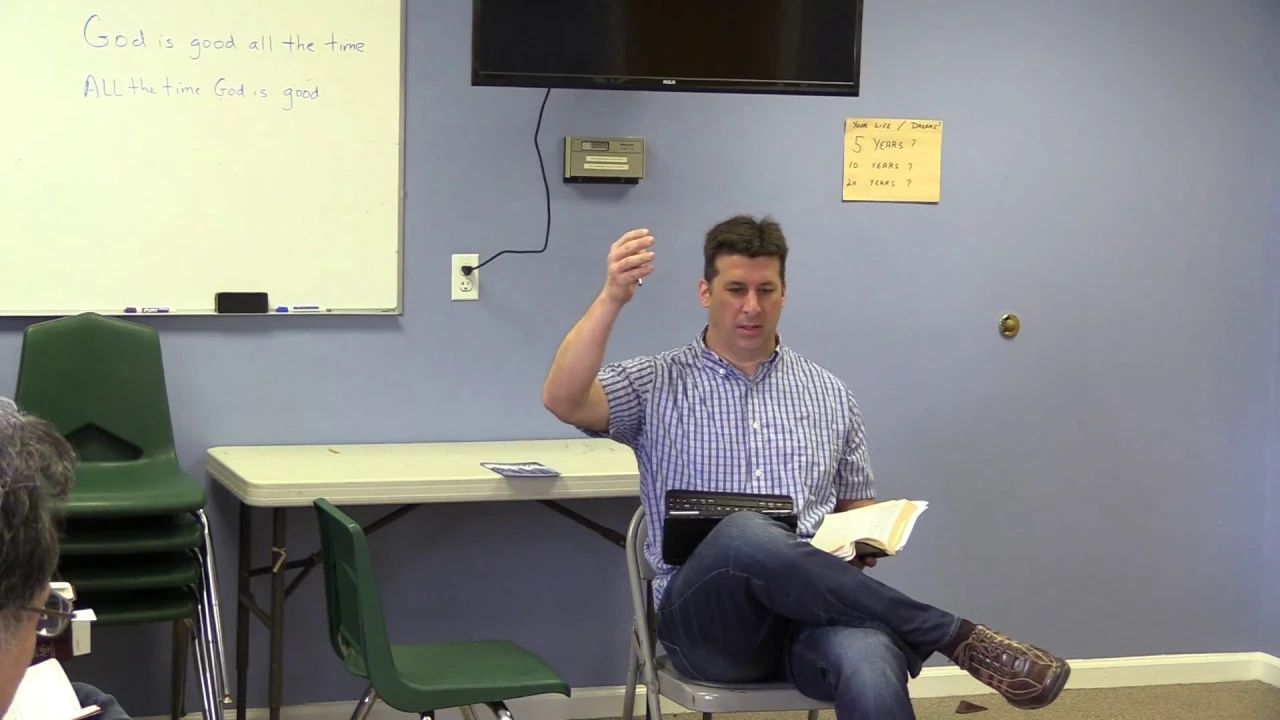
And the first class that I had to teach afterwards, I had written this up on the board, that God is good all the time and all times God is good. And I thought, well, that's kind of kind of fitting. We're starting James.
We're talking about counting it joy to be in various trials. And that was a time in our church history where we were entering this unknownness, you know, like, what are we going to do now? You know, I remember going up in front of the congregation and just challenging the congregation to say, you know, obviously, God has put us in this situation for a reason.
You know, there are going to be things that he wants to teach us through this time, maybe areas that we're lacking in or didn't do a good enough job in supporting a pastor. And we're just going to grow.
So be ready for those and be open for them because they're for our benefit. And because he's good all the time in this situation is where he wants us to be and he's in control. And I just, I was just thinking of that.
And as I was reading through the passage this week, this is what this early church, they were scattered throughout, Christ had been raised, and now this new church is beginning to grow. And everything that they're going to be going through this for.
So John asked me to cover verses one through 18. So if you weren't here last week, we went through five minutes of an overview of the entire book of what we're going to kind of be looking at in each of the different chapters as we go through.
And he had mentioned that it will probably take about 10, he's anticipating 10 weeks or so for the class to run, depending on, and if you know, John, that's not, we always just have the joking. So, you know, this is always loads up the sheet.
And I apologize, I don't have anything. Our printer died at our house. I wasn't able to print off the questions that I was going to use for today. So I apologize if you don't have anything to take notes on.
So we cover the overview of the book. We spent a significant amount of time trying to identify, you know, who the author is through looking through scripture, because there are four different James mentioned in the Bible.
And we agreed that the author is most likely James, the half brother of Jesus. Can we also identify that our audience that the book is being written to is the Jewish believers that were scattered throughout the region there.
And I thought Kim made a really good point last week, too, about trying to always remember the context of when the book is being written and who the audience is. I mean, that's always a great way to think about it.
We always want to jump to how does this affect me, but seeing and trying to really dig in to see what it was like for those early Christians, you know, and I think even too, as we're going like through our small group, we're kind of tracking with Pastor Mark going, what was it really like for those disciples?
Like we were just studying about, you know, last week's sermon about him calming the storm, you know, and how these guys had been with Jesus and he had done all these miracles, but this was like the first miracle that affected them.
Like they were in this boat ready to die, thinking they're going to die and Jesus is sleeping. And now he does this miracle to save them. And, you know, there's this fear, but there's also this marvel, like, my gosh, like we've seen him heal and we've seen him do this, but now he just, you know, like God made it 70 degrees yesterday.
Now it's 30 degrees today. Like that's amazing, like that, his power. And you just, I think when you think about it and try to get into their shoes, like I had an old Testament professor was like, try to get in their sandals.
That was always his big favorite. Try to get in their sandals and see what it was like. And that just makes, you know, God seem amazing, like that he can do stuff like that. And then to then go watch him heal this demon-possessed man and take it to another level.
And then another, you know, raising another person from the dead. Just really amazing. So I probably didn't do such a great job with some of the questions as to linking it back to them. Some of them will be kind of applying to us.
So before we actually read the passage, I think a lot of 1 through 18 is really talking about trials. So obviously enduring pain, and some of us have gone through lots of pain, Friday, things like that.
So, you know, enduring pain is not pleasant. And I don't think any of us would jump, you know, to be like, yeah, I'm looking for a trial to go through. So what are some of the fears that you think, what fears do you have when you think about what it means to face a trial?
Maybe we'll also try to catch that in. Let's think about what do we think these early Christians that were scattered were fearing? Because obviously their fears of what could have happened to them are much.
Different than what could happen. They feel the fear of death. You know, I get amazed. You said it earlier, you said they were scattered, and it's how God himself brought fear into them. They didn't fear death, and they didn't scatter.
Where were the gospel going? Here they are, Christians, and they got scattered. God sent them all over because of the fear that they had. I can't imagine that I'm going to be scattered in fear that I'm going to be persecuted for death.
But they were, God had such a great plan, and then I was reading that especially in Acts, you know, how they feared so much, especially Paul. And even when Stephen got, you know, martyred to death, you know, it was God's plan to bring that fear into them.
They were going. We don't have that here, not in this country today. We don't have that fear of.
Because of our belief. Fear of death. We don't have the fear of death because we don't have a.
Pirate who has a button that says you're gone, you know. You know, if we had Stalin or somebody.
Like that, we would fear death. So now, it's weird how we, you see, like, where you always see the rise and growth of the Christian faith in areas where there are intense persecution. You know, so you often wonder, not that I wish that upon us, that we would have a little bit more less freedom so that we had to.
Yeah, well, I don't know if we want to be martyred. Right. But yeah, you know, like, having that, I think that fear is a motivator because it's like, you know, like, you don't necessarily worry about your unsaved friends, you know, something happens to them because of medicine and things like that.
So we tend to be like, yeah, I can share with them later. Or maybe we don't share with as much urgency or as much passion because, you know, we know that we have the freedom and luxury of living in this wonderful country to be able to take time.
But maybe that's a great thing of God being a patient God, that he knows that this is what happens when you get into a more affluent country, or as the gospel spreads and takes hold, you know, things get a little bit easier.
Isn't that what Satan employs? He uses whatever he can against the people to take them away from their belief. And I think our luxurious life that we have here and that we depend on ourselves when we say, look how well I'm doing, and we forget where God is in that picture.
And so I think that's one of Satan's weapons that he uses against us. Yeah. And the other thing I heard about fear, I just heard this this morning was interesting. God, all things come from God. So God developed fear.
And this person was saying that our fear originally was supposed to be fear of God. Then we sinned, and we fell, and Satan got in there. And he's twisted that fear all around so that we fear all sorts of other things.
But we don't fear God. That's a good point. That was a really, really interesting point that where fear originally was supposed to be, and how, especially us, you know, how much do we really fear God?
And God's ultimately sovereign. All evil.
Will suffer good, like Joseph said. You meant it for evil, he said to his brothers, but God meant it for good to preserve many lives. Yeah. So ultimately we trusted God's sovereignty over.
It all. No matter what happens, God's still in control. And I think fear too is also, it can be debilitating to the point where there's no action. You know, you're panicking. But fear is also a great motivator.
I mean, like, I know, I think, being an athlete, you know, you get those butterflies in your stomach, you know, or before a big test or before a competition. And that's a great motivating thing because it heightens your senses.
It makes you, you know, want to come out the victor on the other side. So it's, and I think that happens in business and in schools and things like that. You don't want to fail, but failure is a great learning tool as well.
So a lot of the things that are very negative also on the other end can be positive, and I think you just.
Have to approach it the right way. You know, God also tells us in the Word here, but also a lot of authors, theologians, tell us too. You mentioned fear of God. We don't have the fear of God because of the luxuries we have here and all the good things we have.
If we were living in another nation, let's say China or even Japan or, you know, even if we're in the east somewhere where you're going, the fear that those people have of being persecuted for their love for the Lord Jesus Christ, that's fear, especially when you got to go into hiding or you got to present the gospel, you know, somewhere underground to get a group together.
That's fear. We don't have that. We have so much here that, you know, that we're exposed to, to the Word of God. Do we just, do we take it for granted sometimes? You know, God is so loving that nothing can happen to us, but you're in another country.
That's fear. I think of the Kamlins. They teach the Word of God in that institute there, and when they're teaching it, those people are going back into countries where they, there was such a fear of teaching the Word of God that their lives are at stake.
That's fear.
And it's funny, it just reminded me on Thursday, one of the opening thing in our small group was the, what is the greatest, what is the command that appears the most in the Bible? Fear not. Do not be afraid.
Do not be afraid. 365 times. So you have one command for every day of the year. So we were kind of amazed by that. Eric, what I think is interesting is.
That I can think of instances where somebody has had very little faith, and God delivers them, and then they, after it's over, they, you know, we made it. You know, how'd that happen? God protected us.
And then the next time the situation happens, you still have fear, but maybe a little less. And after about the fifth or tenth time, you always start saying, you know, God is really sovereign. You know, He's protected me.
But in the beginning, your faith is small, but it grows every time God delivers you, and then you finally realize, you know, God really is, He really does.
Love me, and boy, He's sovereign. And then you also see instances in the Bible, like where Elijah took on the former prophets of Baal and had this great victory, and then, you don't know how much time passes by, but Queen Jezebel says, I'm gonna go get that guy.
And now, you know, Elijah's our first marathon runner in the Bible. He's sprinting, you know, a couple miles, 30-some odd miles away to the mountain, and he's terrified. So you have that as well, like where God works great, you know, takes you to this high peak in your life, and then you hit a valley,.
Like, right after that. You know, another fear would be, and this just happened to me yesterday, that one of my closest friends had pancreatic cancer, was diagnosed on Friday. He has, right now, a big, big fear, because, you know, he's dead.
You look around, you know, and we know a close friend, or a close one, that has been doing like that. I went to visit them yesterday, and they almost saw death in their faces. They were distraught. You know, there was no happiness, no nothing.
It's fear, especially if you don't know that you're after where you're going to be on the other side. That is fear. There is a fear in this family. They're Catholic. I'm not putting under the bus. I witnessed to them many, many times, and was told that the same thing, we're going to hell.
You know, that was the comment made to my wife. They have not professed to really love the Lord Jesus Christ, and put their faith and trust in Him. I'm just praying now that God will let me go and visit as often as I can, you know, with my girlfriend.
I don't know that's in the space of a year, but that's fear. They had that family right now. There's a deep, deep fear knowing that their loved ones are going to die, and what tomorrow is going to bring for.
Them. Well, when I think of fear, I think of that verse from Proverbs once said, fear of the Lord is the beginning of knowledge and wisdom, and I guess as you grow, I think you apply that in your life and in your spiritual walk, because you have to realize the reverence that He deserves and the power that He has to control your life, and when I think of fear, that's the verse that I tend to go to.
It gives me a lot of comfort, because I know what flows.
From that. Well, and in certain circumstances, I mean, I can imagine you're in another country where you know people are coming after you. You know that they would not hesitate to burn down your house and destroy all your crops and kill all your family, and that they wouldn't even face consequence for doing that.
They would have praise. All it takes is for you to be discovered, and in that moment, if it comes, you can't count on the fire department to come and put out the fire of your house, because they want it to burn anyway, so they're going to delay and putz, and they're not going to go there in time.
If they come to murder your family, you need to count on the police department to come and protect you, because again, they're going to take their time. They know what's going on. They're not stupid to the circumstance, and they probably favor the other side, so what do you turn to when you can't turn to the fire department?
You can't turn to the police department. You can't turn to anything else, not neighbors, not friends, nothing, right? That's where you turn to the word, and each day then becomes a gift, and you realize, wow, I've got one more day.
I've got another day. I've got another day, and that's how you, you do have strength and humility in God, and his protection, and his power, and his sovereignty, but even sovereignty through trials. If that day comes, you're not looking to the people that failed you.
You're looking to the.
One person who will carry you through even the next trial, talking about Egypt or Iran, any of them.
Okay, thanks for sharing so far. Let's get into the word. We're going to read James. I know we are, we spent some time on one through four last week, but let's read one through 18, and then I have some questions that we can go through, so I hope we want to go around, go around the room, take a couple verses, or read as much as you want.
James, a servant of God and of the Lord Jesus Christ, to the 12 tribes scattered among the nations. Greetings. Consider it pure joy, my brothers, whenever you face trials of many kinds. Because you know that the testing of your faith develops perseverance.
Perseverance must finish its work, so that you may be mature and complete, not lacking anything. If any of you lacks wisdom, he should ask God, who gives generously to all, without finding fault, and it will be given to him.
But when he asks, he must believe and not doubt, because he who doubts is like a wave of the sea, blown and tossed by the wind. That man should not think he will receive anything from the Lord. He is a double-minded man, unstable in all he does.
The brother in humble circumstances ought.
To take pride in his high position, but the one who is rich should take pride in his low position, because he will pass away like a wildflower. For the sun rises with scorching heat, and withers the plant.
Its blossom falls and its beauty is destroyed. In the same way, the rich man will fade away, even while he goes about his business. Blessed is the man who perseveres under trial, because he has stood the test to those who love him.
When tempted, no one should say,.
God has tempted me, but God cannot be tempted by evil, nor does he tempt anyone. But each one is tempted when, by his own evil desire, he is dragged away in a taste. Then, after desire has conceived, it gives birth to sin.
And sin, when it is full grown, will be deceived, my beloved brothers.
Every good gift and every perfect gift is from above, coming down from the Father of lights, with whom there is no variation or shadow due to change. Of his own will, he brought us forth by the word of truth, that we should be a kind of firstfruits of his creatures.".
So my first question.
To throw out to us is, how are perseverance and maturity developed in us by enduring trials? Bill kind of answered that already, I think. Right? When you start off, you start blaming God.
You know, you figure a young Christian or a non-Christian will enter that type of thing. It's God's fault that I'm in this. If he really loved me, he would have protected me. That's where you start.
And then as you experience more and more trials, as you were saying before, it helps you maybe to gain more knowledge of God and understand the sovereignty and his protection, and you can look back when you've gone through a trial and say, how did I get through that?
It had to be because of the Lord and his strength and power. So I think that's how we, they're tied together. What's interesting is that God is the author of the.
Fact of our faith, and he'll take it from, he'll accept somebody who blames him, where a normal person saying, you're blaming me, I forget you. You know, but God still loves us even if we say negative things to him, start off, and then he'll help us to grow from there.
I think it makes the believer more dependent upon God when you go through trials and tribulations.
You know, a lot of people don't like to go through those trials, especially the non-believers. A friend of mine, she lost her mother when she was 12 years of age, and she blames God for taking her mother away and leaving her without a mother.
Okay, now some more tragedies coming upon her, and she's blaming God like, why? Why are you doing this to me, God? You know, I'm to love you, you're supposed to be a loving God, but yet, where's your love?
You're taking all this away from me. That's what a lot of the world sees. You have such a loving God, but why is he doing this to me? They don't understand. They don't understand the trials that people have to go.
Through to strengthen that. And sometimes it's only through the trials that you can come to the end of yourself. Sometimes you think you can do it on your own, and you realize through the trials you can't.
You've got to trust the Holy Spirit. Like Paul says, when I'm weak, that's when I'm strong. That's when I have to rely on the Holy Spirit, because I can't do it in my own strength.
Unfortunately, the world is not like that. The world goes on their own strength, and that's what they rely on themselves. Me, myself, and I. I can handle this, but when tragedy like that comes upon you, they cannot handle it.
Who are they blaming? They're not blaming us. They're blaming God. Why did you do this?
I looked up the word trials. The Greek word is dokiman. I think it's the pronunciation. It means testing, and it means a positive test. So, you know, as we've been talking about trials, I think most of us would realize that we face these for our benefit.
And so to go and to read that and see that, you know, the word in the Greek there meant it's a positive test intended to make one's faith genuine. And so the result of you being steadfast is a life of faithful endurance through your different troubles and afflictions.
So it's comforting to know that even though like your circumstances around in your life may stink for that time, and it could be a short period or long period, you know, this is ultimately for your benefit to make you grow closer to God.
So I think that's good for us. I mean, I think initially we tend to forget that, but we begin to experience that or realize that maybe as we're going through it when a brother or sister comes along as a gentle reminder of us.
And then I think really when we see, when we get through it, I mean, to think about what I had talked about in the intro, three years ago I sat here, Wallmeyer resigned. We got to form a search committee.
What are we going to do? People are leaving. And now we're coming up on one year anniversary of hiring Jeff. March 1st is his start date. I mean, we've seen some people leave, but I look around the room and some of you were not here three years ago.
And we've grown and we've added to people and to the church. And, you know, Jeff is an amazing person and pastor. And it's like to think back three years ago, it doesn't, it seems three years was a long time, but now it seemed like it was kind of like a blink of the eye.
And to see where we are now, that's pretty, it's pretty amazing. Like what God has done in that period of time. Was it, was it fun? Was it fun being an elder stand during that time? Heck no. Six o 'clock meetings that we've had.
Oh, it's like it was, it was the sad thing.
About the whole thing is that God blessed us so much. And I forget to give thanks for what happened a year ago, two years ago, five years ago. God is so good. I just take it for granted.
And I just think I have to confess. Yeah. I mean, you know, it's, you, you always, you always pray or at least I pray. Like I always ask God to use me, you know, and sometimes we're afraid to say that because you think like, Oh, well maybe God's going to send me to a foreign land.
You know, he's going to be, he's going to turn me into a missionary. That's a form of fear. Yeah. Um, but for, for me, like one of the things that I really realized was that God called me to be chosen to be an elder through this three year period.
So my first meeting as an elder was while I'm, I were talking about being burnt out and us doing this emergency sabbatical with him. So, um, I was an elder through like a very tumultuous time in the church.
I didn't get to experience it being when I was a deacon where it was kind of like, you know, things were going status quo. Um, but I really felt that that's what God had called me for. Like that was, that was an answer to a prayer that I had prayed a lot of times.
And like, yeah, was it, was it a fun time? No way. You know, but I, it forced me to get out of my comfort zone and to do things and to have hard conversations with people that typically I would not want to do.
Or I would be like, Oh, I'm glad someone, so-and-so is doing that. Um, so it was definitely a time of testing. It was a time of, you know, it matured me like, were there, were there some battle wounds and scars from that time?
Sure. Yeah. But you know, like those, they're all for my benefit. And so what I, what I have wished that time to not have happened. Yeah. Sometimes, but other times I'm very thankful that that's what we went through because I'm a better person on the other end.
So, and, and I forget to thank God for that. It wouldn't be who I am today because, you know,.
Going through that, that time. You know, we can use all the scriptures for that. Look at Moses, and then how he was raised, you know, and all the knowledge that he had. And he left that, but he came back with all that experience that he had and God used him for that experience.
We always go through somewhere. I remember here, not, not this church. We were being trained. I was being trained to start another sister church and, and also for missionaries. And that got thumbs down big time.
And I was devastated. There was about six of us on that committee. We were all devastated. Six years of our life we put into this. And now all of a sudden, go back to that. No, I was like a pinch, but at that time, at that very moment, you put all that energy and time into it that you and I did and John.
And then all of a sudden, God said, okay, he knew what he was doing. Two years later, he taps you on the shoulder and said, I want you to start another church. And that's what we started. That's what we wanted to do.
But you don't know that. You don't know you're, you're devastated. And you're like, why? God, why did you use me? I could have used that for something else.
No, God knows what he's doing. Yes. Look at Joseph. You know, if Joseph hadn't been cast into the pit, he wouldn't have gone into the palace. And if Joseph hadn't become the prime minister of Egypt or couldn't, or possibly couldn't have been in Israel.
And if it wasn't in Israel, there wouldn't be a Jesus. And if it wasn't a Jesus, none of us would be here. So even the trials that he went through, God saw, you know, thousands of years down the road, what it would produce.
When Lincoln says here, you know, the trials are meant to produce our completeness, our perfection, lacking in nothing. See, we have, you know, we're myopic. We see only a yard in front of us, not 2000 years down the road.
And we have to remember, I think our calling is not just for earth, but God made a universe of billions of stars and galaxies. We don't know what God's prepared for us in eternity up there. You know, what purpose we serve down here, we don't know, but what purpose we serve in infinity.
Like it says in 1 Corinthians 2, 9, God's eyes not seen, nor is he heard, nor has entered the heart the things that God has prepared for those who love him. We can't even imagine what God has in store for us in eternity.
And I think, you know, that's a problem. A lot of our problems are we're myopic. We only see, you know, in front of us a few feet. We don't see what God's preparing for us in the future. Right. We have to walk in faith.
Who would we be without faith? All right, so let's look at verses 5 through 8. So under pressure, how does the faithful Christian contrast with the person described in verses 6?
If you're wishy-washy, you're going to be on the wrong course. You know, when your faith is strong, there'll be one way, then.
You know, is it way worse? I think this goes back to what Bob had said before about how this is the way the devil attacks us in subtle ways, where he gets us to want to rely on the wisdom of the world, and then you kind of say, nope, and then you're like, I'm going to rely on the wisdom of God, and then you find yourself fluffed up, you know, being the double mind.
Also, Eric, each one of us here, we're sort of like, I look at myself, I'm looking at this, I'm excited, I'm looking at this. We are the light, each one of us. This is what Carol said, you know, you don't want to be wishy-washy.
Who is watching each one of us? Your neighbor, your friend, a relative, you know, even your children. You don't want to be wishy-washy. Your faith has to be strong. You got to show that that you have that strong faith.
If you become wishy-washy, people are going to look at me and say, I don't want to be, I don't want to go to his church or worship his God. We got to be strong. We can't be this wishy-washy. We got to be strong.
There's no doubt in our heart, in our mind, with our faith, that Lord sent His Son, the Lord Jesus Christ. That's what we have to be.
Nate, are you calling me about the Giants again? I think that one of the cool things about faith is that, okay, if I have faith in the Lord Jesus Christ, He is my rock, my foundation, and He is what I've built everything else upon.
And maybe some things were good and maybe some things were bad that were built even on that foundation. And when that house comes crumbling down, where are you standing? You're standing on Christ's solid foundation.
And so it doesn't matter that that house gets wrecked because you still have footing. But let's say you didn't start with Christ as your foundation, or you had one foot on and one foot off. What happens when that house starts to fall?
Well, now you have all kinds of issues. You have an identity crisis on top of whatever catastrophe you're facing. You have no idea what direction you're supposed to go. You feel like you're in complete free fall, but it's a totally different circumstance when you don't have that faith at all.
And then when you have one foot on and one foot off, whether, you know, okay, I kind of think that Christ is the thing to do, so maybe I'm going to build a little bit here, but you're not fully on the foundation.
Well, what happens again? You, all those things come crumbling down and you find yourself falling off anyway because you're not able to stand when you have one foot on and one foot off the foundation.
And so it's when you have that faith and you have built your identity, you've built everything upon that foundation, it doesn't matter what happens around you. Sure, it hurts and it is terrible. Sometimes physical pain, emotional pain, spiritual trials, whatever it is, it doesn't matter because you still have the solid rock of foundation.
Like I think of Hosea, right? And you have this picture of Israel being this adulterous nation, unfaithful, turning to idols, giving credit for all their wealth to those idols. And what does God say he does?
He says, I will put a hedge between them and their idols, right? And so for them, the Israelites, that looks like a trial. It's like, oh man, I'm trying to go to this God and now all of a sudden I hit a solid wall and they can't go anywhere.
And why does he do that? He does that to bring the Israelites back to him because it says later on in that same section that the reason God is doing this is because they have forgotten him. And in the same way, when we build up our own lives around different things, even if we're on that foundation, we can build wrong things on it.
God will be faithful to us to bring those things down in order to what? Bring us back to him.
I know in reading this and reading about perseverance, it's something I think to build on what Ryan said. As I was reading this, I went back to Job, everything stripped from you. His best friends are telling him, turn from God.
His rock was solid. His foundation was strong. He was stripped of everything, yet he was mightily blessed in the end because he persevered. It reminds me about.
The passage in Romans where Paul says, I consider the sufferings of this present time not worthy to be compared to the glories that will be revealed to us, telling us to have that eternal perspective.
Okay, so right after these verses, we now have this James Thurston talking about the lowly brother and the high brother. So in the context of trials and perseverance, why does James contrast rich and poor Christians?
So verses 9 through 11.
It boils down to whether God is on the throne or you are on the throne, and it's more difficult for wealthy people to depend upon that wealth to put God on the throne. And I think, too, here you have the perspective of how quickly our lives pass.
In the big picture, our lives are very short. In the light of eternity, whether you live 20 years or 90 years, it doesn't really, you know, you're both a drop in the bucket of eternity.
As I was looking into this, I found in one of the study articles, it said about how poverty and riches are both two of the most stressful. You wouldn't think riches would be stressful, but poverty, maybe you tend to, like Bill said, blame God for your low, horrible situation.
And then with riches, you have people going after you, you know, or you begin to think, like, hey, I've got all this great stuff. And I know in our family, we have family members who they have no need for Jesus because of how well he's blessed them.
There's no need for them. There's no desperation in their lives to want to turn to him. He showed a special on Fox. They.
Some lottery winners who said the money didn't do them any good. They were more miserable than ever.
And, you know, we also see in the Bible about how, you know, we have the, it was, Jesus always flip-flops everything. So the low person is held in high esteem because of their high status with Christ.
But it also had mentioned about how James is also exhorting the rich believers to boast in their humiliation, realizing that, you know, God has blessed them with this wealth, but it's only temporary. Like the beauty of the flowers is temporary.
It's scorched by the end of the day. So no matter how long, you know, Rick said it's a little drop in the bucket, our life here on earth, you know, so he wants them, the rich people as well, to, you know, exalt Christ for how well he's blessed them.
And then hopefully they'll use their affluence and their wealth to help further the kingdom. As you said before, kind of putting things in context of the culture, everything I've read, it seems like the Jewish people felt that if you were blessed with riches, God was blessing you and you were in his will.
And this letter was to the 12 tribes that were scattered. So I think it's James' way of kind of getting their attention, like Jesus kind of flips things around and he's following up on that theme and saying, you know, because these people over here are poor financially, it doesn't mean they're poor spiritually.
And same thing, you know, with the Brits. So I think it was a way of him also reaching that culture in a special way. And I think, and we'll certainly see more of that in chapter 2 when he talks about the great barter war.
Verse 5,.
God chose the poor people of this world to be rich in the kingdom, inheritors of the kingdom.
All right, so now this should be interesting. So how, so as we get further down into the passage, we now begin to talk about temptation. So how are temptations different from trials? How do we differentiate between the two?
To me, what I've read a little bit is the trials are the outside, external things that happen to us, and the temptations are the things that are within us, that come from within. And that's generally, you know, of our own sinful nature,.
Basically where that's coming from. Yeah, a trial doesn't necessarily have to be sinful,.
But I think temptation is always bringing you towards something that is sinful. Yeah, they use the metaphor in there as, you know, luring away, which is a fishing metaphor, a way of using bait to lure you.
You know, you don't see the deadly hook underneath that worm, or whatever they would use as bait back then. And, you know, Stan had mentioned before about how it's God, God doesn't, you know, God's not tempting us.
And then we look in 1 Peter 5, 8, 9, it talks about how Satan is the one who is seeking to devour, you know, on the prowling, roaring lion, waiting to eat you up. And again, back to Job, right? You know, God gave permission to Satan to bring these things upon Job.
So, you know, there had to be permission for it. God does not, and it says here, God cannot be tempted, and does not bring temptation. But he does allow us to suffer trials with permission. You know, when you say the Lord's.
Prayer, and I go through that every day, lead us not into temptation, then say, God's going to lead. Say, lead us not into temptation. You say those words, when you pray that prayer, lead us not. We're tempted every day by the devil.
Just turn on the TV or open a magazine. What do you see? You're tempted. You are so tempted by the world. But then God's Word, you know, He's person. You're asking, God, lead us not into temptation, but deliver us from what?
Evil. That's what we're seeing in the world all around us. And He knew that when that prayer was written thousands of years ago, that we need that every day of our lives.
But in that sense, it's probably lead us away from temptation.
We're going to be tempted.
1 Corinthians 10 .13 says, no temptation is ever taken you. And 10 .14 says, therefore we're going to flee from idolatry. So we have to put on the track shoes and run the other way. It's so easy to get sucked into and not, what's going on there?
And I don't know how to flee.
Yeah, I once had a Word picture to describe that verse about how, you know, when we are before we're saved, we're handcuffed to sin. So there was a pastor at the time that used an overhead projector as the visual for sin.
And he talked about how he was tied to that sin. But when we're free in Christ and we're saved, the bond has been broken. We have the ability to resist that sin. But he said, how willingly do we relock ourselves?
We clamp the handcuffs on ourselves back to these things, these passions that are driven in us, you know, and those passions, those lusts that we have for sinful things, should, that lusting should be for God.
That's what lust was designed for. It was for lust after God. We were talking about lusting after God. Now, lust always has a bad connotation. But it was, like Bobbie said, for fear. It was originally designed for us to have this healthy fear of God.
And then lust was also this, we were supposed to be lusting after him with all of our heart. But yet we choose to pick these different. So it's funny that every time I see an overhead projector now, thankfully they're on the demise of technology.
I'm like, there's sin over there. But it was so true. It was just a really eye-opening thing about how we willingly decide to still choose these sins. And it's always been a thing that I've always wrestled with.
Why is it always this particular thing that I'm always drawn to? And it's not something else that somebody else wrestles with. We all have our little two, three, or more things that always seem to attack us.
Getting back to Richard's example, it wasn't when he was tempted by God for his wife. He literally put it in conversation. We youth lusts, right?
Okay, I know we're short on time. I only have one more question. Dealing with verses 16 to 18 to finish this off. So how is God the ultimate example of goodness and dependability? He gave us the ultimate gift.
I think when it talks here about, talks about giving us every good and perfect gift, but also that of his own will he brought us forth by the word of truth. And that's this idea of being birthed. You know, it's God who called us to him.
It wasn't anything that we did. It was God who called us, knocked on our hearts, and we responded to him. Which is really a beautiful thing that we now have this ability to have fellowship with him. Which is something that we couldn't have done on our own.
And yeah, does anybody have any closing comments? I know we're we got to get ready for church tomorrow.
And I think in that very last line that we might be a kind of first fruits of all he created. I think of him as the vine and we are the branches. And as long as we are continuing to abide in him, continually to abide in him, we will be the first fruits.
They're not abiding in him as him being the true vine. And us being the true branches.
Thank you very everyone for the opportunity. To sit in for John. Thank you. Thank you very much. Thanks very much. And I'm just going to stand. You want to close us in prayer?