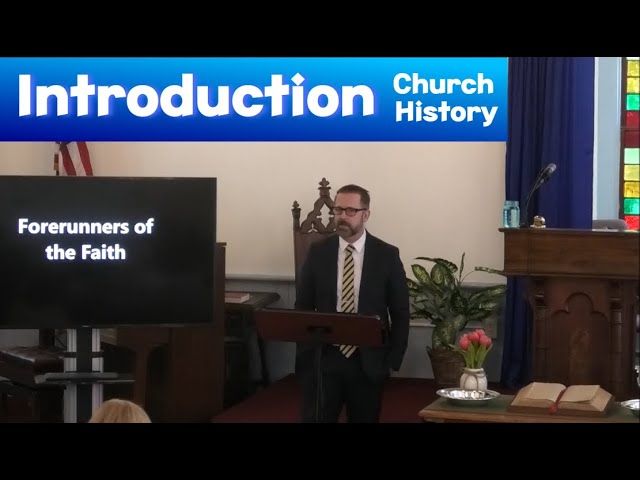
Introduction to Church History (Forerunners of the Faith / Forward by John MacArthur)
Class based on the book by Dr. Nathan Busenitz, Executive Vice President, Dean of Faculty, & Associate Professor of Theology at Master's Seminary in Los Angeles California.
Transcript
So we're going to be studying the book forerunners of the faith Not by John MacArthur.
It says Introduction by John MacArthur, so I'm not going to read that Introduction by him, but I will read the other introduction so this is from it's produced by Master's Seminary, which is the
Seminary that John MacArthur was the Chancellor of So we're going to be looking at this book studying church history
And we're going to be comparing it because church history is not authoritative and he mentions that in the book
So if there's anything in church history some early church father some theologian that We think doesn't line up with what the
Word of God says we will Talk about that so church history is an important subject
So as we go through the book there's also a Lecture or a sermon to listen to so it explains all that but let's begin with the introduction.
Why study church history Reasons every Christian should care about the past It says as a church history professor
I routinely faced the challenge of engaging students in a subject that may initially seem either
Unfamiliar or uninteresting That is that what you thought when you heard we're studying church history.
Oh, that's not very interesting Well, that's what he says very common despite the misconceptions church history is neither boring nor Irrelevant it is so much more than names dates timelines and charts
Some students start out thinking I hate history that was one of my favorite subjects
But I don't know about you. Some people don't like it. Maybe so But the study of church history is not primarily about history
It's about the church the Bride of Christ the most precious Institution on earth.
It's about what God has been doing in the world for the last 2 ,000 years and that means it should matter to every believer
Others might wonder Why they should study church history if our primary focus ought to be on studying the
Bible Without question the Christians daily spiritual diet should consist of the pure milk of the word first Peter 2 1
Through 3 nonetheless the study of church history is a rich and profitable exercise
It can never replace the study of Scripture. We all agree with that. Amen But it can enrich it as you learn from prior
Generations of believers who faithfully studied and applied biblical truth to be clear
The Word of God is the final authority over church history But the study of church history when evaluated through the lens of Scripture is a faith affirming exercise
I have experienced that Reality firsthand the deeper I've investigated the history of the church the more
I have grown to appreciate the power and authority Of God's Word because I've seen that power vividly
Illustrated in the testimonies of past generations of believers. It is the teachers
Responsibility to convince the student you of the importance in relevance of the subject being taught
So he says when asked why church history is important If I only had a minute or two to answer
He says I usually usually highlight the following three points using the acronym a
B and C So this is the first place where you had to fill something in some of you probably listen to the lecture
Or the sermon and you filled it in if you haven't now's the time to start writing a is for Apologetics B is for biography and C is for curiosity
So again, if if you only add a couple minutes to answer why church history is so important It's because of apologetics biography and curiosity.
So a is for apologetics Believers today should take an interest in church history because it will help them guard
Against false teaching and as you know, this is a relevant topic
It's something that well every generation of believers has to face, but it's especially
Timely for us the study of church history helps us understand how false
Movements arose and how believers in the past have refuted them.
So what is apologetics? You know this by now Apologetics is when you apologize for being a
Christian. I'm sorry. Sorry. I believe the Bible, please. Excuse me That's apologetics, right?
No apologetics is defending the faith. So you're giving an answer you're giving a reply
B for a biography Says the halls of church history are filled with compelling accounts of faithful men and women who made great
Sacrifices to follow Christ their examples motivate us to walk in a manner worthy of the gospel and see for curiosity the study of church history answers many questions and shows us the important connections
It explains how broader Christendom came to be what it is today How did certain practices or movements develop
Why are things the way they are church history helps us to find answers to those lines of inquiry?
Okay, any questions or comments on that on the introduction? All right.
Well, let's move on then he gives ten reasons and I have the teacher's guide So I know my book isn't the exact same as yours
But what I understand is you have the ten reasons listed as well I think mine expands on it a little more.
So this is number two Ten reasons to study church history. So let's just go over these
He says when given a bit more time to answer the question Why is church history important we can list ten reasons and I'm sure there's a lot more
But he says these represent an expansion of the three points listed above or on the previous page
Number one. Okay, the first reason to study church history Studying church history is important because most contemporary
Christians don't know much about it, but they should We study church history on Wednesday night did a seven -part series.
What was that a few months ago? four months ago, maybe And I had said that you know
Some people's knowledge of church history goes all the way back to the ministry of Billy Graham You know and not before that which is really unfortunate because Billy Graham, I I'd love to expand on this, but I don't have time.
He really changed Evangelicalism changed with the ministry of Billy Graham.
It was one way back in the 1940s 1950s with fundamentalism and Then there was modernism and liberalism and Billy Graham kind of helped to bridge the gap so whatever your opinion is people became very ecumenical and Presbyterians and Baptists and even
Catholics started working together. Some people think that's really great other people think it wasn't so great
One thing you can't deny is that period of the 1960s 1970s things radically changed?
So if your knowledge of church history only my point is if it only goes back to Billy Graham like you're really unaware of The way things used to be when some of you were children you probably can remember how things were one way in the 60s and then in the 80s, it was like very very different, so But most people most
Christians, I think know something before Billy Graham They know about what what's the great event in church history that most people know you learn about it in Public school even what is it?
Yeah, the Protestant Reformation so that's the 1500s so maybe if someone is informed it'll go back to the
Reformation But for the first 1 ,400 years or from the second century to 1 ,500 most people know little to nothing
So he says sadly most contemporary evangelicals know very little about the history of Christianity even in reformed circles and Understanding of church history often goes back only to the
Reformation but the history of the gospel spans all the way back to the
New Testament if Your knowledge of church history jumps from the Apostle John on Patmos And what did
John do when he was on the island of Patmos? Yeah, he wrote the book of Revelation. So if your knowledge of history jumps from Revelation to Martin Luther with little to nothing in between You ought to consider filling in the gaps
So that's the first reason why we should know church history any questions or comments on that Okay number two
Because God is at work in history Equally history is a testimony to God's sovereign
Providence He says pardon the cliche But it really is
Church history really is his story or I guess this is what people say about the Bible some will say well the
Bible is not a history book or Some people say well it is it's history is his story the story of Christ, right?
Everything is working according to his plans and he is orchestrating all of it for his eternal glory
God declares himself in first Corinthians 15 20 through 28. God declares himself to be the
Lord of what? the Lord of history, okay So any questions or comments on that?
I guess I'll just wait for you to raise your hand if you have anything to add But yeah, it truly is his story
Jesus Christ the Christian Church without question has shaped the
Western world I think I said and there's one lesson a week or two ago that the Bible is really the bedrock of Western civilization
I mean people are trying Today, they have revisionist history, you know, the progressives in our culture want to kind of reinterp
No, America wasn't based on anything in the Bible or anything like they want to rewrite history but no
America was founded on biblical principles and There's all sorts of countries in the
Western world even in South America and Central America You there's countries like what
El Salvador? What does that mean? The Savior right and there's there's actually nations named after Now was that a
Christian nation, you know, I can get into the weeds talking about that, but Western civilization has been shaped
By the Christian Church and the Word of God without question Larry 1726 says and God made man from one blood and Has appointed their times and the boundaries of their dwelling places
So not only has as pastor said God has providentially placed
Every person in history That we're going to be looking at even now for you for me
This is our time and this is where God put us for a specific
Test. Yep Yeah, look at it this way you our church and the churches in the area we are here in Western, Massachusetts, and we're here for a reason to Influence the culture and society around us
All too often Christians have retreated and you know we we have our faith in our heart and we have our faith in our home and in the church house, but We don't always take it out into the community and have a impact but that's we're supposed to be salt and light
So that's that's the purpose of us existing if Jesus didn't have that plan for us He could just save us and take us right to heaven, but he has us here for a reason.
So we read the Bible we Make application we want to make a difference.
Yes You know what,
I mean if you look back in your family history all that God like my dad's parents were from Denmark my mom's parents were from Ireland You know, so but my
Grandparents on my mother's side moved to Hill City, Minnesota my
Grandparents on my father's side moved to Southern, Minnesota and My dad moved from Southern, Minnesota to Northern, Minnesota met my mom and you know
You could go back just looking at your own family history and the heritage of it Where they came from and how
Coincidentally they got together In the same way, I mean I came from northern,
Minnesota. How in the world did I get here from there? Yeah You know, well God Providentially took me
Through by way of Birmingham, Alabama. Yeah, that's how you got to look at it. God is
Yes What? Yeah How did all of these things come together?
I remember when I first started teaching American history for the 7th graders at the Christian school It was the first time
I realized how we got to the Civil War because I studied the political history prior A hundred years prior to that Oh!
It was like a light bulb went off And it was the same thing when I was doing church history These light bulb moments
Oh, that's why we have this particular framework And it makes a lot more sense
Yeah, it helps us understand why things are the way they are. I think he says that in here somewhere
So number three, the third reason we should study church history Because the Lord Jesus said he would build his church
So to study church history is to watch his promise unfold
And of course Matthew 16 15 and 18 he makes that statement I will build my church and the gates of hell shall not prevail against it
So the church is established on the gospel truth that Jesus is the
Christ The son of the living God This is the profession of faith that saves
And son of God is a reference to Christ's deity So the church's unconquerable history is evidence
That he is indeed who he claimed to be How many regimes and movements and nations tried to stifle and you know
Persecute Christians and wipe them out and destroy the Bible And it just spread even further
And now it's on every continent in every nation So the church is the this is key
The church is the only institution that Jesus himself ever established
The only institution on earth that Christ personally established is the church
That's how important the church is That alone is reason enough to study church history
Moreover, his promise that the gates of hell will never overpower the church
This gives us reason to hope that even when the church appears to be weak and infirm
Christ promise keeps us optimistic because our hope is in him
And not in the things of this world This is one problem by focusing on, you know, just what's happening in the world
That can get you really discouraged But we need to keep our eyes on Christ He has made a promise
So we walk by faith and not by sight We believe that promise is going to be kept It will be kept
All right So the fourth reason to study church history Because church history is our history
If you're a Christian, you're part of the church Church history is your history
As believers, we are members of the body of Christ And part of the bride of Christ If we belong to Christ, then we too are part of that bride
And then he lists Ephesians 5 to talk about that So church history is, it's your history
It's our history Let me just add this Today, it's most common when you hear people talking about the
Christian church or the church Most of the time, it seems like people are at least half of the time
They're talking about the universal church, right? We've all heard this term Universal means
Catholic But they're not really talking about Roman Catholic But they're just talking about the church that's all over the world
Every true believer Well, it is correct to say that there is the one true church
The universal church But the thing is, all true believers We're not going to be assembled together until we get to heaven
So to me, and I think you see this in the New Testament epistles When we talk about the church, the emphasis needs to be on the local church
Because if you're not part of a local church There's people that, well, I'm part of the church
What they mean is, I profess Christ and I'm part of the universal church But they're not attending a local church
Well, the local church is necessary You could argue that most of the time in the
New Testament When it talks about the church It's actually talking about the local church, not the universal body
So he says, when we study church history We come to see who we are Where we've come from And how we fit into the flow of God's kingdom work in the world
We are studying our spiritual family tree So where do we come from?
Let's just stop and ask Do you know the family tree of Morris Corner Church?
You ever thought? I came up with a chart where it listed our family tree
Well, officially, Morris Corner Church as I don't really like the word institution
But okay, we'll go with that At the top, you have the Some people would disagree with this
But this is just the way the denominations kind of flowed So at the top, you have the Roman Catholic Church And the
Roman Catholic Church and the Reformation Went down to the Church of England Okay, that was the next one
And then you go down from the Church of England To the Puritans And the Puritans came to the
United States And formed into Congregationalists And as some of you know
Morris Corner Church started in 1895 As a Congregationalist church
So some people could argue that Our history goes all the way back to Congregationalists, Puritans, Church of England The Catholic Church Of course, some people don't
They have no use for that Because we did break away From the Congregationalists Back in the 1940s, 1950s
Sometime around there So now we're independent And I'm a big believer In being independent and non -denominational
But if you just wanted to trace back The church as it's As it's officially organized
That's what you could do So that's sort of the family tree You know, we're not We're not like some cult
Where some guy started A following in his living room And then he just went out
And it's not even ordained And he just started his own thing His own movement
I mean, we do have a connection To historic Protestantism So just figure out
Throw that out there For those of you who didn't know Marcus Is the Church of England The same thing as the
Anglican Church? Yes Yes, the Church of England Is the
Anglican Church, yeah So the Puritans Broke away because they were so corrupt
Back in the 1500s You can imagine what that means For things today
But not to get off topic Let's continue on Since I kind of threw that out there
Any questions or comments? Points of clarification? Okay, yeah, we're a far
Long ways away from that now Okay, number five The fifth reason to study church history
Is because sound doctrine Has been guarded and passed down By faithful generations
Throughout history He says, the study of church history
Reminds us that we are standing On the shoulders of those Who have come before us
The halls of history are filled With accounts of those Who loved the truth And fought valiantly to preserve it
And then he jumps ahead When we study church history We are reminded that some truths
Are worth finding Or fighting for And worth dying for We remember that we are part
Of something bigger than ourselves And that's really important That's a lot of people today
They want to be part of something Bigger than themselves And certainly the church is that Number six, yes,
Larry Well, I was just thinking about In our Bible You know, we have
We can see the beginning of the church In the book of Acts And then as the church progressed
Through the rest of the epistles And then as we get into You know, later on As the church grew and increased
And I don't know a whole lot Between the end of the
Bible And the 1400s There's a space that I'm Not real familiar with But then you get into the 14 -1500s
Where Martin Luther And then I'm familiar with Guys like John Huss Wycliffe, Tyndale And you know, that different area
But as it's said here You know, has been Gardened and passed down And as the pastor said
Many people suffered and died So we can get what we have today
You know, like John Huss He was You heard the statement of Get your goose cooked
He was the goose And he got burned at the stake
Yeah, that comes from him So whether it's Wycliffe Huss, Tyndale Luther, Calvin Maybe not all of those guys
But a lot of these figures They started out as Catholic priests And then they started studying the
Bible And they realized Hey, wait a second This is not This is not lining up And then they broke away
So this is what happens When people are part of the Historic denominations
And then they compare it To what the Bible says And it causes them And unfortunately
People say this is One of the bad things That there's something like 30 ,000 different denominations
Well, that's really An inflated number It's more accurate to say There's more like 20 or 30
Primary historic denominations But the point is We want to compare everything
Over and against What the scripture says So if you're part of a denomination That's not following the Bible Unfortunately, sometimes
You have to break away And that's where you get into Why are things the way they are
With Baptists and Presbyterians And Methodists And all of this Well, you wouldn't know Unless you study church history
And there's a good reason For things being the way they are Yes, Erin I think it's interesting though That none of these men
Tried to break away from the church In the beginning They tried to address their concerns
In a meaningful way And were either kicked out Or driven out Before they went their own way
It's not like they didn't say Well, fine, I'm taking them all And going home Yes, they tried to reform the church
Like Luther said I didn't leave the Catholic Church The Catholic Church left me
So many of these men Loved the church They tried to reform it
But then, you know With Luther's case It's like, okay, Luther Now we're going to put a contract
On your head And we're going to kill you Well, at that point You don't really have a choice
Yes, that's just sort of We live in an imperfect world And because of false teachers And false doctrines
Sometimes you have to break away So, let's move on This is number five
Because sound doctrine Has been guarded and passed down By faithful generations
Throughout history Number six Because we Or just as we Are encouraged by the history
Of the truth We are also warned By the history of error This enables us to be equipped
As apologists So he says here And I don't know if this is
In your books or not I'll just read the first two paragraphs Of what I have He says the New Testament Is full of warnings
About false teaching But both refuting it In the first century
And warning that it would come In centuries that followed Acts 20, 28 -30, 1
Timothy 4 -1 When we study church history We learn not only The history of the truth
But also the history of error We see where heresies And the cults originated
And we have the benefit Of seeing orthodoxy defined And the truth being preserved
The New Testament calls All Christians to be able To defend the faith
In the words of 1 Peter 3 -15 Sanctify Christ as Lord In your hearts
Always be ready to make a defense To everyone who asks you To give an account
For the hope that is in you And do it with gentleness And reverence Also Titus 1, 8 -10
Similarly requires That an elder must be one Who holds fast the faithful word
Which is in accordance With the teaching So that he will both be able By sound doctrine
To refute those who contradict That is a quality All believers should desire
To emulate So that's part of a pastor's job Is to hear what people are saying
In the name of God And compare it to the word of God And then if it's wrong If they're saying something false
About what the Bible says A pastor has to refute that Address it
And refute it But really It's not just the pastor Every Christian To some degree
Should be able to do that So that's why we need To read the Bible And learn for ourselves
Because we're all to partake In this work of the ministry Any questions on six?
Okay, so it's great And I like this point Because we're not just learning
About the truth We're learning about what Did he say? Error This is the philosophy
Of some modern ministers Just focus on what's true
Do not talk about what's wrong Yeah, and the reason I think a lot of them do that Because when you talk about What's wrong
Then you have to identify The error and who's spreading it And they don't want to do that Because then you run the risk
Of offending somebody But it's like with anything You have to talk about What's true and what's false
So we need to be kind of Dynamic and well -rounded In our approach Number seven
Because we have much to learn From those who walked with God Okay And the quote
He quotes Hebrews chapter 12 Verse 1 You know this passage We are surrounded by what?
So great a cloud of witnesses Yeah, so great a cloud of witnesses Now some people think
That that means that There's this cloud of witnesses Up in heaven This is how it's often been preached
That they're looking down on us They're witnessing what we're doing No, that's not the context
The context is we look at The chapter before Which is like the hall of faith
People call it And we see the witnesses Of these Old Testament saints And we see how they lived
And what they did And also what they did wrong To avoid what they did wrong They're the witnesses
So he mentions that Yes, it's true The Bible or the author of Hebrews Was specifically referring to Old Testament saints
But in church history We have many examples Of New Testament saints to look at And they're flawed
Just like the Old Testament saints are Right? Okay, yes, Marcus I was able to clarify this point
In my own mind Because there are many people I just had to attend a funeral yesterday
Of an unsaved relative Which of course is a horribly sad thing
But, you know, you see people Trying to talk to this person
And sometimes they will use this passage That our loved ones
Well, or our loved ones Those that are in heaven Are looking down at us It helps to understand
What it means to be a witness And of course being a police officer For so long
That was my job My job was to testify To give testimony To be a witness
To events that occurred And that is what all these heroes
Of the faith are So that's why they're witnesses
It's not that they're watching us It's what they have seen And what they have done Because of what they have seen
In the past Yeah Yeah, and along those same lines
People are going to look at us And they're going to see What we say And what we do
So we are a witness And like I said In the Old Testament saints
You look at a guy like David And you see some of the great things he did
And some of the terrible things he did And that was true with Peter We had the great examples of him
Preaching on the day of Pentecost But then he denied Jesus three times So church history
I said this in our former series Church history is what? Messy Because people are messy
But we want to look Did they have the right gospel? Were they teaching the truth of the gospel?
Nobody's perfect And certainly church history There's all sorts of different problems
And that's why some people don't like Studying church history Because then I have to look at this church
And this denomination And we see all the things we disagree with The flaws Yeah, but have you ever read 1
Corinthians? Like that's This is the way it is It's always been that way Living in a fallen world
So but we can learn from it And that's the key All right Any Anything else on that?
Okay, number eight Because just as we can learn
From the good examples of faithful Christians See reason seven We likewise have much to learn
From those who failed at various points It is a familiar saying But often true
Those who do not know history Are doomed to what? Repeat it
Or repeat the mistakes of the past In church history We see examples of all kinds of spiritual failure
There are those who strayed into heresy Those who gave way to corruption
Those who denied the faith And those who fell morally
The lives of such individuals serve as a warning For all of us
All right So that's another reason to study church history It's not a reason to avoid I think some people say
Well, that's a reason to avoid church history But again, that's the same type of thing You see in the scripture
You want to look at primarily Do they believe and preach the true gospel? And then look at everything else
Number nine Why study church history? Because studying the past Helps us understand the resources
Opportunities and freedoms We enjoy in the present So he says
Often we take for granted the blessings we enjoy Living in the modern age
What are some of the blessings we enjoy Living as Christians in the 21st century
What are the blessings? Working only 40 hours a week
As opposed to 80 hours I don't know I'll let you know Okay All right
What are some other advantages? Yeah Our freedom to assemble
Because you know full well That there are Could people do this in North Korea right now?
Could people do this in Saudi Arabia right now? No, you couldn't
Because number one Could people meet? Well, you'd have to do it in secret In a house
You could run the risk of getting arrested Or worse If they do allow church buildings
You have to be in conformity to the government So they will say what you're allowed to preach
And what you're not allowed Now we're sort of headed in that direction That's true But as of right now
I still have the freedom to preach The whole counsel of the word of God If I preach something that The governor doesn't like You know
Or the establishment doesn't like And let's face it There's a lot of things in the Bible they don't like What's the worst that can happen to me?
I get kicked off of Facebook I'm not on it anyways But Or the church could get kicked off of Facebook Or YouTube Or you know
People might not like But you know That's That's very very minor persecution
And we don't even like using the term persecution for it But that We still have great freedom to assemble
So we're so blessed And that's why We want to take advantage of it Yes We also have the freedom to discuss things within our churches
And not be at risk of being burned at the stake Yeah Yep Yeah that's one
You know There's always pitfalls The good and the bad You can preach
What the truth is Back in the day You know If you had the wrong view of communion
You could get burned at the stake And today that doesn't happen
Now the downside is people can Teach heresy without any real consequences And that's bad
But You know There's an upside to it as well Not to the heresy obviously
But yeah Marcus It's a lot more than North Korea or Red China The last
I knew The Bible itself is illegal in 51 countries And it's hostile
And Do you know how many? It's hostile Even more I mean Even Israel where I went
Is it right there on the Voice of the Martyrs? It's most of the world Right We are so To live
When we live And where we live Very small percentage of As good as it gets
Right You've seen the Voice of the Martyrs That publication They have the map Where much of the world is what?
Is it red? Where Christianity is illegal In different colors And you look at it
And you're like, wow Christianity is outlawed Or persecuted in much of the world
So we have it better than Yeah, better than we think Or if you know how good you have it
Praise the Lord for that But Yeah Another advantage to living right now
And it's been this way for a long time But When you look at the Bible Right The history of the
English Bible Every home in America Just about Had a copy
Of the Word of God in it Or at least you have the ability To own A Bible Who doesn't have a
Bible at this point? Like there's a time where The average Christian didn't have access
To the Scripture They had a Bible in the church And sometimes it was chained
To the altar or whatever Yeah Or is in a different language Yeah The fact that we have the
Scripture In our own language And you probably I don't know how many Bibles I have At home
There's probably over a dozen You know Of course the issue is Are you reading it? But Yeah I mean we don't realize how blessed we are
To have a Each of us to have a copy Of the Word of God Or it's on It's on this thing
Right You get the app Wherever you go And so I'm not a very good reader Well you just click this button
And it reads it for you Yeah You realize how amazing that is Yeah did I see a hand?
Okay Well the final reason And so we're We're just gonna get to the introduction This week and Next Sunday Lord willing
We'll begin part One or lesson number one The Apostolic Age But just to finish this up The tenth reason why
We should study church history Because history Gives 21st century Christians A right perspective
About their own place In the church age He says
It is important to realize That we Are part of church history It's not just Luther and Calvin And Augustine And all these people
And a bunch of people That no one's ever heard of No we Are part of church history Like church history is still being written
I don't know what they're gonna You know if the Lord tarries What will they say about this time period 500 years from now
I doubt that will go on that long But if it does What would they say I have an idea
What they would say But church history Is still being written We are part of it We are part of the current generation
Of believers And we have a responsibility To faithfully guard the truth
And pass it on To those who come after us Studying church history
Helps us to recognize That we are part of something Much bigger than ourselves
Our local congregation Or even the evangelical movement
As it exists today The history of Christianity Spans two millennia
Of which we are But a momentary blip Studying church history
Also opens our eyes To the fact that Every generation of believers Is greatly affected
By the time and culture In which they live Such that they themselves
Or we ourselves Do not even realize the effects We can then in turn
Ask ourselves What impact And this is the final question I want you to think about this And raise your hand if you have thoughts
Let's ask ourselves What impact Our culture has On our own application
Of biblical truth Okay So how does living in this culture
Affect you How does it affect us As bible believers
I'll just start it out I know if I am not You know swimming against the tide
So to speak I'm going to get swept away If I'm not Fighting to stay faithful If I'm not intentional about it
And intentional about Applying the scripture
I'm going to get conformed To this world And the reality is I'm already conformed to this world
To some degree Now if I recognize it I'll try to change it But this is the problem
We don't recognize how much We are conformed to The world around us
That's why you need to read the word And compare it to the way I think And compare it to what's happening
So if we're not intentional About reading the word And applying the word
We're going to get conformed To the world But we're not supposed to be conformed
We are supposed to be what Transformed by the renewing of our minds So next