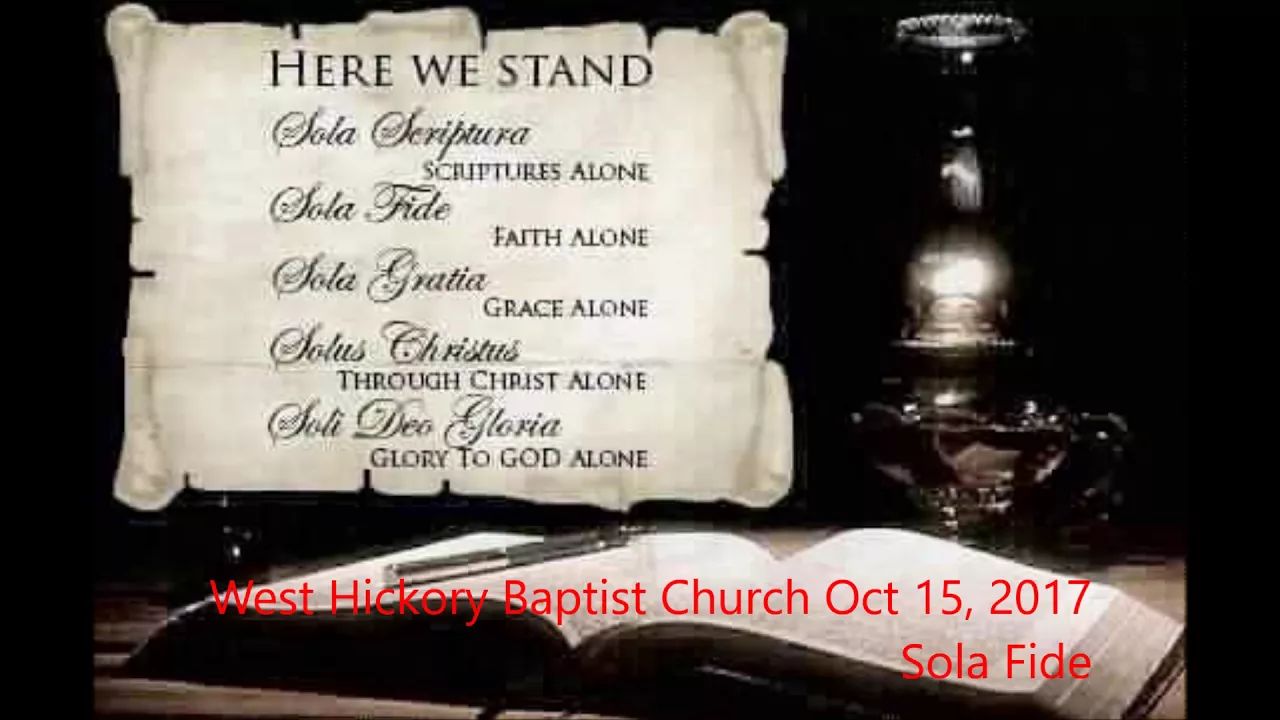
Sola Fide
A Reformation 500 moment during the morning service of West Hickory Baptist Church on Oct. 15, 2017. http://www.westhickorybaptist.org/
Transcript
Our pastor has shepherded us to look at the five souls of the Reformation. The first Sunday was
Scripture alone. The second Sunday was Grace alone.
Today, we look at Faith alone. When Paul explains the
Gospel in Romans, he says that in that Gospel, the righteousness of God is revealed, as it is written, the righteous shall live by faith.
I want to begin by looking at how the Catholic Church obscured the Gospel, then move to how the
Reformation recovered the Gospel, and finally give an implication of the
Gospel for us today. The Catholic Church obscured the Gospel of Faith alone by tangling up regeneration and justification like a bad game of Twister.
Biblically, regeneration is being born again, having eternal life imparted into the soul.
Justification is God the Judge declaring us to be legally righteous in His sight instead of guilty.
The mixing up of regeneration and justification resulted in the
Catholic Church teaching that in baptism, a man receives an infusion of righteousness into his soul, and that infusion of righteousness makes that man internally right before God.
Consequently, the Catholic Church went on to say this, the fruit of righteousness flowing from the divine life experienced in baptism flows out in works so that a man may merit, by gracious works, a second justification before God.
So the foundation of a right standing before God is what a man becomes at his baptism, and what a man does after his baptism, that baptism being an infant baptism.
This was the thinking that plagued Martin Luther. Similarly, when a man,
I'm sorry, my paint is going to get stuck. If ever there was a monk who could have been saved by his monkery, it would have been
Martin Luther. Aside from vigils, prayers, and reading, he would spend six hours at a time in the confessional, and he would go time after time, three days, fasting without a morsel of bread or a drop of water.
But all of this work failed to give Luther the peace with God that he sought for.
And that's because Galatians 2 .16 says, By works of the law, no one will be justified.
So the Catholic Church obscured the gospel of faith alone by tangling up regeneration and justification, and in this way, tortured
Martin Luther. But what the Reformation did was untangle regeneration and justification, and this resulted in clarifying what justification means.
Justification is not a process. It is an instantaneous declaration from God the
Judge in the courtroom of heaven that a sinner is righteous instead of guilty.
And the instrument by which a man is justified is not man's work, but faith alone in Christ and His work at Calvary.
Romans 4 .5 says, To the one who does not work, but believes in Him who justifies the ungodly, his faith is counted as righteousness.
Does not work, but believes.
God justifies the ungodly.
But how can God declare an ungodly man righteous?
He does not do this by infusing righteousness into a man's soul, as the
Catholic Church taught, but by imputing the righteousness of Christ to a believing sinner.
In other words, when a man believes on Christ, God considers the righteousness of Christ as belonging to that sinner.
Think of it this way. When a poor woman marries a rich man, the woman enters into a union with him so that she shares in his wealth.
The poor woman becomes rich. Similarly, when a sinful man believes in Christ, that man enters into a union with him so that he shares in Christ's righteousness.
And in this manner, God considers Christ's righteousness as belonging to the sinner, and thus declares the sinner to be righteous.
This is the only way that a sinful man may have peace with God. Luther put it this way,
Though I lived as a monk without reproach, I felt that I was a sinner before God with an extremely disturbed conscience.
I could not believe that He was placated by my satisfaction. At last, I began to understand that the righteousness of God is revealed by the
Gospel, namely, the passive righteousness with which the merciful God justifies us by faith.
The Catholic Church obscured the Gospel. The Reformation recovered the
Gospel. Here is an implication for the Gospel for the Church today.
We had better get justification by faith alone right before we get to work.
Another way to say it would be this. We had better get the Gospel right before the
Church works. When Paul reveals what the
Gospel means in Romans, he speaks about it in terms of justification by faith alone.
When the Catholic Church obscured that Gospel, it gave rise to an unhealthy religiosity.
Williston Walker says this about Germany. Germany, at the beginning of the 16th century, was in many respects the most churchly of the
European lands. Pilgrimages and masses for the dead were more popular than ever.
Veneration of the saints, especially of the Virgin Mary and of her mother, St. Anne, had increased dramatically.
Collections of relics abounded and the sale of indulgences multiplied. Many new churches, chapels, and chantries were built.
Germany was not being taken over by secularism when the
Protestant Reformation broke out. It was very religious, but it was an unhealthy religiosity that arose from the burial of justification by faith alone.
Contrastingly, we here in America do see secularism taken over, a gross paganism infiltrating our land.
And what a temptation it would be for us in our day to say, we need to get back to America being religious.
But if that religiosity does not arise from justification by faith alone, then we are not standing on the
Gospel. What revolutionized Europe was not increasing religious activity.
It was a recovery of justification by faith alone.