Keep sharing good news without ads.
Description: The author brings three serious charges against the apostate to show that the severe punishment of the apostate is just. An exposition of Hebrews 10:28-29.
Lord, you're calling me to come and behold the wondrous cross, to explore the depths of grace that came to me at such a cost. Where your boundless love conquered my boundless sin, and mercy's arms were open wide.
My heart is filled with a thousand songs, proclaiming the glories of Calvary. With every breath, Lord, how I long to sing of Jesus who died for me. Lord, take me deeper into the glory of Calvary. Find eternal joy in the triumph of the wounds by our Savior's crimson flow.
Holy wrath has been removed,.
And your sin rejoiced.
Proclaiming the glories of Calvary, Lord, how I long to sing of Jesus who died for me. Oh, my heart is filled with a thousand songs, proclaiming the glories of Calvary. With every breath, Lord, how I long to sing of Jesus who died for me.
Lord, take me deeper into the glory of Calvary.
A mercy that forgives my sin, that makes me like yours. And now I'm loved forever. You've done.
Oh, Jesus, place of peace. And my song will not repeat.
Praise.
Welcome to Kootenai Church on this wonderful Sunday in June. Please stand as we sing. I sing the mighty power of God.
I sing the mighty power of God that made the mountains rise, that spread the flowing seas abroad, and built the lofty skies. I sing the wisdom that ordained the sun to rule the day. The moon shines full at his command, and all the stars obey.
I sing the goodness of the Lord that filled the earth with.
Food.
He formed the creatures with his word and then pronounced them good. Lord, how thy wonders are displayed. Where 'er I turn my eyes, if I survey the ground, I tread or gaze upon the sky. There's not a plant or flower below but makes thy glories.
Known.
And clouds arise and tempests blow by order from thy throne. While all that borrows life from thee is ever, and everywhere that man can be, thou, God, art present there. Eternal God, unchanging, mysterious, and unknown.
Your boundless love unfailing, grace and mercy show. Bright seraphim in ceaseless flight around your throne.
They raise their voices day and night in praise to you. Rise up, O Lord, and die.
Best of my works. Pierce your hands.
Your mercy is all I boast.
The goodness I claim, the crowns of my hope. Whatever I lack is still what I need most.
Jesus, your mercy is all I praise. The king who took my eyes to condemn will sing of you.
Jesus, your mercy is all my rest. Fears weigh me down and enemies pressed. Think true in life and in death.
Jesus, your mercy is all I praise.
The king who bore my, took my eyes to condemn will sing of your mercy. Jesus, your mercy is all my joy. My voice to sing of a treasure no power can destroy. Jesus, your mercy is all my joy. Praise the king when I stood condemned.
Oh, how good you've always been to me. Praise the king who bore my sin, took my eyes to condemn, and to sing of your mercy.
Good morning.
Just an announcement concerning a couple of things coming up.
Everybody hear me?
I'll give it a second.
All right.
Am I in my own sound system today?
All right. Well, is that coming through? There we go. Okay. Sorry for that.
A couple of announcements concerning a couple things coming up. We have a new families night on June 25th, so just a reminder that if you want to attend that, please sign up on the sheet out in the foyer so we know who to expect for that.
Those are for folks who are new to the church within the last 8, 10 months, something like that. You haven't had a chance to go through the membership class, and you want to come and ask some questions of the elders and deacons and meet the elders and deacons, that night is for you.
We will provide dinner for you, pizza that night, and that is June 25th. That is a Friday evening, and we start at 6 p .m. And then we have a church campout coming up in the month of July. There are details in your bulletin and coming out in the July newsletter.
And at our annual church campout, we always have a baptism service. So this is my chance to remind you that if you have trusted Christ for salvation and you have never been baptized, I would encourage you to obey the Lord in believers' baptism and come and talk with me afterwards so we can arrange for you to attend a baptism class to find out what baptism is about and then to be interviewed by one or more of the elders and have you baptized at the church campout.
So if that's something you want to do, please come and talk with me sometime the next week or so so we can get that arranged. And then my third announcement is, I talked about this in the adult Sunday school class when we were going through the series of lessons on God Wrote a Book.
I talked about a new Bible translation that is out, the Legacy Standard Bible. This is a translation of Scripture that is done by the Master's Seminary staff. That is the ministry or the school overseen by Grace Community Church and John MacArthur's ministry.
They got the rights to the Lockman Foundation's New American Standard Bible and they took the New American Standard translation and made it even better, altering a couple of ways that they translated things.
For instance, instead of translating the word doulos as bond servant or servant, they translated it as slave, which is a massive improvement over all the other English translations. A second thing that they did is in the Old Testament, when you read the name of the Lord, they usually capitalize it L-O-R-D, capital, all caps.
And that is usually a translation of the Hebrew Yahweh, the Tetragrammaton. And Yahweh is God's name. And so in the Old Testament translation, whenever you see the word Yahweh in the New or Old Testament, the LSB has translated it as Yahweh rather than just as the Lord, all caps.
And they've tightened up the NASB. I think that the NASB, the 95 edition, was, I think, the best English translation available to us. And they have taken the NASB and improved it and made it even better.
And if most people here did not already use the NASB, I would switch over and start using the LSB in my preaching, and that might come at some point. And they recently published the entire New Testament and the Psalms and the Proverbs in the LSB, and the rest of the Old Testament is coming out later this fall, I think in October is when they plan on having that out.
Well, I say all of that, and this is what it looks like right here. I say all of that to let you know that as a gift from Grace to you, the Radio Ministry of John MacArthur, there are 120 of them out in the foyer.
That's enough for one family or every adult in a family to get at least one copy of the LSB. It's their gift to us, basically through Phil Johnson, because he was here and he saw that you didn't have it, and he said, hey, how about if I send up a few boxes for you, and I said that would be great.
So get yours. They'll be on a table in the foyer when you leave here today, and feel free to pick up a copy for you and your family. We turn now in your Bible, not the LSB, obviously, to John 1. We're going to read the first 18 verses of John 1.
This is the prologue to John's Gospel. It describes here the intimacy between the Father and the Son in the Trinity. It is an introduction to who Christ is, describing his eternality and his closeness with the Father and the fact that he is the revelation of the Father to us.
John 1, and we'll read together these 18 verses. In the beginning was the Word, and the Word was with God, and the Word was God. He was in the beginning with God. All things came into being through him, and apart from him nothing came into being that has come into being.
In him was life, and the life was the light of men. The light shines in the darkness, and the darkness did not comprehend it. There came a man sent from God, whose name was John. He came as a witness to testify about the light, so that all might believe through him.
He was not the light, but he came to testify about the light. There was the true light, which coming into the world enlightens every man. He was in the world, and the world was made through him, and the world did not know him.
He came to his own, and those who were his own did not receive him. But as many as received him, to them he gave the right to become the children of God, even to those who believe in his name, who were born not of blood, nor of the will of the flesh, nor of the will of man, but of God.
And the Word became flesh and dwelt among us, and we saw his glory, glory as of the only begotten from the Father, full of grace and truth. John testified about him and cried out, saying, This was he of whom I said, He who comes after me has a higher rank than I, for he existed before me.
For of his fullness we have all received, and grace upon grace. For the law was given through Moses. Grace and truth were realized through Jesus Christ. No one has seen God at any time. The only begotten God, who is in the bosom of the Father, he has explained him.
You stand with me as we pray. Let's bow our heads. Our Father, we are thankful to you for the revelation of your nature, your character, your being and essence in the person of your Son. We thank you that you have sent the Son into the world to show us who our God is and to reveal to us your grace and mercy.
We thank you that in Christ, grace and truth have been realized and that in sending your Son, you have made propitiation through his death for our sin. And we thank you for satisfying your own wrath against us by sending your Son to bear our sin in our stead.
And so we worship you and we praise you for this great gift of grace, your Son. We thank you that our salvation, though it cost him everything, his life, was your predetermined plan and it is the expression of your love for us.
So we thank you for your mercy and we pray that as we sing today that you would fill our hearts with love and affection for Christ. We pray that you would help us to meditate and think upon his goodness and your grace to us.
And we pray that our hearts may be filled with joy as we fellowship with one another and give us grace to sing with enthusiasm and exuberance in a way that is honoring and glorifying to you and fix our hearts and our meditation upon Christ and his work.
And upon your word this morning we ask in his name. Amen.
We're going to sing a new song this morning written by Keith Getty and Stuart Townden called My Heart is Filled with Thankfulness.
My heart is filled with thankfulness To him who plumbed the depths of my disgrace And gave me life again Who crushed my curse of sinfulness And clothed me with his light And moved his law of righteousness With power upon my heart.
My heart is filled with thankfulness To him who walks beside Who floods my weaknesses with strength And causes fears to fly Whose every promise is enough For every step I take Sustaining me with arms of love.
With grace.
My heart is filled with thankfulness To him who reigns above. His love is my perfect peace His love For every day I am given by the King. So I will give my life For every day I am given by the King.
In Romans chapter 8 verses 31 -34 it reads. What then shall we say to these things? If God is for us, who is against us? He who indeed did not spare his own son But delivered him over for us all How will he not also with him Graciously give us all things?
Who will bring a charge against God's elect? God is the one who justifies. Who is the one who condemns? Christ Jesus is he who died Yes, rather who was raised Who is at the right hand of God Who also intercedes for us.
Before the throne of God above.
I have a strong and perfect plea Of great high priest whose name is love Whoever lives and pleads for me My name is graven on his hands My name is written on his heart I know that while in heaven he stands.
No tongue can bid me thence depart. No tongue can bid me thence depart. When Satan tempts me to despair And tells me of the guilt within. Upward I look and see him there Who made an end to all my sin Because the sinless Savior died.
My sinful soul is counted free For God the just is satisfied.
To look on him and call his name.
There the perfect spotless righteousness The great unchangeable I am The King of glory and of grace One with himself I cannot die My soul is purchased with his blood. My life is hid with Christ on high.
With Christ my Savior and my God. With Christ my Savior and my God. Hallelu. Praise the one risen Son Cross of Christ and marvel at this love divine. God's perfect Son was sacrificed To make me righteous in God's eyes.
His rivers depths I cannot know But I can glory in its flood. The Lord most high has bowed down low And poured on me his glorious love And poured on me his glorious love.
Hallelu.
Praise the one risen Son.
The one risen Son. You may be seated.
Will you please now turn to Hebrews chapter 10. Hebrews chapter 10 and looking at verse 26. We'll read verses 26 through verse 31. Hebrews 10 beginning at verse 26. For if we go on sinning willfully after receiving the knowledge of the truth, there no longer remains a sacrifice for sins.
But a terrifying expectation of judgment and the fury of a fire which will consume the adversaries. Anyone who has set aside the law of Moses dies without mercy on the testimony of two or three witnesses.
How much severer punishment do you think he will deserve who has trampled underfoot the Son of God and has regarded as unclean the blood of the covenant by which he was sanctified and has insulted the Spirit of grace?
For we know him who said, Vengeance is mine, I will repay. And again, the Lord will judge his people. It is a terrifying thing to fall into the hands of the living God.
Let's pray together.
Our gracious God, our Father, we pray that you would grant us understanding in your word this morning. That you would open our eyes and our hearts and if there are any here who have never trusted Christ for salvation that they would see their need to do so and that are looking at this passage which warns of turning away from the gospel may truly find a seed and a place in every heart that is here.
Help us to appreciate your great grace today but also to heed the warning of this passage so that you might be honored and glorified to those who trust Christ and lean upon him and believe upon him for salvation.
Be glorified through this time we pray in Christ's name.
Amen.
When we stopped our study last week I had introduced these three statements that we find in verse 29. He has trampled underfoot the Son of God as regarded as unclean the blood of the covenant by which he was sanctified and has insulted the spirit of grace.
And those describe the sin of apostasy. And apostasy is no small matter and the one who walks away from the truth of the gospel has in effect done all three of those things. That is the author's explanation of why the punishment is so severe.
How much severer do you think the one would deserve who has trampled underfoot the Son of God regarded his blood as nothing and then insulted the spirit of grace? Those three things describe the sin of apostasy.
Now, granted, admittedly, the apostate would never describe his own sin that way. The one who turns from the gospel would probably describe his sin this way. He would say, well, I tried the Jesus thing.
It just wasn't for me. Or, I just kind of doubt the legitimacy of it. Or, the church is filled with hypocrites and it wasn't my thing. Or, I just didn't like to go to that place. There's a bunch of people that I didn't know and so I just feel better at home.
Or, I could just go out into nature and worship God on a mountaintop somewhere. I have my own little church in my house. All of those excuses for walking away from the assembly of the saints and for departing away from the truth and denying the gospel, those excuses and a hundred more are what the apostate would say to describe his own rejection of the truth.
And yet, this three-fold description of apostasy in verse 29 is, in fact, the author showing that the judgment that is described in verse 27, the fury of a fire which will consume the adversaries, the severer punishment, the vengeance, the Lord judging his people, the terrifying thing that it is to fall into the hands of the living God, this is the author just showing us that that punishment, that justice is actually just and it is not excessive at all.
It is not over the top. It is not beyond the pale. It's not outside of what the apostate would deserve. Because the apostate, in turning from the truth, is not simply making an assessment about a church body or a preacher or the worship or the message or a church's ability to reach the community or any other excuse that they might use for walking away from the gospel.
The apostate is not making an assessment of any of those things. The apostate... I keep wanting to say apostle. The apostate, in turning away from the truth, is actually making an assessment regarding the work of the Father, the work of the Son, and the work of the Holy Spirit.
It is a direct and blasphemous attack upon the members of the Trinity. So that when the author describes the apostate as deserving of this fury of a fire which will consume the adversaries, he is demonstrating that this is, in fact, justice.
That the sin matches the punishment and that the punishment is not excessive given the nature of the sin. Because in Scripture, these two things always go together. The amount of light that is rejected and the punishment that is meted out by God in the eternal scheme or even in an earthly and temporal judgment.
These two things are always proportional to one another. The light rejected and the punishment that is received. So that the greater the light that is rejected, the more deserving the apostate is of the punishment and the worse the punishment will be for the one who rejects that light.
So then, how much severer do you think it would be for one who was embraced by the Christian community and invited in as one of their own and believed to be one of their own and has enjoyed all of the blessings, though giving only intellectual assent, he has enjoyed in a superficial manner all of the blessings that are part of this new covenant community?
And how much more severe do you think the judgment should be upon one who sees the truth and has superficially experienced the truth and has given intellectual assent to the truth but then has regarded the truth as not true and turned away from it and rejected it altogether?
How much more severe should be his judgment? For who has received more light than one who has been among us and has experienced some of the things that we have experienced and has heard the truth and understood the gospel and come face to face with it?
Who has received more light than that? So the author has this rhetorical question, how much more severe? How much severer do you think he will deserve in terms of punishment? It's kind of like the rhetorical question at the beginning of the first warning passage in chapter two.
How will you escape if you neglect so great a salvation? That is a question that is just sort of thrown out by the author to look upon the question itself. How will you escape if you neglect that? How much severer do you think the judgment should be upon one who has embraced these things on a superficial level and been among us and was thought to be one of us but then has turned away and walked away and apostatized from the truth?
Because the apostate, remember, is not a genuine believer. This is one who has given an intellectual assent to the truth. It is one who has outwardly embraced these things and superficially experienced some of them and then has rejected that truth.
So note the threefold description here of this treachery. And I briefly mentioned last week that there are a couple of different ways that we could categorize these three statements. And last week, we just kind of introduced them and observed some things about all three of these.
We saw that these three statements really could be categorized in terms of the person who is slighted, the Father, the Son, and the Holy Spirit, or the work that is repudiated. In other words, the work of the Father in sending the Son to be the Savior of the world is spurned when one tramples underfoot the Son of God.
It is the sending work of the Father and the Father's love for the Son that is spurned. Or to assess the work of the Son in His self-giving sacrifice and then to repudiate that or to consider as unclean the blood that He has shed that has sanctified Him.
Or to look at the work of the Spirit of God in drawing and illuminating and enlightening the mind of the unbeliever to the point where they see and understand the gospel. To turn away from that is an insult to the Spirit of grace.
So these three sins are a spurning of the Father, a scorning of the Son, and a slighting of the Holy Spirit. All three persons of the Trinity are in some way repudiated and renounced in the sin of apostasy.
And the work of each person, the sending of the Father, the self-giving of the Son, and the illuminating work of the Holy Spirit, the work of all three of them is slighted by the apostate who turns away from it and renounces it.
So that brings us all up to speed. Three persons and their three works. So now let's look at each of these statements. He has trampled underfoot, first of all, the Son of God. How much severe punishment do you think He will deserve who has trampled underfoot the Son of God?
The reference here to Jesus as the Son of God is, I think, well, I know, it's intentional. The author's not doing this by accident. There were a number of ways that He could have referred to the Lord Jesus Christ.
He could have referred to Him as a high priest. He could have said how much more Him who has trampled underfoot the high priest, or who has trampled underfoot Jesus, or has trampled underfoot the Christ, or even Jesus Christ.
There are a number of titles and designations the author could have used. It's interesting to me that he chooses the term Son of God because that is a designation, that is a description that is intended to show the shocking nature of this apostasy.
That the person that is being slighted and trampled underfoot is not an ordinary man, just a man named Jesus of Nazareth, Son of Joseph. He's not just the Messiah, but He is, in fact, the Son of Joseph, the Son of David, the Messiah, the King of Israel, and above all of that, He is the Divine Son of God.
This designation of referring to Him as the Son of God demonstrates the shocking nature of this. It reminds us of His divinity.
In fact,.
This is the title of His divinity. When we see Jesus referred to as the Son of God, it reminds us that this One whom we are talking about is of one nature and one substance.
With the Father.
He shares the substance and nature of God in full, so that He, though being fully man, He is also fully divine in His essence and His nature. And this describes His divine nature. It is also how the same designation, the Son of God, is used in the previous warning passage, Hebrews chapter 6, and I think for the very same purpose.
In Hebrews chapter 6, verse 6, the author says, describing these apostates,.
And then, if they have fallen away,.
It is impossible to renew them again to repentance since they again crucify to themselves the Son of God and put Him to open shame. Hear that description? They crucify to themselves the Son of God and put Him to open shame.
It's almost like he is describing the same thing in this warning passage when he speaks of trampling underfoot the Son of God. It is an open shaming and repudiation of this One who shares the divine nature, so that He, being fully God and fully man, shares in full all of the nature and the substance and the essence of divinity.
He possesses fully the divine nature, so He is not just the Son of God, He is God the Son. And that phrase describes His divinity. So this is a divine person that is being described here. Imagine the sin of trampling underfoot the divine Son, the One who is not just the Son of God, He is God the Son, this One who shares the very nature of the Father Himself.
And when Jesus is described as the Son of God in Scripture, it is intended to show us His connection.
To the Father.
It is intended to remind us that He shares the same nature.
That He has always shared from eternity past. And that title, Son of God, also reminds us of the relationship that He shares.
He is the Son of God. When you and I read the word God in the New Testament, most of the time when we read that word, with very rare exceptions, and there are exceptions, it is referring to.
The Father.
As the person of the Trinity. It is either the entire Godhead that is mentioned or specifically it is addressing the Father. So when we read here, for instance, that He is the Son of God, we are saying here that He is in relationship.
He is the Son in terms of His relationship ontologically.
And with the Holy Spirit, sharing that divine nature. He is related to the Father and there is an intimate and personal and loving fellowship between the Father and the Son. So this is not just an ordinary man.
Not only does He have a divine nature and He is the Divine Son, but His nearness.
And His relationship.
And the Father's love for Him cannot be overstated. In Matthew chapter 3, the voice from heaven said, this is my beloved Son in whom I am well pleased. That is the Father's assessment of the Son. So this one that we are describing as the Son of God shares not only the divine nature, but He has enjoyed from eternity past the infinite and unspeakable and perfect love.
Of the Father.
And the Spirit from all of eternity past. There has been between the persons of the Trinity this infinite love, this perfect affection, this perfect fellowship between them. So that this one who is trampled underfoot here is not just one who is of the same nature as the Father, but He is one who has enjoyed perfect fellowship and all of the infinite love.
That the Father.
Could lay upon anybody. He has put upon His Son. How much severe punishment do you think He deserves. Who has trampled underfoot that one? And has repudiated that one? His designation as the Son reminds us.
Of His divinity,.
Of His relationship.
And of the mission that He came into the world. The idea of His Sonship, His Sonship is related in Scripture most specifically in the Gospel of John.
Sending Him into the world to accomplish a task. The Son was sent with a mission from the Father and it is the Father in the Gospel of John who sends the Son. In fact, it is John in the New Testament that describes this most frequently and it is one of the main themes of the Gospel of John.
If you were with us.
For that trek.
Through the Gospel of John you probably remember how often that theme came up.
Sending the Son. John 6, 38 For I have come down from heaven not to do My own will but the will of Him who sent Me. John 8, 42 Jesus said to them if God were your Father.
You would love Me.
For I proceeded forth and have come from God that is from the Father for I have not even come on My own initiative.
But He, the Father.
Sent Me. And He sent Him before salvation. 1 John 4, 14. We have seen and testified.
Has sent the Son to be the Savior.
Of the world.
So there is this intimate connection between the Father and the Son. They share the divine nature. They share love between the persons. And then the Father has sent, dispatched the Son into the world as Savior for the world.
This one the Father has sent into the world and what is the Father's assessment of this one He has sent into the world? This is My beloved Son in whom I am well pleased. One of divine nature, one of divine relationship.
And one with a divine mission. And the Father has sent the Son into the world and therefore the Son is a special love gift.
From the Father.
To this world. The one whom the Father loved from eternity past. As far back as your mind could go in time prior to creation and go back further and infinitely back before anything even existed including angels.
And the Father, the Son, and the Holy Spirit existed in perfect harmony, perfect unity and perfect love together. And one was sent by the Father into this world to take upon Himself human flesh and to live a perfect life and then to die in the stead of men to bear the sins of all who will believe upon Him.
This one being God in human flesh enjoying perfect fellowship with the Father was sent on this divine mission. And so Christ then is one of infinite value, He is one of infinite worth, He is one of unspeakable majesty, He is one whom the angels worshipped before He ever came into this world.
He was in the form of God and did not consider His equality with God as something to be held onto at all costs. But in the counsel of the Triune God the Father willed to send the Son into the world and the Son came at the heating of the Father's will and the Son came voluntarily, not coerced, not against His will, but He came voluntarily to lay down His life on behalf of any and all who will believe.
How much severe punishment do you think He deserves who's trampled underfoot.
That one?
When the Father and the Son will bear witness against that one? Because the sin of apostasy is in fact a rejection of and a repudiation of the most precious gift.
That could ever have been given.
One of infinite value and one of infinite worth and there is nothing higher and nothing greater and nothing more majestic than the one.
Whom the Father.
Has sent into the world.
And what does.
The apostate do? Tramples him underfoot. Now this is obviously not describing a literal physical trampling underfoot. The definition of that word tramples means to despise, to treat as useless, to trample on or to tread down.
And it's not literally describing that physically this would happen by the apostate. Obviously Christ seated at the right hand of God does not endure that physical shame but metaphorically speaking this is exactly what the apostate does.
He treats by turning away from the gospel and the truth of the gospel. He treats with rudeness and insult and spurn and insults Jesus Christ in trampling him underfoot. This is metaphorically speaking exactly what the apostate does.
He views Christ as nothing more than a doormat to be trampled underfoot for his own purposes or used for his own purposes. He treats him as nothing greater than a stick or a piece of dirt or a gravel path to be walked upon.
This one whom the Father loves and is sent into the world. The beloved Son in whom the Father is well pleased. One with the Father. The object of his eternal love. The apostate tramples him underfoot.
Imagine then that you are hearing this as a Jew who is considering going back to the Old Testament sacrifices in the temple for your worship in the first century. Here's what the author is intending to say.
If you go back to that you are esteeming the person of Christ as nothing greater than an ox.
Or a bull.
Or a lamb that is slaughtered on your behalf. If you would prefer the blood of an ox as better than and greater than the blood of Christ who shed it to atone for your sins you are esteeming him as nothing more than blood to be trampled on in the courts of the temple.
You are esteeming Christ as nothing of greater value than an ox or a sheep or a lamb to be slaughtered in the temple. That's the trampling underfoot. Today if you turn from the gospel and reject Christ and refuse to heed the call to salvation then what you are doing for whatever reason.
You're doing it.
What you are doing is you are saying.
That the pleasures.
Of this world the pleasures of sin for a season are more valuable to me.
Than that one.
Sent into the world. And that I would rather have my sin.
I would rather have.
The fulfillment of my lusts. I would rather be king of my own domain than to bow the knee to this one whom the Father esteems as the most valuable thing in all of creation. Or to walk away from.
And repudiate Christ.
Is to say.
I would rather.
I value higher the esteem of the world.
And the reputation.
That the world may give me if I can turn away from the gospel and instead have the fame and accolades of the pagan world or of this creation. To turn away from Christ is to esteem something else as higher.
Than that.
Which the Father.
Esteemed as higher.
Than all else.
That is what trampling him underfoot is. And one who rejects and turns from the gospel does this very thing. You see a rejection of the gospel message is in fact a rejection not just of a message or of a declaration or of an offer or of an invitation.
The rejection of the gospel is a rejection of Christ himself. That's the hideousness of the rejection of the gospel. Because Christ is the prize of the gospel. What is offered to us in the good news of the gospel is not just a message it's not just an invitation again it is a person.
It is him that we receive it is him that we are to believe upon. So what is held forth to us in the offer of the gospel is the atoning work of that son. It is all that he did as the divine one.
Loved by the Father.
On the cross for our sake. And to look at that to behold that and to turn away from it is to value something else as higher than that. What is offered to us in the gospel is his work his sacrifice his perfection and his righteousness.
What is given to us in the gospel is all of his doing and all of his perfect life and all of the righteousness that he has an infinite and unblemished and perfect righteousness that righteousness is offered to us in the gospel.
All of his wisdom his truth his glory.
The reward.
For years of faithful service and belief and faith his headship you see what is offered to us in the gospel is bowing the knee to Christ and making him our head since he is given as head over all of the church and God has made him as the preeminent one over all of creation when the gospel offers us Christ it offers us him as the head of all things and when we reject the gospel we are rejecting him.
His kingdom and his glory his nature his goodness his mercy his loving kindness and his grace all of that is wrapped up in the gospel. When you hear the proclamation of the good news of the gospel what you are being offered is Christ that's it.
You say that's it? Yeah that's it. But guess what? That's it is everything. He's not just that's it he's everything. So what God offers to us in him yes it is Christ but in him we have everything every good thing that God could give us is offered to us in the person of Christ.
His infinite wisdom his infinite righteousness his infinite grace it's in the person of his son. This one who is the beloved one who is the divine one who is the one in whom the father is well pleased the most valuable and esteemed one by the father the one whom the father esteems and has elevated above all else he is what is offered to us in the gospel.
And the apostate that turns from that and says.
No thanks.
He is trampling underfoot the son of God. And receiving the gospel is receiving Christ. To receive the gospel is to receive him. To reject the gospel is to reject him is to say.
Yeah I don't want him.
I'd rather have something else. It's to say that there is something else more valuable than him. Because in the gospel Christ is offered to us. In fact the command of the gospel commands us.
To embrace.
Not a message not a system of propositional truths not some beliefs or a doctrinal statement or dogmas or a life reformation plan none of that. The gospel command is to repent and to believe upon and trust him.
So the command of the gospel is to come to him all ye who are weak and heavy laden and he will give you rest. The command of the gospel is to trust him for your salvation and eternal life. The command of the gospel is to turn from your sin to him.
You're turning from idols from your sin to the living God and an embrace of Jesus Christ. To trust and believe the gospel is to yield yourself to him to believe upon him to trust him like one trusts a parachute.
To put him on to embrace him to borrow the analogy of John chapter 6 it is to eat his flesh and to drink his blood to appropriate himself to us. What is provided in the gospel what is offered in the gospel is forgiveness of sins and it is righteousness but it is those things contained in Christ and you cannot have.
Those things.
Without having Christ. So if he is not precious to you if he is not valuable to you if you are not willing to submit to him and yield to him and love him and obey him then you have no part in anything that he offers you.
Because you cannot have the blessings of the gift without the giver of the gift as well because the blessings that come to us are in fact given to us in and through the giver of the gift which is Christ himself.
And so I can't have all I can't have righteousness and forgiveness and grace and mercy and escape hell without receiving Jesus Christ and appropriating him to myself. I must take him eat his flesh drink his blood.
I must have him. I must have an infinite connection to him. And if he is not precious then I trust you trust me. There is nothing else in the gospel that will be precious to you because everything that is provided in the gospel is summed up the glorious and majestic person.
Of Christ.
Reject him and refuse him. You're trampling him underfoot. And it is a rejection of the father as well because Christ is a revelation.
Of the father.
This is what we read in John chapter 1. No one has seen God.
The father.
At any time but the only begotten God who is in the bosom in close relationship with the father he that is Christ the divine son has explained or exegeted the father to us. John chapter 1 is saying that no one has seen the father at any time but the son closely related to the father sharing one in essence and nature with the father that one who was the word from eternity past who was always with God and always was God that one has explained to us what the father is like.
So that Jesus could say in John chapter 14 to Philip's question show us the father.
Philip.
If you've seen me you've seen the father and it's not that Jesus and the father are the same person. They're not the same person but they are the same nature they are the same essence and Christ is so much a revelation of the nature and the character of God the father that Jesus could say if you have looked at me and have seen my character and my nature then you have beheld the very same nature and character.
Without seeing his person you have seen his nature. All of the revelation.
That we could need.
Or that we could receive is in the person.
Of the son.
So to reject the son is also to reject whom?
It's to reject the father. To look at Christ and say I do not want him I will not have him I will not yield to him is also to repudiate the father. So if this one whom the father has loved and has sent him to the world and this one who shares the very nature.
And this one who has revealed the nature and the purpose of the father if this one who is himself the revelation in human flesh of the glory and majesty in the person and the being of God. If you reject him you are also rejecting the father.
Jesus said.
He who receives you receives me and whoever receives me receives him who sent me. In John chapter 5 listen to the close connection between believing Christ and receiving the father. Truly truly I say to you he who hears my word and believes him who sent me has eternal life and does not come into judgment but is passed out of death.
Into life.
He who hears my word and believes him who sent me to heed the word of Christ is to believe the testimony of the father. Because Jesus said I don't say anything on my own initiative but I only say those things that the father gave me to say.
And Jesus said I don't do anything on my own initiative I only do those things that the father sent me to do. I only do what the father sent me to do and I do all that the father.
Sent me to do.
And Jesus claimed to be a perfect revelation.
John 12 verse 44. Jesus cried out and said he who believes in me does not believe in me.
But in him who sent me.
See. To receive him was to receive the father. John chapter 13 verse 20. Truly truly I say to you he who receives whomever I send receives me and he who receives me receives him who sent me. Because Christ being one in word and mission and purpose and will and nature.
With the father.
Has revealed the father to us so to reject the son is also to reject the father. You cannot reject the son and expect to have the grace of God because all the grace of God that is to come from the father comes in one place and one place only and that is in his son.
You see Christianity is an exclusive religion in this sense that there is only one path to the father and that is through the son the Lord Jesus Christ. There is no other name given under heaven among men by which men must be saved and if anybody is to be saved.
It would be through Christ.
And Christ alone. Why? Because there is only one perfect revelation.
And that is through Christ. And there is only one person who is the channel of all of God's grace and that is Christ. And there is only one who has done the work necessary to atone for the sins of men so that we may have our sins forgiven and that is Christ.
And to reject him is to reject.
All that the father.
Might give you. It is also to reject the father's assessment.
See the father said.
This is my beloved son in whom I am well pleased. To reject the son is to say the father's assessment of the son. Yeah not so much. It is not really accurate. That is not really truthful. I reject the father's approbation of the son.
I reject the father's love for the son. I reject the father's assessment of the divine son. It is to reject him his beloved son.
This one.
Whom the father.
Has highly exalted and put at his right hand and given him a name which is above every name and it exalted him in the heavenlies above all authority and all power and he has made him head of the church.
This is the father's assessment of the son. So that when the son said it is finished and he died the father vindicated his work by raising him from the dead and then bringing him to his right hand and seating him there above all authority and above all power and has given to him the disposal of all of his creation.
This one through whom the father created all of the world all authority in heaven and earth has been given to him.
By the father.
The judgment of all mankind has been committed to him by the father. And everything in heaven and everything on earth and everyone on earth and in heaven and under the earth will bow the knee to this one whom the father has loved.
And so to reject Jesus Christ is to reject the assessment.
And it is to reject the father himself.
The very nature.
And character of that revelation. This is the one whom the father has given. How much more severe punishment do you think he deserves? Who spurns the son of God by trampling him underfoot and turning from him and saying he is not valuable.
He is not worthy.
He is not majestic.
He is not deserving.
Of my worship or my faith. Instead I would rather have the passing pleasure of sin. Or instead.
The accolades of this world. Or instead.
The acceptance from my family and my friends. Or instead.
My own freedom and my own autonomy. How much more severe punishment do you think he deserves.
Than that?
That would choose playing around in the dirt to enjoying the fellowship with the divine son.
And the father.
Who sent him into the world. Now, non-Christian.
If you're here.
And you're not a believer in Jesus Christ if you reject the truth of the gospel and the person of Christ. All the responsibility.
For that rejection.
Falls upon you and your head.
For you have heard the truth.
And you know the truth and you see the truth.
And you are truly.
Without excuse. If you reject the good news of the gospel you will get exactly what your sin warns you all your blasphemy.
Your lies.
Your stealing your taking God's name in vain.
Your lust your greed.
Your selfishness your slander your gossip.
Your backbiting.
Every idle word you have spoken.
Will be judged on that day.
Every thought motive and deed you have ever had that you thought was done in darkness.
Will be brought out.
Into the light all things are naked.
And open.
Before the eyes of him with whom we have to do there is nothing hidden from his sight. Every deed you have ever done every thought you have ever had is written down in his book and he remembers them all every last one of them.
And on the day of judgment when you die you will stand before him and give an account for all those deeds and you then will bear the responsibility and the brunt of his wrath. Justly so for your sin which you deserve you have it coming and you deserve it and that is what justice will that is what justice will be.
If you reject that message you bear all the responsibility.
For that.
Christian if you have embraced that message and you have trusted Christ.
For salvation.
You get no praise or glory for that whatsoever none whatsoever because it is God himself who has opened your eyes and illuminated your mind so that you might understand and know and receive the truth.
And it is God himself and the person of the Holy Spirit who has drawn you to that message and changed your heart and given you eyes to see and a mind to comprehend that truth. And then he has turned you from your sin giving you the gift of repentance and he has given you the divine gift of faith so that you might believe the gospel of your salvation and receive all of the blessing and all of the glory that comes with salvation in the person of Christ.
So if you reject this message you have no one to blame but yourself. If you have received this message you cannot thank yourself. You can only thank God.
And no one else.
That's the glorious news of the gospel. So to the unbeliever I would say repent and turn and embrace Christ while it is still called today. Today is the day of salvation. If you do not know him and you die in this world without Jesus Christ you will pay for all of your sin.
If you do know him in Jesus Christ you have all of your sins.
Paid for.
And not just that.
But all of the righteousness.
Of the divine son is imputed to your account so you get credit for all of the righteous life.
That he has lived.
That's the good news of the gospel to turn from that is to trample underfoot the son of God. How much severe punishment.
Do you think you will deserve.
Who has done that.
Now as Christians we celebrate.
The gift of the father.
Every time that we observe communion together we are remembering not just the sacrifice.
In what he did in giving his body and his blood so that we may have forgiveness of sins and his righteousness.
But we also.
Are reminded that this is a gift of the father to us.
That the father.
Sent the son into the world a body he prepared for the son so that the son could say a body he prepared for me. And God did not desire the offerings and the sacrifices. The blood of bulls.
And goats.
But instead the father sent the son into the world to shed that blood and to provide that atonement which bulls and oxes and lambs could never purchase could never atone for.
That payment.
That has been done by the person of Christ is full it is sufficient it is final.
And it is enough.
So if you are not a believer in Jesus Christ as we observe communion I would invite you to not partake of these elements the bread and the juice. They are not magical there is nothing mystical about it.
They are not supernatural.
In any sense whatsoever.
They are never miraculous.
These are elements.
That we use.
To remind us as symbols.
Of the body.
And the blood of the Lord Jesus Christ.
They are meaningful.
To us as Christians because we recognize the cost.
Of our salvation.
This was the divine plan the plan of salvation was not an afterthought in eternity.
It was the father.
Willed to give up his son and he knew what it would cost him. Even before he created the first angel or the first Adam he knew what the cost of that salvation.
Would be and he created.
This world anyway for his own glory.
And he created men.
For his own glory and he allowed us.
To fall.
For his own glory so that he might redeem us and that we might give glory to him by embracing Christ. So if you are not a believer let the elements pass from before you this is not for you scripture says.
You eat and drink.
Judgment to yourself. If you are believers we partake of communion. We are going to have first a time.
Of quiet prayer.
Just a few moments for you to confess your sins. Scripture says we don't want to partake of the Lord's supper in an unworthy manner that would be to eat and drink either in the sinful state.
While we are.
Not repenting of our sin and not confessing our sin.
Or while we have ought.
Against a brother. And we know.
That we are at odds.
With somebody we need to reconcile.
Those are ways.
That we eat and drink in an unworthy way.
We don't want to do that.
So I'll ask the ushers to come forward now and I will step down then we will take a few moments.
To pray together.
And then I will lead us in prayer of confession. Alright let's bow our heads.
Quiet our hearts.
Our father we are unworthy recipients of your grace.
We do not deserve.
Any of the gifts of your mercy.
We don't deserve.
To have your son die in our place in our stead so that we may have eternal life we deserve none of that.
His righteousness we deserve only punishment and hell for our sin and so we thank you.
That knowing.
That we were ruined in our sin and undone that we were unable to save ourselves. That you sent your son to die for us.
We thank you.
For so great a mercy we confess to you.
That we.
Though we believe and trust you we are still sin each and every day in ways that we.
Are aware of.
In ways that we.
Are not even aware of. We fail to honor you.
As you are worthy.
To be honored.
We fail to esteem Christ as he is worthy to be esteemed. We fall short each and every day.
But we thank you.
That the righteousness of Christ avails for us that his blood is atoned for us and that.
That forgiveness.
Is ours in him thank you.
For providing.
A sacrifice.
Of such.
Inestimable worth.
And such a value.
And majesty.
For us.
Unworthy sinners.
And thank you.
For including us.
In it.
And drawing us to Christ.
That we may partake of these.
Graces.
And your mercy.
We praise you in the name of your son.
On the very night that our lord.
Was betrayed. He took the bread and when he had broken it he said.
Take, eat. This is my body which is broken.
For you.
Do this in your.
Remembrance of me in the same manner after supper.
He took the cup.
And said.
This is the new covenant.
In my blood.
Do this as often.
As you drink it in your remembrance of me let's pray.
Father your mercy is infinite.
That though our sin debt was also infinite that your grace has supplied.
All that we need we thank you that there is.
Forgiveness in Jesus Christ.
And we thank you.
For the great sacrifice of your son.
In giving him.
To this world so that he might be our savior.
We pray that you would fill our hearts.
With joy and affection.
For Christ.
So that we may.
Love him.
And serve him.
And honor him.
As he is worthy to be honored and may we see.
In him the perfect reflection.
And the perfect manifestation.
Of your nature.
And grace and goodness.
And may you fill our hearts.
With love for him.
And for what you have.
Done for us.
And may we not.
Forget that and may you continue to encourage us.
In our obedience and our love and our mortification. Love for you.
And our mortification of sin we ask this in Christ's name and for his sake.
Please stand.
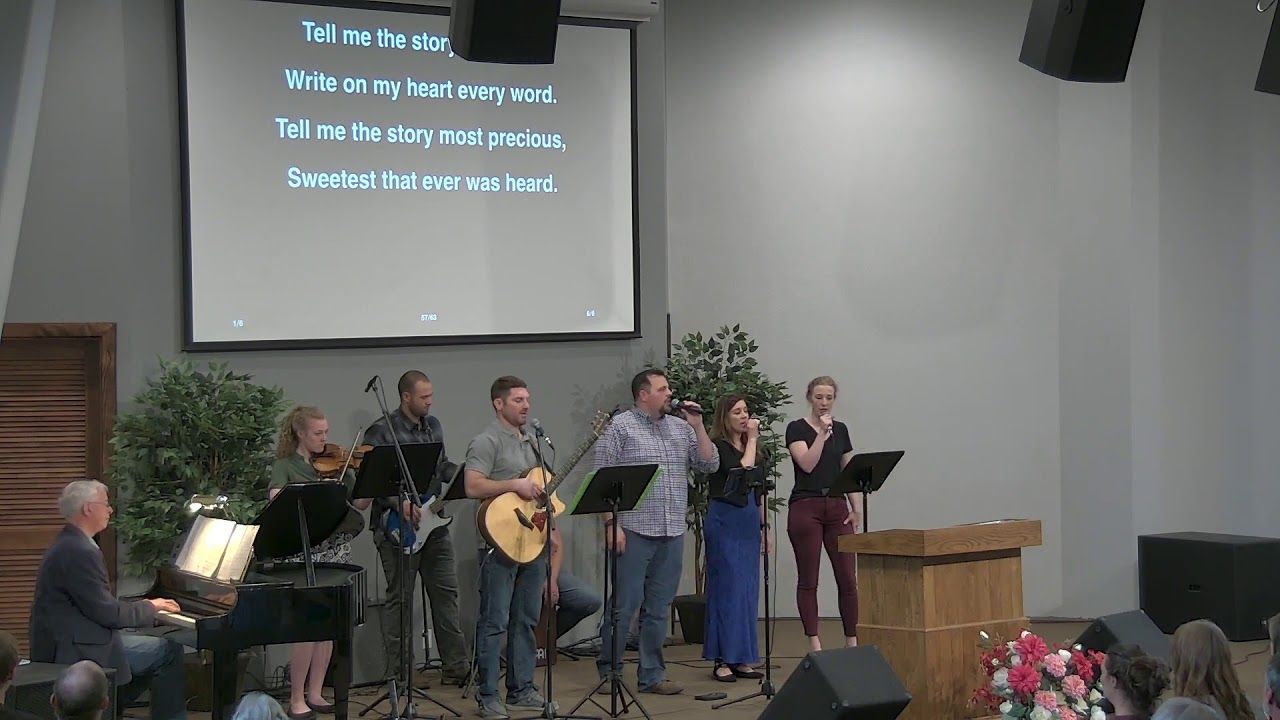
Tell me the story of Jesus. Write on my heart.
Every word.
Tell me the story most precious sweetest that ever was heard. Tell how the angels.
In chorus.
Sang as they welcomed his birth. Glory to God in the highest peace and good tidings to earth. Tell me the story of Jesus. Write on my heart. Tell me the story most precious sweetest that ever.
Where they nailed him.
Writhing in anguish.
And pain.
Tell of the grave.
Where they laid him.
Tell how he lived in that story.
So tender.
Clearer than ever. Say let me weep while you whisper. Love paid the ransom.
For me.
Tell me the story of Jesus. Write on my heart every word. Tell me the story most precious sweetest that ever was heard.
Have a great week.
Time began light dawned at your command began to.
Move mountains.
With your hands breathe life into all that's all that's good.