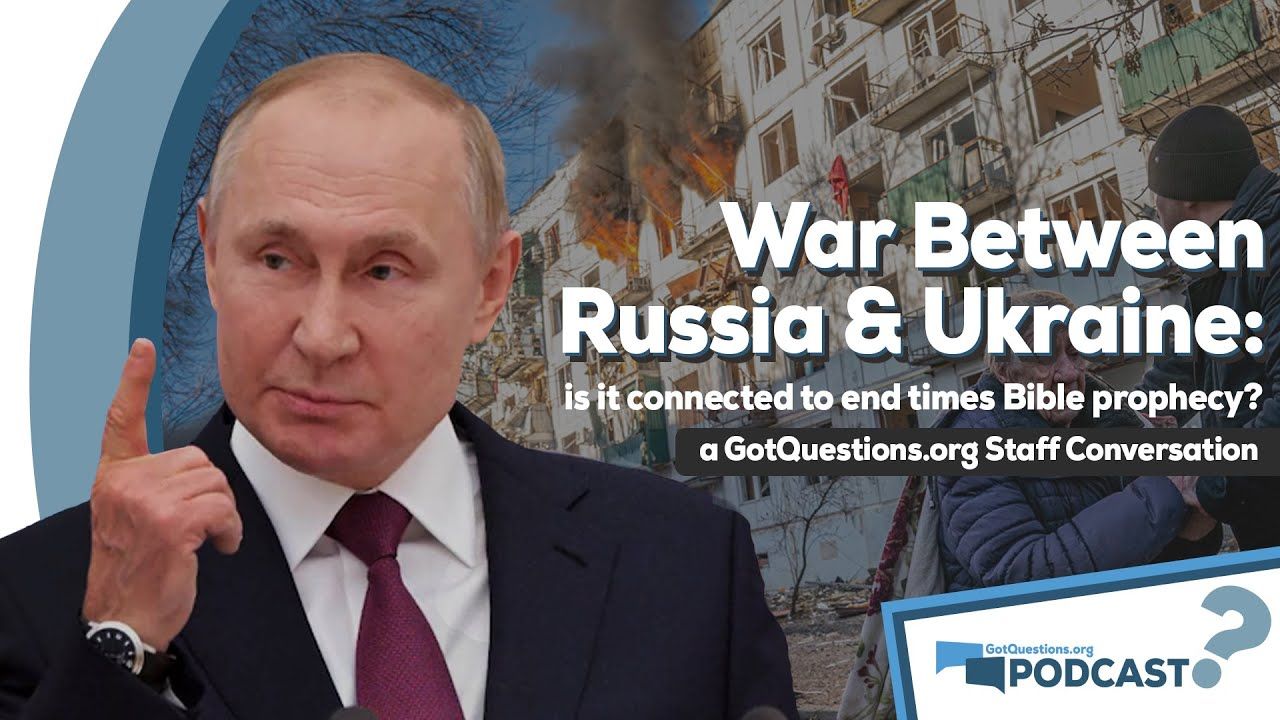
Does the war between Russia and Ukraine have a connection to the end times? - Podcast Episode 75
Does Russia have a role in end times Bible prophecy? Who/what are Gog and Magog? Is Russia attacking Ukraine a sign of the end times?
Links:
https://www.gotquestions.org/Russia-end-times.html
https://www.gotquestions.org/signs-end-times.html
https://www.gotquestions.org/wars-and-rumors-of-war.html
https://www.gotquestions.org/Gog-Magog.html
https://podcast.gotquestions.org
GotQuestions.org Podcast subscription options:
Apple - https://podcasts.apple.com/us/podcast/gotquestions-org-podcast/id1562343568
Spotify - https://open.spotify.com/show/3lVjgxU3wIPeLbJJgadsEG
Amazon - https://music.amazon.com/podcasts/ab8b4b40-c6d1-44e9-942e-01c1363b0178/gotquestions-org-podcast
IHeartRadio - https://iheart.com/podcast/81148901/
Stitcher - https://www.stitcher.com/show/gotquestionsorg-podcast
Disclaimer: The views expressed by guests on our podcast do not necessarily reflect the views of Got Questions Ministries. Us having a guest on our podcast should not be interpreted as an endorsement of everything the individual says on the show or has ever said elsewhere. Please use biblically-informed discernment in evaluating what is said on our podcast.
Transcript
Let's take a break from our normal series of going through the top 20 questions because something big is happening in the news right
now.
So I'm sure many of you have heard that Russia has officially invaded the nation of Ukraine.
And so just from seeing the number of questions we're receiving, the top most popular
articles on GotQuestions, some articles have shot to the top.
And if you're curious, top two articles right now are, does the Bible say
anything about Russia in relationship to the end times?
And does the Bible predict there will be a World War III regarding the end times?
So we wanna discuss these just briefly, just more, and give you a biblical perspective on what the Bible
says, what it doesn't say, because an apocalyptic freakout is not the proper response.
So today I have with me Jeff and Kevin.
Jeff is the editor of BibleRef .com, and Kevin is the managing editor of
GotQuestions Ministries.
So hope you find our conversation today helpful.
I just wanna start off with reading something from Matthew 24, verses five to eight, but I think it is a very
poignant reminder for us all.
So Matthew 24, verses five to eight says, for many will come in my name saying, I am the Christ, and they will lead
many astray.
And you will hear of wars and rumors of wars.
See that you are not alarmed, for this must take place, but the end is not yet.
For nation will rise against nation, and kingdom against kingdom, and there will be famines and earthquakes in various places.
All these are but the beginning of the birth pains.
So to me, this passage is a super helpful reminder that ever since the ascension of
Christ, wars and rumors of wars, kingdoms rising up against kingdoms, these things have been happening.
So not every time a war breaks out at some point in the world, is it a sign
of the end times.
So Kevin's gonna, in a moment, start talking about what the Bible says about Gog and Magog, which most
Bible prophecy interpreters view as a reference to Russia.
But ultimately, what the Bible talks about Gog and Magog, if that's referring to Russia, is
related to Israel.
So this specific conflict between Russia and Cain that's happening right now, the Bible does not explicitly
predict.
And as I said, not every war or rumor of a war has anything to do with the end times.
It's just a sign that sin is still reigning in this world, that evil people are making evil decisions and bringing
destruction upon each other.
But these things have been happening the whole time.
Ultimately, it is a sign that yes, at some point Christ is going to return.
It is not necessarily a sign that Christ is coming back immediately or very soon.
So Kevin, what does the Bible tell us about Gog and Magog and why do most Bible prophecy teachers think
that is a reference to Russia?
Well, we find the reference to the battle of Gog and Magog in two chapters of Ezekiel,
Ezekiel chapters 38 and 39.
Go through some detail in this battle that is called the battle of Gog and
Magog.
And in verses one through three of Ezekiel 38, we read this, the word of the
Lord came to me, son of man, set your face against Gog of the land of Magog, the
chief prince of Meshach and Tubal.
Prophesy against him and say, this is what the sovereign Lord says, I am against you, Gog, chief
prince of Meshach and Tubal.
And then the passage goes on to describe the actions of this particular
person, Gog, as he's called here, and from the land of Magog, as it's called
here, and talk about how they move against Israel with a coalition of a
few other nations, and then God destroys these battles,
these battle armies as they are trying to attack Israel.
And this word Magog is a reference to the land from
which the aggression comes.
And this is a land that, it could be translated the land from the far North.
And so this is why most commentators identify this with Russia, because if you
start in Israel and on the map and just go straight North, then you're going to have
Russia all the way up to the Arctic circle.
It's a few other nations in between, but then Russia, Russia, Russia, Russia, all the way up.
And of course, Russia being a large country and one that,
as we're seeing, as we record this podcast, one that has an aggressive nature
with the current leadership, most people will look at Ezekiel 38
and 39 and say, this is referring to a future battle where
Russia and a coalition of other nations march against Israel.
And some people see Magog not as a specific reference to Russia, but
more of a general term for the populations of people living in the Black and Caspian Sea
area.
But either way, regardless, you've got portions of Russia and portions of the former Soviet Union
that are involved in this battle of Gog and Magog.
So specifically, we've got in Ezekiel 38 and 39, a nation coming from Northern
Asia to attack Israel from the far North, from Magog.
And well, recent events have shown that Russia has been gaining strength
and kind of saber rattling in its march against Ukraine.
In fact, this area of Magog could very well include Ukraine and Crimea
and some of the other nations in that area as part of the march against Israel, again, in this
future battle.
So there's gonna be a time that's coming when Russia will be in alliance with several other nations,
probably including some Islamic countries, and they'll march against Israel to plunder
its land.
And some of the other nations that interpreters point to based on the description
in Ezekiel 38 and 39 would be modern -day Iran, modern -day Libya,
modern -day Sudan, and parts of modern -day Turkey.
Ezekiel says that when these aggressors march against Israel, a few other nations will
stand up around the world and complain, saying, hey, what are you doing?
And that's kind of the question that they ask in Ezekiel.
What do you mean by this?
But that's really as far as it goes.
The other nations don't intervene.
Nobody's there to enforce the peace.
They just say, you know, I don't think this is right.
And the battle of Magog continues.
And then as God says, he will personally defend Israel at
that time.
He will intervene in world history, and he will see to it that Israel is defended.
There's some question as to when this will be.
And I'll point out that I don't think it's happening now.
This is not the battle of Gog and Magog that we're seeing right now in world events
as Russia is invading Ukraine.
We do think that this is gonna be a battle that possibly is leading up to the
tribulation period.
I'm specifically the battle of Gog and Magog in Ezekiel, that that's one of the events that
leads up to the tribulation period, or it could happen closer towards the midpoint of
the tribulation.
Not real sure, but sometime in that timeframe, most likely is where we would put it in our view of eschatology.
And God promises to destroy this army of Gogs.
He says here in Ezekiel 38, verse 22, I will execute judgment on him with plague and bloodshed.
I will pour down torrents of rain, hailstones, and burning sulfur on him and on his troops, and on the many
nations with him.
And then the result of this supernatural judgment from God is going to be to turn the hearts
of Israel back to God and to make himself, God will be making himself
known to the whole world as the king and ruler over all.
And we read here in Ezekiel 38, verse 23, I will show my greatness and my holiness,
and I will make myself known in the sight of many nations.
Then they will know that I am the Lord.
So God's purpose in this is to defend Israel and also to glorify himself and to
get people to see that there is a God in the heavens.
He does pay attention to what's happening here in this world.
I should probably mention, there's another battle called Gog, the Battle of Gog and Magog, that's mentioned in
Revelation, but that is a completely different battle than the one mentioned in Ezekiel, because the
timeframe in the book of Revelation, chapter 20, is very clearly at
the end of the thousand -year reign of Christ, the millennium period, which
we're not close to that yet, obviously.
This is not the peaceful reign of Christ on earth right now.
So that's a different battle that happens to be also identified as being similar to the
battle mentioned in Ezekiel.
So either, regardless of how close or far away we are
from the Ezekiel battle of Gog and Magog, as believers, we have no fear.
We trust in the Lord, the one who is in control.
Trust and a lack of fear is important.
The thing that we have to keep in mind with all these things is when we read through scripture and we see these
descriptions of these things, we don't always get all of the details that we'd like.
We don't always get a chance to say, okay, here's every little tiny explanation that I would hope for.
But what we can do is we can look at that and say, God knows those details.
He's the one who put this stuff down there for us to see.
So even when I don't fully understand what's happening, He does, and He has the ability to
make all these things work the way that they need to.
And for me, that's one of the reasons why I'm not saying that it's not important that
we fully understand, but there's a much lower level of importance to things like interpreting and times
events than there are to other things.
One of the ways that I put it is to say that things that we see in the news today shouldn't change what we as
Christians are doing on a moment -to -moment, day -to -day, week -to -week basis.
We should always be living and acting as if the return of Christ is imminent.
We should always be living and acting like our time is short, because for each of us, it really is.
So we need to be living in that sense and that moment of urgency.
What we shouldn't be doing is saying, I'm gonna wait until I see some specific event happen and now I need to prepare, now
I need to work, now I need to worry.
And that worry and fear really shouldn't ever be part of the process.
That hasn't stopped people from making those sorts of assumptions.
We've seen people talking about, is this the final battle, the end, in the lead up to
World War I and lead up to World War II and the Cuban Missile Crisis and the Persian Gulf War and
so on and so forth.
For me, the Persian Gulf War was one of the first times where I was able to sense that buzz in the Christian
media community, because there's this large war taking place right next to Israel and all these other things are happening.
Well, sooner or later, one of those is going to be right and that's actually going to be the way things that happen, but we
don't need to panic as far as that part of it goes.
God's gonna be in control no matter what and what we need to do is just do what we're doing or what we should be doing
as we go forward into those things.
So when we talk about don't fear, don't worry, the fact that we see these things described in scripture, I think is a very good way for
us to not panic, because it's a reminder for us that even though God isn't gonna tell us every little detail, He did put
these details down because He already knows what's gonna happen.
So we can pray for brothers and sisters, we can hope that things will be resolved peacefully, we can seek
peace, we can seek to ease suffering, but at the same time, we can accept that this is all gonna turn out
for the best whether we fully understand it or not.
Excellent points, Jeff, and thank you, Kevin, for the breakdown of the Gog and Magog conflict.
So if we want to express what our main point is, is that we do not think there is any
explicit biblical connection with what's going on between Russia and Ukraine right now.
Could it lead to something bigger?
Of course it could.
Could it lead to a World War III?
And does the Bible even prophesy a World War III?
That's debatable.
Probably the closest thing the Bible says to a World War III would be the Gog and Magog conflict
that Kevin outlined.
So then transitioning that to what Jeff said, wars and rumors of wars are not things we're
supposed to freak out about.
This should not be driving us to fear.
What it should be doing is driving us to our knees to both pray for, in this situation, the people of Ukraine
and the people of Russia.
This, I'm not by any stretch a geopolitical expert, but this seems like a war
of vanity for Vladimir Putin.
There's really no clear reason for why this conflict is even
happening.
What's not necessary, the nations have lived in a bolt of peace with each other for
decades.
It doesn't make a whole lot of sense.
But ultimately, that's not the point.
Something doesn't have to make sense for us to be able to trust God, to recognize that He's sovereignly in control.
So pray for the people of Ukraine.
I think of our Russian and Ukrainian translator actually lives in Western
Ukraine, and I've not been able to get ahold of him since last night.
So pray for believers in Ukraine and believers in Russia.
I'm sure there are many Russian citizens who are not in support of this conflict.
It's the Russian government who's doing this, not the Russian people.
Pray for people to recognize the brevity of life as their lives
are put in danger, and to seek the gospel, seek salvation in Christ.
God would use this to draw people to Him.
Those are the sorts of things we should be doing.
We should not be breaking out the end times timeline and trying to pinpoint exactly where we are on it.
Instead, we are to be faithful witnesses.
We are to point people to Christ.
We are to pray for people who are suffering.
And from what we're hearing, there's going to be a lot of suffering involved in this.
It's very sad, very, very sad.
So to me, that's what this conflict is driving me to, is praying for the people of Ukraine, praying
for the people of Russia, that this conflict would be short, and that ultimately it results in
people coming to faith in Christ.
It's interesting when you see some of the passages in the Bible that talk about the end times that we look at and we say, oh, there's a parallel.
There are others.
Judges chapter 11 talks about a conflict between Ammonites and
Israel over a particular piece of territory, which is Gilead.
And the judge at the time is Jephthah, and he sends a message to the king of the Ammonites and says, why are you threatening
to take this land?
And the answer that the king gives is, well, this was ours and you took it from us in the past.
And Jephthah responds by saying, among other things, no, that's not what happened.
And oh, by the way, it's been a couple of hundred years and you haven't tried to fight for it since then.
So some of the broad strokes of what we're seeing, even with the Ukraine and Russia, we see reflected in
incidents of the past.
This sort of thing does happen.
And that's why when Christ says, you're gonna hear about wars and rumors of wars, don't lose your marbles because that's just part of
the birth pangs.
It's not that we dismiss any of those things.
It's still an awful, terrible thing when war happens, but that doesn't mean that there's a reason for us to point at it and say, this must
absolutely be the end.
In particular is this idea of it not affecting what we should be doing.
I am, I guess, infamous in my circle of friends and theologians and whatnot for
my take on eschatology.
I am not the greatest fan in the world of some of the end times things.
And that's mostly just because I find people tend to get too invested in particular interpretations.
And one of the things I've brought up before is what I call a lifeboat eschatology.
If you were on the Titanic, then the proper response to somebody telling you this boat's going to
sink is to get into a life vest, get other people into life vests and start getting people into lifeboats.
After that, if we want to, we can start arguing about, is the Titanic going to break in half or go down in
one piece?
Is it going to go down in two hours or six hours?
Is the front going to go down first or is the back going to go down first?
What you don't want to do is to be standing on the deck with somebody else in a life jacket, bickering about what's going to
happen two hours from now while there's other people running around who aren't wearing life jackets.
So for me as a believer, I appreciate that some of what I'm seeing in the news could very well be
signs of literal direct fulfillment of some of these different versions of the end times.
But I also recognize that ultimately, I can't change one thing about what's actually going to happen.
And I have other responsibilities.
I have a responsibility to serve God, love other people, promote the gospel where I am and how I am.
And that needs to be my emphasis instead of talking about these things.
Not that there's no place for those conversations, not that there is something wrong with having them.
I just need to have them when I'm in the right moment with the right people and for the right reasons.
Jeff, you always come up with the best illustrations and I love the lifeboat analogy that you used
right there.
The eschatology is a secondary issue and most important is what's the
condition of our souls?
Are we in Christ?
Are we exercising faith in Him?
Now, we live in a scary world.
The wars and rumors of wars make people very fearful.
We live in a very sad world.
And this Ukrainian conflict, the invasion from Russia is very sad to me, just breaks my
heart.
But we're told in scripture over and over, as God's children, we do not fear.
We trust in Him.
We know who holds the future and we know that He is totally in control and
things are moving forward for His glory and to bring about His plan
ultimately.
And we find real confidence and trust in those facts.
Well said, Kevin.
And it seems kind of weird to transition to this, but one other question that I'm seeing pop up quite a bit
right now in relation to, is Vladimir Putin the Antichrist?
If you read our article on who is the Antichrist, he is one of the people that we identify as the most frequent
targets.
And by that, please don't interpret that as we think he might possibly be.
I don't see any biblical connection to what it says about the Antichrist, the man of
lawlessness, the beast of revelation and either Russia or Vladimir Putin.
So no, I don't think so, but I don't know that the Bible gives you really
enough information to explicitly identify someone.
Back in World War II, many Christians were convinced that Adolf Hitler was the Antichrist.
Back in the Gulf War conflict, people thought Saddam Hussein was the Antichrist or Osama bin Laden or
whoever is causing a massive conflict tends to get a lot of attention for who might the
Antichrist be.
But again, this is one of those things -.
This is where I was gonna insert a pop culture reference for somebody who was supposedly the Antichrist and you said I wasn't allowed, so I won't.
Thank you, Jeff.
So one more thing in eschatology that it's fascinating to study.
I think we should be aware of what the Bible says about the Antichrist, but spending too much time worrying about who
specifically it is, ultimately there's far more productive things we can be doing with our time.
So hope our brief conversation about the Russia -Ukraine
conflict is beneficial to you.
Hope we point you both to scripture, what it says about wars and rumors of wars and not
freaking out every time there's a new conflict.
But ultimately, what I wanna encourage you is one I wanna leave with is pray for the people of Ukraine.
Pray for the people of Russia.
Yes.
Pray that this conflict would be ended quickly with a minimal loss of life.
Pray that the gospel would be proclaimed.
Pray that people who are, their lives are in danger would seek the truth of
God, would seek after Christ, would come to faith in Him, that God would, as He
always does, take what's a terrible, horrible tragedy and use it for His glory and use it to
draw people to Him.
So that's our prayer.
We think that should be your prayer as well.
And to keep studying God's word, be interested in eschatology, but don't let world events, don't let what's happening in
the news freak you out.
This has been the Got Questions podcast.
Got questions?
The Bible has answers.
And we'll help you find them.