Keep sharing good news without ads.
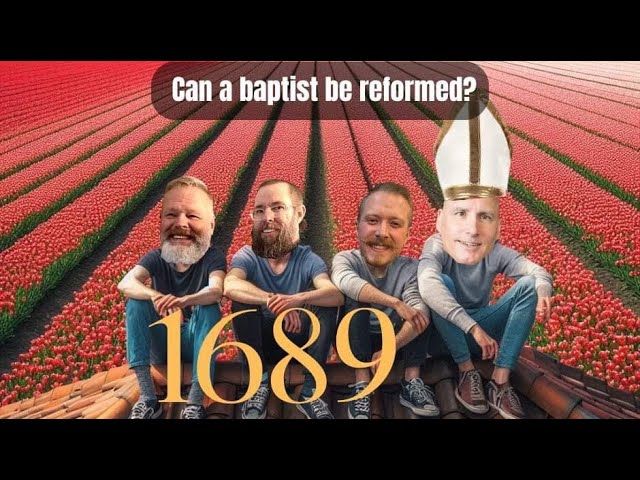
Join us as we ask the question, “Can a Baptist be Reformed”
Hopefully he can read it.
I'm not left, but this elephant won't fight. There's nothing left but the spotlight. Hold my beer, you can find me in the moonlight. You can say what you want. You can say what you want, what you want around me.
You can say what you want. You can say what you... I'm within the deep end and I can't find my assigned seat to sit in. My theology don't fit in. Black sheep of the reformation sheep pen. To the reformed, I'm just another Baptist baptized again.
The bastard child of Anabaptist. Host to child of reformation society. We don't need your education. Give me a Bible and a bookshelf of dead men. Cigars, bourbons, and beer cans. Bow ties, tattoos, and bearded men.
Making reformation great again. You can say what you want. You can say what you want, what you want around me. You can say what you want. You can say what you want, what you want around me. All right, ladies and gentlemen, welcome to Open Air Theology.
We are going to be bashing on Presbyterians tonight.
Hallelujah. My name is Jeff.
And I'm one of the pastors of Covenant Reformed Baptist Church in Tallahoma, Tennessee. And it is such a pleasure to be on here speaking with you tonight. And to hang out with these two brothers right here.
And it's really going to be bashing on one Presbyterian. But I'm going to go ahead and pass it downward to the Brayden Patterson.
Yeah, so I'm Pastor Brayden. I pastor in Hagerman at a church called Valley Baptist Church. We worship God on Sundays on the Lord's Day or the Christian Sabbath according to 1689. At 11 a .m. it would be a blessing if you live in southern Idaho to come meet up with us.
And just to worship our triune God together. I also have a YouTube channel called Reformed Ex-Mormon. It's a real blessing to be able to be on here with these brothers. And really looking forward to this conversation that we're going to be talking about with bashing on a brother in the faith.
But nonetheless, doing a little bit of defense after some bashing he did towards us as Reformed Baptists. So I'll pass the mic up to Brother Tom up here.
Hey, my name is Tom Shepherd and I'm a member of Grace Bible Church of Burney, Texas. And also there's going to be a podcast coming up soon. You guys might have seen it and I've sent you invitations to it.
Even if none, Reformed Evangelism. So join me there. Look for these brothers here too. And we'll reclaim biblical evangelism. Excited to be here.
All right. All right. Sounds good. So now that we got out of the way, the gloves are off. We're ready to rock and roll. So there's this guy, you know, you've probably heard of him. This famous Presbyterian.
His name is R. Scott Clark. And the crowd goes boo! Wait, who is it? R. Scott Clark.
I thought we were talking about R .C. Sproul tonight.
Oh, Lord. Come on, Lord. You need to repent. Look, R .C. Sproul is a Baptist.
That's right.
Yeah, I call him R .C. the Baptist.
Anyway, so one of our friends, you might know him, Keith Foskey, with his YouTube channel, Conversations with a Calvinist. Is that what it is? No, he changed it, right?
No, I thought it was still it.
You are Calvinist? I know that's what his favorite Facebook page is called.
Something Calvinist, right? And so he interviewed R. Scott Clark. And R. Scott Clark, he doesn't think that a Baptist can be reformed. And so I'm trying not to come at this with animosity. I'm trying not to get all streets on him.
But y 'all know how I am. I get a little out there sometimes. So please forgive me. If I need to repent, I'll repent later. But I've got to get this up. We, Corporate Lee, Open Air Theology, we've got to get this stuff off of our chest.
Because, well, I'll give you my thoughts later. Brayden, I'm going to let you take the mic.
I was just going to say we're trying to come at this without emotion. So we're trying to set our emotion.
I'm all emotions. I can't do anything without emotions.
Check it at the door, Jeff, and let's talk about this logically.
I brought me some snacks just in case I need to figure something out.
So, I mean, there was a lot of things that were said that were very and come to find out, I'm not a guy on Twitter. But my elder is, and he was informing me that there's some interesting stuff from this guy on the Twitter side of things.
And he is a lot more famous than what I realized. I didn't really know the guy, to be honest with you. And the thing is, is when you make flabbergasting claims, you better expect there's going to be pushback to it.
And so I'm just going to call him what I say he is right now, is a halfway Catholic. So that's what he's a halfway Catholic right now. So I don't even think he should be taking the title Reformed, to be honest with you.
So we'll get into that later. But anyway, if you guys want to take the mic.
Yeah, so one of the things it seems like he has an ax to grind with anybody who claims to be Reformed. And he had said he calls it the Young and Restless Reform Movement. Now, whoever that is, I'm not young, might be a little bit restless.
But anyway, he talks about if you believe in the doctrine of predestination, people are calling themselves Reformed, which I would probably agree. A lot of people say that they're Reformed because their doctrine of salvation is Reformed.
But what he was quoted as saying is we believe in a lot more than that, i .e. the doctrine of man, the doctrine of God, the doctrine of salvation, the doctrine of sin, the doctrine of church, the doctrine of sacrament.
The thing is we believe exactly the way he does in the doctrine of God, the doctrine of man, the doctrine of sin, the doctrine of salvation, all these things. But he had said that we don't have the claim to be called Reformed because we're Baptists.
So that's the issue he has.
Just to like, Brian, we will answer that question, but just to put this out on front straight, I didn't come up with the name, right? This isn't something that I came up with. This is something that I, whenever I first read this right here, the 1689, I was struggling.
Like I was a part of a Reformed Baptist church, and I was very, very MacArthurist, leaky dispensationalism, right? Like being presented with covenant theology from a classical view, I rejected it from the very beginning and still reject it today.
And it wasn't until this document got placed in my hands, and I read it, and I was like, this is gold. This is gold. And then it really started to transform my life, right? Like I didn't know everything that was laid out in a Reformed Baptist church until I started going to it.
And I didn't know there was like this big difference, like there was this infighting taking place between Presbyterians and Baptists. I didn't choose to be a Reformed Baptist, but I'm telling you that for my convictions, it is, excuse me, I didn't choose the name Reformed Baptist, but for my convictions what this document teaches is biblical, right?
And so like if we could get like a, you know, like a voting of hands between all Reformed Baptists in the world, and we can congregationally change it to something else, listen, I'm down for it. But if I start calling myself something different, people are going to start thinking that I'm a cult leader.
You see what I'm saying? Like we are what we are.
Yeah.
So his issue is that, well, and really he said the term Reformed Baptist didn't even come about until the 1990s. And Keith Foskey agreed. And that, you know, if you look back in history, that we would call ourselves particular Baptists, which he doesn't have a problem with that.
But he has a problem thinking that we're stepping on his heels. Matter of fact, I think the words he used was that, you know, you could live in my tent, but you can't come in my house. You know, you can't claim my house.
And so he said we were poachers.
Well, yeah.
He said we were squatters.
Squatters. Okay. Yeah.
I mean, if that was the case, we would be taking what they believe hook, line, and sinker.
Right.
And it's not the case. Like I was saying earlier, like if classical covenant theology, if I believe that that was biblical, I would be a Presbyterian. Like no problem. Like there's no way that I could be a Baptist and ho to classical covenant theology, like a lot of Baptists do.
In my line of thinking and the way that I study scripture, I want to be consistent. I don't want to have any problem passages. I want everything to connect. And what we're hoping to do is to show that those dots connect under Baptist covenant theology.
And we also should at least define what is, what does it mean to be reformed?
So Brian asked that question.
So there's a lot of different thinking on it. And so I would first articulate this in trying to defend what I would say that we're going to be defending tonight. Let me talk first about the term theonomy.
When we talk about the word theonomy, Jeff, what does theonomy mean in its truest sense of what the word, the epitomology of the word is? What does that mean?
God's law.
Is that what anybody in the post-millennial theonomist crowd means in a sense? Is that the only definition that they mean when they say that they're a theonomist?
Well, they say that, but then they add on to it.
All these definitions, right? That word has changed in its defining moments throughout history so far. And therefore I can't claim the title of being a theonomist, even though the words of those.
So gay first met happy. Jeff would say he's gay because he's happy.
No.
I don't use that word no more.
I've never.
So.
Happy is gay.
Happy is gay. Todd is gay.
With one D.
One D.
Since he's not on here, we can bash him.
We can make fun of him. So has has the term reformed changed throughout the years to now include Baptists? And I would disagree with that. I think when we're talking about reform, we're talking about the same definition of a word that was being used in the 1600s to distinguish Baptists and Presbyterians with each other.
And that's why the 1689 is worded in such a way as that. It's actually showing a fellowship with the Presbyterians in reformed theology, but is at the same time, just distinguishing them from Anabaptists and other sorts of Christians or non-Christians, other sorts of movements in that day.
And so reformed, we're trying to define reformed in the same sense. So it's not a changing of a word. It's not trying to expand this tent or stretch this canvas to meet our needs. We're trying to say that we are in every sense, covenantal, confessional, and Calvinist as what the Presbyterians were.
But our covenant theology is slightly different. It's still covenant theology and there's Presbyterians that would hold to what our covenant theology is, which we'll get into a little bit.
There's Presbyterians that hold to Baptist covenant theology.
I was listening to a Samuel Renahan podcast or not podcast, but thing earlier that we talked about. Right.
Oh yeah.
Well, John Owen's different because John Owen is congregational.
So there was a gentleman, what was his name? William Perkins who used the exact same words as the 16, almost a word for word, this exact same words as the 1689 chapter seven, paragraph three, and defining his covenant theology.
The point of why that I'm going at this, this is if covenant theology or reformed reformed theology could be defined as the big three Cs. And that's what's talked about in that podcast with, with, with Scott is that it's confessional, Calvinistic and covenantal is the three big Cs that define reformed theology.
And so in the 1600s, you had Baptists who were being lumped in to the radical movement of Anabaptists, which was a, which was a terrible radical movement of those time. And Baptists were trying to distinguish themselves by saying, we're not like them.
We're not like them. We're more like you Presbyterians. We, we hold very similarly. We have fellowship with you. We are not doing the radical things that the Anabaptists are, except us as these reformed brothers in the faith at the time in the 1600s.
So this is, this is not a changing of a definition. This is the Baptist of that day trying to say, no, we are too reformed. And the title that they took was particular Baptist, which included reformed theology.
Yeah. Yeah.
That's good. Like I would, I would definitely expand from the three Cs a little more. Like I would also say that reformed theology is not necessarily limited to,.
I mean,.
That law and gospel distinction is not necessarily limited to reformed theology. But I would say that in order to be truly reformed, you have to have a long gospel distinction. And yet there are many Presbyterians who hold the, the name reformed who, who, who, who would say that they are, you know, everything that the Westminster represents and they don't hold to a long gospel.
Distinction.
And so, and there's other things too, when you, whenever you talk about the solos of the reformation and I can dive deeper, but it's definitely more than the three Cs. But, but what we're saying is, is basically this, we are confessional, like our first confession came out in 1644 before there's, and then it was revised in 16.
So I wouldn't say the revised version is a new confession, like it was edited. It was just revised in 1646. And then in 1677, they wrote this document, but it wasn't published until 1689. But famously it carries the name, the 1689.
So I went back. I did a little history regarding Baptist, the general Baptist and particular.
First church plant was 1608.
Right. Yeah.
By John Smith.
Yeah, actually. Well,.
So I had it by that, that the particular Baptist and the, in the confession. So the general Baptist actually wrote a confess confession in 1611, 1651, 1666.
These, these are all confessions by the general Baptist.
Baptists had a, had a confession like you had just mentioned in 1644. And the first particular Baptist church was established by John Spillsbury of London. It was a particular Baptist church of 1633 in opposition to general Baptist and others.
And it says that in 1644, the Calvinistic anti-patel Baptist of London adopted and adopted a baptism by immersion as the only exclusive way to be, you know, to baptize people, adults, professing believers.
We're, we're talking,.
Our history goes all the way back to 1633 is the first established particular Baptist church. And they're saying we don't have a right to be called reformed.
I know.
Like we have a confession from the 17th century. We are Calvinistic and we are covenantal. And I would say that our covenant theology, the one that we represent brought to you last week, and we might touch on it again tonight.
I would say that it is the biblical superior covenant theology.
Yes.
Like show me one Presbyterian that can,.
That,.
That can refute the argument we made last week. Like I've spoken with a bunch of Presbyterian since, since I seen this revealed to me in scripture, since me and Brayden started walking through this.
And,.
And every one of them walked away with their mouth, either hung down, not knowing what to say or shut completely. There is no covenant of grace in Genesis chapter three. And if there isn't, then their covenant theology is false.
Baptists have, have had the superior covenant theology.
And yet,.
Even though we think their covenant theology is false, we still accept them as covenantal.
Hey,.
We still accept them as covenantal.
Brayden.
So Brian Anthony just said, reformed Presbyterians would argue that theirs goes all the way back to the.
Apostles.
You want to, you want to make her remark?
So,.
So I totally disagree with any Presbyterian that would state such.
I,.
I think actually the greatest argument for this is, is while reform theology is commonly defined as, as post-reformation in that sense, that's where it's really starting to be articulated. You see those five souls, as Jeff mentioned earlier, however, covenant theology extends far back, further than any confession ever named of it.
So one of the founding principles of covenant theology is that it's been one people of God throughout all of time, pre and post cross. It's the elect,.
Right?
That there's no distinction between Israel and the church, essentially true Israel in the church. I want to read a quote from Justin martyr, from his book called the dialogue with Typho, the Jew, he says in there for the true spiritual Israel, the descendants of Judah, Jacob, Isaac, and Abraham are who have been led to God through the crucified Christ.
So right here, we can, we can see that the early church was calling themselves true Israel. They had covenant theology in some shape or form or fashion. And that day in the very first century, second century of the church, they are articulating it, believing it,.
Promoting it.
However, what is another document from around that exact same time period? The did a K the earliest document that talks about baptism outside of the Bible and guess what? It teaches in their believers, baptism.
So the earliest form and earliest examples of churches practicing baptism that held to covenant theology is a Baptist.
It's a,.
It's Baptist by definition. And so if we want to talk about reformed and going back to reforming our theology, reforming our churches, reforming ourselves to individually to what God's word says, I'm going to look and see what the early church was saying about the Bible.
And I'm not,.
I want to go back to that. And guess what? They were covenantal and they were Baptists. And so I would argue that Presbyterians, if we really want to start claiming titles and saying, we can't, if you can't call yourself this and I can only call myself this, I think it's improper for a Presbyterian to try to claim the title of covenant theology.
Then at that point,.
Uh,.
Early church was covenant theology and they were all Baptists at that point. And according to the did a K.
You know, something else that we always, all of us always say as, as being reformed,.
We, we, we,.
We named the German, we call out and we say simple referendum, which means what always reforming, always reforming back to what the scriptures say. And so if that's the case, if all of us who are reformed hold to simple referendum on to always reforming back to the scripture say, then as the,.
As,.
As covenant theology develops, you should be able to include the reformed Baptist. It's just a development further on from the,.
From,.
From the reformers back from seven or 15, 17.
So how can,.
How can you say we cannot be reformed if we are always reforming? It's that doesn't make any sense.
I heard Jim Renahan speak on this as well.
And like,.
He's like, you can tell he's kind of aggravated with the same things that that's going on about the name and all this. He said that he wished that we could be called covenantal Baptist,.
You know,.
But, but,.
But,.
But the fact remains,.
You know, like,.
Like unless Baptist, like all the Baptist churches got together and are willing to change their.
Name,.
Like the church that I pastor, the name is covenant reformed Baptist church.
And so every, every one of these churches that have a similar name would have to rebrand if the vote went through. And,.
But it just doesn't make sense.
If I was just start saying,.
Like,.
If he was to ask me,.
So what denomination are you?
I was like,.
I'm covenantal Baptist. Like no one's ever heard of anything like that.
And so like this guy,.
Man,.
Like it just, and listen,.
I really like a lot.
Some of what our, our Scott Clark says,.
Like his, his law and gospel distinction. I think it's really good.
Like I think he,.
I think he's really solid in those areas, but I think that just refusing to accept us because,.
Because our,.
Accept, accept our name or accept us into the reform community just because there's just very little differences.
Like we don't baptize infants.
Our,.
Our church polity is different.
And, and, and,.
And our covenant theology is better.
That's just, that's just garbage,.
Man.
Like we're supposed to be known by our love for one another. And I think that where we can accept someone, we need to accept someone. Like he got me thinking about,.
All these churches out here, like assemblies of God, churches of God,.
Or,.
Or just named the, the different kind of churches that practice believers, baptism. Imagine if us Baptist were to say, hold up, you can't baptize someone as a believer. That's ours.
That's all.
We're bad.
Or imagine.
We're Baptist.
Or imagine if we walked up to our Presbyterian brothers who had someone to join their church as an adult. And that became a believer and they go to baptize him.
We'll say,.
Oh,.
He's a believer. Now you can't baptize them. That's us. We go to believers, baptism. You got to catch them as an infant. Like it's just garbage. And we would never do that because we want community. We want fellowship with our, with our Presbyterian brothers, but they seem to always keep pushing us away.
And if I'm not mistaken, that was the reason why the whole confessions were written in the first.
Place, right?
To get along.
And it's the Baptist who were trying to get along with the.
Presbyterians.
And it's, it seems to me also that the people that I think there was a distinction between, you know, some, so I think cheap Kiefoski holds the 1646, the edited version. He was talking about that. And I guess because he holds the progressive covenantalism.
What's interesting is we did a little research and James Renahan. Wrote an article on that, talking about there were four of the same authors or the, for the same churches that wrote the 1646 that, that signed the 1689.
So they were,.
It was the exact same. They were still covenantal. They still believe the same thing. It might not have been written, but they still believe the same thing. It was the same people.
And it was also, it's also speculated that those three churches that didn't sign the 1689 didn't because they ceased to be a church. And they probably joined into the other churches, the four that signed.
And so I would argue that all the churches that wrote that went on because it further developed what they were trying to articulate in the 1644 and the.
1646.
And as far as somebody asked, so are Presbyterians and they're not covenantal. I would argue that they are covenantal. I'm saying if I was to apply the same type of reasoning that, that Scott is doing, I would say that they're not because that's, that's what he's trying to do.
I mean, he went so far as a saying that Baptists shouldn't even call themselves Calvinists.
We will,.
But we wouldn't be accepted to go into Geneva and we'll, we'll get to it. But that's just ridiculous. That's a ridiculous claim. The Baptist can't call themselves Calvinists.
And just like what Brian was just saying,.
Brian,.
I appreciate that you said that we are a form that's really kind of your brother, but concerning what you said about sprinkling, you still like, if we wanted to be jerks or something like that, we would say,.
Yeah,.
But you're still sprinkling a believer,.
Because Baptist is a believer.
And listen,.
That argument, if a Baptist was ever making is absolutely stupid, it's absolutely stupid. We want to lock hands and arms with our brothers in the faith and,.
And concerning like the covenant theology issue. So we do believe that that Baptist covenant theology is superior. If we didn't believe that we wouldn't believe we wouldn't hope to the position.
All right.
But at the same time, we would still, we still recognize the Presbyterians as true covenantal, truly covenantal.
Even though we think it's wrong, we still think it's,.
It's still covenantal received.
It's still covenantal. And it's still received. It's Orthodox.
It's still Orthodox.
They still believe in some sense of a covenant of redemption, covenant of words, covenant of grace. They're just placing things differently and applying them in the ways that they worked and functioned throughout a redemptive history differently than what we are.
Same with a progressive covenantalism.
They may see the covenants differently, but they,.
They, they,.
They are confessional.
Yep. And,.
And I think the underlying, you know, one of the things that, that is, that we're all unified in is the doctrines of grace. And even progressive dispensationalists who hold to the doctrines of grace, even though they are not covenantal,.
Matter of fact,.
Opposed to covenantalism. One thing that we do have unity with them and Presbyterians is the doctrines of grace. And that affects a lot of how we evangelize, how we do church,.
How,.
How we get along with one another. We would disagree with the, how they, you know, what they believe as far as the covenant and in Israel. But other than that, we could still have unity and brotherhood and lock arms with them in terms of.
The gospel.
Which I really appreciate. So one thing I was going to say with the 1689, what you just were saying, talking about with Tom, I can't remember. Samuel Renahan also mentioned this gentleman in his, in his, his speech that he sent us.
His,.
His last name was Knight. I can't remember what his first name was, but he was also a signature that was to the 1689. And he, he would deny what we would commonly call 1689 federalism. He was saying that I believe there's one covenant of grace in two administrations, the old covenant and the new covenant and the new to old Testament, new Testament.
And guess what? He signed the 1689 and the chapter was worded in such a way so that he could be included Baptists. And that they were trying to not divide Baptists. They were trying to distinguish themselves from Anabaptists and trying to show we have community with the Presbyterians.
We're like you, we hold to covenant theology and we're willing to, to not divide over this.
And I,.
And I think it's through the Samuel Renahan said that there's nothing in the, in chapter seven of the, of the London Baptist confession of faith that a Presbyterian would not agree.
With.
It was written so that we would get along so that, that it would be vague enough. Now, once you get dive in deeper, there's going to be differences, but it was written so that you could, we would get along and have unity as brothers.
It just seems to me like,.
And I'm not saying this about all Presbyterians. Like I got some really good Presbyterian brothers,.
We lock arms. And one of them commented earlier,.
Greg. Yeah.
We love you,.
Greg. We still think you're,.
You're wrong,.
But we,.
Like we have a good fellowship with Greg and there's plenty of other, other brothers that we have good fellowship with, but to be a, a jerk about something like this and trying to push us away, it just shows their lack of unity,.
Like if a Presbyterian is in a foxhole and there's a, and there's this big old theology bash, guess who they're going to call and guess who will be right there with them in that box. So reform Baptist.
The problem is, is the way things are looking right now. If the reform Baptist were in a foxhole, a lot of the Presbyterians wouldn't come in that box with us. And that's garbage,.
It's garbage.
I agree.
Y 'all know I get upset. I'm sorry. I better start eating my snacks.
Calm down.
I get emotional.
You know, on that note, you had mentioned early on in the conversation that they had with, with Foskey,.
R .C.
Scott was talking about lawn gospel distinction. I wrote a little bit of it down and he was talking about the Luther Augustine spirit of the letter. And he was talking about the rich young ruler. And he wasn't saying do this and live.
He was saying, you don't know the weight of your sin. And so that the first use of the law was to drive people to Christ. We would agree. You know,.
The second,.
The civil use of the law was to restrain evil. We would agree. The third, the third norm of the, of the is, is the practice of the Christian life. Once we understand that we can't keep the requirements of the law or the limits of the law.
Now we could understand the gospel, the good news. That's what we need to build upon right there.
And then he goes, goes astray and says, but don't call yourself reformed.
Like I said,.
His law and gospel is really good.
Like there's a lot of guys like, like,.
Listen, if you're a reformed Baptist, you're Presbyterian. You need to get your law and gospel straight.
Because that's key to understanding the text, having covenant theology and understanding law and gospel.
It's key.
Like I wouldn't want to lock arms with ministry with someone who didn't have a law and gospel distinction. Like the law was not the gospel. The gospel is not the law, but in the law, there is good news.
And in the gospel, there are commands.
If you guys remember in minutes,.
It's if you guys,.
I don't know if we have a link to the video, but in minutes, 36, 15, he was, he was talking to, or that was when Keith Foskey announced that he, he held to progressive covenantalism, which is interesting because most NCT guys will not use the law in sharing the gospel.
And they just won't.
He will.
And Foskey will. But here was the interesting thing. He told them he was progressive covenantalism and R .C.'s, R .C.'s reply was,.
Well,.
It's just a matter of time because that's the kind of a hand out halfway.
House.
He goes, it's not a tent. That's long-term. It's not a tent. That's a long-term position. He's telling fast.
He,.
To his face that his confession that he held to since 1646, isn't valid. And I was like, Oh my gosh. And Foskey's face was like,.
He could come out of the video.
Oh my goodness.
No,.
It was not a kind thing to be said. I just want to point something out. In the comments that I'm reading on this, somebody, somebody asked what, what Presbyterian group are we talking about? And Brian responded,.
Reform,.
Reform Presbyterian. So Presbyterians have to try to distinguish amongst themselves.
What's.
So Presby,.
Let me,.
Let me pause here and just say, just because you baptize babies, that does not make you a reformed Presbyterian. Am I right?
So why is a Baptist? Why is a Baptist trying to say, I'm a reformed Baptist? What does that carry weight with typically? It means that you hold to the 1689 typically, and you're trying to distinguish yourself from general Baptists from dispensational Baptists from,.
Just leaky, leaky. John MacArthurites, just to be honest with you, you're trying to say, I'm really close in a lot of ways with the West minister. I'm really close to this reformed way of thinking that was found in the 1600s and the 1500s.
And so I appreciate that,.
That, that, those,.
That comment thread right there.
You see that comment that just came in. Shout out to all my black sheep brothers.
Information.
Yeah, the opening of this, the opening song that we have for open air theology, it speaks about how we are rejected. That's right. Reformed Baptists are the black sheep of the reformation. We hang out in the black sheet.
We hang out in the sheet pan.
We're bastard childs of the Anabaptists.
We know what people are saying about us. It's just like,.
I do evangelism here in a small, in the small town of Tallahoma.
I don't go to like downtown Nashville where I can witness to, or speak to a thousand people in an hour.
Like I witnessed in my own neighborhood and everyone in this,.
In,.
In Tallahoma, they know who I am. When I walk into a store, people are whispering. That's the guy I get my oil change.
Are you the guy that preaches on side road? Like people know who I am. I know that they're talking about me. There was a Facebook post about me last week when I was preaching people in the Tallahoma talk,.
They were,.
They were talking about me. I know what people are saying about me. Just like I know what the reformed are saying about reformed Baptist. We're not trying to hijack somebody's name. We walked into this.
If it was named something else I would, I would represent it hard, but it's not.
It's not.
Even lately, when you, when you look at, you know, in today's day and age, you have G3, you know, who extends, who extends their fellowship to be a G3 church.
Um,.
If,.
If you hold to most of the 1689, Linda Baptist confession of faith, you could be in their network. And so you have churches like progressive dispensational, John MacArthur,.
Right. Churches,.
A church that I tend, you know, as a member of that, because they quote unquote say that they hold to most of the 1689. Now there's there,.
You could,.
You can argue that.
But the fact of the matter is, is G3 has extended themselves and open themselves up and said,.
Let's band together in, and be united in the gospel. You guys hold to the same doctrine of God. This is the same doctrines of grace. If you can affirm most of the 1689 come with us, join us, let's lock arms together and share the gospel.
Amen.
Anything else on this before we move to the Calvinism portion of it?
I think history, it just proves itself that,.
That 1689 federalism, people that hold to the 1689 particular Baptist, they have every right to be able to claim the title reformed.
Absolutely.
No one really knows what particular means anymore,.
When I was a particular Baptist,.
They'd be like,.
It doesn't even represent.
It doesn't even represent what we believe. I think it was, it was, it was one of y 'all two brothers was talking to yesterday.
Like John MacArthur could rightly say that he's a particular Baptist.
Right. But not in the sense of the historical sense, but just as that name has changed, meaning he's Calvinistic,.
Baptistic,.
Calvinistic,.
Baptistic.
It means that it basically means that, you know, it's talking about the atonement. And that was the difference in the first bad, the general Baptist who believed in a general atonement. And then you had the particular atonement that would, you know, that Christ died for his elect only, you know, not for everybody in the world.
So particular Baptist, that title isn't sufficient at conveying all the doctrine that's found in the 1689 and all the ways that it also associates with the 1646 west minister.
Is that correct?
1644,.
Excuse me.
And I think that's funny because like, when we get into this Calvinism conversation here in a minute, because like, this is what was what and connecting the dots for me. He says that we can call ourselves particular Baptist, but the particular they're speaking about the atonement, which is Calvinism.
You said I'm saying, but he's saying that he's coming after the name Calvinism as well. He doesn't want Baptist to associate themselves with being a Calvinist, but we can call ourselves particular, which is speaking about the atonement,.
Which,.
Which is Calvinism,.
The limited atonement.
And I don't think I, I honestly, and I mean, correct me if I'm wrong, was the term Calvinist used back in the 1700s or back in the 1600s? That's a new term as well.
It's fairly new.
I mean, Calvin,.
I mean, nobody in the,.
Nobody, nobody in the 1644 was calling themselves the Calvinist.
Dude,.
How cool would that have been if John Calvin was calling himself a Calvinist? Like I'm brain, I'm a brain in this.
The apostle Paul was a Calvinist.
It's true.
If someone claims a provisionism, I call them a latinist.
So that's right.
This is,.
This is weird.
I call them a Noel. They're a Christian Calvinist.
Noel.
Like where, where do we draw this line that individuals trying to be able to say, I can claim titles over another group of individuals that have the same.
Title.
Like.
Kind of arrogant.
Could I say that the visible church, is it made up of professing believers and who have taken the sign? And so since I define the, the visible church in the way of believing and baptized, could I say that Scott really isn't a part of the church?
Like I'm going to take back the term church. I'm just, it's mine. Now you don't get to use that word. Don't ever say that you go to church on a Sunday anymore. Like that's the type of logic that I see him applying with this.
And it doesn't, I don't think it pans out. I really don't.
Well, well,.
His attitude.
Good.
I was just, you probably remember this Tom. His argument was, was that there was a group of Presbyterians after, was it world war one or world war two where the Presbyterian church was dying out.
And so,.
And like they made an agreement with the Baptist. You can call yourself reformed if you call us Christians or whatever. It's like people were already pushing out the Presbyterians. And so they were supposed to make this handshake agreement that,.
We'll let the Baptist call themselves reformed. If the Baptist will acknowledge that we're Christians. And that's kind of what was taking place in the 16th century, because if you were Baptist, you were being persecuted.
And so the Baptist wanted to align them, align themselves and have fellowship with, with the Presbyterians knowing that they're Christians.
And our document is very,.
Very,.
Very similar to theirs. There's only a few spots in here to where we, we make it better.
Wait,.
It's new and improved.
It's new and improved. It's always reforming.
Greg says that we should call ourselves peculiar Baptists.
And I like that.
We're all peculiar. We're all a peculiar people,.
That's right. That's right. That's right.
I, I,.
I appreciate what Brian is saying and Braden, Brandon, excuse me. There's a lot of Presby's who do not align with our, our Scott Clark. I appreciate hearing that. I don't think that I squared away on a lot of things.
Even my, my friend of mine, Matthew Everhart. So he's made some videos where he was talking about how Baptists are not, are not reformed. But whenever he interviewed me about the Bible rebonding, I was like, you better acknowledge me as reform.
I was doing my thing and he's like,.
You're reform,.
You're reform. Like I'm trying to get through some people like,.
Listen, I'm just not the guy that you want to,.
I'm just,.
I'm, I'm,.
I'm like,.
I'm a Christian, but don't push me.
You know what I'm saying? Like, I love,.
And I love Matthew. Matthew is probably, probably since, since RC Spro has passed away, I would say Matthew Everhart is my favorite Presbyterian. If you haven't checked out his show, please go check out Matthew Everhart's YouTube channel.
So I, I just recently, I got asked my top five theologians,.
And one of those people I put down was John Calvin,.
I am a Calvinist because I'm confessional and I believe in covenant theology. That's what's led me to believe in the five points of Calvinism. That's typically what somebody means when they believe in Calvinism.
They're saying, I believe in the five points of Calvinism. Tulip,.
I have an interesting question for you,.
Jeff,.
Because I would say no to this. If John Calvin,.
So the, the,.
The statement that was made in that, that show was John Calvin. Wouldn't allow us to live in Geneva. And that's a reason why we can't even claim to be Calvinist because we couldn't even associate with Calvin himself.
I would push back and say, I would let John Calvin come to my church, but he's not preaching.
I would let him preach.
I want it,.
But I wouldn't listen.
Listen,.
Hear me out. Hear me out.
I would let John Calvin preach. No problem. If he wasn't baptized as a believer, he wouldn't be able to take the Lord's supper.
So that was that question too. I wouldn't let him preach. I would let him come.
Now I know we might have different opinions on that and that's fine,.
But I'm just trying to be consistent with what I say that I believe. And I put it out there. I put it out there.
So that's, that's one thing too. Let's say, let's establish too that, that our confession is great as it is. It's not the final word. It's not the ultimate authority.
I agree with that.
Correct.
The Bible is our final authority.
Chapter one lays that out.
Chapter one of the confession lays that out.
I'll tell you when I'm reading through the Bible and then I go read John Calvin and it says something different than I think I'm like,.
Okay,.
What did I do wrong?
I mean, that's immediately what I do. It's because,.
So of course I would let him preach at my church.
Of course I would let him. I want it because you know what?
I know he's going to bring up baby baptism and that's not being preached behind my pulpit,.
Dude.
If he promised me, if he said, Hey Brayden, I will not speak about infant baptism. I'd be like,.
All right,.
You can preach,.
But I know he's going to do it. He's watching. We need to call him out real quick.
You should have told our Scott Clark that we don't play, but we don't play. I mean,.
I'm not,.
But I heard him say that.
Bring it. My mom's getting gangsta,.
Son.
So is that, so let's say it could,.
Can a, can a group call themselves reformed without one of those three C's?
Even though,.
Even,.
Even though they're,.
They,.
They hold to their doctrine. Salvation is the doctrines of grace. Can they be called reform?
Can John McArthur be called reform?
When I got some,.
He called himself.
I love John.
I love John McArthur. I love John McArthur. He's just recently said something that, that I think we need to do a show about pissed me off if I'm going to be honest with you. And I still love him, but I think, I think he needs to retire.
I need to get him out of the pulpit. Cause all he's doing is say,.
We can talk off air,.
But well,.
You know where he's talking about those mental illness and PTSD. Like there's no,.
Listen, I got PTSD and,.
And you know,.
Like I don't take anything for it. Maybe I should, but you see how I'll be tripping.
I did.
I did see that, that there was,.
I'm going to tell you right now,.
It's easy to say something like something like that when you ain't, you've never been in a war. Or if you ain't never been in,.
Had a real tough upbringing. But I think that we should do something about that as well. I really do. I'm not going to let what he says deter all the stuff that he's done in.
The past.
That that's not how I wrote, but I do think that that brother should be removed from the pulpit. Cause when the people start getting too old, they start saying some crazy stuff.
Yeah. I haven't,.
I haven't listened to the message yet, but that is, that is absolutely wrong. Is, is PTSD come about from a fallen nature?
A lot of things do, but that doesn't, that doesn't mean it's not real. I don't know exactly the context of what he's saying, but being a firefighter and, and going on some of the calls that I've gone on.
Absolutely. It is absolutely.
I got kidnapped at a, I got kidnapped at 11, molested robbed at gunpoint at 14, beat up real bad, joined a gang, live the life of gang violence. I had two drive-bys pulled on me.
Like this stuff or stuff like that, you know, like at 14 years old, I'm walking around carrying a steel pipe in my, in my right side back pocket and carrying a 45.
Like I'm, I'm wondering,.
And I don't know what happens to me again.
I don't, I don't know what the context was, but I'm, I'm wondering, and just giving John McArthur the benefit of the doubt. I'm wondering if he's talking about the actions of, of people that have,.
He says that it just relates to sin. Like all this is just that they're refusing to repent of sin.
And that's, and that's my, that's what I was going to ask.
Sorry.
Even let's say if a person has gone through a traumatic experience, and this would be a good show. Even if a person has gone through a traumatic experience,.
They are,.
They are still called to, to be obedient to Christ, to be 100 to please Christ in,.
In all their life.
So, yeah,.
I'm called to keep God's commandments.
So our,.
Just because we,.
We,.
We've been traumatized, doesn't give us a right to act a certain way.
100%.
So let me give you an example of how PTSD can play out in it, in a non-sinful way.
After this, we got to get off PTSD. We can do another show on it.
For sure. I just,.
As an example though, like call, I go on very traumatic incident happens there,.
There's people that I know that cannot drive by that house anymore. Because of what is reminded in their mind, their way of living has changed. And now they purposely take a different route when driving through that area, because they cannot go by that house.
Nothing sinful about it, but that incident has made it. So in their mind, they cannot go back there without having some sort of response inside of them given because of it.
Right. So it's,.
It's what they learned real quick,.
Jeff.
I want to touch on this. So if,.
If a, if a,.
If a little toddler walks outside and sees a, a Cobra,.
Underneath a,.
A,.
A water fountain. And he's not afraid of it. He's not afraid of it. Cause he's never seen a snake. It's never entered his mind. He's never learned anything about that creature and everything.
So he's not going to respond to it. He doesn't know it's dangerous. He doesn't know anything about it, but as soon as he sees something that, that snake kills something or other next time he walks out, he's going to take caution because of what he's learned and everything.
And so when things happen to us, still at the same point, does it give us a right? Is it, is it right for us for that to trigger it?
It's,.
You know, our mind to, to be cautious over it,.
But it,.
It shouldn't, it shouldn't create us to cause us to act in a sinful manner.
You have something. I said,.
We ain't gonna talk about it. Now we are. All right.
We're taking a little short segment here. So PTSD, you have what's called fight or flight,.
And so when you get put into a situation, it's either fight or flight. When I became a Crips, like before I became a Christian, my whole life was violence.
That's all I knew. I got trained in martial arts. Most of my whole life,.
Like that was the one thing that I did outside of gang bang and that I just.
Enjoyed.
I enjoyed martial arts.
And mixed martial arts and all that good stuff. And I was really good at throwing him hands. And when I became a Christian, I was no longer allowed to throw hands.
And so, and so when I would get into an altercation, whether it be theological or whatever, it may be right. A disagreement.
My,.
My initial was to throw hands.
Sure.
Fight or flight.
And if I,.
And if I get that feeling and I,.
And I was like,.
I can't throw hands. I'm a Christian. I can't be doing this. So I would run away from all my problems. Anything that I couldn't settle.
I would just use them. A conversation. I would just run away from it. And most of my Christian walk was me running away from everything. And it wasn't until I,.
If you know what happened to me in 2000. 17. I came, I came down with banal positional vertigo. And so every time. So every time I changed from one position to another position, if I'm sitting or standing, if I'm sitting down now, if I stand up, I'll get dizzy.
If I'm standing up and I sit down, I get dizzy. My vertigo is bad. Anytime I changed from one position to another, I get dizzy.
So my PTSD, the doctor says would kick in as I was getting dizzy and it would cause my brain to shut off. And I would pass out like there's some days my wife will walk. It hasn't happened in like two years, but she'll walk in here and I'll be passed out on the ground.
Before I got dizzy, my PTSD kicked in, my brain shut off and I'm just passed out on the floor.
But you wouldn't say that was sinful behavior.
Let me finish. Let me finish.
Okay.
So once I realized that there was something mentally going on inside of me that was causing me to run away from everything, me being a fighter saw that there was a bigger fight to fight. And so now when I get that feeling to run, I do not run.
You see,.
Because I know that it's something mental in me that's telling me to run.
Gotcha.
Now what helps me with my PTSD? I said earlier, I don't take any kind of prescription or anything like that. And I don't, because what they gave me for the PTSD, it caused me to see things that wasn't there.
Like I saw, like I was 37 at the time,.
Again,.
X game banger. Like I was just,.
Like I ain't scared of nobody.
I saw a little bitty kids running around my bed, laughing of this medicine they gave me. And I could hear guys beside my wife's bed talking.
I was like, man,.
She got some guys over there.
Like I was just tripping.
You didn't have PTSD. Now you have it.
I called the doctor.
He told me not to take that medicine. And so what, now what I do is I use CBD,.
That little CBD.
I take the little,.
The drops, the gummies, whatever it is. And it keeps the PTSD from freaking out. When I get dizzy. There's no side effects. I don't see little kids running around my bed. You know what I'm saying?
House would be jealous of you because he would think those are midgets that are running around. He'd get all excited and happy.
He would be happy.
Anyways,.
I do not run from anything now.
Which is why we're doing the show.
Earlier,.
When I was talking about covenant theology was all arguing back and forth.
Like I was like, forget it. Let's just have a conversation. So I hit the call. We FaceTime and we argue.
Back to the 2016. Before I would have never made that phone call. My heart would have been pounding so hard because I'd be afraid that you make me mad. I just want to get in a fight with you.
But once I realized I had that, I knew it was a bigger fight to fight. And that's my wife. My whole life has changed since realizing this.
And I think our lives mostly change, but the, you know,.
The,.
The word being in our life, you know,.
In the,.
In the transforming power of the Holy Spirit and the power of God's word. I mean, thank God we have that Calvinist. He wants to take away. He wants to take away us being called or us calling ourselves Calvinists.
My heart.
R. R.
Scott Clark. If you're watching this, come get it. Come and get it.
Say,.
When, say,.
When,.
Bro,.
When I can be here.
How to tell you anyways,.
Going back to the particular, we can be particular Baptist, which is speaking about being Calvinist, being Calvinistic, but we can't call ourselves Calvinist. Like it's very inconsistent. And if something is biblical, like if something is biblical, why would you want to take that away from us?
If being reformed is biblical, why do you want to take that away from us? So being Calvinism,.
Calvinist,.
Biblical, why you want to take that away from us?
You want them to deform us.
Instead of unite with us in,.
In being a Calvinist. Why would I, you know, I go to other Baptist churches around here and, and they're all general atonement,.
Pat,.
It's like,.
There's just no fellowship there.
There's,.
There's none. I want you to be a Calvinist. I want to explain the doctrines of grace to him. I want to talk to him about Tula.
Like, let's just, for example, I don't like the way that I would like, look at this is. So the 1689, let's say it's 94 in agreement with the West minister word for word. I don't know the exact percentage, but let's just say it was, that would be like saying,.
Since that,.
That 5%, that 6 disagrees with the West minister, we're just going to claim all the words of the West minister. And you can't use any of those words. You can't use any of them. And so since John Calvin was also baptizing babies, but you're claiming the title Calvinist because of the soteriology, I'm just going to take that whole word from you.
And you can't say it at all because we hold to a more pure form of Calvinism.
That's ridiculous.
That's what I've been trying to say. What I've been trying to articulate this whole time is this is not how we claim titles and terms.
It's not going to go home.
It's mine. You can't use it. If you don't hold them, I exact same for you. You can't have it.
So tomorrow's my birthday. I appreciate that gift,.
Bro. That's funny.
I don't know what y 'all have to say.
I would argue. I would argue that Baptists actually do a better job at baptizing babies. Do you want me to tell you why? Let me say it again. Baptists do a better job at baptizing babies. Because we're born again, children of God.
And then we're baptized. We do a better job at baptizing babies. I'm sorry to tell you that Presbyterian. You're trying to baptize them when they're still in the womb. You're still trying to circumcise when they're in the womb.
You're trying to give the sign why they're in the womb. You got to let them be born again. When they're in the womb, profess faith and then receive the sign. We are Baptists are being born. Baptists are baptizing babies in the faith.
Boom.
Because whenever you're born again, you are an infant in the faith.
Whether you like it or not. And that's what we were talking about last week.
A lot of qualifications there.
You can't just say that and then leave.
I'm leaving.
The Baptists get to claim the title baby. We're just doing it right. You can't say that. We're baby Christians. We're infant Christians when we first get born again.
We got it.
It's ours. It's our turn now.
David, we love you, brother. We ain't right. Listen, there's a reason why we're called the Black Sheep of the Reformation. I'm serious. If there was a bunch of Reformed Baptists around me and they were a gang, we would start a gang, a biker gang, called the Black Sheep Gang.
For reals.
If Jeff and I ever have the privilege of living in the same town, we are definitely going to start a biker gang.
Leather jackets.
It's a fact.
All right. Let's see.
What other questions did we have?
Did we have anything else in that video that we wanted to address? Before that, I'm not technologically savvy. We're trying to figure out. I hit a switch today that allows my brothers to see everything that I'm seeing.
It will allow them to figure out the stream yard system to where we can play people's YouTube videos and kind of walk through them and stuff like.
That.
The reason why we are not doing that tonight so that you can hear for yourself what R. Clark Scott said on a Kefalski show is because I just figured it out today that I could share that with them. It's up to Brayden and Tom here to figure out how to put their videos on here now because I'm just not the guy.
I'm not the guy. Hopefully in the future, whenever we bring up other videos, you'll be able to get the context and hear what they're saying, and then we can respond.
To it.
Other than that, was there anything else in that video that you can.
Remember?
That's why I don't like it whenever we don't have the video because then we're just going by memory of what was said.
They talked about a lot of stuff. The biggest things were the reform and the Calvinist statements. He also talked a little bit about sermon length time.
I'm about 55 minutes average.
He was like 130 minutes, he said.
He was like an internal timer goes off at 29 minutes to wrap things up.
I'm just getting started at 29 minutes.
Look, we can make the argument that you're not truly a reform preacher unless you're preaching over, right?
I mean, Pearson was going three hours, bro.
How long were they preaching back then?
How long were they preaching when the confessions were written?
Two hours.
Oh, okay. No, no, no.
At minimum.
Scott can only claim to be a quarter.
I mean, he's telling me.
At minimum, it was two hours.
He almost sounds Southern Baptist.
Like they used to say, if a preacher couldn't preach for two hours, he wasn't worth his salt and weight, however that saying goes. If you couldn't preach a two-hour message, you weren't worth your salt and weight, your weight and salt, whatever.
However, you know how it goes.
That's right. I would just say on Brian's point, again, I want to make this very clear in what I was saying earlier. I would be more than happy to preach at a Presbyterian church if they said, don't preach on baptism.
I would not preach on baptism, and I would preach a gospel-centered message, whatever the text pointed to. But likewise, if Calvin was at my church, he would be allowed to preach, but it wouldn't be with infant baptism.
It would not be allowed.
Well, it wouldn't be able to violate any of the statements of faith.
That's absolutely right.
You would let him preach on Calvinism. You would let Joel B.
Calvinism.
Calvinism. Amillennialism. That's right. You would let him preach on things that we agree on. That's right.
Just as long as you let Durbin preach on post-meal theonomy.
Nope.
And I would let him preach in my pulpit, just not on my pulpit.
We preach from the Bible, not stupid ideas, okay?
And I have to say, hey, keep it at an hour. Keep it at an hour. We got food cooking. All right. Now, if you're new to this channel, you're probably like, these guys are nuts, and you would be right. And for those that don't know, so we adopted Tom here.
So Tom is officially a part of Open Air Theology.
Yeah, glad to be here.
Whenever we see him at the next conference, we'll beat him in. Yeah, I got to go.
I got to walk the line, right?
You got to walk the line, yeah. We're going to smack him with Bibles as he goes through.
I mean, that's not fair, because Rappaport, he's a martial artist. You, if you keep Foskey as a black belt, I'm going to get whooped.
I'm going to teach you some Mormon hand signs on how to get into the behind the veil, and that's how you do it.
You can barely even see your hand.
I walked into that one, gosh dang it.
I used to be a Columberland Presbyterian. My oldest daughter, Trinity, she was actually baptized as an infant.
Time out.
Here's a good question for you guys.
Don't change the subject.
What?
Jeff's a Presbyterian.
No, I used to be a Presbyterian.
How dare you?
Let's not forget that word, used to be a Presbyterian.
I'm questioning this now.
What is the one verse, if you can narrow it down to one verse, that keeps you from holding to Presbyterian covenant theology?
What would it be?
Genesis 3, verse 15. There's no covenant. There's no inaugurated covenant. There's only a promise of the covenant. And if only the endemic covenant is the covenant of works, and all the other covenants, Abrahamic, Mosaic, and Davidic, are an administration.
Also, the new covenant is an administration of the one covenant, the covenant of grace that's found in Genesis 3, verse 15. Then that Genesis 3, verse 15 better be an inauguration, and there is no inauguration.
If Genesis 3, verse 15 was the inauguration, I'd be a Presbyterian. I agree with that.
There isn't a covenant in Genesis 3, verse 15. That's a promise of what will be done in the means of the covenant of grace with the seed, destroying the stepping out or crushing the head of the serpent.
The text that I would go to is the very text I preached on at the conference, Hebrews 8, or Jeremiah 31, 31 through 34. It's very clear in there that that is the covenant of grace. It is told us that it is the new covenant, the covenant that was inaugurated with the blood of Jesus Christ, in chapter 9, chapter 10, chapter 11.
However, the issue with the Hebrews 8 is it says it's a new covenant, not like the old covenants, for they were full of fault. So why were they full of fault? Were they full of fault because God was involved?
No, they were full of fault because man was involved, and there was required obedience, therefore making them a covenant of works. When you read the entirety of that Jeremiah 31 through 31 through 34 text in Hebrews chapter 8, there is no involved obedience in the covenant of grace.
That's what makes it grace, unmerited favor. It was mediated by the better mediator, enacting on better promises, Jesus Christ. Through that mediation of that mediator, through the Christ, he is inaugurated, he is brought about, he is instituted the covenant of grace that requires no obedience from myself.
That sounds a lot like what the gospel involves, right? The life, death, burial, and resurrection, all the work of Christ, no work of myself. It's a law gospel distinction that needs to be made regarding covenants, and that's what the covenant of grace is.
Tom, I know you want to answer this question as well, but can you also answer Brian's question?
Yes, a promise is a promise. That is not a covenant. The covenant is a binding agreement, a binding agreement. So I would not say that a promise is a covenant. A promise is a promise. A covenant is a covenant.
I would also go, Hebrews 8 with Brayden, and I would also go to Romans 8. It said that everybody who is in the covenant has to be bought by the blood of Christ, basically, and I don't have it with me here.
I need to look it up. Give me a second.
While you're looking that up, I would also point to Galatians 3. In Galatians 3, it speaks about covenants, and it tells us that basically, speaking of the law, that it was added to the Abrahamic covenant, and that they, the old covenant, was only until Christ.
It's an argument against theonomy, and it's an argument against the administrations of the covenants existing. If it was only until Christ, then the new covenant comes, but how can it be a different administration if it was only until Christ?
It would still be continuing after Christ, but since it said it was only until Christ, that means everything that came before the new covenant is over. It's ended. It's ended.
So if I were to narrow it down to one verse, it would be Romans 8, verse 9. It says, however, you are not in the flesh but in the spirit, if indeed the spirit of God dwells in you. But if anyone does not have the spirit of Christ, he does not belong to him.
So the only ones who are in this covenant, in the new covenant, are those who belong to Christ. It's not a mixed congregation. Not a mixed congregation like the Jews, like the covenant was with a nation where there was a mixed group of believers and unbelievers in there.
The only people who are in this covenant are born-again believers in Christ, and this is why we baptize people upon professional faith.
And that's why what is the significance, the historical significance of Jesus Christ saying be born again to Nicodemus? It only adds weight when we understand that is being spoken to a Jewish individual who is looking at his heritage of being a child of Abraham for his hope in a covenantal standing.
Jesus looks at him and he says, hey, you got to be born again. This first birth of yours doesn't mean diddly-squat when it comes to salvation. It doesn't mean anything. You have to be born again, and what is that being born again into?
You can't even see the kingdom of God. What is the kingdom of God? It's the kingdom that Christ inaugurated that is full of the people that are a part of guess what covenant? The old covenant, the covenant with Abraham, the covenant that was physical, the covenant that Jesus told Nicodemus you must be born again?
No, it's the covenant of grace.
That's what God is speaking about. And again, going back to the rich young ruler, he wasn't saying do this. He wasn't giving us the Ten Commandments so that we might be justified by the works of the law, right?
Because the Bible says by the works of the law, no flesh will be justified. And so we can't present ourselves righteous by our performance, our good works, or anything that we do, only by the blood of Christ putting on our account, only by his righteousness, not our own, can we be made right with God.
Hey, Brian, I don't know if you watched last week's video, but we walked through covenant theology and somewhat compared the two. And you'll be able to really see from last week's video or if you go to my church's Facebook page and listen to my message from last week concerning John 10, I walked through what a covenant is.
A covenant is imposed upon us. It's forced upon us by God. That is a covenant. It's not something that we agree to. It's something that's forced upon us. And if a covenant was a coin, and I can take you through Abraham all the way to David, all those covenants, and I can take you that if it was a coin, on one side you'll see the inscription do this and live, and on the other side you will see the inscription do this and die or do this and stay in the land.
When a covenant is made, if there is no do this and live or do this and die and be removed from the land, it's not no covenant. Now, the Abrahamic covenant, so in chapter 15 it starts, but it's not actually finalized, I would say, until chapter 17.
The stipulations on the covenant isn't given until chapter 17. So you have anywhere between 10 or some people say even 30 years between 15 and 17. But in that covenant made with Abraham, you have God himself, I would say it's a pre-incarnated Christ walking through as a burning, as a flaming torch in a fire pot.
I think it's what it is. Yes, it's a Christophany. And then in chapter 17, Abraham, I would say, as well as his descendants were to walk upright and circumcise their children. And if they don't, they would be cut off.
And so you have the do this and live. If you don't do this, you'll be removed from the land, cut off from your people. Every one of the covenants, I can take you all the way through it and show you those things taking place.
That is not taking place in Genesis chapter 3. It's only the promise of the covenant pointing to the new covenant that Jesus makes in his blood. This is the blood of the new covenant. And when he bruises the head of the serpent while only bruising his heel.
We also have to have a covenant head. There has to be a covenant head if it's going to be a covenant. Abraham was the covenant head. Adam was the covenant head. So if there's no covenant head, it's not a covenant.
So if the king falls, so if you look at Adam, and he is our federal head of all of humanity, it's just like if we have the president, for example. I mean, Joe Biden, like it or not, he's our president.
If Joe Biden goes to war, we all go to war. If Joe Biden loses that war, we all lose that war. So the covenant is made with the federal head. And so we are under that covenant head.
Yeah, our federal head took the curse of the old covenants. Cursed is every man that hangs upon the tree. Christ became that curse. He was treated as that curse. He took the wrath of those that he had mediated the covenant of grace on behalf of and fully paid.
He was the full substitute, the full propitiation for our sins. That's why we're Calvinistic, and that's why we're covenant theology.
So as y 'all may know, so once a year, we have a conference, the Open Air Theology Conference. Now, it's not going to be the next one, but we're hoping to have one. So the next conference is going to be called War, and it's going to be focusing on war against the spirit and the flesh.
So sanctification. But we also want to have one on war focusing on covenant theology. We want to have a conference to where we have Presbyterians and Baptists, Reformed Presbyterians, Reformed Baptists all present their covenant theology.
And their reasons for why they baptize and who they baptize and don't baptize. And then on the last day, have about two or three debates on the subject. This is something that we're hoping to do within the next three years.
Now, we are willing Baptists. We're just looking for willing Presbyterians.
We ain't scared. You know what I'm saying?
Let me run something by you. This is something I was thinking of when you were talking about that Christophany earlier, Jeff, when we were messaging with each other on Genesis 12. Is that it? Is that a great text that shows the foreshadowing of the hypostatic union?
So let me explain. So when God passed through those two animals, he did not take the curse on him right there. But he's demonstrating I'm the one that's going to pay for the curse that you are going to be that you are deserving Abraham.
Right. I'm going to pay for this. Right. So God is the one that does that. Right. But then later on in the promise, it's a seed, a physical descendant. Right. A seed. So physical. Yet God is spirit. Is that a great example of the hypostatic union?
God becoming flesh, taking the payment, the price.
Yeah, absolutely. Yeah, yeah, absolutely. And it represents him paying our fine. Right. Right. We could not keep the covenant. So he came, kept the covenant and died as a covenant breaker. Absolutely.
We broke God's law. He paid our fine by sending his son, Jesus Christ.
And it just goes back to that hope that the Old Testament saints had. Even the garden had hope in her seed. Abraham had hope in the seed. Isaac had hope in the future seed. David had hope in the future seed.
It was always looking forward to what Jesus Christ was going to fulfill.
He was going to institute the federal head that he was going to be.
Even though they didn't know what it looked like. And I had a matter of fact, I want to say it was Kim Riddlebarger who explained it like this. That when you see a mountain range from 100 miles or out, you know, all you see is one ridge.
And it's going to go on the camera. All you see is one ridge doing this. But as you move closer and closer and closer to the mountain range, you see layers, layers of the ridges, just mountains and mountains and mountains going back further and further and further.
So what you saw from far off wasn't clear and everything. And that's what Abraham saw. It wasn't clear to him, you know, and that's what, that's all he knew. But he believed he had faith, you know, and now that Christ has come, everything has been fulfilled or that's been fulfilled.
And so we trust in Christ. We look back to Christ for salvation. They look forward to the cross. Everything meets at the cross.
So, so this past Lord's Day, and I'm going to be bringing it up again this coming Lord's Day. I mentioned it as imagine looking, trying to look out of a window. But this window is covered in mud and it's on the, it's on the other side of the window where you can't get to it.
And I said, now imagine I had some Mr. Clean on my thumb and I stuck my thumb to the window and removed it. And so you could see only as big as my thumbprint was. You can see clearly. And as that, and as you read the Bible and you see that seed, that covenant of grace and that seed that's been passed through all the other covenants.
God is in one sense cleaning that muddy window with his hand. Right. And then you get to the New Testament. You get to Christ and you get to the epistles. And the next thing you know, you have a fully clean window that you can see.
Right. That's good.
And that's how I see it playing out.
Brian.
He has to get another good question.
He has some good questions.
He goes, do you believe the Old Testament states have the Holy Spirit? I'll answer this. I have no idea what my friends are going to answer, but I'm going to say that one of the things that the promise of the benefits of being in the new covenant is having the indwelling of the Holy Spirit.
I will send you a comforter and everything. So I would say, no, they did not. But I think maybe, maybe, you know, there might be some exceptions to the rule. But the indwelling of the Holy Spirit comes and you become a born again believer in Christ.
Yes. I would say that they experienced a similar regeneration outside of the indwelling. I think that in the Old Testament, we have we have evidence that the Holy Spirit would come upon them.
But I don't think that they had it embodied within them like we have, because at the time, the spirit of God was was pictured as embodying the tabernacle and then embodying inside of the Holy of Holy in the temples.
Right. The God of all eternity who wants tabernacled and who wants tabernacles and tents and temples now tabernacles in us. But when you read the Old Testament, you would see that it would come upon them, but it would not stay with them.
I would argue that's the same thing that we see with John the Baptist. I would argue that that's why we are greater than John the Baptist, because we have the Holy Spirit. But I do believe that they experienced some kind of regeneration because in regeneration, you receive the forgiveness of sins and you receive faith to believe.
So share my screen.
Those two outside the other one.
Share my screen real fast. I appreciate hearing you guys say that.
Just yeah.
OK, so I was able to do it. So this is what Tom was talking about with with this idea of a mountain range. Right. You can't see how many miles are between this this mountain, that mountain. You can't see how much land is between this hill down here as there is between that mountain range.
You can't tell how far away this bush is right there. It all looks like one picture right there. And so when the prophets, they were looking forward to the seed, they couldn't tell in fine detail all the ways that Jesus was going to fulfill all these prophecies.
But they knew he's going to fulfill. They believe they look forward.
I'll hit stop sharing now at this point. But that's something I've struggled with is how exactly we've we've argued. I've argued back and forth with. I do think there was some sort of regeneration because I don't think there was leave in God be reckoned with righteousness without regeneration of some kind.
Right. You are right there. Ezekiel, Jeremiah, there's promises that are future that were only post cross promises. And it appears that the indwelling of the Holy Spirit is one of those things.
So I think would there be a distinction? And he brought up in numbers and talking about Joshua was filled with the Spirit. Is there a difference in that? And I think there is with the indwelling of the Holy Spirit.
Yeah, there's a difference between being filled with it and then being indwelled with it. Like we are indwelled with the Holy Spirit. But we are so we're still supposed to ask God to be filled with the Holy Spirit.
Whenever I go up to like I have the Holy Spirit in me right now. He is in here. And when I go up to that pulpit, like like like as they're reading that last portion of Scripture, if you're ever at my church, as I read it, you'll see me freaking fall face down on my Bible.
And I'm begging God to feel me in this moment with His Spirit to speak to His people. I see and even John MacArthur and a lot of reformed guys would agree with me on this, that there's a difference between the indwelling and being filled.
And so we see that the Holy Spirit comes upon people.
Yeah, you look at you, you look at, you know, how God, how God was with the people in Israel as they came out of the wilderness. You know, it totally different. And it was a type and shadow of what would happen in the new covenant, the better covenant.
Now we have as believers have the Holy Spirit indwelling us. You know, this is what makes it possible that we are no sin no longer has power over us because we have the indwelling of the Spirit, you know, because we've been regenerated.
Is it the power of God to regenerate Old Testament saints?
Is it the power of God to make them alive?
That's the way God saves. You know, we know that through Scripture.
You figured it out, didn't you, Brayden?
Just wait one second. Don't have you shared it yet?
I got to figure it out, guys. We're squared away on all this now.
I know that you could figure it out, man.
I'm a smart guy.
Go ahead and share it. I think I think it's time that I got to get going. I've been away from my family all day, but I just want to. I want to point this out real fast. So here's this brother in Christ, R. Scott Clark.
We are not kicking him out of the kingdom. However, can we claim to be reformed?
Can we claim to be Calvinists?
Brayden, did you? So I'm just curious. On your end, did you can you see that too?
I can. I figured out a way.
Okay. Yeah.
Can y 'all see yourselves over here on the side?
So Keith Foskey, great brother in the faith. Funny guy.
Super, super funny. Hilarious. Scott, you need to stop trying to claim titles that aren't yours to claim. You live in the 21st century. The 1689 was trying to do the very thing that you were trying to continue to push them away.
From.
The 1689 was trying to show fellowship. You were trying to distance Baptists from being able to do the very thing the 1689 was seeking to and aiming to do. And that was to claim being reformed.
Moses said we can't kick him out, but we can certainly throw hands.
We can throw bottle verses.
Love it.
That's awesome.
Y 'all got anything else to say?
Yep. Yep.
If anybody's watching and does not know Christ, repent and believe the gospel. Repent and believe. Don't trust in your own righteousness to be reconciled unto a holy God. The mountain is too high to climb.
Trust in the personal work of Christ alone for eternal life. Call unto him. Repent of your sins. Turn away from your sins. Forsake your sins. Turn towards Christ and follow him daily and ask him to save you.
And he will. He promises he will. If you place your faith in him.
Baptists are better at baptizing infants. I'm just saying. Born again. Children of God. They're infants in the faith. They're drinking milk. We're baptizing them before they're eating meat. So, yeah. Be born again.
If you aren't. Be baptized. Take the sign of the covenant and go join a local church.
And yeah.
Hey, everybody.
We really appreciate y 'all watching. We really appreciate the interaction that y 'all give us. We love going live. We don't want to just film this and then send it out here because we. I think the interaction with the messages and stuff like that are just.
I wouldn't want to do it without it, in my opinion.
I like to hear what people are thinking as everything is going on. I like the disagreement. I like the camaraderie in our disagreement. I really appreciate y 'all watching.
And if y 'all have any.
Ideas of something that y 'all want to see us do, please. Message us. Put it on here or private messages, whatever it may be. But sometimes I think the hardest part about doing a podcast or what we call. We call ours a show is just figuring out what to talk about.
So if you have any ideas or something that you want us to tackle, please let us know. But outside of that, if you're ever in Tallahoma, please come check out Covenant Reformed Baptist Church and listen.
Do not miss the next Open Air Theology Conference. Like, I don't know what you're doing with your life.
Come on.
We just added somebody else. It's a fun time.
Anyways.
Come check us out. Hallelujah.
Hollaback.