Keep sharing good news without ads.
In this sermon, Pastor Jensen continues to discuss what love is and how great God's love is toward us.
The podcast episode can be found here:
1 John chapter 4, starting in verse 7.
Hear now the inspired word of God. Beloved, let us love one another, for love is from God, and everyone who is born of God and knows God. The one who does not love does not know God, for God is love. By this, the love of God was manifested in us, that He has sent His only begotten Son into the world that we might live through Him.
And this is love, not that we loved God, but that He loved us, and sent His Son to be the propitiation for our sins. Let's pray. Father, once again, as we prepared to look into Your Word, we ask that You would prepare our hearts, that, Father, that You would cleanse our hearts, churn up the hard ground, that we would be able to see, hear, and understand what You have to say to us.
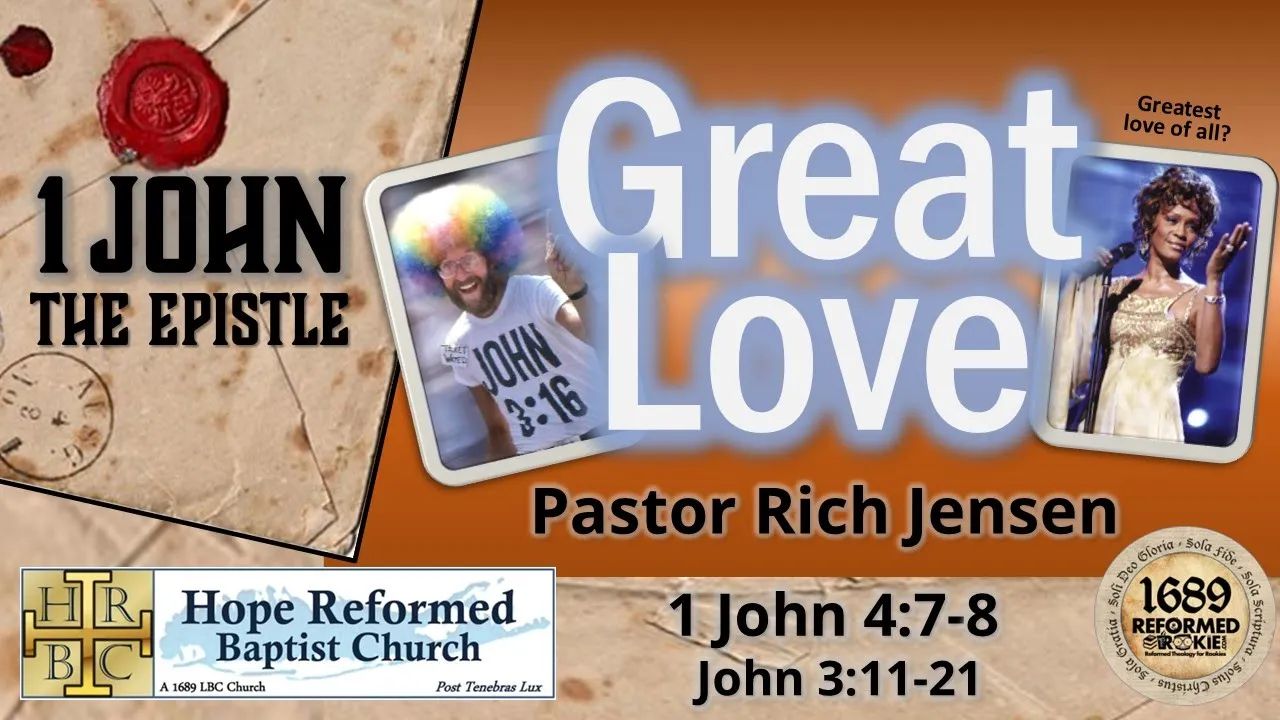
And that by hearing and understanding, that we would be conformed to the image of our great and Savior, Jesus Christ. It's in His name we pray. Amen. Please be seated. During the 1970s and the 80s, if you watched any of the major sporting events in that era, there's a good possibility you would see a man wearing a rainbow wig, holding a sign that said, John 316.
His first major appearance was at the NBA Finals in 1977, but then he compared, continued for a number of years, showing up behind the goalposts at NFL games, behind home base during the baseball All-Star game.
He actually made appearances at the Indy 500, and during a golf match at none other than Augusta National. He was quite unique and was very adept at getting his sign. He knew the camera angles and would always position himself so that he would be on camera.
But he isn't the only one that has used John 316 in somewhat unusual ways. The In-N-Out Burger chain in California at least used to print on the bottom of their cups John 316. The Forever 21 chain printed it on their shopping bags.
And of course, who can forget the Heisman Trophy winner and controversial person, Tim Thiebaud, who put it on his face with eye black, John 316. Without question, John 316 is one of the most recognized verses in all of scripture.
It's one of the first verses that Sunday school students are asked to memorize. It could very well be, I don't have anything to back this up, but it could very well be that it is the most preached verse in all of scripture.
It's been called the gospel in a nutshell by some. And there's good reason why it's so popular, for it contains some of the most basic truths about our salvation in one short, concise verse. But because of these same facts, it's quite often taken out of context and oversimplified and sometimes even downright misinterpreted.
And as with the rest of scripture, it must be preached in the context of the whole passage. Now you may be asking, we're studying 1 John 4, aren't we? How did we get to John 316? Well, the answer is quite simple.
We're in the middle of the epistle of 1 John, and we've come to chapter 4, and we've read these two verses in particular. Beloved, let us love one another, for love is from God. And everyone who loves is born of God and knows God.
The one who does not love and does not know God, for God is love. And then in verse 9, the love of God was manifested that God has sent his only begotten son into the world, that we might be saved through him.
So you can see the relationship of the two passages of scripture. These two verses, 7 and 8 of 1 John 4, are just packed with rich and important truths. And we've kind of pitched our tents, metaphorically speaking, and camped out on these two verses for a number of weeks.
I think it's four or five weeks now. We spent two weeks examining the encounter of Jesus with Nicodemus. And then we looked at the relationship of, you must be born again for entrance, in fact, even to understand the kingdom of God.
And then last week, we examined what biblical love is, its importance and its description. Today we're going to examine just how great this love of God is. And this is a necessity because we are commanded by scripture, and in these verses in particular, to emulate the love of God.
That's where John 3 .16 comes in. Because right in the middle of the encounter with Jesus and Nicodemus, which is an important encounter in scripture, we find John 3 .16. Now what has happened so far in this encounter?
Just a quick recap. Remember, Nicodemus has shown his utter inability to grasp the concept of the new birth. And Jesus has rebuked him. He said, are you the teacher of Israel and you don't understand these things?
And Jesus then proceeds to impress upon Nicodemus the authority that he has as the Messiah. He says, he's the only one who has come down from heaven. And he's testifying about things that he has firsthand knowledge to.
And then he gives him another analogy from the Old Testament. He talks about the bronze serpent, how the bronze serpent was lifted up. And in crystal clarity, he explains to Nicodemus that just as God was the one who saved the Israelites from those poisonous snakes, but only if they exercised faith by looking upon the bronze serpent.
In that same manner, he says, so must Christ be lifted up and become the salvation of mankind. And that's the context we find John 3 .16 in. And the context of the entire dialogue is simply this. God is sovereign over salvation.
Only he can save through the new birth and the power of the Holy Spirit, because of the love of the Father and the obedience of the Son. This passage clearly shows the Trinitarian work of God in saving mankind.
And these verses are an excellent summary of this great work of love. But to begin, we want to look at this very carefully. For John 3 .16 begins with one little word, for. And it's an important word, because it shows the connection between all that was said beforehand and what is coming next.
Jesus has been explaining to Nicodemus how one is saved. It is by the new birth and that by the power of the Holy Spirit only. And he asserted, don't try to figure it out, because the Spirit is like the wind.
He doesn't tell you how he's going to do it, doesn't tell you why he's going to do it. And that's an important one. He doesn't tell you why he saved someone. But you can know his motivation for saving anyone.
For God so loved the world. Love was the motivation. The reason that anyone is saved is because of the love of God and for no other reason. It's not a love that mankind, that we, can even understand this side of heaven.
Look at the text again. Look at John 3 .16 again. For God so loved the world that he gave his only begotten Son that whoever believes in him shall not perish but have eternal life. The wording is interesting.
For God so loved. Not merely loved, but so loved. That's a good translation, but sometimes it can be misleading. What it means is, in this manner, or exactly like this. It anticipates what is to follow and that is the giving of that which is most precious to God.
His only begotten Son. And so this love is the greatest love. And it's not only here that we see this concept expressed. The Apostle Paul describes love in this way in Ephesians 2 .4. But being rich in mercy because of his great love with which he loved us.
I like that title. Great love. Well, you would expect nothing less, would you? Because he is a great God. If we understand the character of God, we should expect and express that his love would be the greatest love of all.
With all deference to Whitney Houston. I'm sorry, but that is not the greatest love of all. It's not even close. The love inside of me. Brothers and sisters, you don't want to look inside of me. And I don't mean physically.
The greatest love of all is not to love yourself. I want to remind you once again just how important theology is. Theology is merely the study of God. You start asking questions about God, you're studying theology.
Just a question of you doing a good study. And the more we study God, the more we come to understand his greatness. He is the most glorious, majestic being that there is. He is the first cause of all things.
And everything he does is the best because he is perfect in all that he does. You know, we studied Daniel about a year ago or so. And I know I constantly refer back to Nebuchadnezzar. He's one of my favorite people in scripture.
And we won't get into that why. But no one said it better than Nebuchadnezzar. You remember the story. Nebuchadnezzar was bragging about all that he had accomplished. He looked at all the glories of the kingdom of Babylon, which was magnificent.
And what did he say? Look what I have done. And of course, God caused him to lose his mind. Just to show him he became from the king of kings as he's called in scripture. He became like a beast of the field.
But then, God had mercy on him. And I love this portion in Daniel chapter 4. Daniel writes, but at the end of the period, I, Nebuchadnezzar, raised my eyes toward heaven and my reason returned to me. And I blessed the most high and praised and honored him who lives forever.
For his dominion is an everlasting dominion. And his kingdom endures from generation to generation. All the inhabitants of the earth are accounted as nothing but he does according to his will in the host of heaven and among the inhabitants of earth.
And no one can ward off his hand. Or say to him, what have you done? At that time, my reason returned to me. And my majesty and splendor were restored to me for the glory of my kingdom. And my counselors and my nobles began seeking me out.
So I was reestablished in my sovereignty and surpassing greatness was added to me. Now, oh and I love verse 37. Now, I, Nebuchadnezzar, praise, exalt, and honor the king of heaven. For all his works are true.
His ways are just. And he is able to humble those who walk in pride. Throughout all of scripture, we find that God is the greatest in every respect. So it only follows that his love would be the greatest love of all.
Let's look at some examples of just how great the love of God is. First, it's an infinite love and an eternal love. And they're not the same thing. Being infinite means without measure. Paul prays for the Ephesian church in his letter to the church in Ephesus in chapter 3.
And the prayer is interesting because it's almost self-contradictory. Almost. He prays that they may be able to comprehend with all the saints what is the breadth, length, and height, and depth. And to know the love of Christ.
He's praying that they would be able to know the love of Christ, which then he says, which surpasses knowledge. That you may be filled up with all the fullness of God. We are to strive to know the love of God, but it's beyond our ability.
Paul is praying that you would know more and more about God's love every day in your Christian walk. That you would seek to understand his love as much as your finite mind can comprehend the infinite.
But in the end, our minds are too small for us to fully understand. There's an old hymn written around the turn of the last century, not the 21st century. And the hymn writer sums up these thoughts of the love of God.
I'm just going to quote a few parts of the verses. The love of God is greater far than tongue or pen can ever tell. It goes beyond the highest star and reaches to the lowest hell. And then he continues in the second verse.
Could we with ink the ocean fill? And were the skies of parchment made, where every stalk on earth a quill, and every man a scribe by trade. To write the love of God above would drain the ocean dry. Nor could the scroll contain the whole, though it stretched from sky to sky.
And then he breaks in to refrain, oh, the love of God, how rich and pure. How measureless and strong. It shall forevermore endure the saints' and angels' song. So God's love is infinite. But his love is also eternal.
Remember, God is love, is what the scripture tells us. Love is not just a part of him. He defines what love is, and his love is from all eternity. A great professor of theology, Louis Burkhoff, says this.
Since God is absolutely good in himself, his love cannot find complete satisfaction in any object that falls short of absolute perfection. Now keep those thoughts in mind. Because in them you will see the absolute necessity for the atoning work of Jesus Christ.
And that's what John is relating to us in this verse. Because God's eternal love for his people, because of his eternal love for his people, it necessitated the sacrifice of Jesus Christ. You know, sometimes we sing choruses at the beginning of our service and sometimes sitting around the fellowship table.
But there's a little chorus that expresses this thought. How deep the Father's love for us, how vast beyond all measure, that he should give his only son to make a wretch a treasure. His love is infinite.
His love is eternal. Second, it's an unchangeable love. One of the great doctrines of scripture is the immutability of God. And immutability means unchanging. God does not change. And this is clearly taught in all the scripture.
Beginning when God reveals himself to Moses. Remember when he's sending Moses on the mission. And he's explaining who he is. In Exodus 3 .14, God said to Moses, I am who I am. And he says, thus you shall say to the sons of Israel, I am has sent me to you.
God is who he is and there is no changing, no becoming. He is who he is. We see James express that same thought in James 1 .17. Every good thing given and every perfect gift is from above. Coming down from the father of lights with whom there is no variation, no shifting shadow.
And in fact, to show just how important this doctrine is, God says to Malachi in Malachi 3 .6, For I, the Lord, do not change. Therefore, O sons of Jacob, are not, therefore you, O sons of Jacob, are not consumed.
Therefore, the love of God is unchanging. Just like every one of his attributes. And remember, because God does not consist in parts. Has no body parts. He is one God. And since he is love, that means his love is unchangeable.
And as he says in Malachi, that's a good thing. Because if I could change, you would be consumed. Think about that. It's the unchangeable character of God that prevents even his people from being consumed.
Let me quote Professor Birkhoff once again. He says, He does not even withdraw his love completely from the sinner in his present sinful state. Though the latter sin is an abomination to him, since he recognizes even in the sinner his image bearer, at the same time he loves believers with a special love, since he contemplates them as his spiritual children in Christ.
And the unchangeable nature of his love is seen in the election of his people. In Ephesians 1, starting in verse 4, the Apostle Paul says to the church, Just as he chose us in him before the foundation of the world, that we would be holy and blameless before him, in love he predestined us to adoption, as sons through Jesus Christ to himself, according to the kind intention of his will, to the praise of the glory of his grace which he freely bestowed on us in the Beloved.
So his love is great. It's infinite. It's immutable. But third, it's giving. Now this really goes without saying. It should. For at the heart of biblical love in general is that it is a giving love. In fact, that's an essential attribute of love.
And that's clearly seen in the present passage of John 3, 16. For God so loved the world that he gave his only begotten son. The love of God for his people mandated that he do something for them. Those whom he loved from before the foundation of the world could not be allowed to remain in their sin.
And so he gave the greatest gift that could ever be given. His only begotten son. And that's the pattern for us. Notice the way the text says it. For God so loved the world that he gave. Paul puts it in a slightly different way.
In Romans 5, he says, but God demonstrates his own love towards us. And that while we were yet sinners, Christ died for us. Notice that giving is a demonstration of true love. Love is not static or sedentary.
And God demonstrated his love. And that while we were yet sinners, Christ died for our sins. He gave us the greatest gift which met our greatest need. And that is the pattern for us. We are called to love like God.
The two great commandments. Love the Lord your God with all your heart, soul, mind, and strength. Love your neighbor as yourself. And then in the Sermon on the Mount, we're told, oh, by the way, love your enemy.
If you're a Christian, you are called to love just like that. Husbands and wives. Question for you. Are you loving each other in that way? Parents and children. The love goes both ways. Are you loving like that?
Church members. Are you loving other church members in the same manner that Christ loves you? Christian love is to be manifested in real, tangible ways. In forgiveness and patience. In practical ways such as helping and giving of your time and effort.
God's love for his creation demanded that he do something. And that was to give the greatest gift which met man's greatest need. Look again at the text. For God so loved the world that he gave his only begotten son.
Oh, by the way, I don't mind quoting this over and over again. I hope you don't mind hearing it. That he gave his only begotten son. It only follows that the greatest love of all would bestow the greatest gift of all.
And that's exactly what the text tells us. The gift, of course, is the only begotten son. Now, we've spoken of this before, but there's much confusion, even in the church, as to what that phrase means.
The problem comes because we have a tendency to think of begotten in terms of physical generation. Especially in biblical terms when we see what we affectionately refer to as those begat passages. You know the ones you always skip over.
How many times do you skip over the begat passages? Don't do that. There's a lot of rich theology. I know a man who was saved by reading the begat passages. All scripture is profitable. But back to the text.
This phrase has led some people to assert that Jesus, at some point, came into existence after the creation. He was begotten. But, of course, that flies in the face of the clear theology of the Bible as a whole.
Jesus Christ is the second person of the Trinity. He is eternal. He has no beginning. He has no end. He is fully God in every respect. He was not begotten in incarnation, but is eternally begotten. The Greek term that is used for begotten is monogenes.
Which literally means unique, one of a kind. And while we become sons of God through adoption, through the work of Christ on the cross, Jesus is unique, one of a kind, the one and the only one. And here is an extremely important point.
The love of God that we have already spoken of this morning is given unto us only because the love of God that he has for his only begotten son. He loves us in Jesus Christ. Remember the context of this verse.
It is the gift of Jesus Christ entering humanity and paying the price for sin that allows men to enter into the family of God. That's what Jesus told Nicodemus. Unless one is born again, he cannot see the kingdom of God.
It is the regenerating work of the Holy Spirit that allows men to receive the gift of the only begotten son. And apart from this work, men will never accept even the teaching of the substitutionary atonement.
That's exactly what the problem was with Nicodemus. Remember in verse 11, Jesus says, Truly I say to you, we speak of what we know and testify of what we have seen, and yet you do not accept our testimony.
The greatness of the gift of the son can be seen in many ways. So we're going to examine just a few of them this morning. First, it meant the taking upon himself humanity. Just sit back in a chair for a minute.
Think about this. The eternal son of God. Very God. Condescended to take upon himself the limitations of human flesh. He became a true man. Fully man, yet still being fully God. Can you even imagine what that means?
The theologians call that the beginning of his humiliation. The only thing that I can think of that comes close to explaining a little bit, and it's so poor I hesitate to mention it. If you were born into a family where you had all the riches you could have, all the power, everything was at your whim, and then you became homeless.
It's not even close. So he took upon himself human flesh. He became one of us. Second, he came into his own and his own received him not. This one really has to hurt. We see in chapter one of John's gospel, he came to save his people.
And they rejected him. The very people that needed him the most. The ones to whom he entered into covenant with. The nation that he had chosen from all other nations. And when they had gotten themselves into the biggest mess they could have found themselves in, he comes to them and offers salvation and they refuse.
And even when a Gentile ruler tries to reason with them and say, I find no fault in him. They rejected him and cried out, crucify him. Crucify him. And what did Pilate say? His hand, his blood is not on my hands.
Even he recognized the folly of it. And what did they say? His own people. May his blood be upon us. And on our children. And then right to the very end of his ministry, they plotted against him. And then plotted against his disciples.
And they rejected him. The greatest gift of all. Third, he was the greatest gift because he took the sins of his people upon himself. He who knew no sin became sin. He paid for the price of sin. Not for his own, because he never sinned.
And he suffered the death of a common criminal on the cross. And he took the wrath of God in place of his people. Can there be any question but that the gift of Jesus Christ, given by the Father, is the greatest gift ever given.
Now we could spend many more hours just discussing why Jesus is the greatest gift. But the text gives just one more reason at this point. And that is simply this. It's the greatest gift because it brought about the greatest result.
What is the result? Eternal life. But notice that this result, the gift of the son, eternal life, is conditional. It's based upon faith. Whoever believes are the one to whom the gift is efficacious. This is an important point.
So before we look at the greatness of the result, we must examine who are these whoever believes. And to do that we must go back to the world that God loves. What does it mean that God so loved the world?
Well in one sense, even as we read from Professor Burkhoff, it can be said that God loves the whole of creation. Because all humanity retains the image of God even though it's tarnished and shattered.
Jesus has been telling Nicodemus that entrance into his kingdom, receiving eternal life, is not based upon being an ethnic Jew. Nicodemus was an ethnic Jew and he tells him you must be born again. And back in chapter one John has told us, but as many as received him, to them he gave the right to become children of God.
Even to those who believe in his name. Who are these people? Well we're not left in the dark. Who are the people who believe? John 1 .13. Those who were born not of blood, nor of the will of the flesh, nor of the will of man, but of God.
Those who are born again. Those who have been chosen by God. And these people are now to be chosen not just from the Jewish nation, but from the whole world. And on that basis, whoever believes him shall not perish, but have eternal life.
And we see this come to fruition in the ministry of the Apostle Paul. And this makes it so compellingly clear. In Acts 13, verse 47, Paul is speaking to the Jews and he says, For the Lord has commanded us, I have placed you as a light for the Gentiles, that you may bring salvation to the end of the earth.
Notice what he's saying. Paul was given specifically to the Gentiles. Most of us are Gentiles. He says that you may bring salvation to the end of the earth. Well, we kind of live in the end of the earth.
We are on an island. And when the Gentiles heard this, they began bickering among themselves. And. Oh, no, that's not what it says. When the Gentiles heard this, they began rejoicing and glorifying the word of the Lord.
And as many as had been appointed to eternal life believed. And so the whosoever is all those in the world upon whom God has set his love and gave them to Jesus Christ. And that's the context for the world and whoever believes in John 3, 16.
So Jesus Christ has the greatest gift because those whom he saves shall not perish. You know, people do not like to speak about hell. They don't like to speak about eternal damnation. But you cannot speak about salvation without coming to grips with these doctrines.
The fact is, whether you like to think about it or you put it out of your mind. The reality is that apart from Christ, everyone perishes. And let me clear something up here. When when Jesus says perish, he doesn't mean that you cease to exist.
That's a fanciful doctrine that has become in vogue as of late. But has no basis in scripture. To perish in a biblical sense is to remove to be removed from the mercy and the grace of God. And be subject to the wrath of God for all eternity.
Jesus Christ described it as the place where the fire is not quenched and the worm doesn't die. It's an eternity removed from anything good. And it's only through the gift of Jesus Christ that anyone is delivered from that fate.
Eternal life. This is truly an amazing thought. People from every tribe, every tongue, every nation will be saved and have eternal life. And by the way, eternal life is not merely life without end. And that's part of it to be sure, but only a part of it.
We are told that all true believers will have no part in the second death. That's eternal damnation. But it's much more than that. We will be brought into the eternal state as sons and daughters of the Most High God.
With all the blessings associated with such a position. Even the angels will be subjected to us. All the anguish, all the heartache of sin, gone. All the disease and illness will be banished and erased.
Boy, will our prayer list be reduced. The love of God, the love of the people of God, which can be difficult on earth. I thought I might even get an amen on that. It's the reality, isn't it? But all of the people of God will have perfect love for one another.
There will be no sin. Nothing to get in the way of our worship of the Almighty God. Imagine perfect worship. There are times I wish I could sing. But I struggle, so I keep it low so you don't hear me.
Whenever I go and preach someplace, I always make a deal with the sound man so that he cuts my mic when we sing. But imagine perfect worship. Imagine the heavenly choirs. It's unimaginable. But one of the greatest blessings will be that we will have an eternity to communicate with our great and awesome God.
Perfect communication. Everything about God is infinite, eternal. There will be no boredom in heaven. We will constantly be amazed as we get to know him more and more. Why? For God so loved the world that he gave his only begotten son, that whoever believes in him shall not perish but have eternal life.
You know, that simple verse says so much. It's a shame that the man in the rainbow wig turned out to be somewhat less than he appeared to be. He wound up being arrested on rather bizarre charges. Ended his career.
He's no longer the John 316 man. But because of people like that, John 316 has often become a catch phrase for those who are wacky. It's also a shame that the most memorized of all Bible verses used to promote poor theology has now been defamed.
But none of those are reasons for us to abandon the verse because it contains some of the most profound biblical truths in all of scripture. And in a simple and in a straightforward manner which supports our text in John chapter four.
So if you're here today and you are a believer, this verse is not only great comfort but a source of great encouragement. It reminds us that the special love God has for his children is nothing short of amazing.
It is the greatest love of all. It is the reason we are saved from perishing and receive the gift of eternal life. The love of God is eternal, infinite, the greatest love of all. And as we have seen in past studies, the love he has for us is the same love that he has for his only begotten son.
Now there's a thought for you. How much does God love Jesus Christ? He loves you in that same love. The love of God for us is eternal, infinite, the greatest love of all. And this should motivate us to strive to love just as he has loved.
Think of how patient he is with us. How forgiving he is with us. Jesus Christ is the sympathetic Savior who understands our weaknesses because he was tempted in every way just as we are yet without sin.
Oh, what manner of love the Father has given unto us that we should be called the sons of God. If you're here this morning and you're not a believer, you have heard the gospel very clearly, very simply.
Jesus Christ was sent into the world to save sinners. He did so by sacrificing himself on the cross of Calvary. That sacrifice is only applied to those who believe and repent of their sin. Today is the day of salvation.
Repent and believe. Let's pray.