Keep sharing good news without ads.
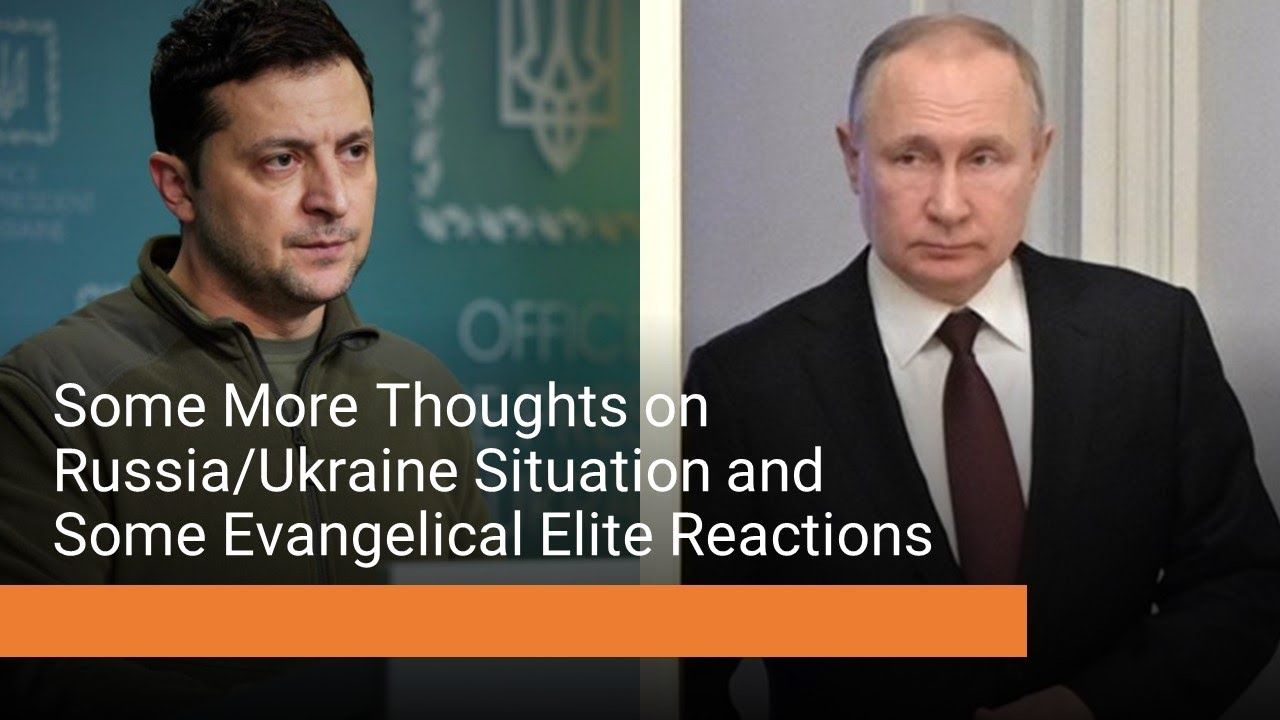
Jon follows up on his video from yesterday on the situation in Ukraine and talks about Russell Moore, Karen Swallow Prior, and the ERLC's Response.
Welcome to the Conversations That Matter podcast. My name is John Harris. It is a snowy and sunny day here in upstate New York. We were supposed to have a blizzard yesterday and it ended up being a mild snow storm, which is good.
No one really wants a blizzard. Maybe some kids out there who want to go sledding or something, but it is beautiful. The sun's shining today and I might even go for a walk a little bit later in the snow.
I know maybe I'm weird that way. Not everyone likes that. You know what I should do, and I thought about this, cross-country skiing. I saw someone doing that the other day and I thought, man, that really actually looks pretty fun.
I do downhill skiing. I have at least in the past. I haven't this year. I really need to, but I never got into it. I never knew anyone who did it, at least that I was aware of. That's something maybe for next winter.
I don't know, but I'll go for a trudge, a little walk in the snow later hopefully if the time allows. I wanted to talk today a little bit about some of the reactions to this Ukraine situation that I have been made aware of on social media from some evangelical elites, which I found interesting.
We're going to talk about the ERLC. We're going to talk about a few tweets. I think it's necessary every once in a while to remind everyone of why I talk about these things, why you listen when I talk about these things.
It's not for shock value. It's not to just beat up on people, certainly. It's definitely not because we don't have maybe other things that are important to do because I know I do. It's not to be sensational.
It's not to feel superior about ourselves. These are all things that I think I sense and sometimes I see someone like myself can be accused of as well as you for listening. That's simply not the case.
None of those things are true at all. In fact, people just don't know. I think semi-regularly about other things that would be in many ways, and I'm not saying in every aspect, but in many ways more rewarding and more fulfilling than talking about errors and not just, as we'll talk about today, not just deep theological errors because those are certainly the most important, but just the political jostling, positioning, the strategy that's being deployed against you, common people in your churches.
Many of these evangelical elites, your pastors in some cases, or pastors you may know in your community now, former pastors for some of you, they listen to. They listen to these people. It gets filtered down.
That's really why we talk about it because these narratives, some of which I'm going to talk about a little bit today, they get filtered down. They ended up arriving at the pew level. They're sometimes used to batter, and I'm speaking very figuratively there, but rhetorically batter those of you who are conservative politically, who are orthodox in your theology.
I talk about these things to explain why there's an error there or how you should perhaps respond, give you some ideas. That's the main reason we do this kind of thing. We want to defend the truth. We believe in the true gospel.
We believe in Christian ethics. We believe in objective truth. We want to defend those things, those things that we love, and of course the tangible things as well, our home, our church, our identity that's been given to us by God, the fact that we're a man if you're a man, the fact that you're a woman if you're a woman, the institution of marriage and family.
These are important things to us, and so we defend them when we sense that they're being attacked. I wouldn't consider some of the things I'm going over today to be certainly. They're certainly not the most egregious things we've talked about on this show, but I think they are worth, I think, mentioning, and hopefully this will help you as things are unrolling for me about this whole Ukraine situation, and I've done a lot of reading on that even yesterday and trying to just figure out more and more what's going on.
By the way, I should say this, if you haven't listened to the previous episode on my opinion about the situation in Ukraine, that's not on social justice in the church, but I just give you a window into this is how I'm thinking about it, that may be a good episode to watch because I'm not going to reinvent the wheel on this podcast, and there may be things I say that you think, wait a minute, hold on, that's not what I'm hearing in the mainstream news media, and it's not.
I'm certainly not buying the narrative that's being spun out there in the mainstream, and of course, a few people have accused me of, well, that must mean you're pro-Russian, and that's not true either.
I'm certainly not Vladimir Putin's, on his side, in believing everything he says and thinking that he's a bastion of truth or that his motives are pure as the driven snow or anything like that. Far from it.
I have what I would think would be a very healthy suspicion of him, but I have a healthy suspicion, and this is where I get in trouble. I have a suspicion of our State Department and of the narrative being spun by our media right now, and I just don't think that the full truth is being told to us.
In fact, I know the full truth is not being told to us in some circumstances, so you're going to want to, if you're curious about any of that, go watch yesterday's podcast, but we're going to talk about Ukraine, and I'm going to lead into some of the evangelical URLC articles, evangelical elite stuff.
Let's start, though, just with an update. Here's what's going on today as I'm on the 26th of February, and I'm on the Twitter account. Actually, I'm not sure if Ukraine, I know Russia's website's not back up.
Ukraine's website, I am not sure, but their Twitter account is up, and so is Russia's. I said this yesterday when I showed you some of the memes and just posts that I just thought were strange to me. I don't know who's running Ukraine's Twitter account, but it just seemed immature and weird for a country that's undergoing an invasion to post some of the things that they were posting.
Today, they're asking people to donate Bitcoin to them and other cryptos. They're posting some videos, and the narrative today is that Europe is under threat, the entire continent of Europe, Vladimir Putin's objectives lie beyond Ukraine, that he wants to take over Europe, and that civilians are being targeted.
That's the narrative today. I've seen some of this on Twitter as well. I've seen the videos. I'm aware. I want to say this before we get into the geopolitical stuff. Anytime there's a war, it is absolutely tragic.
War is one of the worst things that someone can undergo and the most traumatic experiences. No matter where it is, it is always going to be traumatic. It is always going to be an open war like we have here.
We've been dealing with bio war. That's bad enough. We've seen in cyber warfare and things like this, but when you have actual people shooting at one another, killing one another, trying to hurt one another in physical ways, it is always going to be tragic, and there will always be civilian casualties.
Any student of history knows this. There is no way to avoid that. Israel knows this. Israel probably the most fastidious at trying their best to avoid civilian casualties. You cannot avoid it, especially when the other side likes to use them as human shields, but it is downright, it is about impossible in a war to avoid that.
For those of you, this opens up some bigger questions. For those of you out there who might not be Christians, who for whatever reason, you're listening to this podcast, this can seem like purposeless evil.
This can seem like it's not fair. This can seem as if it's horribly evil and where is God? That's the question that's often asked. The answer to that is that God is still ever present. God never went away.
Every one of the people that have died in this, and it's not to minimize the horror of the ways in which they're dying, but every person who's dying is going to die anyway. We all have an appointment with death, whether it is through a gunshot wound or whether it is through a disease or just old age, we're all going to die.
The real question, the bigger question is what happens after that? There is a place of judgment that people go to who have not repented of their sins, who die in their sins, guilty of breaking God's law, and then there's a place where God reigns in his grace and mercy in heaven.
It's going to be heaven or hell. That's Christian Orthodox teaching on this, small o Orthodox. I need to clarify that since we're talking about Ukraine and Russia. We're not going to understand everything that happens this side.
We're just not. The temporal world is a mysterious place because we don't have all the information, but we do have the information we need. We do have the information we need. We do have a revelation from God in his natural revelation.
We do have a revelation from God, more importantly, in a special revelation in the word of God in the scripture. And this kind of question comes up in scripture as well. In fact, in a passage in Luke chapter 13, Jesus is asked about a tower that fell and 18 who died.
And why did this happen? And Jesus says, are those 18 who died when the tower in Siloam fell on them, do you think they were more guilty than all the others living in Jerusalem? I tell you no, but unless you repent, you too will all perish.
Sometimes people are born with diseases. Sometimes there's trials that come. For the Christian, we know all things work together for good to those who love God and are called according to his purpose.
We know that God gets all the glory in the end. We know that some maladies are there, Jesus said this, so that the works of God could be made manifest. But we don't have all the answers. We don't know.
And simplistic explanations often fall short. And it is fine to have a grief. These are people made in the image of God dying. And this is the cost of war. I will hasten to point out that there has been violence in Ukraine for the last eight years and things have been unresolved since 2014 and there was really no end in sight.
And so what's happening right now, perhaps in the here and now, it's definitely more visible, more tensions being brought to it, it's more deadly, drastic, but the slow leak of violence going on over areas of Ukraine that were pro-Russian in sentiment and Ukrainian militia, for lack of a better term, has been ongoing for the last eight years.
And I think it's important to remember that. Just because you didn't see it on camera doesn't mean it wasn't happening. And part of what's happening now is an attempt to rectify that situation that has been unresolved for eight years.
And the obvious question is, why was this unresolved? Why weren't cooler heads able to prevail in a negotiation process? And the answer to that, I don't entirely know the answer. Someone probably does, but I don't.
And I talked about this some in the last podcast, I don't want to reinvent the wheel, but the way that our government in particular has treated Ukraine and the factions or the, yeah, factions, I guess would be a term to use that we have backed is perhaps shows our cards a little, shows that our interests might not have been, and when I say our, I'm not talking about you and me, I'm talking about our government.
The government's interests in this may not be pure as the driven snow. So this is Ukraine's Twitter account. And I would encourage you, if you're going to follow this situation, try to follow sources that are primary, follow Ukraine's Twitter account, see what they're doing.
If the website's back up, check it out. Here's the president of Russia, Vladimir Putin, and his Twitter account. You can see it's a lot more professional, whoever they have running this. And it talks, it's more diplomatic.
It's just showing, it's cataloging almost, it seems like for historical purposes, perhaps, what Vladimir Putin is, what kinds of meetings he's having. He had a telephone conversation recently with President Xi Jinping.
And he also had a, it's showing the president of Uzbekistan, of Syria, France, India, Iran, or Iran, all these places are, he's talking with. So here's what's going on there. Now I'm, I'll be honest with you, I'm not sure why Russia has not immediately dominated this situation.
With Ukraine, I was under the impression they had overwhelming forces. I've read some things to indicate that might not be the case completely. I know I talked about in the last episode, we've been, Ukraine's been the recipient of a lot, a lot.
I mean, I think they're like number three in the world, or they were at one point recently for foreign aid. And a lot of that foreign aid, I think like 40 percent of it is military. They've received billions of dollars from us, actually, in other ways through, they have our foreign aid.
But then we've also sold strategic defense and military equipment to them. So they have been the recipient of much of this. And maybe, I don't know, I don't know if it's just interesting to me, this is a social media war.
And Ukraine, it's hard to tell the facts from reality. Ukraine, every time, even allegedly, there's a Russian plane that goes down or there's a Russian attack is rebuffed. There's a social media post and there's a victory dance going on.
And I just don't know to what extent that's accurate or not accurate. It's very hard to tell some of these things. This title is from this morning. A number of news outlets reporting on this. Ukraine wants to rapidly join the European Union and cut Russia off from SWIFT, which would hurt more than just Russia if that happened.
But joining the EU, this is an interesting thing. The news stories seem to indicate this would show solidarity and send a message, right? Because Putin hasn't gotten enough messages, apparently, right?
We're going to send him a message. That's what Biden tried to do. Right. Talking tough and then nothing really to back it up except some sanctions that Putin was ready for. What is this going to do? I don't understand.
What is this going to do? I have some suspicions and I'm just thinking through the possibilities. I don't know. Is this a stepping stone for something else? Perhaps. I don't know what that thing would be.
Or is this maybe a reflexive knee jerk? Let's use this situation as a pretext for forming economic ties with the European Union and we're going to jam it through because of the supposed emergency. This is an economic alliance.
This isn't NATO. This isn't a military alliance. They need guns, tanks and planes right now, you'd think. Not an economic alliance. What's that going to do in the short term? Now, maybe there are some things.
Maybe someone can explain to me, you know, there to give them some kind of an economic edge in the here and now right now to get military equipment or something. I I just don't see how I don't get it.
I don't see it. I suspect something else is going on. But that's the latest this morning. And then you have I wanted to show you this. I mentioned Eric Zuse yesterday. I just wanted to say I'm still not 100 percent sure about Eric Zuse.
I said that in the podcast. I mentioned some commentators I did trust. I really like if you're going to listen to some commentary, you could go to Peter Hitchens. I think you could go to many of really anything Chronicles puts out is going to be generally pretty good.
I think on this, Pat Buchanan put out something I thought was was pretty reasonable on this whole situation. Paul Craig Roberts, who served in the Reagan administration as an economist. He's, I think, pretty decent on this.
I don't know Eric Zuse. This is a new guy to me. He put out an article in 2018, I mentioned in the podcast yesterday about the coup. And this is what he calls it. In 2014, the United States supported.
And there seems to be some compelling evidence in this that we that the United States government was, in fact, involved in a coup and really backed some some not so great people in Ukraine. Remember, Ukraine, you got to understand Ukraine, very corrupt government, very, very dysfunctional government as well.
And it's been like that for decades. And and so there's there's lots of opportunities to take advantage economically of a country like that. So I just wanted to throw that out there because it dovetailed with something I wanted to share with you now, which is an article I read that I thought was really enlightening called Why the Ukraine Crisis is the West's Fault, the liberal delusion that provoked Putin by John Mearsheimer.
And I know what some of you are thinking right now, like, oh, it's just the West's fault. It's just America's fault. Just like everything we hear about systemic racism is America's fault. Everything is blamed on us.
Well, I think the title is a little bit misleading, perhaps it's because it's not, I think, fully blaming everything happening is from 2014, by the way, eight years ago. It's not blaming every single thing that's happening on.
It's all the West's fault. But it gives you a a line to trace that is not even being mentioned in our Western media that I think is important to understand. John Mearsheimer is a center left guy, kind of a mainstream guy.
This was published in Foreign Affairs in 2014. He's a professor of political science at University of Chicago. And I just thought this is a really good article, if you can get it. It's also an audible why the Ukraine crisis is the West's fault.
And it traces our involvement in destabilizing regions that have affected Russia and specifically our involvement in Ukraine and how we've attempted to use Ukraine. We've pushed for, since the Clinton administration, NATO pushing West by getting countries like Bulgaria, Estonia, Latvia, Lithuania, Romania, Slovakia, Slovenia, all putting them within the orbit of NATO influence.
And this comes down to one of the fears Putin talked about is like we don't need a threat on our border. We don't want NATO there. If we do go to war, then we are at war with all the NATO countries. We don't want a nuclear missiles in our backyard.
Right. And for Americans who live through the Cold War, you can probably understand that to some extent. We didn't want that in Cuba. And so that's part of what's motivating this. And so this was an article.
This is, again, eight years ago. That really explains the situation well. And this has been unsettled. This has been an open wound for eight years. So why wasn't diplomacy able to carry the day for the last eight years?
That's a good question that I think needs to be asked more. Why wasn't this solved? There's been open violence in Ukraine for eight years. There's been an unresolved border in the Donbass region of Ukraine or the Crimean Peninsula.
Why in the world has this been left the way it is? And there are regions of Ukraine that are different from other regions. I don't think people realize that it's like the United States. It's even probably perhaps in some ways more pronounced in some ways.
You have sections that are kind of pro-Russia. And so they've in their minds, they've felt in some ways like they've been under the thumb of a government they don't agree with and they want popular sovereignty.
And now Ukraine's saying, no, we want popular sovereignty against Russia. So you can see how complex this situation gets. But the West hasn't helped in some ways. And so we already talked about this. Let's go here.
I saw this as well, and this was interesting. I'm just sharing with you interesting things that I saw that maybe for some of you who like to research and follow leads on these kinds of things, maybe you can research.
So South China Morning Post, October 2021. Last year, China and Russia asked the U .N. to check biological warfare strength of U .S. and allies. China and Russia, let me turn this off. China and Russia have jointly called for the U .S. to abide by a United Nations Convention on Biological Weapons.
The focus on biological weapons has intensified as Beijing and Washington have traded claims that the coronavirus origin could be linked to each other's research in that field. So you can, I mean, the lab was in Wuhan, right?
So there's a suspicion about the United States and their overseas military biological activities. This is fascinating to me. Well, John, why is this fascinating to you? Let me show you something. Vladimir Putin's advisor says U .S. is developing biological weapons near Russia.
What's the date on this? April 8th, 2021. Last year. There's concern in Russia that the United States has labs like the one in Wuhan, perhaps, to develop bioweapons in their backyard. So this is something I haven't talked about, but it just came to my attention.
And I found this fascinating. This is a thread that I wasn't aware of. And then you go to the U .S. Embassy in Ukraine website and look at the Biological Threat Reduction Program. The U .S. Department of Defense Biological Threat Reduction Program collaborates with partner countries to counter the threat of outbreaks.
And let's see, part of that is they have labs over there. The sanitary epidemiological, if I can say that, epidemiological department of the Medical Command of the Ukraine Ministry of Defense received four lab laboratories from the DTRA.
So there are labs. There's laboratory construction. 2019, they constructed two laboratories, one in Kiev, one in Odessa, which are places that are under attack right now. This is fascinating to me. I don't now again, I don't have the full picture of what's going on here completely, but this is another concern that I was not aware of that could be factoring into this whole issue.
Is Ukraine harboring potential labs like the one in Wuhan where these viruses could be released from and that kind of thing? All right, another commentator I didn't mention that I'm mentioning now in last episode is Paul Craig Roberts, served in the Reagan administration as an economist.
I think he has some good things on his website about this whole issue. So I just wanted to mention that particular website as well for people who are I know the mainstream is really difficult right now.
So if I can give you some other names of people that I find, they're not perfect. They might not agree with everything I don't, but that they're at least trying to deal with this truthfully by seeing both sides of this, that you have an aggressor nation coming in, but you also have reasons that aggressor nation is coming in that aren't being reported and they're not perhaps legitimate enough to warrant invading that country.
But there's certainly some kind of a diplomatic failure on the part of perhaps the West and perhaps on the part of Ukraine as well. And and so they're acknowledging the bad on both sides. And that's that's kind of what I like is someone who's going to try to be as objective as possible with this stuff.
I think Paul Craig Roberts does a decent job with this to some extent. I think maybe he's got a little more of an anti-American State Department bone, but he's you know, it's not the kind of you you're going to get in the mainstream.
Now, let's get to the big Eva stuff, shall we? I know most of you, that's what you've been waiting for. All right. So you got Russell Moore. Vladimir Putin is a murderer and a tyrant. He is an abuser of evangelical Christians, other religious minorities and even his own country's orphans.
And now he attacks a neighbor, a democracy, a friend of the USA. God save Ukraine. And and this is the narrative. This really is the narrative that I think is prevailing in Big Eva land. And I don't have, you know, all the I mean, you can go check yourself, check the Twitter accounts of the Big Eva folks.
And many of them are posting very pro-Ukrainian things or they could be taken that way and very vilifying Vladimir Putin. And, you know, you don't have to do a lot of vilification. I think there's there's certainly some some things that Vladimir Putin, some character traits and some tendencies he's had that you could very well vilify.
But he's not a cartoon character. And that's what a lot of them, I think, try to turn him into is he's this cartoon character. And it's true that in Russia and I've asked people, missionaries in Russia about this.
I ask this every chance I get. And I've talked to a number of missionaries in Russia. OK, tell me about it. You know, I hear that there's persecution, but I also hear Christianity is on the rise. Like what's going on?
And of course, the Orthodox Church is the official church of Russia. And they're very against Jehovah's Witnesses. And there is a sense in which they are against religious minorities. And in fact, there was a law passed a few years ago to squelch cults.
And and I think there was an article, if I'm not mistaken, a National Review saying like this is going to come to Ukraine. It's going to ruin all the missions efforts there and the evangelicals. But there are many evangelical missionaries in Russia that are doing fine.
It's I mean, it's nothing compared to the Soviet situation. And I think that's what I've noticed a lot is that a lot of the fears that are arising right now seem to be kind of recycled Soviet era, just cartoon kind of characters.
And Russia is a different place now. You understand that it's not in some ways it's probably similar, but it's not the same place. It's not the Soviet era government that's in charge now. Yep. You have an ex-KGB guy.
I understand that you have a guy that called the fall of the Soviet Union one of the biggest diplomatic or one of the biggest mistakes or I forget the word he used. In fact, I watched part of that speech yesterday where he says that and I'm convinced even that has been taken out of context a little bit.
I don't think he meant let's get the band back together necessarily, but he very well may be wanting to get the band back together. That's totally, totally within the realm of possibilities here. But some of the things that people are pointing to to prove that I'm not so sure about.
But anyway, this is Russell Moore. This is what he's saying. And it's a one way street. And that's all I'm pointing out is it's always it's a one way street. It's just Vladimir Putin bad and Ukraine good.
And why is Ukraine good, by the way? Because democracy. Right. And I'm not even sure that's quite accurate in Ukraine. I'm some of the things I've been reading seem to suggest that it's it's kind of it.
You need a strong moral foundation in your country to have a true republic and a democratic process. If you don't have that and you have corruption, democracy becomes a joke. And we're finding that out in our own country.
I mean, our system was created for a religious, moral people. It is wholly inadequate for any other. And this is part of the problem in Ukraine when you have the mob and big business and government all kind of intertwined and a lot of shady stuff, a lot of corruption.
It's it's not you know, I don't know if this democracy resembles something that we want to claim as similar to what we have. This is Karen Swallow Pryor, she this she said, all right, so she says, all right, so Ukraine's president, Zelensky, posts a new video of himself and his team outside of the presidential administration in Kiev, and he says, we are here, we are in Kiev, we are defending Ukraine.
And it's all these tough guys, right? They're all looking tough. They're all looking there. He's taking a selfie and video and showing how tough they are. And Karen Swallow Pryor says, I doubt these guys tweet about manliness.
OK, well, Karen Swallow Pryor, you know, she's she's not a guy. Let me just break it to Karen Swallow Pryor here. That's what they're doing in this. OK, they are. This is a we're still here. We are defiant, you know, come and get us.
We're not afraid to fight. We're confident. We're ready for you. We can't wait to fight you. We're tough guys. That's exactly the communique. That's exactly what this is supposed to be communicating. That's what they're doing.
They're tweeting about how manly they are as a deterrent. This is so obvious to any guy out there. I would think it would be obvious to Karen Swallow Pryor, but apparently it's not. Apparently this isn't tweeting about manliness.
Now, why is she saying this? She got raked over some coals for this from some political conservatives. Now, of course, David French, Kristen Dumez. There was there was some other folks trying to even think Daniel Darling.
There was a bunch of folks who were liking this tweet. That is a really good hot take there. I mean, Karen Swallow Pryor, she's really showing those toxic, masculine people in the United States, you know, really showing them, you know, who like what's going on and how they're not really tough.
I mean, it's a it's kind of a she's taking a shot at the quote unquote patriarch movement in the United States, the Christians who really want to recover manliness and saying, well, you know, those Christians all tweet about manliness.
But these guys, they're truly tough in comparison to you, Christians who always tweet about being tough, which means you're not tough if you have to tweet about it. And so she follows up, she says, I actually thought my tweet was a niche inside baseball comment that just a few people get.
The huge response shows that this posturing of manliness rather than embodying it is a problem that many, many see. I had no idea. Pastors, leaders, please step up. So she's saying, hey, pastors, you know, you need to go correct these want to be masculine people in your church who aren't really masculine.
They're fakers. But you know who who's really masculine are the people defending Ukraine, Ukrainian nationalists, really, really masculine. And so what about what about a what about Christian nationalists in the United States?
Can they be masculine, too? Or no, that doesn't that doesn't count. There's an invasion at our southern border. Should, you know, Christian nationalists supposed to, you know, if they make videos about, you know, how, you know, they're against it or they get tough about like, well, I don't.
How about truckers that go to D .C. because of or in Canada? Are they a are they somehow tough, too? You know, if they don't tweet about it, I mean, it's just so stupid. This is just the kind of cheap shots that are being taken right now are internally there.
They're contradictory. They're there. They lack just any understanding of the situation that's right in front of them. Yeah. OK, these Ukrainian guys are tweeting how we are manly. Don't come and fight us.
We're ready for you. That's the whole point. They are tweeting about their manliness. And that's what guys do. OK, this is something this is just it's baked into how guys are. OK, they they they are competitive.
They walk uphill. OK, that's what they they're they're made for it. They're made to take dominion. All right. This is like, you know, to there's a sense in which out there a lot of these more progressive feminist types and evangelicalism, they just don't like the way that men are built and what men are like.
And they and then you have men who are passive aggressive that get their aggression out in in these just super passive ways that are similar to the ways women would get their aggression out. And that's that's OK.
That's so cool. That's totally fine. If you're Russell Moore or David French like that's that's within the boundaries. But if you act like, you know, an overt masculine man and you're in Karen Swallow Pryor's backyard, not good.
But if you're in Ukraine, you know, that's that's OK. Anyway, let's talk about the RLC. The RLC has been posting stuff now, to my knowledge, to my knowledge, they haven't posted anything about Canada and the situation going on up there.
Recently, you'd think that's closer to home now with the trucker thing going on in the United States. You think that would be just a more relevant situation for Southern Baptists who give their money to the to the cooperative program, which then filter some of that money into the Ethics and Religious Liberty Commission for the Southern Baptist Convention.
They're supposed to literally that's their one job to guide Christians and Southern Baptists in particular on ethic ethical questions. They file briefs. They get involved in political issues. And and to my knowledge, there's been nothing on that situation, which is right in their backyard.
But here and you can see the last two, February 23rd, February 24th. It's all on, I guess, race issues. Right. It's even tagged race, civil rights. Now they're they're weighing in on Russia. And here here's the first one.
I'm sure there'll be more. The four reasons why Christians should care about what's happening in Ukraine. Now, are there Christians who don't? Is that a big problem out there? I didn't realize that, that there's all these Christians who don't care about what's happening in Ukraine.
I mean, I certainly care about what's happening in Ukraine. I'm praying for the people in Ukraine. My wife and I, every night before bed, we pray for the people in Ukraine, specifically the Christians who live there and that God would keep them safe.
We can see what's going on, that the horrible images that just are the result of war and we we hate what's going on there. But apparently there's some Christians, according to the ERLC, that that don't care and they should they should care, I guess.
I don't know. I mean, and what does care even mean? I don't know. I mean, is it enough to pray? Do we is there do we have to petition our government to get involved militarily? Like what? I don't know.
But we will go through this article and it's not long at all. So I'm going to do some skimming here. It starts out with the situation of Vladimir Putin invaded Ukraine, launched attacks. They quote the New York Times.
That is the go to source, of course. Russian troops moved across the Ukrainian border in multiple areas at once. And Putin, who wields the largest estimated nuclear stockpile in the world, is a threat to nations.
Ukrainian forces are fighting. This is the largest ground invasion in Europe since World War Two. More than 40 Ukrainian soldiers have already been killed with dozens more injured. I'm still amazed, to be honest with you, at the low death count.
How can you say it's low, John? I because if it's a war, you would think it would be a lot higher than it than it is. And I'm grateful to God for that. I know that the policy has been or what's being said, and I don't know if it's true, but the low death count would seem to indicate it might be true that they're trying to target.
The Russians are trying to target military strategic capability. They're trying to target the military capabilities of Ukraine and they're trying their best to avoid civilian casualties. And from everything I've read, they're they're putting warnings out there.
They're trying to get civilians out of the areas that they're coming into when they can. Now, of course, there's been a lot of videos and not a lot. There's been a few. There's been some videos out there that show civilians who have died, civilians who have gotten injured.
There's one of a tank that goes and runs over a car. And the people on Twitter are saying it's a war crime. I don't know. The context is very hard to determine. I'm sure this stuff is happening. I'm sure there's civilians dying.
That's unavoidable in war. And I'm sure there's also Ukrainian soldiers or Russian soldiers who are specifically doing some of this kind of stuff. I mean, you have a big army like that. You're not going to keep that from happening, even if you wanted to.
So I don't know the policy objectives, but anyway, there are there are there are civilians dying and it is horrific. But still, we're thankful that the death count doesn't seem to be as high as it could be.
Now, Ukraine is a sovereign country and a U .S. ally. That's the first reason. Reason number one, you should care about Ukraine. Russia's illegal invasion is so important to pay attention. Is there any invasion that's not illegal?
By the way, the invasion at the southern border, although much different, is still also illegal. But the E .R .L .C. takes a very soft approach to that. Right. You can go and look at the articles or the things Russell Morris said in the past when he was in the E .R .L .C.
Or the how they've been involved, how Russell Morris has been involved, the evangelical immigration table. And you can totally see the E .R .L.'s track history on that particular issue. But I digress.
It's so important to pay attention to is because Ukraine is not only a sovereign country, but also a democratic partner. You see that everywhere, right? They're democratic. If they're democratic, they're our ally.
Obviously, this is I talked about it in the podcast yesterday, so I'm not going to talk about it again. But something's up with this. This whole thinking, if you're democratic, we share so much in common, not necessarily.
And to what extent are some of the countries that claim to be democratic actually democratic? Ukraine not only has a strategic importance to Europe, but also the United States. That is true. It does have a strategic importance to Europe.
In fact, Cuba had a strategic importance to the USSR. Although Ukraine is not a member of the North Atlantic Treaty Organization, is aligned with the United States and other NATO nations in Europe. Putin plainly wants to undo the post-Cold War settlement.
Yeah, that's his whole thing. He wants to invade every satellite state. Now, I don't know. I tend to be suspicious of this because Putin has stated his objectives. He could be lying. He could be wanting more.
But if he's having this much trouble invading Ukraine, I don't think he's got the resources to go into all these other states that are in the orbit of NATO. But that's the fear that they want you to have.
So that's number one. And then so number one was Ukraine is a sovereign country and U .S. ally. Number two, cyber attacks could trigger Article 5 of NATO. Cyber attacks? OK, well, we've been going through cyber attacks for a while and it hasn't triggered that.
An attack against one ally is considered an attack against us all. So this I don't even understand this, why this is even here, to be honest with you, just that there's a Democrat senator who has outlined ways in which the U .S. could be drawn into a conflict through digital warfare.
OK. Yeah. Number three, Russia's invasion could cause a refugee crisis in Central Europe. And that's already happening. You have thousands of people fleeing to these other countries because they don't want to be in a war zone.
And that is totally, totally understandable. That actually is a good point, I'm going to say. And then the Ukrainian church. Ukraine is a home to a vibrant church, a number of missionaries. And we are praying for them.
Many serving in Ukraine have made the difficult decision to relocate out of the country while others have chosen to remain. OK. All right. So this is kind of, in my opinion, a little bit of a bland article coming from the publication it's coming from, from the ERLC.
It just, I don't, the ERLC kind of writes, the articles that come out a lot of time, they're kind of in the vein of like gospel coalition articles. I mean, the titles even, you know, four reasons why Christians should care about what's happening in Ukraine.
You know, you get the impression there's some guy who's like, I don't care about what happens in Ukraine. And then, oh, this article comes across his news feed. Oh, I guess I should go click on that. Everyone's aware of what's happening in Ukraine if they're listening to anyone.
And they're, I guarantee they're listening to other news sources before the ERLC. This is this kind of stuff. It's just obvious stuff. Most of this, it's just, you know, I don't know. Southern Baptist, do you really, is this the kind of stuff that you pay your cooperative program money for?
Commentary like this. Is this what you want? Is the political engagement you want from your denomination? Or is this kind of stuff, are these kind of fluff pieces? You know, maybe some of you want that.
And if that's what you want, then that's what you're getting. And that's fine. But here's the other one. What does a just end to the Russo-Ukrainian war look like? Here's by Paul Miller. If justice were to prevail in Ukraine, Russia would cease military operations, withdraw from the country, return Crimea and Donbass to Ukrainian control, publicly apologize and provide restitution to Ukraine.
And Vladimir Putin would resign the Russian presidency and turn himself in for war crimes for a war crimes trial. This has to be one of the, and I'm holding back. I'm trying to hold back. One of the most ignorant things I've ever read on this entire situation.
Maybe the justice would be a lot more complicated than that. Paul Miller. Return Crimea and Donbass to Ukrainian control. Have you looked into Crimea and Donbass? Have you looked into the populations there?
And it's, I get it. It's hard to tell sometimes what you would trust some of the polls and the referendums and all this kind of stuff. But have you looked into why the situation exists in the first place?
And a lot of it has to do with Crimea and Donbass. I mean, the Russians have had a port in Crimea since the 1700s. Donbass at this point, at least, is there's a plurality of Russians and the majority apparently, according to some, identify with Russia.
They're pro-Russian. You have a similar thing going on in Crimea. You know, what about what about those regions? Is that the right thing? Just put them back under but make sure they're under Ukrainian control.
Is that is that the right thing? Or, you know, maybe is there another solution? Is there a popular sovereignty solution? I thought you all loved democracy. Maybe those people should be able to choose their own destiny in those regions, free from Ukraine and free from Russia.
Now, the reality is they're going to be sucked into one of those orbits because they have, you know, it's very hard unless you're Switzerland and you're really able to maintain neutrality. You're probably going to be sucked into one of those orbits.
But it's a lot less or more complicated than Paul Miller's making out here. Yeah, Russia would cease military operations. I mean, I think we all want that. But at this point, with the way things stand, it's not real.
You know, it's not realistic. I think Paul Miller knows that. But, you know, is is is that going to mean full justice? Is does that mean, you know, now that this has happened? I mean, now if Russia withdraws, I think they know Ukraine becomes part of much more likely to be a used by the West, even more than they already are.
And those close ties will develop even further. There'll be more money pumped into Ukraine, military spending from our country and others, mostly probably from our country. And and so, you know, that if they just if that's all that happens is you just cease military operations, that's going to there's going to be a pushback.
And and so to adjudicate this would require a lot of wisdom and a lot of humility. Publicly apologize. Yes, that's very important to the evangelical elites to do a public apology, except when they do something, except when the ERLC goofs on something.
Then, you know, there's no public apology there and provide restitution to Ukraine. So restitution for the American equipment that the Russians have destroyed and some Ukrainian, obviously, but, you know, this is just so unrealistic.
And Vladimir Putin would resign and turn himself in for war crimes, war crimes, war crimes. You know, really? I mean, I would think at this point, everything that I've seen so far, just about any person who's gone to war would be any president would be in charge, would be in trouble for war crimes.
OK, so absent divine intervention, that will not happen. What then can we hope and pray for? What should the end of the Russo-Ukrainian war look like? In my recent book on just war, I stress the importance of working to achieve justice and peace.
Oh, man, this guy wrote a book on just war. Many debates about just war focus over much on the justice of starting wars. Was it justified to invade or not? Spoiler, spoiler, no. But justice demands much more of statesmen than they fulfill on a short checklist of criteria.
Let's just let's skip ahead here. What do justice and peace look like for Ukraine? Well, that depends on the course of the war, and it's hard to say in advance what might happen. Lasting peace may require Kiev and its international backers to agree to some kind of permanent neutrality, as Finland and Austria agreed after World War Two.
Yeah, but Russia's already made clear. If you're reading anything that Russia is saying about this, they don't trust any of what the Americans are saying. They don't trust what Ukrainians are saying because of corruption and the unwillingness to enforce previous agreements.
So, like, this is just naive. I don't know what else to say about this. Russia seems to win a quick victory, then gets bogged down. That could happen. The war drags on for years. That could happen. I mean, look, you got these neo-Nazi right wing militias in Ukraine that are, I mean, truly, I mean, I'm not using that as the pejorative that is cast around about conservatives in this country.
I'm saying there's real neo-Nazis in Ukraine that are going to be a thorn in Russia's side if Russia occupies. So that is a possibility. Let's see. How do we relate to Russia after the war? That will depend on the manner of the war's end and the Russian government's behavior.
Putin loses power, then the world has both greater opportunity and responsibility. We should not aim at violent regime change in Russia. So it doesn't give any, it's not given great solutions. It's kind of, it's a bit word salad-y, like a lot of the pieces you see at Gospel Coalition and ERLC.
And it's a bit naive. And these are the folks that are supposed to be the ones who know ethics, that are going to really give advice to Southern Baptists on how to think about ethics. And they're going to file court briefs and help in political decision-making for Southern Baptists.
And this is what you're getting. And to my knowledge, you know, we can look it up again. Let's see, Canada truckers. Maybe there was a piece that I'm not aware of. But to my knowledge, hmm, yeah. And there's nothing about Canada truckers here on this particular website.
I think there's more Southern Baptist churches probably in Canada, I would imagine, than Ukraine. I could be wrong, but anyway, that's the ERLC and what they're putting out about this. And so to wrap this all up, what's not being talked about is the history of the last couple of decades, specifically the history of what's taken place since 2014.
The mainstream media's analysis of this doesn't seem to cover any of that, to any extent. It's all an immediate here and now, you have this Ukraine minding their own business, not doing anything provocative.
Pure as the driven snow, defending their people. And then Russia comes in and kills a bunch of civilians and commits war crimes because they want to take back the Soviet Union and control the world. That's the narrative that's out there.
And the evangelical elites that are commenting on this, that I've seen, what they're doing is they're just reinforcing what the mainstream media is saying. And that's no surprise that they would do that, that they're not looking into this a little deeper and seeing that this is more complicated, as most wars are, by the way.
Most wars aren't that clear cut. There are some, but most are not. You can't reduce World War II or World War I to these kinds of things. And most people know that, maybe not about World War II as much.
Now that's unfortunately become cartoonized in some ways. But World War I, we still know that, man, this is a complicated affair. And it's really hard to see clear cut good guys and bad guys. You can kind of lean in one direction and think, okay, these guys seem they have a more legitimate reason to be at war.
But a lot of wars are complex. I mean, this is what's happened in historiography and in media narratives. And I do have a podcast that I'm planning to release on this. I started writing something about it now, like six months ago, and I just never got around to finishing it.
But I'll give you some thoughts that I will share eventually when I do release this. But what I've noticed in historiography is there is a narrative that changed post-World War II. After the Holocaust happened, that was viewed as the most extreme, horrible, wicked, evil thing that had ever occurred on the history of the planet.
And of course, it was extreme, horrible, evil, and wicked. I don't know that it was the most wicked thing that has ever happened. Soviet crimes, communist crimes in Cambodia and China, I mean, these are horrible things.
What we've done with abortion, I mean, the death toll is way bigger than anything Hitler could even try to claim in the Holocaust. But it was horrible. And it was so visible. It was so visible. You have these camps.
You have victims and people with numbers tattooed. I mean, my mom's a nurse in LA. And she would see these victims of the Holocaust who survived come in, and they'd still have the tattoos from the concentration camps on them.
There's a large Jewish population near that particular hospital. I mean, it's very visible, and it's very horrific. And it became, once that was discovered, the full extent of what Hitler was doing, and people saw it with their own eyes, it became a greater moral justification.
People, the allies knew what they were fighting for more clearly at that point, or at least what they were fighting against. And so this has worked itself into historiography. It's been used by a lot of Marxists, to be honest with you, in historiography.
But it's become the lens through which everything else is read. And that's through critical theory, but it's applied to historiography. It's been reading things like the Civil War, for instance, or American slavery, the American slavery experience, reading that through the lens of the Holocaust.
You even hear now today, it's so often said that the plantation was the concentration camp, which is, for anyone who studied slavery in any depth, and there were some horrible things that took place, but to make that comparison is insulting to the people who died in the Holocaust.
That it was just, yeah, there were guard towers and barbed wire fence, and just shooting people and starving them, and mass deaths, and these kinds of things. No, I'm sorry. But that's the historiographical way of looking at things now.
You assign an oppression level, and the Holocaust is like, that becomes the standard for what oppression looks like. And so everything else is then kind of compared to that, every other kind of oppression.
And that's why anyone who's an oppressor, quote unquote, is a Nazi. So the F scale, Aderno's F scale just gets pulled out of this, where you're a Nazi if you have these certain tendencies of controlling, and oppressing, and nationalism, and loving your family, and thinking foreign ideas are a threat, and these kinds of things.
And so other situations get compared to the Holocaust quite regularly. And history becomes this, kind of like Marx taught, this class conflict. Only it's not just class. It's now cultural Marxism makes it more complicated than that.
It's race. It's along all kinds of other lines. It's gender. But it's conflict theory. That's what history becomes. That's what it is. That's all it is. And there's conflicts. That's not all history is.
And so anyway, it's not just history that this is happening to. This is also happening in journalism. And I wouldn't be able to trace that out quite as well, since I'm not a journalist. And I don't know the history of journalism quite as well.
But I see the same tendency I see in history in journalism. This very binary, black and white, good guys being the victims, like the victims of the Holocaust. And then the bad guys always being Hitler.
And this reemerges every time there's a situation that they can somehow parallel to the Holocaust. And right now, that's happening with this whole situation. And I'm just telling you, it's not that black and white.
Is Putin a thug and a bad dude? Yeah, I have no doubt that Putin and Putin's interests are, you know, would he like it if he had the former Soviet Union back? Of course, he probably would. Of course. I mean, we should be suspicious of Putin.
Does that mean he's Hitler? No. Ukraine. Is Ukraine passive victims, like the victims of the Holocaust, that are just being destroyed by this Hitlerian army coming in and blitzkrieging them? No, that's not necessarily the case either.
If you study that last eight years and the last few decades of Ukrainian history, the Ukrainian government, I'm not saying the people, the Ukrainian government doesn't seem to be in that position quite.
And and there are opportunities to probably negotiate some of these things and prevent this from happening. So that's I'm not even seeing people try to give that nuanced take in the big evil world or otherwise in the mainstream.
And that does disturb me to some extent because emotions are flaring. Believe I believe some of the people listening to me right now probably have some emotions flaring. I mean, it's been so ingrained that Russia is horrible.
Russia is horrible. Russia is horrible. And we need to be willing to commit treasure and blood to go beat Russia, downsize Russia, put Russia in their place. Meanwhile, through our in the midst of our failure to negotiate a some kind of a piece and to put in place some kind of a defensive measure for Ukraine, which apparently we haven't done a great job at.
We've given a money. But if that's truly the objective to have peace in the area and and to defend Ukraine, it doesn't seem like that's taken place. And while that's happening and Ukraine's has been somewhat used economically and we've got our bio labs over there.
I mean, why? Why do we have this in Ukraine? Why are we studying biochemical warfare in Ukraine? Why? Why do we have multiple labs? Why there? I don't understand this. I mean, if I if I was bordering Ukraine and I knew there were Wuhan type labs in my backyard, I'd be kind of nervous myself.
Something's going on here. I'm just telling you, it's I'm not saying I know all the ins and outs. I'm just saying this is way more complicated than what's meeting the eye. I think we have an iceberg situation going on.
And in the midst of all this, of our of the West, the governments of the West, the governments, not us, the governments of the West failing in so many ways to really even negotiate and not saying Putin is not failing here, too.
Guess who's becoming closer? China, China and Russia becoming closer. And that's that's concerning. That's very concerning. This is pushing Putin closer and closer into China's economic arms. And China's economy and military much more threatening and big.
And that's what I got my eye on. So I know that's not the most encouraging thing to end on, but I wanted to I want to put out a podcast before the weekend. I did have a few thoughts and I did want to share with you some of the big eve it takes.
And look, they're just they're not that interesting, really. I did share it. I shared with them with you just to reinforce that. Look, they're just parroting the same narrative the media's, the mainstream media's talking about.
And that comes as no surprise. But real people are dying. Real people are losing their homes, fleeing their homes. This is a tragic situation. Put yourself in that for just a moment and think about what that would be like if, you know, I live next.
I live very close, actually, to a an Air Force base not too far away. And if that was being shelled, it would have a devastating impact on the region I live in. In fact, I just found out not too long ago, one of the Republicans running for governor has revealed that there is a Chinese military styled camp in my backyard, probably 15 minute drive from my house.
And I saw a video on it. It's public. It's on it's online. I haven't been there. I'm not seeing it. I don't necessarily have an intention of that, but I am aware of it. And it makes me kind of uncomfortable.
And this is going on in our country from other folks I've talked to in the military. They're saying that China is buying up land around a lot of military bases. This particular situation where I am, where I live, it's hundreds of acres, apparently, according to it's a police chief, actually, who's running for governor.
It's barbed wire fencing around it. The dogs, khakis, you know, military style dress, and it's Chinese. And I don't know, you know, I don't know what to say about that other than it's I think the domestic issues in our country are probably some of the things that are preventing us from being able to help in international situations all that much.
And if that ever went south, if something happened, if China and the United States were at war, and they're attacking the region that I live in, and I have to escape, I have to flee to Canada. Lord forbid, please, I don't want to go to Canada.
What would that be like? That would be horrible. And a lot of the people in Ukraine, including our Christian brothers and sisters, are going through that. So pray for them. Pray that the Lord would protect them, because it doesn't look like they're going to get protection from other places.
And pray for wisdom. And that includes our government leaders, obviously, the leaders in Ukraine, the leaders in Russia. There's a lot of geopolitical maneuvering going on right now, and I don't know where it's all going to lead, but we need to trust God.
He knew all this was going to happen. It's part of his decree. And he is still in control, even in the midst of this. And his purposes, as Daniel reveals, right, his purposes aren't always visible to the naked eye.
But his purposes are still accomplished. And one of his purposes is for his church to prevail. And so the true Christians are never going to go away. We're always going to be around. And our basic duties remain the same, even in situations like this.
And I'm sure there's missionaries rushing into these areas to minister. And God bless them. Pray for them. Pray for them. So that's all I had to say today. Wanted to get this out. Hope it's helpful to you in some ways.
Just even if it's... I know the purpose of this is to show the narratives Big Eva's putting out there. And in this case, it's not the most egregious thing. They're copying and parroting just what the mainstream media says.
And that's no surprise. But I hope also maybe it helps you in a way of just talking through things. Sometimes hearing another voice talk about these things. And in a way, that's a little more from your world.
Not from the mainstream media. But I'm a guy. I'm like you. And I'm a Christian. And I'm trying to understand these things to the best of my ability. And we can understand them together. I hope that kind of helps you to some extent.
I know it does help some. And some have told me it's even kind of therapeutic. I don't know about that. It wouldn't be for me, maybe. Maybe that's just because it's my own opinion. I don't find that therapeutic.
But if you find it comforting in any way, then I'm glad. I'm glad for that. And I hope the information was helpful. That's part of the reason I do this as well. It's just to share with you. Here's some places to look and sources outside of what we're being told.
Which is not the full truth. God bless. Hope that was helpful. Bye now.