Keep sharing good news without ads.
No description available
Well good evening. Hi James. Good evening everybody we are Finishing up tonight with our course on church life and ministry. This is class eight which means at the end of this class we will be talking about what is required for you to earn your certificate and Then we will have a week off and then we'll come back to the next term which I was just talking about which will be An introduction to hermeneutics and technically it is the it is the beginning of the second.
Time we've gone through all the courses. We've gone through two years of courses plus because there was a few in there that Before we made the structure of two years like Greek and things like that. So this will be next course will begin the two-year cycle and If you're looking to earn your two-year Diploma, then you have to do all the classes and all the work.
You can't just come and and attend the classes. You have to be a part of the classes and do the work for all of them. So far we've only had one person do all of it and that was Alan Duren in court. Yeah, that's when the two-year start.
I mean you're taking this class now. So you're already into your two years. What I'm saying is the officials restart of the two-year cycle. Starts next semester. But if you've are I mean if you do the work for this class and turn in your paper.
You'll already have the credit and you won't have to redo this class again, you know, because it'll already be done. All right. We're going to look at tonight. We've already looked at the local church.
We've looked at what the church is. Who the leaders are how the leaders are chosen? What the ministry of the church is and how ministry is supposed to function within the body well today we're going to look at supporting the local church and We're going to be talking about compulsory versus voluntary giving and We're going to be talking about the purpose and manner of our giving.
But before we do that, we're going to recap the previous lesson and our reading material. Our previous lesson we discussed conflict management. We talked about different ways that conflict can arise within the body and how that conflict is To be managed biblically, excuse me.
I lost my words there we looked at church discipline and we looked at the discipline process the methods that go along with church discipline and. Are there any questions from the last lesson that maybe you went home thought about wanted to ask?
The next one would be We're going to recap the reading assignment. Did we all do our reading assignment? Huh? Well, here's here's here's something I'd like to know why I sounded like rooster from Looney Tunes there hey.
Here's something I'd like to ask you all and this is for my own benefit. It doesn't really it's not really for the class. But those of you who have read the book now if you've gone through the class you should have read the book.
I would love to get feedback. Outside of your regular class work. I don't know if you want to write a few paragraphs or just give me some thoughts as to things that you thought maybe the book helped you with or maybe some things that were.
That you thought the the book needs because I am probably going to do another edition of the book sometime soon. Some of the information in there I'd like to update and clarify and so any any help that you guys are willing to provide would be a big help to me.
I'm thankful that was helpful so. What. Oh. Yes, sir Ross. Well I appreciate it, and that's what Jackie said it read read like you're reading my sermon, so that's that's exactly how it should. Did you have a question Ross I thought your hand was up, okay, not yet.
All right, so are there any questions about chapter 10 before we get into the lesson? All right good. Let's just dive right in. One of the most basic responsibilities that church members have is financial support.
Yet, this is also one of the most controversial. From the amount which is given to the manner in which it is given the offering causes a lot of debate and disagreement and. This issue is compounded by the existence of many false teachers Who use the church as a way to fleece the flock and.
Here's a case in point. This is a little loud, so that words not for everyone, but it's a particular person.
Oh Miracles that are in a Bible you're going to have to do what God said to do. And I've got the faith to believe they'll come to pass. This is hot soil for anyone who's got the faith to sew into it right now.
So I I couldn't help but look up old Robert Tilton probably one of the most famous faces of Televangelists in the last 50 years he was known for doing what you just saw going on TV and Telling people they better send that money in if they want the blessings of God and men like this Have Made untold fortunes by fleecing the flock of God.
But they have also Sadly Diminished in the minds of many the importance of real stewardship. Stewardship is When you a steward is a manager of something God Makes you the manager of everything that he gives you think about Jesus when he talks about Giving you or giving the parable of the talents when the talents are given out those men who had those talents were stewards of those things and They were responsible for managing them.
We are responsible for managing everything God gives to us. But when we start talking about giving people get very uncomfortable because a lot of times we feel like it's a subject that has been either mistreated or We just don't understand.
I Put this down even if the subject of giving does conjure images of money hungry false teachers. We still have to consider it when we think about the church because it is part of our worship and That's one thing.
I want you to really put in your mind Giving is an act of worship. This is why it's done in the worship service. We do allow at our church For people to give online because we realize many people don't use cash anymore.
I don't even use checks anymore. I don't remember the last time I wrote a check. If I need a check I go to the bank. I have to get a bank Countercheck because I just don't use Checks, I always felt like well Seinfeld said, you know checks are like a note from your mom.
I don't have any money. But if you call these people they'll pay for you. I just don't like checks and I don't use cash a lot. So Which may change here shortly, but that's another conversation but in a lot of people's life just Giving online was fine but the one thing that kept us from it for so long is because we wanted people to understand that giving is an act of Worship and we wanted it done in the worship service.
You know, we wanted that to be a part of the worship service. And so it was a it was an ebb and flow of back and forth as to whether or not we do it. We finally gave in and did it but but one of the things we try to Do in our worship service is stop Pray for the offering ask that God would bless the gifts to be used to his glory and his service and his kingdom and We make a point in the worship service to have the God the offering given.
And and because it is an act of worship. So tonight we're going to talk about Two different kinds of giving that are found in the Bible now if you read the book. You're gonna say well tonight's lesson comes straight out of the book.
It should because that's what we're talking about. We're going to talk about exactly what I wrote about. We're going to talk about compulsory versus voluntary giving. The Bible describes two ways that Giving was done.
The first is compulsory which means the giver has no choice as to when he gives or how much he gives. Voluntary giving however involved a choice in regard to when and How much was given. That's the two types of giving that are mentioned in the Bible and both types are found in the Bible.
That's the most important thing to consider here is the Bible doesn't just talk about compulsory giving and it doesn't just talk about voluntary giving but there are both types of giving or both types of financial transactions which are mentioned in the Bible.
Compulsory giving is mentioned in Romans 13 if I put it up here on the board. Romans 13 mentions taxes. I want to ask you a question. Have you ever given your taxes joyfully involuntarily? No, you give them out of compulsion.
If tomorrow the government said you don't have to pay taxes the rest of the year. You'd dance a jig because you didn't have to pay taxes the rest of you. You ain't doing it because you want to you're doing it because you have to.
It's a compulsory thing. I'm not saying it's wrong. I'm just saying that is what it is. It's not a choice. Nobody on April 15th goes. I'm so glad I get to do this. No, it's a have to. I mean we understand.
What does the Bible say in Romans 13, what does Romans 13 say and I remember that's right. Yes, and the key to that one right there is what you just said. Taxes to whom taxes are owed. Now we can discuss them this kind of came up last night a little bit brother Andy and I you know.
We're chatting during the service and after Jackie you were here talking about sometimes. It feels like there's too much tax and and you know, some people say well if it gets too much I just ain't going to pay it.
Well, we can have that discussion. But at the the text does tell us to pay our taxes and it says pay taxes to whom taxes are owed and We are responsible to do that but we also have another type of compulsory giving and which is tithing the tithe by the way, the word tithe means 10 so the tithe is the practice of giving 10 of someone's increase to God and Because of the nature of Israel In the Old Testament.
What kind of government was Israel in the Old Testament? It was a theocracy it was a it was a God-ruled government in the sense that the priests and the and the The the people of God were essentially the governing body.
They were the judges and the rulers and they they had that responsibility and the tithe that was given was given to them under compulsion. It was not voluntary you paid your tithe because you were commanded to.
Well, that's what I was just going to say. Israel was commanded to tithe, but it wasn't the way we think of tithing today. We think of tithing today as well. I'm gonna give 10 and then people who wasn't 10 of my gross 10 of my net.
Is it 10 of the $20 I made when I went and mowed the ladies lawn or what? Yeah, I mean we think you know all kinds of conversations about what's it? What do I got to pay? You know what what what when we start thinking in terms of compulsion?
That's the next natural question. Well, how much is compelled? All right, but when we look in the Bible Israel actually had two different tithes. The Levitical tithe which was found in Leviticus Leviticus 27 and The festival tithe which was found in Deuteronomy 14 and there were also smaller amounts that were required compelled in Leviticus 19 and Exodus chapter 23.
And as you both just said in the end the total estimated annual giving of the Israelites was not 10 But was more in the range of about 23 This revenue was used to operate the nation to maintain the civil government and to aid in the meetings and the needs of the poor.
It did do that and as noted it was a compulsory Giving. It was stipulated regarding when and how much was to be given and People could not choose not to give. I would have to look it up right off the top of my head.
I can't think of what they were. I believe there were but I can't think of where it would be and how to find it. But it was certainly not something where a man could choose not to and be in the right for sure.
So we get to. The idea of or we looked at the idea of compulsory giving now we're going to look at the idea of voluntary giving. Voluntary giving. Yes, and we're going to talk about that in just a moment.
We're going to talk about what kind of giving is demanded in the new covenant. I would argue it's voluntary giving only. But I'll explain why and let me get a little further in and we'll get to that. Ross you know I I Hate to even say that when you said I struggle with tithing I really thought you were going to say I struggle putting the money in.
Which is which is what a lot of people from a pastoral perspective. I hear that a lot. I struggle being able to give it, but you're saying the opposite. I enjoy giving it so much that I kind of I'm proud of myself in it and that in and you feel like a sinner there too, you know I'm thankful that you do give.
I am I'm thankful that you feel the the desire to give and. And there's there's always a battle we fight when we do something when we do something good. That that it's not feeding our flesh, so I get it.
I get it. It's I would just say we do what's right. We should always do what's right but you know just pray that the Lord would would would take that feeling of pride and the sense of Look at me or think about what I'm going to get or whatever and you don't say look at me.
But you know you know I mean that that sense of pride. You know the Lord will do your heart in time. I I I I'm sure and it's just a part of maturity and growth. He had to stand up first. Frank, and I'll go yes.
Well Malachi 3 8 talks about Robbing God in the danger of robbing God. Yes, so that that is one passage. That's a good point. That's a good passage to point out. You know you have robbed God have we robbed him and it's in the holding back of tithes and offerings.
Yeah, that's a good. And in one of my old professors said you a god robber. Just I was like that phrase. Frank had his hand up first.
Part of that struggle too sometimes I think if you found it in in Give. Whether you know questioning yourself as to whether you you you're giving for what has already been done or for what you.
Expect or hope will be done. Yeah, I mean.
I think that's part of what Ross is talking about too because you know like you said like I said I give and then I go like Yeah.
Or things are gonna be alright because I gave. Doesn't work. Yeah, the flesh the flesh is a problem for sure and that's why I was just saying it is something that you know. We struggle with for sure. All right.
I got I got to get on but go ahead you had. Now that's a. And I since fire I'm going to talk about them in a minute because specifically their sin was not the holding back of money but the lying about it the Holy Spirit.
They lied to the Holy Spirit and that's an important distinction because Peter even says it was your property to do with what you would what you would. Nobody commanded you to give that. But the problem was they lied to the Holy Spirit.
So that's important.
Someone else and I've always looked at it that way my time is just as important as a monetary. I don't know that the church has financial needs but whenever the finances are not there, especially in in times of Out-of-season work when you're able to put 10 of your time more into a situation.
That was just.
There there is a there is a responsibility in all of us that we give not only of our treasure But of our time and our talent. So that is certainly true. But I Don't have time to really break it down. I would say that I Would say that there we would.
How do we quantify it and how would we just there's a lot in that and what you just said that's what I'm saying that things change and but the point I'm getting to and this is Compulsory giving. I mentioned tithing compulsory giving.
And this is getting ahead of myself in the lesson because I haven't gotten to the voluntary giving. Compulsory giving is not found in the New Testament. At all, this is part of what if you didn't read the lesson this week, please go back and read it.
Compulsory giving is only found in the Old Testament. We do not find and people say well, what about tithing? The the New Testament command and if you want to Look up here at the board. I have examples of voluntary giving in the Old Testament.
Exodus 25 That is simply it says every man gives us his heart moves them. That's a voluntary gift. So there is so there's voluntary giving in the Old Testament. There's voluntary giving in first Chronicles 29 Which we see it says they had given willingly they offered freely.
That's the terms that are used in that text. But the most I would say the most important New Testament passage. We read this passage almost every week in our in our worship service is 2nd Corinthians 9 7.
2nd Corinthians 9 7 says each one must give as He has decided in his heart. Not reluctantly or under compulsion for God loves a cheerful giver not under compulsion, that's The difference notice go back.
What do we call that? Compulsory giving. What do we call this voluntary giving? What's what is something that's not under compulsion? Voluntary it's voluntary, right? So we look at this and we see this.
This is on your on the board. The only type of giving described in the New Testament in regards to the church is voluntary giving. The New Testament never describes a compulsory gift or amount regarding the local church, so I cannot compel Anyone to tithe.
If I did I would be violating 2nd Corinthians 9 7 Because it said you are to give Not under compulsion right so if I go to Chuck and I say Chuck you got to give that 10 man, and I Force him by guilt or if I force him by Threat if you don't give we're gonna put you on that list.
Yeah, I mean whatever I mean you don't you going next up for church. Discipline yeah, I mean whatever if I threaten him or if I threaten him with some other form God's gonna be displeased you're not gonna get your blessing like Ross was talking about right if I if I threaten him with some form of Guilt or shame or danger all I'm doing is increasing the compulsory nature of the gift.
Paul's point in 2nd Corinthians 9 7 I think is simple to understand Christ has given freely to us. Therefore we are to be Giving freely to his service and to his work and to his kingdom and therefore I mean you know if times are sparse I mean brother.
I'm going back to your question. I mean if somebody came to me So you know I don't have the cash type, but I want to do something to show my love for the church. I want to fix the we've got a fan and the you know in there.
That's been broken I want to fix that fan or do whatever I you know I certainly wouldn't turn down that service. I wouldn't say it was wrong. But I do think and we're going to see this later in the lesson.
I think a lot of people Don't understand why to give and Why giving is important and therefore they don't simply out of ignorance? They don't know why the church needs this and why the kingdom needs this.
I mean These are things that people they just Well, I mean I I miss your offering plate this week I'll make it up next week and then three weeks go by and whatever they just don't see the value of they don't see the importance of it and so I Would never compel anyone to give but I do encourage everyone To look at what God has done for you look at what he has made you the manager over.
He's made you the manager over However much he has and be faithful with it. You know Here let's talk for a moment about this. Because some people say well, what about the tithe isn't tithing New Testament and Old Testament?
And here's I'll tell you a story I a few years ago our seminary was offering a Greek class and I and I had an opportunity to go Audit the class and what auditing is is what Jackie's been doing you sit through the class.
But you don't have to do all the text where it was nice. I just got to sit there and Be refreshed in Greek. It's interesting because while I was there the professor had to take a couple weeks off. I got to substitute teach which was nice.
But it was during the Greek course that at some point the concept of tithing came up and Boy the class went at it like a pack of wolves because you had these group over here I was saying tithing is not New Testament you had these people over here.
So tithing is absolutely New Testament my pastor told me and I mean it was just boom. It was like a bomb went off in class. I did not opine. Oftentimes when I'm in large groups like that I just I don't want to just be another shouting voice.
But I did listen just sat and listened and I noted That all of the ones who are saying tithing is absolutely New Testament tithing is absolutely a half to in the New Testament. Would would make this statement.
Maybe you've heard this maybe you've even said this. Certainly if God required 10 under the Old Covenant Would he not require even more under the better New Covenant. You know wouldn't there wouldn't be even what who could say where God has done less for us therefore Why should we give him less?
I mean that was the argument and I get what they're saying but again, it comes back to the issue of comes back to the issue of compulsory. Because for me this was my this was the way I sort of in my mind again.
I didn't know pine I didn't interject I didn't argue, but as I got to thinking about it I Got to thinking we think about this concept of the tithe and this 10 How much of this is people's Biblical understanding or how much of this is there?
This is how I was raised. You know or whatever this is what I mean my daddy tithed and he believed in tithing and I'm gonna tithe because I believe you know and Pastor said we ought to tithe and and and here's the thing tithing does have Precedence all the way back to the time of Abraham.
Do you remember when Abraham met Melchizedek? Coming back after fighting The war of the five kings right he came back, and what did he do? He tithed to Melchizedek later the writer of Hebrews would point out that event and Point to why Melchizedek was greater than Aaron this Aaron was.
Or Levi Levi. Levi was the priest who Aaron came from Levitical priesthood and and and the writer of Hebrews said See Melchizedek is greater than Levi because Abraham is greater than Levi and Abraham tithed to Melchizedek.
Therefore tithes go up you know it goes to the greater and There's this whole point about the the idea of tithing but some people say well see this was all before the law. So we can't say tithing is a is Mosaic law because that was before Moses right that's several hundred years before Moses, so tithing predates Moses.
I get that argument and so here's how I sort of Find my understanding and maybe it'll help you. I say tithing 10 if you understand tithing is 10 I do think it is a. I think it's a good model for Amount if you're thinking about amount we're going to talk about amounts later.
But if you're thinking you know well I don't know how to give how to start to give or what I should give. If we look at 10 of what we have I think it's a good model. But I don't think it's something we should compel and I don't think it's something we can compel under the new covenant.
So that's the difference if somebody said pastor. Do you do you think I should tithe. I would say well right away I think it's a good example. But I but I'm not going to tell you what to do. I'm going to tell you you should give.
I'm going to tell you you should give your time talent and treasure. But I'm not going to tell you how much. I'm going to tell you when I'm going to tell you in what manner I? Mean our family gives once a month.
You know we have a specific amount that we give we give based upon what I make my annual salary pretty much doesn't change and If I do make extra money doing other things I've tithed off that but I but we give a monthly amount.
That we believe is what God has laid on our heart to give and it's. It's that amount. That's what I'm not going to go into what it is, but the point is If somebody came to me, so what must I give? You must give what you have decided in your heart to give not reluctantly or under compulsion for God loves a cheerful giver.
That's what you must give because that's what Paul says. But notice what he doesn't say he doesn't say you shouldn't give it all. You know and and that's the way sometimes we. Yeah, yeah so. The next question would be well.
You know if we if there's no Compulsion well, then how should we give how should we give? I want you to look at these passages. I do want you to open your Bibles. We're going to look at three particular passages first Corinthians 16 Acts 11 in fact I'm going to get Chuck to read first Corinthians 16.
James to read acts 11. And I'm I would choose you guys, but I would like it to be heard on the microphone so much who's John John. Will you read the other one? Are you you okay with that reading the? Second Corinthians 9 said well, you don't have to actually we already read that one never mind.
We already looked at that one so Chuck read first Corinthians 16 1 and 2.
On the first day of the every week each of you is to put something aside and store it up As he may prosper so that there will be no collections when I come.
All right notice a few things from this passage number one the amount given Was determined by the amount of increase it says there. It says as he may prosper He's going to give us as God has prospered him so everybody's giving is going to be a different amount.
There's no set amount. It also says the command was to give a poor according to what he had proportionately so not only was it determined by the amount he had but it was proportionately to how he prospered and.
This makes you kind of think about the idea that how should we give well as the Lord increases are giving increases? I think I've told you guys the story of JCPenney. Then we talked about him earlier in the class.
JCPenney had was known as a as a man who gave so much and yet the Lord continued to Increase him and as he increased him is giving increased. You know some people would some people say this some people say God if you would just give me a little more I would give.
And I say if you can't be faithful with what little you have you guys aren't gonna Give you more to be unfaithful with. I mean, that's just you know that I know that sounds very televangelistic. But because I've heard televangelists make that same argument.
But it there is a little truth in that if we can't be faithful what little we have. You know why. That's Scripture. You know he who is faithful in the little things or he was unfaithful little things can't be trusted with the with the more important things.
That's right she gave everything sacrificially. Yes, sir Ross. No, I don't think that's the case. I mean I see where you're going with that. I think what it actually is saying is Paul saying don't wait until I get there to collect the money.
Start doing it now start setting aside things. And what's interesting we could we could spend an hour on 1st Corinthians 16 1 2 because we also learn things about the early church. One that they were meeting on the first day of the week.
Why does he reference? Coming together on the first day of the week or collecting the first week because that's the day they were coming together. This shows that the church even at this time was meeting on Sunday not on Saturday.
The first day of the week was Sunday. Not Saturday and and the the Jewish Sabbath was Saturday. But the early church met on Sunday the Lord's Day the day that Jesus rose and this was happening and when they came together there Was a collection there was a collecting of these things and and it was stored up for when Paul did come so that when he came.
They didn't have to collect it all at one time. They've been collecting it over time, and they were able to give it to him at that point. All right, all right, so let's look at Acts 11 now James you.
Prophets came down from Jerusalem to Antioch and one of the name Agabus It's okay. Agabus stood up and foretold by the spirit that there would be a great famine over the world all of the world. This took place in the day of Claudius.
So the disciples determined everyone according to his ability to send relief to the brothers Living in Judea, and they did so sending it to the elders by the hands of Barnabas himself.
Notice it the verbiage here each one gave according to his ability. Those who had more gave more. Those who had less gave less. Certainly we don't see a minimum standard. You don't see it saying in this passage when Agabus came there was a statement Everybody take 10 out of your bank account and put it right here.
No they gave as they had been prospered they gave as According to their ability so. That's those are just two passages and of course 2nd Corinthians 9 7 teaches us what not under compulsion, but. As what's that?
Yeah. Yeah, well again not the goal is that it not be that way yeah and Again in the end what these passage teach us is that while we should give in proportion it Or in proportion that should be in proportion to our prosperity the amount that we choose to give is ultimately between us and God.
In our church and again our church is certainly not perfect, but in our church The only persons who know who gives what are the people who count the money and those people? What's that? Well, we caught that we call them finance officers, but they're stewards of the church.
They are Three two ladies and a man they all three know who gives and where it goes and how much? And at the end of the year everybody gets a little letter showing how much they gave that way people can look and Make sure it lines up with what they believe they gave and there was no money missing or anything everything was you know on the up.
And up right everybody who gave we know how much they gave so That is between them and God. Even the finance officers if they were to go to that person and be like Jackie you didn't you know I mean That would be wrong.
One of them's her sons. I mean But but but if if Mike were to come to you and say Jackie your mom that would be wrong and Because he doesn't have the right to compel you. That's the point. It's not under compulsion.
No, that's not a problem, I mean We have in this church Little envelopes that people can put stuff in write their name on it. I do that for mine again just so that at the end of year I know how much I gave and it's helpful for me just to know what how I contributed to the church.
You know and some people do use that Taxes it is a it is a. It's yeah, it's exactly it's giving to a nonprofit because the church is still considered a nonprofit at least for now. So some folks who itemize their taxes can claim that and I've had people say was it is that wrong.
No, I mean the government offers that ability and the government. I mean again They're compelling you to pay taxes. But they're also making you be the one to determine how much you're supposed to pay by those types of things.
So there's nothing wrong with it. And that's but if you get if you give in cash. There's no way for somebody to give you a report at the end of the year. You're not going to get that report because you gave in cash, and there's nothing wrong with that.
But that's just something you got to realize. You know if people give in cash, and there's no record of it. Then the only person who knows is you and God and that's fine, but that's the only person who's yeah, who's gonna know?
Being a faithful giver in a local church is best accomplished when a member Understands the purpose and manner the New Testament describes and that's what we're going to move to now the purpose and the manner of giving.
So let's look first at the purpose of giving under the purpose of giving there are three Main purposes for which we give to the church. These are not the only Things that we give to but these are the three major purposes that the Bible tells us that we ought to give number one.
We give to meet the needs of the brethren. First John 3 17. I'll read these because there's a few of them in a row here first John 3 17 and 18. But if anyone has the world's goods and sees his brother in need yet closes his heart against him.
How does God's love abide in him. Little children let us love not in word or talk but in deed and in truth? So we give and part of that money meets the needs of others. We have in our church what we call the benevolence fund that money goes into an account that if anybody in the church has a need.
It's not a question you come and that that need is is taken care of that's what that money is. Therefore and that's part of the reason why we give is to meet the needs of the brethren. Galatians chapter 6 let us not grow weary of doing good for in due season.
We will reap if we do not give up so then as we have opportunity. Let us do good to everyone and especially those of the household of faith. Again, the giving here is spoken of of doing good. You know, this is part of doing good would be meeting people's needs.
I mean, what does James say if we see somebody who's hungry or cold and we say go beef be fed be filled. And we don't do the things that are necessary for feeding and clothing them. Then we are worse than unbelievers.
We're doing the you know, because we're we're mistreating them by saying go be be fed be filled. But or be clothed be filled but not giving them the things needed. Doing good to them, you know James talks about good works.
One of the good works is doing good things for others. Acts chapter 4. This is key. There was not a needy person among them. For as many as were owners of lands and houses sold them and brought the proceeds of what was sold.
Wouldn't it be awesome? If all of the churches Didn't have a needy person among them. That's what it said in the early church. There was not a needy person among them. Because the church was generous that held what it had with an open hand and it was generous with what it had that was How it was.
And that's the model. What's that? Yeah to do that to do that the second thing is to meet the needs of the poor. Now you say well. What's the difference? Well, I think when the Bible talks about meeting the needs of the brethren, that's one thing.
But we also meet the needs of those outside of the church those who have needs outside of the church, too. And we do that as well. Ephesians 4 28 says let the thief no longer steal but rather let him labor.
Doing honest work with his own hand so that he may have something to share with anyone in need. So why'd you choose that passage? Well, the reason that the idea here is Paul is writing to the people of the church.
They used to be a thief don't do that anymore work hard. Why so that you now have money to share. The Bible never promotes the idea of building our own Fortune but that we would earn so that we would have more to share.
Remember the guy who built his Barns and he had a great crop and he says well I'm gonna build more barns to fill my barns rather than sharing and what the Bible says tonight God said your soul is is accounted it required of you and boom.
What was what was a good and storing up all that he had? Yeah, yeah. Yeah. So one of the things we have to ask ourselves is is the goal of life really to amass great fortunes for ourselves. Absolutely now I am NOT saying and I do want to be clear about this.
I'm not saying that it's a sin For a man to have wealth because again going back to somebody like JC Penney. He did it, right? You know he was able to give Out of his abundance because he had an abundance and Martin Luther made the point.
That if you never had anybody in Christ that was wealthy you never have Christian businessmen. You never have Christian managers. You never have Christian leaders supervisors things like that. So we're not saying that nobody can ever have wealth, but what do they do with it?
Absolutely. So helping or meeting the needs of the brethren meeting the needs of the poor the last one is meeting the needs of Christian workers. First Timothy chapter 5 verse 17 Let the elders who rule well be considered worthy of double honor especially those who labor in preaching and teaching.
For the scripture says you shall not muzzle an ox when he treads out the grain and the laborer deserves his wages. The It's important to understand That this is this is the passage many of us as many pastors myself included would look at and say It's oh it really is right for me to be a salaried employee.
Because I've had people tell me. Not many to my face, but many people online who said you know by being a salaried pastor you are a you're a Hireling. You're nothing but a hireling and that's a biblical term for somebody who just just in it for the money you're just in it for the money and This passage says no it says that in the double honor here, I do believe is referring to The vocation the being paid for what you're doing because it References the ox and and and the ox eating while it's treading out the grain.
And What is his job? What is the job of the elder? Preaching and teaching those who labor in preaching and teaching you say that don't seem like much of a labor. Yeah. For some it's not. Because for some they don't.
They don't treat it as labor, and they don't labor well but for those who do it as Called biblically it is quite the labor because it's not just you know well you only work an hour on Sunday. You know you get up on Sunday and give your book report.
You know I've heard that you know that one once a week you get up and give a book report. That's not what it is absolutely. I'd still do it. I still preach. I'd have to do something else to pay bills.
You know and there were times when Paul did that Paul had You know built tents. I have my what I call my tent making degree, so I have a degree in teaching. It's a degree of it's actually a bachelor's of art and social science with a minor in education.
That's my. From the University of used to be called Ashford University now. It's called the University of Arizona global campus. But that was my degree that I got for. Being able to teach if I couldn't Preach if the church couldn't afford to pay me I could go to any high school and teach social studies.
I could teach History. I could teach any any of the most of the humanities types classes could teach because that's what my degree is in and I did that for that reason because I have a seminary degree.
I have that degree which allows me to do this, but the seminary degree. It really doesn't mean a lot in in in marketable skills outside of the church. So I have that and if I ever had to do it. It would be tough, but I would do it.
Thank you. I was a substitute teacher for eight years. Yeah, I think I had you in class no. First Corinthians 914. Listen to this one closely. The Lord commanded that those who proclaim the gospel should get their living by the gospel.
There it is. I mean, it's just so so the three purposes of our giving is to meet the needs of The brethren meet the needs of the poor and to meet the needs of Christian workers now. Some something else to consider and this is I'm going to go kind of quick through this one.
But people ask the question well, what about the church building should the church have a building fund? Well. It's not necessarily wrong because we are in a situation where we have a building to upkeep and you guys are thankful for it I'm sure because you get to come here every Thursday night and learn the word and you've comfort and there.
Let me tell you something one of the things that I do as part of my job as the minister here because I'm the only salaried employee of the church is I Do a lot when it comes to managing this place. I remember when we decided to take I know there's some things that need to be here.
He looks at the the vent that's broken and I see you're doing great. No. Anyway, I remember when this was used to be in Bobby. Bobby and Jackie remember too when this was multiple rooms here and we came in and we tore it all out.
We scraped the floors guys from set free came in. JP came in and he did these floors for us. Mike Collier came in painted for us and gave us this nice learning facility. And it did cost a little money to do that, but it's being used to the glory of God.
And so there's no shame and nothing wrong with that. But here's something we should consider we are not put here to build elaborate temples and structures and I do think that oftentimes churches Invest so many millions of dollars in Unnecessary architectural things.
Well, yeah maybe but I'm not saying that having a church building is wrong. Obviously, I believe a church building is a blessing and church building can be used to glorify God. But the building is not the temple of God.
We are the temple of God and and I've that's a part that people often miss. I'm gonna give this money to God's, you know, the building fund because I want to build God's temple. No, no, no. You know does the month do we need to spend money on that?
Yes, but we need to put it in its right context this building has one purpose and that's to be used to glorify God if If it needs something we need to do it. We need to have money set aside and if the air conditioner goes out you realize if an air conditioner building this size goes out it's $20 ,000.
I Mean, that's no joke. So you got to have money set aside for something like that. You know, you got to be ready because that's that can happen and and and those are expenses. I mean. You could yeah, and it would and we would.
I mean if we didn't have air-conditioned we'd still have church. But we're blessed with this certain comfort that we have and there's nothing wrong with you know. Having this building and and and using it to the glory of God as I said.
But our main goals meeting the needs of the brethren meeting the needs of the poor and meeting the needs of Christian workers. That's always got to be the first part first purposes and I would say under Christian workers.
Missionaries should be included. I didn't mention that before it just came to my mind. It's not just pastors. It's not just elders. It's it's we we give money to missionaries as well because let me tell you something when you go to Somewhere out of this country.
It ain't like you can just go teach high school or something. I mean you you there's got to be somebody holding the rope. There's got to be somebody Helping you. It's not just oftentimes a matter of well, I got you know, these skills.
It might not matter if you go to a country that's totally different or that ain't hiring or doesn't have the economy to hire. You know, what's that? Yeah. All right. So let's quickly go through and then we'll take our break the the manner of giving the Bible gives us for Considerations.
When it comes to the manner of giving number one. Our giving should be done Anonymously, we should give anonymously. Matthew 6. Beware of practicing your righteousness before other people in order to be seen by them for then you will have no reward from your father.
Who is in heaven. Thus when you give to the needy sound no trumpet before you as the hypocrites do in the synagogues in? The streets that they may be praised by others truly. I say to you they have received their reward.
But when you give to the needy do not let your left hand know What your right hand is doing so that your giving may be in secret and your father who sees in secret Will reward you openly. So we give how we give anonymously.
It's not about you know. Somebody standing up. Look what I gave in the offering plate and people do that sometimes. Not supposed to. We're to give sacrificially. Somebody mentioned earlier the story of the widow with the Mike.
You mentioned that brother. That's Luke 21 1 to 4. Jesus said look at this woman who has given all that she had to live on. She gave the most. She didn't give a tithe. She gave. She didn't give 10 She gave a hundred percent, right?
We should give cheerfully Luke 8 or assuming 2nd Corinthians 8 1. We want you know brothers about the grace of God that has been given among the churches of Macedonia for in a severe test of Affliction their abundance of joy and their extreme poverty have overflowed in a wealth of generosity on their part.
For they gave according to their means as I can testify and beyond their means of their own accord. Begging us earnestly for the favor of taking part in the relief for the Saints and this not as we expected.
But they gave themselves first to the Lord and then by the will of God to us. Notice what he's saying there. He's saying they they wanted to give and they gave abundantly because they wanted to give and They were begging us.
How they could do more? How can we do more? That's a that's a wonderful example and then of course the last one. We've seen this passage and this is again the passage of the evening 2nd Corinthians 9 7 we were to give voluntarily.
Each one must give us. He has decided in his heart to give not reluctantly or under compulsion for God loves a cheerful giver. All right. I Said we were going to take a break. Let me just say one other quick thing.
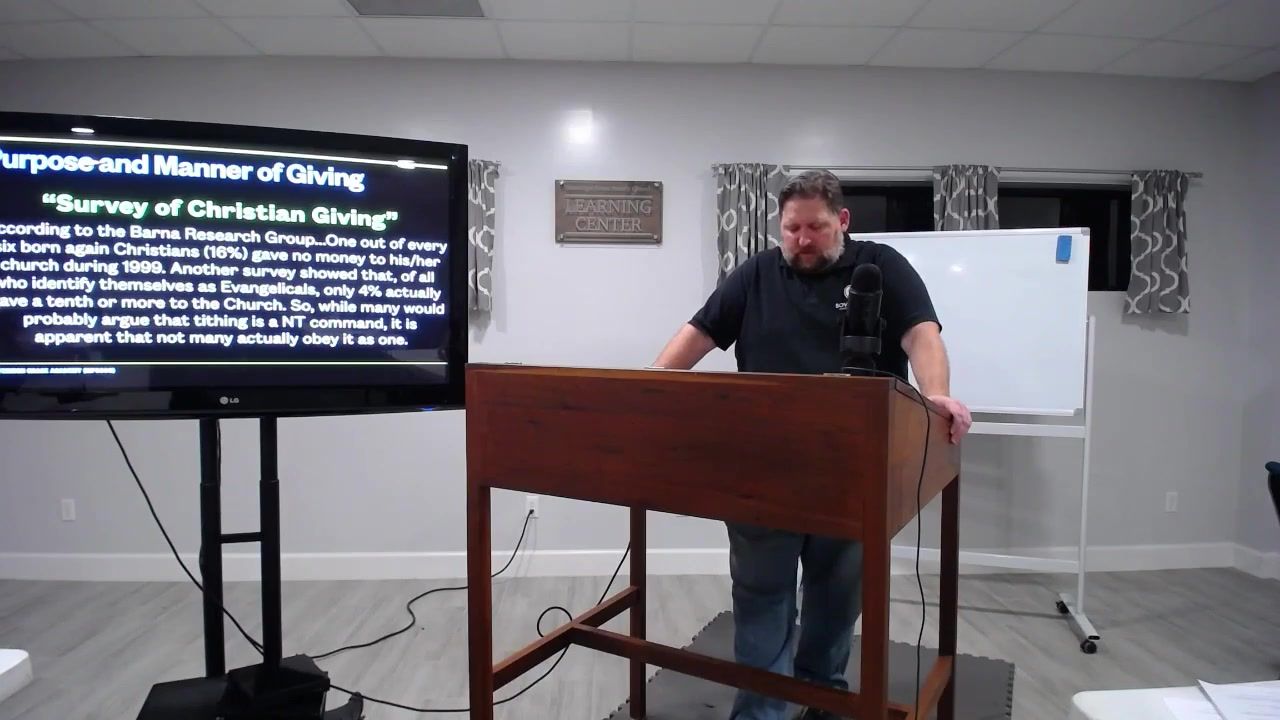
According to the Barna research group One out of every six born-again Christian that is 16 Gave no money to his church. During 1999. This is an older survey 20 years old. But still it takes time to do surveys and collect data and put out statistics.
But according to Barna one out of every six people who claim to be born again gave nothing to their church. Another survey showed that of all who identified as evangelicals only 4 actually gave a tithe or more.
So one out of every six gave nothing and Only 4 Gave a tithe or more. So while many would probably argue that tithing is not a to excuse me while many would argue tithing is a New Testament command.
It's apparently one that most people don't follow. They would say it's command, but I don't do it. So here's go ahead Frank. Yeah, there's an attitude of the heart. Yeah, if we're if we come with our gifts, but we're we're at odds with someone we ought to make that right for sure.
Yeah, yeah, and and again is our heart, right if that's where it's at. And so we should have a right heart when we're giving for sure. Giving is not an obligation. Giving is an opportunity to worship God.
With that let's take a break.