Keep sharing good news without ads.
A quick (well, relatively speaking) DL Short providing a reply to comments from Dr. Dale Tuggy concerning yesterday's DL.
Comments are turned off for this media
Welcome to a Dividing Line Short Program. You may wonder what in the world is a Dividing Line Short Program? Well, we've done it a couple times before, but it's where I'm just trying to get to one particular topic.
Sometimes, I think we did one that was short, it was like five minutes. This will not be five minutes, but I don't think I'm going to go a whole hour. It's where we just throw it out there and we provide some extra information to folks and hopefully edify you in the process.
Yes, we are on the road, and yesterday I did a program where I went into the book of Jude and we looked at Jude verses four and five, and we are doing a lot of responses on the subject Unitarianism. There's a lot of reasons for that, I've explained some of those reasons.
This is relevant to all the groups that we deal with. Rich has told me that there have been some Muslims jumping in, defending Dale Tuggy, which tells you all you need to know right there, really, in many ways.
But the subjects that we're dealing with and the subjects we will be dealing with in the future are relevant, for example, to our deep concerns about the movement to do apologetics within a quote-unquote great tradition concept, and how to identify that, and issues along those lines.
So, the role of philosophy, Dale Tuggy is a philosopher, analytical philosopher. That results in bad theology, really, really bad theology. A super example of how, at its best, philosophy has to be a very subservient handmaid to theology.
And if you do theology the way you do philosophy, you can hear, if you listen to Dr. Tuggy and Dr. Craig talking in the first half of their exchange less than a year ago, I think, or about a year ago, the models and the, well, I don't affirm this, or I don't affirm that, and there's no conclusion to be drawn.
When you're dealing with philosophy, you're dealing with the principles of men's thought. And if that is not ordered and under subservience to divine revelation and how God has made his world, philosophy can come up with any theory on the planet and do anything it wants.
And that's what you end up with. Well, I don't necessarily affirm this, but I'd be open to that. And you just, you end up with no authoritative proclamation whatsoever, no divine revelation, no way of having sure knowledge of anything at all.
So what I want to do is Dr. Tuggy responded briefly to the program. And I found it interesting, somewhat dismissive, and he's made a couple of other comments that I want to quickly get to in this as well.
He hoped that I feel better soon. Thank you. I am feeling better today. He said, well, let's go ahead and I had, well, I'll just read it to you because I already have his article up to show you on the screen, so it'd be easier to do it this way.
It says, I listened and you said some relevant things, but did not address the arguments for Lord in my post, nor did you explain whether CBGM is a game changer on this, if it is. At the end of the day, the lay person mostly sees NA27 versus NA28 regarding Jude 5.
Okay, so let's address, first of all, nor did you explain whether CBGM is a game changer on this, if it is. I did. And I just, I'll be perfectly honest with you, I don't think Dr. Tuggy has any serious knowledge whatsoever of, I don't get the feeling that he reads any of the biblical languages.
And I don't get the feeling he has any serious knowledge of textual critical studies at all. And so as a result, maybe didn't understand what I was saying is that the ECM, the Odysseo Critica Major, which the manual New Testaments, the Nessie-Aland text, the UBS text are the same text, different punctuation, but it's the same text being produced by the same people.
And they are now derivative from the ECM. The ECM will determine the text of the Nessie-Aland text and of the UBS text. And so until Jude was done in the ECM, every textual commentary that came before that does not have access to that information, doesn't have access to the coherence of the manuscripts that read Yesus and the manuscripts that read Kurios at Jude 5.
And so any discussion of that textual variant or any textual variant in the New Testament once the ECM is published will have to take into consideration at minimum the weight of the CBGM analysis. And if you're going to argue against it, for example, the NESB 2020 did not adopt that reading.
So you have to go read their analysis, but they have to analyze that and say, this is why we didn't do that. So, yeah, of course, it's a game changer. It's the fullest collation of manuscripts, analysis of the relationship of manuscripts, coherence.
I almost thought about bringing up some of the CBGM databases just to show you, but the things that you can do, the analysis that you can make based upon this information, I realize the vast majority of textual critics today are not fully up to speed on CBGM.
I get that. I understand that, but that doesn't change how vitally important it is. And even if you have questions about, and I have certain questions about how CBGM approaches the appearance of manuscripts in history.
And I've expressed some of those in the past. You can go back to some of the CBGM introductions I've done on the dividing line. So it's not done yet, but the information is vitally important. So it is a game changer.
And I thought I explained that, but now I have again. So he says, you did not address the arguments for Lord in my post. Well, two things. You didn't seem to know what CBGM was. And in fact, what I'll show you here is one of the comments that was made.
Now, there's some things I want to look at earlier, but let me show you, this is from the, no, that's not what I wanted. I want that. And go to there. There we go. There. All right. So this is from Dr. Tuggy's article.
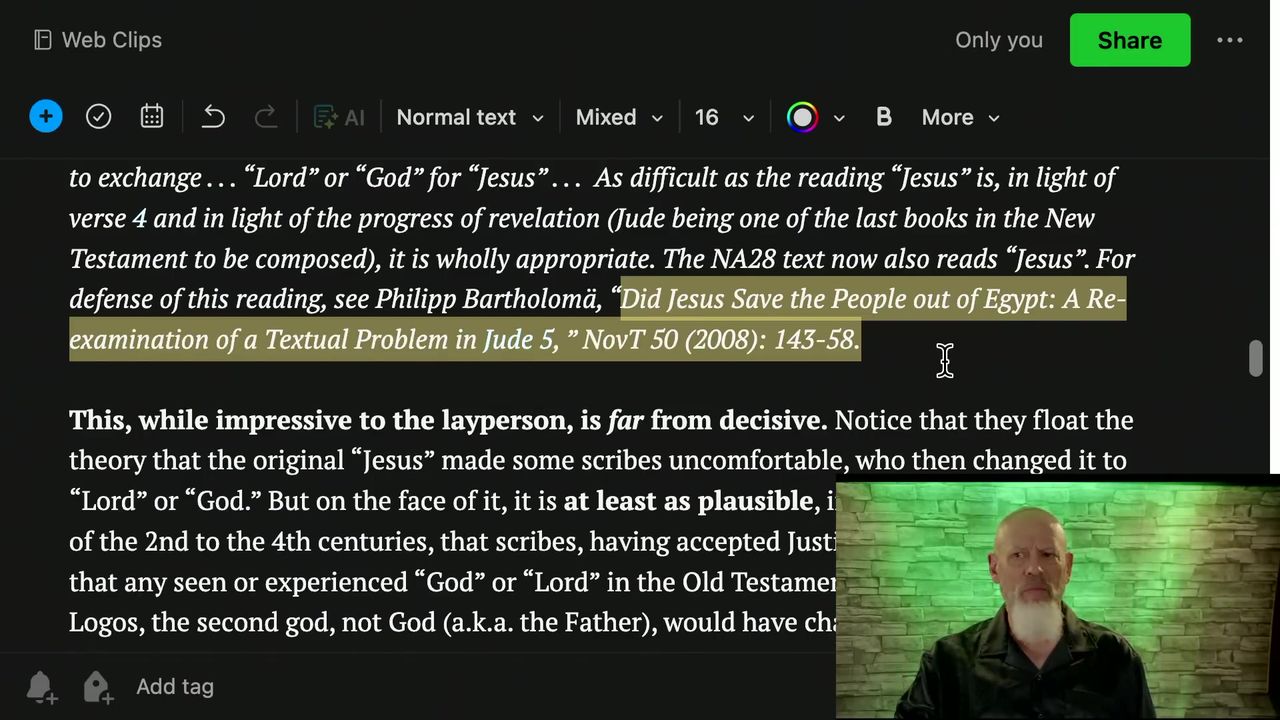
This is my Evernote version of it. Notice it says, inciting one article agrees to the editors. Well, that's not enough for the reader to make up her mind. And notice the most widely used critical edition of Greek New Testament.
That's the one in its 27th edition had Lord here, but in its 28th edition has Jesus here. But who knows why? And here's, there's the point. Dr. Tuggy does not understand what's going on here. Does not understand the current state of the study of the text and textual critical analysis of the text.
So he's going after the NET here, which has a good note, gives a reference to a, notice it's a 2008 article. Did you save the people out of Egypt? A re-examination of a textual problem in Jude 5. It's from 2008, which is before any of the CBGM material was available.
Um, the theory had been developed, but the practice had not yet been developed in 2008. And so, um, when, when he says, but who knows why Dr. Tuggy, the why is CBGM. I explained that. Now this was written before I said that.
So fine. But the why is the, why is there a difference between NA27 and NA28? He says, but who knows why? Well, everybody in Munster knows why. And anybody who knows textual criticism knows why. And that is the CBGM analysis of the coherence of the manuscripts to say Jesus at Jude 5.
So, um, this is sort of important stuff. Real briefly before that, uh, he had said thus you, the lay person not, not to base any controversial doctrine on this verse, such as that Jesus was active in old Testament times, something we don't see clearly see anywhere else in the new Testament, except where Jesus says, Abraham saw my day rejoiced and was glad.
And every passage identifies Jesus as Yahweh, um, which is why he has to deny all these things. So you see the, the philosophical presuppositions that keep Dale Tuggy from dealing with the biblical text in any kind of holistic fashion are here in full display.
Um, and so, uh, let, let's go to the arguments cause it's supposed to be short. Here are the arguments, um, that, uh, Dr. Tuggy said I didn't respond to. So let's, let's take a look at them. Hopefully this will be useful to you.
Um, first we don't see any other new Testament authors crediting the man Jesus with the Exodus, but probably we would see that had they believed it, but they probably did not. And so probably Jude did not.
So probably Jesus is a corruption. So this is, this is exactly how you do not do textual analysis whatsoever. Um, this is taking your presuppositions, your theological presuppositions and going, well, um, the textual variant that fits my presuppositions is, is the variant that we will need to take.
Uh, this is of course a temptation for anyone, but here you have a Unitarian doing it and that makes it all the worse. Uh, but the fact of the matter is, uh, we see the new Testament authors identifying Jesus as creator, um, as Yahweh.
Um, and therefore he is clearly active in the old Testament. Um, the whole starting point, uh, for Tuggy is nope. He's a man that came into existence at that point in time. And so, um, there's, there's nothing, there's no activity in the past, even though, uh, you know, there's just so many places you would point to.
Um, clearly, um, John tells us in John 12, 41, that it was Jesus that Isaiah saw. So if, if, if Jesus is on the throne being worshiped in Isaiah six, then is that a different Yahweh than, than was involved with the Exodus?
Uh, isn't there some significance as there clearly is in Genesis 18 and 19 that you have Yahweh in human form and two angels who meet with Abraham and Yahweh on earth rains fire and brimstone on Sodom and Gomorrah from Yahweh in heaven.
There's only one Yahweh and all your philosophical presuppositions have to give way to biblical revelation, not the other way around. You can't use your philosophical presuppositions to limit biblical revelation, which is what you have going on here.
Second, Jesus is the proper name of the man born to Mary. And this man was not around in the time of Exodus, of the Exodus. Well, you know, that's quite true. However, obviously the point that Jude is making is that Jesus is going to be the one that is going to be judging and cutting off the false teachers.
And so there, the connection is Jesus saved a people out of Egypt and destroyed those did not believe. So here you have false teachers in the church that say they're following Jesus. They're going to find him to be their judge.
That's why we went to Revelation chapter six. We saw Lamb, he sits on the throne, made the connections, the Old Testament, the very language that is used of, uh, of, uh, and, and, and, and, uh, we looked at all that the last time together.
So, uh, that is not a meaningful, uh, argument, uh, third and, uh, perhaps most importantly, this author now here, now here's where you're going to see presuppositions. Big time. This author distinguishes between Jesus and God, AKA Yahweh to catch that you catch that.
Unitarian presupposition Yahweh's Unitarian. Therefore, if, uh, the author distinguishes between Jesus and the father, and we're going to make the father God only. So the father is God only who is Yahweh only.
Therefore, Jesus can't be Yahweh. And therefore Unitarianism follows. It is a vicious circle. I don't understand how they can't see it. Well, I can on a spiritual level, but it's so plain and obvious that Jesus is being identified as Yahweh.
He's our only master and Lord Yahweh is only master Lord. It's right here. You just got to get rid of their Unitarian glasses that filter out all the stuff they're not supposed to see. And so, and the text he has in mind, unambiguously described the actions of Jude five to seven to Yahweh, uh, right.
Uh, it's God's judgment, which is referred to in this whole section, which is why Jesus is God, which is why when Jesus judges those in his own congregation as Yahweh, this is the same thing we have in Titus two, 13 through 14, where Paul takes passages about Yahweh creating a special people for himself.
Why is it to Jesus? That's why Jesus is called our great God and savior, uh, because he is Yahweh incarnate. And if you don't just start with this simplistic presupposition that Yahweh is Unitarian, it all makes perfect sense.
And you don't have to be throwing out any of the biblical texts as you have to do as a Unitarian. And finally, uh, fourth, many commentators have noticed that for whatever reason, this author prefers the fancier Jesus Christ or Lord Jesus or Jesus Christ, our Lord.
So it is surprising if he, if he should use just the adorn unadorned Jesus here. Well, um, okay. So that's a stylistic argument. And given the brevity of Jude and irrelevant one, it's, it's, there's not enough texts there to say, well, this author, if you were in Romans or first Corinthians, maybe you could say all the way through this lengthy letter, but Judas isn't long enough to make that kind of an argument, um, whatsoever.
So it just doesn't provide you with what, what you needed in, um, in those texts. So he said, you know, respond to, uh, what I, what I had to say. And in regards to Kurios, and so we did, and hopefully that is useful to you.
Uh, let me, uh, take this down for a moment. Uh, and look at two other comments real quick. We are, we are trying to make this a DL short. So, um, I've only gone 20 minutes. That's not too bad. Uh, so let's look at the, uh, at the next thing that Dr. Tuggy said.
Uh, he said, uh, in my view, Dr. White does not have a fully developed theory as he still labors under the assumption that there is some one theology called the doctrine of the Trinity. Still, one could argue that he does assume or imply these claims among others.
Then of course he wants to give, uh, himself a credit because he, uh, wrote an article for a, uh, online encyclopedia. Well, I have two, so what? Big deal. Um, lots of people have, um, but he, he wants to say, well, well, he, he, um, still labors under the assumption that there is some one theology.
Well, obviously if you believe there is one God, um, one eternal God who exists in three divine persons and you define this on the basis of biblical revelation, there is far more consistency between those of us who start there.
Now, those who do not start there, those who start with philosophical presuppositions, those who do not start with divine revelation will come up with everything under the sun. And so you can do your Trinity stuff and come up with all sorts of stuff like that.
And look at what the Mormons say, or the Jehovah's witnesses have to say, or whatever. There's lots of stuff like that, but there are three biblical doctrines, monotheism, the existence of three divine persons and the equality of those persons.
I, I was defending that before Dr. Tuggy even started dealing with this stuff by his own admission today. He said he started dealing with Trinity stuff in 2002. I published Forgotten Trinity in 98 and was doing my first interactions with Unitarians about 1984.
Um, so I've been consistent from the beginning in insisting upon a biblically defined doctrine of the Trinity. And in fact, over the past year and a half, I've been pointing out to some within my own tribe that once you leave that solid foundation, uh, what could come after that could become quite ugly, uh, honestly.
Um, and so when you do that, whoops, didn't mean to do that. I apologize again, just doing this fast and, uh, and quickly. Um, so yes, there is a doctrine of the Trinity. Um, and that doctrines of Trinity is accurately represented by the Nicene faith.
Um, it's also accurately represented in writings before that, despite Dr. Tuggy's very unique, uh, views on church history, um, which we'll get to eventually. Um, I mean, that's, that's secondary to me.
It's interesting. You know, we started off looking, for example, at, uh, Ignatius and a few things like that. It's, it's interesting. Um, but the issue is what does divine revelation say? Not what did people after divine revelation interpret that revelation to say that's a part of history that doesn't determine the content of divine revelation itself.
Uh, Dr. Tuggy also, uh, said, and, uh, we'll pop this up here real quick. Um, my one hesitation is that he has shown a lot of impatience working with any material that is outside his wheelhouse. He likes what he likes and shows basically no appreciation of the virtues of analytic theology.
Oh, well, you can understand as much as he wants to. God bless him. Well, isn't that kind? Um, well, here's, here's the problem. Analytic theology. Now, analytic philosophy is bad enough, but analytic theology, uh, give me biblical theology any day.
Um, I don't even know what he's defining as analytic theology. I mean, there's lots of different uses of phraseology like that. Um, but, um, let, let's just lay this on the line. Dr. Tuggy is a philosopher.
He is not an exegete. He is not a theologian. He's not a textual critic. Um, and so evidently he's, um, you know, if, if he wants to say that the, the truth about the Trinity is to be found outside of divine revelation, outside of the actual text, outside of what the text actually says, outside of the exegesis of that text.
Fine. My argument has always been the doctrine of Trinity is based upon what God has revealed in his revelation. And that's where I stand. And so why should I go anywhere else? I mean, we demonstrated the sophistry of the argumentation he presented that Jesus could not be a God because of all these category errors and, and, uh, definitions that are not, uh, based on scripture and stuff like that.
Uh, but okay, fine. I find that to be incredibly, uh, lacking in, in compelling force, uh, incoherent, inconsistent, and irrelevant to anyone who takes the Bible seriously. The fact of the matter is Dale Tuggy knows he cannot stand in the scriptures.
He cannot deal with the original languages. He cannot deal with sexual criticism. He cannot deal with exegesis. He is a philosopher and that's where he's coming from. And I think he just needs to come out and say, you know what?
Uh, being a philosopher is more important than being able to handle divine revelation in scripture. And historically, Unitarians have always collapsed on the doctrine of scripture. Always have. Because fundamentally, if you don't have a divine savior who actually is the, a divine Lord, who's actually the one who has revealed these things, um, eventually the foundation comes apart and just look at all the Unitarian churches in, in history, where have they gone over time?
Have they maintained any kind of high view of scripture? No, they, they might start off as, as a, as a, you know, in new England, as, uh, denominations apostatized as they moved away from the faith, uh, they moved away from a lot of things, reality of the atonement, um, all those types of things, Trinity.
But what was one of the first things that went was the highest view of scripture, highest view of scripture. And so my argument very plainly is if you stand in the highest view of scripture and you take scripture seriously and you do consistent exegesis, the results are clear.
The results are plain. Um, that's why I am a biblical Trinitarian and will stay right there as a biblical Trinitarian. Yes, I do believe that Nicaea was correct, but I am not a Trinitarian because of Nicaea I'm not a Trinitarian because of Constantinople.
I am not a Trinitarian because of Chalcedon. All of those give us insights. They give us language, they give us tools, but they are all subservient to scripture. And the only way to pass a vital living definition of the doctrine of the Trinity for the worship of God's people on to the next generations is to root it in that which the spirit of God makes to come alive in our hearts, and that's scripture.
It's not philosophical argumentation. It is not. And the only philosophical argumentation that actually honors and glorifies God is that which starts the lordship of Jesus Christ, starts the lordship of Jesus Christ.
And I don't know of any practicing analytical philosophers that start there. We've had some brilliant Christian philosophers. Greg Bonson was brilliant, but he started with the lordship of Christ. Started with the lordship of Christ, and that's where we need to be as well.
So I wanted to get those taken care of because it's today's Saturday, and so I won't probably have a chance to do a dividing line until Tuesday. And so if that's the case, then there you go. Wanted to get those out there, and we will press on.
And I want to, I've started working on the audio notetaker files for some of, for the debate with, that Tuggy had with Chris Date, and for the dialogue with William Lane Craig. And one of the things I do, I've already started marking since I stumbled across it, was the many places where Dale Tuggy massacred the rules of debate, primarily in cross-examination with Chris Date.
I thought it was extremely disrespectful to the audience, to debate, to Chris. And I'll play some of those. And we'll say, hey, if something ever happens to where a debate were to take place with Dr. Tuggy, I can guarantee you one thing, you have to have a moderator that will control them and say, oh no, sir, you don't do it that way.
You don't make comments in cross-examination. And Chris, he may have picked it up from me because I've done it many, many times. During debates, when someone polls one of those things, and they start making comments and making arguments in cross-examination, I'll go, is that a question?
And if they say no, then I'll say, well, then you're breaking the rules. I'm going to answer it anyways. And that's what would have to happen in a debate in the future if that were to happen. So thanks for listening to this DL short.
Appreciate it. We will see you the next time on The Dividing Line. God bless.