Keep sharing good news without ads.
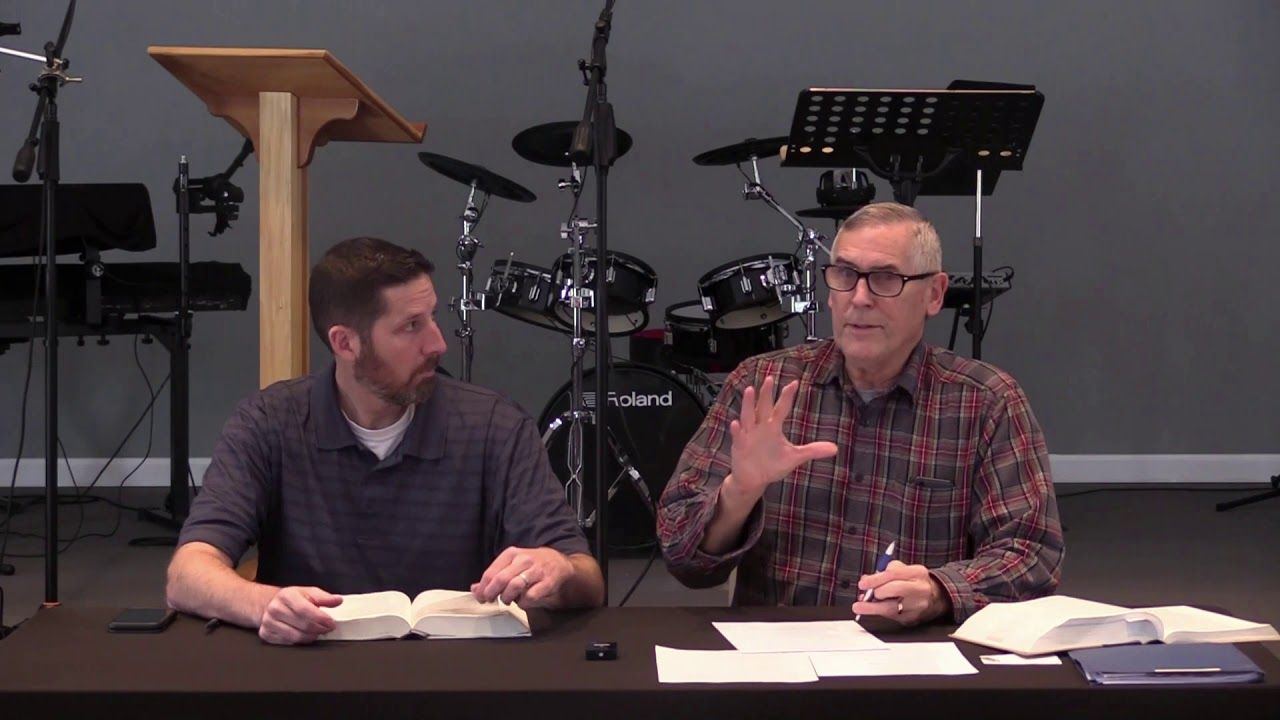
Isaiah: Prophet of the Suffering Servant Lesson 19: Isaiah 11:1-5 Pastors Jeff Kliewer and John Lasken
Good, I'm going to say good afternoon. If we were in Japan, it would be konnichiwa. We were talking about that earlier. It is exciting. I mean, right now, you look outside. God has given us his decorations, and the sanctuary is still filled with people.
So it's encouraging to see everybody come out and to spend time. And last night, our small group is studying in Zachariah. And we were in chapter 11. And actually, chapter 10. What he's doing there is he's contrasting devotion to Yahweh to being sucked into not Yahweh, idol worship and stuff.
And at one point, he talks about the Lord, the Messiah that's going to come. He's going to be the cornerstone. He's going to be the tent peg. He's going to be the bow of battle. And from him, all rulers come together.
The picture there is that sure assurity foundation that you can rely on that is the standard of truth. And it's that tent peg that will hold up against the storms of conflict and battle. And then there's the ability to fight in the battle, the bow of battle.
And then the reality that while there are rulers, he is the ultimate ruler. We're in a different look this morning, because in Isaiah, as we get into chapter 1, we're going to be seeing Yahweh as Yahweh.
We're going to be seeing the coming king. And we're going to be perceiving exactly the attributes that are so amazing, that are so fulfilling. And then a little bit of a contrast about how God deals with those who don't rely on him as opposed to those who do rely on him.
But in all, it's the sovereignty of God. The handouts that were sent out on those of you who are coming in in Zoom, it says we're going to do verses 1 through 9. We're only going to do 1 through 5. But I guess you'll give me your grace on that one anyway.
Pastor Jeff, could you open us, please?
Yes. Father, thank you so much that you have given us the spirit, the same spirit that raised Jesus from the dead, now dwelling in us, the same resurrection power, Lord God, in the spirit of wisdom and understanding, spirit of counsel and power, spirit of judgment and fear of the Lord.
God, we look to you for an outpouring of that Holy Spirit in our lives, that we would be filled, that we would walk by the Spirit, that we would be controlled by your Holy Spirit. And Lord, as we look to your word, we ask that you would lead us and illuminate the text to us, that we would see what is already there, written, and we would have understanding of the deep things of God.
So we ask for your mind, the mind of Christ, to help us as we open your word this morning. In Jesus' name.
Amen. So we do have significant reading that we'll be doing. If you're not ready to read, that's fine. If you are, that's awesome. And for those of you with us on the Zoom, you should be able to download the notes.
We recognize that our microphone really works here at the table, not so much out in the room, and we're looking for a solution to that. But for now, we will deal with what we've got. As we came out of chapter 10, there was a reality that in that day, the Lord is going to take down the thickets of the forest with an axe, and Lebanon will fall by the majestic one.
And as Pastor Jeff showed us last week, we're not talking about thinning the forest of trees. We're talking about the conquering of the mighty forces. The imagery there would be cutting down and actually overcoming this incoming empire.
And so as we get into this one, we are going to be given a vision now of what is to come. There's an immediate picture towards the coming of this Messiah, but then there is also a vision of the kingdom that will come at the end of time.
So this is God making things right in accordance with him. So Jeff, could you give us the first five verses, and then we'll take it a little bit at a time.
There shall come forth a shoot from the stump of Jesse, and a branch from his roots shall bear fruit. And the spirit of the Lord shall rest upon him, the spirit of wisdom and understanding, the spirit of counsel and might, the spirit of knowledge and the fear of the Lord.
And his delight shall be in the fear of the Lord. He shall not judge by what he sees with his eyes or decide disputes by what his ears hear, but with righteousness he shall judge the poor and decide with equity for the meek of the earth.
And he shall strike the earth with the rod of his mouth, and with the breath of his lips he shall kill the wicked. Righteousness shall be the belt of his waist, and faithfulness the belt of his loins.
So what I like to do as we go through this is, I leave blanks in there so that your eyes start to pick up some of the significant truths as we start to mine the information. So in verse one, there shall come forth, and I'll fill it in for you, a shoot.
And it's gonna come from the stump of Jesse. Who's spoken of there? It has to be Jesus. We would have to go there, and that branch is going to bear much fruit. This is the reality of what is to come. What is so amazing, too, is Jesus God, God chose Israel to be his chosen people and gave them blessings.
God already knew, even before he did that, the disappointment that they could be in denying him and going in their own way. But yet he's remaining faithful to the point that he allows them to be chastised in the fire of captivity, but then calls them back and continues to work through them.
In Isaiah 10, 33 and 34, Kimberly, if you could read that for us, please. In great height, the tall ones will be cut down and the lofty ones will be brought low. As we talked, it's speaking specifically historically about the Assyrian Empire and what's gonna happen to them.
But in application, it's a truth that man sets up kingdom and man sets up power and man sets up his desires and man thinks he's all that. And time after time after time, there is no kingdom that stands up against God that will thwart his ways.
When we get to the end of time, as we get into Revelation, we're going to have perhaps the second Babylon, perhaps we're gonna have the Antichrist and his beast and we're gonna have all of these forces put in in one last attempt by Satan to just put God to an end.
But as we go through the book of Revelation, we know as we get into the end of it, God actually wins. And in fact, he sends his witnesses and even all of these attempts cannot stop the kingdom of God.
Isaiah 11, one, Bob, if you would get that. Hey, shoot. And that's what we've just read. We have all of these kingdoms right now typified by the end of chapter 10, believing that they're high and mighty and powerful, but God is capable and God does cut them down.
And it's his plan and it's his intent to fulfill 2 Samuel 22. And I'm gonna ask Laurie if you would get that for us. Now, verses eight and nine are speaking about David and he's going to be the ruler of his people.
So give me verse 16, please. All right, that's obviously not the right verse. The one I was looking where it was, your throne will be established forever. Do you know where that one is, Jeff? 2 Samuel 7.
Thank you. Yeah, 716, that's 716. Thank you. I apparently had the wrong reference. We don't have Rich here to verify it, but Jeff says it's 2 Samuel 7. 16, is that right? Okay, go ahead. 2 Samuel 7, 16.
This throne that comes through David is the throne that becomes the kingdom. Jesus, as the prophet, priest, king, ascends to that position. But then we're now in this phase we call the time of the Gentiles, the age of the church, the parentheses leading up to the 70th week.
Eventually, though, God does reestablish his kingdom, the millennial reign, and then eventually the new Jerusalem. This promise that a shoot will come is the promise of the one of David. Isaiah 9, 6, and 7 says a child will be born, no end to his kingdom, on the throne of David.
And then in Jeremiah 23, it will say, days are coming when I will rise for David, a branch. Matthew 1, 1. Barb, if you would read that. And that's the beginning. If you go Matthew, Luke, you get the genealogies, and it proclaims right from there, from the son of David.
Revelation 22, 16. Carol, if you would go back to the end of it, please. And that's who our Christ is. In verse one, it says there will be a shoot that's gonna come forth. Where is this shoot coming from?
The stump of Jesse. Why is it called the stump? What is a stump? It's what's left, right. Yeah, we had to get a stump cut out of our backyard, it took like forever. But it's a stump. But why is he called the shoot that will come from the stump of Jesse?
Absolutely, the roots are still there. Yeah, there was a very famous picture that was taken. Poland had been under the thumb of the Iron Curtain, and I've lost the word for the Polish national, there was a word that they used for it.
Anybody remember that? Okay, there was a picture taken of a tree that had been cut down, and out of the side of the tree, a sprout had sprung up. And it was a picture that, try as hard as communism could be to take away the national desires, the national pride of the people of Poland, that tree could be cut down to a stump.
But this little branch grew up, and it was a picture. This is the picture that Satan has done everything he possibly can now to eliminate the presence of God, to assert himself, I will be like the most high, it says in Isaiah.
And David's line appears to have come to an end. And as we go through this, and as we approach Jesus's birth, it appears that the kingly line of David had been cut down. But here's this picture again, the stump and the sprout growing up.
And this is the reality. You said that the roots are still there. God is still working, and he's not dead. Although man might think he's cut down that tree, that stump is still there, and is still providing.
And this shoot comes out, and it will bear fruit. Jeff, give me two and three, please.
And the spirit of the Lord shall rest upon him, the spirit of wisdom and understanding, the spirit of counsel and might, the spirit of knowledge and the fear of the Lord, and his delight shall be in the fear of the Lord.
He shall not judge by what his eyes see, or decide disputes by what his ears hear.
This Messiah, we're now clearly in the actual Messiah. We're in the person of Jesus Christ, who is there, who is, he was the coming priest king at this time. And as we go into his Passion Week, he's, they accuse him of being a king, and Jesus says, well, okay, but my kingdom's not of this earth.
You know, his kingdom, he is ruling over his king. Matthew 3, 16 and 17, Bob, if you would read that for us. This individual Jesus, we know the account of how this individual Jesus comes to be. Born of a woman, and it's actually an immaculate conception because there's no man involved, but physically, miraculously, there is a sperm and an ova that unite into the womb of Jesus, and we have the union of fully man, of fully God.
But other than a few small accounts, Jesus remaining behind at the temple when Mary and Joseph are walking back in separate groups, both thinking this young child, Jesus, is with the other, eventually going back, and what is Jesus doing in the temple?
He's teaching, who is he teaching? The priests? This is this young lad, and his response to his parents, well, you knew I needed to be in my father's house. All right? Doing my father's business. But there's not a whole lot of insight into what Jesus does until this event.
Go ahead, Bob. There is, it's a Trinitarian passage to be sure. We have the second person hearing the voice of the father from heaven, and the spirit descending like a dove. It says, the spirit of the Lord will rest upon him.
Now, according to this passage, this spirit of the Lord that rests upon him actually empowers him with certain things. This is a mystery. Jesus is fully God, but the spirit of the Lord is involved in his wisdom, his understanding, his counsel, his might, his knowledge.
And I'm gonna hold the last one off for just a minute. Matthew 13, 54. Gene, if you wanna pull that one out for me. For those who were seeing and perceiving Jesus, they're seeing and perceiving him as the man, as the son of the carpenter.
And the abilities that he had to proclaim truth, to proclaim with authority, drives them to say, where does this guy get all of this wisdom from? Well, in Matthew 28, 18, in the Great Commission, it says that all authority on earth has been given to me.
Now, there is a transformation, and there is a level of the hierarchy of the Trinity of God, the Father, the Son, the Holy Spirit, all co-equally, totally co-equally God, but yet each having their role within the Trinity.
And so the Father, when we have Jesus praying, he prays to the Father. And when he tells his followers, you have seen, if you have seen me, you have seen the Father. And so the way in which Jesus subordinates himself to the Father and shows the Father, this is all packaged also within the Trinity.
Remember Jesus, totally God and totally man. And in Acts 10, 38, I believe it's Paul at that time, he says, you know how a God has anointed him with Holy Spirit and with power. Matthew 11, 27. John, if you want to pull that one out there.
We need to understand that Jesus is fully God. Now, I was actually challenged on this one yesterday afternoon we were talking about the completeness of God. He is totally the second person, totally co-equal and I was challenged.
How about when Jesus said, nobody knows except the Father? How would you answer that, Jeff?
I could take the Andrew Rappaport view, which is possible that it was related to like a wedding, a Jewish wedding. But I think there's some merit and possibly that's the case but I still lean towards the idea that it's only referring to the humanity of Jesus at that particular point.
Yes, as Jesus becomes flesh, he of his own allows certain limitations of knowledge. In his humanity, yeah. Of omnipresence in his humanity. He of his own, it's not taken from him. Matthew 11, 27, you got that John?
Yes. All things have been handed over to him. There is nothing held back. And in fact, in John 16, 15, Jesus proclaims that all that the Father has is mine. And then he says that the Holy Spirit takes what is mine and gives it, there is a total co-equality going on there but yet there is a certain level of subservience that must be recognized also.
John Dottoli, you're gonna get Luke 22, 42 for me if you would. In this list of attributes for the coming king, we have wisdom, we have understanding, counsel, might, knowledge, and then one other is in there.
What is that? Explain. That's what Ricky Ricardo would say to Lucy. Explain, explain Lucy. What does it mean that Jesus manifested the fear of the Lord? Go ahead and read your passage if you would. Luke 22, 40.
Keep going, I meant to go where it says where he prays not my will. Jesus accepts his Father's authority and if the Father's will says it, it is. Jesus is not, Jesus never presumes over the authority of his Father.
And I wanna say that that's not a bad definition of the fear of the Lord. I will never presume over the authority of my God. I will allow him to be God and I will accept his will, his sovereignty to rule.
Now we get into another interesting one. It says, I think it's verse three if you wanna give me verse three again. Please.
And his delight shall be in the fear of the Lord. He shall not judge by what his eyes see or decide disputes by what his ears hear.
He shall not judge by what? He shall not judge by what he sees. This is Jesus. He shall not judge by what he sees and will not settle disputes by what he hears. This is Jesus who is acknowledging the frailty and the folly of allowing appearances to be expressions of truth because well, they're not.
John 18 .38, Jesus tells Pilate, I have come to bear witness to the truth. And John 8 .44 is gonna describe Satan as what's, how has he described Satan? As the devil, the father of lies. What happens, Satan is given dominion on the earth.
In fact, of the three temptations, the one that most clearly acknowledges Satan's dominion is when Satan says, bow down to me and I will give you all these things. And Jesus doesn't refute the fact that he has that power on earth.
He quotes scripture. Satan is called the prince of the power of the air. And then because of that, Satan has a ton of influence on the flesh. And we all fight against that. We're all fighting in the flesh with the spirit, by his grace and through the Holy Spirit working within us.
But Satan is the father of lies. For 2 Thessalonians 2, Chris, if you wanna get 2 Thessalonians 2 for me versus chapter two, I think, 11 and 12. And then, who's that sitting next to you? Karen. I'm sorry?
Karen. Karen, if you could get Proverbs 21 .2 ready for me, please. Go ahead. People are actually deceived and deluded into not even realizing that they're doing what they're doing. It seems right. And in fact, Proverbs 21 .2 is gonna describe how people perceive their own actions.
All right. Okay, now that's the key. If we go into this section, he shall not judge by what his eyes see. He shall not decide disputes by what his ears hear. How does Jesus come to determinations? How does he do it?
Looks at the heart. Yeah. I mean, he clearly knows all situations. The woman at the well, yeah. I know you've had how many men, and the one you're with isn't your husband now. He does know these things, but what he knows for truth is he's able to go beyond the deceptions and the manifestations that we all put on these facades that we're deceived into thinking.
And he doesn't get fooled by them. He doesn't get fooled. How he judges is because he knows the heart. And that's who this Messiah really is. Give me four and five, please.
But with righteousness, he shall judge the poor and decide with equity for the meek of the earth. And he shall strike the earth with the rod of his mouth and with the breath of his lips, he shall kill the wicked.
Righteousness shall be the belt of his waist and faithfulness, the belt of his loins.
With righteousness, okay, now that's the word there. With righteousness, he will judge the poor and decide equity for the meek of the earth. Who are the poor? Who are the meek? It's not a tough question.
It's though, that's a good answer. Actually, in this specific context, he's just talking about needy. Yeah, in this, he's actually talking about the needy that, and the meek. He's just talking about the down.
Those that are considered not worthy. Those that would be not given a place of honor. Those that, have you ever walked through Center City and seen somebody who's homeless and hopefully when you see that, your heart goes out to them because that's who we're supposed to be.
But that's not who, that's not how they're necessarily treated there. If you were to take a look at the tent cities in Los Angeles and places like that, there's a certain level that you judge them. They're into drugs.
You know, they've done this to themselves. Jesus' judgment, and it goes along with the previous passage. Jesus does not ascertain truth by what he hears with his eye, hears, sees with his eyes. His perception of a person's real need and real value is not on the outside.
Romans 2 .28, it says, please, John, where are you seeing that, please? That's verse four. Okay, decide with equity for the meek of the earth. Okay, it's kind of getting into what I've got to say at this time.
What criteria should we use for caring for somebody? It should be that they're made in the image of God. It should be, and it shouldn't be that there is a certain attribute that they've met, a certain expectation that we desire.
Okay, a personal confession. I am really, in my heart, praying every day and struggling about how I will respond. A certain person who's very important in my life has the total opposite political views and ideological desires and placing blame totally different than how I perceive things.
And I struggle with how I'm going to talk to this person. And I'll be honest with you, I have rehearsed some great speeches over and over and over again. I'm judging, I really am. What it says here is we are to decide with equity.
Whoever it might be. And equity should mean that if they're lost, we want to show them Christ. If they're found, we want to have fellowship and disciple one another. It shouldn't come down to, probably it's easier for those who feel like we're walking in the counsel of God to have compassion on the down and out but I guarantee that there is a certain something where that is going to be challenged.
And to be honest with me, with that one person, the ideological differences are a struggle. Yeah, Chris, there is a huge difference between them. Yes, we should not look at physical in deciding what the spiritual needs are.
The spiritual needs should be judged with righteousness, not with any kind of judgment or any kind of false perception. We should know who they are made in the image, needing God, with God. Yeah, you're absolutely right, Chris.
And his justice. Yes, the purity and justice and truth.
If I go back to the passage in Zechariah, this Messiah is the cornerstone. Everything about him, everything that comes from him is based on that true setting of that true cornerstone with the true measurements coming off of it.
So there's no deviation. There's no deviation. First Samuel 16 .7. Dave, if you would pull that one out, please. And Chris, what you were saying is that there has to be a realization that the physical is not the issue, it's the spiritual.
And Kimberly, what you were saying is how God goes over and doesn't get deceived by the things that don't matter. He sees what does matter. And you're absolutely right with that. It's a prayer of ours here at the church as we continue to grow.
And on a given Sunday between first service, second service, online, I think we're seeing somewhere around 160 people on a given Sunday. Somewhere there, Jeff? I don't know. Yeah, somewhere in there. The reality is that the likelihood that there is somebody who puts on the picture of a believer but is not.
And we need to have the ability to seek out God because he sees the heart and that we would minister to the heart. One of the realities is that someday somebody may come through that door and we're going to look at them and we're gonna say that there is something off with them.
And are we gonna judge them for what we see or are we going to be walking up to them? I wanna show you Christ. I'd love to have felt, whatever it may be. It's going beyond not seeing the flesh shortcomings but perceiving the heart needs.
Give me verses four and five again, please.
But with righteousness he shall judge the poor and decide with equity for the meek of the earth. And he shall strike the earth with the rod of his mouth and with the breath of his lips he shall kill the wicked.
Righteousness shall be the belt of his waist and faithfulness the belt of his loins.
He shall strike the earth with the rod of his hand and with the breath of his lips he shall kill the wicked. There are no expectations that because God is loving and everything else that wickedness gets a pass.
There's no expectation. He is holy and because he is holy he is just and it says he's going to strike the earth. How is God going to deal with wickedness in the world? How is God gonna deal with wickedness in the world?
Thank you. Eventually, eventually he's gonna get. But the frustrating thing for us in the here and now is it doesn't seem like he's getting rid of it in the here and now. And so the frustration of wickedness that seems to prosper or the frustration of evil that seems to just get a pass.
And you've said it right. Eventually at his timing it all happens with the breath of his lips he shall kill the wicked. When will this occur? Thank you. For any individual they don't know when it's gonna occur.
So let's put that out on the table. If you were to take somebody who is being incredibly wicked, evil, opposing to God, their time of judgment could be coming right now. It could be for anybody. And there's that sense of urgency to proclaim truth to them but at the end of the day and as we get into the end of revelations eventually we do know he wins.
So what actually motivates the actions of God? It says he will strike the earth with his hand. With his breath of his lips he will kill the wicked. What actually is motivating God's work? His hand.
Scales. What equity used to mean which was equal weights and equal measures biblically. Nowadays to John's point there is a movement to see equity like shares in a company. And everybody needs to have an equal number of shares in the equity as in the stock market kind of thing.
That we need a redistribution of resources and things to make sure that there's equity in society which is not biblical. But rather that the scales of justice would not be weighted in favor of the poor or the rich.
Yeah, that's the concept there.
Psalm 119, Louise, if you would get that, verse 90 I believe it is, Deuteronomy 7, 9. Gus, if you could pull out. And Ralph, I made it all the way around the room. You got Hebrews. 10, 23. Do you like how I, yeah.
You made the whole. Made the whole. What is meant by the faithfulness of God? It says here righteousness will be the belt on his waist and faithfulness the belt of his loins. What is meant by God's faithfulness?
You can always trust him. Why? Why? I feel like I sound like a two-year-old. Why? He keeps his word. Correct. So if you were to have a God who was righteous but not faithful, there would be a weak God.
And if you had a God who was faithful without being righteous, you could have an evil God. But we have a God who is both righteous and faithful. And that makes him worthy of our trust, Carol, as you said.
Psalm 119, 90. Isn't that a beautiful word? His faithfulness endures through all generations. Deuteronomy 7, 9. Deuteronomy 7, 9. This is so powerful too because specifically who received this message?
And so who is this message intended to be given to? The people of Israel. And I have this imagination of a family sitting around a dinner table while they're in captivity, no temple, but mom and dad being faithful to telling young Daniel about the things of God so that eventually when Daniel goes into the chambers of the king, he holds true.
But these messages here that the Lord, he is faithful and he keeps his covenant has to supersede circumstances. It has to just be the foundation behind this, know that the Lord your God is faithful, he keeps his covenant is because he's God.
And the fact that it looks difficult, he's God. And holding on to that Hebrews 10, 23. Let us hold unswervingly. And I wanna leave you with that thought, hold unswervingly to the hope you confess he who promised is faithful.
That's why I wanna leave us with. This morning, we've looked at these five verses and you can look back at them and think about the attributes of God and what makes this promise, this exhortation of Hebrews 10, 23, so real, the omnipotence of God.
Everything that he desires to do, the world doesn't stop. Everything that needs to be done, he can do and he's just, he's a holy God. And we see difficulties and we see evil around us, but he's a holy God.
He judges in righteousness, the needs he sees the real needs. And he's faithful. And whatever the circumstances are, he is faithful and he will see it through to the very end. It says, righteousness will be the belt of his waist and faithfulness, the belt of his loins.
That's it for now.
Do you wanna close us in a prayer? Absolutely. So Father, thank you for this messianic promise that the Messiah is coming, the omniscient one who doesn't judge by mere appearances, but makes a right judgment.
Thank you that he is controlled completely by the Holy Spirit and not deceived in any way, shape or form that he makes righteous judgments and will judge the earth. And so we look to that coming judgment, knowing that God, you are in control.
And we pray also that we would learn to reflect your judgment by studying your precepts to know what is true. And we thank you God for this word to us in Jesus name. Amen. Amen.