Keep sharing good news without ads.
No description available
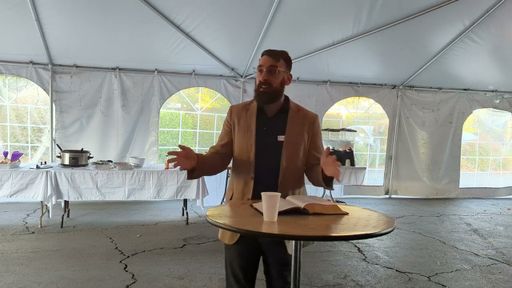
If you don't have a church and you're looking for one, we'd love to have you join us some Sunday and check us out. Our worship services are at 11 o 'clock, and this upcoming Sunday my friend Tim is going to be preaching.
You don't want to miss that. And also, I have another friend named Andrew Case who's recently written a prayer book. If you're familiar with Matthew Henry, he has a book like this called Method of Prayer where he goes through different scriptures and shows how you would pray those passages of scripture.
I have a lot of extras of these books. If you would like one, please feel free to grab one on your way out. And so, with that, every month I go through a different myth about marriage. Today's myth is that your choice of church will not have any significant effect on the health of your relationship.
There's a lot of people who think of their home life as being very distinct from their church life, or their friends and family as being very distinct from their church life. The reality is, there's a pretty big relationship between the two of those.
If you've ever heard the phrase, do not ask for whom the bell tolls, who knows how the rest of that goes? Do not ask for whom the bell tolls? Yeah, do you know? Do not ask for whom the bell tolls. Yes, the bell tolls for thee.
Do not ask for whom the bell tolls, it tolls for thee. What does that sound like? It sounds like something from a horror movie, right? It sounds like, you know, do not ask for whom that funeral bell is ringing.
It's coming for you. You're going to die too one day. That's actually not what that poem is about. When it says do not ask for whom the bell tolls in your wedding bell or in your funeral bell, it tolls for you because if you're part of the local church and you hear the bell tolling, you are part of the body, and so that death or that wedding, whatever it is, it affects you as well, so you should not ask for whom the bell tolls.
The bell tolls for you. In fact, that's the same poem from which the phrase, no man is an island, it's the same poem from which that comes from, and this is known as Meditation 17 by John Donne, if you want to look that up.
So if you've ever heard the phrase, no man is an island, same poem as do not ask for whom the bell tolls. It is the case that we're all knit together in one body of Christ. We have trust in the Lord, and so that effect that the body has on us is not something that's distinct from us, that lives out there, but rather something that's pretty significant to us individually and affects us in our lives, and especially in our relationships.
It affects the way we go about relationships. It doesn't matter if you're in a dating relationship, a court relationship, a marriage, or other kinds of relationships. It affects those as well, and so what I want to do today is I want to consider what you should be looking for in church and how you should be thinking about the health of your church, and this is for three kinds of people.
One, if you're not part of a church, so that you can think rightly about what kind of church you should be a part of. Two, if you are part of a church and you realize that maybe there's some problems, those of you who know how you can attend to those problems and improve the life of your church.
And three, if you realize that maybe some of these problems, while they're so insurmountable, that they would be bad for your relationship, bad for your marriage, bad for your courting or dating, then it will help you think about where you should be instead.
So I want to go through five things that I think are important for a church in regards to your relationship. These are by no means an exhaustive list of parts of the health of church or anything like that.
But just five things I think should let you consider about how your choice of church is going to affect their relationship. So the first one is that a church should have the word God. A church should have the word God.
And this seems, of course, most important, especially in a relationship, especially if you're preparing for marriage. Ephesians 5, 25 says, So how does Christ love the church? He loves the church by washing her with the water of the word.
How are husbands supposed to love their wives? They're supposed to love their wives as Christ loved the church. And so what does that mean for someone who's preparing for marriage, for someone who makes sure that when he's married, he's able to provide for his spouse what she needs?
Well, the answer is you should be in a place where she would be washed by the water of the word. Of course, that's important for men as well to be cleansed with the water of the word. But especially if you're going to take on the role of a spiritual leader, you want to be in a place where you can accomplish that spiritual leadership well.
So that's one thing for you to consider. A couple of litmus tests that you can look at in your church. One is the music. A lot of times in churches, the music will really have an emphasis on the word of God or on the words being said, the deep and full of theology.
And a lot of times the words will be very vague, very full of emotion, but not very contentful with the things that we are supposed to be meditating on. In fact, some of them are so generic, you couldn't honestly say that you would know, apart from knowing this song already, that it was about the Christian God.
You might know it might have been about the Father or God in a way that many religions could have heard. So that's one kind of area where you can look at and say, you know, is the word of God held highly here?
Another is in the preaching of course. Now, you know, almost every Christian church is going to make reference to the word of God. But making reference to the word of God is not necessarily the same as making the word of God central.
So you want to be in a place where the word of God is central. Now, a lot of places they'll preach on things that are outside the Bible and then just make reference to the Bible occasionally. Now, I'm not saying it's wrong to have a topic of preaching, but a lot of times the main text of the message would be something else.
It'll be, you know, a book or a movie or something like that. And then they will explain how you should think about the themes from that movie based on, you know, a few references to the word of God. Is a church like that, you know, really holding up the word of God highly?
Is it washing people with the water of the word? Is it really elevating the word? So those are a couple of examples of things you could look at in your church to know whether or not it's really shining in this category, whether or not it's really trying to honor the name of Christ in the way it preaches the gospel.
Secondly, considering the word of God, there's also the matter of theology. You would want a church that has good theology. Now, a lot of times people don't think of that very distinctly from the word of God, right?
They think, well, if you have the word of God, you have good theology, right? That's not exactly the case. A lot of times people will say they believe every word of the Bible, but they're not understanding the words.
First Timothy 4 says this. If you put these things before the brothers, you will be a good servant of Christ Jesus, being trained in the words of the faith and of the good doctrine that you have followed.
Now, Paul is talking to Timothy and he says that he should be trained in these two things, the words of the faith and the good doctrine. Okay, so Paul is distinguishing between the words of the faith and the doctrine.
It's important not to know just the words of the Bible, but what those words mean and how you can synthesize those things and think about those things. Have it in order to do that. It's important to do it.
And it's important to do it at a mature level. Hebrews 6 .1 says, Therefore, let us take the elementary doctrine of Christ and go on to maturity, not laying again a foundation of repentance, dead works, faith for God, and instructions about washing and laying on your hands, resurrection, death, eternal judgment.
And this we will do in God's name. So he says we should move on from elementary doctrine and go to deeper doctrine. Now, this is not a lot of people think, okay, the elementary doctrine is Christ, and then we move on to other things that are not about Christ.
That's not correct. Paul said when he was with the Corinthians that he preached nothing but Christ and crucifixion. Right? So the elementary doctrines of Christ are not in contrast to other doctrines about other things.
They're in contrast to more advanced doctrines about Christ. If you think of the elements, elements like in the periodic table, you build them together and you make molecules. Okay, that's what it's talking about when it's talking about the elemental principle.
They're things that on their own are important, you know, resurrection, death, things like that. But putting those things together and understanding their fullness in Christ is what's really important to develop in your maturity as a believer.
And this is important. This is important in the life of the church. Another litmus test you could use. I have found that when I ask pastors about a particular topic, like, for example, election, if they tell me, well, it's not important to go that deep, I'll know that, well, you know, if you don't care to understand what our salvation, the details about our salvation, that's not necessarily a good sign.
And so this is important in your marriage or in your dating relationships or in preparing for marriage. First of all, because that is practical. A lot of people think of that as just being stuff that builds up the head.
But all the Word of God is designed for the heart. It's all designed to help us understand who He is and understand who we are. And it really plays out in your life. You know, if you trust in the sovereignty of God, that's going to affect the way you approach your relationships.
If you understand how God has ordered salvation and what He's accomplishing in the world, it's going to affect the confidence with which you approach your relationships. And so all that is important. In addition to that, if someone has avoided doctrines because they might be too controversial, that's going to affect practical things in the Bible as well, right?
There are practical areas of Scripture that talk about relationships, talk about the roles of men and women, that are very controversial right now. So if someone is avoiding things that are considered more advanced doctrine because they're too controversial, that would lead that same people to avoid things that are also controversial in more practical areas.
And then on top of that, if that's an approach to unity, if you're trying to keep the body unified not by centering around the two details and the truth, right, but around avoiding details about Christ that might bind people, then how are you going to approach unity around marriage, right?
Are you going to approach unity around marriage by addressing those conflicts head on, or are you going to address them by backing off and avoiding them and just trying to ignore things? And that just builds all kinds of prejudice and all kinds of problems.
It's important to address these things head on. Just several passages. Matthew 18 talks about if your brother offends you, go and show him his fault. Matthew 5 says that if your brother has a problem with you, you're supposed to go and be reconciled, so that the onus is on both ends.
And then Ephesians 4 says,. So it's very important to address these differences. And what I'm suggesting to you is someone who wants to avoid differences in other areas will also want to avoid differences in practical, important areas as well.
It's a nitty-gritty of relationship. So something to consider there. Now, a third thing that you want to consider is accountability in a church. So I just mentioned conflict resolution, the importance of relationships.
If you're preparing for marriage, pursuing marriage, and then you're married, conflict resolution, the importance of relationships, so you want to be in a place that would be able to hold others accountable, and you accountable as well.
I've talked to a number of couples who they've decided they're going to get married. They'll figure out the church thing later. They'll figure out their relationships and get married. They'll figure out church later.
And what ends up happening is in the early days of their marriage, they come across a conflict where it's pretty heavy, and there's a need for real accountability just outside of those two. They aren't sufficient to resolve it just by themselves.
They need the help of others. But then there's no help of others to go to because either they don't belong to a church or they're not at a place that would be willing to engage in the kind of accountability you see in marriage.
Right? Matthew in Kings says, if your brother bids you go and show this call, if he won't hear it out, then you bring one or two others. And if he doesn't listen to them, you take him to the whole church.
If he doesn't listen to them, et cetera. And how can you do that if you don't have a church that would be willing to participate in these things? If there's not a kind of identity and membership of the church that would allow you to pursue these things.
And this is stuff people find out really early on in their relationships and then end up regretting that they hadn't sorted this out earlier. So part of my encouragement here is if you're thinking about these things, sort them out earlier rather than waiting for further along when you're further in court, or you're thinking about further in marriage because that's when you will have once already established a place to give yourself a foundation to work from.
And then beyond accountability is just community in general. Now a lot of times when people think about the importance of church communities, they're thinking about peers that they get along with really well and share a lot of common interests with them.
What you see in the Bible is a healthy community is not necessarily centered around well, it's definitely not centered around, but it doesn't necessarily even include the kinds of things that a lot of people center their relationship with.
Those common interests they find outside of Christ, but they're centered around Christ. In fact, a lot of those relationships are multi-generational. And a part of those it's hard to have a healthy community.
In fact, a lot of times what people are looking for, especially when they're single, especially when they're wanting to pursue marriage and don't have a marriage yet, is they go to a place where there's a lot of their peers because they think that's what is going to help them find a spouse and pursue that marriage relationship.
But a lot of times it ends up working the opposite way because what does the Bible describe a healthy community that's really going to be a sister to you? It's one that's multi-generational. Titus 2 talks about those multi-generational relationships, mentioning both men and women, but it more particularly talks about women.
Older women, likewise, are to be reverent in behavior, not slanderers or slaves of much wine. They are to teach what is good, and so train the young women to love their husbands and children, to be self-controlled, to fear and work in the world of science, and to discipline their own consciousness.
But the Word of God may not be reviled. So a healthy church relationship looks like the older women interacting with the younger women. And you can infer from this passage, because it speaks about older men and younger men too, and it's true of older men and younger men as well, that they should be interacting with one another.
And a lot of times people, when they're trying to find a healthy community, and they're just looking for peers, or on top of that, a lot of times the churches are structured so that you're isolated, you're just around your peers, and you're not actually interacting with those that you should be interacting with, and would be able to give you that kind of spiritual guidance, that kind of spiritual mentorship.
And then the last thing, so there are four different things. The last thing that I'll mention that will be important to your relationship is your pastor, a pastor. And not every church, I don't believe that a pastor is the church, right?
Not every church would be a church without a pastor. And I also don't think it's a case that you're a lot of times you see people, well, if your pastor does this, leave your church. I'm not the kind of guy who does that sort of thing.
You know, the pastor is not the church. At the same time, your pastor or pastors are going to be very important to your health as an individual Christian, as well as to the health of your relationships, whatever kind of relationships they are, friendships, marriage, dating, whatever it may be.
So some things to consider about that is what is a good shepherd? Jesus says, a good shepherd lays down his life to the sheep. He who is a hired hand, not a shepherd, who does not know the sheep, sees the world coming, and he leaves the sheep in peace.
So a good shepherd, a pastor being a worthy shepherd, an old-timey word that's not in modern Bible translation, is a good shepherd. A good pastor is one who cares about the sheep. The Bible describes a good pastor as being one who prays for the sheep.
So a couple more tests for you to think about is, one, does your pastor know your name? A lot of times people will think, well, a pastor is just shepherding me by, you know, occasionally telling me some things.
It's a one-way communication. A pastor is supposed to be praying to God on behalf of the sheep. And if he doesn't know your name, how is he able to responsibly pray for you in that way? That would be one thing to consider.
The other thing is, just a couple more tests, not necessarily, you know, surefires, but one thing to consider, has he ever been to your home? Now, maybe that's just because you've been very introverted and haven't welcomed him over.
Ideally, you have a relationship with your pastor such that you are together, walking through life together. Or have you ever gone to his home? The Bible describes a pastor, one of the qualities of an elder, in order for them to be called to government, they must be hospitable.
Do you see that kind of hospitality? And if none of those things are there, what you're seeing is something different than the kind of pastor or church relationship that the Bible describes. And I know that's a very common thing, and a lot of you might be thinking that what I'm describing, you know, you going and talking to your pastor in his home, or him coming to your home is just like out-of-this-world crazy, you couldn't imagine, you know, having that kind of relationship with your pastor.
Look at what the Bible says about hospitality, what it says about the responsibility of the pastors, the flock, and you'll see that what's required is a little more than just him giving you one-directional messages.
So something to consider with all that. So now, what should be your response if you're in a place that is missing some of these marks, or is lacking in some of these marks? Like I said a minute ago, I'm not the kind of guy who just hands out litmus tests and says, if you see this, leave your church.
I think there's a lot of reason that people should actively work toward the betterment of their church, even through difficult times, even through hard times. At the same time, there's a couple of realities to acknowledge.
One is that a lot of times people, especially in their early years, especially before they've built up much of a household of their own, have less to contribute to the household of God in a leadership sense to be able to lead it.
A lot of people just aren't equipped to make those kinds of changes. Secondly, the other reality to consider is a lot of churches aren't structured so that the members are able to contribute to the leadership in that way and to change around the church.
In fact, they're very top-down such that there's a few guys making the decisions and everybody else there is a consumer. So if that's the situation, there's not a whole lot of recourse if you find yourself in one of these situations where you're really lacking in this, and you want to prepare for having a healthy relationship in a church that's really going to support you in that.
And if that is the case, if you find yourself in a position where the more responsible thing to do, where you can best serve Christ is not by staying and trying to horse correct or anything like that, but by finding somewhere else, do look for a healthy place.
Now, how would you go about looking for a healthy place? One, consider the various things that I've mentioned here. Consider that those are good things that, like I said, not exhaustive lists, but some good things to examine a church by.
Secondly, there are a couple of good websites I can recommend. I usually go to founders .org when I'm looking for a good church. There's some other good websites too, like 9marks is a decent site for trying to find a healthy church.
And if you're in this area, like Ari said, I'd be happy to have you come join here. This might sound very self-serving, but know this. I didn't come here as a pastor. I became a pastor about four years ago.
I joined this church 14 years ago. And the reason I joined this church was because I knew I would be married in short order. I was engaged, and I wanted to go to a place that I thought was going to be supportive to my pursuit of marriage and to the marriage itself.
So that's why I came here. So it might sound self-serving for me to say I want you here, but that's the reason I came here is for the sake of making sure that I have a good foundation for my relationships.
And if you're not from around here, or even if you are from around here and you're looking for something different, I'd be happy to talk with you and try to help you find a good, healthy place for you to be.
So those are some tips for how to find a healthy church to be a part of. Now, with all that considered, I'd like to make sure that we're thinking about this in the big pictures in terms of the gospel.
What is the wages of sin? What is death? And sometimes that's pictured in the Bible in different ways, and one of the ways that death is pictured is as a cutting off, right? A removal of communal identity, a removal of someone from the people of God.
But Jesus Christ, when he has died for us, when he has died for those who put their trust in him, he reestablishes them into the body of Christ. And you want to fully take advantage of that. Hebrews 10, Hebrews 10 .25, when it says,.
And let us consider how to stir up one another to love and good works, not neglecting to meet together as it happens, but encouraging one another. And all the wars you see today and tomorrow, how is it that you're to be encouraged?
How is it that you're to be stirred up to good works? It's through the gathering, it's through other people that you gather with. And Jesus has given this not as a burden to us, but rather as a gift to us.
In fact, it's one of the few gifts that we get of our salvation that we have a guarantee that we can enjoy in this life. A lot of the blessings of salvation that point to eternal life, streets of gold, all those kinds of things that the Bible talks about, health and wealth, that kind of stuff is not guaranteed in this life.
God often gives us very good things like that. However, what we see in Scripture is what is guaranteed. It is rather these relationships that we have here of us being knit together in the body. In speaking to the rich young ruler, Jesus tells him the difficult things that he needs to do.
He needs to abandon his attachment to worldly things and his possessions. But when he heard these things, he became very sad for he was extremely rich. Jesus, hearing the giving from Saddam, said, How difficult it is for those who have loved to enter the kingdom of God, for it is easier for a camel to go through the eye of a needle than for a rich person to enter the kingdom of God.
But those who were in sin, then who can be saved? Jesus said, What is impossible with man is possible with God. He is describing the impossibility of salvation that God establishes, that God solves. If this is possible with God, he can save.
Even if it means leaving everything behind, how is it possible to leave everything behind? Peter said, See, we have left our homes and followed you. And he said, Truly I say to you, there is no one who has left house or wife or brothers or parents or children for the sake of the kingdom of God who will not receive many times more in this time than in the age to come eternal life.
So in the age to come there will be eternal life. But what do we have in this time? We have many more brothers and sisters and mothers and fathers and this whole relationship that God has established in his church.
And the one who believes in Christ but does not take advantage of that gift that he is giving is missing out on the main aspect of salvation that we are to be enjoying in this life. That is the brothers and sisters and mothers and fathers.
And I want you all to fully enjoy that and to enjoy its benefits. Because as we celebrate Christ together, as we are looking at him together, we are able to profit from his grace, from his goodness all better than if we were just looking at him alone.
It is the way that God has made his church to rely on one another and to enjoy the salvation that we have. Let me go ahead and pray for us and then we are going to have a little discussion. Dear Heavenly Father, thank you for your word.
Thank you for your establishment of your church in Jesus Christ. We pray that you would continue to strengthen your churches. I pray for all these people here that you would strengthen the churches that they are in.
And that you would grow them through the communities you live in. In Jesus' name, amen. Amen. All right, so Sarah, my wife, is going to be passing out some stamps that are going on the tables to have a few discussions with us.
And after maybe 10 minutes of this, we will go to Q &A. So... Q &A.