Keep sharing good news without ads.
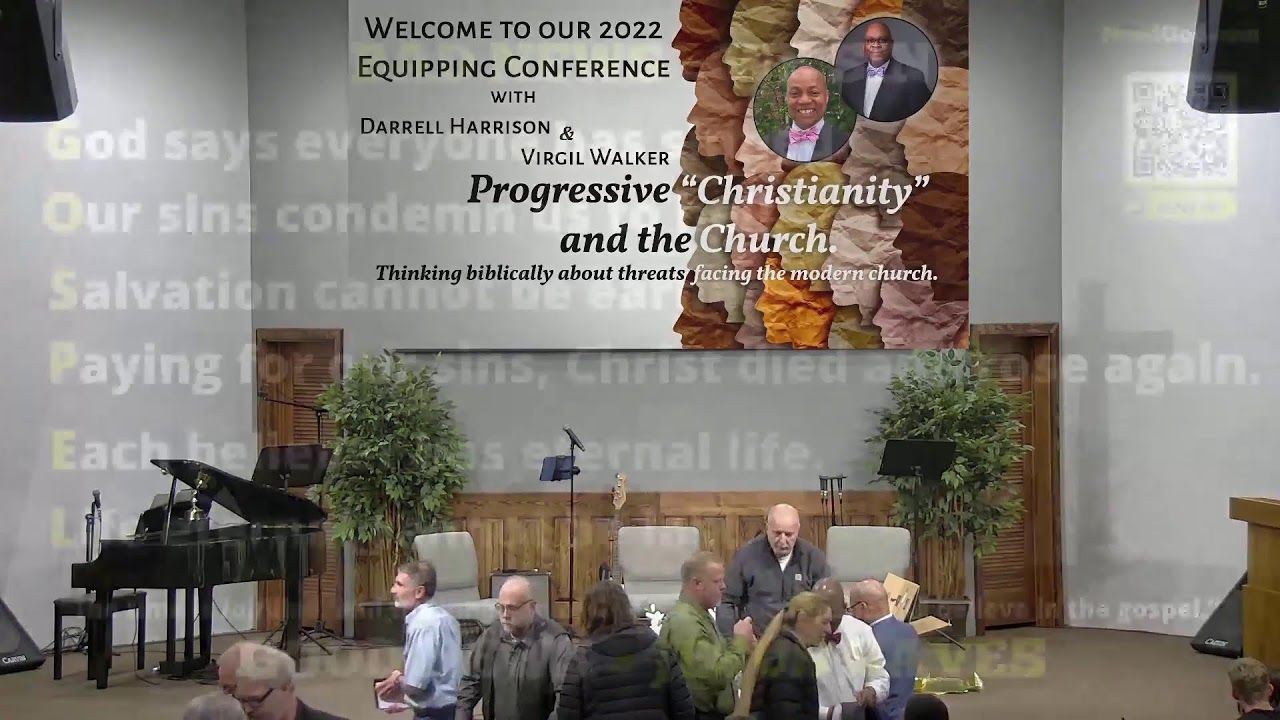
Session 4: The Problem is Enmity, Not Ethnicity with Darrell Harrison - 2022 Equipping Conference
Was always a good choice so if you didn't buy a ticket you really lost out. Sorry to hear it. Would you please stand as we sing. How firm a foundation.
Upheld by my right just omnipotent fiery trial sufficient shall be thy supply the flame shall not hurt my goal. Jesus hath leaned for me. You may be.
Seated. I will. Can we it says. Build black better. Thanks Jim. How am I gonna get through this message with that thing. Staring at you guys. A chance for hanging in here today. We've come with some really heavy stuff and y 'all are hanging in there with us.
So we appreciate that. I want to talk to you this evening. I've taught this message. The problem is intimacy not ethnicity. The problem is enmity not ethnicity. Because I can't do it man. Stop laughing any minute.
The problem is enmity not ethnicity. And I'm gonna be speaking to you from Ephesians chapter 2 verses 14 through 16. I'm gonna be reading that passage from the New American Standard Bible translation or as those of you who are familiar with the Just Thinking podcast the non Armenian Standard Bible translation Ephesians 2 verses 14 through 16.
For he himself is our peace who made both groups into one and broke down the barrier of the dividing wall by abolishing in his flesh the enmity which is the law of commandments contained in ordinances so that in himself he might make the two into one new man thus establishing peace and might reconcile them both in one body to God through the cross by it having put to death.
That is by the cross having put to death the enmity. Enmity it's a word that has all but disappeared from our contemporary lexicon. I mean think about it when was the last time you use the word enmity or heard someone else use that word in a conversation.
Exactly. But despite its rare usage today enmity is a word that carries significant weight and importance particularly when considered within the context of Scripture. By the way speaking of context I want to say at the outset of this message that I am rather dogmatic that when Christians engage in apologetics that is when we engage the culture in a defense of the truths of the gospel it is critically important that we begin that defense by defining our terms biblically.
Now every Christian in this room is an apologist. The only question that remains is whether you're a good apologist or a bad one. But every one of us is an apologist. That's 1st Peter 3 15. Now I sort of emphasize the importance of defining our term bib terms biblically because words have meaning words have meaning and it is the meaning of words which for better or worse establish the context for our apologetics.
By not defining our terms biblically we risk engaging the world using the world's terms on the world's turf. Consequently we run the risk of seeding the moral ethical and more importantly the theological high ground to an unbelieving culture and end up losing the argument altogether as Christians to not stand on a solid biblical foundation as it relates to biblically defining the terms we use that opens the door to pluralism.
Pluralism is the idea that all beliefs are equally valid. And that's exactly what the culture is trying to tell you today. As DA Carson declares in his book titled the gagging of God subtitled Christianity confronts pluralism.
Quote. Entire vision of reality is at stake. Let me pause here by the way that's why you're here. That's why you're here at this conference is because there is an entire vision of reality that is at stake.
That's exactly why you're here. Quoting Carson one thing is very clear. It is quite impossible to be a Christian in any responsible use of that term and be a pluralist. The pluralist will explain the Christian and will doubtless conclude that the Christian is too tightly bound by tradition naive in the area of epistemology intolerant of other views and so forth.
All those things are happening by the way if you're not being accused if you're not experiencing one of these accusations or more of them that is you're being accused of being too tightly bound by tradition.
You're naive of what's going on in the culture. You're intolerant of other views. If you're not being accused of any of those things you're living in some kind of bubble that you need to burst and get out of continuing to quote DA Carson he says pluralists are inconsistent and that they want to be understood univocally while insisting that ancient authors let alone God himself cannot be understood univocally.
So you're getting me pause here and say again what you're getting is even with it evangelicalism. You've got people like Tim Keller and others like that trying to argue well nobody can really understand what the scripture means.
You know none of us is God. You know. So they're coming at us now saying well God can't be understood. How do you know. I mean even as Virgil and I and you have Jim here who's not just an expositor but he's an exegete.
You can tell a person what a word or verse means in the original Hebrew or Greek language. And they'll say yeah. But how do you. How do you know that. So so it's a circular questioning always trying to deconstruct what we know and how we know it even when it comes to scripture.
That's what Carson is saying here that the pluralists are inconsistent and that there they would argue that they want to be understood with one voice. But there's while insisting that the original authors and let alone God himself cannot be understood with one voice.
Carson says they may have many religious experiences but none of them deals with the heart of the human problem the sin that is so deeply a part of our nature. Let me stop here again I'm gonna get through this quote.
I promise you I will see what I run into many times and I was saying this on Twitter just a couple weeks ago. What you're finding within the social justice movement and the critical race theory movement and Black Lives Matters is a good example of this because the payoff for them is to get paid.
What you'll find is that they want the problem to be something other than sin in the human heart. They want the problem to be something else. They want the problem to be something that they can target that will get them paid in the end.
So they'll say the world the problem is racism. The problem is discrimination. The problem is you know the weight of my student loan debt. They want the problem to be something else something that will reward them and give them the payoff that they want.
They can't afford to let the problem be sin and that the solution be biblical confession and repentance and come into faith in Christ as a result. Because that doesn't get them what they want. So the so scriptures not enough for them they need to have something else.
That's the problem that can be either identified as a problem with no solution but as long as that problem gets them what they want that's what they want the problem to be. It's never sin in the human heart.
So for instance you've got the dialogue is ratcheting up again about gun control an oxymoron of a term if ever I heard one. They want to blame the gun. They want to blame the gun. Why. Well because the goal is to what's the what's the right word for it really I think is to the target is the total deconstruction of the Second Amendment.
That's that's really the goal. But what they're having to do is with the especially with these mass shootings they always want to blame the gun. They'd never want to point to the motive or the intent in the heart of the person.
Because I say all the time the night before or the day before the shooting in Texas and then this recent one in Tulsa Oklahoma before those incidents occurred those those weapons existed but they hadn't harmed anybody the day before those same weapons existed the day before didn't shoot anybody.
Why. Because there was no animate human being with the intent to pull the trick get the gun aim it at targets and then pull the trigger. But they want to say it's the gun because the goal is to minimize if not eliminate your right to own weapons.
That's not Jim Osmond saying that. That's me saying that. So don't come at don't come at. Jim continue with it. With DA Carson they may have many religious experiences but none of them deals with the heart of the human problem which is the sin that is so deeply a part of our nature.
In short we must deal with massively clashing worldviews again. That's why you're here. This is really a worldview conference. It's got a cool name the equipping conference. But what you're here to really talk about is as DA Carson has put it massively clashing worldviews.
And part of our responsibility continuing to quote Carson part of our responsibility is to explain competing worldviews from our vantage point. Let me stop here again. That's what an apologist does. That's what a capable equipped prepared Christian apologist does.
They explain competing worldviews from the biblical standpoint. That's why it takes virtually me three hours of an episode of a Just Thinking podcast. Because that's what we're attempting to do. We're trying to help equip folks to understand things like critical race theory deconstructionism salvation and other theological topics so that they can they can understand and be able to articulate these issues.
Because that's what first Peter 315 commands us to do. And I want to challenge anybody here. I'm not trying to be condescending toward anyone at all but if you know this in your heart of this is true if you're a lazy Bible reader you need to repent of that.
You need to repent of that. And you need to get serious become a serious student of the Bible. Don't just read it. You need to study it and dig into it. Get a Greek Hebrew lexicon and understand what these words mean in the Greek what they really mean literally.
So you can peel back the layers of God's Word. Because I promise you there's more there than what's on the page. Carson says we cannot possibly engage at that level unless we ourselves have thoroughly grasped the biblical storyline.
And it's entailed theology. Unquote again. That's why you're here as apologists for the gospel. And as I said every true believer in Christ is an apologist. It's vital that we not embrace the language of the culture as we endeavor to engage the culture.
Did you understand that you must resist the urge to embrace the language of the culture while you're attempting to engage the culture. Because the language of the cult is going to change from the language they're using today is going to be different tomorrow.
Your job is to become so good at understanding and articulating the scripture. Because you know scripture does not change. I don't care what the language and vernacular of the culture is scriptures not going to change.
And it's still going to be able to address that issue regardless of the language that the culture uses. So you need to dig into that book. That's your job is to become better at that book understanding that book not understanding the culture.
Okay. Christians ought to love others. Yes but not at the expense of the truth. This is what narratology tries to achieve. It tries to make you feel guilty for standing on the truth. And then they'll accuse you of being unloving because you don't cave.
This is why we have the I don't care mug on the Just Thinking website. I don't care a parenthetic. We have Galatians 110 to give you context there because Paul the Apostle Paul is saying listen if I'm trying to be a friend to the world that that would mean I'm not a friend of God.
And guess which one of those is going to take priority. Guess which one of those is gonna win out according to Paul. That's why we say I don't care. I don't really care of the world things I care what God thinks.
So yeah Christians ought to love each other but not love others. But not at the expense of the truth. We dilute the message of the gospel when we exchange biblical terms for the vernacular used by the world.
John McArthur says it this way. He says the health of the church and the impact of the church is always based on the church's ability to keep objective truth clear. The church is the pillar and ground of the truth.
And the health of the church is always based on her ability to keep objective truth that is biblical revelation. What we have in scripture clear and never to blur. The line between truth and error with theology is watered down.
MacArthur says that line between truth and error is rubbed out and I'm sad to sit stand here and say that the enemies of the church aren't just outside the church. We have enemies within the church who are trying to do this very thing.
We're trying to water down the Word of God so that that line between truth and error is rubbed out. This is why you have many evangelical churches embracing the LGBTQ agenda saying we need to make room for them.
They're embracing critical race theory. They're embracing liberation theology because we. They think the church is some big tent. As I said on one of the episodes they think the church is like a Fred Flintstone Water Buffalo Club as calls for racial reconciliation and social justice increase both in fervency and infrequency.
Christians must be willing to call a thing what the Word of God calls it. The word is homosexuality. It's not gay. What the court what the culture calls racism. The Bible simply calls hate. That's 1st John 2 verses 9 through 11 and 1st John 3 15.
Listen. What the world calls racism the Bible calls hate. Listen. There's only two attitudes. You're gonna have one against up towards one another. One of two attitudes. I either love you or I hate you.
Period. There's no isms. There's no phobias. I either love you or I hate you according to Scripture. That's clear. Read 1st John I either love you or I hate you. The only question is how that love or how they hate manifests itself.
There's no isms to show ethnic prejudice or ethnic partiality which is a more biblically accurate term ethnic partiality from what society calls racism. To show ethnic partiality toward another image bearer of God is sin.
That's period. There's nothing else to say about that. This James chapter 2 verse 9. Hatred of any kind is a matter of the heart. That's why enmity not ethnicity is the root cause of the societal disharmony we are witnessing in the world today.
Now just a little bit of exegesis here in its singular form. Because the plural form of the word occurs in Galatians 5 verse 20 the word enmity appears only eight times in all 66 books across all 66 books of the Bible.
Those eight occurrences are found in Genesis 3 15 numbers chapter 35 verses 21 and 22 Deuteronomy 442 Ezekiel 25 15 Ezekiel 35 5. As we just read in Ephesians chapter 2 verses 15 and 16. And in each of those instances the word enmity denotes a very intense fierce intentional and deep-seated spirit of animosity or hostility between parties that are in opposition to one another.
The 18th century Puritan theologian Jonathan Edwards elaborated on that reality when he said this quote. Natural men are greater enemies to God than they are to any other being whatsoever. Natural men baby may be very great enemies to their fellow creatures but not so great as they are to God.
There is no other being that so much stands in sinners way. And those things that sinners chiefly set their hearts upon as God men are want to hate their enemies in proportion to two things. One their opposition to what they look upon to be their interest and their power and ability.
A great and powerful enemy will be more hated than the one who was weak and impotent. But none is so powerful as God. Man's enmity to others may be gotten over time may wear it out and they may be reconciled.
But natural men without a mighty work of God to change their hearts will never get over their enmity against God. They are greater enemies to God than they are to the devil. Yea they treat the devil as their friend and master and join with him against God.
Unquote. And the book titled man's enmity to God. The 17th century Puritan theologian Stephen Charnock says this. He says. Every action of a natural man is an enemy's action but not an action of enmity.
A toad does not even um every spire of grass it crawls apart nor poison everything it touches but its nature is poisonous. Certainly every man's nature is worse than his actions. As waters are purest at the fountain and poisoned most pernicious in the mass so is enmity in the heart.
And as waters relish of the mineral vein they run through. So the actions of a wicked man are textured with the enmity they spring from. But the mass and strength of this is large in his nature. There is in all our natures such a diabolical contrariety to God that if God should leave a man to the current of his own heart it would overflow in all kinds of wickedness.
For the mere nature has fundamentally and radically as much of this enmity as the worst. For the disposition is the same though the effects may be restrained in some men more than in others. No man is any more born with a love to God than he is with knowledge of the highest sciences.
There is indeed an active power to the attainment of those by the assistance of a good education. But man hath only a passive power to the other as being a subject passively capable of the grace of God.
This inherency of the the inherency of this enmity in our nature the psalmist expresses when he tells us the wicked are estranged from the womb. They are estranged from God from the womb they go astray as soon as ever they are born as Psalm 58 verses three and four they go simply before they go.
Naturally their poison is like the poison of a serpent which you know is radically the same in all of the same species. Unquote. Now whether we want to admit or not the fact is that you and I are congenital enemies of God were born were conceived as enemies of God.
Consequently that makes us congenital enemies of one another. Enmity not ethnicity. Is why there can be no horizontal reconciliation that is between us one-to-one human beings apart from first of all having vertical reconciliation between us and God.
But in either case whether vertical or horizontal it is faith in Jesus Christ by the power of his Holy Spirit and regenerating sinful human hearts that makes that reconciliation possible not any man-centered or man-concocted method as the 18th century Welsh minister and Bible commentator Matthew Henry said if God justified and reconciled us when we were enemies much more will he then save us when we are justified and reconciled now.
Sadly the church's understanding of the biblical doctrine of enmity is so languid that it is virtually absent from our preaching and our apologetics. But there was one individual on whom the doctrine of enmity was not lost.
His name was Jupiter Hammond. Jupiter Hammond. Jupiter Hammond was born a slave in October 1711. He died a slave sometime around the year 1806 literally every breath every heartbeat every blink of his eyes every cough every sneeze every hiccup that Jupiter Hammond experienced over the course of his 95 years on this earth was as a slave.
On September 24 1786 Jupiter Hammond gave a speech in New York City at the inaugural meeting of an organization called the African Society. Hammond's speech was titled an address to the Negroes of the state of New York also known as the Hammond address.
Among the remarks Hammond made in that speech was this sobering admonition quote. Now you may think that you are not enemies to God and that you do not hate him. But if your heart has not been changed and you have not become true Christians you certainly are enemies to God and have been opposed to him ever since the day you were born.
Unquote. Now I want to remind you at this point that Jupiter Hammond took every breath literally of his nearly 100 years of life in this sinful world as someone else's property. And yet the biblical doctrine of enmity is something that Hammond clearly understood now contrary to what was a common stereotype concerning slaves Hammond was not unintelligent or uneducated.
Both of Hammond's parents his father was named Obadiah and his mother was named Rose. They were both literate meaning they both knew how to read and write. That was rare of course. But it was a common stereotype that if you were slave no slave could read or write.
But Hammond's parents could. They were both literate and those slave. Jupiter Hammond's owners his owners were husband and wife Henry and Rebecca Lloyd. They were Anglican okay. And they provided for Jupiter Hammond a rather rudimentary education through what was known in the Anglican Church as the Society for the Propagation of the Gospel in Foreign Parts.
That was the Anglican Church Church's missionary arm the Society for the Propagation of the Gospel in Foreign Parts. As a result that education Hammond would go on to become the first black poet in the history of the United States to have his literary works published.
Jupiter Hammond was a Christian who was convinced of the sovereignty of God. Convinced so convinced was Hammond in fact that so convinced was Hammond that God was in absolute control of everything that occurred in his life that he saw even his own enslavement as God's divine providence in his life.
Now let me ask you me pause and ask you no show of hands. What is there going on in your life right now that you're complaining to God about. Here's a man who lived to be almost 100 years old and every tick of the clock of those 100 years he spent as a slave.
Yeah he attributed that he attributed his station in life to God's sovereignty. Now I don't know what's going on in your in your life. But you're not a slave. So whatever it is is going on in your life that you're complaining to God about as Hammond declared in the aforementioned address to the Negroes of New York quote.
Listen closer to this Hammond said we live so little time in this world that it is no matter how wretched and miserable we are if it prepares us for heaven what is 40 50 or 60 years when compared to eternity.
Unquote. What are you complaining about in your life though in bondage. Physically Jupiter Hammond was a free man spiritually perhaps freer even than some of you who are within the sound of my voice tonight Hammond firmly understood that emancipation from his slavery to sin was a far greater concern and importance than being liberated from his physical shackles.
It's my personal belief that Hammond's understanding of what scripture teaches about enmity demonstrates that he was a more orthodox. He was more orthodox in his theology than many formally trained theologians who have earned seminary degrees.
This guy was a slave. But regardless the level of theological acumen Hammond may have possessed I'm convinced he would be criticized if not all the guys are ostracized by many evangelical social justicians today for holding to what they would undoubtedly regard as a hermeneutic of passivity for having the temerity to believe that his subjugation to his white slave owners have been providentially ordained by God before the foundation of the world.
No way. If Hammond were alive today there is no way he would survive within woke. Ism absolutely not within the church because they would say you're crazy. How could it have been God's will for you to spend 95 years on this earth as a slave.
I have no doubt whatsoever that Jupiter Hammond. Were he alive today he would be labeled either a race traitor a coon and Uncle Tom a house Negro. Or worse. He would have been accused of not being enlightened or woke enough to the historical struggle for justice in America by those who are of a similar shade of melanin as he was.
In other words Hammond would be denigrated and dismissed especially by many black social justice advocates today for not beholding to what I refer to as a gospel of perpetual grievance. Hammond Jupiter Hammond was a slave for almost 100 years.
Yet his belief in God's sovereignty was so deep he didn't complain. Now let me just put Daryl in the mirror. Daryl could you do that. Whatever it is whatever whatever in see. Listen unless I don't see I don't hear any balls and chains clinking around here.
So I'm unless I'm in this guy's shoes. Look at what people are complaining. Look at what people are saying they're oppressed about today. I'm tweeting from my $800 iPhone in the comfort of my air-conditioned BMW from my two-story house in suburbia.
From my office home office desk where I work remote that I'm oppressed. Listen to what Booker T Washington had to say about people like that. Booker T Washington in his book titled my larger education he wrote about people like that people who all they do is just walk around preaching a gospel of perpetual grievance.
This everything's grievance everything's oppression everything's woe is me. Listen to what Booker T Washington had to say in this story here. Please listen closely. Washington writes. He says a story told me by a colored man in South Carolina will illustrate how people sometimes get into situations where they do not like to part with their grievances.
In a certain community there was a colored doctor of the old school who knew little about modern ideas of medicine but who in some way had gained the confidence of the people and had made considerable money by his own peculiar methods of treatment.
In this community there was an old lady who happened to be pretty well provided with this world's goods and who thought that she had a cancer for 20 years. She had enjoyed the luxury of having this old doctor treat her for that cancer.
As the old doctor became thanks to the cancer and to other practice pretty well to do he decided to send one of his boys to a medical college. After graduating from the medical school the young man returned home and his father took a vacation.
During this time the old lady who was afflicted with the cancer okay called in the young man who treated her. Within a few weeks the cancer or what was supposed to be the cancer disappeared and the old lady declared herself well.
When the father of the boy returned and found the patient on her feet and perfectly well he was outraged. He called the young man before him and said this. My son I find that you have cured that cancer case of mine.
Now son let me tell you something. I educated you on that cancer. I put you through high school through college and finally through the medical school on that cancer. And now you with your new ideas of practicing medicine have come here and cured that cancer.
Well let me tell you son you have started all wrong. How do you expect to make a living practicing medicine in that way. Here's the point. Washington went on to say this. He says I'm afraid that there is a certain class of race problem solvers who don't want the patient to get well because as long as the disease holds out they have not only an easy means of making a living but also an easy medium through which to make themselves prominent before the public.
If the patient gets well an entire industry of victimhood will get cancer and die. This would be the best thing for the black community. Until blacks throw off the shroud of victimhood they will be at the mercy of doctors who treat a cancer that does not exist but that they are paying for.
You get the point. Washington's words are important for us to consider. Because you're hearing a lot today about systemic racism in America. But for something to be dystemic hear me out here this again I said earlier about why it's important for us to define the terms.
Understand this. For something to be systemic is by definition to mean that it is literally everywhere and in everything. That's why systemic means by objective that's what systemic means by the objective definition to say something systemic is systemic means it's everywhere.
So for America were systemically racist nation I wouldn't be standing here today in the middle of Idaho. Or do my favor. Look up the percentage of black population of Idaho. Will you I mean seriously if America was systemically racist why would I be here.
Listen the problem not only in America but in the world at large. It's not systemic racism. It's systemic sin. Now sin is everywhere. Sin is the most systemic reality on the face of the earth. But as I said see the woke don't want that to be the problem.
Because God gets the glory for that. They get nothing. They get nothing. You gotta be. We double it. That's two percent two percent. See we do our research on the just thinking. We research everything.
The British preacher and writer JC Raul reminds us of the systemic nature of sin in this classic book titled holiness. I mentioned earlier that there's two books you need to have in your library. Actually there's three.
If you have not read JC Raul's holiness I commend it to you. Please get a copy of that book and read it. It will change your life. It really will. JC Raul says this. He said sin is the universal disease of all mankind.
Search the globe from east to west and from pole to pole. Search every nation of every climate in the four quarters of the earth. Search every rank and class from the highest to the lowest and under every circumstance and condition.
The report will always be the same. Excuse me while the report will always be the same. The remotest islands in the Pacific Ocean completely separate from Europe Asia Africa and America beyond the reach alike of oriental luxury and Western arts and literature.
Islands inhabited by people ignorant of books money steam and gunpowder uncontaminated by the vices of modern civilization. These very islands have always been found when first discovered. The abode of the vilest forms of lust cruelty deceit and superstition.
If the inhabitants have known nothing else they have always known how to sin. The sinful attitudes biases and prejudices that you and I harbor toward one another all have the same root cause and origin sin in the human heart of the individual.
Jesus makes that abundantly clear in Mark chapter 7 verses 17 through 23. When he had left the crowd and entered the house his disciples questioned him about the parable that he had given them in the previous verses.
And Jesus said to them are you so lacking in understanding. Do you not understand that whatever goes into the man from outside cannot defile him. So it's not that the culture is not the problem the guns not the problem.
White supremacy is not the problem. Do you not understand that whatever goes into the man from outside cannot defile him. Because it does not go into his heart but into his stomach and is eliminated. And he was saying that which proceeds out of the man.
That is what defiles the man. For from within out of the heart of men proceed the evil thoughts. Fornications thefts murders adulteries deeds of coveting and wickedness as well as deceit sensuality envy slander pride and foolishness.
All these evil things proceed from within and defile the man virgin. I are both biblical counselors. We have a passion for that. My wife and I do biblical counseling back in LA through Grace Community Church.
And one thing we try to make clear. I don't care if it's premarital or marital. I don't care what the specific issue is. The root cause is always sin. Somebody in that relationship does not want to give up their sin.
They don't want to give it up. They do not want to give it up. For the young people here I know we have a boyfriend and girlfriend here. We may have some. I think there's an engaged couple here or soon to be engaged couple.
But especially for young people. Because my heart is with you all. Before I met Melissa let me just be transparent with you for a second. Before I met Melissa I came out of an abused abusive marriage where my wife was the abuser that God used that situation to put me on the path to becoming a biblical a certified biblical counselor.
I've just never understood why spouses sin against each other. I just I don't understand it. I just don't get it. But if you're taking notes there's a book I want to recommend to you. It's called when sinners say I do.
When sinners say I do by Dave Harvey. And if I could just put on my biblical counseling hat for one second the one piece of marital advice that I would give you. I don't care if you've been married 40 years you need to remember that you are married to a sinner.
And the best thing that you can do for your marriage is to be is to is to pre forgive that person. For when they sin against you you will forgive them. Because they're going to sin against you. They're going to sin against you.
That's the one piece of marital advice that I have for you. You get that for free. We're not. We're not billing that to Jim to the church. This is just free. You need to remember that you are married to a sinner.
So when sinners say I do by Dave Harvey I commend that book to you. It was the 19th century Baptist preacher Charles had to Spurgeon who said this sin poisons the wellhead. Sin is in our brain. We think wrongly.
Sin is in our heart. We love that which is evil. Sin bribes the judgment intoxicates the will and perverts the memory. We recollect a bad word when we forget a holy sentence. Like a sea which comes up and floods a continent penetrating every valley deluging every plane and invading every mountain.
So has sin penetrated our entire nature. I gotta say one more thing about the whole marital thing. When you many of you probably had marriage vows that you exchanged with one another when you got married.
The thing about vows is that. And I want I want I want the young people to hear me here young people who are not married but who may want to be married someday. Do your marriage vows. Do them however you want just understand this.
What makes a vow are not the words. It's not the words you know. What makes a vow. A vow. What makes a vow. A vow is a heart that has the intent to live by those words. Then it becomes a vow as you lift those words out.
And until you do that they're just words on a piece of paper. Worthless worthless. So do your marriage vows. But understand this. If your heart is not motivated to commit to the words that compose that comprise that vow worthless and it's pragmatic zeal to partner with the world are matters of social justice and racial reconciliation.
The evangelical church today has succeeded only in complicating what the gospel makes very simple. So simple in fact that a child can understand that according to luke 18 16 that simple gospel is this.
Each of us has sinned against the holy god. That's romans 3 23. Our sinfulness is congenital. That's romans 5 12. Our sin makes us subject to god's wrath. That's john 3 36. But by faith in jesus christ and his atoning and propitiatory work on the cross sinners like you and me can be reconciled first and foremost to god and then consequently consequently we can be reconciled to one another.
That's the gospel simply stated. But see when the simple message of the gospel is integrated and interwoven with worldly philosophies and ideology ideologies such as liberation theology the social gospel the marxist worldview that is that undergirds critical race theory and intersectionality.
The gospel loses that simplicity. Consequently it becomes nothing more than an obscure humanistic proposition of moral and ethical rules that center on mankind trying to save himself. That's the most silly aspect of what we're seeing in the culture right now.
The culture believes that it can save itself from itself. Gun control. It's an oxymoron. How are you going to control an inanimate object. I'm convinced that the failure on the part of the professing evangelical believers to embrace a proper biblical anthropology which is to say a biblical understanding of the innately sinful condition of mankind is precisely why so many professing christians today believe as if skin color were dynamic and not static.
I'm going to explain what i mean by that that kind of misplaced thinking is totally contrary to what the scriptures declare about the innate depravity of the human heart. To view melanin as dynamic and not static is to believe that skin color in and of itself possesses the inherent and autonomous capacity and ability to somehow cause a person to form sinful attitudes prejudices and biases about someone.
Such misplaced reasoning is why i wholeheartedly reject the term racial reconciliation. I totally reject that term. Listen. Racists don't reconcile hearts do. Did you hear me. Racial reconciliation is a non-sequitur.
It's an oxymoron. Listen. Your melanin does not feel. It does not think. It does not love. It does not hate. It does not form intent whether for good or ill. Nor can it comprehend discern or distinguish between good and evil.
Your melanin doesn't do any of that. So how can this reconcile. Because you know that's how the culture defines race. They look at your skin color and they say oh you're white or you're black. See that hat is black this is white.
But that's what the culture does. That's why we have to reject these terms. We have to reject the vernacular of the culture. Your melanin does none of those things because it cannot do any of those things.
To argue otherwise is to deny what jesus clearly declared in the passage. I just read earlier mark chapter 7 that the genesis of all disharmony and disunity that exists in the world not only today but throughout human history is a direct byproduct of the sin nature that indwells each one of us.
Racial reconciliation. It's a joke. It doesn't even make sense as believers our collective failure to apply what is taught by christ himself in mark chapter 7 is what has given rise to a doctrine that i've termed sin by proxy.
You heard virgil allude to this earlier as it relates to specifically to the concept of racial reconciliation. Sin by proxy is the unbiblical idea that this present generation of white people should be regarded as collectively guilty of historical sins and grievances allegedly perpetrated by their ancestors against black people particularly with regard to slavery solely on the basis of their ethnicity.
You recall one of the five reasons why critical race theory is unbiblical is that it imparts guilt to image bearers of god solely on the basis of the color of their skin. This is what sin by proxy does.
So in addition to you being guilty by virtue of your skin color you must also collectively repent of that sin and then make reparations for those alleged presumed offenses. By the way on the matter of slavery especially slavery in america those of you who are listeners to the just thinking podcast you've heard me say this before.
If you ever were to visit valencia california come by the offices of grace to you. I would love to give you a tour of the building show you around. Maybe john will even be there when you show up. But if you were to come to my office that's where my library of books is.
You will find that i have more books in my personal library on slavery than any other topic other than theology. I've studied slavery for years. I'm not saying i'm an expert but i know a something something about it.
What wokeism does. Well it's like i said earlier my first message slavery is one issue one way that that the woke try to reproblematize things so they'll reach back 400 years. It's always 400 years. America's been 400 years of guilt.
400 years. America's not even 400 years old. So how are you going to say america was. And i'm pretty dogmatic about this. Don't approach me want to talk about slavery. And you want to begin in 1619 james town virginia.
Don't do that. You got to go a couple thousand years back. I stand before you at this podium as a descendant of slave owners. I got both sides going. One side of the family i have had their roots in slavery.
The other slaves. The other side of i got slave owners. My wife melissa right now she's in the process of doing a really in-depth research of our but her genealogy and mine on ancestry .com. And just a couple weeks ago she dug up my fifth great-grandfather.
His name is john r harrison. He resided in fairfield south carolina. Fairfield county south carolina. He owned 200 over 260 slaves. We saw the slave manifestos. We saw him slaves handed down to him by his father reuben harrison.
So you got people like the 16 who's ever heard of the 1619 project. Oh a lot of you have see that project is really named incorrectly. But again that's that narratology. The narrative of people like the one who heads up the 1619 project.
Their chronology of slavery always starts at 1619. And i've always i've always argued that what we really need is a 1618 project. Meaning we need to if you really want to talk have an intellectually honest conversation about slavery.
You need to start way before 1619. You start 1618 and go all the way back a couple thousand years because there would have been no slavery in america were it not for black africans who willingly participated in the transatlantic slave trade to deport those slaves from west africa onto north american shores.
Listen to what dr uh david eltis and david richardson say in their book titled atlas of the transatlantic slave trade. Just to make that point quoting the strength and capacity of most west africans bring us to a subject that is both surprising and upsetting to many uninformed readers that burger man was.
It was good. But agree with me. Apparently the strength and capacity of most west african nations brings us to a subject that is both surprising and upsetting to many uninformed readers namely the indispensable listen to this the indispensable complicity of africans in creating and maintaining the slave trade.
Even in the earliest history of the trade the portuguese discovered the extreme hazards and counterproductivity of trying to capture and enslave west africans on their own. West africans could and did attack and sink some european ships in retaliation.
The rulers of congo benin and some other regions succeeded at times in temporarily stopping the slate the trade and slaves. Yet the crucial point was the eagerness of african rulers and merchants to sell slaves similarly similarity rather in skin color and other bodily traits as europeans view them brought african rulers no sense of a common african identity with the captives sold.
Let me pause here and say so what he's saying. Here is a point i made earlier that the idea of black community is a myth. Even going all the way back to the transatlantic slave trade in africa these african rulers didn't care that they're the people they were selling and the slaves looked like them.
They didn't care. They did not care european ships. European ship captains soon discovered the need to present ceremonial gifts to african rulers to pay fees and taxes even to anchor their ships and engage in trade and to employ black interpreters who went ashore with the ship's captain to haggle and bargain with local rulers over the price of slaves.
So don't come to me telling me that slavery was just a white person thing. Oh no. Oh no no no. There would have been no slavery on the shores if it weren't for people who look like me but see they don't want to talk about that reparations.
What. What. What does the reparation. How does he handle someone like me. You pay me reparations over here because on my mom's side of the family yep there were slaves. But over here you take the reparations back because on my dad's side of the family they sold the slaves.
So i'm a net zero. I'm a zero sum. I get nothing. I told you it doesn't pay to be black like virginia are black. It doesn't pay. Is this idea of sin by proxy that has fueled and fed the propagation of such unbiblical philosophies as white guilt and white fragility even within the church.
So much so that many white evangelical christians have chosen to remain in the closet so to speak for fear of being labeled racist for saying anything that might even be remotely construed as going against the current social justice narrative.
And that narrative is to portray all black people as oppressed and all white people as oppressors. But the prejudicial feelings and sentiments that you and i hold toward each other is a direct and tangible byproduct of the enmity that resides in our hearts towards god.
It's a reality that is affirmed by the apostle paul in romans 8 7 where he says that the mind set on the flesh is hostile toward god for it does not subject itself to the law of god for it is not even able to do so.
And yet despite that truth the false gospel of racial reconciliation continues to be preached from the pulpits of many evangelical churches today. But you see nowhere in scripture is the term race used in the same context as it is consistently employed today by the culture.
Now here what i didn't say what i didn't say is that you won't find the word race in the bible. Yeah you'll find that word there. But when you exposit and exegete that word you understand that it's not the same context in which the culture uses the term.
It's like i said this morning race is a social construct to the culture in the bible where you see the word race it's not used. That's not the same definition. In april 2018 national geographic published a special issue titled the race issue april 2018.
You can go online and search for this national geographic special issue titled the race issue. In that special issue there was an article included in the title of that article was there's no scientific basis for race.
It's a made-up label. It's the national geographic. Now you usually expect national geographic to concentrate on animals and but they nailed it with this one. November 2018. I'm sorry april 2018 there is no scientific basis for race.
It's a made-up label. And in that article was included a very important yet little known fact about a man whose name you heard virgil mentioned earlier dr samuel morton. I'm quoting from that article in the first half of the 19th century one of america's most prominent scientists was a doctor named samuel morton.
Morton lived in philadelphia and he collected human skulls. He wasn't choosy about his suppliers. He accepted skulls scavenged from battlefields and snatched from catacombs. One of his most famous craniums belonged to an irishman who'd been sent as a convict to tasmania and ultimately hanged for killing and eating other convicts with each skull morton performed the same procedure.
Now listen to closely to those. Closely to what morton's procedure was. He stuffed the skull with pepper seeds. Later he switched to lead shot which he then decanted to ascertain the volume of the brain case.
So what would what would happen. Morton would take a human skull stuff it with pepper seeds to see how much pepper seeds the skull will hold. Then he would empty the the skull of what it contained. Morton believed that people could be divided into five races and that these races represented separate acts of creation.
Here's why you need to be a better theologian. Because here this guy morton morton had his own theology. He had his own theology of creation. He believed that there were five separate acts of creation by god to create these five categories of races which i'm going to describe to you now still quoting from the national geographic article the races had distinct characters which corresponded to their place in a in what morton believed was a divinely determined hierarchy.
So morton argued that this is god's providential order of the species of humanity. Morton's craniometry showed he claimed that whites or caucasian were the most intelligent of the races. Again because the cranium of a caucasian person held more pepper seed.
Morton's cranium on his craniometry showed he claimed that whites or caucasians were the most intelligent of the races. East asians morton used the term mongolian though ingenious he said and susceptible of cultivation were one step down.
Next came southeast asians followed by native americans. Blacks or ethiopians as morton called them were at the bottom in the decades before. Please listen closely to this. In the decades before the civil war morton's ideas were quickly taken up by the defenders of slavery.
So you see what believing a lie can lead to. When morton died in 1851 the charleston medical journal in south carolina praised him for quote giving to the negro his true position as an inferior race. Unquote.
Today samuel by the way i don't know how many of you in here have ever been to charleston. But if you've not been there and if you ever have an opportunity to go there please take some time to visit what's called the old slave mart in uh downtown charleston south carolina.
It is uh the actual literal uh port where slaves ships would come in to port in charleston and uh and offload their slaves to be auctioned off uh on that spot matter of fact there's a cobblestone street that you will walk down.
The slave mart is well depending on what direction you're coming from. Um was on the left. But there's cobblestone. It's a cobblestone street from one end to the other. Those cobblestones actually come uh from actual slave ships from a couple hundred years ago that they use those stones to balance the the weight of the ship out.
So if you're ever in charleston take some time to go by the uh the old slave mart. It's definitely a an impactful uh experience. But when morton died in 1851 the charleston medical journal in south carolina you i read what they said that that they praised morton for giving the negro his true position as an inferior race.
Today samuel morton is known as the father of scientific racism. Another word for scientific racism is darwinism. Is darwinism. So many of the horrors of the past few centuries can be traced to the idea that one race is inferior to another that a tour of his collection is a haunting experience to an uncomfortable degree.
We still live with morton's legacy. Racial distinctions continue to shape our politics our neighborhoods and our sense of self. This is the case. Even though listen to this this is the case even though what science actually has to tell us about race is just the opposite of what morton contended.
It's like virgil said earlier this morning if you don't have act 1726 highlighted in your bible you need to highlight it. Act 1726 is a one verse apologetic against this kind of worldview. One verse you don't need another verse one verse act 1726 will debunk the idea of race and totally shut it down.
In a commencement address delivered at western reserve college in 1854 titled the claims of the negro as ethnologically considered the noted abolitionist author and educator and former slave frederick douglass wholeheartedly and unambiguously denounced dr samuel morton's scientific conclusions.
Now before i read this quote from douglass notice here the title of his commencement address. He didn't title this the claims of the negro racially considered. He titled it rightly and accurately the claims of the negro ethnologically considered.
I'm gonna read a quote that's excerpted from this address. But if you're taking notes again the title is the claims of the negro ethnologically considered. I would encourage you to go online and read that entire address because in that address frederick douglass uses act 1726 to argue the equality of the black man with the white man.
And what you'll find is black abolitionists use the bible regularly to do that. The bible is often blamed especially by critical race theorists. And this was true to some degree. The bible has been misused over hundreds of years to promote propagate and advance unbiblical worldviews like slavery especially in the south.
But the bible was also used to abolish slavery. Apart from the word of god slavery would have lasted much much longer than it did. But douglass said this about samuel morton. He said common sense is scarcely needed to detect the absence of manhood in a monkey or to recognize its presence in a negro his speech his reason his power to acquire and to retain knowledge his heaven erected face his habitudes his hopes his fears his aspirations his prophecies plant between him and the brute creation a distinction as eternal as it is palpable.
Away therefore with all this scientific moonshine that would connect men with monkeys that's what he thought of samuel morton. He thought his craniometry conclusions were scientific moonshine away therefore with all the scientific moonshine that would connect men with monkeys that would have the world believe that humanity instead of resting on its own characteristics petal matter of fact let me say this just just poetic language that douglass use here uses here he said away with all that scientific moonshine that would have the world believe that humanity instead of resting on its own characteristic petal gloriously independent is sort of a sliding scale making one extreme brother making one extreme brother to the orangutan and the other to angels and all the rest intermediaries.
Douglass says that mankind rests on its own characteristic pedestal gloriously independent. I'm reflecting on genesis 2 verse. Correct me if i'm wrong on here. But if your translation is correct where god creates man and woman when adam says you shall be called woman that word there is a capital w.
When he goes on to say you were you shall be called woman for you were taken from man. That's a capital m. If your translation reads those words man and woman in small letters that's an incorrect translation.
The reason is capital w. And capital m is because of genesis 127. Because god created man in his image there's not another creature on the face of this earth that god created in his image. This is what douglass.
This is what douglass realizes that samuel morton did not. This is where this poetic language is coming from. It's coming from genesis 127. Douglass goes on. He says. Tried by all the usual and all the unusual tests whether mental moral physical or psychological the negro is a man considering him as possessing knowledge or needing knowledge his elevation or his degradation his virtues or his vices.
Whichever road you take you reach the same conclusion. The negro is a man his good and his bad his innocence and his guilt his joys and his sorrows proclaim his manhood and speech that all mankind practically and readily understand.
Unquote. So the idea of human races is a myth. Race is a myth. If you don't hear anything else i'm saying hear that race is a myth. You must reject that term. You must reject it. The proper word as douglass rightly understood it's ethnicity.
It's ethnic not racial. It's ethnic. It's ethnicity. Race is a myth both theologically and scientifically. And i would add biologically for centuries society and sadly to a great extent the church has unquestioningly unquestioningly bought into that myth.
The resulting damage has been well documented over the annals of both societal and ecclesiastical history not only in america but around the world. Man-centered efforts to reconcile people of different ethnicities is nothing new and yet invariably those efforts have proven futile in ameliorating what is the root cause of the enmity that exists between human beings.
And that root cause is the sin that dwells in us. I left my head off when i see people on cnn saying well we need to have a conversation about race. No we don't. No we don't. We have a conversation about the sin in the human heart.
That's conversation we need to have see. By definition reconciliation is a volitional act that occurs at the level of the human heart. If i make make another biblical counseling. Note here. This is what my wife and i do when we bring uh two people together husband and wife.
Or in premarital council we bring a fiance two fiancees together. What you're doing is you're bringing two hearts together. Is what you're doing. That's really what you're doing. The only question is are either of you going to be willing to humble yourself enough to come out of here.
Reconciled reconciliation is a volitional act. It's a volitional act. Skin color plays no role whatsoever. None. This is static. It's not dynamic. It's static. Only the regenerative power of the gospel of jesus christ can alone turn our stony hearts to hearts of flesh.
That's ezekiel 36. Only the gospel of jesus christ can remedy what separates us both from god and from one another. I mean think about this. Think about this apart from the gospel. How can it. How can it be understood apart from the gospel.
And what part what the gospel says about the congenital condition of our heart that it is sinful from conception. Apart from that how can it be understood how something as innocuous and fixed as the color of someone's skin can be observed with our eyes processed in our mind and formed as simply prejudicial attitudes in our heart.
How can you explain that. How can i look at my god squirrel right here. I'm observing the color of his skin. With my eyes i process what i observe in my mind. How does it get from here to here. See. Only the gospel explains that there's no other explanation other than the gospel.
I wholly concur with what pastor john mcarthur says. He says. As christians we ought to have a moral and social influence in our communities. We ought to use the rights granted to us to promote morality and decency in the public arena.
But that's not the sum total of our responsibility to this world. We can't settle for mere social change and behavior modification. We must bring the light of the truth to bear in a world blinded by sin.
And we must do what we can to halt society's decay. Not through protests and political action but through the bold proclamation of the gospel. Unquote. But see the culture doesn't want that to be the problem because that doesn't get them what they want.
Jupiter hammond who lived his entire life as a slave is now a free man. He's eternally free you see. But the truth is hammer was already a free man even in the midst of his earthly enslavement. See. Are you some of us in this room on as free as hammond was when he was a slave.
Some of us aren't even that free right now we're not chained but in your heart in your mind you're not free. You're more enslaved than he was. The gospel of jesus christ frees us to rest in the reality that the same god who spoke into existence the heavens and the earth is in complete control of everything that occurs in it.
Everything. Those of you who listen to version of me on the on the podcast you know this is my favorite verse in the entire bible. Ecclesiastes 7 14. Ecclesiastes 7 14. In the day of prosperity be happy.
But in the day of adversity remember that the lord created the one as well as the other. I promise you if you can get that verse into your mind and heart you will never have a bad day. Never. You will never ever.
I don't care what's going on. Ecclesiastes 7 14. In the day of prosperity when things are going well be happy. Celebrate. But when things aren't going well you need to remind yourself that the lord created that good day as well as that bad day.
See that's what. That's what hammond believed for 95 years that god is sovereign over everything the blessings and the adversity. If you can get that up here i promise you you will never have a bad day.
Never cringe. Van till who lived from 1895 to 1987 said this in his book on christian apologetics quote. He says. I feel that the whole of history of civilization would be unintelligible to me if it were not for my belief in god.
So true so true is this that i propose to argue that unless god is behind everything you cannot find meaning in anything. Now as i prepare to close i want to shift gears for a moment and say a word about justice.
Because we hear stuff here stuff incessantly about justice. Justice. Justice. Blah blah blah. There's an old maxim that says justice delayed is justice denied. Who's heard. Who's heard that before justice delayed is justice denied.
Well those words could not be more wrong in terms of what scripture teaches. As far as god is concerned justice is neither delayed nor denied. God has promised that his holy righteous and impartial judgment will be meted out to those deserving other of it either in this life or in the next.
I want you to make a note of one verse. First timothy 524. This is a one verse biblical theology of justice. One verse. One verse biblical theology of justice says. For some their sins will be judged in this life but for others their sins are going to be judged.
After this is why i can accept. Hmm what is happening in the culture knowing that a sovereign god is going to judge wrongdoing. He's going to judge injustice. If someone was murdered unjustly he's going to judge that if someone has something stolen from them unjustly.
If a spouse was hurt by an adulterous spouse who left them without biblical reason god's going to judge that. He's going to do it either in this life or in the next one. But they're listen hear me clearly on this injustice is not non-justice.
That's what first timothy 524 is teaching us. Injustice is not non-justice. That's what the culture wants you to believe. So this this is what gave rise to black lives matter because they thought the trayvon martin trial was an injustice because george zimmerman was acquitted.
Oh it's an injustice. Injustice is never non-justice. That said it is naive for us to expect perfect justice in a world that is inherently imperfect. Justice is never perfect when left to the determination of sinners like you and me.
It's imperfect because of enmity not ethnicity. Scripture is clear that the world in which we live rests in the power of the evil one. That's first. John 519. Ecclesiastes 5 8 says. If you see oppression of the poor and denial of justice and righteousness in the province do not be shocked at the sight for one official watches over another official and there are higher officials over them crooked politicians.
Ecclesiastes 5 8 got that covered. Jesus christ came into the world to save sinners. He did not come into the world to save society. The culture's view of racial reconciliation fails to realize that our need for reconciliation is rooted in the enmity that exists between us and god.
And society cannot hope to remedy with temporal solutions what is fundamentally a spiritual malady. The only solution is what jesus himself preached. You must be born again. Thank y 'all very much. We are for a break.
Jim 10-minute break is come on bro. You go. You're gonna learn about taking those yeah red eyes. All right. You want.
To come on inside and have a seat. Uh our very first question is we need you guys to approve a design. Oh yeah i like that all. Right. Let's get it. You couldn't get your design guy on it so i got my design guy on it.
Man i like that. So that will be available at the church website. Man if you did.
That you talk about people coming at you. Only thing missing is the reference to act 1726. That's.
The only thing missing to give it context. We'll have that by the end of the session. You got that.
Way to go. Jim i like that. All right all right. First question i'm gonna try and go through the we've got from the audience here so far. You can take that down. You don't need that.
Somebody's probably taking a picture and then shouting out on social. It'll be a whole nother.
Issue tomorrow when you guys can deal with that. Yeah we can handle it. From your book about the state your chapter on elections and going into the voting booth with a biblical worldview was absolutely relevant.
I use the information talking with others over and over. Have you thought of printing this in a way that we can hand it out to people to educate them before elections.
Oh well uh we have uh the the actual episode that that that that was the catalyst for the chapter. One of the things that we did as a part of the process to putting the book together we we actually took the sections from the um our we started with the transcripts from the uh the actual episodes and then from that we would build out whatever we needed and then would edit it and and make sure that it read in a way that you weren't reading the podcast but that you were reading a book as if you were sitting down and we were talking directly to you.
So the the goal of the process was for to to to look like that sound like that read like that and for the most part i think between us and the editor they did a fantastic job. It was a kind of collaborative effort.
If you want to take that portion separately and give it to someone i would just encourage you to do that. I mean you could go back and and actually get the episode. I don't.
Remember what number it was. Like yeah i don't remember what number episode that was. I'll look.
I'll look at 105. I would just get that. Knows your podcast. You guys do. I would just i would just go grab that episode and send it to someone for them to listen to and think about separately. Uh so that you don't have to buy the whole book.
But i would also encourage i would also encourage the purchase of the book because it is a it it's a compendium of information that will be helpful year after year after year. We we wrote it so that it could be a resource uh for someone to use over and over.
We had a a conversation with with one of the the the folks who put the publisher who put the book together and said well here's what sales are doing. My thought is every election cycle with regard to this book you should see a spike in sales as people begin to think about how should i think about this issue or that issue biblically and and the hope would be that they would pick up that book and it.
Would be. Yeah i was just going to mention real quick. In the book the chapter is titled just elections but on the podcast the episode is titled the doctrine of elections uh but they shortened the title of the in the book uh the table of contents but if you're going to go listen to the episode it's episode 105 but the title is the doctrine of elections.
Yeah do you.
Want to tell a little bit about what we covered in that. I mean the reason i mentioned that is simply because uh if you are reformed and you hear doctrine of elections you're actually thinking about soteriology.
Right. And that's not what we cover. Uh it is actually about play on words. Yeah it's a play on that. It's a play on the words. And the thought process is you know what. What kind of a worldview do we need to have as we go into the election booth.
What kinds of things should we be thinking about. How should we be thinking about issues biblically speaking as we approach an.
Election the election. Yeah that episode is like a three-hour biblical primer on how to vote. And what i'm most proud of in the work that virgin i did in that episode is we went three hours. We didn't name a single political candidate by name and we don't mention a single political party by name.
But we give you three hours of biblical precepts and principles which we hope would encourage you to to go into the voting booth with a biblical worldview. Uh so as to not be so we wouldn't be in the position of being accused of being biased or whatever.
We don't mention any candidate by name no political party by name in three hours. Worth of content. So that episode is evergreen as Virgil just said. Uh you know coming up on a minor or major election cycle you should send that episode out to everyone you know and have them listen to it.
That would be helpful all right. The amount of material resources and books that you two read for your podcast is immense. How do you find time to do that research and how do you schedule that.
One of the reasons why we don't do the podcast every week is for that very reason um and and daryl can walk through a little bit of how we uh process each subject. But every time we we begin a portion of the research we just got to do it.
As we go we have to consider. Okay we've got travel schedules uh we've got work we've got day jobs. We've got day jobs we got to take care of. So we really are processing all of those things. And we won't we won't do an episode until we feel like we fully vetted the the um the subject.
One of the things that really caused i think an elevation or an increase in uh in in the amount of research that goes into each episode for for me at least and daryl could speak to this himself it was who was listening.
It was who was listening right. Initially it was just me and daryl. We were having a good time and a couple hundred people. But when it gets to 10 ,000 and then 20 ,000 and then a 50 ,000 episode and then a 80 ,000 and then a hundred thousand plus i'm thinking that's a whole lot of folks who are listening.
And and many of them while many of them are are favorable uh to what we say and do there are a number of.
Them who are not. Can i can i interject real quick right here speaking of speaking of a number of them that are not it's not a large number but the small number. There's a small number what i'm recalling right now for a person who shall remain anonymous.
They left us a review. A negative review. On apple itunes. On apple podcast. They left us a negative review. They accused us of being too articulate. I'm not kidding. That review said we were too articulate.
He gave us a one star. One star out of five because he said we were too articulate. Was it joe biden. He wants to broccolini.
Yeah yeah so so we as we begin thinking about who's listening it's imperative that we get things right. And and daryl spoke to this earlier that's important to us. Right. If i'm if i'm quoting something to you from uh someone who's uh who has a different world view i want to be honest about uh about what they're saying what they're doing how they're believing.
And so again you'll hear let's try to quote from original resource material because we want to be accurate in what's said. And and doing that takes time. It's more than just a quick google search and you got it and pop and go.
You've got to buy these books at times and read through them and unpack them so that takes time. So our hope is that with each episode you come away feeling like wow if i hadn't listened to that there's no way i would have had the time uh to go research that and know that apart from these guys spending the time taking the time and dissecting it uh for us and then pushing whatever the issue is through a biblical world view and so that's kind of that's kind of the thought process.
It takes a while uh right now we're we're trying to average about one episode per month and i think this is the first time that it's going to be a little bit it's going to be a little bit delayed.
Because of our travel schedule for the month of june so we have to push the next episode out to the middle of july. Yeah yeah. But just give you guys some background versus kind of alluded alluded to this.
Give you guys some background on how we how we do what we do. Usually there's nothing scientific or complicated about it. If there's a a topic or an issue or a theme that's burdening one of our hearts we'll just send a text text message out and uh like virgil for instance for the episode that's coming up the one that we're going to be releasing in middle middle of july is uh titled cultural denominationalism.
Virgil sends me a text uh to say i think we should do one on denominationalism. And i texted back. I said political denominationalism. He said yeah. Then a couple days later i was dwelling on that. So now political denominationalism is too narrow i said.
What about cultural denominationalism. He said let's do it. So i got to work uh so that's how we agree on a topic or or an issue for an episode. It's just a couple text messages maybe a phone call real quick.
We'll nail it down after a few seconds and then that's my cue to go get to work for this upcoming episode episode 119 on cultural denominationalism. If you want to make a note we're tentatively tentatively scheduling that release uh for july 13th wednesday july 13th i went out and bought 12 books on denominationalism uh to study and prepare uh for this episode.
So virgil's right. Uh we invest a lot of uh not just time but a lot of our own resources uh financially to prepare for these episodes to to rightly divide the word of truth up against these topics. So i went on to order 12 books on amazon.
Uh what you're going to hear me. I'm done with my preparation for that episode. But virgil is just now beginning his i think i emailed virgil like 15 pages of notes. Um is that what that was. Yeah that's that's what that email was.
You might want to open that email. You might want to open that one. Um so yeah. So i emailed virgil 15 pages of notes on my end. Uh from my side i'm quoting 17 different theologians in that episode just from the reading that i've done.
So now virgil's getting to work on on his end. And what happens is is when i send virgil my notes we both develop our content in manuscript form. So every word you hear when you press play is written down.
It's in it's in manuscript form we have every single word written down. And as i prepare my notes i have places within my commentary where virgil will come in. Okay. So when i send him my notes he sees what my thesis is.
He sees what my argument is. And he sees where he needs to come in. Right. That's why you never hear us talking over one another. Because i've got designated spaces for him to come in. Now we have moments where we add limb and kind of go off of our notes.
Uh periodically. But for the most part all that stuff is structured. So when i send my notes uh to virgil virgil knows. Okay now it's time for him to get to work however much time he thinks he may need that we will build that time into the date that we're going to release the episode.
So i just emailed me emailed my notes to him last week. I'm thinking verge probably needs about three weeks to get ready. So we built that three weeks in. I'll text verge. I said. Okay verge for this three weeks that you may need.
I think that puts us out maybe we can record the episode on july 9th. What do you think he'll look at his calendar. Boom. Okay we're good all. Right. Got it. We set the record date. We set the record time.
The release date is always the following wednesday. So we're going to record this episode on july 9th. It's going to be released on july 13th. And and the cool thing about it is that when i send virgil my notes he sees what i'm going to say.
But he never sends me his notes. He never says. I never know when we hit record on that scheduled date and time. I never know what he's going to say.
Never. And there's a reason for that. There's a reason for that there's a couple of dynamics that are happening when i get his notes he's got a very methodical thought-out process and and usually he already told you he's got 17 different quotes in the in you know 17 different theologians alone that he's quoting in order to maintain some fluidity.
I can't come back in with with 20 more quotes. Right. In order to maintain fluidity i've got to think through where he's going and what i need to do to help you breathe when you hear that podcast. When you when he comes with a with a quote that's you know a paragraph long i've got to think okay do i need to help them process what was just said.
Are there points that were made that i need to reiterate or is there a completely different direction that i need to take so that it can illuminate what's taking place. And so while i didn't do this early on and i i was i kicked myself for not doing it when early on when we started i would my he told you he's the writer.
I'm not the writer. I would use bullet points. So i would bullet point my ideas and just kind of be very extemporaneous which was great and it helped the you know helped with the flow of and continuity of our conversation.
The problem with it became when we started taking our transcripts and putting them into manuscript form for preparation for a book. Right. So the first book they're like where are your notes. And i said oh they're bullet points we can't i mean i was what's the bullet point going to do for that.
Right. So we had to go back through in the manuscript thing. So so that that was that took a lot longer to get the first book out. But the other piece of it is i'll i i try once i get his notes to think of a different direction that he's not seeing or thinking.
And for the most part i try to operate in a pastoral framework. Um yeah i'm the more prophetic voice of the two. So i'm always hitting the the truth aspect darrell is gonna is gonna hit you with truth real hard in your face and i try to think about it through a pastoral lens.
How can i not soften the truth but but frame it in a way that that helps bring someone along for where we're going. So he's got.
The application piece. Yeah okay so i'm the doctrine guy he's the application piece of you. You hear that distinctly in our uh most recent episode on a biblical response to perfectionism where it's a three-hour biblical counseling session.
So if you know anyone who's dealing with the sin of perfectionism in their life you want to turn them on to that episode. It's a three hour biblical counseling session on perfectionism where where you hear our distinct uh spiritual gifts.
Uh i'm more prophetic this guy right here is more uh pastoral more application uh. But uh we warn people at the top of that episode that this is not going to be a comfortable episode for you to listen to if you're dealing with that issue in your life because like any biblical counseling session you're trying to identify what the heart issue is.
Because perfectionism is no different there's a heart issue at play here that you need to identify and deal with. So we walk you through that. But you hear our distinct voices as you as you listen. Last thing i'll say about this.
And then.
We'll get back to more of the questions is is there's a if you're thinking about podcasts or doing a podcast and or listening to us and kind of are thinking about what's the secret sauce. I don't know that there is any um i will simply say um he i've always thought of our partnership and daryl's been gracious daryl daryl has never daryl has never said well you you only get so much time or i gotta make sure there's no that that that never happens.
Uh daryl is when we when we turn the microphones on he can't wait to hear what i'm gonna say and i know what he's gonna say but i can't wait to hear him deliver what he's going to say. And so there's still that mutual um just kind of effervescent kind of joy to to hear in two brothers talk about things.
But in my mind just so that you know i try to think whatever he's delivered i need to be about 40 of that. So i'm thinking when i'm preparing 60 40 60 of his voice needs to be heard. 40 of mine needs to be heard as a co-host.
Some people do 80 20 some people do 90 10. I try to balance it about in that that range. So if i see he's you know sometimes i'll do a word count. If i'm gonna manuscript i'll do a word count. I'll see okay in that section uh he had a thousand words okay whatever i say needs to come in at 600.
So i've literally done that at times to just make sure that that there's a balance of matching that's probably way more than you ever wanted to know about that. But all right we we don't have three.
Hours to get through the rest. Sorry brother. You boys need to pick up the pace. Here we go. Why do you think the new testament does not directly address slavery as a sin.
It does address it it does address it. It directly addresses it. Um version you may be better to respond to this question than me but i think the question gets into the area of uh you know bible study methods how do you go about bible studying the bible how do you go about uh the process of hermeneutics how do you deal with exegesis exposition and things of that nature.
Because fundamentally i think that's what that's what the question gets to the the bible does uh directly address slavery and it addresses it as a sin issue. So the the question uh the question needs to be reframed because the issue isn't slavery.
The issue is the sin that leads to slavery that led to slavery. So you you have to root call what you're what you're what you're dealing with in that question is the the fruit of the root. You need to deal with the root.
Yeah you need to deal with the root. Um the bible from cover to cover directly addresses slavery. Now because you don't see in exodus 20 thou shalt not commit slavery. That doesn't mean the bible doesn't address it.
The bible does address it. It's a sin issue. And the bible does anything nothing else. It addresses the sin in our hearts. I i tried to address that in the message that i just gave um in that section where you know talking about jupiter hammond talking about um uh uh quoting from uh david eltis in the atlas of the transatlantic slave trade share my own uh ancestral um uh realities with uh with slaves and slavery.
But yeah the new testament does address directly slavery because it addresses the sin issue that resulted in that sin. And uh and i think virgil i think it was you who said at some point uh today slavery has been a global issue for thousands of years.
It's going on right now as we sit here. So slavery has not been uh uh eliminated uh throughout the world. But the new testament does address and so does the old testament. By the way um i think our culture is so reactionary we're so emotional we're so sentimental.
Where when we hear words like slavery we automatically default to an uncle tom situation when we think of somebody being whipped or beating or beaten or abused. And there definitely was that. But the thing about scripture when it comes to slavery when you look at it the bible doesn't outlaw slavery.
It doesn't prohibit it. What it prohibits is the maltreatment yes of your slaves. Um historically slavery was i don't care if you want to call it slavery or servitude whatever word you want to use in many cases those situations were the only opportunities for many men and women and children to maintain a standard of living so that they could remain alive.
They weren't employable in certain occupations or jobs or things like that because they weren't skilled. Um those cases were rare. But we've gotta we we've gotta remove ourselves from these default reactionary responses to where when we hear the word slavery we think only on the worst case scenarios not also matter of fact most slavery was not that.
So the bible addresses the maltreatment of your slaves. Because even slaves were image bearers of god uh so um you know that question is a very um it's a very important question. But the question itself needs to be exegeted a little bit to get the context i.
Would add a couple things to that quickly i'm trying to make sure i watch for time. Two things. One is the old testament actually does deal with it directly from a standpoint of of man-stealing right.
You have that kind of kjv language exodus 20 it's it really forbids the stealing it. And what you're talking about with with chattel slavery particularly here in the united states. And what that looked like that were those people who went into a land stole a man brought him here put him in chains and enslaved him.
The issue of slavery uh in the old testament when you see culturally speaking people sold themselves uh in in indentured servitude uh in the old testament very natural part of of the uh of the culture of the time.
So we have only one view of slavery. And that's what blacks experienced here in the united states of america. Uh you also have uh first timothy uh 110 uh that were paul and writing to timothy. Actually uh calls slave traders immoral.
These same slave traders would be the ones that are kind of looked at in the old testament as man-stealer. So the the text does address uh the nature of of what we would talk about here in america as as chattel slavery uh the manner in which it was it was encountered.
But the but the point of scripture wasn't to clear up slavery. The point of scripture was a story about about a sovereign god who would send his son to redeem mankind and and save us from the from the true slavery that would lead to eternal death in hell.
And so as a result of that that message is the message that's focused upon and and with the hope that people's hearts will be transformed by the power of that gospel and they will engage in things that dehumanize other image bearers of god.
Finally i'll say this you've got the the uh the book of philemon or the story of rather philemon who was a slave leaves and paul tells him to go back and tells the the the the slave and the slave master how to how to engage one another.
So you have christianity being the first of a worldview that tells slave and slave owner that they are brothers in christ and need to treat one another in that manner. So there's all kinds of things that you can look at from the text i think that point that daryl is making is it it takes someone responsibly exegeting the text unpacking it for.
The clarity of truth that's there in so i hope that helps. Yeah okay. Now as we see more and more men whom are once trusted we're talking about this more in just a moment begin to sort of go off the beam head in a trajectory.
This makes us uncomfortable. If a pastor author that you have read and heard turns to embrace an unbiblical idea at what point do you abandon any helpful materials that they have produced. Man. Because we got guys that produce good materials sometimes volumes produced by ministries and now they're wavering on some of these issues.
Embracing it. Yep. What point do we just walk away from it and and turn our nose up. Yeah i i think i think there.
I think that's a challenging question because i think there are categories for these kinds of things. Right and again i i don't want to i i'm going to share with you kind of how i view this but i wouldn't prescribe this as hey here's what i do follow me.
Right because there's there's still aspects of this that i'm working out that a similar question that that daryl and i were asking as we watch the whole woke thing unfold is when do we begin calling these people these these men who have been when we begin calling them unbelievers.
Right when they're preaching a different gospel they're they're advocating ideas that are anti-biblical and they're embracing a worldview that that doesn't match what scripture is taught. When do we when do we finally challenge it and say they're unbelievers and so that's what that's what galatians is all about.
I think i think that's i think that's challenging. So the the way i kind of view that i i'll give you an example of what i what what i demonstrated here. Okay today when i gave my talk i quoted who dr martin luther king right that trusted hero and and really an iconic figure uh but i i said we should we should have problems with this theology.
Right because it was off it was wrong i even went so far as to say i don't believe that martin luther king was a was a christian but under the umbrella of common grace whether believer or not believer you can speak truth about about an issue a a situation circumstance you can speak that truth and we can advocate that truth as something that that it coincides with the biblical worldview.
While while identifying the wrongness of that man i think i would in light of a of a believer a man that we've trusted i would do the same kind of thing i would say listen here's someone who who has maybe some good material i i at this at the point at which they've gone off the rail.
I don't um promote their works. I would not promote you would not see me advocate hey go go buy this hey go go go for the purpose of your own own soul's protection. I would not advocate doing that. I would simply say that that you know this person has written some good material if you came to me and asked me and that's usually the how this happens.
This is not a i'm on a a facebook page or a or a live and i'm telling you about let's just call it out i'm not telling you about nine marks of a healthy church on a on a on a on a facebook post or in some space and place because i i know what what whatever now where he is what he stands for what what he's promoting in the way of of a of a gospel that's that that that's tainted right and by that what i mean is simply the the the wokeism that's invaded things at capitol hill uh what he's allowed to take place in that space and i've got the quotes and can do all of that.
But i just i i personally would not promote that work in an open space. I would not now someone were to come to me with the book and say is this a good book. Should i be reading this. I would say listen you're free to read what you want.
However here's where this man is in error here's where some things are wrong and you need to be aware of that know that for your own soul's safety. So that would be the manner in which i would i would operate there again i wouldn't i wouldn't prescribe that i'm just telling you how i navigate that very.
Challenging and difficult issue. Yeah i will just add i'm sorry people when you brought dr king it just occurred to me. Any of you who are interested in reading and studying dr king's theological worldview or his worldview in general you can do a google search.
Just just search martin luther king jr. Stanford university. Stanford university has a partnership with the king center in atlanta where you have many of dr king's papers online. At stanford university website many of his papers going all the way back to when he was in seminary at crozier theological seminary back in the 40s.
So you can read a lot of his own words a lot of his writings while he's in seminary where you get a clear picture of what his theological worldview is. And when you read those depending how thoroughly you want to read them you come to the understanding that christian was sorry king was not a biblical regenerate christian.
He was more of a moralist. He was more of a humanist. He was more of a globalist because he partnered it was more of an ecumenicist. He partnered with hindus buddhists middle eastern religionists. Um to to he was a matter of fact in his sermon uh titled i'm sorry a paper he wrote a seminary titled preaching mission he said.
And i'm quoting i am a staunch advocate of the social gospel. Unquote. So king was a so he was a social gospel conformist. Uh he was more of a moralist.
Uh humanist than a uh biblical he named walter rauschenbusch as one of his largest influences.
If that would tell you anything all right. How do you decide whether to engage in debate and confrontation on social media. And at what point do you cease from debating. I don't debate people.
On social media um i simply put what i what i'm thinking or an idea that i have i push it forward and call it a day. Now what i may do for fun is i may engage somebody who's you know being a or i've got 15 minutes to waste.
This will be fun um but but it's it's it's never for the purpose. And and here's and let me say this. I i will i will never be disrespectful to someone to the to the degree that i've called them a name or pejorative or something like that.
But i but i will make fun of what they've said or or something that that they've shared. That's an idea. I will i will expose that for its foolishness for its folly. I will do that. But but i usually don't resort to name calling.
That's kind of that's kind of childish behavior. I do think there's a there's a there's a there's a way to to operate from a standpoint of social media etiquette uh that i think as believers we should all demonstrate now.
Am i perfect at it. Absolutely not. And if you ever and if you ever see me demonstrating it in such a way that that's not the case. Feel free to to check me call me on it. And and uh i'll do my best to to make that right.
But that's kind of my.
My m .o with social media yeah i apply that same m .o. You might your battery might be shot. Is that it battery shot. Yeah uh. I'm looking at proverbs 26 5. Proverbs 26 5 says. Answer a fool that he be not wise in his own eyes.
That's what i employ uh on social media. Especially if any of you follow me on twitter you've probably seen me do this. What i'll do is i'll ridicule the idea. I'll ridicule the comment. I'll never ridicule the person.
Um so a system that i've come up with i i have a a clown emoji that i like to use and i'll award you from anywhere between one and five clowns so depending on how absurd your comment is you know for the absolutely incredibly astoundingly absurd you get five clowns.
If it's only you know minimally absurd minimally stupid you'll get one clown. So that's what i'll do. I'll just quote you quote tweet you and i'll drop a series of clowns. And i've done that so often now that people know people get it.
They're familiar with my clown scale. They've actually come to copy themselves uh to where they'll go by and award uh a certain number of clowns. But it's only to ridicule the idea. It's only to ridicule the comment in the context of proverbs 26 5.
I've never made fun of an individual. I've never called someone a fool. I've never called someone an idiot. I never do that. But the ideas that they approach us with and trying to hook us into a debate argument.
We won't do it. I'll just let them. I'll quote so the world can see how asinine what they're saying is now a lot more of a series of violence.
Right yeah all right. As a christian author i want to promote biblical truth and combat wokeness. I'm concerned about cancel culture being silenced or i'm concerned about cancer culture and being silenced.
Sure and doing that. Do you have any advice or encouragement for christians.
Facing cancel culture. Yeah we i mean we're trying to think through those pieces of the puzzle at at g3 we have a youtube page we've got a lot of content that i just uploaded on there we've got all of our archive material that that that's been sitting in different spaces that now has gotten there and we're i mean we're concerned that the none of what we do is a shying away of of truth right of whether it's biblical sexuality uh or wokeism or anything and you know so we have the concern of of um you know what happens if we've got this stuff on the youtube page and all of a it's gone and so we just our thought process is just doubling our efforts in spaces and places so that we never lose the material.
But we anticipate. My thought would be expect that to take place. I mean you should expect to be canceled at some point you should expect to be uh you should expect the persecution that scripture says that you're going to endure for for living a life that that's it.
You know that that chooses to honor god. And so with that said i just would would make sure that i did whatever it whatever it took to have duplicates triplicates of what you need where you need it so that people can access it and the more you can get off of those kinds of platforms and at least have your own um you know your own resource.
For example i think it'd be wise for you to have your own app with all of your materials on it accessible. So i mean that's what gty does. That's what g3 does. We we have our own own application now that that's not going to stop google from shutting you down as as can be the case uh but but your hope is to try to navigate what you can stay and connected with those who want to connect with you uh in a way that that's that's helpful.
But you you cannot operate from a standpoint of fear. You really cannot. You've got to go forward preach the truth tell the truth and and and believe god for the.
Rest. So yeah i really agree with that practical counsel there verge matter of fact i'm reading matthew 5. Um i would just encourage that person to number one guard your mind and heart against what virgil just said.
Guard your mind and heart against falling into an attitude in the mindset of fear anxiety. Guard your mind and heart against that. I would encourage you to go back and listen to our podcast episode this title.
Why are you afraid. Yes i'll go back and look at that. That's the episode upon which the book is is based. But i would encourage you to go to matthew 5 and read jesus. Read the words of jesus especially the latter part of verse 12 where jesus says when you are persecuted and insulted rejoice.
That's the attitude you should have. Rejoice and be glad for your reward in heaven is great for in the same way they persecuted the prophets who were before you. And i also would encourage you to go look at philippians chapter 1 verse 29 where it says.
For to you it has been granted for christ's sake not only to believe in him but also to suffer for his sake. So if you're in that situation don't be concerned don't be anxious rejoice be glad be happy that the grace of christ has shined upon you to where in his providence and in his uh sovereignty he has chosen providentially to uh permit this situation uh to come to fruition.
In your life and you should rejoice in that all right. I have a black friend who has adopted many tenants of crt and i want to help lead him to a biblical position. Any advisor council.
For how i can help him. No no. I'm only half kidding. Um uh i don't i don't. That's a difficult question to answer. I don't know all the dynamics of the situation. Uh and there's no one one answer fits all scenario that i can give you.
There's not one thing that's going to work with every black person so that now you have the the black person answer that you can go and take care of the of the black person. The black person corn. Yeah i don't.
I don't i don't have that. I would black person alert. Black person alert. Yeah i i would need a lot more information to to to deal with that. I would simply in a general sense uh you know tell you that that all of that is is about relationship.
You know how are you. How are you interacting. What are you. What are you saying. What are those conversations. Look like. One of the one of the keys that i tried to give you while while i while i had an opportunity to speak is the more that you can engage in those kinds of conversations devoid of emotion the better off you are.
That. That's a better position that's a better circumstance from which to operate. If you're operating from a standpoint of you you can't wait to jump in and nobody's gonna want to deal with you. Right.
If that or you're not that way and they start talking you feel yourself just going. Just stop. Just stop figure something else out. Because you're not ready for that conversation i will tell you being here is important.
Being in spaces like this is important. Why. Because you're getting information that you wouldn't have otherwise. And that information is always helpful. I think more information helps you to calm down.
I when i when i would teach apologetics classes i would tell people um that would that would have the tendency to get riled up in situations i said listen. Have you ever argued about the fact that that two and two is four.
I mean have you ever gotten to a heated debate. Well no. Well why. Because you you know that two and two is four. Now again i i know that there's a whole world of crazy critical thinking. Right. Now that's saying two and two is five.
Right. But no one's gonna get wound up about that debate. Why. Because you know the truth. What i'm trying to get you to understand is the more truth you have and know the calmer you can be. Because it's not about you um it's about a defense of the truth.
And so you can operate from that vantage point that's probably more than more than.
That than than i could yeah i'll just advert really just kind of hit on my counsel to you would just be to be careful what your motives are. Uh i thought the key word in the question was help. If you truly want to help the individual then you'll take yourself and your bias out of it.
Take your position out of it. If you really want to help the person uh make sure that the manner in which you approach them to help them um is is rooted in pure motives rooted in godly motives. You're not trying to win an argument.
You're trying to win a debate. What you're trying to do is present them with the truth of the gospel. And and then what you do is just do that stick to that. And then trust god to work his word in the heart and mind of that person if he so chooses.
But you need to take yourself out of the situation be as objective as possible and make sure your motives are right and wanting to help the person. And then uh you're not uh in the position of you know fidgety and going all emotionally uh berserk uh in that situation you've removed yourself from it.
What's at stake here is the truth of the gospel. You help them uh you share with them as much as possible. But do it objectively um but with a pure motive and intention. And i'll.
Let you answer this one because it's more kind of your people. Okay. Next sbc president askel or barbara askel if he wins. Will some of the churches that have left the sbc come back. No. For clarity the church that you are part of has left the sbc right.
Prismobaptist. Yes prismobaptist is no longer prismobaptist now. You're prismal church. No prismobaptist. Oh we we we. How can you be a.
Baptist church and not be part of the sbc we we were we were as we were baptists before the sbc was. That's how that works. Our church is older so they should be joining you. Thank you thank you. The the prismobaptist church was was was uh put in place or was in place as a church um i want to say at least four or five years before the sbc actually uh formed itself and so um we're we're we're good uh.
If you're interested in why dr josh bice has written an article that you can go to g3 men .org and he he articulates his thought process very well. In fact justin peters had him on his his podcast and he did a fantastic job of a asking the right kinds of questions and unpacking that.
So if you're interested in why the church and what the process looked like for the church to leave the sbc you can you can see what that is but but again we've got friends who are still connected. You know i was a pastor an associate pastor at a church that was sbc.
There are good people who are still in the sbc. I wish the sbc well there's no ill feelings or harm that that we wish them. I do hope uh that that tom askell is the next president. But even if he is the next president um the the the sentimentalism and pragmatism which we'll talk about some tomorrow that is infected the sbc will take 10 years at least to bring it back to you know to back to par right back to zero.
And then it will take another 10 years to push it into a reformed uh idea about worship where where scripture is sufficient to inform all that we do in every facet of worship in life and so and and and tom is very aware this isn't a hey i won it's over y 'all come back.
It's it's a it's a process right. The conservative resurgence took 25 years to unfold and people who were there oh for a lengthy period of time making sure that that every every uh committee member was placed in the right positions so that the conservatives could win.
This is not a one and done situation with the sbc so it'll be a part of a process. I wish tom nothing but the best we're both darrell and i have had. Our book was uh printed with founders press which which is over which is which uh tom askell is over.
We have a great relationship with him. We'll continue to have that i think i i texted tom or sent something out or tweeted him or something today and just to encourage him as he's going through the process.
We pray for him. Uh we pray for for things to change and turn around in the sbc but uh it's a long process and um no question is it yes or no.
Short short short answer yes or no. Is the sbc beyond repair. Oh wow. It's more than a yes or no i mean no no. It's a yes or no question. I mean it either is or it isn't. If it isn't there's no need to explain it.
There is it's self-evident. Yes or no. Is it beyond repair. I i. Here's what i.
Say to that and in this public setting um i i would say that for me and the and the role that i've played in that space and what i've what i've experienced and seen in that space. I don't believe i'm qualified to make a a judgment like that.
Are you qualified. I'm not qualified. But my answer is.
Yes. Let's be on repair. Let's be on repair.
This is i just i i i i'm maybe maybe here's where here's where i come from. I'm hopeful.
I'm hopeful i i don't want to see it. You don't want the answer to be yes. No i don't. I don't want the answer. I don't want the answer no. I don't think anybody does want the answer yeah.
I don't want to answer yes but if it's yes no question i'm answering yes.
We lived in georgia for six years and struggled with sunday being the most segregated day of the week. What effective biblical responses have you seen to unifying the white black hispanic etc.
Church within the same city. Two things. One the gospel. Two is the idea that that uh the idea that this quote we did an entire episode on this quote alone uh when we were at g3 and the and the if you want to hear the lengthy hour-long version uh it's called woke church and then we we circled back and did and did woke church.
Part two. So if you want to go hear those hear a lengthy answer to that question you can simply to say that that the quote comes from dr martin luther king uh and and the quote in and of itself is is not an accurate assessment of what's actually taking place in the church.
12 o 'clock is not the most segregated hour. Right. And not from a standpoint of you not being able to go and experience church wherever you. There's no church that i can't walk into as a black man. When you're talking about segregation you're talking about a law that requires me to stay on the side of a street to drink from a specific fountain to do some specific things.
Now if people are choosing to go where they're located in a particular city to a specific church that's a choice you're making. Segregation is something that was enforced so the idea that it's the most segregated hour that's a nice little quote to that that king popularized.
But it's it's not an accurate assessment of where we are today. That's a the idea behind that is a re-problematizing you've heard us use that word. It's a re-problematizing of something that took place historically speaking as if it's the same way today.
And that's absolutely not the case now. The other aspect of the question which is uh you know what do we do to to fix the the the segregation again my premise would be people are choosing to go where they go based upon what they desire to do.
They're not forced to do. So they're free to. I was free to walk into this church. I had no inhibitions about doing that. There was no sign on the wall that kept that from taking place. So i go where i want to.
And if someone is staying at an all-black church it's because that's what they choose to do. It's not because it's not because that's the only place that they can go. They can go wherever they they choose to go.
So i the the nature of the question i think it needs to be it needs to be looked at from a standpoint of how it's framed and because it based upon how it's framed it it then posits the next idea which is this is a problem right now what can we do to fix it.
And my argument there would be there's nothing for you to fix the church is not yours it's christ. So what you and i are to do is we're to go and be obedient to what the word says which is to go and preach the gospel to all men and as they as the gospel is preached hearts will be transformed and the power that gospel will draw them into a church.
And if you're the one that shared the gospel with them guess where they're probably going to go they're probably going to go to church with you. And so that'll be the opportunity what do we do. We preach gospel.
This is this is the kind of thinking that if we're not careful lends itself to the idea that a the gospel isn't enough and b i've got to do something more. And and and those those those kinds of things are things we need to we need to we need to we need to push back against.
And really open the scripture and think about it. So yeah i'm thinking about the episode we did on the leave loud movement with jamar tisby. And uh who's uh. Uh spearheading that movement. Where he's urging uh black evangelicals to leave.
Uh predominantly white churches. If that's what they are to to leave loud to protest. On your way out. We did an entire episode on that issue. We titled it activist theology. So i would encourage you to go back and listen to the episode that's titled activist theology.
Uh personally one of my favorite episodes that we've done where we we kind of walk you through. Uh why that whole leave loud movement is unbiblical. Um. But um i think the question presupposes. Uh it's presuppositional.
It's presuppositional on his face. Yeah. Uh the presupposition is that in order for a biblical local church to be truly biblical it must like we said this morning it must represent multicolored. It must be multicolored.
And virgil just nailed it. The church is church doesn't belong to you. Um god every truly every true believer in christ is by faith automatically a part of the universal church automatically a part of it.
So what. Right do we have at the local church level to put these stipulations on something that christ doesn't apply to his universal church. You become a member of the church by faith and that occurs monogistically by god alone.
First corinthians 1 30 says that by his doing that is by god's doing. You are in christ jesus by his doing. So who am i to say. Well your church at the local level needs to look like this. See there's a difference between having a multicolored or multi-ethnic church and having a multicolored.
Uh multi-ethnic congregation. That's good. We're in a church right now multiple ethnicities represented. But unless these multiple ethnicities are believers. Right. You don't have a multi-ethnic church.
Yep the church by definition is comprised of believers not attenders. So that's the distinction that we have to make. And whomever god wants to bring into his church.
He's gonna bring them absolutely if you recognize at the end of the at the end of my talk i read from what was uh revelation seven nine following this idea of of many nations many ethnicities that's the work of christ that's that's the work of god the father son and holy spirit all you have to do is go do what you were commissioned to do which is to go and preach the gospel be faithful to the preaching of the gospel and and and.
All of that color stuff takes care of itself in the end.
I can take you to some churches on the west side of atlanta where i grew up they're predominantly black churches. They're all black. They're all black. But this question whenever it is raised you touched on this earlier version it's like the onus is always on the white church to become more dark.
It's never on the dark church to become more white. Right. You know. And in the area where i grew up over there uh 30314 zip code you're not gonna find caucasians living over there. No hispanics live over there.
No asians live there. You know the the so this whole idea of listen let me just say this with all due respect to how god used dr martin luther king when he did. And i get that. But dr king's his worldview was just wrong.
He throws out this statement like this from a speech that he gave. And here we are six decades later still talking about still talking about needing to reproblematize it. I mean come on. Really. I mean so so the the with all due respect to the questioner who lived in georgia for six years i lived in georgia for all my life with the with the exception of the past three years.
I know that state like the back of my hand. I know that city city of atlanta where i grew up like the back of my hand. Um churches are not segregated because if to say that a church is segregated presupposes a a a standard or a benchmark that christ doesn't apply.
That's good to his church. So we need to get rid of this question. We just need to stop asking it. With all due respect all. Right. This is the last one from the.
Audience we had a couple others but i'll save those because we're wrapping up with some other questions here in a moment. Okay could you please help my pastor and teach him how to tie a bow tie. I got i got you.
It would strongly complement his fedora that his wife loves. Oh okay awesome.
Awesome. Yeah we could both do that. By the way these ties are the ones you have to tie. Yeah.
These are tie ties. We don't do clip-ons all right. What do black people experience that white folk don't know about or understand. Are white people blind to racism. I don't i don't know what black.
People i don't have i have no idea. If you find out come come tell me what they will.
So are you profiled. Can you go for a walk without an id. Did you have to teach your kids how to respond when an officer pulls them over. Are you traded treated differently on the basis of your color.
Are you pulled over for driving while black. Are you expected to vote a certain way. Is voter id racist. Are you too incompetent to get voter id.
I have no idea i to every single one of those i have no idea how to how to respond to any of that because any any issue that i run into related to that i've never experienced through the lens of the color of my skin none of it ever.
So i mean i even even if someone came to me and and said something blatantly what we would all identify as racist i would attribute that to they're stupid not not to anything related. It says more about you than it ever says about me.
So it's not even a conversation like i'm not even going to spend the time entertaining what was what the motivation was. It was stupid and that's about as much time as i have for that.
Yeah that's that's a five clowner right there. I mean if we were on twitter right now that would.
Get five clowns. Yeah so you can go for a walk without id. I mean i pulled over for that reason. You've been pulled over. I have been pulled over. How'd it work out. It worked out.
I'm here right. Yeah yeah so it worked out. Do you want me to tell the story. I do. Yeah go ahead all right. Um i was i was i was telling pastor jim's story. I gotta say this. Yes. Can you like give us the the snippet.
Yeah yeah he wants me to get a snippet. Okay let me give a snippet. I i uh i got pulled over by an officer. I was headed out driving too fast past the stop sign didn't stop all the way i the lights go up.
Right. So apparently i mean i wasn't i wasn't afraid obviously because i had i had my cell phone and i literally the cop is behind me and i literally in the car i took a picture and the picture i could show it to you if you want to see it it's of my face and the lights behind me.
I took the picture because i thought dang it this is gonna be funny. That's the real reason i took the picture took the picture and i put it down and then he comes up we do all the stuff and you know you blew through the stop sign.
I was like i know i'm headed to such and such he's like all right let me get your license and i fills out the thing comes back and uh i took the ticket from him and i said listen because this is this is 2020 i said listen with the you know all the verdicts and all this stuff happening now officers are getting a bad rap and uh and we just had an exchange black guy white cop you know this is this is the narrative i said so why don't you do me.
Why don't you do me a solid and uh let's take a picture together. There was absolutely no fear. I just thought this would be cool. I took a snapshot of he and i and uh him giving me the ticket took a picture and i took that picture and i did a side by side of a the police officer uh car behind me and b me and the police officer and i'd written something up on social media thinking this is probably going to go nowhere my friends will get a laugh at me and that'll be it.
Well this thing blows up about 80 ,000 likes and shares and it goes all over the country. In fact uh i found out later from the officer that there were police uh stations around the country that reached out to him and just said hey great job like you know because i basically because i said in the piece i said you know i i didn't fear for my life all the stuff that you named i didn't fear for my life.
I wasn't afraid i i knew i'd done wrong. I knew that all of that stuff and uh the exchange was respectful but i did get the ticket you know and so i was trying to make joke of it well needless to say the news media in this in omaha heard about it and they actually called me and said hey we want to put you and that officer together and do a news story uh so they did they did a news story i went down and saw the guy and we were you know he hugged me he's like man thank you for the positive feedback and you know all these officers i was like man that's great but.
Then i still had to pay for the ticket. Virg what i want to know is how much was the ticket?
It was about a hundred bucks. A little over a hundred bucks. Yeah yeah i paid it though.
I was in the wrong yeah. To what extent is your experience in america contingent on the color.
Of your skin. I have no idea. That depends on the individual. I have no i like i have no i don't there's there's not. Like okay i'll be right back. You know i'm keeping record. Let me look let me check my records.
I that's not. I don't i don't have that like i don't like i don't. I have no answer for that. Was that. I didn't even know it was that funny. Your life wasn't better.
When you were a white man right. Yes. So you have no bar by which to no no i didn't i didn't i've.
Been black my whole life. I don't have a clue. Let me check my records of how this has been.
How this has been going. I'll be right back all right. On february 27th it was racial reconciliation sunday. In the end we all reconciled. Did y 'all know that on a.
We're all reconciled. Did y 'all know. The sbc reconciled us all on that day. The nomination did. The nomination did. Looky there wave that magic wand. Y 'all are reconciled. I saw that and i could not believe that they were doing that.
It was racial reconciliation.
So let me finish the question. Sorry this is going to come as a shock to most people but i saw both of you post negative twitter comments on that subject. What's the issue with that. Are.
You opposed to racial reconciliation. I am actually. Yes i am i am opposed to it but i mean it's.
Nonsense it's nonsense. We both subscribed to the idea that races don't reconcile hearts do. In fact daryl coined that and then i i took it a step further when not when we were in being interviewed by ali beth stuckey and just and gave the example of.
Okay let's say that this is a real thing right. Who who is the black representative that's going to represent all black people. And then who's y 'all's white representative that you're going to send to reconcile on behalf of all white people.
What are going to be the terms of the reconciliation and how will it be reported to us all that we've now been fully reconciled. You see how silly this all is at the end of the.
Day reconciled from what. Absolutely reconciled from what. So this whole idea of racial reconciliation. I think i made that clear my position on the message that i just gave. The whole idea of racial reconciliation is totally nonsensical.
So for instance let's pretend today is racial record reconciliation friday. What are we. What are jim and i being reconciled over. Yeah that could be an issue but we we don't need to be reconciled over that.
So the point i'm trying to make is this the whole idea of reconciliation. Pre-reconciliation presupposes that there is an objective issue of conciliation that needs to be resolved. What reckons what the idea of racial reconciliation bids you do.
First above. Everything else is to acknowledge who this person is based on the color of their skin. That's what the racial and racial recognition reconciliation forces you to do. That's a problem at the heart of it.
Exactly right. So white people go find a black person reconcile with them. Black people go find a white person and reconcile with them.
Just because they're white it makes no sense. It's just the dumbest thing. And my hope is that i hope everywhere we go to debunk this to the degree that every time you see it you laugh it's five clowns.
You laugh every time you see it you just throw it. That's garbage. It's ridiculous.
All right this is the last one for tonight and then uh we have some more to tackle tomorrow. What is happening in our seminaries in our churches in our denominations. We used to have uh coalitions around the gospel people used to get together for the gospel and now some of these people who've gotten together for the gospel and coalesced coalesced around the gospel right are embracing some of the very things that you guys are here criticizing and taking issue with and that is not how it should be and that's not how it was even 10 years ago right.
So there is a drift taking place right. Would we call it an apostasy. What's happening in what's happening.
What's going on on the large scale. Well i think they were i think i think they were captured those organizations you mentioned uh were captured in this wave uh with with regard to wokeism and they went there and and really it caused it caused the downfall of one and the teetering of the other um the the issue really now is what's happening what what's happening in their uh it what they're doing to rebrand themselves.
Right. So so what what what tgc is doing to rebrand itself is they're trying to find this middle ground. So they'll do a video now where you've got both sides someone who's a proponent of of crt someone who's antagonistic against crt and they'll be they'll be kind of going at it in a in a debate.
Right. You see this this format where where they get all of their issues out and they get all their issues out and then they sit down and talk and it's not really a debate uh in fact if you watch the the quote-unquote debate uh it's a man who steps up who who's supposed to be standing against you see that won't ask a daryl harrison to come debate.
They won't ask a virgil walker a bode bachem to come and have these kinds of conversations and set it up in the real debate format. They won't ask a james white who can handle himself in that space to come and debate these issues because that's not really what they're after what they're now after in these arenas are for for you to be.
They're really wanting to be tone police. And so now the the issue is thou shalt be nice. Right. It's it's never it's never about what's right and wrong about the issues of the subject matter. It's oh you've you had some good points and you said it in a in a nice way and oh you had some good points and you said it in a nice way.
Now what would you say to the people who are on your side that they could do better to be nice. And that's the conversation that's now being had. So it's this kind of third wave niceness that's that's supposed to permeate all of what we say rather than saying no there's some real distinctions here that need to be talked about even passionately if need be in an effort to examine what scripture has to say about these.
And either we need to accept one and reject the other or accept the other and reject the one. But we're going to stand for something regardless. And that's not what's actually happening as a rebranding that's actually taking place that you're going to see happen that they recognize woke wokeness will leave you broke.
They recognize that. So now the next step in the phase is a rebranding of of things. It's kind of the the idea hey we went we went too far here we went too far. Here's the middle ground that we can find ourselves in and and and proceed forward.
There's a lot of there's a lot of uh terminologies and jargon around that i won't i won't bore you with all of that uh this evening but but just know that that's what's.
Happening. And that's what you're going to be seeing. Moving so between to that note just real quick to virgil's point i would encourage you to go back and listen to our episode titled a nuanced gospel because this is what happened.
What virgil just described is the integration of nuance as a new um uh hermeneutic nuance. Then the irony is that anything nothing that's nuanced can be hermeneuticized if that's a word uh. But that's what they're trying to do.
They're trying to do. Use nuance as a play on a way to uh offer a more uh palatable hermeneutic so as to make the gospel less offensive make standing for truth less offensive under the guise of what i call the 11th commandment that thou shalt be nice.
So check out our episode uh a nuanced gospel. So in all of.
The gospel coalition events that they have and all of the together for the gospel events that they have combined. How many times have you guys been asked to come speak zero. And again i i don't.
Know at this point because of what they stand for that i would take an invitation uh from them. It would be i would i would question why i was there to be honest with you. Um down down or i seek a platform.
We we've never been one to seek a platform. Trying to get somewhere or be i mean that's not how we operate. We're grateful for any opportunity that we have and we try to deliver uh something that's beneficial for all those who are who are are listening.
So we're not chasing anyone's platform. Um at the end of the day we just we want to do what we talked about which is just stand for truth. Um we want to be about that. And if you hear us and believe that what we bring is going to be of value then then then there's mutual benefit in that.
And if not we're fine with that. We don't. We're not. Neither of us are losing sleep because we haven't received an invitation from them. But i i do recognize who they do platform and what they do platform.
And that gives me all the information i.
Need to know exactly where they're going. Yep yep. All right. Uh one last thing.
Josh. Uh-oh oh what is he up to. Uh-oh what what i'm afraid of what's gonna jump out of it.
It's five clowns five little clowns.
Oh that's good. Would you please open that up for us. I don't know if i want to open this thing. It's not that i don't trust you jim. I'm just saying watch black lives matter. Oh that's a noose.
If you call it a noose we could have 15 fbi agents here tomorrow right.
Investigating. Right right dude. Somebody somebody went in on that what they were doing.
Wow that's impressive. I had to go back to the hotel with glitter all over.
Well at least your wife's here so she knows what's you know.
Yeah she know i wasn't at the club that's right.
She don't she know i wasn't in downtown kootenai. Man you don't need a knife for that. I know y 'all.
Saying man hurry up with this keeping them keeping them in suspense man i'm gonna need a knife for this man. Everybody got all these all the hunters. Oh snap. Will you open that. Don't ask for a gun.
Everybody's room would have got yeah. Don't don't come mess with nobody here don't be messing with these people up in.
Idaho man they are prepared. Play right here. They are prepared man. Amazon no y 'all didn't no y 'all you know no y 'all didn't. Oh my gosh. You know what they've done you know what they've gone done man.
You guys gonna make me tear up up here. Oh wow. Look at that i finally got my look at that look at that. Did you did you know about this you didn't know about this it was.
It was our little attempt at racial reconciliation. Once you said it's out we're reconciled once you said that once you said it was my fault that you didn't have one i went. We have to do something like.
That was not my idea but thank you all thank you guys this is this is awesome all right ladies and.
Gentlemen we are done for tonight so you are free to leave whatever you want here. Please take any valuables that you have weapons that you have home with you but anything else you can leave on the tables for tomorrow and doors will open at 8 a .m.
We will have food out coffee again and session starts at 8 45 tomorrow morning. All right. Have a good night. You're dismissed thank you.
You take care of home by every situation. May god be gracious to us to shine upon that you're with.