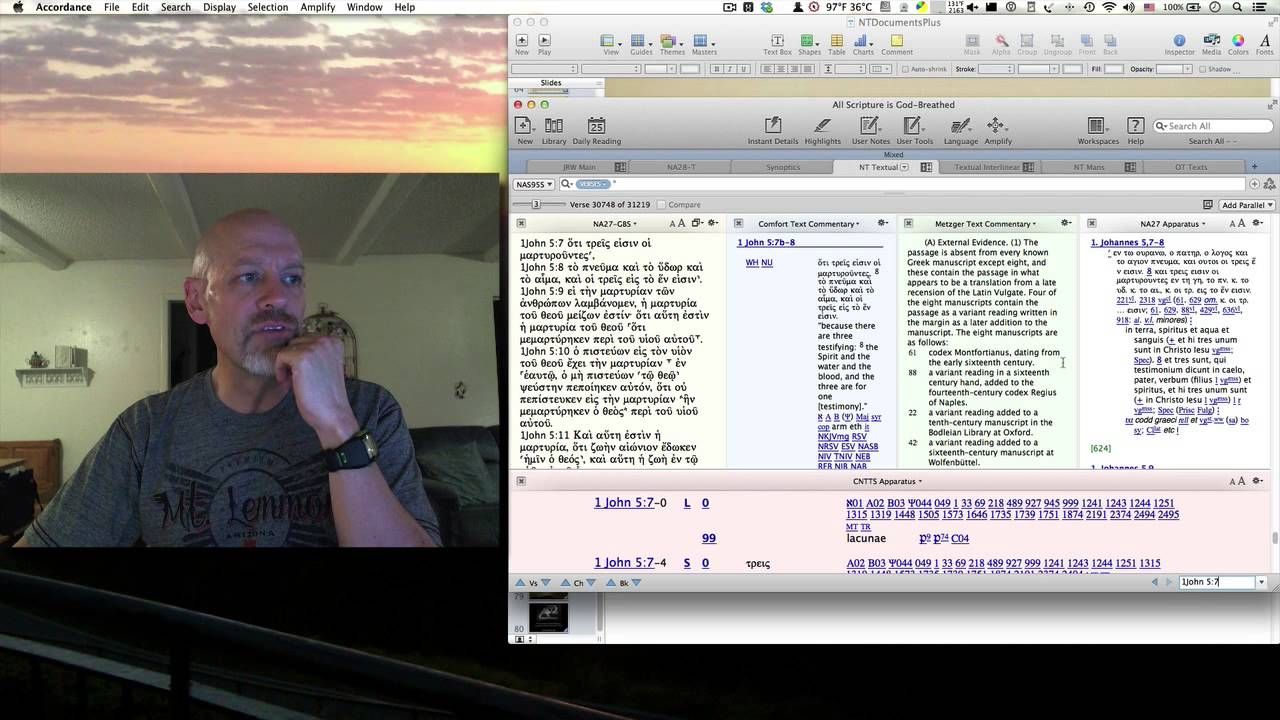
The Comman Johanneum for Reformed Baptists
A quick response to comments made by Pastor Riddle on the subject of textual criticism
Transcript
So this morning at Confessing Baptist one of the first things I got in in Twitter when I got up this morning was a link
To an article an audio that was posted to Confessing Baptist this morning
Jeff Riddle interacts with James White's answers to issues related to textual criticism. It's an audio file
Along with just a brief summary that's been posted here There's there's a lot that could be said in in response to this
I was I was Disappointed very disappointed Instead of interacting with a book that I wrote
What 19 years ago? It's been out at least that long. I wrote it. I actually wrote it 20 years ago.
It took a while to get out but That's been used as a textbook for all that time That has all the references hundreds of footnotes and instead of interacting with my actual presentation, which was fairly lengthy it's only about a snippet that Todd Friel posted where he's asking me a single question about King James only and A lot of the you know,
Pastor Riddle Says I'm trying to undercut people's confidence in the traditional text and all the stuff
Well, if you want to make that argument, how about going for my real stuff rather than the cheap shot?
Because that's that's really how it felt it was I mean, I've discussed this stuff for decades now
Why go for you know a few snippets? hurriedly answered at the end of a longer presentation
You know, for example, Pastor Riddle says and I'm just following after Metzger and stuff If you go to the book, you'll find all these references to Erasmus biographies and histories and articles and stuff like that So, you know, it was it put me off along those lines
But be that as it may I realize there are reformed Baptists that are TR only I think
It's primarily because they've been reading Turretin of lots of folks like that great men of God but when it comes to textual criticism
If anyone wrote before the discovery of the papyri What they had to say
Isn't all that relevant anymore to be perfect honest with you. I mean sure theology things like that. That's great fine wonderful But as far as the actual state of the question if you're writing before the discovery of the papyri
You're you're writing on the basis of Minimal information and it's very difficult to really
Be consistent at that point So, you know, I understand they're reformed
Baptists take that perspective Okay, I don't think it's consistent. And the reason I'm doing this is one of the things that came up is something
I feel very strongly about I take The reformed
Baptist belief in the inerrancy of Scripture into battle around the world
And there's a big difference when you do that then the theory in the in the nice quiet of the study
What might work real well in the study doesn't work in front of Bart Ehrman or John Dominic Crossan or Marcus Borg Or Shabir Ali or all my
Muslim friends it's real easy to you know, armchair quarterback things, but I have to take this stuff into the into the battle place of ideas
And One of the things I feel very strongly about is the Kami Ohanian. I think anyone
Who demands that the Kami Ohanian as found in the text of Septice not in the Byzantine text, it's not a majority reading you have to for some
I think primarily theological reason invest and there isn't any just one text but You know the 1633
Elsevier or the or the you know, a Scrivener's text or whatever
You get to pick and choose which one you want because there's variations but for theological reasons this authority is given to the textus receptus, but Inconsistently so because the the
Kami Ohanian is not a Byzantine reading. It's not a Greek reading and So if you defend the
Kami Ohanian first John 5 7 in the King James version of the Bible If you defend that as original
I do not believe that you could ever defend the concept of the accurate transmission of the text of the
New Testament against any meaningful opponent Atheist Muslim, whatever you couldn't do it
To to defend that text is original is to abandon all Meaningful apologetics of the
New Testament. Just just admit it. Just just give it up. I Feel very strongly about that Because if you can defend a reading that arises in the
Latin tradition Enters into the later Latin versions is
Not a part of the Greek manuscript tradition is not a part of the manuscripts from which any of the early versions were translated if if a vitally
Theological Assertion like that can disappear wholesale
From the New Testament, then we have absolutely no reason to believe the New Testament's accurate none
Just give it up. Just just throw in the towel And I just don't think most of the people who have a traditional
Dedication to this recognize that they are in essence Destroying any meaningful
Apologetic for the defense of the New Testament by holding this position. I don't think they realize that I just don't think they've ever been in a position to have to actually defend it in that kind of a context
It's one thing debating your fellow Baptist friends about it's another thing to take it up against a Bart Ehrman So I feel strongly about this.
I I know the background of the TR and I know the background of the Kami Ohanian and Pastor Riddle even reads from Metzger's commentary on this, but he didn't actually read everything from Metzger's commentary on first John 5 as we'll see
But I want to address what was said here because I think it's very very important for us to give a meaningful defense for the accuracy of the transmission of the text in New Testament and If you hold the comma,
I just don't think you can so let's listen to what's what's found here and I hope this will come through.
I'm playing it just a little bit quicker. I listened to it at two times speed, but Let's let's listen to this section here and I'll make some some comments
All right.
Let me address this for a second. He says that the TR Has the
Koma Yohaneum and again, this is this is accurate This is a place where the TR would diverge from the so -called majority text or Byzantine text
He he mentions that The Koma Yohaneum doesn't appear in Greek manuscripts until the 14th century.
Let me address a couple things related to that I Haven't gone to check the apparatus
To see when exactly the first The earliest Greek manuscript that it includes the
Koma Yohaneum is It may be late But again, but the date of the manuscript should be less important it a late manuscript may contain a tradition
That is goes back to the various very earliest sources So just because a document is late doesn't mean that it is invalid now.
This is very important. There are Certain Minuscule manuscripts
That have been identified by scholars as having been copied from very early much much earlier sources than they themselves are 1739 1881 are the two most famous minuscule texts that clearly are copied from From magiscule texts that go way back none of the manuscripts that contain the
Kama Yohaneum in Greek have Any meaningful claim to be a
Much later copy of a much earlier source none none here here on the screen
Taking out the manuscripts that only contain the reading in a like 18th century hand in the margin we have
The list here we have one from the 14th 15th century number 629 Which is a
Greek Latin diaglot and the Greek is taken from the Latin text now No one is arguing that by the 6th century as Metzger pointed out
That the Kama is a part of the Latin Vulgate It's not a part of the other translations.
It's not a part of the Greek. It has entered in via a gloss Similar to how John 5 for did into the
Greek manuscript tradition, etc, etc Into the Latin at that point now, we are Baptists and so we do not invest the
Latin Vulgate with infallibility We got rid of that long time ago so Here the reading is in a
Greek Latin diaglot. It's in the Latin. So it ends up in the Greek There's no reason to think that there is a
Greek manuscript behind that that there's any earlier Transmission in the in the
Tradition there Behind that it's coming from the Latin then 1520 we have
Codex Monforteanus and Here by the way, since we're doing this live. There's lots actually my friend
Doug. He's a lot smaller now, but all you can see is my Part of my arm right there, but there
I am examining Codex Monforteanus in the library at Trinidad College, Dublin a number of years ago and So we have
Codex Monforteanus. That's the one that Actually differs in reading from the text in the
Texas Receptus But that is that is the one that many feel was actually written to refute Erasmus and that caused him because remember
Erasmus did not Have this reading in his first two editions of his Greek New Testament Something that I don't think unless I missed it because I was listening to it quickly
So maybe I did miss it, but I don't think Pastor Riddle mentioned that But anyway that this was the the manuscript that Evidently forced
Erasmus to insert in the third edition. It's remained there ever since that we have one of the 16th century code number 918 16th century codice
Codex 110 Codex Ravianus and the 18th century number 2318 those are all original and they are all after the invention of printing
What this means is that? Functionally the Kami Ohanian is not a part of the
Greek manuscript tradition if you cannot find the earliest references until Almost a millennium and a half
After the original writing There's no reason whatsoever to think that that's original none
And so there you have the evidence it was right there in Metzger, I'm not sure
Why the pastor didn't didn't actually give us everything in Metzger's because when we look at Metzger I can't blow it up large enough for you to really see it here.
I'm sorry, but if we look at Metzger, he actually under external evidence gives us the manuscripts
I just gave you plus the others with the Readings and the margins then he also points out number two
The passage is quoted by none of the Greek fathers who had they known it would most certainly have employed it in the
Trinitarian controversies Its first appearance in Greek is in a Greek version of the Latin acts of the
Lateran Council in 1215 So it's not even a biblical manuscript and it's coming from the Latin once again
Then it points out the passages absent from the manuscripts of all ancient versions Syriac Coptic Armenian Ethiopic Arabic Slavonic Except the
Latin and it is not found in the old Latin in its earliest form So why not mention those things he goes on to to read the
Libra apologeticus reference Which only demonstrates that it was part of the
Latin reading But all this material was right there So when he says
I didn't bother to look it up. I'm not sure why it's right there He's holding the book in his hand and and could take a look at it if he wanted to if he wanted to do so So there's there's some of the the information right there.
Let's let's continue listening here The other thing to take into consideration is that the
Koma Yohaneum There is evidence that that reading has been around for a lot longer than Nearly the 14th century and this is where he goes into what
Metzger says It's funny in one place. He called basically says I'm just slavishly following Metzger and now seemingly doesn't think that I read
Metzger Obviously what Metzger is pointing out here is that it was it originated in Latin and I'm all those people that believes that the key question in textual criticism is what did the original author write and John did not write in Latin and so Doesn't matter to me when something arises in Latin It's relevant to historical studies.
But as far as the original readings in the New Testament We need to stick with what the original authors wrote and not what came about at a later point in time
We continue on a little bit farther along Contrary to what James White implies when he says that it doesn't appear in Greek manuscripts until the 14th century now first I've said just because it doesn't appear until in a
Greek manuscript until late doesn't mean it doesn't come from much earlier source Secondly now, we've got Metzger telling us that it's being quoted
As early as the fourth century in Latin works and then by the fifth and sixth century in the
Western Church It was it was automatically accepted as part of the scriptures now if there were
Latin Versions of it in the fourth century There were probably Greek versions of it
Even if we don't have manuscript evidence of that until the 14th century if you follow me No, I don't follow you.
First of all, nothing that Metzger said is in any way contrary to what I said and again
If you had looked at my published work on this subject, you would see that There's a little bit of tilting at windmills going on here, but no
I do not follow you here Are you saying that every Latin reading has a
Greek origin or source? Do you really want to go there? because this again
I Find I do not believe there is such a thing as a consistent
TR defender doesn't exist can't There are too many errors in the
TR and he talked about going to the Percocet adultery conference with dr. Robinson Dr. Robinson is not a
TR guy. He's a Byzantine guy and Dr. Robinson would not say that his own principles
Would contradict the insertion of the Kama Johannium He's a majority text guy in the sense of the
Byzantine text platform because that's the majority text Not majority in the sense of the
Hodges Farr stat They have a methodological difference as to how to work that out. That's we're not getting that right now. I Appreciate dr.
Robinson, I disagree But anyone can tell that when
I have addressed dr. Robinson's position even in the second edition the King James only controversy
I I've done so very fairly and have bent over backwards to even allow his position to speak for itself, but That's not the point here because dr.
Robinson is consistent here His consistent textual principles would require him to defend the
Percocet adultery. No question about it, but not the Kama Johannium just the opposite and so I Do not follow here because if pastor riddle were to follow this methodology
There'd be all sorts of readings So you have to be changing in the TR on the basis of the
Latin Vulgate But he doesn't even go there probably doesn't even know they exist Probably isn't even aware of the textual tradition of the
Latin Vulgate And where it differs and if you make if you if you make this leap just to defend this one why not all the rest where the
Latin Vulgate would require us to Make insertions and changes in the
Texas Receptus whatever version of that you happen to be working with so That is a totally unwarranted leap a totally unwarranted leap then we go off in there something
That's I think relevant if you read the nestle on 28th edition Which I'm starting to do there are places in the nestle on 28th edition where there are complete
What are called conjectural inundations that is there are places in the new modern critical text?
Where the editors have given a reading that doesn't appear in any extant
Greek Manuscript that we have I was talking about this when I was at the periphery adults right conference at Southeastern with Maurice Robinson And he said if you look at Acts 1612 and I think it's 2nd
Peter 310 It might be 1st Peter 310, but anyways you track 1st Peter 310 or 2nd
Peter 310 Those are places where in the new nestle on 28th edition they offer a conjecture
That isn't that doesn't have any extant Greek manuscript that supports the reading if James White and other people are
So upset about the coma yohaneum not appearing in a Greek manuscript until the 14th century
What do they say about the current modern critical Greek New Testament that has readings that have absolutely no
Greek manuscript support Are they going to say we're not going to use this modern critical text and Translations that are going to be made from it and by the way in the future all the modern major Translations will come up with new additions that will adjust to the nestle on 28th edition
My point here is that that those who support the modern critical texts are sort of caught in a conundrum
They want to criticize on the TR for readings that have less solid support
But then they're willing to accept a modern critical text that has readings that have in some places at least no support
But let's listen to a little bit more about James now. I Am especially sensitive to allegations of inconsistency and that's what we just got.
I'm being inconsistent Am I if what pastor Riddle just said was true? I am but of course what pastor
Riddle just said isn't true and Let's take a look at the screen What was ironic here is that pastor
Riddle has it backwards Well a couple things first of all the
Here we have the second Peter 3 reference and Second Peter chapter 3 now
I it probably would be a little bit easier if I had the These these two windows switched back and forth.
I apologize for that but here is
The ne27 right here. Here's the ne28 above it and the ne28 apparatus is down here
So this should be over here. But anyways, I've just told you what it is Here is right here.
Let me see if how See how big I can get that there. There we go You're you're given that little thing right there
CJ conjecture conjecture Bradshaw conjecture is the read the reading
Argo All right, that that's what called a conjectural emendation.
Now. That's not in the text. It's in the apparatus Translations are made from the text almost never from the apparatus
I don't know of anyone who has made a translation based upon a conjectural emendation an apparatus at least not a
Not a major translation not one done by a committee or anything like that So, let's first compare
The level here. We have a central doctrinal affirmation in the Kami Ohana the
Trinity itself sort of It's not how anyone nearly Church defended the
Trinity, but that's another issue Vitally important this I don't think anybody could even tell you what it's about The other one over an axe is about how you express the first in Macedonia and It's whether you have a
Sigma Wow, hmm. Okay. These in other words, these are utterly irrelevant issues
There's another what no Chi is another Enoch and okay is another possible conjectural emendation there's very very very very very few of them and Nowhere, does any of the modern text make the text reading the conjectural emendation?
certainly doesn't hear but the point is The conjectural emendation was in the previous editions of the
Nessie Alan. He's got it backwards. Look at the na -28. Let me let me Well, if I blow this up, it's gonna just sort of disappear for you
But I'll just scroll through the whole thing here and you will notice Go to verse 11 and that which is in the 27 is no longer in the 28
That's because an SEL and 28 took out all the conjectural emendations even from the apparatus So the exact opposite of what pastor riddle said
Is what actually takes place in the in the text? So I'm not being Inconsistent by any stretch the imagination there is no meaningful parallel between any of the conjectural emendations, but may
I now sort of wrap things up with Well, I've got one of the section here color -coded let's listen to it real quick Whoa, so he's saying
James White just said the manuscripts that were used in a TR Did not come till 1200 years after the time of Jesus Well, perhaps some of the manuscripts that Erasmus used dated from the 12th century
But that doesn't mean the content of those manuscripts just sort of magically appeared in the 12th century they include
Copies of copies of copies that go back We could say to the very beginning of the Christian movement
Now, what was I saying? What was I saying to Todd Friel? I was comparing the manuscript foundation of the
TR to that of the modern text What's the manuscript foundation of the TR the manuscripts that Erasmus had?
Because Stephanos and Beza aren't well Beza did a little expansion, but very very little
The primary manuscript foundation of the TR are the manuscripts that Erasmus had and we we know the character of those manuscripts and we know he had a 10th century manuscript that he didn't trust and That the primary manuscript that he did trust was from the 12th century.
That's all I was saying Now if you want to argue, well every reading in that 12th century manuscript goes back to the beginning
Well congrats, you know If you want to do that You gotta have a lot of work to explain some of the odd readings in the
TR some of the readings that have Absolutely, no manuscript support which are discussed rather fully in a book that I wrote about 20 years ago 15 years ago
Whatever 20 years ago 1994 came out in 1995 That discusses all these things, but that didn't get discussed here, but I want to I want to wrap up by asking
Pastor Riddle Maybe the inconsistency isn't on my part because You just objected to conjectural inundations, even though they've all been taken out of the apparatus of the na -28, which is interesting
I'll see what kind of commentary you have on that Um, what about the conjectural inundations in the
TR? Now again my book on this subject documents this rather fully so I'm not gonna spend a lot of time on it but Revelation 16 5
Let's take a rebel look at Revelation 16 5 And I heard the angel of the water is saying righteous.
Are you ha own Kai ha ain ha ha see us Because you have judged us
Righteous, are you the one being and who was the
Holy One now? this is the Nessie Allen 28th and Here is the
Greek Byzantine the Byzantine platform Since you mentioned dr. Robinson, there's there's his work and what does it say?
Ha own Kai ha ain ha ha see us the Holy One the
Holy One, right? Well Here the
Byzantine manuscripts and then the modern text line up They all say the
Holy One, but let me add The TRM and let's blow the text up here.
Oh, I don't look up so much bigger. There we go Oh, wait a minute.
Ha own Kai ha ain Kai ha esaminosh Who was who is and was and is to come
Well, look at that that is a text elimination Yeah, that's a text elimination done by Theodore Beza.
I've actually had some folks man. I'll tell you people will I really wish my reformed brethren would put as much effort into Doing research in reaching
Muslims or dealing with Roman Catholicism stuff as they do in defending TR only ism the few that do it.
I Actually heard of somebody I think I'm the Puritan board who speculated that there was a
That that there once had been Greek manuscripts at the time of the Reformation it had esaminosh and There was a reference to one in a
Latin commentary somewhere, but they've all been destroyed since then The reality is that Theodore Beza Felt that the poetic parallel Who is and who was and who is to come?
Which has other parallels in the Book of Revelation Bit better than ha ha see us and that sense esaminosh and ha see us
Look enough alike in magiscule text that he could make the change and that's where it is
It's not in It's not in Erasmus as far as I know. I have
Stephanos and I if I recall correctly even I even provided the Stephanos 1550 graphic for the second edition of my book
But Beza made the change conjectural inundation. He didn't have any manuscripts that said it Do you defend it pastor riddle?
Is there anything in the TR that should be changed? Should this be ha ha see us? What's your standard?
Because if you say this should be a ha ha see us then you need to get rid of the Kami Ohanian on the very same textual basis, right so consistency requires but I've never met and will never meet a
Consistent TR onlyist because I don't think it's possible. I don't think it's possible.
Let me reiterate one more time Why is this important? It's important because we have to be able to defend
The text of the New Testament in the midst of a tremendous number of tax today and we have to do so with Consistency and if you hold the
TR onlyism if you defend the Kami Ohanian Don't even go into battle Don't even go into battle.
You're not armed. You're not armed The fatality rate will be very high and it won't be good for those who follow you into battle and it won't be good for the war as a whole
So that's why it's important to address these subjects, so there you go Ended up being a lot longer than I expected to be.
Sorry about that. Pastor Riddle. I appreciate the opportunity of responding to you I hope you hear my heart