Keep sharing good news without ads.
Visit our website: https://moorescornerchurch.com/ -If you would like to support the ministry send donation to Moores Corner Church PO Box 42 Leverett MA 01054
Tonight, we're going to be looking at what the Bible says about prayer, so let's open up to the Gospel of Luke, chapter 11. Luke chapter 11, we're going to see what Jesus says about how to pray. We'll talk about what prayer is, but we're also going to talk about what prayer isn't.
So over the past 10 years or so, I've done Bible studies and sermons on the subject of prayer, and usually it's all been pretty similar. Always try to establish that basic principle that God answers prayer according to His will.
We know this. We don't always get an affirmative for whatever we ask. Sometimes we ask amiss, as the Scripture says. We ask for the wrong things. We know from 1 Peter 3, verse 7, that sin and strife in our relationships can hinder our prayers.
But I've never really... So I've talked a lot, I think, over the years about prayer and what prayer is, how to pray, but I've never really talked about the wrong way to pray. So I want to spend a little time tonight, since this is the first lesson in our discernment series.
Discernment is not just explaining the difference between right and wrong, it's explaining the difference between what's right and what's almost right. So something can seem good, they're talking about Jesus, it's in church, they're praising the name of Jesus, but we want to look at all things, are they biblical?
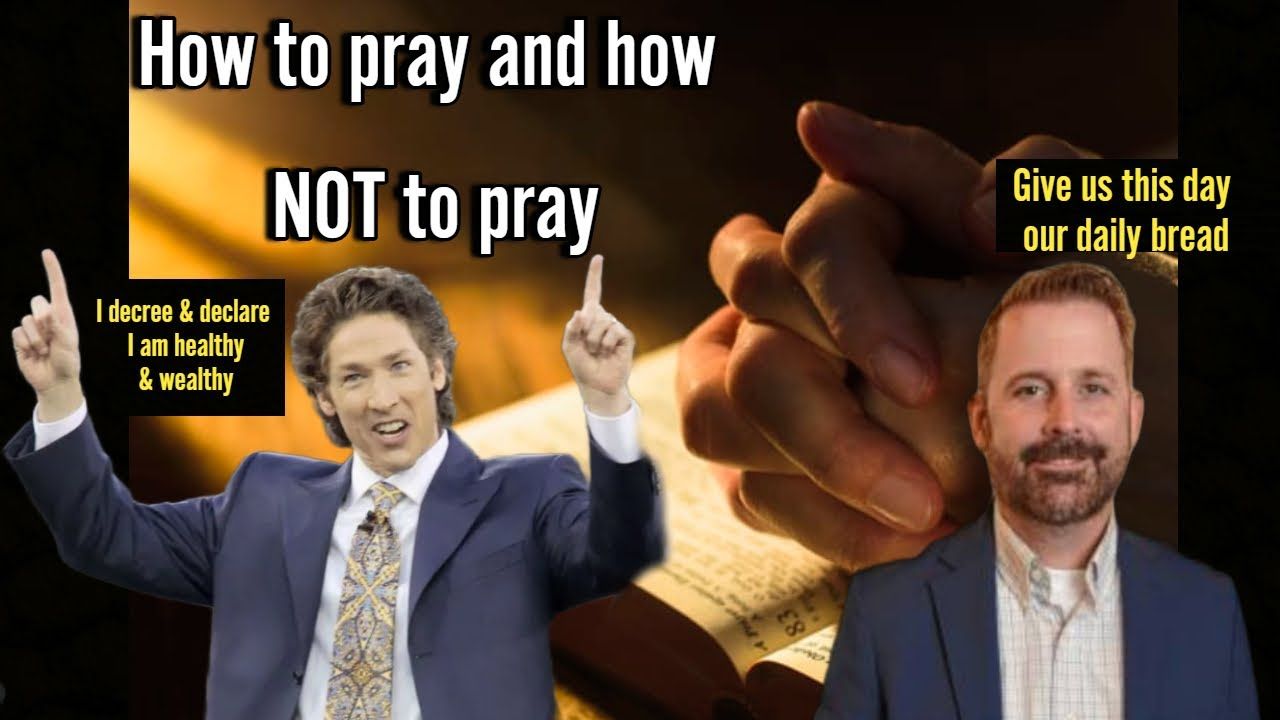
So for that reason, I've noticed this new trend that has really gone mainstream. We're gonna watch a video clip in a moment, and then a few more later on. But this has gone mainstream to where people are no longer, I mean, they're doing this too, they're praying to God and asking for things, but now it's very common to hear people making what are called declarations, or decreeing and declaring.
Who's familiar with this? You've heard people stand up in church or in a meeting and they're declaring things like this, it's almost like they're God and they're decreeing what's going to happen. So a lot of Christians are being taught this, and here is a brief example of something that, it doesn't really seem like prayer, but it sort of is, but it's, yeah, making declarations.
So let's just watch this first clip and then I'll explain.
If you were to do the declarations for 31 days, your life would change. That's what you did it for, right? Yeah, that's exactly right.
One day a month, and you can continue to do them, and it's a great start.
You can watch Pastor Joel's entire I Am Servant, we have it on Oprah .com. Final thoughts from you, Pastor Joel.
You get up in the morning, you're in the shower, you're driving to work, saying, you know what, Lord, thank you, I'm strong, I make good decisions, I'm healthy. Just simple things like that.
I'm looking forward to my future. Yes, yes. I'm looking forward to my future. Yes, yes. Could you lead us in a few I Ams?
Absolutely. Can we all stand?
Can we all stand? All right, let's stand.
All right.
All right. Just repeat after me. I am strong.
I am strong.
I am healthy.
I am confident.
I am secure.
Okay, he kind of goes on like that for a while, so. Now, I want to be fair. There is something to, you know, because he goes on about negative thoughts and negative. There are some people that are very negative.
They have a lot of negative thoughts, and they're always speaking negative words. And yes, that can have a negative impact. If you're always negative, other people aren't going to like that. And it's not really doing you any good.
So there is a problem with the positive only type of ministry. But yeah, okay, there is a point to be made about people who are maybe too negative. So that, I grant. But you saw the video. I declare, or, you know, I am this.
I am successful. I am healthy. I am this or that. Normally, Joel Osteen will end those declarations by saying, in Jesus' name. And then his congregation will say, amen. Which does make it seem like it's sort of like a prayer.
Since that was the secular audience with Oprah, he doesn't do in Jesus' name. But he did mention the Lord, right? He did say something about talking to the Lord. But instead of asking for good health, you notice he's declaring it.
He's making declarations that it is so. So if you're speaking to God and you're declaring things, I mean, that is a form of prayer. But it's not prayer, like the Bible says, and bring your petitions before the Lord and ask the Lord.
You're making a statement. You're not really asking. You're decreeing and you're declaring. So that's a brief example, maybe, of how not to pray. More on that later. But just to prove this isn't just something you see on TV.
Who remembers those prayer meetings that Dennis Jacob organized over at the Moody Center? Remember the first one? Who was there at that first one where there was like 70 people? I think 4D1G opened and then we had a prayer time afterwards.
So I just remember at the end of that prayer time, a woman stood up in the back and she had a Bible. I think she had the Passion Translation of the Scripture. And she said something like, thus saith the Lord.
And then it's like, oh, wait, that's not the Bible. She said, thus saith the Lord. And then she was kind of giving her own words. And then she started to decree and to declare things as if like she was talking as if she was God or as if she was a prophet of God.
At that point, Dennis intervened, thankfully, because he knew what that was. Dennis understands that's all part of the prosperity gospel, little gods, basically the name it and claim it movement. Who's heard of name it and claim it?
So you're not asking God, you're saying, I declare this to be so. You name what you want and you declare it. And the idea is if you just have enough faith, it will happen. So this is very widespread. It's happening on television.
Joel Osteen is about as mainstream as you can get. It's happening on TV. It's happening locally. So that's why I think it's important to not just talk about how we should pray what Jesus says, which we're going to look at, but also this new thing that's coming into churches that we're going to talk about how not to pray.
But let's look at the scripture first. Luke chapter 11, one through four. This is the passage where the disciples come to Jesus and they ask him, Lord, teach us to pray. OK, so this is this is the passage we want to go to learning how to do it.
Luke 11, one through four says now it came to pass as he was praying in a certain place when he sees that one of his disciples said to him, Lord, teach us to pray as John also taught his disciples. So Jesus said to them, when you pray, say this, and then he gives what we call the Lord's.
Prayer.
Our Father in heaven, hallowed be your name, your kingdom come, your will be done on earth as it is in heaven. Give us day by day our daily bread and forgive us our sins, for we also forgive everyone who is indebted to us and do not lead us into temptation, but deliver us from the evil one.
So most people agree that this what we call the Lord's prayer. This is a model prayer. I think it's totally fine to say it as is, and we do that every Sunday. But really, I think it is it's a model prayer to teach people this is the general pattern of how you should pray.
So what's the first thing we see? You address who? Yeah, you're addressing God the Father. I don't think it's wrong necessarily to pray to Jesus. To pray to the Holy Spirit. I don't know that that's wrong.
I just I see Jesus saying pray to the Father. So that's what I try to do. Clearly, we're praying to the Father. So he gets to decide whether and how it gets answered, right? We don't get to determine how the prayer is answered.
We're bringing it to him. God decides. So this is where I think you need to establish this is a key principle. If you're taking notes, write it down. 1 John 5 .14. Really, this is assumed straight through the Bible.
This is assumed straight through the Old Testament. But we get this clear statement. 1 John 5 .14 says, now this is the confidence that we have in him that if we ask anything according to his will, he hears us.
So we pray to the Father. And if it's according to his will, he will do it. Now, if we pray and ask God for something that is not according to his will, what's he going to do? He is not going to answer it in the affirmative if it's not his will.
He may answer it in a different way. So prayer, obviously, is not just a blank check. We don't get to declare and decree things. God makes decrees. We don't. I mean, the only way I can decree something is if I'm just repeating what God says.
And even then, it's not me decreeing. It's still God decreeing it, right? Now, I mean, push back if there's something I'm not thinking about. If there's another argument, I'm willing to listen to it. But another thing I'd write down, the acronym ACTS, A-C-T-S.
I think this is a good thing to keep in mind. A stands for adoration. So this is how you would pray. Start with adoration. C stands for confession. T stands for thanksgiving. And then S, supplication.
That's last. So the last thing we do is ask God for things. Because the temptation is when we pray, just to go through a list. God, can you do this? Can you do that? And prayer should be more than just asking God for things.
It's about our relationship with God. If you have a relationship with a person, you talk to them, right? So prayer is our way of talking to God. So when we pray, we're learning in the Lord's Prayer. This model, we start by speaking to the Father.
We praise Him, keep His name holy. We confess our sin. We ask God to forgive us. And we thank God for what He has done. I mean, this is just a general way to do it. So verse two, when you pray, say, our Father who is in heaven, hallowed be your name.
So when we talk about God's name, we always want to speak of God in a reverential way. Realizing He's Lord, He's King. Thy kingdom come, thy will be done on earth as it is in heaven. This is our hope.
We want Jesus to return. We're looking forward to this, that His kingdom would be established on earth. That way, His will will be done. This is our desire. Verse three, give us day by day our daily bread.
I think this shows our dependence upon God. It's also implied here that we should pray every day. There's that verse, pray without ceasing. That doesn't mean 24 hours a day, but you just continually, you pray every day, probably multiple times a day.
And give us this day, our daily bread. It also demonstrates we can pray about the little things. Our daily bread. Some people have the idea that, well, I don't want to bother God. You know, unless it's something big.
Wrong.
We can talk to God about anything and everything, even the small things. Verse four, we confess our sins, says and forgive us our sins. For we also forgive everyone who is indebted to us. So we remember who we are, who God is.
And if we bring this up, confessing our sins, seeking God's forgiveness, that should help us to be more patient with others. Because we realize we need to be forgiven. So we, Lord, help me to forgive other people.
You know, we don't want to become boastful or arrogant in our prayers. We want to remember who we are and approach God humbly. And that's very important. And then the last part, verse five, do not lead us into temptation, but deliver us from the evil one.
Now, does God lead us into temptation?
No.
James 1 .13. So God, here's the thing, God never actually leads you into temptation in the sense that God will never entice you to sin. James 1 .13 says, let no one say when he is tempted, I am tempted by God.
For God cannot be tempted by evil, nor does he tempt anyone. So the idea when Jesus says to pray, lead us not into temptation, it's more of the idea that we would avoid those situations altogether. And if not, that we would pray that the Lord would deliver us.
And if we're constantly praying, you know, think of it like filling your gas tank. I mean, if you're driving around and you don't fill your tank, you're going to run out of gas, you're going to get stranded.
I mean, if you're never praying, you're not filling your spiritual tank, so to speak. So, you know, you're going to run on empty. And when temptation comes, you're going to give in because you're not praying.
You don't have that spiritual strength. So the Lord can deliver us from temptation. He can make sure we avoid it altogether. And these are the things we're asking. And then the final statement, deliver us from evil.
That's how we usually pray it. But here he says, deliver us from the evil one. So specifically, deliver us from Satan and his plans. Because the devil walks about like a roaring lion seeking whom he may devour.
And that'll be us if we're not praying and being mindful of these things. So these are kind of the basics of how to pray. I'll get more specific later on. Because in the Psalms, you get a lot of specific prayers where David or the psalmist is praying.
He's going through one situation, so he prays this way. A different situation, he prays a different way. We can learn from the Psalms in how to pray. So let's turn to James chapter 4. So that's the right way to pray.
Let's spend a few minutes on the wrong way to pray. I know there's some pastors, their philosophy of ministry is don't tell people what's wrong, just tell them what's right. Just preach the gospel, just tell them what's right.
Don't get into what's wrong. Well, that's a good way of maybe avoiding upsetting people. That might work. But when I read the Bible, I see the apostles pointing out what's wrong. So I've never really bought into that.
So there is a wrong way to pray. For example, if I pray like I did earlier, and I say, okay, Lord, there's a missionary coming to town, and she needs a place to stay, and we want her time to be enjoyable.
And Lord, open up a situation where she's gonna have a place tomorrow. Like, that's a good thing to pray, right? I think that's a spiritual prayer. God, forgive me for what I did. Please forgive me. That's a good prayer.
If I pray and ask God for a million dollars, though, or considering inflation, if I go home tonight and pray, Lord, give me $10 million. Is that a spiritual prayer? I don't know. I mean, that might be a little indicator that I'm carnally minded, maybe, possibly.
So there's a wrong way, and certain things that are wrong, it's wrong to pray for certain things. If I say, Lord, I need a new Ferrari, new private jet. I don't know. I'm thinking that's maybe not the best prayer, right?
This is where James, you're in James 4. This is where James 4, verse 3 applies. What does he say? You ask, and you do not receive, because you ask, what? You ask amiss. Does anyone else have a different translation than that?
What does that mean? You ask amiss. You're not asking in God's will. You're asking the wrong way for the wrong things. So he says, you ask, and do not receive, because you ask amiss, that you may spend it on your pleasures.
Okay.
So I think asking for a new Ferrari might fit that. You agree?
But then someone will say, yeah, but in John 14, Jesus said, whatever you ask in my name, I will do it. Jesus did say that. So I would point out, though, Jesus, number one, he said that to his apostles and not to me.
So I don't know that that's a guarantee for me. Number two, you have to compare scripture with scripture. I admit there are some verses where Jesus makes it sound like, yeah, if you pray for anything in my name, I'll do whatever you ask.
But you have to compare that with 1 John 5, 14, that if you ask according to his will, he hears it. So we have to compare scripture with scripture to get that balance. And then number three, this idea that we can have whatever we ask for, if we ask in faith, this is where you get into the name it and claim it doctrine.
So I want to spend a little time on this, because there's really an entire movement, and I showed the clip of Joel Osteen, who really Joel Osteen is not as bad as some of the other people. He's fairly mild when it comes to this stuff.
But this is very widespread on Christian television. Like I said, it's trickled down into local. So there's local churches that are teaching this. But this is all part of what is called the word faith movement.
So this is a subset of the larger charismatic movement. To be fair, not all charismatics are the same. There are a lot of charismatics who don't go along with this. So that's true. But many people are taught, if you just speak the word, the word of faith, if you just believe hard enough, whatever you speak, that word, it will come to pass, that it's something like a guarantee.
And some of the more extreme cases, there will be famous preachers who say, you know, health, miracles, healings. I mean, it is a guarantee if you just do this, do this, and do that. And then, of course, when people are not healed, when they don't get their miracle, when Aunt Sally is not cured of cancer, what's the response?
Yeah, well, you didn't see, you must not have had enough faith. And I really believe that's a type of spiritual abuse. And I won't tell you what I really think about that. But, you know, you can imagine.
So let's look at some of these examples of the word of faith movement, where prayer becomes less and less praising God and asking God. They do that, too. They'll praise God, and they'll ask God for things.
But it becomes more and more about making declarations and decreeing and declaring what will happen. So in this second clip, I'm not just playing this to critique Joel Osteen. Like, Joel Osteen, there's a lot of people worse than him.
But Joel Osteen, like I said, he is about as mainstream as you can get. So I think that's why this is a good example. But let's see what he does. I think this, I think you'll get the idea. Let's just listen to this next clip.
This isn't so bad. Lord, as we start off the new week, we say it publicly. You're our Lord, our God, our Savior. Make us and mold us into who you want us to be. Lord, I thank you that you're opening the right doors and closing the wrong doors, bringing the right people across our path.
And Lord, weed out those that shouldn't be there. Give us wisdom to make great decisions this week and in life. Lord, I thank you that we'll make decisions that honor you, that move us toward our God-given destiny.
Lord, I thank you that we will not be at this same place next year as we are right now, but that we are moving forward. And we are coming up higher, getting better and closer in our walk with you, and better off in our career and our finances, our skills, our gifts, our talents coming out in new ways.
Better in relationships, kinder, more compassionate. Lord, I thank you that we're growing, maturing, that we'll never get stuck or stagnant. Lord, that we will become all that you've created us to be.
Lord, you've done great things in the past, but we thank you in advance for the great things you have in our future, for the new doors you're going to open in 2019. And we will take new ground. We will set new standards, and we will step into new levels.
And 2019 won't be a maintained year, but it'll be an advancing year.
Okay, so I don't think there is anything too bad with that. I mean, that was a pretty standard. It kind of annoys me how he interjects finances into like everything, but, you know, I don't want to nitpick.
I think that was a standard prayer you might hear in any church. So, you know, that would be, I think, an appropriate way to pray for the most part. But, and I just noticed that he had a certain outfit on in this next clip.
It's the next thing that happens. So he does his prayer the right way, I think, but then he moves into his second part of the prayer where he does the declaration. So it's this second part that I want you to focus on.
From now on, I'd rather us all say it together. So are you ready? Here we go. I am blessed, prosperous, redeemed, forgiven, talented, created, secure, disciplined, focused, prepared, qualified, motivated, valuable, free, determined, equipped, empowered, anointed, accepted, and approved.
Not average, not mediocre. I am a child of the Most High God. A victor, not a victim. I have seeds of greatness. My best days are still in front of me. I will become all God created me to be in Jesus' name.
And if you receive it, can you say it with me tonight?
Any reactions, Marcus?
Me?
I always have a reaction. It does not say what? Who is he talking to? Is he talking to the audience? Is he talking to himself? I think he's talking to himself. On all these things, he's not saying, thank you, God, for this, or please make me this way.
God's word says that we should be strong, courageous, and we're urged to do that. I mean, a lot of it was, boy, it sounds like the way I do pray. I mean, to be conformed to the image of Christ. But he's saying that it's happened.
Is he telling God what's going on, as if God doesn't know?
Well, that's the thing. That's what I'm asking.
I think it reminds me of when I've heard people say that you manifest in your life.
Yeah.
I don't know where that would come from spiritually, but you have the power to manifest.
And I also noticed that the prayer is mostly about him.
Like, it's about I.
I am, yeah.
Right.
Sounds like where Jesus had the seven I .M .s, now he's saying 17 I .M .s.
Right. Yeah.
So it was, you say, well, who is he talking to? You say, well, he's talking to himself, he's talking to the audience, or he's talking to God. What he's doing, he's making declarations. I mean, he'll say that.
It's time to make our declarations, making decrees. It was said in the form of a prayer, even though his eyes aren't closed, and he doesn't say, our father, and then go into it. It is in the form of a prayer because he ends it by saying, in Jesus' name, and all the people say, amen.
So, and it was right after the first prayer time. So the first prayer time wasn't that bad, but then it moves into this. So this is part of the way some of these word of faith charismatics pray. Making declarations are part of their prayers.
So, yes.
There were people, while Jesus was still alive, that were casting out demons in his name. They were doing miracles in Jesus' name. And Jesus' response was, depart from me, I never knew you.
I would point out in both, there is no confession of sin. He doesn't really do that. I don't really view this as teaching people to come humbly before God. I think we should come before God humbly, not making decrees.
Here's the thing. If I, pretty sure if I stood up in front of a group of Christians, and I just started with my fist in the air, I am smart. I am successful. I am prosperous. You probably think I'm arrogant, and I'm boasting and bragging.
I mean, that's, but either way, these are declarations. And Osteen is mild compared to some of this stuff. I didn't want to play some of the more extreme clips, because someone would say, oh, that's just outlandish.
And most people don't do that. But a lot of people do do this. And it's, yeah, decreeing and declaring. So you're not asking God to do it. You're stating, this is what's going to happen, because I said so.
And that really turns prayer on its head.
Janet.
He speaks in a way that can just draw people in. If you didn't have the training, or the gospel, and the preaching, the way you preach, I know people that are really involved with him, because of the way he brings you, just makes you feel like you're in power of everything.
He's eloquent. He's positive. He's got a great smile. He has better teeth than I do. You know, better hair.
When I witness him, I always tell him one thing, to be careful who you listen to, and what they're preaching, and be sure that they're preaching from the Bible, and what the Bible actually teaches. Because people are just drawn in.
And if they're looking for something, this is a good example of how he can bring you in, and you don't even realize that what he's preaching is wrong.
Yeah, Peg.
Well, and also, the I am, I am, if you're going to keep repeating that, reminds me of the vain repetitions that Jesus said not to do in Matthew 6's version of the model.
The thing that bothers me the most is, I am, as Christians know this, I am is that sacred name of God given to Moses at the burning bush. When Jesus said, I am, you know, the Jews took up stones to stone him, because they knew the claim he was making, I am the Lord.
So for us to kind of take the I ams, and to do that, declare as though we're God. Yeah, I mean, I don't think that's biblical, but he's going to explain why. So this is the last clip. He explains why he does that, and why words are so important, and why the word of faith is so powerful.
So let's hear his explanation.
You are where you are today, in part, because of what you've been saying about yourself. Words are like seeds. When you speak something out, you give life to what you're saying. If you continue to say it, eventually, that can become a reality.
Whether you realize it or not, you are prophesying your future. This is great when we're saying things like, I'm blessed. I'm strong. I will accomplish my dreams. I'm coming out of death. That's not just being positive.
You are prophesying victory, prophesying success, prophesying new levels. Your life will move in the direction of your words.
Okay, now, okay, maybe there's a little bit of truth to every lie, right? Again, if someone's always negative and speak, yeah, that's not going to do you any favors in life. And if you're more positive, and you have a positive outlook, that can help in some ways.
But he mentions prophecy. You're prophesying over your life. Here's the thing. When God gave a prophecy, God could give that prophecy because God is the one who decrees, and God knows what's going to happen.
God will tell you the future. God can do that. We really don't have the ability to prophesy over our life and declare what the future is going to. I don't, we don't have the ability to do that. And he goes on in the full clip.
He talks about if when you speak negative words, like if you say, well, you know, flu season's coming up. And you know me, I just have bad luck. I always get the flu. He says, you know, if you say that, if you're negative, guess what's going to happen?
You're going to get the flu. That, but that's really superstition. Whether or not you get the flu does not depend on whether or not you said it or not, or however your mindset is. That is no bearing on whether or not you actually get the flu.
So really, it's, in a sense, superstition. It's very similar to the New Age movement, the law of attraction, where you speak positive words out into the universe. And it's like karma. If you speak the words out, it'll come back to you.
And it'll just kind of turn your life around. So I do not believe any of this is biblical. But when you say, in Jesus name, well, oh, it's a Christian thing to do. Well, I don't see the apostles doing that.
I don't see them leading. Paul did not lead the Corinthians and, you know, in their affirmations. And I would wonder what he would say if they were practicing that.
But I see it, these positive things, you know, that you've heard the power of positive thinking. I don't think just because you think positively, that's going to make it happen. But I do think if you think negatively, and I just think of people that tell me, well, I can't memorize.
I say, yeah, for sure. You just told yourself you couldn't. So your brain thinks it doesn't have to. Why try? So you can talk yourself out of some things.
Sure, sure.
But there are things that we are commanded to do. Oh, here's a good one. Jesus said, be ye holy, for I am holy.
He's told us that we should. Yeah, you say, well, I just, oh, I can't. I've been trying for so many years.
But at the end of the day, this is not prayer. This is not how Jesus taught his disciples to pray, to make declarations, and to decree and declare, you know, the way it's going to be. But the whole premise is that you need to do it, speak the words.
And again, if you just believe hard enough, it will come to pass. But ultimately, that's teaching people that faith is really trusting in your own faith. It's dependent on you and you saying the right things and you believing hard enough.
That's not what faith is, though. Faith, I said it on Sunday, faith, true faith is not believing in your own unshakable faith. Faith is putting your trust in the unshakable God. That's why we have to come humbly before God and make our petitions.
We don't tell God what's going to happen. We don't decree it. We don't declare it. We ask. And if God says no, Lord, give me the grace to accept the no. Or maybe he'll surprise us and ask or answer it a completely different way.
But I just think that this decreeing and declaring stuff is just, again, it turns prayer on its head. One last thing before we close. Let's turn to Psalm chapter 9, if you would. Psalm chapter 9. If you want to learn to formulate prayers, like the Lord's Prayer, we get a general pattern, how we should pray in general.
But if we want more specifics and how to formulate prayers, the Psalms are, it's the largest book of the Bible, and they are either poems or songs or prayers that are inspired by the Holy Spirit. So looking at the Holy Ghost-inspired prayers are very important.
Before we read Psalm 9, just a few examples. If you want to learn how to pray, go to the Psalms. Let's say you feel like God isn't there. Maybe you feel like you pray and God isn't listening. You ever felt like that?
Well, Psalm 13, how long, O Lord, will you forget me forever? How long will you hide your face from me? This is a psalm about David or the psalmist feeling like God isn't there, like he's not listening.
And we realize that great men of God have felt that same way. I mean, that's an encouragement in and of itself. But we can learn how to pray by looking to these prayers. If you need to repent of something, let's say you did something, you feel terrible about it.
You turn to Psalm 51. You know, have mercy upon me, O God, according to your loving kindness. For I acknowledge my transgressions, and my sin is always before me. Against you and you only have I sinned.
So we can learn from David's prayer of repentance in Psalm 51. One last example. If you are having a hard time understanding the Bible and you want to learn it better so you can explain it better, you could read Psalm 119.
Psalm 119 verse 33 says, Teach me, O Lord, the ways are the way of your statutes, and I shall keep it to the end. Give me understanding, and I shall keep your law. Indeed, I shall observe it with my whole heart.
Make me walk in the path of your commandments, for I delight in it. Incline my heart to your testimony. So no matter what you're going through, just search it out. There's a Psalm in the Bible probably for whatever you're going through.
Marcus.
Psalm 37 verse 4 is one of my favorites. Delight thyself, and he shall give thee the desires of thine heart. That's often taken out of context. You're starting with the desires of your heart, but if you're delighting yourself in the Lord, your heart's desires are going to be nothing but to please him and follow him.
Sure.
So I think you get the idea. So if you want to know how to pray, not only do we have the model prayer, the Lord's prayer, we have the book of Psalms. So I'll close with these words from Psalm 9. I mean, this is a good way to pray.
I will praise you, O Lord, with my whole heart. I will tell of all your marvelous works. I will be glad and rejoice in you. I will sing praise to your name, O Most High. That's the way I want my prayers to sound right there.