Keep sharing good news without ads.
Sundays at 10:15am - 434 Oak Street, Central Point, OR 97502
www.redeemermedford.org
John chapter 15, I invite you to read verses 1 through 8 with me. John 15, 1 through 8. Brothers and sisters, these are God's very words to us.
Jesus is speaking.
I am the true vine, and my father is the gardener. Every branch in me that does not produce fruit he removes, and he prunes every branch that produces fruit so that it will produce more fruit. You are clean because of the word I have spoken to you.
Remain in me and I in you. Just as a branch is unable to produce fruit by itself unless it remains on the vine, neither can you unless you remain in me. I am the vine, you are the branches. The one who remains in me and I in him produces much fruit because you can do nothing without me.
If anyone does not remain in me, he is thrown aside like a branch and he withers. They gather them, throw them in the fire, and they are burned. If you remain in me and my words remain in you, ask what you want and it will be done for you.
My father is glorified in this, that you produce much fruit and prove to be my disciples. Pray that God will bless that reading of his word and give us understanding of it. Allow me to pray, ask for the Lord's help, and we will get to work in God's word.
Let's pray together. Heavenly Father, we thank you for the gift of the Lord's day. We thank you for this gift of being able to gather in worship, fellowship, and for the purpose of finding encouragement from your word.
And so Father, as we come to the apex of our time together, which is the preaching of your word, I pray that your spirit would be at work, both in the one who speaks and in your people who hear. May Christ be lifted up.
May our souls be encouraged. May we be challenged. May we even be convicted where need be. But above all, may you be glorified. Father, as we pray that for us, we pray that for our friends at Jacksonville Presbyterian Church.
Thank you for Pastor Dustin and the session there. Pray for him as he's preaching through the first letter of Paul to the Corinthians, even right now. Pray that your spirit would bless the preaching of the word.
May disciples be made. May people who don't know you come to know you. May that church grow in the grace and knowledge of our Lord Jesus Christ. Father, we pray that for them. And we pray that for us now as we come to your word.
We ask all these things joyfully in the name of our Lord and Savior Jesus Christ. And for his sake, amen. Please be seated. As I said, we are beginning a sermon series that I have entitled Connected. Connected.
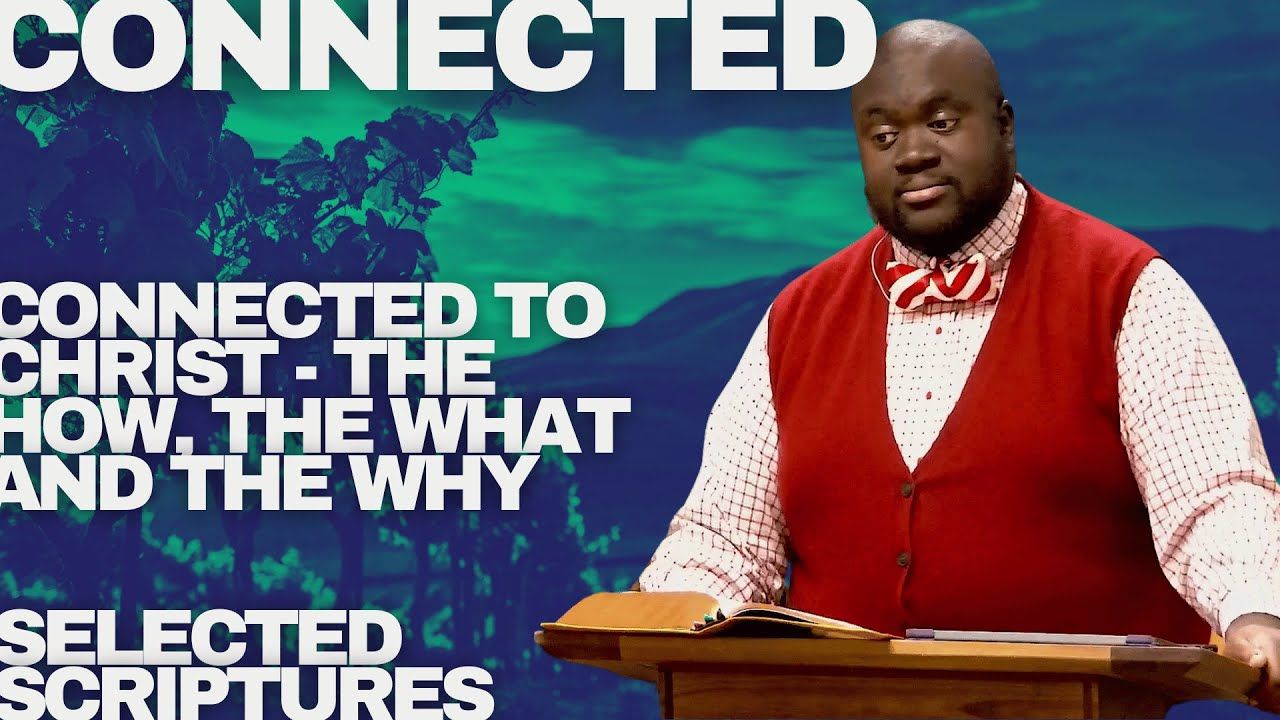
Finding joy in our union with Christ. And this morning, I tagged this text. I've given it the title Connected to Christ, the how, the what, and the why. Connected to Christ, the how, the what, and the why.
I think we can all agree, or at least I hope we can all agree that the world feels a little bit, okay, maybe not a little bit, a whole lot upside down, doesn't it? Doesn't it just feel to you like the world around us is in something of a hot mess right now?
I look at the world around us, and I think the word that comes to mind is confusion. And as I look at the world around us, and I think about the confusion that we see in the world around us, I think the confusion really boils down to three big questions.
Three big questions. If you stop and think about it for a moment, you think about all that we see, all the craziness we see in the world around us.
Three big questions.
Number one, the question of identity. Just who am I? You think that would be an easy question to answer, but our culture has done its level best to make even answering the question of who we are confusing.
So much so that when a Supreme Court justice in this country is being confirmed in hearings, and the justice has asked a simple question, what is a woman? She says, I'm not a biologist. We have confusion on the question of identity.
We have confusion on the question of purpose. So if identity asks the question, just who am I? Purpose asks the question, just why am I here? And again, simply just need to jump on social media, which I don't recommend, but just jump on social media and you will see very quickly, there's a lot of confusion about why we are here.
If there's confusion on identity and confusion on purpose, then of course, you can only imagine that when it comes to questions of destiny, there's confusion. Just where am I going? I don't know. Some people have just given up entirely on answering the question of where am I going?
Don't know and couldn't tell you. Others don't think that asking the question as an individual matters. It all just matters. Where is society going and what can I do to bring that about? If those are the questions that we have, questions of identity and questions of purpose and questions of destiny, well, I mean, you have to ask the question, what answers are people coming up with?
Not for some, but you've asked them, who am I? Well, goodbye. Even in our culture, if you ask somebody, hey, tell me a little bit about yourself, what's the first thing we usually do after telling someone your name?
Oh, I'm so-and-so and I do this. That's not a bad thing to answer that way, but it does kind of portray the fact that for many of us, who we are is simply just what we do. Ask somebody why they're here and again, you'll get some people who might just say, I don't know and I don't really care.
I'm just, I'm not here for a long time. I'm here for a good time. For others, it's, I want to just be good. I want to fulfill my dreams. You know, you'll get super idealistic folks who are just like, I want to change the world.
And of course, you ask people, where are we going? And some have just given up on answering that question entirely. You know, I don't know. And again, does it even really matter? It's the thing, the way that God has made us in his image, we can't help but ask and answer questions like that.
So, have you heard of a site called 23andMe before? 23andMe, the genetic testing site. Do you know how much money they made last year? Anyone want to guess? Try 44 million. 44 million dollars. Because lots of people have questions about where did I come from?
At one point, social media was touted as the place where people will be able to form genuine connections. I've been on Twitter since I was 17 years old. It's never been so bad. It's very clear that whatever social media was intended to be, it has glorious.
Even the current cultural craziness surrounding gender demonstrates to us that we are fundamentally confused. So this, just this week, anyone following March Madness? You don't need to watch more sports, sports are fun.
March Madness is happening right now. I love March Madness. I used to watch it back in the UK. Dawn Staley, who is the coach of the South Carolina Gamecocks women's basketball team, in a press conference just this week, maybe just this weekend even, said that she would more than welcome transgender women to participate in women's basketball.
Again, cultural confusion on all these issues. And in one sense, I'm not really surprised because you expect that kind of struggle in the world, don't you? I expect a world that by and large rejects God and his word to be confused about that.
But let's put the world to one side. What about in church? Do you find that same level of confusion in the church? Are Christians immune to asking the questions of who we are and why we're here and where we're headed?
I've been in ministry long enough to know that Christians wrestle with exactly those same questions. And sure, we can try, as some Christians do, to just borrow from the world and borrow their tools for trying to do this.
We can try some affirmations and some self-help stuff. We can try creating a list of action points for feeling more alive or something. But the reality is even Christians can struggle at times with questions of identity and purpose and mission.
And destiny, excuse me. And I won't be so bold to stand up here and tell you that I have all the answers to all the individual questions you may have. But as a pastor in Shepherd, I think the primary way that I serve you as God's people, if you're here and you're a Christian, the primary way in which I serve you as God's people is by opening up this book and letting God answer the questions that you have.
That's why it's one of the requirements of what I do, that I spend a lot of time in God's word. Because the answers are there if we would simply apply ourselves to finding them. The tools that God gives me as a pastor and teacher are not a mood board or clever slogan.
Those things are not bad in and of themselves. But when it comes to matters of identity and purpose and mission, I suggest to you that this is the toolbox that God has given. So that's why here at Redeemer, we make it our point to teach the Bible, the whole Bible and nothing but the Bible.
Typically we're working our way through books. And yet I think there's also a benefit at times to thinking a little more thematically or dare I use this word topically about what the Bible teaches. And I think that when we think about questions of identity, purpose and destiny, thankfully the word of God gives answers.
This morning, I want to introduce you to a teaching from God's word. A teaching that I believe if you will just hear it and meditate on it. I come from the marketing world. I hate when things are oversold.
So I'm gonna try my best not to oversell this. But I genuinely believe that if you would just simply hear this and meditate on this, this biblical teaching could change your life. This is a teaching that I am convinced will help you or help others you may know to answer questions of who you are,.
Why you're here.
And where you are ultimately going. Well, Kofi, what is this great and grand teaching that you want to share with us? Well, it's known by many names. The standard name that those who studied the Bible give to it is the teaching of our union with Christ.
That word union isn't a word we often use in our culture. I prefer to use the word connection. I think we all understand that term.
Same thing.
It's not a teaching that always gets the most press. It's not, you talk to a lot of Christians, you ask them, what's your favorite biblical teaching? If they can answer the question, they might not pick this one.
But I am convinced and I have been for a number of years now that this is a vital teaching for Christians to understand. And I'm not alone in that. Actually, Christians of previous generations understood that to be true.
Let me give you a sampler. Jonathan Edwards. Some of you have heard that name, Sinners in the Hands of an Angry God, that famous sermon. Jonathan Edwards said that by virtue of the believer's union with Christ, he really does possess all things.
One of my favorite Puritan rites is a man called Thomas Goodwin. Goodwin said that it is through our union with Christ and the perfect holiness of his nature to whom we are united. It is through that union that we partake of the privileges of the grace of God.
That's just two.
There were loads more quotes I could heap up. Were those men overselling the point? I mean, these were very bright men. Was it that they had spent so much time in reading and studying? Did they get lost in their books and manuscripts when they said stuff like this?
Is union with Christ, is connection to Christ that important? Actually, I think it is. And so I asked you to give me just four Sundays. Four Sundays, and let me prove it. Four Sundays, the month of April, for four Sundays, I want us to see how being united to Christ, how being connected to Christ, how that reality can give you real joy, real hope and real meaning in a world that often has those things in very short supply, I think we can agree.
So that's what I want us to consider for the next month as we come to the word of God. This morning, what I want to do is to really just lay a foundation for what we're going to consider in this series.
Because what I'm going to do in the future messages in this series is we're going to look at three texts in the Bible. I won't tell you what they are in advance, but three texts we're going to look at.
These will be sort of mini expositions, if you will. Three texts that talk about this union with Christ, this connection with Christ that all of God's people has. And my hope is I'll be able to show you how they speak to our lives as everyday people.
But before I can do that, I have to lay something of a foundation. We need to define and explain what union with Christ is, what connection to Christ is. If I can put it bluntly, I really want to answer the question this morning, why on earth should I care about this?
If this teaching is not as well known as I fear it is, then maybe I want to ask the question, well, why should we care? That's my aim this morning. Why should you care about union with Christ? Well, simply put, you should care about union with Christ because I would argue this is the Bible's answer to our deepest questions.
Pretty simple. Why should you care about union with Christ? Because I would argue that those three questions we talked about, identity, purpose, and destiny, all of those questions are wrapped up in this whole business of the Christian's union with Christ.
So again, why should you care about union with Christ? You should care about union with Christ because I'm going to argue it is the Bible's answer to our deepest questions. For the rest of our time this morning, I want to walk through four questions.
I want to walk through four questions, four questions about union with Christ. I hope will lay a foundation for answering those questions of identity, purpose, and destiny. Four questions, I'm going to do my best to move quickly.
By the way, this is going to feel more like a Bible study than a typical sermon. I'm going to have you turn to a lot of passages. So hopefully keep your Bibles locked and loaded because we are going to need them this morning.
Four questions about union with Christ, which I hope will lay a foundation for answering the questions of identity, purpose, and destiny. So four questions, let's start real basic. Question number one, what does it actually mean to be connected to Christ?
What does it mean to be connected to Christ? In other words, when I use this phrase union with Christ, what do I mean? I'm not going to spend too long here. Here's my definition based on the best reading and studying I've been able to do for the last few weeks.
Here's my definition of union with Christ. I'm going to put it up on screen. If you want to try and write it down, feel free. I'm going to repeat it a few times, but just a heads up, beginning next week, this definition I'm going to give you will be on each one of the study guides.
If you don't catch it all today, don't worry, you will catch it for sure, because I'm going to put it on the study guide. But here's my definition of union with Christ. When we say we have been united to Christ, that we are connected to Christ, what do I mean?
Simply this, union with Christ is the biblical truth that by faith, God has joined us to Jesus in his life, death, and resurrection, so that all of the benefits of Jesus' work for us becomes ours through the Holy Spirit.
Let me read that again. Union with Christ is the biblical truth that by faith, God has joined us to Jesus in his life, in his death, and in his resurrection. And he's done that so that all of the benefits of Christ's work for us, all the benefits of Jesus' work for us becomes ours through the Holy Spirit.
That's what we mean when we say union with Christ. I know it's a mouthful, that's why beginning next week, it will be on the study guide for your convenience. But that in a nutshell is what we mean when we talk about union with Christ, that God has joined you to Christ, the medium by which he does this is faith.
As a result, all of the benefits of Christ's work becomes yours, and that happens through the Holy Spirit. So let me read it one more time. Union with Christ is the biblical truth that by faith, God has joined us to Jesus in his life, in his death, and in his resurrection, so that all the benefits of Jesus' work for us become ours through the Holy Spirit.
That's my working definition for union with Christ, for being connected to Christ. So that's it in a nutshell. I told you I'm not gonna spend long on this first question. That's what we mean by being connected to Christ.
For your benefit, one more time. Union with Christ is the biblical truth that by faith, God has joined us to Jesus in his life, death, and resurrection, so that all of the benefits of Jesus' work for us become ours through the Holy Spirit.
I'm not gonna spend a ton of time on this because that's what I'm going to basically flesh out in the next three weeks, but that's sort of a working definition for us to start with. Okay, how does that happen?
Well, that's my second question this morning. If question number one is, what does it mean to be connected with Christ? Question number two is, well, how are you connected to Christ? So question number one, what does it mean to be connected to Christ?
How are you connected to Christ? Well, it's important for us to recognize that the way in which we're connected to Christ is that the Father, the Son, and the Spirit all play a role in our connection to Christ.
The Father, the Son, and the Spirit.
All have a role here,.
And it's important for us to be clear on what their roles are so that when we begin to think about this glorious truth of union with Christ, of connectedness to Christ, so that we're clear on what's happening.
So how are you connected to Christ? Well, let's start with the Father's role in this. How are you connected to Christ? Well, you're connected to Christ because the Father chooses a people. The Father chooses a people.
Let's start the sword drill this morning. Turn with me to Ephesians chapter one. Ephesians chapter one. Ephesians one begins from really verse three through to verse 14 with this expression of praise to God for all the spiritual blessings that God's people enjoy in Christ.
Again, I'm going to come back to that phrase in Christ in just a few moments. But Ephesians chapter one, and I want you to look at verses three and four. And as we turn here, I want you to think about this because I'm going to put it to you that there's a right way to think about union with Christ and a wrong way to think about our union with Christ.
If our union with Christ starts from our perspective, well, I became a Christian. And so because I became a Christian, I'm united to Christ. I'm going to say not wrong, but you just started in the wrong place.
You're a little further down the field.
Than you need to start.
And I think Paul made that case to Ephesians chapter one. Look with me at verse three. Ephesians one three. Blessed is the God and Father of our Lord Jesus Christ who has blessed us with every spiritual blessing in the heavens in Christ.
For he chose us in him before the foundation of the world to be holy and blameless in love before him. Notice that Paul connects the father choosing a people.
So verse four,.
He, the father chose us in him in Christ before the foundation of the world. Note that Paul connects the choosing of a people not to the people themselves, but to Christ. Let me see if I can spell out the logic here.
Paul starts by saying that God has blessed us in Christ with every spiritual blessing. Of course, the only way in which we can experience God's blessing is in his son, Christ. And Paul says that this blessing begins.
The first thing he says, as he's saying that we should thank God, by the way, in the original language, verses three through 14 here, one long paragraph, it's all connected. And he starts by saying, God is worthy of blessing of being spoken well of.
That's what that word means.
We should speak well of God.
Because it begins with God choosing us in Christ. And know that this choice isn't based in anything that we've done. Because did you notice verse four? For he chose us in him before the foundation of the world to be holy and blameless in love before him.
This choice wasn't made when you made a decision. It wasn't even made on the fact that God knew you would make a decision. It says that this choice was made before the foundation of the world. Your union with Christ starts before you made a decision to believe in Jesus,.
Before you were born,.
Before anybody was born for that matter. Union with Christ begins with, if you will,.
The choice of the father to say,.
I am going to save a people for my own names sake. This can get tricky, but follow me here for a second. Follow me here. If God's choice was based in anything that you did or in anything that you are, if God's choice was based on you making the right decision, I just have one question.
Just one question.
If God's choice was based on you making the right decision, here's my one question. Be honest. How do you think that's going to go? I mean, let's have a painful moment of introspection for a second. Think about your life from day one till now.
If you think about your life from day one till now, all I want to ask is, would you choose you? Now, I think you're all very honest people here. So I don't think any of you would say, you know what? Actually, yeah, I think God would actually, because let's be honest, I'm from London, in inner cities London, where I grew up, we used to have a saying when something wasn't going to work out, we'd say, it's not looking good, bruv.
It's not looking good. If the choice of God depended on you, it probably wouldn't happen. If you think of it this way, it's actually a gracious work of God that His choice of you isn't grounded in you.
It's actually the most gracious thing that God could do, that He doesn't take you into account. And that's why Paul says, did you catch it? Paul says, for He chose us, not in you, He chose us in Him. If I want right to put it, that just as the Father loved and chose Christ from before the foundation of the universe, so we who are Christ's people were chosen by the Father before the world was created and before any of us existed.
We have to start here with the fact that the Father chooses a people and that He graciously chooses a people who otherwise would not be chosen.
So the Father chooses the people,.
But as amazing as that is, and as wonderful as that is, that only gets you so far. The Father choosing a people doesn't get you all the way to the other side, if you will. So the Father chooses a people, that's where this all starts.
But secondly, the Son dies for the people the Father chose. The Son dies for the people that the Father chose. Yes, the Father chooses a people, but the Father choosing a people is not automatic. It's not automatic that, oh, because He chose them, they're automatically going to be saved.
But something has to happen for those people who are chosen to be saved. But I was very clear about how salvation happens, by the way. In the Old Testament, it's clear. Leviticus 17, 11, God says, the life of a creature is in its blood and I have appointed that blood to make atonement on the altar for your lives since it is the lifeblood that makes atonement.
New Testament picks this up. Hebrews 9, 22, that without the shedding of blood, there is no forgiveness of sins. People cannot be saved without the shedding of blood. It's been that way, I would argue, all the way back in the garden.
Hopefully, you've still got Ephesians 1 open in front of you. Look at verse 7. You know what Paul says? Verse 7, he's continuing to praise God for all the blessings that we enjoy. He says, in Him, in Christ, we have redemption through His blood, the forgiveness of our trespasses, according to the riches of His grace.
In the Old Testament, God sets up this system of sacrifices. He sets up this system where His people can come and make offerings for their sin. And we can debate what happens in those sacrifices. And that's not really the point of my sermon this morning.
What we do know is they had some effect. It did deal with sin, but it couldn't deal with sin finally.
The blood of bulls and goats.
Couldn't deal with the problem of sin. But the Bible makes us to understand that the blood of Jesus can and does. And so the son dies, and that's what brings about salvation. But that raises a question, though.
I think it raises an important question, actually. Does Jesus' death make salvation possible? Or does that death actually save? Does Jesus' death get us a little further down the road with us having to kind of kick in a little bit?
Or does it actually get us all the way across? If I can ask the more technical question, is Jesus' work on the cross,.
What theologians call the atonement,.
The work that Christ does for the salvation of His people, is that work potential and general? Or is it actual and definite? Kofi, why do we have to deal with this? It's Sunday morning. I haven't had enough coffee.
My brain's not ready for all this. Hold on. It's actually massively important, because I'm going to argue that Christ's death wasn't a general work that makes salvation possible. You know, it depends on which way you choose, depends on the right factors.
No, I'm going to argue that Jesus' work doesn't make salvation maybe possible. It actually saves a people who are united to Him. I'm going to argue that's how Jesus understood His own work. Don't need to turn that.
I'll read it for you. But John chapter 6, verses 38 and 39.
Jesus says,.
For I have come down from heaven not to do my own will, but the will of Him who sent me. This is the will of Him who sent me, that I should lose none of those He has given me.
Hold on.
We read that the Father chose the people, right? And Jesus says, yep, He did. And the people that He chose, He gave to me and gave me the task of making sure that none of them are lost. So He says, this is the will of Him who sent me, that I should lose none of those He has given me, but should raise them.
Who's the them?
Those given to Him by the Father. I should raise them up on the last day. In John chapter 10, Jesus is explicit about this. He says, I am the good shepherd. The good shepherd lays down his life for the sheep.
There's one text I want you to see for yourself. Tell me it's John chapter 11. John chapter 11. John chapter 11. Once again, the enemies of Jesus are plotting on how they, essentially how they can trap Jesus once again.
Pick up with me in verse 49. John chapter 11 and verse 49. One of them, the chief priests and Pharisees, that's 47. One of them, Caiaphas, who was high priest that year, Rome had introduced the system where the high priesthood kind of rolled among a select group.
So the person who's high priest this year is Caiaphas. Caiaphas, who was high priest that year said to them, you know nothing at all. You're not considering that it is to your advantage that one man should die for the people rather than the whole nation perish.
Here's John's commentary on that phrase, 51. He did not say this on his own, but being high priest that year, he prophesied that Jesus was going to die for the nation and not for the nation only, but to unite the scattered children of God.
John writes under inspiration that there were people who were gods who had been scattered all around. And Jesus' work would be the means by which all of those scattered people, those people that the father had chosen, not just among the Jews, but among all the nations, that they would come together.
I put it to you that Christ's work doesn't just make people savable. It actually saves a people. As the writer and Bible teacher, Dr. John Murray put it, Christ did not come to put men in a redeemable position.
He actually came to redeem for himself a people. Okay, what does this have to do with you being connected with Christ, with union with Christ? Well, everything, because Christ's death is the price paid to unite us to himself.
Yes, the father chooses the people, and then the son dies for the people that the father chose. And that's good news if you're here today and you're a Christian. It's good news because your union with Christ, think about this, is secured on pain of death, but it's not your death.
It's Jesus' death. And since it's secured on the pain of Jesus' death, think about this, Christian, you can have ironclad assurance. You can have assurance because you are in Christ, and you are in Christ because Christ died to make you.
If you are here today, a Christian, he died to make you his. The father chose a people, and the father gives these people to the son, and the son dies to make this people his. And then the spirit steps in.
And what does the spirit do? Well, the spirit creates a bond between the people Christ died for and Christ himself. The spirit creates a bond between the people that Christ died for and Christ himself.
So many passages I could turn to and go to where that makes this point. Let me just look at one. 1 Corinthians chapter 12. 1 Corinthians chapter 12. Paul is writing to the church at Corinth, the church with a great many problems, one of which was their abuse of spiritual gifts.
And as you come to chapters 12, 13, and 14 of 1 Corinthians, he's addressing the issue of spiritual gifts. And so he starts in chapter 12 with explaining what spiritual gifts are and how they work in the life of a church.
This isn't the time for me to get into that whole subject, but for now, I want to draw your attention to verse 12. 1 Corinthians 12, beginning in verse 12, Paul says,. For just as the body is one and has many parts, and all the parts of that body, though many, are one body, so also is Christ.
For, verse 13, we were all baptized by one spirit into one body, whether Jews or Greeks, whether slave or free, and we were all given one spirit to drink. While union with Christ, while connection to Jesus starts all the way in eternity past with the father choosing a people, and then Christ dies to make that people his, it doesn't become ours in time until, as Paul describes it here, the spirit baptizes us into the body of Christ.
There's lots of debate,.
If you've been around Christian circles for any length of time, about what the baptism with, I don't think it's with, I think it's in the Holy Spirit, that's a whole other conversation for another time.
There's a lot of debate about what spirit baptism is and what it does. When does it happen? Is it when somebody becomes a Christian? Is it some later point? Not really my topic for this morning, but I will say this, I think the text of scripture is very clear when the baptism with the Holy Spirit happens, if you simply read the text on its own terms.
Because what does Paul say in verse 13?
He says,.
We were, past tense, all baptized, so every Christian is baptized in the Holy Spirit, or by the Holy Spirit, by one spirit into one body. When, if you're a Christian, when did you become a part of Christ's body?
At the moment of conversion. It's not you become a Christian and then you become a part of the body later. No, we all recognize that conversion is the moment where a Christian becomes part of the body of Christ.
And so Paul says that at the moment that you became a Christian, you were baptized by one spirit, with one spirit, in one spirit, into one body, Christ's body.
Whether you're a Jew or a Greek,.
Whether you're slave or free, and we were all given one spirit to drink. The spirit, when you became a Christian, baptized you into Christ. You became a partaker, a partner, a sharer in all that Christ has and all that Christ is.
The subject of the Holy Spirit can very quickly end up in the world of the weird and the wonderful. If you've been around Christianity for any length of time, I actually think that if you sweep all of the debate and all of the nonsense that happens out the way, if you just get rid of all that, and some of us read the Bible in its own terms, what's the work of the Holy Spirit?
Very simple, to glorify Christ and to unite you to him. I mentioned the Puritan Thomas Goodwin. He's one of my favorite writers. Thomas Goodwin gave me an insight years ago that has stuck with me when I think about the work of the Holy Spirit.
Goodwin says that the Father promises a bride to the Son. The cross is when the Son pays the price for that bride. And Goodwin says that the Holy Spirit is given to Christ as the love gift of the Father.
To the Son that he loves. And then the Son who loves his bride and has become one with his bride, shares the Spirit with his people. Kofi, what does that have to do with anything simple? When he shares his Spirit with his people, Goodwin makes us to understand, then we become one with the bridegroom.
The Spirit's role in our union with Christ is that he creates a bond between the people that Christ died for and Christ himself. And so how are you connected to Christ? The Father chooses the people. The Son dies for the people that the Father chose.
And the Spirit creates a bond between the people Christ died for and Christ himself.
Well, that leads to a third question. Third question.
We've asked, what does it mean to be connected to Jesus? What, how does connection to Christ happen? Question number three. How does the Bible describe that connection? How does the Bible describe that connection?
I can understand, I can appreciate that. This moment, all of this sounds 30 ,000 foot up in the air. Okay, Kofi, how do we concretely get our minds around all of this? Thankfully, God knows how to speak to us in exactly the way that we need to hear it.
And so to explain this reality to us, the Bible speaks in two ways. There are two particular ways in which the Bible speaks about our connection to Christ. Sometimes it speaks using pictures, illustrations of our connection to Jesus.
I want to just focus on three of them very quickly. So one of the pictures that the Bible uses is the picture of a temple. This picture actually goes all the way back to the Garden of Eden again. Talked about this in our study in Genesis way earlier.
You can find it on our website. But when you look at the Garden of Eden, Eden was designed to be a temple, a place for God to dwell with his people and for his people to worship him. It's laid out, if you pay attention in Genesis to the way it's laid out, it looks like a temple.
Adam is given priestly work to do when he's told to work the garden and to keep it. Of course, the fall happens and man is expelled from the garden, expelled from the presence of God. But God's, if you can use this phrase, God's desire to dwell with his people, that desire never wanes.
And so God's from the beginning had a desire that he would express his desire to be with his people. And so fast forward, God creates a nation called the nation of Israel. And then he tells them to build a tabernacle, a tent essentially that he can live with his people.
And when you look at that tent, it's built with a lot of reminders of Eden. Later on, Israel will build a permanent structure called a temple. And the temple again has a similar layout and features that are meant to point you back to Eden.
Kofi, what does this have to do with Christ temple? Those were pictures, the technical term, they were types, pictures that were preparing us for a greater reality. The greater reality being the relationship between Christ and his church.
So when you get to the New Testament, 1 Corinthians 3 .16, Paul can say, don't you yourselves know that you, and he's speaking of the church, that you are God's temple and that the spirit of God lives in you.
What's true on a group level becomes true on an individual level. So chapter six, he's addressing the fact that there was some confusion about sexual morality among the Corinthians. 1 Corinthians 6 .19, don't you know that your body and the you there is singular.
One of the few times where you in the New Testament is singular. He says, don't you know that your body is a temple of the Holy Spirit who is in you, whom you have from God. You are not your own, but you've been bought with a price.
One of the ways the Bible helps us to understand our connection to Jesus is through this image of a temple, that in Christ, we have become a dwelling place for God by his spirit so that we are now joined to him.
The second picture we've already seen in 1 Corinthians is this picture of a body and its members, the body and its members. The New Testament actually loves this picture,.
Uses it a lot.
Because of time, I'll just read one. 1 Corinthians 12, that we were in verse 27. Paul says, now you are the body of Christ and individually members of it. Bible presents the picture to us of Christ as the head and we are his body.
You all have a body, that's why you're here today. Your head is vitally and inseparably joined to the rest of you. Should you be separated from your head,.
You're over.
And it's the same way with Christ and the Christian. That we are vitally joined to Jesus. And as those who are joined to Jesus, we derive our life from him. So there's the picture of a temple, the picture of a body and its members.
There's the picture of a bride and a bridegroom. A bride and a bridegroom. Again, I don't have time to read it, but Ephesians chapter five, if you're taking notes, Ephesians 5, 25 to 32, that instruction that Paul gives about husbands and wives in the Lord's church.
Remember how he ends that in verse 32? This mystery is profound, but I'm talking about Christ and the church. And actually that's a very helpful analogy if you think about this. Married people in the room, you recognize that a husband and a wife are two people.
They don't stop being two people when they get married. You know, it's not like the wonder twins. You remember that cartoon back in the day? Yeah, they, you know, pound the rings together and suddenly they can merge and take whatever form they want.
That's not quite how a marriage works per se. They're still two separate people. They don't stop being two different people. So I'm married. I didn't become Laura the day that we got married and she didn't become Kofi.
They're still two people, but the two people become one. The Bible makes us to understand they're one in purpose. They're one in their devotion to one another. They're one in their shared life. And so we can say, as the Bible does, that for this reason, Genesis 2 .24, a man will leave his father and mother and will be joined to his wife.
And the two, the husband and the wife become one flesh. When you became a Christian, you were joined to Jesus the way a husband is joined to a wife. They don't become the same thing. There are versions of Christianity which teach that, you know, the longer that you, you know, know God and the longer you participate with God, you can essentially become one with God in a sense where you share.
No, that's pulling the analogy way too far. The Christian doesn't become Jesus or become God over time, but the Christian has a very real and a very tangible union with Christ. And I just picked these three because these were the easiest ones to pick.
There are lots of other ones. If you wanna know more, come join us on Wednesday night at seven during our discussion time. I can share some more with you. But that's one way the Bible speaks about this.
It speaks to us in terms of pictures of our connection to Christ. But it doesn't just speak to us in terms of pictures. At times it talks to us about the results of our union with Christ. In the version of this that will go up on the website this week, I'll include all of the references to what I'm about to read to you.
But when you read the Bible, there are lots of things that happen as a result of our union with Christ. We're regenerated. We are given new spiritual life because we have been united to Christ according to Paul in Ephesians two.
We died in Christ, Romans six. Justification, that happens because of our union with Christ. As Paul says in one of my favorite verses, 1 Corinthians 1 .30, it is because of him that you are in Christ Jesus, who becomes for us wisdom from God and righteousness.
We're sanctified because of our union with Christ. Same verse, Paul says, and sanctification. We persevere in the life of faith because of our union with Christ. Paul could even say in a number of places that when the Christian dies and goes to be with Jesus, that they die in the Lord, that they die in Christ.
Every part of God's work of saving you happens as a result of being connected to Christ. Are you starting to get a sense of just how important this doctrine is? That's how important this teaching is. You see how important it is once you kind of put it all together, you start to realize, whoa, this is huge.
I'm almost done. But before we come to the Lord's table, I want to give Jesus the last word on this. Let's end where we started this message, John chapter 15. John chapter 15. As you turn to John chapter 15, let's answer the final question that I have.
I told you I had four questions. It's question number four this morning. As I wrap up, simply put, why does being connected to Jesus matter? If I haven't convinced you up to this point, maybe the words of Jesus will do it.
So John chapter 15 is another one of these pictures. It's a rather extended one that comes to us from Jesus. And in fact, he explains to you all the major parts of this. So again, look at verse one. I am the vine.
So Jesus is the vine. And my father is the gardener, the one who maintains the vine. Verse five, I am the vine. You are the branches. So the Christian, Christians are the branches who are connected to the vine that is Jesus that is maintained by the father.
So Jesus explains to us all the major parts of this word picture. And as we hit the homestretch this morning, thank you for your patience, by the way. I know it's been a lot. As we hit the homestretch this morning, I want to look at this text very quickly and consider those three questions that we started with.
The questions of identity, purpose, and destiny. I don't want to show you from Jesus's own mouth, how being connected to him, how union with Christ answers all of those questions. Why does being connected to Jesus matter?
Well, if you're a believer, first of all, your identity is found in Christ. Your identity is found in Christ. Did you notice when we read this at the beginning, just how many times Jesus uses the language of in me, first to every branch in me.
Verse four, remain in me. Verse five, the one who remains in me. Verse six, if anyone does not remain in me. Verse seven, if you remain in me. Jesus doesn't view his relationship as, I'm Jesus, I'm over here.
Christian, you over here.
No, no, no, no, no.
Someone remind me on Wednesday night when we gather for me to draw my diagram about union with Christ. Salvation is not Jesus over here. I said Jesus was over here in my analogy, right?
Okay.
If not, he's not here. Jesus over here does stuff for John Christian over here. No, it's Jesus is over here and he invites John Christian over here to come into relationship with him. It is in him that the Christian finds their identity.
That's what Jesus can say in verse two, that every branch that doesn't produce fruit, he removes. I'm not even gonna get into all of that this morning. Ask me on Wednesday. But he says that every branch that does produce fruit, he prunes so that it will produce more fruit.
The Christian, because they are joined to Jesus, is always being made more like him. Sometimes painfully so. But here's the good news for the Christian. Look at verse three.
He says, you are already clean.
Because of the word I have spoken to you.
That yes, though Jesus will,.
I would argue pruning here is referring to the disciplinary work that God does in the life of every Christian. That even in that, he's not disciplining you because you're not his. He's disciplining you precisely because you are his.
That the Christian can have assurance that they are already clean. Why? Jesus says, because of the word I spoke to you. It is the gospel that gives the Christian their assurance. That's the good news of Christianity, that your salvation is very truly in Christ.
That your ongoing growth in becoming more like Jesus happens, not disconnected from Christ, but in him. And that takes the pressure off, doesn't it? It takes off this feeling of, oh, I'm not doing enough.
I'm not trying hard enough. Yes, there is a role the believer plays. But beloved, we play that role, if you will. We work in that, not to earn a right standing with God, not trying to earn in this with God, if you will, but because we have already received it in Christ.
So this becomes a saving and a sanctifying connection, but it also is a life-giving one. Just like branches can't produce fruit outside of a vine, believers can't do anything outside of Christ. And so in a very real sense, our identity is found in Jesus, but not only is our identity found in Jesus, our purpose is found in Christ.
Did you notice how fruit keeps coming up in this passage over and over and over again? I would argue that this is the fruit that comes from the believer's ongoing relationship with God, what Paul will describe in Galatians 5 as the fruits of the spirit.
If I can put it like this, the more that we feed off of our connection with Christ, the more fruit that we will see. Long time redeeming folks know how much I love Matthew Henry. Commenting on this verse, Matthew Henry said, we depend on Christ, not only as a divine upon the wall for support, but as the branch on the route for life.
That's why previous generations could say things like, what is the chief purpose of man? What is the chief end of man? Man's chief end is to glorify God and to enjoy him forever. Can I put it to you that you cannot really find your purpose in life, your ultimate purpose, the reason why you're here, you cannot find that outside of Christ.
How would our lives be transformed if we actually meditated on just that reality?
That in whatever we do,.
Actually Paul says it, 1 Corinthians 10, take one, whatever you do,.
Do all to the glory of God.
And if that's true, then it makes sense that not only is our identity found in Christ, our purpose found in Christ, but our ultimate destiny will be found in Christ. So look at verse eight as we conclude.
My father is glorified in this, that you produce much fruit and prove to be my disciples. God's great desire for you, if you're here today and you're a Christian, God's great desire for you, a desire that he will bring to pass.
God's great desire for you isn't just to kind of languish and just get by. No, God's desire is to be glorified in you as you produce much fruit. And as a result, you show yourselves to be his disciples because ultimately God receives glory both now and for all eternity when the believer is not just getting by in Christ, but he's abounding in Christ.
I have so much more to say on this in the next few weeks. So I'm going to park it here. We'll pick it up next week. But again, I never want to presume that when I preach a message like this, that I'm speaking to everybody who knows this.
Maybe you're here today and you're not a Christian and all of this just sounds like, wait, what? Like, might I suggest to you that as weird as this all may sound, all of this can be true of you if you're here today and don't know the Lord Jesus.
Maybe you found this online and you're listening to this. This can be true of you. Well, this might sound weird and I don't blame you. But the beautiful thing is this, that God sent His Son into the world that He had created, that had rejected Him.
When He sent His Son, His Son came and lived the perfect life that we were unable to live. That when He came and lived that perfect life, He then obeyed the Father in the most radical way possible. He went to the cross.
And when He went to the cross, He died, but He did not remain dead. He rose once again. And as a result of His rising, all men are commanded to turn to Him in faith. And the Bible basically says, if you will do that today, He will save you.
So if you're here today and you don't know the Lord, come talk to me, come talk to any one of us. We'd love to share more about that. And for those of you who do know Him, I hope that the next few weeks help you to just relish and enjoy and be excited by the fact that you are truly connected to Christ.
And Heavenly Father, we thank you for that connection. We thank you that you have done a great and wonderful thing in joining us to yourself. That when we were outside of you, when we were disconnected from you, you chose a people from the foundation of the world.
You sent the Son to die for that people. And the Spirit brought us to you. Father, help us that we would never lose sight.
Of that reality.
Help us that we would always find our identity and our purpose, even our ultimate destiny, not in us, not in anything that we do, but in the work of. And Father, as we come before your table, this visible reminder of the fact that you have indeed made us yours.
Father, may this table take on all the more greater the meaning as we are reminded of our union with you. And we partake of that in a very real sense.
Through this table.
We ask it in Jesus' name and for His sake,.
Amen.