Keep sharing good news without ads.
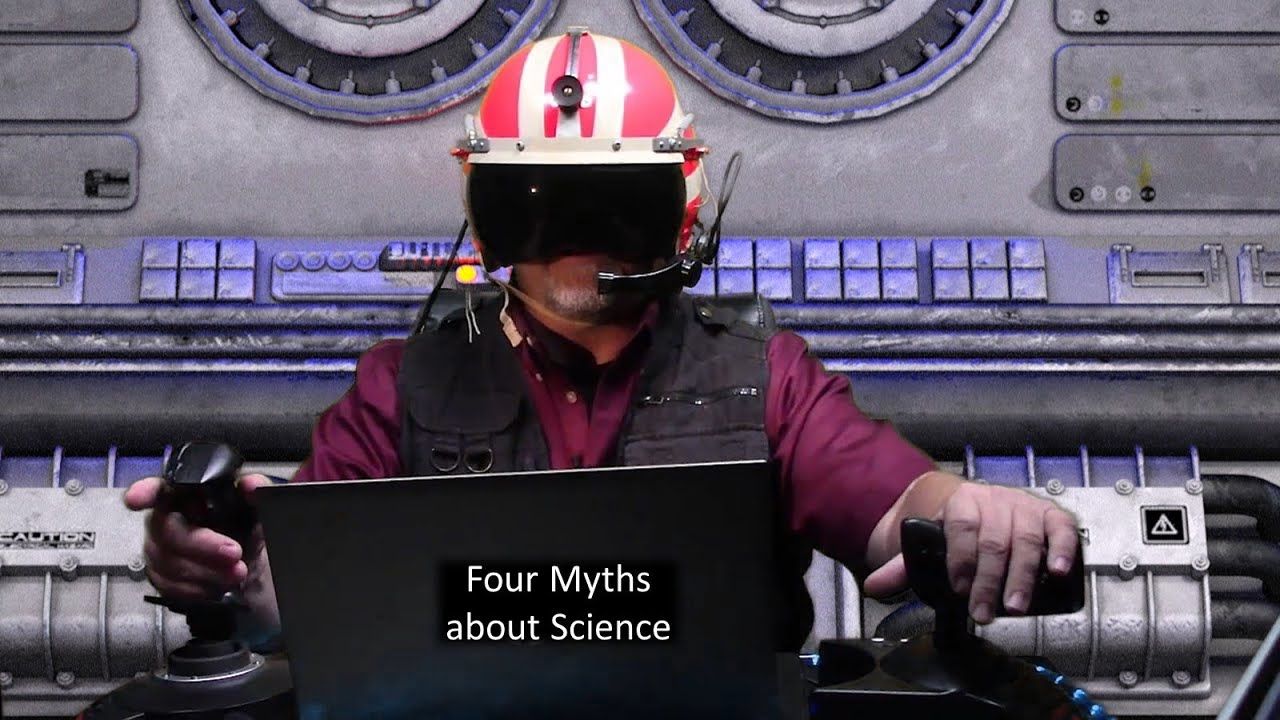
Are scientists always right? Is all science the same? Please join us as we explore the galaxy in search of four myths about science! This video is recommended for students in third through fifth grade.
Well, hello and welcome to The Zone. I'm your host, Big Wave Dave. Today, we are going on an exciting journey. Our mission is to find and debunk four myths about science. Well, it looks like our ship is ready.
Let's get on board. Welcome aboard. Please fasten your seatbelts, because we're going to lift off in just a moment.
We made it.
Now remember, our mission today is to find four myths about science and eliminate them. It looks like our sensors have picked up something over by the moon. Let's go check it out.
Hang on. Something coming up on the scanner.
Tractor beam ready. Lock on. All science is the same? Well, it looks like we found the first myth, my friends. Is all science really the same? No, actually, it's not. You see, there are two types of science.
Observational science and historical science. So, have you ever done an experiment at home or in class? That is observational science. You see, in observational science, what we do is we use testable, repeatable experiments to see if our ideas are true.
Now, observational science is also responsible for cool new technologies. Let's look at a few examples. Thanks to technology, we can talk to anyone almost anywhere. We grow more food than ever. We have invented cars, planes, and trains, even spaceships.
And medical breakthroughs are helping people everywhere. Historical science is quite different. Historical science deals with the unobservable past. See, what happens is scientists will dig up things like fossils and then come up with ideas about them.
The main problem with historical science is that we're unable to test these ideas because these events occurred in the past. Another issue is that the worldview of the scientist has a big impact on how they interpret the evidence.
You see, historical science is kind of like putting a puzzle together but not having all the pieces, or even a picture of what the puzzle is supposed to look like when it's done. So, historical science can be very subjective.
And again, there's really no way to test to see who's right. That's why two people can look at the exact same fossils and come up with completely different ideas about the creatures that made them. For example, somebody who doesn't believe in God will look at this fossil and say, Hey, I'll bet that was an ape man.
While somebody who does believe the Bible will look at the same fossils and say, Oh, an extinct ape. I wonder what it ate. The thing to remember is that observational science and historical science are not the same.
Observational science, we can test in the here and now to see if our ideas are correct. Observational science is also responsible for a lot of the cool technologies that we enjoy today. Historical science is very subjective and we cannot test many of the ideas.
You get it? Great. Okay, so we have proven that this first myth is not true. Let's get rid of it. Lock phasers on target.
Fire!
Alright, let's continue our journey. Uh oh, looks like trouble ahead. Something coming in. Always trust science. Lock on. Fire! Something else coming in. Scientists are always right. Lock on target.
That was a close one. Let's talk about these two myths, okay? Should we always trust scientists? Well, the answer is no, we shouldn't. You see, scientists are people, and people often make mistakes. Now, I was in lighting research for over 20 years, and I can tell you firsthand that there are many things that affect research.
Some examples, politics, peer pressure, pride, who paid for the study, all of these impact the research. They determine what is studied, how and when the results are presented. This is especially true with historical science.
Please remember that. Now, the Bible tells us that the fear of the Lord is the beginning of knowledge. Sadly, people like this gentleman here don't believe in God, and they try to explain everything around them without Him.
Now, this has led people down the wrong paths. Okay, let's look at some mistakes that secular scientists have made in the past. In 1922, scientists found a tooth, just one tooth. And from that tooth, they made Mr. and Mrs. Nebraska Man.
Aren't they lovely? So they went around telling everybody that they had found proof that we evolved from apes. Well, about 10 years later, they went back to the same site looking for more fossils, and they found a tooth.
This tooth was attached to a jaw, the jaw of an extinct pig. So Nebraska Man was a pig, not an ape man. In the 1900s, scientists found a skull that you see here. And from that skull, they drew this really scary picture.
Well, since then, we have uncovered hundreds of fossils, and we now know that Neanderthal Man was fully human. They used fire, they made makeup, and they buried their dead. Now, when I was a young man, I was told that Ramipithecus was our ancestor and was a link between humans and apes.
Well, we now know that this was simply an orangutan. And who can forget Ida? In 2009, scientists announced, Darwin was right, we evolved from apes. Well, since then, scientists have come to the conclusion that Ida was just a lemur.
We have been told for years that human and chimpanzee DNA is 98 the same. However, modern studies have shown that it's only 85 similar, and that there are more than 450 million differences. That's a lot.
Now, as Christians, we should always use God's word to test what people are telling us to see if it's true. We can trust God's word, my friends. Alright, let's continue our journey.
Hang on tight.
Whoa, wait a minute, what is that?
Whoa.
Real scientists do not believe in God? You know, I've heard people say that, but is that true? Let's take a closer look. When you get older, you're going to learn about these guys. They were called the fathers of modern science.
You'll learn all about their discoveries and how we apply them today. What you probably won't be told is that all of them were Bible-believing creationists. Today, there are hundreds of scientists who believe in God.
In fact, the scientists that work for these organizations believe that God created everything in just six days. But don't all scientists believe in evolution? Check this out. Over 1 ,000 Ph .D. scientists have signed a petition saying that they have problems believing in Darwinian evolution.
Why? Because they know that everything could not have just created itself. And did you know that the Bible answers questions that science cannot? For example, where did everything come from? How did life on earth begin?
What is a soul? Is there life after death? Scientists that don't believe in God come up with ideas to try to explain this. Things like the Big Bang and evolution. But when you take a closer look, those ideas really don't work.
We're going to talk a lot more about that during our next session. Okay, so we have proven that this is simply not true. Let's get rid of it. Well, my friends, we did it! Alright, it's time for us to head home.
Hang on. Okay, fasten your seatbelts, because we're about to land.
Great job.
Well, we made it.
Great job on the mission.
You know, I really hope you like science. And if you do, and if you want to learn more, I found these great resources on ICR. They have books about animals, and earth, and space, and my favorite, dinosaurs.
Well, that's all the time we have together. I hope to see you soon here on The Zone. God bless you.