Keep sharing good news without ads.
This is a sermon preached on July 15th at Redemption Church Rutland. The topic is Christian unity and the way forward.
All right, I'll be reading from Ephesians chapter 4, the whole chapter. These are the words of God. I, therefore, a prisoner for the Lord, urge you to walk in a manner worthy of the calling to which you have been called, with all humility and gentleness, with patience, bearing with one another in love, eager to maintain the unity of the spirit in the bond of peace.
There is one body and one spirit, just as you were called to the one hope that belongs to your call, one Lord, one faith, one baptism, one God and Father of all, who is over all and through all and in all.
But grace was given to each one of us according to the measure of Christ's gift. Therefore, it says, when he ascended on high, he led a host of captives and he gave gifts to men. In saying that he ascended, what does it mean but that he had also descended into the lower regions, the earth?
He who descended is the one who also ascended far above all the heavens, that he might fill all things. And he gave the apostles, the prophets, the evangelists, the shepherds and the teachers to equip the saints for the work of ministry, for building up the body of Christ until we all attain to the unity of the faith and of the knowledge of the Son of God, to mature manhood, to the measure of the stature and the fullness of Christ, so that we may no longer be children tossed to and fro by the waves and carried out, carried about by every wind of doctrine, by human cunning, by craftiness and deceitful schemes.
Rather, speaking the truth in love, we are to grow up in every way into him who is the head into Christ, from whom the whole body joined and held together by every joint with which it is equipped, when each part is working properly, makes the body grow so that it builds itself up in love.
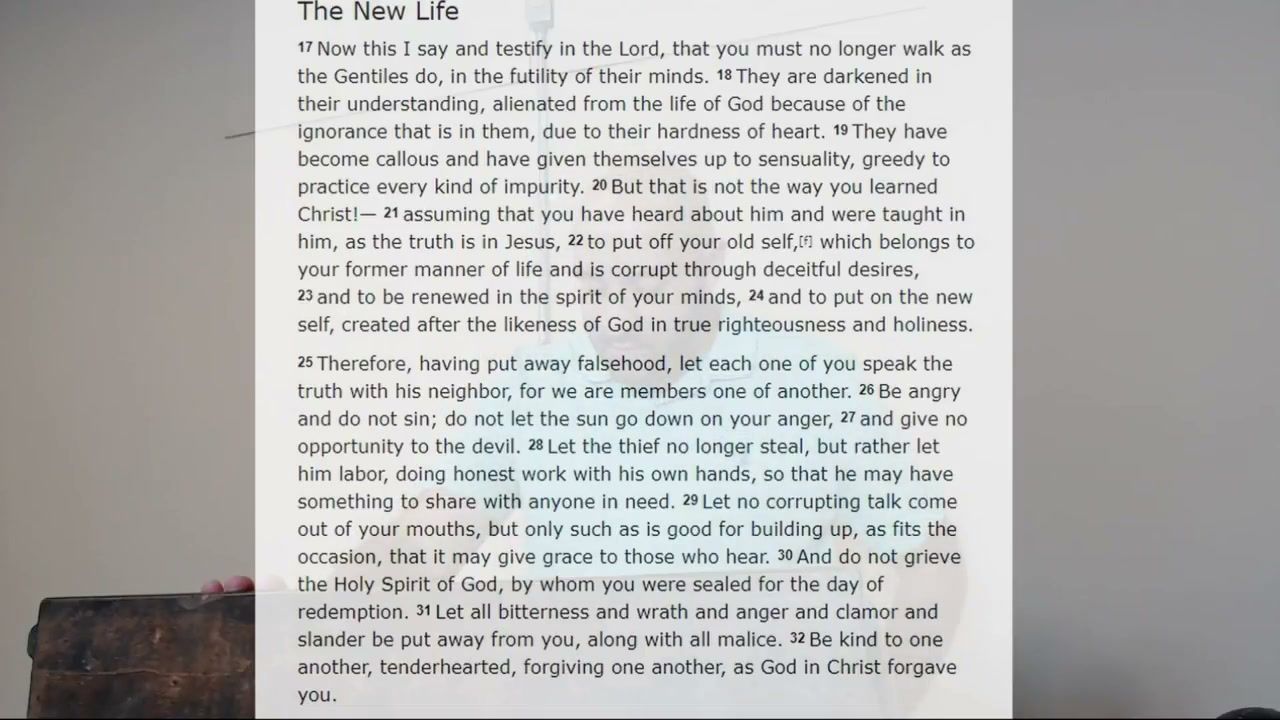
Now this I say in testifying the Lord that you must no longer walk as the Gentiles do in the futility of their minds. They are darkened in their understanding, alienated from the life of God because of the ignorance that is in them due to their hardness of heart.
They have become callous and have given themselves up to sensuality, greedy to practice every kind of impurity. But that is not the way you learned in Christ, assuming that you have heard about him and were taught in him as the truth is in Jesus to put off your old self, which belongs to your former manner of life and is corrupt through deceitful desires and to be renewed in the spirit of your mind and to put on a new self created after the likeness of God in true righteousness and holiness.
Therefore, having put away falsehood, let each one of you speak the truth with his neighbor for we are members of one another. Be angry and do not sin. Do not let the sun go down on your anger and give no opportunity to the devil.
Let the thief no longer steal, but rather let him labor doing honest work with his own hands so that he might have something to share with anyone in need. Let no corrupting talk come out of your mouths, but only such as is good for building up as fits the occasion that it may give grace to those who hear and do not grieve the Holy Spirit of God by whom you are sealed for the day of redemption.
Let all bitterness and wrath and anger and clamor and slander be put away from you along with all malice. Be kind to one another, tenderhearted, forgiving one another as God and Christ forgave you. This is the word of the Lord.
All right, so this morning I was going to focus on the first half of this chapter. As I mentioned here last week, I believe that the book of Ephesians is extremely relevant to the topic of Christian unity, the debate regarding Christian unity that's happening within sort of general reformedom today.
If you remember Ephesians chapter 2, we found that that chapter demonstrated that for Christians our unity is a foundational result of our gospel. Jesus Christ accomplished a complete unity for his people that goes deeper than anything we can imagine.
There is absolutely nothing we can do to add to our unity that we already have in Christ, and likewise there is absolutely nothing we can do that will take away from the unity that we already have in Christ.
Everyone who is in Christ by grace through faith is a fellow citizen right now. Everyone who is in Christ by grace through faith is a brother and sister. We're in the same household right now. This is the truth that we accept because the scripture says so.
We accept that truth by faith because sometimes it doesn't look like we're all members of the same citizenry, right? Sometimes it doesn't feel like we're members of the same household. We've created artificial divisions, but we know.
So we've already established from Ephesians 2, we accept by faith we have unity in Christ, but we've created all kinds of artificial divisions. We are experts at that. Think about the artificial kind of walls that Christians have sort of created, at least on the surface, again, that kind of show that maybe we're not as united as we think we are.
For example, denominations, right? I can understand why an outsider would look at the church and be like, well, so what's the deal with the church? I mean, there's Presbyterians, there's even forms of Presbyterianism, there's PCUSA, there's RP, OPC, PCA, like what is going on with this?
There's Charismatics, there's Anglicans, there's Episcopalians, there's Baptists, there's Reformed Baptists, there's Traditional Baptists, Southern Baptists, Fundamentalist Baptists. That's a lot and that's just a fraction of what I could have said.
That's a lot. I could understand why an outside observer would be like, well, what unity are you talking about? And of course, last week we talked about the apparent superficial divisions that we could talk about.
People talk about the black church, they talk about the white church, the Latino church, Korean church. Even in a small town like Rutland, we don't have that many people here. And yet, from an outside perspective, they're like, well, how many churches do we really need?
There's division here. And so, we accept by faith that we have unity in Christ, but on the superficial level, we have some divisions that are, you know, not fundamental, not really deep-seated, but they're there.
And so, what we need to do is we need to manifest the unity that we already have in Christ better tomorrow than we do today. That's the point. And I'm not saying denominations are wrong, but they do demonstrate a sort of a superficial, at least, disunity.
They do demonstrate a little bit of a problem that we have right now that we need to work out our unity better. And so, Paul is not the kind of person that says, well, here's the problem, and just leaves you like in the lurch.
He actually gives you a way forward. And so, the question is, what is the plan that Scripture gives us in order for us to manifest our unity in Christ better? The problem is that there's all kinds of fake unity out there as well.
There's all kinds of fake unity. Like, if you want to see some fake unity, all you got to do is watch a World Cup game. There's one going on right now. Or a football game. Because there, you'll have people that seem united.
Like, it doesn't matter what their economic standing is. It doesn't matter what their political opinions are, their skin color. Everyone will be cheering the same things, right? They're wearing the same colors.
They're drinking the same beers. They're having the same hot dogs. Rich or poor, they're eating hot dogs, the same food at the football game. But all the while, we know that in their hearts, there's division.
There are divided people there. So, it's not a deep-seated unity. It's just very superficial. We cheer for the same team, so we'll come together. You guys live in New York, and you can see this in the subway cars, right?
The subway cars bring everyone together. We've got really rich people in the subway cars, and we've got really poor people in the subway cars, but there's no real unity there. So, this is the thing. We want to avoid the fake unity.
We want to avoid the appearance of unity, but we do want to manifest the actual unity that we have in Christ. So, here's what Paul says. How do we do this? Paul says this. He says in verse one, I urge you to walk in a manner worthy of the calling to which you have been called, with all humility and gentleness, with patience, bearing with one another in love, eager to maintain the unity of the Spirit in the bond of peace.
So, he calls it the unity of the Spirit. And folks, I ask you like I did last week, how many spirits, how many Holy Spirits are there? Well, there's just one. There is no Black Holy Spirit. There's no Latino Holy Spirit.
There's one. And so, he tells us we should walk in a manner that demonstrates an eagerness to maintain that unity. Again, we can't break that unity, but we want to demonstrate, we want to manifest it.
And so, we want to walk in a that we're not only, not only are we united in Christ, but also it looks like it. We're actually acting like it. And so, here's the thing. We know this can be hard. We know this can be hard because we all act like we're not united sometimes.
I love talking about how, you know, this is not a Presbyterian church, but I love talking about the Westminster Confession when I have debates. And so, I have a lot of unity with people there, but sometimes I act as if I don't have a lot of unity with Reformed Baptists.
That's not actually not true. And so, we all act like this sometimes. And Paul says that what he wants you to do is walk in this way, this way that shows your eagerness. And he knows it's hard because he knows, and this is why he says, he says, walk with humility, right?
He knows that in these issues where there is division, a lot of times there's a tendency to think that your position or even you yourself are better than you are. We talk about this every week. We talk about Philippians chapter two right before communion every week.
Consider others more important than yourselves. Paul says walk in humility. That's one of the keys here. He also says to walk with gentleness. This means that when there's division or there's disagreement that we don't just get angry automatically.
Sometimes there's a time for anger, but here's the thing. What it means is when people bring up things that maybe we think in our opinions, so is division, we should still take them. You know, maybe if you're angry, that's okay.
Take them seriously. Treat them with respect. Don't respond in harshness. That's what he means when he says he's walking gentleness, hear people out, consider them more important than yourselves and respond in a loving, gentle way.
Even if you're in disagreement, he goes on and he says, walk with patience and bearing with one another. This is what this means, by the way, is that when someone says something or does something that in your mind causes division, the default starting point isn't, all right, well, you're a heretic.
Let's excommunicate and forget about you. That's not the default. Bearing with one another. You know, that's the thing that there's a lot of people in this debate that, you know, they operate from a stance where it's just sort of like a hair trigger.
You know, they say something that's a little bit off and they're like, well, you're out of the body. That's the opposite of bearing with one another. That's the opposite. The bearing with one another means that you operate from a stance that says, look, I'm going to put up with as much as I possibly can and still be biblically faithful because I love my brothers and sisters and I'm committed to not cutting them off unless I have a biblically commanded reason to do so.
Bearing with one another is very hard. That is one way that we can manifest our unity better than we currently do. You know, I mentioned the current debate in the reform world, and that's a division that is happening right now before our very eyes.
Many people who take the same perspectives that I would take on that issue have sort of given up on the other side. A lot of them will say, well, they don't even think these guys are Christians anymore.
Or if they are, they're barely Christian. And there's people on the other side that would say the same about people on my side. There are people that don't think I'm a Christian because of the stance I take on this regarding ethnic unity.
But you see, I don't think we should take that perspective. I don't think that's bearing with one another. I think the people I'm critical of are wrong. I think that they're causing, they're doing much damage to the unity of the church.
But the stance I'm taking, and I hope that others will take this as well, is that I'm going to put up with as much as I possibly can from that perspective before I start lobbing my anathemas at people.
Because I want to bear with one another. I want to be patient as fellow citizens, because I consider myself fellow citizens with the people I disagree with very strongly. That's how Paul tells us to maintain our unity of the spirit in the bond of peace.
But obviously, that leaves the fact that we do disagree with people. Even if we stay humble or patient, even if we are gentle with our responses, there's still a disagreement. And a disagreement is a form of disunity.
And so what do we do about our disagreements? Because they're there and they're real. We shouldn't just pretend they're not there. We should deal with them. See, pretending they're not there is like the people that all gather at the football game and pretend they're united.
They're really not. It's just for a few hours in a day, they can put it aside and pretend like it's not really there. And so here's what Paul says about our disagreements. This is verse 11. Paul says, he, talking about God, gave the apostles, the prophets, the evangelists, the shepherds, and teachers to equip the saints for the work of ministry, for building up the body of Christ until we all attain to the unity of faith and of the knowledge of the Son of God.
And so to Paul, that's the job of the apostles, prophets, evangelists, teachers, pastors, to equip the saints. That's you and me. And it's our job for doing, you know, the saints, they're doing the ministry.
They're doing God's work, essentially. So you and I, all of us, are to be working in ministry under God in our various spheres of influence. And that's going to look different for each of us, right? So some of us, we have our family.
That's a sphere of influence. And so we do our ministry work to equip the saints for God's work in our families. Some of us have businesses. Some of us interact on social media. Some of us are involved in the communities.
And so Paul says that the apostles, the prophets, the evangelists, the pastors equip the saints for that ministry, essentially the ministry of unity of the faith. And so that's the issue here. The ministry, the work that we have to do is until, he says, until we all attain the unity of the faith and the knowledge of the Son of God.
This is what we do about our disagreements in the church. This is the solution. See, this is what we really need to understand, right? The unity that we need to be eager to maintain, the unity that we should be eager to manifest, the unity that Paul is talking about is not a superficial unity.
It's not an appearance of unity, but rather it's a unity of the faith, unity of the knowledge of the Son of God. And all of that is contained in this book. Unity of the faith and unity of the knowledge of the Son of God is contained in the Bible.
And so when Christians disagree on something, whether it's economics or politics or church government or church diversity, whatever it is, the way that we achieve unity is to make sure that whatever we're promoting, whatever our position is, it's in line with and derived from the scriptures.
And so we need to be debating our ideas, weighing them. Even in the scripture, Paul says, you know, we weigh what the prophets say. That's the point. We want to find out, is what I believe, is what I'm promoting, is it biblical?
We want to go back and forth with people and hear people out. By the way, we can't really do that if we're lobbying anathemas at people and say, well, you're out of the body of Christ. Like, that's not how you debate ideas.
And so we find out, are my ideas biblical? And then we let the truth rise to the top. I'm a big believer in sunlight being the best disinfectant. And so if somebody has an unbiblical idea, I want it to be exposed.
I want to talk about it. I want to show it up the light of scripture and find out whether or not it holds water. And I think we should be willing to do that with our own ideas as well. We need to subject ourselves to some scrutiny, I think, sometimes.
This is the ministry that pastors and prophets and evangelists should be equipping the church to do. This is why we need humility, right? Because having a debate, a conversation with someone with which you agree on everything, you don't need any humility for that.
You don't need any patience for that. But someone you disagree with, that's when you need to be humble. That's when you need patience. That's when you need to bear with people because you don't agree with them.
And we need to find out what is actually biblical. That's when we need to treat people with gentleness and respect. Nobody ever needed to be warned, hey, treat the people you always agree with with respect.
You don't need that warning. Everyone already does that. And so that's the thing. That's how we achieve the unity, rather the manifestation of unity that Christ has already given us. It's not through some diversity scheme.
It's not through ecumenism. It's not through affirmative action. No, no. Christian unity, real unity, is in the faith and through the knowledge of the Son of God. It's doctrine, essentially. That's how we do it.
It's doctrine. And so that's why I'm constantly saying to people online when I'm doing my YouTube videos, you know, interactions online, I'm constantly saying, well, just show me in the Bible. Show me in the scripture.
It doesn't have to be a chapter and verse. It could be a sort of an argument, but just show me how the scripture teaches this. I'm a very simple person, right? If your diversity plan is in the Bible, I'll believe it.
If your economic system is in the Bible, I will implement it as best I can. That is the key. The unity that we seek can only be achieved through right doctrine and scripture. Verse 13, the unity of the faith and of the knowledge of the Son of God to mature manhood, to the measure of the stature of the fullness of Jesus Christ so that we may no longer be children tossed to and fro by the waves and carried about by every wind of doctrine, by human cunning, by craftiness and deceitful schemes.
So you see, this is how it works. When we don't have unity of faith and in the knowledge of the Son of God, Paul says we're like children. We'll believe anything. When we don't have unity of the faith and the knowledge of the Son of God, we could be carried along and tossed to and fro by human doctrines, made up doctrines, fake doctrines.
We can be deceived and carried along by deceitful schemes and craftiness, human craftiness, it says. This is why, you know, in a lot of ways, as believers, we need to have a one-track mind. We need to be laser focused on the scriptures because they reveal the knowledge of the Son of God.
Like, does that make sense? Like, we need to be, like, really just like a one-track mind, almost obsessed with it. That should be our obsession. What does God say to us? Because if we love Christ and we say we do, we sing about how we do.
If we love God, we want to show our love for God by doing what he says. That's the key. And so if we're going to manifest our unity in Christ with our black brothers and sisters, with our Latino brothers and sisters, our poor brothers, our rich brothers, if we're going to manifest our unity with our Republican brothers and our Democrat brothers, we have to be laser focused on the scripture because they reveal the knowledge of the Son of God.
If we're not, the danger is this, if we're not focused on the scriptures and the revelation of the knowledge of the Son of God, we try, let's just say we put that aside and we try to implement the world strategies for achieving unity, I guarantee you it will lead to more division.
I guarantee it. In a recent video, I was very critical of a very famous pastor and author who I love. I love this guy. His sermons and writings have been such a blessing to me and, you know, very formative in my early years of being a Christian, but he recently had come out and advertised that part of his pastor search committee, he was trying to find a pastor for one of his churches, he was using skin color as a qualification.
He wanted to hire a black man. And so he said very publicly, I'm willing to overlook these other qualifications in favor of skin color. And that was his strategy to promote unity and diversity in his church.
And so I was very critical of that. I was very critical because what I did was, it's very simple. I want one track mind, right? I look at the scripture. I look at the place where we go when we want to find unity and faith, unity of knowledge of the Son of God.
That's where I went. I went to the scripture and I saw that skin color was not a qualification of elder. So I was critical of it. I went back to the scripture again, because you want to be humble about this.
You want to see what's going on with this kind of a, of a strategy for unity. I went to the scripture. That's the place where we look for unity of faith and of the knowledge of the Son of God. And I saw that, uh, essentially the Bible says that, that showing partiality based on stupid things like skin color, for example, that's sinful.
And so as a believer, I hear a famous pastor telling me what he's doing to achieve unity, people cheering it. And then I look at the Bible and say, well, no, that's not what you do to achieve unity. And so I know for a fact, it's an easy criticism to make because I know for a fact that scheme will not produce the desired result.
It will not promote unity. Now I know that that pastor's heart was in the right place. He wants to promote church unity between black and white. And so do I. But the problem is that a scheme that is based on human cunning will never work.
It will never work. And the scripture demonstrates that it will never work to the consequences of not looking to scripture are very high. They're very high. If we do not stick to the Holy word of God on these issues of unity in the church, it will make our apparent division worse and not better.
And again, I stress, you cannot do anything about the actual unity we have. The unity we have with black and white Christians is you can't change it. Christ accomplish it. It's perfect. But I'm talking about what people see.
If we stick to the word of God, we won't have these apparent division issues that we currently do now. And if you try to implement human cunning, you'll drive a wedge between the races deeper instead of building bridges.
And so I'm passionate about this kind of stuff, about the unity of the church, because I love God and I love his church. And I want to see it manifest the unity that we have in Christ better than it does right now.
And I know the only way to do it is through the scripture. Now, this is a kind of a funny comment I made. I don't know if it's actually true, but I bet you it is. This is a very small church. And if you look at our church, it's very small.
And you you go by percentages. I think we probably have the most diverse church in Vermont. I really do. I mean, you count me and my kids. Of course, you count Andrew. I think we're doing pretty good.
And the thing is, though, and I'm joking about it, but it's true. We didn't get here by human cunning, right? We didn't get here by a man-made diversity initiative. The way that we got here is because we have unity of the faith and of the knowledge of the Son of God.
We love God. We love his church. And God just so happened to see fit to bring us together in this configuration for his own glory. And we thank God for that. That's a beautiful thing. Diversity is a beautiful thing in the church of God.
But the unity that we have is not because of what we do and how we try to set things up and we'll bring in a black pastor here and then maybe we'll get some black people here. No, the unity that we have is of the knowledge of the Son of God.
And God gets the glory for bringing the people that he wants to bring together together. And so I pray that we continue to demonstrate our eagerness to maintain the unity of the Spirit in the bond of peace.
And I ask God that he would do his will in every church around the country to grant us a commitment to the scriptures and a commitment to the unity of faith and of the knowledge of the Son of God that we can achieve with them.
Let's pray. Lord God, I thank you for the clarity of Paul's words, God. I thank you for the clarity that Paul had last week in chapter 2 when he talked about the unity that Christ accomplished for us on the cross, killing the dividing wall of hostility.
I thank you so much for that, Lord, that that reality is real, no matter what it looks like. We have that unity with brothers and sisters in Africa and Asia, everywhere where they named the name of Christ.
We're grateful that we're fellow citizens, that we're of the same household, that that's just such an amazing mystery that you revealed. And so thank you for that, Lord. But I acknowledge that even though we have that foundational fundamental unity, that sometimes we don't act like it.
We don't act like it. And sometimes that can be across denominational lines. Sometimes that can be across ethnic lines, economic level lines. There's all kinds of things that we manifest division when we actually have unity.
And so I pray, God, that you would give us the eagerness to maintain the unity that we already have. God, give us the eagerness to remember that there's one Lord. There's one Lord, God. And we know that we're responsible for sometimes not acting like we have unity with people.
But God, I pray that you would change our hearts, God, that you would remind us of where we find our unity, how we achieve it, God, and that we would be laser focused on the scriptures and on the doctrine that brings us together, Lord, that we would never seek to implement our own schemes or even, God forbid, the world's schemes to achieve unity.
But rather, we recognize that those things are false unity. Those things are appearances of unity, but not the real unity we have in Christ. I pray, Lord, that we would be laser focused on the scriptures, God.
I pray that you would be humble to realize that maybe we're not understanding these things the way we ought to, God. I pray that we would be patient with our brothers, that we would not seek to anathematize people that don't see things the same way we do, God, that we would be eager to bear with people.
Because we're all understanding who you are and knowing who you are better every single day. And so, let us give grace to people who, you know, in our opinion, might not understand the way we do. Because we have to remember that we don't understand the way we should.
So, I pray, God, for unity. I pray for us to be patient and for us to love our brothers and sisters in Christ all around the world. In Jesus' name, amen.