Keep sharing good news without ads.
Thank you for joining us this Sunday to Worship Jesus Christ our King. This and previous sermons are available at https://www.youtube.com/kootenaichurch
In ceaseless praise. Let them flow in ceaseless praise.
Can we test the piano one more time? We had the volume set too high up here. Hold it please. Good, thank you.
How's that? There we go. Good morning, everyone. Good to see you all. As one of my teachers used to say, all the A students are in their seats. This morning, we're going to begin a study through the Old Testament prophet Haggai.
Haggai, the minor prophet. And there's a set of notes for this, and some of them have been passed out, but I'm pretty sure there's gonna be enough. Does everybody get a set of notes? If not, I think there's still some.
Yeah, right over here, there's some. So help yourself to those, and maybe find your way to Haggai in the Old Testament. Haggai, the minor prophet, one of the 12 minor prophets. And as you know, they're called minor prophets, kind of an unfortunate term.
It's not like American baseball, you know, where you start in the minors and work your way up to the majors. The 12 minor prophets were, of course, they're just shorter in length. That's all, really, they're all there is to it.
And so we're gonna be working our way through Haggai over the next several weeks, starting today, and for, it'll be a total of four weeks, because there's only 38 verses. He's a minor prophet, and it's relatively short, but it's also very powerful, very powerful part of God's Word, as we're going to see.
So we're going to approach it today. We're gonna go through the first chapter, but also we're gonna wanna set up the context, and its historical context, and hopefully we'll see it, too, in its theological context, and place this really important prophecy in its historical setting a little bit.
So we're gonna be looking first at Ezra in the Old Testament. So you might find your way to Ezra, and we're gonna start there, because Ezra was one of the returned exiles who came after Haggai did, and he also wrote the history of this period of time.
And so it's gonna be, I think, profitable for us to go and spend a little bit of time in Ezra to set the context for our study through Haggai. So we're gonna be looking at both Ezra and also Haggai this morning, Haggai chapter one.
And before we do, let's commit our time to our Lord and ask his blessing on our study this morning. Our Father, we do thank you for the privilege that we have to be able to gather here, to be able to gather in the name of our Lord and Savior, Jesus Christ, and now, Father, to study your Word.
We know we are totally dependent on you to be our teacher by your spirit, and so we would just ask your blessing on our study over these weeks. We ask that you would show us what you would have us learn, that you would apply these great truths to our lives, help us to be eager to hear, quick to obey, and then we will give you all glory in Jesus' mighty name, amen.
Well, if you found your way to Ezra, the historian way deep back in the Old Testament, and as you're gonna see, one of the challenges in studying these Old Testament books is, of course, trying to set them in their proper timeline, at least it is for me, I'll confess that right now.
Sometimes it's a little confusing, the way the timelines work, and they are also giving us time stamps, and we're gonna see that Haggai has been called the most time-sensitive of the prophets. He dates his oracles, or his speeches, down to the day, and we're going to see that as we get there.
So if you found your way to Ezra chapter one, turn to the left to 2 Chronicles chapter 36. I tricked you a little bit. If we're gonna look at the history, we also need to know what happened to Judah. What was going on?
Why were they taken captive for 70 years? And so we're just gonna go through this last part of 2 Chronicles chapter 36, and set the stage a little bit for the prophet Haggai. Haggai, of course, came back after the exile, and ministered to the people who returned from the exile, but why were they taken into the exile in the first place?
It's important for us to know that. And in 2 Chronicles 36, which is also a post-exilic history, or chronicles of the history of the nation, first and second kings are pre-exilic, we're gonna just get a taste here.
We're gonna start in verse five of chapter 36, and remember now, this is just kinda coming down to the end. This had been a long-term decline in the nation of Judah. A whole series of kings. There was a few bright lights in there, here and there.
Some tried to make some reforms, but for the most part, it was a series of wicked kings in power in Judah. And the prophets were prophesying this whole time, especially Jeremiah. He's just banging away at this nation, calling them to account, rebuking them for their sin, not only the kings, but also the spiritual leaders, the priests.
They had a corrupt priesthood. They had false prophets that were giving false prophecies to the people. All the while, they are engaged in idolatry and all kinds of perversions, and the business practices were corrupt, and the kings themselves, for the most part, were very corrupt.
And one of them was Jehoiakim, kinda coming down to the last few here. Verse five of 2 Chronicles 36, and I'm just gonna kinda move quickly through here, and this is sort of a condensed timeline of these events.
So we're gonna be around 605 B .C. here, and I already made up my mind. I'm not gonna, because I know how I feel when I just get peppered with dates. You're studying history. Pretty soon, it's like, oh, I've got all these dates.
And especially when you're studying the Old Testament. I mean, we are in 2021, and so we sort of have that timeline that even the first century Christians were on. We're in the 21st century, but once you get into the Old Testament, the timeline flips around, right?
It's a mirror image, and so it goes the other way, and that can get a little bit confusing. They didn't have that timeline. They still counted time based on who was the king. So you might see in the first year of King Nebuchadnezzar, in the ninth year, and then in the 19th year, King Nebuchadnezzar.
So even though we're looking at it, and the timeline's going the opposite way, they're counting time back in the other way. So it can get a little confusing. But so hopefully, we can sort of set this in its proper perspective.
But in verse five of 2 Chronicles 36, Jehoiakim was 25 years old when he began to reign, and he reigned 11 years in Jerusalem. He did what was evil in the sight of the Lord his God. Now, at this point in time, Nebuchadnezzar and the Babylonian army were in occupation, and they had been probably since around 605 BC, four years before the Babylonian Empire came into power when they defeated the Ninevites, the Assyrians, right?
And so their presence as a power in the area pretty much starts at 609, but they were just in occupation now. They had probably taken a few people captive at this point in time. There was a series of deportations back to Babylon.
Daniel would have been one of those early ones, also the prophet Ezekiel. But here we are, these evil kings, and he did what was evil in the sight of the Lord his God. Against him came up Nebuchadnezzar, king of Babylon, and bound him in chains to take him to Babylon.
He gets deported. And what follows is very interesting. Nebuchadnezzar also carried part of the vessels of the house of the Lord to Babylon and put them in his palace in Babylon. Remember in that day when one army besieged another country, it wasn't just my army defeating your army, and now we got you and we've occupied you.
It was also my God has defeated your God. And so they just would go into the temple, which he did, and they would take their God's stuff. And in this case, it was the sacred vessels that God had set aside way back when and set them aside and made them holy for the purpose of worshiping Yahweh, okay?
And he deports them back to Babylon and puts them in his temple. Daniel 1 .1 also mentions this. You can look that up when you have time. And then verse eight, now the rest of the acts of Jehoiakim and the abominations that he did and what was found against him, behold, they are written in the book of the kings of Israel and Judah.
So that would be the pre-exilic history of the book of the kings. And Jehoiachin, his son, reigned in his place. Jehoiachin was 18 years old when he became king and he reigned three months and 10 days in Jerusalem.
He did what was evil in the sight of the Lord. And as you might expect, in the spring of the year, King Nebuchadnezzar sent and brought him to Babylon with the precious vessels of the house of the Lord and made his brother Zedekiah king over Judah and Jerusalem.
Zedekiah did what was evil in the sight of the Lord, his God, and then there's a whole list of his transgressions. It gets very detailed. And as you might expect, it was wholesale. As the leader goes, so goes the country.
And it's just an absolute spiritual political train wreck. Verse 14, all the officers of the priests and the people likewise were exceedingly unfaithful. Following all the abominations of the nations and they polluted the house of the Lord that he had made holy in Jerusalem.
The Lord, the God of their father, sent persistently to them by his messengers because he had compassion on his people and on his dwelling place. But they kept mocking the messengers of God, despising his words and scoffing at his prophets until the wrath of the Lord rose against his people until there was no remedy.
Jeremiah had probably been prophesying at this point for around 22, 23 years. And he just persistently called the people to repentance, called the kings to repentance. And he just confronts the false prophets and the corrupt priesthood over and over and over again, warning about the judgment of God that's going to come on them, even prophesying the 70 year captivity that's going to happen.
But all spurs to through there, and we're going to see some of these passages. He also promises them God's restoration. Why? Because even though they were violating the Mosaic Covenant that God had given, the Mosaic Covenant, as you know, is a covenant of law.
It was a bilateral covenant. Not only when that covenant was made was the blood of the sacrifice poured out on the altar, which represented God's part of it, they were also spattered. Remember that? They had a basin of blood and they put the hyssop branch in it and they spattered the people with the blood.
That would have been a clear audio visual representation of their responsibility, but they failed. That covenant promised blessing for obedience, cursing, chastening for disobedience. And that's exactly where they were at this point in their history.
But there was another covenant that had been made centuries before the Abrahamic covenant. That covenant was a unilateral unconditional covenant in which God promised that nation perpetuity as a nation and as a people.
It also promised them land, a seed line, and we're gonna look at that, but also blessing, blessing through them to the nations. And that covenant is not conditioned upon their behavior. It is not conditioned upon their obedience.
It was all of God to take care of that. He takes all the responsibility onto himself in that covenant. Repeatedly, Genesis 12, he says, I will, I will, I will, I will. And so when Jeremiah refers to the promises of God, the restoration of God, that's what he's referring to.
That's what saved them from total annihilation was the Abrahamic covenant. But right now they're under the consequences. We come up to about 586 BC in verse 17. By this time, Nebuchadnezzar has pretty much had it.
He's the occupying force, the occupying army. It says, therefore, he brought up against them the king of the Chaldeans, none of the he there is God. This is God carrying out his judgment that he had warned them about, prophesied about, who killed their young men with a sword in the house of their sanctuary and had no compassion on young man or virgin, old man or aged.
He gave them all into his hand. And here we go again. All the vessels of the house of God, great and small, and the treasures of the house of the Lord, and the treasures of the king and his princes, all these he brought to Babylon.
And they burned the house of God and broke down the wall of Jerusalem and burned all its palaces with fire and destroyed all its precious vessels. There were other structures in the temple, some big brass columns, bronze columns.
They had this big bronze basin, the labor that was sitting on the back of bronze bulls. Well, they just broke all that stuff apart and hauled the bronze back to Babylon, tore everything down, destroyed the walls of the city, made it desolate.
And here's why. He took into exile in Babylon those who had escaped from the sword and they became servants to him and to his sons until the establishment of the king of Persia. And when you see that word until in scripture, you're bumping up against an endpoint, okay?
Until. This period of time came to a stop and it came to a stop in 539. This is Daniel chapter five, right? Remember the handwriting on the wall that night? And the Babylonians were inside that great walled city.
They felt really secure because it was a tremendous fortification. And they were having a drunken orgy, worshiping their false gods in a religious ceremony, which was nothing more than a carnal drunken orgy.
And they were getting drunk using the vessels from the holy temple from Jerusalem that night. Remember that? This guy's name was Belshazzar. And then remember the handwriting on the wall? And he had to go get Daniel, who had been taken captive to interpret it for him.
And I liked that story because his knees were shaking, as he saw Daniel interpreted it for him. Basically, you've been weighed in the balance and you're a lightweight. And that very night, the city was taken from the inside by the Medo-Persian coalition.
They stormed up through the Euphrates River, which they built the city over the river and they had gates. Well, the Medo-Persians went upstream and diverted the river that night. And the river dropped down to the point where that marshaled army just swarmed right into the middle of that city, took it from the inside out.
And in one night, that entire city fell. That's why this chronicle says, until the establishment of the King of Persia. And it was over for the Babylonians from 609 to 539. That empire came to a terrible end that night.
But here's verse 21. This is a purpose statement. To fulfill the word of the Lord by the mouth of Jeremiah. God's word comes to pass. Until, here it is again, an end point. Until the land had enjoyed its Sabbaths, all the days that it lay desolate, it kept Sabbath to fulfill 70 years.
What is this about fulfilling Sabbaths? Well, Leviticus 25, back in the law, Leviticus 26 had required that they had their land, they were in their land, but they were required to let that land lie, old King James term, fallow or desolate.
Don't plant the land periodically. They didn't do that. And they had actually accumulated over several centuries, 70 Sabbath years that that land had to lay desolate or fallow. That was part of their violation of the law.
And God is actually now going to implement it for them. They go out of the land in captivity. Everything is desolate and it stays that way for 70 years. Now that's the background for what we're going to look at next.
70 years later in 538, and this is verse 22 and 23, the King Cyrus, the Persian King, who's now in power, he issues a decree to let these people go, let the Jews go back and rebuild their temple. God had promised to bring them back into the land.
Now, verse 22 and 23, I'm not going to read through that because it virtually is identical to the first three verses of Ezra chapter one, okay? Now we arrive at Ezra chapter one, the history of the people back in the land.
And it says, in the first year of Cyrus, King of Persia, that the word of the Lord by the mouth of Jeremiah might be fulfilled. He keeps coming back to this is fulfillment of God's word. Jeremiah was right.
Basically he's saying, and God is going to fulfill his word through Jeremiah. The Lord stirred up the spirit of Cyrus, King of Persia, so that he made a proclamation throughout all his kingdom and also put it in writing.
This is fascinating to me. Here you have a godless pagan king of a major kingdom. He's just wiped out the Babylonians. He's in power now. The Jews are there in this land in captivity, and yet God stirs him up to let them go back in fulfillment of his prophecy.
It's amazing. A pagan king. Did you think God couldn't use an unbeliever? God can use whatever he wants. He's the sovereign Lord of this universe. One of the great themes all the way through the Bible.
And so it says in verse three, whoever is among you of all his people, may his God be with him and let him go up to Jerusalem, which is in Judah, and rebuild the house of the Lord. This is very important.
Cyrus knew why he was letting these people go back to Judah. It was for the purpose of rebuilding the temple. This is very important to remember. He knew it, and eventually they forgot it. And he says, let each survivor, in verse four, in whatever place he sojourns, be assisted by the men of his place with silver and gold, with goods and with beasts, besides freewill offerings for the house of God that is in Jerusalem.
Not only is he issuing a decree to let the Jews go back and rebuild their temple, it's going to be paid for by the kingdom. It's an amazing thing. They're gonna have an all expense paid trip back to be able to build their temple back.
Why? Because the worship of Yahweh is important to him. And that's what the temple was for. To reestablish the worship of God. And the temple was also the place where God dwelt with them in that point in time.
One Old Testament scholar, Dr. Meryl, Dr. Eugene Meryl said, the real tragedy of the exile was not the removal of the people, nor even the utter destruction of the city and the temple. It was the departure of their God from their midst.
An absence symbolized in one of Ezekiel's visions by the movement of the Shekinah, that was that brilliant, blazing representation of God that dwelt over the Ark of the Covenant in the temple. You remember the vision of Ezekiel, Ezekiel 10 and 11, he saw that glory move off of the top of where it dwelt in the Holy of Holies to the threshold of the temple and out the door and then eventually over the Mount of Olives and then it was gone.
And that represented because of your sin, because of your idolatry, the glory has departed. Sad and tragic event. Another scholar says this concerning the removal of objects from a temple, taking temple objects was common in times such as this as it represented the complete military and religious conquest of a city.
Again, it's not just my army is gonna beat your army, my God is better than your God and is gonna dominate your God. That's an important issue here. But here he is, issues the decree, they're going to even pay for it and what follows in verse seven through 11, I find absolutely fascinating.
Remember all the vessels that were taken back? After 70 years of captivity, they're still there and they're not just there, they're there down to the very vessel. In verse seven, Cyrus the king also brought out the vessels of the house of the Lord that Nebuchadnezzar had carried away from Jerusalem and placed in the house of his gods.
Cyrus king of Persia brought these out in the charge of Mithridat, the treasurer who counted them out to Sheshbazar, the prince of Judah. Sheshbazar is some scholars would say, well, there's two different people there that are leading the return.
One is Zerubbabel who is mentioned in Haggai and then the other one was Sheshbazar. Probably the best way to see that, Sheshbazar was his Chaldean name. When they got taken captive into Chaldea, they would give them new names, just like Daniel was given another name and the three young men as well.
It's the same person, I think is the best way to see it. He's the one who's going to lead them back and this whole passage reads almost like a forensic chain of evidence, right? Carefully being delineated out.
He even gets a treasure, probably had a pencil behind his neck and a clipboard, and he's counting these things out. And this was the number of them. Now they're even numbered and recorded. 30 basins of gold, 1 ,000 basins of silver, 29 censers, 30 bowls of gold, 410 bowls of silver and 1 ,000 other vessels.
All the vessels of gold and silver were 5 ,400. All these did Sheshbazar or Zerubbabel bring up when the exiles were brought up from Babylon to Jerusalem. He's making a real point of these vessels that have survived not only the destruction of Jerusalem and the city and the temple, but taken into captivity 900 plus miles away in Babylon.
They survived 70 years in the hands of these pagans and here they are being carefully counted out so they can go back to Jerusalem, be put back in the temple for the worship of Yahweh. That's an amazing thing.
But God is superintending this whole thing. Well, those are even enumerated before the people are. In chapter two of Ezra, if you see there from verse three all the way down to 39, see all the people listed there in the numbers?
How about I volunteer to read through that this morning so that, no, no, no, no, we won't do that. You can just see though how many people are there. They're counting out the people after they count out the sacred vessels and then it moves on through and they're talking about all the different people that were going to come back.
We get all the way down to verse 64 and it says the whole assembly together was 42 ,360 male servants, female servants. They have horses and mules, camels and donkeys and so on. And then again, a mention of all of the money and silver and everything and gold that they were taking back in order to finance the rebuilding of the new temple, the rebuilt temple.
It's about a 900 plus mile trip from Babylon all the way back down into Judah and it would have been quite an undertaking for these people to do this. Well, that's kind of a real race through the background here and let's look in your notes.
I'm gonna let you go through for the sake of time the first page, there are page two and then I just wanna look at one thing. I hope you can find some time to read through this and find some time if you can to read through Ezra, like the first six chapters because that's gonna give you a real sense of what's going on as we move through Haggai.
The overarching theme, this is page three under theological emphasis and we wanna highlight this a little bit. The overarching theme of Haggai is the need to rebuild the Lord's house, the need to rebuild the Lord's house.
God moved Cyrus to do that and he specifically says, here's the reason you're going back. It's just not you're gonna be free to go do your own thing now that you're free after 70 years captivity. No, no, the specific purpose is for you to go back, rebuild the temple.
Why? Because God wants to be worshiped. He deserves to be worshiped and the worship of Yahweh was their top priority and Yahweh dwelt in the temple and that was where he was worshiped and so it was so important to rebuild the Lord's house but it's in the context of Israel's messianic hope and the promise that he will rebuild the house of David.
There's a stream of truth running through here and it's the seed line of the promised Messiah. Why? Because Zerubbabel, the governor at the time is in the messianic line, okay? And so that line, he is a descendant of King David and he's an ancestor of Joseph, as Matthew says, the husband of Mary of whom Jesus was born who was called Christ.
In all of the movement of the nations all over the place and the wars and the destruction and all this, remember God made a promise through Abraham. He's gonna provide a seed line. He's gonna provide a Messiah and this is part of the picture.
And as we'll see as we go through Haggai, the address of the oracles, the four messages start out fairly broadly and then it narrows down at the end to addressing just one person and that's Zerubbabel.
Why? Because he is in the seed line, okay? So I'm gonna let you read through the rest of three. There's the outline that we're gonna use is basically just the outline that's given in the book itself. So let's look at Haggai and I think we'll have time to get through this first chapter.
Okay, so Haggai chapter one. Now you see the background. Here they are back in Judah. And when Haggai opens up, remember, they've been in Judah probably around 18 years. And we're gonna look next time a little bit more at the history.
But for the first year they were back, they didn't do much except for rebuild the altar and have a lot of sacrifices. Probably because they thought, we better get busy obeying the word of God now or the Old Testament now, which is what they did.
But they didn't start the temple until at least a year later. And all they did was build the foundation. And once they built the foundation, they stopped. And they stopped because there was opposition from the indigenous people there, probably the Samaritans and other people groups.
They probably got, it was hard work rebuilding a temple. The smallest stones in that temple were anywhere from two to five tons. And they've actually found one existing stone, archaeologists calculate it to be 50 tons.
And so they were probably anywhere from 10 to 20 tons, these stones they had to build a foundation with. So it was hard work. They had opposition from the people that were living there, and they probably also got discouraged.
But as we're going to see, they also got concerned with their own lives. So Haggai, this is probably around 520. It has been 16 years since they finished just the foundation of the temple. And Haggai is called by God to confront them, to rebuke them for their laziness, for their lack of work, and to call them to rebuild the temple.
So chapter one, verse one of Haggai, in the second year of Darius the king, at this time, the king is now Darius, in the sixth month on the first day of the month, the word of the Lord came by the hand of Haggai the prophet to Zerubbabel, the son of Shaltiel, governor of Judah, and to Joshua, the son of Jehozadak, the high priest.
In that first verse, we have the very interesting timestamp. When you see a timestamp like that, it is really God's way of saying, this is anchored in history, okay? Much like Isaiah's call in Isaiah chapter six.
He has five verses, five chapters, kind of leading up to that, and I had to sort of give you a preview of that great prophecy, but when he gets to the call of Isaiah in chapter six, there's a timestamp in the year of King Uzziah's death, I saw the Lord, and he had that great vision.
And so these timestamps are God's way of anchoring this in history. All sound theology is anchored in history. It has to be. If it's not, it's merely the musings of men. Do you believe in the resurrection of Jesus Christ?
The foundation of that is what? The historic resurrection of Jesus Christ. And you can just go down the list. All sound doctrine is anchored in history. When you listen to somebody who does not have an historical foundation for what they're trying to teach or propound, it's probably because it didn't ever happen, okay?
All sound theology, all sound doctrine is anchored in history. And this is what Haggai does at this point in time. So in your notes, the repeated date formula, anchor it in history, and Haggai is the messenger or the prophet, but the words are the words of God.
Very important. Remember what they were indicted for was rejecting the prophets, abusing the prophets, scoffing at the prophets. Well, in doing that, since the prophets taught the word of God, proclaimed the word of God, they were rejecting God.
The recipients are Zerubbabel and Joshua, the governor. One of the comments that I found really pretty important to note, to refuse to build the Lord's house was at best saying that it did not matter whether the Lord was present with them.
At worst, it was presuming on divine grace that the Lord would live with his people even though they willfully refused to fulfill the condition of his indwelling that he had laid down. They have a priority to rebuild the temple because God wants to be worshiped.
Another commentator said this, the need to rebuild is urgent because temples in their world are the center for administering the political, economic, judicial, social, and religious life of the nation.
In other words, rebuilding Yahweh's temple would symbolize his rule over the life of his people and his prophesied rule of the world. Very important. When you wanna take down another country, you not only go after their army and their fortress, you go after their temple.
Why? My God's better than your God. And in this case, Nebuchadnezzar's God was not. He's gone. God's still carrying out his plan. Well, in verse two, we have this confrontation and the command to rebuild.
It says, thus says the Lord of hosts. And you're gonna see this repeated prophetic utterance, they're called, in various forms. In 38 verses in this little short prophecy, that occurs 29 times in various forms.
So one of the main themes here is the word of God. The word of the prophet is the word of God and it's important to listen to it. So thus says the Lord of hosts. These people say the time has not yet come to rebuild the house of the Lord.
Then the word of the Lord came by the hand of Haggai the prophet. Is it time for you yourselves to dwell in your paneled houses while this house lies in ruins? Now, therefore, thus says the Lord of hosts, consider your ways.
And this is repeated through this prophecy. Consider your ways. The Hebrew word heart is actually included in this. Examine your heart. Stop, think deeply about your life, about how things are going in your life right now.
Consider your ways. And he just details how things have gone for the last 16 years, since they stopped working on the temple. You have so much and harvested little. You eat, but you never have enough.
You drink, but you never have your fill. You clothe yourselves, but no one is warm. And he who earns wages does so to put them into a bag with holes. Commentators usually stop at that point and say there's inflation, okay?
Thus says the Lord of hosts, consider your ways. And this is repeated. And what does he call them to do? Get back to work. Go up to the hills and bring wood and build the house that I may take pleasure in it and that I may be glorified, says the Lord.
They're called these people, okay? There's distance there. There's insulation. Normally, God calls his people my people. It's almost a term of endearment. But they're disobedient. And now he calls them these people because of their excuses and disobedience.
Why? They misused God's resources, resources. What are the resources? Time, treasure, and talent. They have time. They say, well, it's not time. We don't have time. They had time. That's why they were there.
They had treasure. This was being paid for and financed by the Persian kingdom. They had no excuse there. And they also had the talent. That list back in Ezra had all kinds of craftsmen and different people that were able to work on this.
And so they don't have any excuses. They just have another agenda other than God's. Time, treasure, and talent. They misused God's resources. That little statement there in verse four, is it time for you yourselves to dwell in your paneled houses?
And later on, then he calls them to go up to, and basically they would go to Lebanon, cut down cedar trees and make paneling, cedar paneling for the insides of this. It's thought by some that maybe they had done that and they were using some of the materials for the temple in their own homes.
Can you imagine that? Can you imagine a minister of Jesus Christ with a lot of wealth, using money that had been given to him to buy his own stuff and do his own things and build mansions and fly around in Learjets?
Who could imagine that? But the same, we can name names, but maybe not today. But remember, the same God that was overseeing this is the same God here and now. And his standards don't change. The judgment is still there, okay?
Well, God calls them to get busy and go back and get more wood, why? Because it will please God and glorify him. Their disobedience, their obedience will please and glorify God, but their disobedience will result in God withholding his blessing, as we see in nine through 11.
You looked for much and behold, it came to little. And when you brought it home, I blew it away. Why, declares the Lord of hosts, because of my house that lies in ruins while each of you busies himself with his own house.
Therefore, the heavens above you have withheld the dew and the earth has withheld its produce. And I have called for a drought on the land and the hills, on the grain, the new wine, the oil, on what the ground brings forth, on man and beast and on all their labors.
Gets pretty granular, doesn't it? Right down to the food they're getting off their grain and their wine and their oil. God is in charge of that. God is the sovereign God of this universe. And he's making sure that these people are feeling the pain.
Do you notice they're not starving to death? They have something, they're surviving, but they're not being blessed as they should be back in their own lands if they would have been obeying God. And there's nothing wrong with building a house or planting crops.
They need that, right? These are not things that are outside of the order. These are not luxuries. I suppose maybe like a Learjet. But what the problem was, they had lost their priorities. They had lost the top priority, which is why they were there, to rebuild the house of Yahweh for the worship of Yahweh.
I mean, this same theme runs right into the New Testament, right? Remember Jesus' Sermon on the Mount? People were worried about their livelihoods. They're worried about their food. They're worried about their clothing.
And what did he say? Look at the lily. Look at the lily. God's gonna take care of that lily. Aren't you more valuable than the lily? And then what does he say? Seek first, right? The kingdom of God and his righteousness, all these things will be added to you.
Their priorities were upside down and they're being rebuked for it. They're also not experiencing the blessings that they should have. But verse 12 starts an amazing response, the response of the people.
Then Zerubbabel, the son of Shealtiel, and Joshua, the son of Jehozadak, the high priest, with all the remnant of the people, obeyed the voice of the Lord, their God, and the words of Haggai the prophet.
Notice the connection between the word of God and the words of the prophet. They're obeying it now. It's a wonderful response. As the Lord, their God, had sent him and the people feared the Lord. Of course, we know that fear as it's being used there is not necessarily fearing what God will do, although they had very good reason to, right?
After 70 years of captivity and the destruction of their city, and they're looking at the entire destruction there of their city and their temple at that point in time. But that fear, as you know, is reverence for God.
Obedience to the word of God and reverence for God are closely linked all through scripture, as you know. And so they now are fearing the Lord. Then Haggai, the messenger of the Lord, spoke to the people with the Lord's message.
I am with you, declares the Lord. It's important to remember here that this is not God's response to their obedience, okay? It kind of looks that way, but it really isn't. He's always been with them, and he's not responding and saying, if you obey me, I'm going to be with you, okay?
The reason I say that is verse 14 and 15. And the Lord stirred up the spirit of Zerubbabel, the son of Shealtiel, governor of Judah, and the spirit of Joshua, the son of Jehoshaphat, the high priest, and the spirit of all the remnant of the people.
And they came and worked on the house of the Lord of hosts, their God. Yes, they're obeying. Yes, they're fearing God. Yes, they're getting back to work, but why? It's the spirit of God that's working in their lives.
And when it's all over and done with, they can't pat themselves on the back and say, oh, look what we did. Where's my trophy? Give me a trophy for what I did, because it's the spirit of God who is first working in their lives to move them to be obedient, and therefore he gets all the glory, right?
And it says in verse 15, on the 24th day of the month, in the sixth month, in the second year of Darius the king. One of the reasons I wanted to go through all 15 of those verses, because that's how it's written.
There is, you see the very last verse, the very last clause there, in the second year of Darius the king. You look up at the front, back up to one, one, the first clause in verse one, in the second year of Darius the king.
So it starts and ends, and then it works its way back. The next to the last clause in 15, in the sixth month, the second clause in the sixth month at the top. What does this do? This is simply a literary device that creates like a bracket, and very much like a bracket, or even your hands, it creates a mirror image front and back that tells you that this is meant to be taken as an entire section, as sort of an inclusio, but it's simply a literary structure.
So that's how we did it. So you see, this is where they are. They got back to work after 16 years, and at this point, they can probably expect more of the blessings of God. And so next time we'll get into chapter two, but the response of the people, they obeyed the word of Yahweh and feared him.
They experienced the blessing of Yahweh and the promise of his presence. They did the work of Yahweh. I mentioned that Jeremiah the prophet, who just hammered away, calling these people to repentance for 23 years before the captivity, also intersperses his negative prophecies and his rebukes with reminders of the promises of God.
You have one there in the very front page from Jeremiah 33, but then there's one here at the bottom of page five out of that same section. For behold, days are coming, declares the Lord, when I will restore the fortunes of my people, Israel and Judah, says the Lord, and I will bring them back to the land that I gave to their fathers, and they shall take possession of it.
When God gave them the land that was unconditional, unilateral promise of their land, and even though at times they were chastened and out of their land because of that, remember the captivity was not just for the purpose of chastening them.
He could have done that with the Canaanites, right? What happened to the Canaanites? They were obliterated. They were gone. You can't find any Canaanites running around now, right? Parasites, Jebusites, but these were the recipients of God's promise that they would perpetuate as a people, not because they're any better than anybody else, but because the sovereign God of the universe said so, and that's true.
They're brought back in the land, so that when you think of somebody who would say, well, what was the purpose of the 70-year captivity? Well, it was the judgment of God, and it was, but it also preserved them as a people so they could be brought back, and in particular, the Messianic sea lion that we're going to see.
Well, there's a couple of minutes here, so that was, you've been very patient. That was a real marathon through here, but I hope we sort of set the stage a little bit for the rest of Haggai. Are there any questions that you might have?
Okay, quiz next time on that big list of people. No, no, we won't have any quizzes on that. Okay, let's pray together. Our Father, thank you for your word today. Thank you for your spirit who is our teacher.
We pray, Father, that over the next several weeks, you would help us to think on these great truths, and also, Father, help us to apply them to our lives, even if it means to considering our ways and the way our lives are lived.
We hope that in doing so, we can grow in the grace and knowledge of our Lord and Savior, Jesus Christ, and now, Father, as we gather to worship you, we ask your blessing on that time and on all those who lead us.
We pray that you would give them great freedom and strength to lead us, to worship you, and in preaching your word today, help us to be eager to hear your word and to obey it. This is one of the lessons we see from Haggai, and so we pray that in that, you would be glorified in all things.
In Christ's mighty name, amen.
Exalted and he was all of your delight He was all of your delight Father, what love you've shown to rest Your Son so deep grief and trouble To bring unworthy sins Watch your dear Son suffering Hearts with one leave your heavenly place To take on flesh to thirst and hunger
To save the one who drank the reserve for us to make
And good morning, and welcome to Kootenai Church on this wonderful Sunday morning. We've had a little bit of a reprieve today with the weather, so please stand, if you would, as we sing. We're gonna start this morning singing the doxology.
Praise God from whom Amen. Let the joy begin Let our songs ring Let our hearts be glad Love is mad All our debts are gone With grace remain We're gonna sing a song we haven't sung.
In probably eight years, so it's not technically a new song, but Guide Me, O Thou Great Jehovah.
Guide me, O Thou Great Jehovah Pilgrim through this bay I am weak But Thou art mighty, lead me till I want me till I Is stole, Thou extreme and cloudy pillar My strength and shield Thou still might tread The verge of Jordan, bid my anxious fears subside The swelling currethon, songs of praise Worship his holy, bless the Lord, worship your holy
You may be seated.
Well, good morning. Welcome to Kootenai Church. I've just got a few announcements for you. First of all, Jim's not here today. You notice right after he criticized my sermon last week, the Lord took his voice.
Just saying. He's fine. I was texting with him this morning. He just, he's lost his voice. He's got some sort of cold. Yes, just some sort of cold. And so his voice has gone and he's got a little bit of a cough.
So Cornell is gonna be preaching this morning. So that'll be a treat. Some announcements though, he asked me to share. The membership class, we're planning for membership classes in October. So if you're interested in that, there'll be a table back in the foyer to sign up.
The midweek Bible study that Brian and Jeff are doing, that starts up September 1st. So you'll wanna let them know if you're gonna be part of that. Then Adventure Club. I got a few announcements about Adventure Club.
There's a registration table that will be open in the back. So if you haven't registered yet, registered your kids for that, now's a good time to do that. It's open all the time. You can do it anytime, but the sooner you do, then the better we're able to plan.
This Friday, there's a leaders meeting. So if you're part of Adventure Club as a leader or a director, there's a meeting for you this Friday. And then next Sunday, so kids that are in Adventure Club and leaders, this coming Sunday, not today, because that's this Sunday, this Sunday that's not today, that's the next Sunday, wear your shirts.
Okay, it's Adventure Club Sunday. So we're gonna have some announcements about Adventure Club. Let's see. Word of the day. The word of the day in the bulletin, I don't remember what it says in the bulletin, but you shouldn't either because it's wrong.
For obvious reasons, the word of the day has changed and the word of the day is shepherd. So kids, the word of the day is shepherd. All right, that looks like the announcement. So turn in your Bibles to 1 Peter 4 though.
1 Peter 4 and we'll read verses 12 through 16. 1 Peter 4 verses 12 through 16. Beloved, do not be surprised at the fiery ordeal among you, which comes upon you for your testing as though some strange thing were happening to you.
But to the degree that you share the sufferings of Christ, keep on rejoicing so that also at the revelation of his glory, you may rejoice with exaltation. If you are reviled for the name of Christ, you are blessed because the spirit of glory and of God rests on you.
Make sure that none of you suffers as a murderer or a thief or evildoer or troublesome meddler. But if anyone suffers as a Christian, he's not to be ashamed, but it's to glorify God in this name. Please stand and we'll pray together.
Father, we are grateful for your word. We're grateful for men here in this church that are able to open it up to share it with us. We pray for Jim, pray that he gets back to us quickly and pray for Cornell as he's preaching today.
We just pray that the word that he preaches would be the word that you would have preached, that you would speak through him, that we would hear what it is that you'd have us to hear. And Lord, may we now sing to you out of our heart, Lord, in Jesus' name, amen.
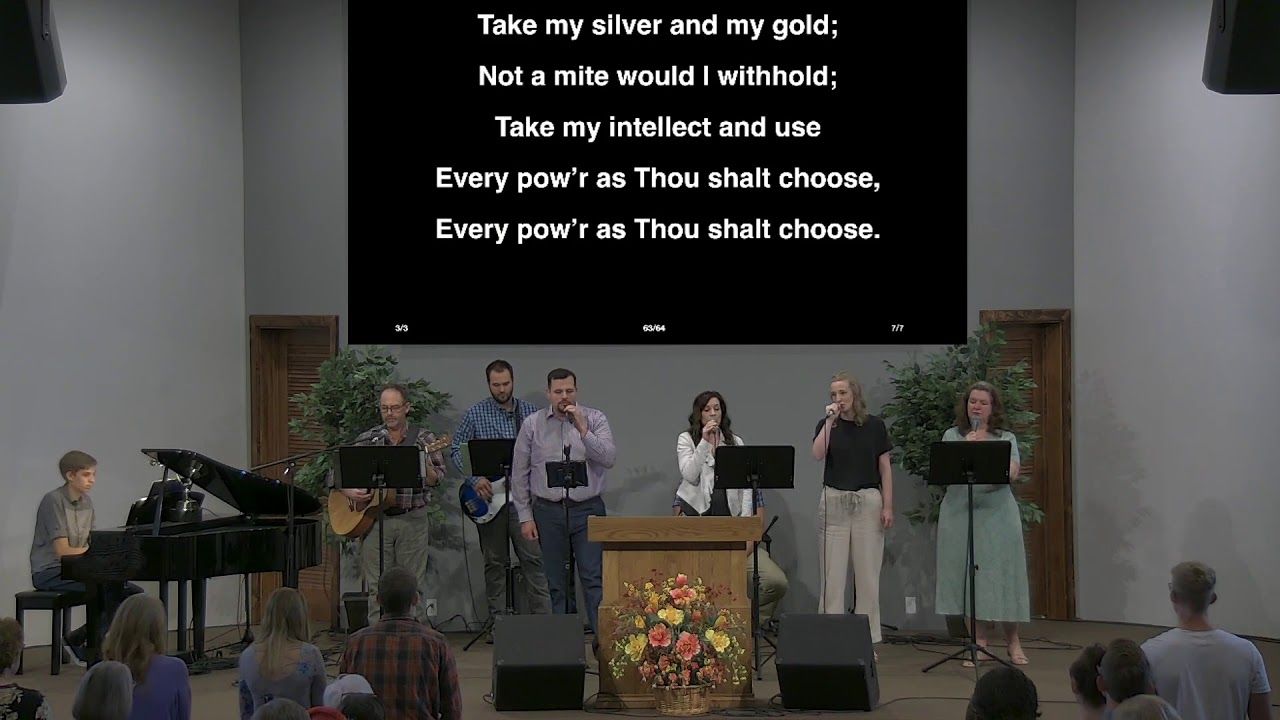
We will trust God's word alone Where his perfect will is known Our traditions shift like sand While his truth forever stands We will live by faith alone Clothed in man, all weakless Christ And his finished sacrifice Glory the church that he redeemed us By grace alone, undeserved yet freely shown We will stand on Christ alone Nations rage and dance for ever that he redeemed us He will keep us till we're saved
In Hebrews chapter 12, verses two and three, it says, fixing our eyes on Jesus, the author and perfecter of faith, who for the joy set before him endured the cross, despising the shame and has sat down at the right hand of the throne of God.
For consider him who has endured such hostility by sinners against himself, so that you will not grow weary, fainting in heart.
Jesus, look at the things not forsaken In the light of his glory, just the son, our savior.
Would you open your Bibles to the book of First Thessalonians with me? Chapter three. We'll read the first five verses. First Thessalonians chapter three. Therefore, when we could endure it no longer, we thought it best to be left behind at Athens alone.
And we sent Timothy, our brother and God's fellow worker in the gospel of Christ to strengthen and encourage you as to your faith. So that no man may be disturbed by these afflictions, for you yourselves know that we have been destined for this.
For indeed, when we were with you, we kept telling you in advance that we were going to suffer affliction. And so it came to pass as you know. For this reason, when I could endure it no longer, I also sent to find out your faith, to find out about your faith for fear that the tempter might have tempted you and our labor should be in vain.
Would you join me in prayer? Father, as we look at your word, your blessed word this morning, it's there we look for hope, for illumination, for guidance, for instruction, for correction, for rebuke, for all the things that you will bring into your church to make it a glorious thing that will show the Lord Jesus Christ in this world.
It is his glory that we seek. It is his glory that we want. And so this morning, as we look into your word, we ask for your wisdom, for your encouragement, and for your blessing, Lord, on these times when we live in times with potential affliction, which is what this section of scripture talks about.
You will bring your people through. You have started a good thing in them and you will finish it. Of that we have every confidence. And we thank you for that and look forward to it. In your name we pray, in Jesus' name, amen.
So this morning, here in 1 Thessalonians, we'll be talking a little bit about affliction. And you get a little bit of taste of it this morning, a little bit of a taste, because those of you who came thinking Jim was going to be preaching, it's going to be something like expecting tri-tip at a venue and getting a half-eaten Big Mac.
But what I do have is the word of God, and that is always a feast. And I would like to say one more thing before I get started. Dave's sermons are awesome. When we were last together in March of this year, we finished chapter two of 1 Thessalonians looking at verses 17 through 20.
In that section, we continued to look at what the ministry of a genuine under-shepherd would look like, a genuine under-shepherd of Christ. And it's good for under-shepherds to remember that word under, even though it's not got a hyphen and it's not attached.
The people, the men that God has chosen to put in positions of responsibility in his body are under-shepherds. The great shepherd is who we look to. Back to my introduction. It depends on, someone asked this morning how long the message would be, and I told them it depends on how many rabbit trails I go down, so.
So at any rate, we looked at the genuine, we began to look at the genuine ministry of an under-shepherd. Chapter one, true to Paul's format, was something of an introduction as well as a statement of praise, a praise regarding this young church that had taken the gospel and had run with it, if you will.
They had quickly developed into a local example of a genuine church of God. They were convicted by the word, as we see in chapter one, verse five. They became imitators of the Lord, and thus a huge blessing to the apostle, as well as a distinctive addition to the churches in this area, that the apostle was establishing in this area.
And we will see that through verse, we see that in verses six through 10 of chapter one. They were somewhat of a quick study, and for that reason, possibly, Paul had more than a little concern that there were probably some whose roots didn't run deep, as it talks about in the parable of the sower.
Chapter two is a reminder to the Thessalonians of how Paul treated them. Coming from Philippi, where they had been mistreated, they still boldly spoke the truth of God to those in Thessalonica. They treated them like a father, they treated them like a mother, they treated them like friends, and they gave them the truth, all of the truth, unadulterated truth.
They used no flattering speech, as Paul and his companions mentioned, Paul mentions in this testament, this epistle, nor did they look for glory. There's a good sign of a genuine under-shepherd of Christ.
They are more than delighted and grateful to pass all the glory on to others and to Christ. They were there for a short time, they were gentle, they labored hard. In the short time they were with the Thessalonians, the heart of a loving under-shepherd shines through in this chapter, as Paul and his companions were truthful, gentle, fondly affectionate towards the believers there, and they developed deep relationships.
They got to know the people there, they knew them as people and as families, not just a church, a building. They were devout and upright, they behaved blamelessly, Paul says in chapter two. They exhorted, encouraged, and implored the believers in Thessalonica as a father would their own children, as verse 11 of chapter two explains.
The Thessalonians received the word from Paul, Silvanus, and Timothy as the word from God, and they believed it. And that belief translated into a life, a beginning of the beginnings of a life of service.
They followed the Holy Spirit, they allowed the Holy Spirit into their lives to transform them, to take them from glory to glory, from grace to grace, as a believer will do. They endured suffering, even at the hands of their own fellow countrymen, in verse 14.
And then sadly, Paul and his companions had to leave. Throughout Paul's message to the Thessalonians, he continually made clear to them that the word he brought was in fact the true word of God, and they not only believed it, but they trusted God's word and they grew as they were sanctified by God's word.
He also reminded them directly of how he loved them and how he blamelessly and devoutly ministered to them. In this, we see many of the characteristics that should typify a genuine unheard shepherd of the Lord Jesus Christ.
One of the biggest statements he makes is in chapter two, verse six, where he says, nor did we seek glory from men, either from you or from others, even though as apostles of Christ, we might have asserted our authority.
He did not seek the glory of men, he sought the glory of Christ. Today, this is one of the easier ways to identify the charlatan who uses scripture to enrich himself and seeks the glory of men. Paul, Silvanus, and Timothy never did this.
They were only interested in advancing the Lord Jesus Christ in the world, and this was their food, it was their drink, it was their existence. They had to be spreading the gospel. Woe unto me, Paul said, for if I preach not the gospel, I have nothing to boast of, for I am under compulsion, for woe is me if I do not preach the gospel in 1 Corinthians chapter nine, verse 16.
Then Paul finishes up chapter two, reminding the Thessalonians that they had to be spirited away from Thessalonica for a short time. They wanted to come in the worst way, but Satan thwarted them, he says in verse 18.
This created a good, if you will, anxiety in Paul's heart, the kind of anxiety that a dedicated under-shepherd will feel, will experience, when they cannot be with those whom they love and want to serve, those whom the Lord Jesus Christ has entrusted to them.
So chapter three, that's a quick review. And so as you who are regulars know, Jim is our main preacher, our main teaching elder, and he's up here Sunday after Sunday expositing the word of God. We fill in, and so there's usually long stretches between the fill-ins, and so that's why we will tend to review stuff.
So in verse, chapter three starts with an unfortunate division of thought. If one were reading this as a book, without chapter headings or verse addresses, it would read something like this, starting with chapter two, verse 17.
I'm gonna just read it quickly, as it would have actually read in the original, before the chapter divisions were put in. But we, brethren, having been bereft of you for a short while in person, not in spirit, were all the more eager with great desire to see your face, for we wanted to come to you.
I, Paul, more than once, and yet Satan thwarted us. For who is our hope or joy or crown of exultation? Is it not even you in the presence of our Lord Jesus at his coming? For you are our glory and joy.
So when we could endure it no longer, we thought it best to be left behind at Athens alone, and we sent Timothy, our brother and God's fellow worker in the gospel of Christ, to strengthen and encourage you as to your faith, so that no man may be disturbed by these afflictions, as for you yourselves know that we have been destined for this.
So you see how it's basically a long thought there that starts there and culminates in the early parts of chapter three, and the divisions are convenient so that I can say, would you turn to 1 Thessalonians 3, verse one, and you know where to turn to.
If I was to say, would you turn to the Bible, and we're gonna talk about the Thessalonian church, okay, that's probably in 1 Thessalonians, could be in Acts, he might, you know. So chapter divisions are handy, I'm not running them down, but in this particular case, it's a split that kind of indicates a change of thought when there isn't one.
Paul is continuing on, therefore, when we could endure it no longer, he says. So leaving aside chapter designations, recognize from 2 17 to 3 5, we have basically one semi-long, painful, and joyous description of Paul's heart to be with those in Thessalonica.
So chapter three begins with a decision by the companions to tend to the needs of Thessalonica by sending Timothy. Paul has detailed some of Timothy's bona fides in verse two, and he will, and later he speaks joyfully of the return of Timothy with the information he sent him for, about the flourishing church in Thessalonica that was indeed truly growing from grace to grace every day in the glory of the Lord Jesus Christ through the word of God by the Holy Spirit.
Chapter three continues with a statement about what causes an under-shepherd to be joyous and thankful. He also, Paul also assures the Thessalonians that he prays for them, and he seeks their very best in Christ.
So these first five verses have a wealth of information about the ways an under-shepherd can tend to the needs of the brethren. Now, I titled this Comfort for Believers, and I don't want you to think it's a bait and switch, because we're gonna be talking about affliction.
And how many of you are comforted by affliction? Man, if I could just be broke this week. If the car would just break down again. If those people would come and try to burn the house down one more time.
We don't need to seek affliction. So are you encouraged by that? You don't need to seek it. It's not something you have to chase. The first five verses, I said, have a wealth. So here's three things that I will be referring to as we walk through these five verses.
What will an under-shepherd, a genuine under-shepherd, not do? They won't leave the believers alone, and I'm coining a word, unhelped. They will not leave believers alone and unhelped. Number two, they won't minimize the fact that believers will be afflicted, verses three and four.
And they won't ignore the possibility of apostasy in verse five. So there are a couple of things to know about this first section of chapter three. First of all, in 1 Thessalonians chapter three, verse one, therefore, when we could endure it no longer, Paul uses what has been called the narrative we or the epistolary we there.
He is not talking about he, Silvanus, and Timothy necessarily. It is most likely that he is using we because Paul was a humble man and he did not like calling attracting attention to himself. So he would use the word we as a narrative we to describe what he was doing in some cases.
Not every case, often it means we. But in this particular case, the construction indicates that he was talking about himself. Second, we're told not to be anxious. So I want you to know that his anxiety was not an ungodly anxiety as some might surmise.
He had a deep abiding love for every church that he planted and that he ministered in. And it wasn't just the church at large, it was the people in the church. He knew them, he knew their names, he knew their condition, he knew what they were struggling with.
He missed them. This little church had just gone through some fiery trials and he was concerned about satanic influence. So it was a godly, anxiety might be the wrong term, a godly concern that they be built up and strengthened.
And he's gonna talk about that in this section here. We will see, he was concerned that they might not know how to sustain one another. They were brand new Christians. Do you remember back to when you were a brand new Christian?
You knew everything, didn't you? And then as time wore on, you began to realize that Paul was a pretty smart guy. He knew more than I did. Jesus knew more. You began to learn and you began to bounce your ideas off of more mature believers.
And the body life that exists in a church grew you and some of your foolish ideas were put away and some of your ideas that you'd never thought of came to the fore and you grew and you became more useful, useful in the church, more useful to one another.
That's what Paul wants for this new church. They might not know how to sustain one another. We will see that these concerns were unfounded but he didn't know that. Paul was Paul. He put his toga on one leg at a time, just like we do.
Do you wear a toga? Well, I had to leave it in the, it had to be historical. Finally, in this section is a beautiful insight into the heart of a loving under shepherd. While he would want to mitigate the suffering of the believers he loved as much as possible, Paul was a realist and he knew that living in the world meant struggling in the world.
A body of believers in a pagan world in the middle of the Roman empire was a prime target for affliction. This is true in every age and Paul pulls no punches in bringing solace and teaching to his charges.
Now, no one who is really in their white right mind wants to be the bearer of bad news. Do you like bearing bad news to people? I get to ruin their day. No, yeah, that's whatever that was prompted by, thank you.
So we've developed methods over the centuries of delivering negativity. I have good news and I have bad news. Who has heard that heartwarming phrase? It's like if we just throw in a puppy and a latte, we can mitigate the destruction and death, you know?
We don't want to bother people. We don't want to scare them. As I was studying to prepare for this morning, I was impressed with the fact that Paul was unafraid to deliver difficult news to even a brand new church.
Did you notice that in this section? This is not the best marketing, folks. If you're gonna sell a car, don't tell them what's wrong with it. Actually, if you're a Christian, you oughta. And I'm gonna develop this a little bit more, but I actually sold a pickup not a few years back, and I knew the transmission was going out.
And so I would tell prospective buyers, the transmission is going out. Okay, nevermind, you know, most of them. But I subtracted the amount from the cost of the vehicle that I checked with a local transmission repair shop.
How much will it cost to repair this transmission? And I subtracted that from the value. And so finally, I got a taker. And I actually put that in the bill of sale. The buyer acknowledges that the transmission is, and I had is in capital letters and bold and underlined, is going out and attested that by their signature.
They were actually grateful. And later on, a year or two, I don't remember how long ago it was later, I met him in a grocery store in the line, and I went, how's that pickup doing? Oh, yeah, the transmission went out in about three months, but we got a new one in, and I love it.
So if you can be apprised of difficult news, it can be a help to the believer. And Paul knows that. He knows that apprising, giving people the information up front can be a blessing. And then I got way off.
See, that's why it's gonna take longer for this message. So the fact is, if you're gonna tell something about, tell people about something that has the potential to absolutely change their lives for eternity, don't be afraid to give them the entire counsel of God, the whole truth.
As Paul said in Ephesians, this is a long section, but if you get nothing more out of this morning than the scripture, you will be blessed beyond measure. In Acts chapter 20, verses 17 through 28, Paul said this when he was talking to the elders and the leaders of the church there.
From Miletus, he sent to Ephesus and called to him the elders of the church, and when they had come to him, he said to them, you yourselves know, from the first day I set foot in Asia, how I was with you the whole time, serving the Lord with all humility and with tears and with trials, which came upon me through the plots of the Jews, how I did not shrink from declaring you anything that was profitable, and teaching you publicly and from house to house, and solemnly testifying to both Jews and Greeks of repentance toward God and faith in our Lord Jesus Christ.
And now, behold, bound by the Spirit, I am on my way to Jerusalem, not knowing what will happen to me there, except that the Holy Spirit solemnly testifies to me in every city, saying that bonds and afflictions will await me.
So the Holy Spirit had no problem telling Paul that troubles await in you. And what did Paul do? Oh, I'm not going to Jerusalem. No, he set his face like Flint and he went to Jerusalem. Back to the scripture, but I do not consider my life of any account as dear to myself so that I may finish my course in the ministry which I received from the Lord Jesus to testify solemnly of the gospel of the grace of God, and now, behold, I know that all of you among whom I went about preaching the kingdom will no longer see my face.
Therefore, I testify to you this day that I am innocent of the blood of men, for I did not shrink back from declaring to you the whole purpose of God. Be on guard for yourselves and for all the flock among which the Holy Spirit has made you overseers to shepherd the church of God, which he purchased with his own blood.
So the message this morning to us, at least as I was studying this, is that affliction is not something to be afraid of. Affliction is not something to be fearful of. And we'll find out that it's actually part and parcel of Christianity.
Now, I don't have some special message that is different from what is written in the pages of Holy Scripture. In fact, what I have is from the pages of Holy Scripture, which is what an undershepherd should do.
But in the message, there is beauty and there is pain, and I will not shrink back from declaring the difficult things to you and, turning the page wrong, so in this little short section of Thessalonians, beginning in chapter three, Paul bears his soul.
And maybe intentionally or unintentionally, he bears his soul to the Thessalonians about their, his love for them and his concern for the difficulties they would face. And so I would do that this morning as well.
Brothers and sisters, the gospel is the most beautiful message that has ever been proclaimed, ever. But it contains within it difficulty. We must understand that trusting Christ has eternal blessings.
But while here, while here, is it not attended with difficulty? Somebody's gotta nod their head at that. Have you got that life? Your best life now? No. It is attended with difficulty. Paul made sure that his new brothers and sisters in the faith in Thessalonia, Thessalonica, understood this, and we will see that as we look at this section.
So that's the introduction. Verse one, therefore, which refers back to his love for them in chapter two. Therefore, when we could endure it no longer, we thought it best to be left behind at Athens alone.
Here then is the epistolary we that Paul used, and Paul uses very strong words here. The word for endure is the Greek word stego, which means to cover over or to hide by covering, to ward off by covering.
It later came to include the idea in the New Testament of to bear up against or to endure. It only occurs in two other places in the New Testament. In 1 Corinthians 9, 12, if others share the right over you, do we not more?
Nevertheless, we did not use this right, but we endure all things so that we will cause no hindrance to the gospel of Christ. And then in 1 Corinthians 13, seven. So Paul uses it three times. Bears all things, believes all things, hopes all things, endures all things.
It's the idea of strongly and steadfastly waiting for something, but he couldn't wait to hear from the believers in Thessalonica. In both cases, in all cases, this word communicates steadfast endurance.
The apostle had to know what was going on in Thessalonica. He had to know. He loved his charges. He loved his charges there, and he had poured himself into them for a short time, and he wanted to know how it went with them.
He could have used Timothy in Athens. He was going into one of the most godless cities in the Greek empire, where it was full of pagan philosophers who had worked their, plied their trade, and sharpened it to a great, to a point.
They were good at what they, they were good at the false theology they propagated. That's where Paul was headed, and he elected to send Timothy back to Thessalonica. He was less concerned for himself than he was for his people, his people, if you will, the church of Thessalonica.
This is the true heart of a dedicated under-shepherd. He will be more concerned for those that God has called him to serve than he will be about himself. When he believed there was a need in Thessalonica for support and encouragement, he stripped himself of that support and encouragement and sent Timothy back.
The heart of a true under-shepherd will always seek to meet the needs of those they serve more than they will meet their own needs. They will never leave believers alone and unhelped. There is a tendency today to talk about taking care of yourself, taking care of your personal needs.
The big talk is making sure you take care of yourself first. I'm not gonna talk about any current events, just the philosophy itself. Look to your own needs first. Take care of yourself first. That's the idea.
That's not how Paul operated. And it shouldn't be how a genuine servant of Christ operates. It's not that one shouldn't have a concern for their own needs. It's just that it has become a nasal gazing operation that precludes servanthood.
We cannot be servants if we are obsessed with ourselves, if we are obsessed with our needs, if we are obsessed with what is going on in our lives. We need to look to the needs of others. We need to look to the hurts, the pains, the concerns of others.
This is what Paul did. Paul couldn't bear to think about those in Thessalonica struggling on their own. So he sent the best help he could because he couldn't go. And we sent Timothy, in verse two, he says, "'Our brother and God's fellow worker "'in the gospel of Christ to strengthen "'and to encourage you as to your faith.
"'So if those you love need help and you can't go yourself, "'send the best you've got.'". Paul describes Timothy here with superlatives intentionally to give him better stature in the eyes of the Thessalonians, to know that he was sending genuine help to them.
He called him God's fellow worker. That's a remarkable statement. Think about that. Not Paul's fellow worker, not Paul and Silvanus's, not the apostles' fellow worker, God's fellow worker. That's a wonderful title, a wonderful title.
That's what he called him. It's an incredible appellation, and his work wasn't in just anything. It was in the gospel of Christ. He gives this praise to Timothy in the book of Philippians. Remember this praise?
In Philippians chapter 220, Paul said this, "'For I have no one else of kindred spirit or like-minded "'who will genuinely be concerned for your welfare.'". Paul knew that if he couldn't go, if he could send Timothy, it would be almost as if he were going because Timothy was such a servant and had developed to such a potential of being everything Paul could have been himself.
And his intention was that Timothy, oh, do you work for someone, by the way? This thought just occurred to me. Here's another rabbit trail. They should be able to say that about you. I sent so-and-so because they will be genuinely concerned for your welfare.
You ought to be, we ought to be that kind of servant in whatever area we are engaged. And his intention was that Timothy would strengthen and encourage their faith. The purpose was twofold. The word strengthen comes the idea of giving someone staying power, whether it means holding them up or feeding them or biblical encouragement.
This would be needed for new converts who had to face genuine persecution, sometimes for the first time. Their life was sailing along just like a normal Greek peasant life was at that time. And then they trusted Christ.
Now, all of a sudden, people don't like them, really badly don't like them. Some of them want to kill them. This would be needed for new converts who had to face genuine persecution. Paul had a close relationship with Timothy and he knew him well.
He knew that he could trust him to take the proper biblical support to the converts in Thessalonica. This is another example of an under-shepherd refusing to leave those they care for unhelped. And the strengthening wasn't for their emotional or mental wellbeing.
It was for their faith. It was for their faith. Their trust in Christ needed to be firmed up, not with spurious demonstrations of pseudo power, but with the sure word of God, for this was the tool, this is what gave strength to Paul and his companions, the gospel of Christ.
This is what they took back to Thessalonica. They didn't take shows of power or demonstrations or anything else. They took back with them the very word of God that they used to plant that church. The strengthening here is a reminder to all of us, by the way, that it's not just enough to have a remarkable conversion.
We've all seen remarkable conversions. They're on television, they're in the news, they're on Facebook, they're on Twitter. I can't remember the name. The truth of the matter is demonstrated when one stays the course.
Paul knew that there would be temptation in Thessalonica to run from the afflictions that were coming. Sometimes people mistake affliction for God's disfavor. More often than not, in the lives of faithful Christians, it's just the rotten world and all that goes along with it, and the fall that is mitigating against their walk with Christ.
Don't misunderstand the difficulties in your life as some strange thing. Timothy would bring this truth to the Thessalonians as well. Peter put it this way. David, Dave read this before the message. He put it this way in his epistle.
He said, beloved, do not be surprised at the fiery ordeal among you which comes upon you for your testing as though some strange thing were happening to you, but to the degree that you share the sufferings of Christ, keep on muttering, complaining, keep on rejoicing, rejoicing, so that you also at the revelation of his glory, so that you may rejoice with exultation.
If you are reviled for the name of Christ, you are blessed, because the spirit of glory and of God rests on you. Make sure that none of you suffers as a murderer or a thief or evildoer or a troublesome meddler, but if anyone suffers as a Christian, he is not to be ashamed, but is to glorify God in this name.
So these would have been some of the strengthening things that Timothy would have taken back to the Thessalonians who were being persecuted. Glory in God, glory in these persecutions. Don't seek them, but when they come, glory in them.
As you are properly interpreting and living out the word of God in your life, glory in those persecutions. One of the more important things to remember here though is that Paul understood the need for a minister to actually be present with the new converts or with old converts.
We all need someone else standing next to us during the difficult trials in life, don't we? Is it comforting to you when you have someone who's willing to come spend their time and be with you when you're going through difficult times?
They don't have to say anything sometimes. Sometimes people like me, it's better if I don't say anything just be there, just put your arm around them and God will give opportunity for the strengthening that needs to come.
Further, a true under shepherd would not seek to tell those he loves to avoid every possibility of affliction for he knows that difficulties and pain must come to those who trust Christ. And so in the next verse, Paul himself confirms that.
So that he says in chapter three, verse three, so that no one would be disturbed by these afflictions for you yourselves know that we have been destined for this. I don't know how many times I've read Thessalonians and I didn't ever really catch this.
We're destined for things. There are some gear in there, some rock solid guarantees in the Christian life. And you know what's right at the top of the list? Persecution. Hey, do I see any, no arms are going up.
A true under shepherd will never minimize the fact that believers will be afflicted in this world. The word disturbed here comes from a Greek word and it's lovely these metaphors that the Greek language has.
We have our own, I mean, we got rule of thumb, you know where that comes from and little metaphors we have and stuff like that. But this word, this word disturbed comes from a Greek word which has its idea of the wagging of a dog's tail.
And it implies being fond over and cajoled. Dog lovers will understand this. Can you resist your dog's wagging tail? You dog lovers out there? No, you can't. You reprobates. Or the purring of a cat on your leg.
This is what it's talking about. It's people who will cajole you. You know, if you just give in a little here, you don't need to be going through this. Just, they won't use the word compromise, but that's what they're saying.
Just compromise a little and it won't be so rough for you. This dog is wagging its tail. Sometimes when afflictions come to Christians, there are those who urge us just the least little bit of compromise in order to stop the affliction.
Are you suffering because you're a murderer or a troublesome person or a thief or a liar? Stop that. But if you're suffering because you've been obedient to the word of God, you need to ignore that kind of advice when it tells you to compromise.
In this particular case, this might have very well been the Jews urging the Thessalonians to give up Christianity and to adopt Judaism so the affliction would stop. There will be those who come into our lives who will urge us just to give in a little bit and not take such a hard line.
If you just go along with the flow a little bit, you know it won't be so bad. The simple fact is God strengthens us by his Holy Spirit to be obedient to his word. The fact is he often uses other to strengthen us as Paul did with Timothy for the Thessalonians.
But Paul's statement here was not only that they should not be disturbed, but they should recognize that they were destined for affliction. So you were destined for affliction when you became a follower of the Lord Jesus Christ.
The idea behind the word is that our dedication actually causes us to lie in the way of affliction. It's like there's a car coming and you lay down in front of it. I'm not telling you to do that. I mean, but that's, I'm trying to give you a picture of what it's talking about.
It's to lie in the way of affliction. It's the same word for set in Matthew chapter 5, 14. We are a city set on a hill. You're placed there. You're put there. You're put on that hill. It's the same word in Philippians 1, 6 that Paul uses as one appointed for the defense of the gospel.
You have been appointed for the defense of the gospel. You've been set in the way to defend the gospel. It implies immovability, immovability. Now, that does not mean, like I said, that we should glory in difficulty.
It doesn't mean we have to look for it either. It will come to us. If we are faithful to Christ, the world will be faithful to hate us. And make no mistake, they will do that. Let us make sure that the hatred the world has for us, though, is hatred of the gospel and not of our own wickedness.
One of the most important truths that a believer can understand is that the life of a Christian is not and will not, most likely not be, a life of soft, fluffy kindness from everyone. The world hated Christ and it killed him.
We should expect it to hate us. If, in fact, we are consistently loved by the world, it should be a red flag to us that not all is well with our faith. Scripture warns that those who remain faithful to Christ will be hated by those who pretend to be faithful to Christ.
Jesus' words in Matthew, the gospel of Matthew, teach this very thing. Then they will deliver you to tribulation and will kill you and you will be hated by all nations because of my name. At that time, many will fall away and will betray one another and hate one another.
The Lord Jesus Christ said in John that the world must hate you because it hated him. In fact, when the world hates you, persecutes you, and kills you, they actually think they're doing service to God.
Boy, isn't this a comforting message. I'm not done. It's Friday, but Sundays are coming. They will make you outcasts from the synagogue, but an hour is coming for everyone who kills you to think that he is offering service to God.
These things they will do because they have not known the Father or me. Timothy had to make sure that the Thessalonians understood this. Their trials were not an anomaly, but as a matter of fact, they were a good indication that their lives were, in fact, lives of dedication and service to the Lord.
We can't make this the only litmus test, of course. Don't do that. Scripture and scripture alone is what we use to evaluate our lives of service to the Lord Jesus Christ. But as one is properly interpreting and applying scripture, when the difficulties come, you can be sure it is because you are adhering to the word of God.
One note about translating this verse. Some people believe that the word we is again the epistolary and refers to Paul only, but the most natural reading of this is that it applies to both, both Paul and to the Thessalonians.
Remember that Paul later reminded Timothy, the very person he sent to Thessalonica, that if he desired to live a godly life in Christ Jesus, he and anyone else who chose to do that would be persecuted in 2 Timothy.
Verse four, for indeed, when we were with you, we kept telling you in advance that we were going to suffer affliction, and so it came to pass, as you know. Again, we have a situation where the we could be referring to Paul alone or to Paul and the Thessalonians.
Likely here, again, it most naturally refers to both. He wanted to make sure that they understood, they really understood that affliction was coming and would come. Paul knew that making the Thessalonians aware of persecution ahead of time would have the effect of strengthening their faith.
Giving someone a heads up about difficulties to come is a blessing to them. It allows them to be as prepared as they can be. Now, we can't anticipate every eventuality, but we can be students of the word of God, and we can see how his messengers and his children are treated, and know that the potential for that exists in our lives.
Then we won't be surprised at the fiery ordeal. We will be more prepared to resist him, firm in your faith, knowing that the same experiences of suffering are being accomplished by your brethren who are in the world.
I stole that from your book, too, Dave, 1 Peter. You just picked a great book to preach through. What can I say? We will recognize it, the difficulties that come, as a good fight, and we will be more likely to finish the course, keeping the faith.
In fact, when Paul and Barnabas wanted to strengthen the believers in southern Galatia, one of the things they told them was that it will be through many tribulations that one enters the kingdom of God.
Strengthening the souls in Acts 14 .22, strengthening the souls of the disciples, encouraging them to continue in the faith, and saying, through many tribulations, we must enter the kingdom of God. This is not to say that the difficulties of Christianity should be the only message, as it sounds like it is this morning.
But a true under-shepherd will not mislead believers by ignoring the fact that tribulation is part and parcel of genuine Christianity. Wolves and shepherds will not share this information. They want your praise.
They want your money. So they're only gonna tell you about the health, the wealth, the fairy dust, the golden feathers, and the unicorn breath. For this reason, finishing up, Timothy, Paul says this to the Thessalonians.
For this reason, when I could endure it no longer, I also sent to find out about your faith for fear that the tempter might have tempted you, and our labor would be in vain. Repeating what he said in chapter three, verse one, Paul shows his protectiveness and his desire to see the Thessalonians grow.
He did not want the work that had been done in Thessalonica to be damaged by Satan. As a true under-shepherd will, Paul did not ignore the possibility of apostasy, but as his manner was, he most certainly prayed for the Thessalonians, and he included this reason for sending Timothy back.
He wanted to know how the seed he had planted had fared. Did they receive it with joy, but have no root, so that when persecution came, it caused them to fall away? Were they weakened by the affliction that came, or had they stayed true to Christ?
Paul wanted to know if the joy that was evident on their faces in their lives at the beginning, when he shared the gospel with them, was real. Now, here's a delightful piece. The construction of the Greek here indicates that Paul trusted the Holy Spirit to be working in Thessalonica.
It changes from, and I hate to get so technical, but as you're reading this, in verse five, he says, for this reason, when I could endure it no longer, I also sent to find out your faith, about your faith, for fear that the tempter might have tempted.
That's in the indicative. He made a statement. I was worried that the tempter might tempt you, but he says it's not a possibility by changing the case. He says, and our labor should be in vain. He knew that the tempter would tempt them, but he didn't believe their labor would be in vain.
He was a shepherd, an under-shepherd, that trusted the Holy Spirit, trusted the word of God. Well, what this actually means is that his statement, for fear that the tempter might have tempted you, was a statement of fact, and our labor would be in vain, was hypothetical.
As one commentator put it this way, he said, Paul thinks it probable that Satan has applied pressure to his converts, but improbable that they have given way. Why? Because of the Holy Spirit, because of the word of God.
What did he sow into their lives? What is sown into our lives? The word of God. And the word of God does not return vain. Further, he knew he could trust Timothy to bring back an accurate report, and we will see the next time we're together that Timothy did bring back a great report.
And so, even though it sounds like I'm ending on bad news, I'm not. The fact is, Timothy is gonna come back from Thessalonica, and he's gonna report to Paul that not only did the words fall on fertile ground, but they are now examples to other churches.
Why? Because they lived the word of God out in their lives. So Paul had a great desire to minister to the Thessalonians, but he could not go. So he sent his best, he sent Timothy. As a faithful under shepherd sent by Christ to plant the churches, he would never leave believers alone and unhelped.
Further, he would never minimize the fact that commitment to Christ will result in affliction, and he cautioned and warned the Thessalonians about that. And finally, he would not ignore the possibility of apostasy, but his great desire was that the Thessalonians would prove true to the gospel.
Under shepherds do not want their work to be in vain. And so, as Paul has done here with the Thessalonians, they must pour themselves into the flock that God has entrusted to them. They cannot leave them alone, unhelped, and bereft of teaching.
They must be sure to tell the truth about life so that those who come, they know that they are destined for difficulties and not shocked by the afflictions that come. They should never ignore the possibility of apostasy, but always trust Christ to finish the work that he started in the lives of those who have put their trust in him.
So in closing, although it may seem I focused too much on the negative this morning, it is negative, it is a negative that we need to know so we can be prepared. As we face the difficulties that may be coming in these days, we must remember that Philippians 1 .6 is a promise, and that Romans 8 .28 is not a cliche.
And frankly, there's no better way to end a message than to end it with scripture. And so I close with this, Philippians 1 .6, for I am confident of this very thing that he who began a good work in you will perfect it in the day of Christ.
And Romans 8 .28 through 30, and the Thessalonians needed to hear this. And we know that God causes all things to work together for good to those who love God, to those who are called according to his purpose.
For those whom he foreknew, he also predestined to become conformed to the image of his son so that he would be the firstborn among many brethren. And these whom he predestined, he also called, and those whom he called, he also justified, and those whom he justified, he also glorified.
Let's pray. Father, the world is bent on undoing what has been done by you. But we know that you are a conqueror and you have made us more than conquerors. Let us always turn to the word, turn to Christ when difficulties come.
For we are destined for difficulty, but we also are destined for glory. And we look to you to make that happen day by day in our lives so that we might honor you, bring glory to you, show the world that the Lord Jesus Christ is worthy.
He is the lamb who was slain for those who will believe, and he is worthy of all praise. Might we be about that business today in our lives. In Jesus' name we pray.
Would you please stand? Take my life and let it be Consecrated for to thee Take my voice and let it be Take my meekness and let it be Take my silver and let it be
May the grace of our Lord Jesus Christ be with your spirit, brethren. Amen. You are dismissed.
I spoke to say