Keep sharing good news without ads.
This is my presentation from August 19th, 2009, in Neutral Bay, Sydney, Australia, on justification and the uniqueness of Jesus.
It is indeed an honor to be with you this evening. I will begin by apologizing for the extra bass in my voice. I am hoping and praying that this is only due to the fact that it is winter here and summer where I came from.
And that it's not anything else because early tomorrow morning I have a flight to Brisbane and it's the folks in Brisbane who actually first contacted me to get me out here. So I would hate to show up in Brisbane all beat up and unable to talk.
So come at your prayers for that. I have been asked to address a very important subject and that is the topic of justification along with the uniqueness of Jesus. And I put these two together because of the fact that it is the work of Christ that provides us the means of justification and it is only the work of Christ that does so.
And it is that emphasis upon the uniqueness of Jesus and the fact that God has spoken in him and in him in a definitive way that our society finds to be so reprehensible about the Christian faith and that we as believers are frequently then put under pressure to compromise, to be ashamed of the fact that we are saying that it is only in Christ that this means of peace with God has been provided.
And so I would like to in the time we have this evening to consider this particular subject and I hope that God will bless our time together this evening. Justification is an area of constant controversy.
It has been an area of controversy down through the history of the church and remains an area of controversy to our day. Controversy in and of itself is not something that is bad. In fact when you stop having controversy is when in essence a tradition or a falsehood has won the day.
I think controversy is demonstrative of a living body of people because people are still thinking. There is still activity going on. But it has been a controversy ever since the days of the apostles. We should not be surprised that it continues to be a controversy today.
If even when the living oracles of God were being delivered in scripture through the apostles, if there was still controversy about this subject at that time, why should we be surprised if in our day that is the case as well.
Since you have been going through the book of Galatians, I am not sure if you have gotten to Galatians, but you have already gotten through Galatians chapter 2. And so you would be familiar with this text but I want to draw your attention to it again.
Galatians chapter 2 verses 4 through 5. It was because of the false brethren secretly brought in, who had sneaked in to spy out our liberty which we have in Christ Jesus, in order to bring us into bondage.
But we did not yield in subjection to them for even an hour. So the truth of the gospel remained with you. The fact that the book of Galatians is in the New Testament, is one of the main reasons that my ministry remains a small ministry 26 years after its founding.
In other words, it would be a whole lot easier if Galatians was not in the canon, to be considerably less concerned about the issues of justification, the issues of what the gospel is. And therefore to be much more shall we say broad minded, which is very much what our society likes us to be.
But the reality is this text is there. And when we read the words in this book, we are struck by the strength of the words that Paul uses. So much so that in one debate I had with a liberal in the United States by the name of Barry Lynn, that he described the epistle of Galatians as over the top, and rejected it as having any meaningful inspiration or use for Christians today.
And this text might be one of the texts that would cause someone like that to respond the way that they did. Notice the politically incorrect things the apostle says. He talks about false brethren, well how judgmental of you.
Here is a decision that has been made by the apostle, there were those in the church who wanted to look like they were brothers. They wanted to look like they were in the fellowship, but they were false brothers.
In fact they had snuck in secretly. They were doing this with improper motivations. They wanted to bring the Christians into bondage. So clearly there was a danger, even during the days of the apostles, of false professors.
These were not people who came in dressed in some other garb, pointing themselves out and saying I'm a false prophet, I'm a false teacher. They dressed like us. They spoke like us. They shook your hand and said hi brother.
And yet the apostle came to the conclusion that they were there for only one reason. And that was to bring the believers into bondage. If it was a danger for the apostolic church to be brought into bondage, is it not still a danger for that to happen in our day as well?
So there are those who are false brethren. They sneak into the church. They want to spy out the liberty which we have in Christ Jesus. They want to bring us into bondage. Well what kind of bondage? What is the nature of this bondage?
It clearly wasn't something that was just an external type of thing. This was doctrinal in character. They wanted to somehow change the very message of the Christian faith, as Paul had discussed in Galatians chapter 1.
They wanted to pervert, to twist the message. It may have still sounded similar, but it was changed enough to bring the people into bondage. But notice what Paul says. We did not yield and subjection them for even an hour.
For any period of time we did not compromise on this one subject. Now in our society we were told, no wait a minute, you can't be so dogmatic. Who do you think you are? How can you be so unloving and so unkind as to not listen to the other side?
But Paul says we did not yield and subjection them for any period of time at all. Why? Because Paul was an unloving person. Because Paul didn't care about other people. No. So that the truth of the gospel would remain with you.
His ultimate priority was the truth of the gospel. And I want you to hear that phrase. Because a large portion of our world today, and even a large portion of those who call themselves Christians, are not really convinced that we can know what the truth of the gospel is.
If you don't believe that it's God's purpose that in each generation we can know the truth of the gospel, I'm not sure what kind of solace you can find in Christian faith. If the Christian gospel can disappear, if the word of God is insufficient to reveal what the gospel is, then we of all men are most to be pitied.
For we no longer have a message of hope. It is the promise of Scripture that God preserves that message. That message which brings us peace within. That truth will exist in each generation. We may have to fight for it.
We may have to struggle for it. But the truth of the gospel must remain with God's people. And we as believers are called to struggle, to be passionate about passing that truth on to the next generation.
It is something that has been entrusted to us. It is a possession far more important than anything else that we have. And I truly believe the Spirit of God stirs up our hearts when we ponder what it is that God has done for us in Christ Jesus.
And the importance of accurately handling that message. These men had snuck in and Paul said we did not subject ourselves to them for a moment. Why? Because to do so is to compromise the very truth of the gospel.
He even uses an illustration of that. What happened with Peter and Antioch. And he said they were not walking straight in accordance with the truth of the gospel. Peter had buried, and so publicly, Paul, the last of the apostles, rebukes Peter, who is on the Mount of Transfiguration with Jesus.
What audacity, unless the truth of the gospel is more important than anything else. Anything else at all. And so here we see why it is important that we gather today and we discuss this very, very important subject.
What are some of the issues that we think about today in regards to this very important subject? Well, obviously, in light of the Reformation, we have the Roman Catholic concept of justification that involves infusion of grace into the soul.
And their assertion that the position that we take on this matter is involving merely a legal fiction. What do I mean by that? Well, history tells us, or at least tradition tells us, that Martin Luther used a particular illustration to talk about justification.
The reality is, no one can find this in any of Martin Luther's writings. But it sounds like something that Luther would say. And that is, he used a rather earthy example of a dunghill. If you think about Germany, you would pile up the animal waste and that was what you would use to fertilize the fields when it was time to plant your crops.
And piles of dung are not exactly very attractive on any level whatsoever. And so Luther told the story, or at least by tradition told the story, of how that repulsive pile of dung, when that first snowfall would come, it would be covered over.
You could no longer see it. You could no longer smell it. It was just simply a bump on the horizon. And that that snowfall was like the righteousness of Christ that covers over our offensiveness before God.
It didn't change the pile of dung. Don't get me wrong. Luther did believe that we were changed by the grace of God. But that that was different from what justification is, which is a legal declaration on God's part that we are right with him because of what Christ has done.
Now that illustration of the alien righteousness of Christ that covers over our sin has been criticized many times by Roman Catholic apologists. They say, see that demonstrates the legal fiction. There really isn't anything going on here.
But I thought many years ago about how you could take that same illustration and understand it from the Roman Catholic perspective. And that is, from the Roman Catholic perspective, God infuses grace into the soul and makes you objectively pleasing before God.
And so in other words, it would be like taking that pile of dung and turning it instantly into a pile of gold. And that's why it goes to heaven, because it is pleasing to God. It fits in heaven. But there's a little bit of a problem.
And that is the Roman Catholic theology. Once you commit a sin, if it's a venial sin, you end up with, well, a little dung appearing on the surface of the gold. And over your life, if you don't do all the penances you need to do before that pile of gold can go to heaven, it has to go to purgatory to be purged to get rid of the dung that has appeared on the surface.
But the really scary thing is no one can know the Roman Catholicism, whether they have committed only venial sins or if they've also committed mortal sins. Because when you commit a mortal sin, all of a sudden that pile of gold becomes a pile of dung.
And no one can know for certain which one they are. And so to criticize Luther's illustration while having a system like that, well, I think you need to see what the differences between the two are. Luther was saying none.
It is an alien righteousness that is given to us. It is the righteousness of Christ that is imputed to us. It is not that God makes me objectively pleasing and therefore I go to heaven because I am pleasing.
What he does is he gives me the righteousness of Christ so that I am clothed in that perfect righteousness. And then that process of sanctification, being made holy, occurs in my life as I am conformed to the image of Christ.
The two go together. They are married together. But they must be distinguished from one another or we end up turning the glory of justification into something else. Now, obviously, various cults and isms over the years have provided us with all sorts of interesting takes in the doctrine of justification.
Since justification points us away from ourselves and only to Christ, then almost every cult and ism out there perverts this central teaching of the Christian faith. And so anyone who has family members, anyone who encounters some at the train station or wherever else it might be, maybe a Saturday morning knocking on your door, knows that there is controversy concerning this particular area.
Some of you are probably aware of the fact that now there is, in our modern day, the new perspective on Paul. A perspective where we start with, I think, a very flawed foundation of view of even the canon of scripture itself.
We come up with a new perspective on what Paul was actually trying to communicate. And as a result, say, all that justification stuff, you know what, we don't have to worry about it anymore. The Protestants were wrong with the Reformation.
So were the Catholics. The whole reason for the Reformation was just a misunderstanding. If we would just embrace this perspective, then we would all have peace with one another. And yet this requires us in many instances to view Paul in a radically new way that does not do justice to his historical context at all.
And then, of course, there is the general apathy in the church on the topic due to humanism and a low view of sin and holiness. I mean, let's face it, we could have packed this place out and we would be talking about all sorts of different subjects that would get people really excited.
Especially end times speculations or maybe something about Christian financial success in the midst of recession or something like that. Justification is not the topic that today causes people to get all excited and to make plans to travel far and wide to hear discussions of that particular subject.
And I think one of the main reasons for that is that justification is a precious message to sinners. Justification that God makes man right with himself and does so perfectly. That God provides peace is a message that rings the bells of the hearts of sinners.
And we live in a society where there aren't any of those left. Or even if there are, well, we're all sinners, right? The idea of the holiness of God. The idea of the imminency of our own mortality. The fact that we will all stand to give account before God.
And that he is holy. And that nothing impure or unclean is going to enter into his presence. That's not a popular message in our day and our time. We live in a day where we amuse ourselves to death. Ever thought what the word amusement really means?
Amuse. To think. To ponder. A. To not do that. Therefore amusement means to not think or ponder. To distract oneself. How many in our society really spend time pondering eternal sins? We don't have time to.
Even if you start doing it, you know what happens? Your cell phone goes off. The next generation doesn't know what it's like to walk down the road without some electronic gadget stuck in your ear. We are always being distracted from silence and self-contemplation.
And as a result, we just don't think about things like the holiness of God. I've been talking to some of the brethren on this trip. And I'm not an old man. I'm a middle-aged man. But I'm closer to 50 than 40 now.
And if you are in my age bracket, you know that after that magical 4 -0, stuff just doesn't work the way it used to. And all of you who are laughing just demonstrated that you're over 40. And for me as a Christian, the fact that I need to have reading glasses.
And the fact that my right knee bothers me. And when I do get a sports injury, it takes longer for it to heal up. As a Christian, that tells me, think about eternity. Think about what's important. Think about what you're going to leave in this world.
But for most of the people in our society, all that does is resolve in whining and complaining. Not looking forward to eternity. And so there is a general apathy on these important subjects that makes it difficult for us to communicate these things to others.
I would like to look at some scriptures with you because I'm always more comfortable in the text of scripture itself. Hopefully find the appropriate place to take our interval. That's something that Americans don't say, so I had to translate there for a moment.
And then especially discuss the uniqueness of Jesus in regards to the subject of justification. Romans chapter 4, a tremendous text. If you ever want to go to one place when you're challenged on this matter of how we're made right before God, I would suggest to you Romans chapter 4.
Here in discussing Abraham, his being made right before God by his faith in Genesis 15 -6. Paul describes for us what justification is. And I have an entire presentation just on this text, so I really have to resist going into depth on it.
But notice what it says. Now to the one who works, his wage is not credited as a favor. That is, his wage, what is due to him, is not given to him according to grace, literally. But as what is due, something that is a debt.
But to the one who does not work, using the exact same phrase, the preceding verse, and just negating it. To the one who does not work. But does what? But believes in him who justifies the ungodly. His faith is credited as righteousness.
Now I cannot read this text without pointing out that we have here one of the most important definitions of what saving faith really is. Saving faith never looks to itself as the grounds of justification.
We're never looking to ourselves, we're never looking to our works, we're never looking to our own righteousness. We are never looking at fulfilling things so that God owes us something or will give us something.
Saving faith does not seek to indebt God. Instead, it presents the empty hand of faith to the grace of God. Only that empty hand. Brings nothing. Doesn't come along with my own works and say, will you accept this much and fill in the rest?
No. To the one who does not work. But does what? He believes. He doesn't just simply have some vague nebulous faith. His faith has an object. In him who justifies the ungodly. We don't have faith in just some God.
We have faith in a specific God who has done a specific thing. But please know the primary reason I quote this is that it demonstrates to us that justification is something that God does. It's not a plan that he puts out and we do certain things and then get justification.
He is described as the one who justifies the ungodly. God makes a declaration about the believer. God as judge brings down the celestial gavel. And he says, not guilty. Not as a legal fiction. But because of what Jesus Christ has done in places.
And so counter is this to the world's understanding. That a man who started a religion in the United States back around 1830. By the name of Joseph Smith. Who began a religion called the Church of Jesus Christ of Latter Day Saints.
Also known as the Mormons. Could not understand his text. And so some of you know that he made up his own translation of the Bible. Where he fixed some things. And here in Romans chapter 4 he changed from him who justifies the ungodly.
To him who does not justify. He could not understand. How God could justify the ungodly. But you see the only one who needs to be justified. The only one who is going to with an empty hand. Recognize I have no righteousness of my own.
And come to God is the ungodly. Who is looking away from himself. Knows his own sin. And seeks a true divine savior. Justification is a divine act. God is the one who justifies. The same thing is true in Romans chapter 8.
The tremendous golden chain of redemption. Notice once again. For those whom he foreknew. He also predestined to become conformed to the image of his son. So that he would be the first born among many brethren.
And these whom he predestined he also called. And these whom he called he also justified. And these whom he justified he also glorified. Each of these is a divine act. Each of these is placed in the past tense.
So that we can see that from God's perspective. It is an absolute certainty. What he is accomplishing in this world. But notice justification is included here. Those whom he predestined he called. Those whom he called he also justified.
This is a divine act. He is the God who justifies. This is something God does. It's not simply something man accomplishes. It is a divine action. A divine declaration. That is vital for us to understand.
This is something that we dare not place simply in the context of what human beings do. Look just a little bit down below that in Romans 8 .33 -34. Who will bring a charge against God's elect? God is the one who justifies.
Who is the one who can nail us? Christ Jesus is he who died. Yes rather who was raised. Who is at the right hand of God. Who also intercedes for us. Again the temptation to spend the rest of our time right here is great.
But I cite this tremendous text once again. God is the one who justifies. This is a divine action. Justification is something God does to his own glory. We so often looking down from below.
Looking up at what God does.
See things primarily in a human perspective. Certainly justification is relevant to us. But since this is a divine act. This is something that God does to accomplish his own glory. And it's based upon the work of Jesus Christ.
And the work of Jesus Christ alone. That comes out in that great Reformation phrase. Solus Christus. Christ alone. No mediaries between us and him. Christ alone. The glory of God alone. Here we read in the scriptures.
But now apart from the law. This is from Romans chapter 3. Apart from the law the righteousness of God has been manifested. Being witnessed by the law and the prophets. Even the righteousness of God through faith in Jesus Christ.
For all those who believe there is no distinction. I stop for just a moment. Faith in Jesus Christ. For all who believe. For there is no distinction. Jew or Greek. Male or female. The reason that the ground is level at the foot of the cross.
Is because there is only one way of obtaining. True standing with God. Through Jesus Christ. And that is by faith in him. Faith in Jesus Christ. Not just by nebulous faith. Not just by believing. There is always an object to Christian faith.
Just as that faith is born in the heart by the work of the Holy Spirit of God. The Holy Spirit of God will never direct someone to some kind of nebulous non-specific faith. He draws the heart out to Jesus Christ.
He takes of the things that are Christ's. Even Jesus himself said that in the Gospel of John. And so here we have the righteousness of God. Do you want to have the righteousness of God? Do you want to have that right standing that only can come from him?
That is only through faith in one way. One means that God has provided. By which we can have this. And that is faith in Jesus Christ. For all those who believe. There has never been one who has turned in true saving faith.
To Jesus Christ and found him to be an insufficient savior. Never. And there never will be. There is no distinction. Why is there no distinction? For, as it goes on to say, all have sinned and fall short of the glory of God.
Being justified freely. As a gift. By his grace. How? Through the redemption which is where? In Christ Jesus. Whom God displayed publicly as a propitiation in his blood through faith. Here is the Gospel being laid out for us.
How can a holy God. Say that any of us. We know our hearts. We know our tongues. We know our thoughts. How can a holy God. Look at you and I. And say. This one. Is right before me. We cannot fulfill his holy will.
His law only condemns us. So how can he. Because we are being justified. Freely. By his grace. How? Through the redemption which is in only one place. In only one way. Christ Jesus. That redemption. Which comes from his blood.
That propitiation. That sacrifice that takes away the wrath of God. God displayed him publicly as a propitiation in his blood through faith. That is the only way that God has provided. This is how a person can be justified.
But only through the redemption which is in Christ Jesus. To separate out the work of Christ. To separate him out. And to tell us that. You can believe that Jesus is important for your salvation. But what is offensive.
In our society. Is for someone to say. Jesus is the only means. That has been provided. For true salvation. That is where our society says no, no, no. You can't say that. You can't believe that. So in reality what is being said is God.
You have to provide multiple ways. You have to provide multiple ways for people to be right with you. The way that you have chosen. Maybe for some people. But you have to provide others. That is what our society is in reality.
Later on in Romans chapter 4. Paul is wrapping up his initial presentation of justification. He says. Now not for his sake only was it written. That is Abraham. That it was credited to him. But for our sake also.
To whom it will be credited. As those who believe in him who raised Jesus our Lord from the dead. He who was delivered over because of our transgressions. And was raised because of our justification. This faith that Abraham had.
Before there was a law that he could obey. Before there was a sign given to him. This faith that was his. Made him right before God. It was credited to him. And it will also be credited to us. To all those who believe in him who raised Jesus our Lord from the dead.
You see how Christian truth is one whole. It is one cloth. If you start pulling at the threads and separating. You no longer have that one beautiful tapestry. Of Christian truth. Here you have the death and the resurrection of Christ.
Tied together. He was delivered over because of our transgressions. He dies upon Calvary's tree as the perfect sacrifice for sin. Raised because of our justification. His resurrection demonstrates the acceptance of that sacrifice.
And the acceptance of that righteous life that is his. It then becomes the source of the righteousness that you and I enjoy before God today. Solely by faith. This is the message of what justification is.
I've often asked many audiences. Why did you get up this morning. And you did not fear the wrath of God. Breaking out. If you rose this morning. And you pray. Why did you think you could approach. A holy God knowing your own.
Thinking about the attitudes that have been yours in the preceding 24 hours. Your actions. Your words. The hatred that was in your heart for your fellow man at various and sundry points in time. The lustful thoughts.
The lies. The selfishness. Why did you think you could approach. A holy God this morning in prayer. Without his anger bursting forth upon you. Do you not remember Uzzah. The man who reached out his hand to steady the ark.
And God struck him dead. Why did you not fear that. There is only one answer to be given by a Christian. There is only one answer to be given by anyone. Why do you not fear the wrath of God. Because that wrath has already found it's place in it's fullness in a substitute.
One who was born into the place. That wrath that was justly and rightly yours. And that's why in a single passage. Which we use to go to our interval. Romans chapter 5 verses 1 -2. Therefore having been justified by faith.
We have peace with God through our Lord Jesus Christ. Through whom also we have obtained our introduction by faith. Into this grace in which we stand. We exult in the hope of the glory of God. Christians are a people.
At peace. True peace. Most of you know what the Hebrew word for peace is. Shalom. That's not just a greeting that you. Might learn to give to your Jewish neighbor or something. Shalom. Does not simply refer to a cessation of hostilities.
There is no shalom in the Middle East right now. Even if there hasn't been a rocket attack from Hezbollah or Gaza today. That does not mean that shalom exists in Israel. As long as there are tanks on the borders.
And the people of Israel walk around with guns upon their hips. Expecting an attack. Expecting a bomb to go off. The same thing in Iraq or Afghanistan or Pakistan or wherever. That's not shalom. Even when the bomb doesn't go off.
Shalom is a wellness of relationship. It is a positive term. And so here Paul drawing from that says. Therefore having been justified. Something that has been accomplished in the past. Because you have had faith in Him who justifies the ungodly.
We as the people of God have peace with Him. But how? Through our Lord Jesus Christ. Not outside of Him. But only through Him. Through whom also we have obtained our introduction by faith in this grace in which we stand.
One door enters into the place of peace with God. Only the person that is united with Christ has His life. Only the person who is united with Christ has His righteousness. And since He is the only one who has loved God perfectly.
Fulfilled His law perfectly. When you are in Him that is the only place. Where eternal life exists. Where peace exists. That is why justification is so closely tied to the uniqueness of Jesus. And to make Jesus but one way of salvation.
Is to completely alter the Christian message of justification. I hope before we take our interview. That you will think for a moment. How precious is it if you are a believer. To consider the fact that you have peace.
And it is not based upon your goodness. It is not based upon your accomplishments. It is based solely upon the perfect work of the mind. No one in the world can take that from you in any situation. That truly is the power of the Christian.
Peace with God. We should indeed truly be thankful for it. Now I believe it is at this time that we should take our interval. And I believe that that allows for those who are addicted to tea. And things like that to obtain some of that.
Yeah if you are not buzzing already. I am. We have got more stuff to get you going. So please feel free to go and grab whatever you want. If you want to bring it back into the pew. So they are going to hang around in the back for a while.
And then in a while I will pull you back. So whatever. If you have got questions remember to hang on to them for the end. So everyone can share.
I trust you have had a good interval break. I want to press on with a few more texts. And we only have about 20 minutes. And then I believe we will be taking some questions and answers. So I will have to stop preaching quite as much as I regularly like to do.
Ephesians chapter 1, likewise, helps us to see the centrality of Christ. This act where God is glorifying himself in salvation of a special people. Notice these words. Blessed be the God and Father of our Lord Jesus Christ.
Who has blessed us with every spiritual blessing in the heavenly places in Christ. Just as he chose us in him before the foundation of the world. That we would be holy and blameless before him. In love he predestined us to adoption as sons through Jesus Christ to himself.
Through Jesus Christ to himself. According to the kind intention of his will. To the praise of the glory of his grace. Which he freely bestowed on us in the beloved. That is in the beloved one Jesus Christ.
In him we have redemption through his blood. The forgiveness of our trespasses. According to the riches of his grace. Which he lavished on us. Now there is much more that we can read here. But in the first 13 verses of the epistle to the Ephesians.
Paul uses the phrase in him, in the beloved, in Christ ten times. The point that needs to be emphasized. Is that all this that God has done. This lavishing of grace upon an undeserving people. That is founded in the eternal decree of God.
Before the foundation of the world. The forgiveness of sins. The adoption as children of God. It is all in Christ and only in Christ. There is a uniqueness to this message. That is a scandal to many today.
They want the benefits of adoption. The benefits of forgiveness. The benefits of grace. Without the chosen channel that God himself uses. And that is Jesus Christ. They want other ways. They don't want that scripture, that restriction.
That God himself has chosen. It is in him that we have redemption. Through his blood. It is the only way that we can have redemption. It is the only way that God can act justly toward his own creation.
As if he does so through Jesus Christ. Whose perfect self-giving. His self-giving sacrifice. Protects and assures the holiness of God's actions. The psalmist tells us that justice is the foundation of God's throne.
He does nothing that is unjust. But he has transcended that. In mercy and grace. Fulfilling his justice. And graciously providing salvation. But it is all in Christ Jesus. You see now why the enemy of our souls wants to attack the central aspect of what God has done.
In denying the uniqueness of Jesus. And placing pressure upon us. To desire to compromise. To maybe be embarrassed. At the nature of the Christian message. But the reality is my friends, I would suggest to you.
That we have no reason to be embarrassed at the exclusivicity of Jesus Christ. It is the world that has reason to be embarrassed. That it would ever look at what God has done in Christ. And said, oh thanks, but could I improve that?
Could I ask you to do it a different way? The arrogance of man is truly amazing. Especially in the face of the gracious condescension of God. Hopefully none of us have had this experience. Maybe you have feared it might happen.
I don't know about you, but I love the celebration of the coming of Christ into the world. And I love planning on giving my children gifts. Especially when they were younger. Now that they are driving cars around and things like that.
They would just rather have me help them with things like that. But when they were younger I put a lot of thought into what I would like to give them. And it would be a horrible thing if I had put out so much effort to get something that I knew they would really like.
And when they open it up, they go, oh thanks dad, but can we take it back and do this instead? I heard someone laugh. Maybe you have experienced something like that. And it hurts. And that's just a small sampling of what we do toward God.
When we say, oh the second person of the Trinity has taken on human flesh. Oh well thank you very much. And oh, bore the wrath of God and raised from the dead. That's wonderful, but you know it's just a little too restrictive for me.
Could we find another way maybe? That displays about the heart of man. I truly believe that when the Spirit of God reveals to us our own sin, He drives us to the Savior. And He does not drive us to the Savior in such a way that we come arrogantly thinking that we can determine the parameters upon which our pardon will be given.
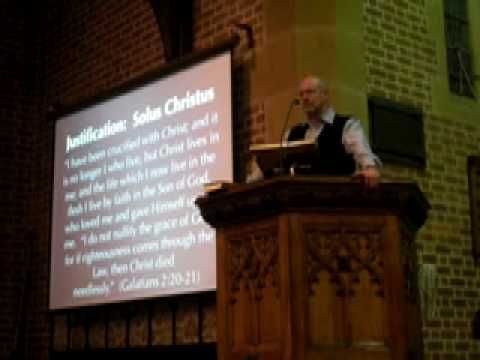
The Christian is one who can say with the Apostle Paul in Galatians chapter 2, I have been crucified with Christ. And it is no longer I who live, but Christ lives in me. And the life which I now live in the flesh, I live by faith in the Son of God who loved me and gave Himself for me.
I do not nullify the grace of God. For if righteousness comes to the law, then Christ died in me. Can you say those words? I have been crucified with Christ. Crucifixion was a repulsive concept when Paul wrote these words.
It was repulsive to anyone in that society. It was a horrible way to die. The Apostle Paul recognized that the only true way was to be crucified with Christ. I was united to Him in His death. And it is no longer I, but Christ lives in me.
And the life which I now live in the flesh, I live by faith in the Son of God. He is all-consuming to me. He is my all in all. He is not a self-help methodology. Sometimes you hear people say, try Jesus.
Does it sound like Paul is saying, try Jesus? I have been crucified with Him? That's not trying. I live by the faith in the Son of God who loved me and gave Himself up for me. The Christian knows that.
The Christian is assured of God's love. Because the Christian, in repentance and faith, has bowed before the cross. A recognition that apart from this place of death and sacrifice, I can never have life.
I will never have life. The need for life to be given to me, and it flows from this cross. He loved me. He gave Himself up for me. That giving is a self-giving. That is the sacrificial giving of Christ.
If this is what God has condescended to do in Christ, how can we ever give consideration to changing His revelation? Adding something. Subtracting something. That's why Paul says, if we think that righteousness can come any other way, if we think that by obeying rules and regulations, we can work up enough righteousness to be right before God, then don't you realize, not only are you nullifying the grace of God, you're saying that Christ died needlessly.
And that's exactly where our society is putting pressure upon us to believe. Oh, don't say Christ is the only way. That's offensive to us. And you're saying that Christ died needlessly. Because you're saying there's some other way of salvation.
That's what our world is saying to us. And only by the grace of God can we withstand that constant pressure upon us to compromise in that way. Just a few other texts. Also in Galatians. Christ redeemed us from the curse of law, having become a curse for us.
For it is written, curse is everyone who hangs on a tree. And are that in Christ Jesus the blessing of Abraham might come to the Gentiles, so that we would receive the promise of the Spirit through faith.
That curse of God's holy law. That curse that had been pronounced long ago upon anyone who did not keep all the things written in the book of law to do them. How can we be redeemed from it? How can we be removed from it?
Christ redeemed us from that curse. Having become a curse for us. Voluntarily. He gave himself. If this is the only way to be removed from the power of the curse, then how can there be multiple ways of salvation?
How can we not cling to, rejoice in, and proclaim the uniqueness of Christ? For this is the way that God has chosen. To bring God his own glory and to redeem a special one. And then a text that normally would not be used in this discussion.
But I think it's beautiful. Hebrews chapter 2. Hebrews chapter 2. Listen to these words. Words written to Hebrew Christians who are under a tremendous amount of pressure to go back to the old ways. Give up that Jesus stuff.
Go back to the temple and offer sacrifice. And say, no, Jesus isn't the Messiah. His death is not enough. But we do see him. That is Jesus. Who was made for a little while lower than the angels. Because the suffering of death crowned with glory and honor.
So that by the grace of God he might taste death for everyone. For it was fitting for him for whom were all things and through whom were all things. In bringing many sons to glory. To perfect the author of their salvation through sufferings.
Now there's so much we could talk about here. But I want to focus upon one thing. Yes, we have the description of Jesus who is the creator of all things. Notice it says it was for whom were all things and through whom were all things.
Just as we have in Colossians 1. But have you ever thought about that last phrase? In bringing many sons to glory. To perfect the author of their salvation through suffering. Perfect the author. How was Jesus perfected?
How could Jesus need perfecting? What is this talking about? In bringing many sons to glory. To perfect the author of their salvation through sufferings. Was Jesus lacking something? Was he imperfect and needed to be made perfect?
These words have mystified many. But they don't need to. They don't need to if we recognize. That what's being talked about here is about Jesus' sufferings. Not just the sufferings of the cross. When you read the rest of the context.
It's talking about the whole aspect of his sufferings. His humiliation. His entering into human flesh. His taking on human flesh. His being surrounded by the sinfulness of man. His ministry. All of that life is wrapped up in these sufferings that were his.
How was Jesus perfected by those sufferings? I think one of the most beautiful things that I've ever contemplated is the message of this text. You see. It is absolutely true. That Jesus bore in his body our sins upon the tree.
The wrath of God that was due to my every lie. To my every lustful thought. To every time that I loved myself more than I loved God. The just wrath that was due to all that fell upon him. To love the Lord your God with all your heart, soul, mind and strength.
In the seconds like unto it to love your neighbor. If all Jesus did was take away the punishments of the sins I had committed. Where is my positive? Where is my fulfillment? Of the law of God. That I am to love God perfectly.
And my neighbor is my sin. I haven't done this. Think about the righteousness. That is imputed to the believer. Yes it involves the removal, the remission of sin. But you see. The author of my salvation suffered.
He suffered in his life. He suffered in all those sinners who were around him. We didn't understand who he was. The Pharisees who chased him around and tried to trap him in his words. He loved his father perfectly.
He loved his neighbor as himself. He fulfilled that law perfectly. And so the righteousness I received from him. Is a perfect, complete and full righteousness. I don't just come back to a moral neutral point.
I have a perfect righteousness. You see he is the author of our salvation. Because all of our sin flows from him. He is able to bring many sons to the Lord. Not to try, not to make it possible. To bring many sons to glory.
Because he was perfected as the author of our salvation through his suffering. He fulfilled God's law perfectly. And so I have a perfect righteousness when I stand before God. Once again how can there be any salvation.
For anyone. Outside of this one way. The second person of the Trinity. The eternal son of God. Enters in the human flesh. And provides the perfect way of salvation. How can anyone look at that. And knowing that God accepts that and say.
Oh that's very nice. But that's just not for me. I want to go this way. How can that be. In our modern situation. Men untouched by deep conviction of sin. The soul changing sense of God's holiness. His sovereignty.
The fact that he is our creator. The fact that we exist because he extends to us life every moment. The fact that the sinner who remains in rebellion against God. Is literally stealing God's air. Because every breath I take and every beat of my heart comes from his hand.
Modern men arrogantly assume that God must conform to our sense of fairness. And providing equal opportunity in the matter of forgiveness and salvation. The idea that we are all justly condemned. Though thoroughly biblical.
Is simply not acceptable. To modern men. It is the fact that Christianity proclaims a savior who actually saves. That creates the scandal. For this precludes the possibility of multiple ways of salvation.
To believers here this evening. I want to emphasize to you. That the world's pressure upon you. To compromise at this particular point. Is so very dangerous. You must know that it is there every single day.
And pray for God's strength to stand against it. You must recognize. That the uniqueness of Jesus as the sole means of bringing salvation to mankind. Is not some secondary thing that we can take or leave.
It is part and parcel of the gospel itself. It is part and parcel of how you have peace with God. Therefore it should be something that causes our hearts to rejoice. And when you love something. When you are passionate about something.
You will recognize when it is being attacked. Any man in this room. Will respond very quickly. To an insult as well. Because we love heaven. And yet the uniqueness of Jesus as the sole means of salvation is attacked.
How do we respond? To the believer. I hope you see the beautiful tapestry of Christian truth. That redemption. Adoption. Forgiveness. Justification. It is all found in Jesus Christ alone. And to see that.
And to recognize that the very peace that you have with God. Which should be your most precious possession. The uniqueness of his work. And the uniqueness of his person. May I say something to others.
If you are here this evening. And you have not bowed in need of Jesus Christ. You are listening to me and you are saying. Some of the things you said sort of make sense to me. Some of the things you said I don't really understand.
But you said that God is holy. You said that God has a purpose in this world. You said that I am a sinner. And you know in your heart that you are. You recognize all of us here are confessing that we are sinners before God.
That we have broken his perfect law. That we have been separated from him. And in fact if we are really honest. We love our sin. If we recognize that. Then there must be a way of salvation. Christians believe that God changes the heart.
In fact the Bible uses the illustration that we have a heart of stone. And it is only God that can take out that heart of stone and give us a heart of stone. If you are here this evening. And you have heard about this Jesus.
And maybe you have heard about him in a way you have never heard about him before. He is not merely a babe in a manger. He is not merely a baby. He is not merely the one nailed to a cross. He is the risen Lord.
He is the only way of salvation. He is the King of Kings and the Lord of Lords. And through his name repentance is preached to all nations. He is the only way that God has provided for any of us to have peace.
And he is a powerful savior. He has the ability to save all those that the Father gives to him. He is able to save to the uttermost all those who draw near unto God by him. He has never turned away one who has turned to him.
I say to you.
If God in his mercy and grace has revealed to you your own sin. Then I exhort you. As one who has himself fled to Christ. Flee to him. You will find him to be a perfect savior. One who can provide to you forgiveness of sins.
Gracious Heavenly Father we do ask that in this hour. By your spirit you would cause us to remember your word. By your spirit you would cause us to understand. And Lord for those in this room this evening.
The sheep of your pasture. May you remind us that Jesus Christ is the only way of salvation. That Jesus Christ is the only source of peace. For your glory. That we can add nothing to what he has done.
May our hearts be filled with rejoicing. As we consider what Christ has done. But Father if there be any here. In the sound of my voice. Who have not yet. In repentance and faith turned to Jesus Christ.
May this be the day of salvation. Reveal Christ. Out of this world. May they see him as the beautiful and powerful Savior they need.
Friends we've got time now to take a few questions. If you've got a question. Just stick your hand up. I'll come to you. We'll get you through the microphone. So everybody can hear. And we'll get an answer from James for you.
Does anybody have a question? Sure.
That's James. So you see your job as clarifying the truth for people. Presenting the truth before things like that. How do you see the Holy Spirit as part of your mission?
Well this evening I see myself as simply a servant who opens the word of God. And seeks to explain justification and uniqueness of Christ. And in any situation any servant of God is completely dependent upon the spirit of God.
To make the word of God become alive in someone's heart. The scriptures tell us that natural man does not receive the things of the spirit of God. And so I recognize that in any context I'm in. In a debate.
In preaching. Sitting on the airplane. Whatever else it might be. That unless the spirit of God moves. My words are empty. But at the same time I also recognize that there is never a time when you speak God's truth.
That God is not glorified in that. Even when those words are rejected. I don't expect that every single time. The apostles certainly didn't experience success every single time they opened their mouths.
In fact when you look at Paul you would think that the majority of the time that that wasn't the case. But the reality is God is glorified when his truth is proclaimed. And it's wonderful to see the spirit of God opening people's hearts and minds to embrace these things.
Especially when they've been given a false faith. Or in some way maybe given a scripture. A different kind of scripture. Or other scriptures or something like that. When they see Jesus. And they see their own need.
And then they see Jesus and his perfect ability to save. It's glorious to see the spirit of God open someone's heart and mind in that situation. So any minister who thinks he can do anything outside of the work of the spirit of God.
Is not really ministering the work of God. Anyone else? Tonight it's been great. You've obviously done a great job of exposition of the gospel I suppose. Would you say that in general I suppose Evangelicalism or Christianity.
Obviously in average churches there tends to be a lack of emphasis on the gospel. Yeah from what you say. There tends to be a lack of emphasis upon the specific elements of the gospel. That are most offensive within our culture today.
Sadly I wish there was some way that we could put a filter on those doors back there. So that when people walk in. A worldly way of thinking would be kept outside the doors of the church. But it doesn't work that way.
The world has you most of six days a week. And we have a very small amount of time to try to counteract that constant pressure of the world. And so those elements of the gospel are the most offensive to the natural man.
And I think different cultures have different areas of emphasis along those lines. In Western culture today I'm assuming Australia, United Kingdom, United States. Even though we have our slight differences.
And even though David thinks that the crown still owns us all. That in Western culture now. There is such a focus upon humanism. So that the central teachings of scripture concerning the sovereignty of God.
The holiness of God. The right of God. To hold us accountable for our behavior and our actions. That is simply gone in many churches. In many churches the result of that is that wow. God is really lucky to have me.
When I show up at church he's really lucky that I'm here. And I think that massively impacts the worship of the church. The life of the church. And certainly the proclamation of the gospel. We need to proclaim all that scripture says.
A person who does not see that he needs a savior. Is a person who is not going to be looking for the Jesus of the Bible. He's going to have to come up with somebody else. And that's why there are so many rather endemic Jesus's being presented out there.
They're not powerful saviors. But are more like self-help methodologies or something along those lines. Okay. One more. Over here.
Two. Excellent. My question has more to do with sharing one's faith. Now I understand you're an apologist. There's obviously, there's ways of sharing your faith through your field of conscience. What do you see, how do you see related to conscience and apologetics when sharing one's faith?
Well that certainly is I think a very biblical methodology. That is the connecting point we have to anyone. No matter what their religious background might be. Is the fact that they're made in the image of God.
And that God has revealed his truth in the conscience of that individual. And so that is an excellent way of getting past a lot of the barriers that frequently stand in the way. Because of religious traditions.
To go directly to you know your heart. You know if you look deeply inside yourself and stop distracting yourself. That you're not right with God. How do you think that you're going to have peace with God?
How can you have peace with God even now in your life? As some of you know I engaged in a debate on Islam on Monday. And that's one of the key issues in dealing with Islam. That's why you have, I mentioned in another context.
But I'll tell the story very briefly. Remember about two and a half years ago. The two men who drove the jeep into the Glasgow airport and ignited it. They died of their burns. It didn't blow up the way it was supposed to.
But that struck me tremendously for two reasons. First of all I have a lot of friends in Glasgow. And I do ministry there fairly frequently. And I have stood exactly. I've walked through the very door more than once that that car crashed into.
And that makes you think in many ways. But the other thing was the men who did that were medical students. They weren't down and outers. And I know what drives them to do that type of thing. The only way in the Quran that you can know that you're going to enter into the presence of Allah.
Is if you die in Jihad. They don't have a mediator. They don't have one that they can have faith in. Who can guarantee because of the perfection of his work. That those who are united with him will enter into the presence of God.
They can't have the righteousness of God imputed to them. I was sharing with two brothers in the car this afternoon. That at my middle 40s. So that I can pursue this work. I've been learning Arabic. My seventh language, Arabic.
It works a lot better when you're 20 something. And that when you read the Quran. You see the name Allah all the time. And so you just become accustomed to seeing that form of the Arabic word. But then I was reading my Arabic Bible.
In the church services on Wednesdays we go to the Psalter. And I kept running across this form. That I didn't recognize. And then I figured it out. It was the form my God. You see the phrase my God appears in the Bible.
But it doesn't appear in the Quran. Because the Quran does not present to us a God. That we can have a relationship with. To where anyone would say my God. It's all through the Christian scriptures. But Allah is so transcendent.
So far removed. That it's not found in there. And it struck me. That's why the Muslims struggle so at this point. That's why some Muslim sects have elevated Muhammad to such a high position. To where he becomes a mediator.
They actually believe they can pray to Muhammad. And he'll take their prayers to Allah. Hmm. Why would you need that if you had a true mediator? Which they don't. That's the major difference. Is that Christianity is God centered.
It's what God has done. To bring about salvation. It's his work. Rather than well here's a plan. You work it. It's up to you. And so. That to me illustrates once again. The vast difference between the two.
And it really does become what I want Muslims to understand. Is that this Jesus. Is not the Jesus they've been given. It's the Jesus who truly. This guy flies out tomorrow morning. So tomorrow is too late.
I need to see somebody here. I heard you. Obviously a lot of discussion about justification. I hope I'm. I'm probably getting this out of context. In James. Chapter 2. Verse 24. He says. You see the person is justified.
By what he does. And not by faith alone. And I just wondered. How does that. That troubles me. Either. In the context of what you may say. It should. If we back up. And see what. What James's point is.
I have an entire sermon on this. In fact. Brother David has. My book. Titled. The God who justifies. Is a 24 page chapter. In the book. Exegesis in James. Chapter 2. That I would. Recommend to you. For a fuller discussion.
But. If you'll. Back up. The truck. In essence. To verse 14. What good is it. My brothers. Someone claims. To have faith. But does not have works. Can. This. Kind. Of faith. Save him. The point. In James 2.
It's a beautiful text. I love. To preach. Out of James 2. Because it's a. A necessary balance. But the point. Of James. Chapter 2. Is to speak. To those people. Who think that faith. Can exist. Solely.
In word. That it does not have. Any corresponding. Reality. In life. That's totally. Different than those. Who say that. Saving faith. In debts. God. To do something. For us. You have. To be able. To hold.
James 2. And Romans 4. Together. They're both. In the same can. And James. His point. Is not talking. About how. We become. Made right. With God. Initially. If you look. At the illustration. He uses. He uses.
A point in time. After. Abraham. Has been justified. By faith. In Genesis 15. 6. Where Abraham. Demonstrates. His faith. The whole point. Of 2. 14. And onward. Is the demonstration. Of faith. And his assertion.
The truth. Saving faith. Is always coupled. With the work. Of the spirit of God. In someone's life. So that there should be. No one. Who says. Well I have faith. But you can examine. The entirety. Of my life.
And you'll find. No evidence of it. That's why he also. Uses the illustration. That. Breathing. Is natural. To the body. In the same way. Living a godly life. Is natural. To saving faith. Or uses the other.
Other illustration. The mouth. When it speaks. A spring. Should not put forth. Both. Bitter. And sweet water. At the same time. There should be. A consistency. Between what we say. Is true. And what really. Is true.
And so. Unless. James is contradicting. The poem. Which there are some people. Who say he is. The. Illustration. That he uses. Of the offering. Of Isaac. Which comes over. 20 years. After. Abraham's justification.
By faith. In Genesis 15. 6. And after. The receiving. Of the sign. Of circumcision. Clearly. Is. Abraham's. Demonstration. Even. In Genesis. Remember. What does God say. To Abraham. When he. Raises the knife.
I see. That you truly. Fear me. In other words. Abraham. Had given evidence. Of. That. Saving faith. Was his. But that's not when Abraham. Became a friend of God. And that's not when Abraham. Was made right before God.
And so. It is very important. That we emphasize. That the faith. Saves. Is a spirit. Born of faith. It is something. The spirit of God. Works within us. And that's why I said. As. As Luther said. You have.
Justification. You have sanctification. We must. Distinguish them. But they are never. Separated. From one another. That is the balance. That we find. In the word of God. So. If you want to see how that works out.
Verse by verse. Phrase by phrase. From verses 14. To 24. I spent. A good deal. Of time. Trying to make sure. To be as fair. As I possibly could. With that text. And I do like. To preach James 2. Because.
Especially in our context. Today. There are people. Who mishear. The message. Of justification. By faith. Alone. And take it as a license. And that's. Not the balance. To you. Of what. Scripture says.
We need to listen. To all of it. But at the same time. The danger. Of self-righteousness. In thinking. That our. There is something. We can add. To work with Christ. Is even more. Thank you. Thanks James.
Thanks for the question Stuart. In a minute. We're going to close. In prayer. After you've done that. There may be a number of things. You want to do. You may want to come and chat. Briefly. To James.
Please do that. You may have been so struck. Tonight. By what you've heard. That you've actually. Realized.