Keep sharing good news without ads.
Help me wrap my head around satoshis #FreeMenHere2021
Hello there, this is AD Robles, and you're listening to AD on the Fight Laugh Feast Network. Alright, alright, well, before we begin today, let me just say this. If you have not considered doing so, please consider becoming a Fight Laugh Feast Network club member.
Use the show code ROBLES, that is R-O-B-L-E-S. Use the show code ROBLES, that is R-O-B-L-E-S. You get to support the content that you enjoyed listening to, so that we will keep making it. But more importantly, you get access to private content that only members get.
You get access to discounts on awesome gear like, for example, this shirt or even this hat. Other stuff like that. Plus, I also think if you sign up, you get sent to you like a mug or a cup or something like that.
Check it out before you do, just to make sure that I'm right. But there's lots of benefits as well. So not only do you get the benefit of supporting this content, but you also get benefits beyond that.
So you will have lots of benefits to partake in. As a Fight Laugh Feast Network club member, use the show code ROBLES, that is R-O-B-L-E-S. Today, I want to talk about Bitcoin. Because I like Bitcoin in some ways, but in a very fundamental key way, I don't like it.
And so I want to talk a little bit about it. Because one of the things that I know is true is that I kind of agree with Elon Musk that he said he was responding to Peter Schiff about something or other about Bitcoin.
Peter Schiff is a notorious Bitcoin bear. And I agree with a lot of what Peter Schiff says about Bitcoin. Not everything, but a lot. And he was saying that Bitcoin is BS, but not as BS as fiat currency like the U .S. dollar or something like that.
But there is something about it that I just fundamentally can't get on board with. I can't wrap my mind around, so maybe you can help me out. And I was listening actually to Peter Schiff about this. And he kind of put a fine point on something that I've been thinking a lot about regarding Bitcoin.
Again, I like Bitcoin for some things, but there's a big problem in my opinion. And I want to talk about that today. So I started thinking about this problem as a child. And we'll say as a child, probably like a teenager or something like that.
I was doing something I was not supposed to be doing. I was watching a rated R movie, a very inappropriate movie for a teenager to be watching called Blood In, Blood Out. It's a prison movie. And I was watching it with my cousin Sal, so I'll never forget.
Yeah, so definitely not recommended for kids. But anyway, there's a scene in it where the white guy—. There's some critical theory in this movie too, now that I think about it. There's a white guy, but he's actually Mexican.
He's like half white, half Mexican, but his skin is very white. So he's not allowed in the Mexican gang at first. But then he eventually gets in, and eventually he's leading the Mexican gang. That's some white privilege right there, that's for sure.
Anyway, when he first gets to prison, he's new, he's a fresh fish. And like a Mexican pimp tries to take him under his wing, if you know what I mean. And he starts off by giving him some stuff. That's how it typically happens.
They give you some gifts, whatever. And one of the things he gives him is cigarettes. And I want you to hear Miklo's reaction when he gets the cigarettes. There's Miklo right there. I got some smokes for you.
Why do you smoke cigarettes? Because it's like cash. He said, he said, I got some smokes for you. Miklo says, I don't really smoke cigarettes. And he says, no, no, no, no, in jail, that's like cash. You know, it's important to have cigarettes.
It's like cash, you can buy, you can sell, all this kind of stuff. And if you've watched any prison movie, then you know that cigarettes operate like cash. Actually, I've heard that that's no longer the case.
I've heard that nowadays, ramen noodles are cash, like a package of ramen noodles. You say, hey, man, I want a tattoo. Can you do a tattoo on me? And he'd be like, yeah, that'll be 10 ramen noodles or honey buns.
And I do mean the little debbies, the ones that you eat, not the other kind. So just don't get a sick mind. I mean, actual physical honey buns, honey buns, books of stamps, ramen noodles, other food, stuff like that.
This all operates as cash in the prison because you're not allowed to have cash as a prisoner. So in order to buy and sell things, you gamble with ramen noodles, you gamble with honey buns, stuff like that.
And so it operates like money. It's a currency. It's a form of currency. Cigarettes are the same thing. And so I used to think when I was a kid, like, why is that, right? Why in prison does cigarettes become money?
Did they just decide, OK, well, our money is going to be cigarettes. And it's like everyone's using cigarettes now. That's how I was thinking. And the reason I was thinking that way is because I was educated in public government schools where, you know, we just are taught that the government decides everything for us.
That's not what happened. That's not how cigarettes became currency. It wasn't like the shot callers or the gangs decided, OK, it's just going to be cigarettes or it's going to be ramen noodles or it's going to be books of stamps.
That's not how it was decided. It's decided a lot more organically. And I want to talk about that in relation to Bitcoin in a second. Actually, the Bible talks about a situation where something very similar happened, where all of a sudden food became money.
And so there's a passage in Genesis chapter 47. I'll credit Gary North for being the first one to point this out to me. Gary North has written a lot about the Bible and economics, the Bible and money.
And this is the first the first place I read this was with Gary North. And it's from Genesis 47 when there was a famine in Egypt. You remember this. Joseph has a dream. He predicts the famine. He becomes like Pharaoh's right hand guy and all that kind of stuff.
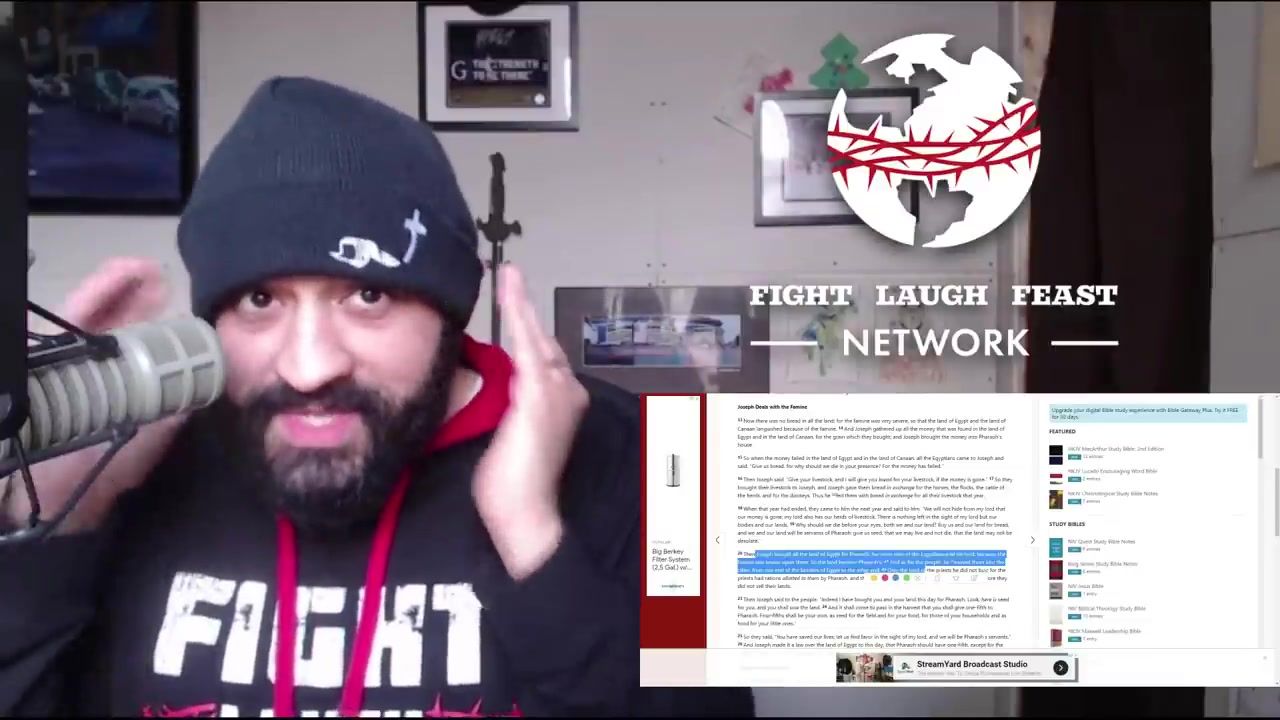
And here's what chapter 47, verse 13 says about the famine in Egypt. It says, God says, Listen to this next line. All the Egyptians came to Joseph and said, give us bread for why shall we die in your presence?
For the money has failed. Then he says, so Joseph said, give me your livestock and I will give you bread for your livestock if the money is gone. So they brought their livestock to Joseph and Joseph gave them bread in exchange for the horses, the flocks, the cattle and the herds and the donkeys.
And then he thus he fed them with bread in exchange for all their livestock that year. So what's what's going on here? What's happening? This is very interesting. So what's happening here is is price inflation has caused the money to fail.
The cost and the value of grain has become so high that the silver, which is essentially silver and gold, is probably the money he's talking about here. Silver and gold is worth less than the grain itself.
So food has become the currency here. So what's happened here is that Joseph has dealt very shrewdly and he's acquired a lot of assets. He's acquired gold, silver, and then when that no longer was able to purchase the grain and stuff like that, inflation had gone through the roof because of the central ownership of this.
The pharaoh owned everything. They had to start giving them their assets, their stock, their livestock, and they exchanged their livestock for grain so that they could survive. Like grain was essentially the currency here.
Grain was what people wanted. And see, that's the key, because for money to actually be valuable, to actually have like intrinsic actual value, people have to want it to use it for something. Right. So food in in prison.
It's easy to see why food might become valuable because food everybody needs. Everybody needs food. And so you get like your three squares a day in prison. But it's a lot of people say it's not enough food to really get by.
So people buy extra food. And so ramen noodles becomes highly valuable. It's highly sought after. Honey buns becomes highly valuable. Highly sought after because after, you know, Chow Hall shuts down for the night, you're still hungry.
You want to have a honey bun. You want to have ramen noodles. You want to have whatever it is. And so people want this currency. People want it because they're going to use it. It's the same with cigarettes.
Right. So people if even if you don't want cigarettes, you you'll take it as currency because, you know, somebody else wants it. Somebody else is going to use it. You know, they need they need to take that hit because they're addicted to tobacco or whatever it is and all that kind of stuff.
And so there's a use case for it. Right. There's like a there's a valuable use case for cigarettes. So you'll take it as currency because, you know, you can offload it very easily because somebody is going to want it.
There's actually there's a use there is a value there to that ramen noodles. And so in the book of Genesis here, it's very easy to see the use case for grain because people were starving. And so, you know, everybody wanted grain.
And so they would take grain. That's the thing. And so Joseph dealt very shrewdly here, though, because what happened with Joseph is he knew that gold and silver was was valuable. People were using gold and silver for a variety of things in those days.
And so he got all the gold, all the silver in exchange for the grain that he had stored up. He got all that. And then he also got all the stock. He got all the livestock as well. He got all the land, I believe, as well.
Joseph bought all the here. It says Joseph bought all the land of Egypt for Pharaoh. They sold him all their land in order to eat. So it's like they own like Pharaoh got everything because he had cornered the market on grain.
And in order to survive, people had to sell them the shirt off their back kind of thing. And so the money failed here. But but really what happened is the silver and gold failed. But the the the true money at the time, the currency of the time was grain.
And so grain became the money kind of thing. So what does all this mean? Right. What does all this mean for Bitcoin? And and something that I I personally think is is is is the future of money, honest money, gold.
What does this mean for these kinds of things? So I think when you think about Bitcoin and how it's it's it's a digital currency. You know, Elon Musk says it's B .S., but not as B .S. as as as the American dollar.
I kind of agree with him there. But do we need to have money? That's B .S. I don't think we do. We don't need to have money. That's B .S. Right. And think about Bitcoin. Right. Like when you if you own Bitcoin right now, is it all that is it all that desirable?
Like is it like cigarettes in prison? Is it like ramen noodles in prison? It really isn't like there's not that many stores that take Bitcoin. There's a lot of speculation that eventually that'll be the case where everyone will want Bitcoin and all of that kind of stuff.
But what I'm wondering is what's the what's the use case? What's the end game for Bitcoin? Right. I know that there are use cases for it, but they're, in my opinion, like they're not that strong for Bitcoin.
I think they are pretty strong for blockchain in general, but for Bitcoin, I just don't see it. And so right now you're kind of like when you hold Bitcoin, it's like, OK, well, you know, OK, pretty soon you'll be able to buy a Tesla.
I bought a Gab pro account with Bitcoin. Like there's certain things you can buy with Bitcoin. But at the end of the day, it's it doesn't have the same kind of value as, say, ramen noodles in prison. Right.
And I'm and you're going to say you're nuts, Adam, because ramen noodles are, you know, 15 cents a bag. And a Bitcoin is is got a price of fifty thousand dollars per Bitcoin. And you're right. The price of Bitcoin is great.
And everyone who held Bitcoin before is looking like a genius right now. But what I'm wondering is what's the end game here? Right. What's the end game to to to to people that are holding Bitcoin and have a Bitcoin collection is what Peter Schiff likes to call it.
Just to kind of just to kind of zing people a little bit. See, I prefer gold because of the use case for gold. See gold people. People use gold like somebody wants gold. The reason why you would take gold as currency is because somebody is going to want gold.
And so gold should be something that could be easily exchanged. And I don't mean like person to person. What I mean is if you had a currency, for example, that was backed by gold that you could redeem for gold.
See, that would be a lot better because people do need and use gold. I'll never forget when I was I was taking a tour of a manufacturing facility and these guys manufactured a few a number of electronics type things and different products and all that.
And we were doing the facility and I saw what they had a way they had a waste receptacle set up for scrap gold because they used gold for manufacturing a number of different products that they made. And I remember thinking to myself, man, there's hundreds of thousands of dollars worth of gold in this trash receptacle.
And they're obviously not going to trash it. They're just collecting it so they can melt it down and sell it, whatever. But but but but gold is used in manufacturing. So is silver. Not only that, but like it's also desirable for beauty.
Like people like to have gold jewelry. People like to have gold things. And back in the old days, that's why they used gold and silver as money, because silver and gold was desirable. Lots of religious artifacts are made with gold.
Kings wanted gold to do whatever it is they did with them, you know, just for luxury items and things of that nature. So so so gold does have value in that way because it's useful. You might not be able to use gold, but somebody can.
It's the same thing with Mikla with the cigarettes. He couldn't use the cigarettes. He didn't want them. You know what I mean? Like there was no reason for him to have the cigarettes. But he knew. Well, he learned rather that somebody in prison wanted cigarettes.
And so it would be easy to offload them as an easy way to sort of exchange value because eventually somebody is going to want to use the cigarette. And so that's that's that's the that's the main problem, in my opinion, with Bitcoin.
Now, I'm not saying that Bitcoin is worthless. I'm not saying that at all. In fact, you know, as far as Torba, he did an interview with with the brothers that fight, laugh, feast and cross politic. And he was saying how it's free speech money.
It's there's there's definitely use cases as far as free exchange and freedom and stuff like that. Not not having access to a bank, but still being able to do your transactions and stuff like that. I definitely think there's something there.
There's no question about that. There is something there. And, you know, I don't I don't want to say that I don't own any Bitcoin. I'm not going to say that either. But I'm just saying what I am saying, though, is be careful, especially some of you people that are putting significant portions of your of your net worth in Bitcoin.
Make sure that it's going to be a situation where it's like it's not just that somebody wants to speculate on Bitcoin, that you're counting on that value coming out. There's actually a use case behind it.
There's actually a situation where it's like in like in prison, like you get the ramen noodles because people like to eat ramen noodles are going to want that after chow hall closes down. Same thing with cigarettes and stuff like that.
Same thing with grain back in Genesis. Like we need to understand, like there's at the end of the day, you better hope somebody wants it and sees value in it for something, I think, beyond speculation, because if it's just speculation, that's that's driving the price up, which I think it probably is a lot of speculation right now, then that's a problem.
Now, again, please hear me saying I don't say that there's no use case for block chain. Of course, there is. But I just I just want you to be careful. That's all I'm saying. This episode should be titled just just be careful.
All right. Just be careful. You know, I think I think I think the Bible is very interesting with the way it deals with money and economics and things of that nature. You probably don't know a lot of what the Bible says about money because it's not really taught that from pulpits that much about money.
Of course, people talk about the love of money is the root of all evil and stuff like that. But but but the actual money itself and economics, the Bible actually has a lot to say about that kind of stuff.
And I think as far as, you know, inflation and all these, you know, one point nine trillion dollar stimulus package and stuff like that, Christians ought to be against those things because those things actually are immoral.
You know, we see many places in the Bible and one of the most popular ones is Isaiah, where it talks about your silver has become dross, your best mine mixed with water. Obviously, those are metaphors, but they're metaphors that are actually built in something that the people understood was really going on.
Like like their silver was becoming devalued. People were dealing immorally with the money in such a way that they were pretending it was worth a lot. But it really wasn't because they were they were mixing it with other things.
Same thing with wine was being mixed with water. So you would think I'm getting a liter of wine, but you really you were getting only a half liter of wine. It was mixed with half water as well. They were devalued.
That's immoral. And so all the stuff that the government does with them with our money supply right now, the inflation that's happening at tremendous scales right now, it's immoral. God judges nations because of that.
And so he will destroy. We'll be at a point where the money has failed. We'll be just like the people in Egypt were saying the money has failed. And so we've got we've got an issue, I think, when it comes to that kind of thing with when it comes to money in the United States.
We really need to reconsider what is money. What what what is what is it for? What does it do? And how do we protect ourselves when God kind of pulls that curtain and says, here's what's really going on here.
Your silver has become dross. Your best mixed wine has been mixed with water. He's going to do that at some point. The curtains going to be he's going to expose the whole fake system for what it is. And is the solution Bitcoin?
Well, you better have some good reasons why you think that might be the case. I think that there are potentially some reasons there. You know, is gold going to end up being money? Is it going to be something else?
We need to consider these things as we consider planning for the future and all of those kinds of things. It's not dirty to talk about this stuff. This is stuff that is spiritual in nature. The Bible proves it again and again and again.
And so we ought to consider that stuff as well. By the way, if ramen noodles became money, I would like that. I like ramen noodles. Anyway, I hope you found this podcast helpful. By the way, all of you Bitcoin guys out there again, I'm not talking bad against Bitcoin.
But if I've messed up a little bit here some way, let me know. Let me know what you think and let me know where I've gone wrong about Bitcoin. Again, I'm not saying I don't own any Bitcoin. I might own a little bit.
I don't know. Actually, maybe it's more accurate to say some Satoshis. Isn't that what it is? There's Satoshis. I own a few Satoshis, you know what I'm saying? But yeah, guys, I just wanted to bring some of that to bear.
The scripture talks about a lot of this stuff. I am by no means an expert, but it's worth thinking about, especially in a time where the nation is so clearly being judged in almost every way. I don't think economics is going to get a pass from God.
He's got his eye on what we're doing with our economics. It's totally immoral and all of that kind of stuff. I hope you found this podcast helpful. God bless. Don't forget to tune in next week on Thursday for AD on the Fight, Laugh, Feast Network.