Keep sharing good news without ads.
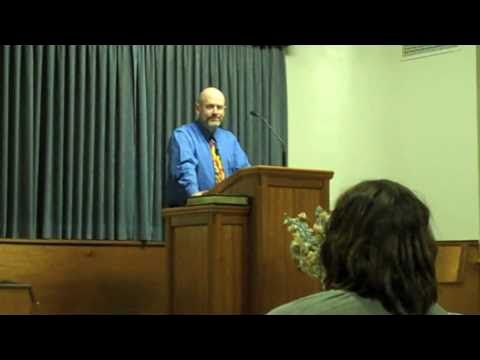
Phoenix Reformed Baptist Church, PM service, October 4, 2009
Chapter 1 through verses 6 through 10. We will continue our study through verse 14 this evening, which will include, of course, verse 12, which we just sang, and the hymn. 2 Timothy chapter 1. Let's ask the Lord to bless our time again.
Father, in these brief moments, we ask that by your Spirit, we once again would make your word come alive in our hearts, that we, as your people, would hear, that we would be obedient, and that we would be encouraged in our faiths in Christ's name.
I remember, I believe it was right before my junior year of high school, that over that summer, I really seriously began studying the scriptures. I had been raised in a Christian family, so my earliest memories are of Bible drills and Bible stories and my first Bibles and things like that.
But I think it was during that summer that I memorized this text. It was very easy to do, because the song that we just sang was a song that was very popular in the churches that I grew up in. And maybe some of you as well have memorized that text simply because once you put the text to music, it is much easier to remember.
And yet it has a context. The only suggestion I would have for anyone who, as I did that summer, did an intensive period of scripture memorization, is always make sure, if you're using those little card type things, that's perfectly fine if that works for you.
But if you do like buy a packet of memory verses or something like that, always make sure that when you memorize the verse that you know what the context is. So often there will be a little bit of a title or something like that, and sometimes the title isn't quite accurate with the context.
And so this this text that we just sang has a context. We started looking at it this morning. We saw that Paul was exhorting young Timothy to suffer together with him and with all believers in verse 8 for the gospel by the power of God.
These are words addressed to a young elder, one who is leading a very large church along with other elders there in Ephesus, and he is being encouraged to recognize the spirit has been given to him is not a spirit of timidity or of cowardice, but is the spirit marked by power and love and a sound mind.
And he has been reminded that it is his duty, it is indeed his privilege, to suffer together in the gospel, to not be ashamed of the testimony of our Lord or of Paul, Christ's prisoner, but instead to suffer together for the gospel according to the power of God.
And then we saw when he makes reference to God that he cannot help but for verses 9 and 10 describe what it is that God has done, that he is the one who has saved us and called us for the holy calling, not according to our works, but according to his own purpose and grace, which was given to us, granted to us in Christ Jesus before the beginning of time itself, before time eternal, but now has been made manifest to the appearing of our Savior Christ Jesus, who abolished, destroyed, nullified death.
And that's the negative aspect. On the positive side, he brought to light life and immortality by means of the gospel. And so we've seen twice this emphasis upon the gospel, suffering for the gospel. And so when he talks about what the gospel is, what God has done, that gives a substance to what it is that we are to be so concerned about that we would be willing to give up earthly possessions, to give up earthly pleasure in behalf of this gospel.
It is so important to recognize that when you start to diminish the gospel, when you start to minimize the gospel so as to avoid offending men, you likewise are robbing from the people of God the very purpose for their high calling.
Think about it for just a moment. Think of the kind of gospel that is so often preached in our land today. Is it worth suffering for? I cannot help but think of one of the most popular quote-unquote Christians in our land today.
And he stands in a sports arena and he smiles through everything. He has a big globe circling behind him. And he tells people about how God has a wonderful plan for their lives. And how God wants them to be successful and happy.
Is that kind of self-help psychobabble something that anyone is really going to be willing to suffer for? Is that something worthy to give up life and pleasure and the accolades of men for something like that?
I can't see how it is. The gospel that is worth suffering for is the gospel that Paul summarized there and it is a gospel focused upon what God has accomplished for His own glory. That is the gospel that has inspired men of the past.
That is the gospel that we are called to love in our day. And so having made that proclamation then Paul says that in verse 11 that he has been appointed, established as a herald. Most translations say a preacher but it's literally the term that would be the one who would proclaim the king's announcements to the people.
He is a herald, an apostle, a teacher. And it is God who has established him in these offices. But notice that it is unto that gospel. Paul doesn't get to define these things. Those who proclaim the gospel don't get to edit the gospel.
It is instead going to be viewed here as a precious thing that is entrusted to us that we are then to proclaim to others in the power of God. And Paul recognizes that since God has placed him in that position that it is for this reason, verse 12, that he is suffering these things.
And notice he does not minimize the fact that he is in fact suffering. I mean, Apostle Paul walked on the ground. His feet didn't just hover two inches over the ground like we might think. There wasn't any little glowing halo over his head as medieval art might put it.
Like us, he had his good days and his bad days. And I'm sure there were many days when he experienced feelings. Especially, as he says, when all of Asia abandoned him. No one was there in his defense in Rome.
He had done all these things. There were times he felt alone, I'm sure. And I'm sure there were times when he looked at people going about their daily business and they have nice robes, they have nice clothing, they have better food than he has.
That he couldn't help, if he's a human being, to desire his freedom. To want to have his freedom. And so he doesn't minimize the fact that he is suffering these things. But he continues to have the proper attitude in the midst of these things because he says, I am not ashamed.
When people see me going through the streets and there's this Roman soldier and there's the chains, I'm not ashamed. Why is he not ashamed? Because he knows, first of all, he is convinced. That he has been placed in this position by his Lord.
He knows he is exactly where God and his providence would have him to be. He has been established as a herald, an apostle, a teacher. And it's because of his faithfulness in those callings that he now waits for his time before Caesar.
But he also gives a further reason. And here is the text of the hymn we sang. But I am not ashamed, he says. For I know the one in whom I have placed my trust. And I am convinced that he is able, he has the power, he has the capacity to guard.
To guard what I have entrusted to him. That deposit that I have entrusted to him against or unto that day. Now we know the text. We've sung it. Many of us have memorized it. But what does it mean? Sometimes there is a danger that when we are so familiar with the words, that how they are actually related to one another escapes us.
We haven't stopped to actually ponder. Notice what he says. I know the one in whom I have trusted. I know whom I have believed in. Now that is the term, the regular term, to believe. But you see, the word to believe in the New Testament almost always has in it, and it certainly has here, the element of trust.
We recognize, in our own use, these different ways of using the word believe. Someone might come up to us at work, and let's say it's someone we don't have the most cordial relationship with. Maybe it's someone who has let us down more than once.
And once again, he's let us down on a certain project or something. And he comes up and says, Oh, well, you know, I'm almost there. And we say, Oh, I believe you. And there's something in the phraseology, there's something in the way we say it.
We're not really saying, I believe you. What's missing is trust. You don't want to just come out directly and say, Oh, I think you're lying to me. Oh, I believe you. The way you say it, the way your body is, your presence, your voice, your questioning, even though you're not making that open.
But then when we talk about trusting someone, you say to someone, I trust you. There's something personal. There's an investment. You are giving to someone something that you know they're worthy to possess it.
I trust you. That's why I translate it that way. Because Paul does not say, I know what. He's going to emphasize in the very next verse. Timothy, you hold that standard of sound teaching that you've heard from me.
So the what is important. The what of who God is and what he's done. Very, very important. But there's a danger when someone only knows the what, but doesn't know the who. Known people who have a lot of what, but no who at all.
And young people are wondering. But I think you understand, there's an 18 inch difference between the head and the heart. And when Paul speaks of why he is not ashamed in the chains and the bonds that were his, he does not say, I'm not ashamed because I've really got my theological P's and Q's down.
Well, he certainly did. And you can't separate that out from knowing who God is in Christ. But, what he says is, I know whom. And it's not just I've trusted once. There is a permanence to this. My trust is placed in him and it's staying there.
Because I know him. Words that especially have meaning to the saint who has walked with the Lord, as Paul had walked with the Lord. It's something you grow in. It's something you experience over time.
When you can look back over your life and you see time after time after time, when God has borne you up and you didn't even know it. Sometimes it's years later you look back and you go, I see the faithfulness of God.
I didn't even see it at the time. God supported me. God protected me. I know whom. The one in whom I have placed my trust. There's a personal, a personal aspect here. He goes on to say, I am personal.
I've experienced the fulfillment of God's promises in my life. And I am convinced about his character. He is worthy of my trust. Because he is able to do something. He has the power. He is able to guard.
To keep something. To guard it. To keep it from being spoiled or taken away. Well, what is it that he is guarding? Well, the phrase that is translated here is deposit. He is able to keep that which I've committed.
It's a deposit. It's actually used in the very next, in verse 14. When it talks about guarding the deposit. But there it's different. Some would argue, scholars divide on this. Some would argue it has to mean the same thing here as it did in verse 14 and then back in 1 Timothy 6.
But I don't think so. Because notice it says in verse 12, my, what I have committed. It's literally guard my deposit. The deposit of me. It's what I have committed to him. In verse 14, there I believe it has to do with the gospel itself that has been committed to us.
So I think there is a difference. And most of our reformed theologians of the past would agree in reading it the way that I'm reading it now. So Paul has committed something to God. And see that I think would reflect upon why he is not ashamed of the bonds that he has.
Because he has committed his entire life. All of his actions. All of the decisions that he's made. The decision to go to Jerusalem. The decision to preach in the places where he has preached. And as a result has been stoned, driven out, arrested, beaten, flogged.
All these things he has committed to God. His trust. His ultimate vindication in the end. He has committed to God against that day. And that day is always the day of judgment. That day is the day when everything is made right.
When all of the injustices that we see in this world. That it looks like they got away with it. All the unsolved crimes. All the open violations of justice. That we just shake our heads and go oh Lord.
Do what is right in that day. What is right will be done. In that day justice will be done. And Paul looks forward to that day. And certainly we can imagine as he sits in prison unjustly accused. It is a great blessing to him to think of the fact that someday justice will be done.
He will be vindicated. He will be seen for who he really is. But he is absolutely convinced that while he has entrusted to God. God is able to guard that deposit. To bring his servant through. To vindicate his servant.
And so I wanted to get this verse because I wanted to ask each of us the question. When we sing those words. Are they just words? Not just whom I have heard a lot of teaching about. Theology and I go to this kind of church because that feels a little better for me.
It fits my personality. That is not the question. I know the one in whom I have trusted. Do you know him so well that if he were to fail you would have no backup? Is that the kind of trust that you have in God?
Many years ago at another church. That means it was many years ago. I would teach a class on Mormonism. And then I started teaching a class on systematic theology. Which is essentially what got me in trouble.
But anyway. In both we would talk about what it means to really believe. Use an illustration. I would say when you are talking about really trusting. Really believing. If I were to say and I would normally use a chair.
We don't have a chair to use this. I am going to use the pastoral half pew. I am not really sure what we call that. The pastoral half pew. If I were to say that I really trust this pew to hold me up. We have all started noticing now that the air conditioning is so quiet.
How many times the pews make strange noises when we sit up on them. And so there might be reason for some pews to be less trusted than others. But if I were to say that I trust that this pew can hold me up.
And then I were to sit down on it like this. Would you believe me if I trust this pew? See if I have got all these other things I am doing. Just in case. Do I really trust? The essence of the trust that Paul has here.
He has no backup. He has got no other righteousness that he is sort of keeping in reserve. Just in case. He didn't stop by the Zoroastrian temple on the way to Jehovah's temple to offer a few sacrifices.
Just in case. This is a total abandonment of everything else. If God is not faithful to Paul, that's it. But he knows. In whom he has trust. Do you know the one in whom you have trust in? Is your relationship more than merely a set of doctrinal points?
Has that connection that I ask on the basis of this text. Because that's the only kind of knowledge that is going to give you a solid foundation. When the really tough times come. When the suffering happens.
When death enters into the family. When you can say, I know the one in whom I have trust in. In those situations. That carries weight. That changes lives. And the people of the world look at that and go, I have trust in him.
Do you take the time to look at your life? To look at what God has done in your life? Like to ask for spiritual eyes so you can see what God has done in your life. So that you can be convinced of his ability.
It seems the entire world is designed to cause us to question God's capacity. Everything in our society is designed to drag our eyes down off of these things. On to the mundane things of the world. So we need to specifically take time to think about.
How many times God has been faithful to his promises in our lives. And that will result in our being convinced that he is it. To keep that which we have committed unto him against that day. But have we committed anything to him?
Or have we allowed the frowns of the world. The resistance of the world. To cause us to keep back from that full commitment of the entirety of our life to him. Do we really trust him? That's the question we have to ask.
Because when we can answer. When we can sing that hymn. And mean the words. The world cannot stop people like that. Because the world can't understand. Let me tell you something. As a Christian. You will never have.
As long as you really don't trust. Keep that which I have committed unto him against that day. That he says to Timothy. Oh Timothy. Those whole healthy words. That sound doctrine which you have heard from me.
Hold on to it. Don't let it go. Because it's what explains this. It's what makes it possible. For us to be convinced. To have trust in God. Hold to those things. Along with the faith and the love which are in Christ Jesus.
Hold to these things Timothy. The world is going to throw everything at you. To try to loosen your grip on these things. Oh the tragedy. The tragedy when people lose that grip. The flailing about. Looking for something else to grab hold of.
Then he says. That good deposit. Same word. That good deposit. Guard by the Holy Spirit. Which is dwelling in us. You know that. After we moved down to the. Place where our offices are right now. My office sort of became a one stop shop.
For various thieves. Who wanted to have whatever they wanted to take. And. Because of that. I have become somewhat of a security Nazi. And. If it's happened to you. If you've been robbed multiple times.
It really takes away a lot of your. Feeling of security. And so I'm concerned about those things. And so here. When I hear this. It reminds me. Of the fact that. There are things. Worth guarding. Now there are things.
That I still just leave out in my office. Because I know. Someone's going to break in there. And look around and go. Oh good grief. In fact that's what happened. When Rich and I were up in Seattle. A couple of years ago.
A guy broke into his office this time. And I can just imagine. When he opened that door. And looked around and went. Oh man. There was nothing worth taking. Everything that was worth taking. We already had up with us in Seattle.
And he just probably looked around and said. Man. And just jumped out the window. And ran off in the darkness. To go rob somebody else. But when there are things. Everywhere I go. My Mac. I almost chain it down.
If I'm going to be gone. It's locked. It's chained. It's got a doldrum next to it. Something like that. The idea of seeing some thief. Running down the street. Carrying that computer. Would just be more than I could bear.
We guard the things. That are precious to us. So when Paul says to Timothy. Guard. That good deposit. He's saying. As God has delivered to us. The very message. That changes hearts and lives. Guard it.
Because it will constantly be. As Jude said. We have to agonize. In defense of the faith. Every single generation. It has to become something. That's precious to us. But we don't do it alone. Just as we did not.
Suffer alone. We suffer together. For the gospel. Here Timothy is told. To guard that good deposit. But how? By means of the Holy Spirit. And I love this. The one. Indwelling us. It's not just you. It's not just the one.
Indwelling you. It's the same spirit. In each believer. This is something. We as a community must do. From the time I first came here. Sure I talk about it. Pastor Frye talks about it. But we don't beat you over the head.
There has been. An unstated. Normally commitment. To the fulfillment of this. An unstated commitment that says. We know. That there's going to be. All sorts of attacks. Upon this good deposit. And there's all sorts of.
Ways that. People are going to come up with. To preach the gospel. That are unbiblical. We're not going there. Sure we can fill this place up. And have to build a parking structure. Some place. But the cost of compromise.
And it is not just. The elders that are committed to that. This says us. It's something we do as a body. When you pray. For the ministry of the gospel. In this place. You are showing your commitment. That same spirit.
That indwells each one of us. Convinces each one of us. That holding to those. Sound words. Honors God. Honors the gospel. Pastor Frye said. What you win them with. Is what you win them to. When you present a shallow gospel.
Don't be surprised. You end up with shallow. So this tremendous text. Can you imagine what it was like. When Timothy first got this letter. As he pondered the words. As he read them. For the first time.
I don't know about you. But I am so thankful. That despite the fact. The next. Over 250 years or so. The entire Roman Empire. Tried to destroy this book. Killed people. Who would copy it. Yet after all that hatred.
And all that time. Here we sit. And we possess it. We can understand it. We can embrace it. And we can walk out of this place. Ever more convinced. Ever more convinced. Convinced that. The one in whom we have trusted.
Is worthy. He is able to guard that. Which we have him against that day. May God by his spirit. Cause us to understand. And to live in light. The divine truth. Of these inspired. Indeed our heavenly father.
We ask that by your spirit. You would write these words. Upon our hearts. For we know that nothing. Other than your spirit. Can cause us. To truly believe. To trust. To be convinced. So father we thank you.
We thank you for preserving. This word for us. May we live in its light. Experience true joy. Born of your spirit. In our hearts. And may we be willing. With Timothy. With all those down to the ages. Who have stood with him.
May we be willing. To suffer for the gospel. According to the power of God. In Christ's name.